For 90 years, Consumer Reports has been the premier source for product reviews and ratings, consumer advice, and consumer issues advocacy in the United States—and a model for consumer movements around the world. The nonprofit organization manages a complex of testing facilities, advocacy and outreach offices, and a media operation that delivers content through radio, television, and online, in addition to the popular Consumer Reports magazine and seasonal Buying Guides.
Join the Duke University Libraries for a special event featuring a panel discussion and gallery talk highlighting the opening of two Consumer Reports exhibits—This Sneeze is for Science, featuring photography of the striking visual narratives depicting scientific testing of consumer products; and Test, Inform, Protect: The Consumer Reports Archives at Duke University, which explores the history and impact of the organization over its 90-year history.
Attendees will hear from panelists from Duke and Consumer Reports, who will comment on the significance of the Consumer Reports Archives, the evolution of the organization and the impact it has had on the Consumer Movement.
Gallery talks with exhibit curators will offer opportunities to connect with the exhibits and reflect on the intersection of science, activism, and public trust.
Panelists will also be available for questions at the conclusion of the panel discussion.
Welcome and Introductory Remarks
Joseph A. Salem, Jr., Duke University Librarian and Vice Provost for Library Affairs
Phil Radford, President and CEO of Consumer Reports
Panelists
Lisa L. Gill, Investigative Reporter, Consumer Reports
Jason Holmes, Director of Testing, Consumer Reports
Edward Balleisen, Senior Vice Provost of History and Public Policy, Duke University
Jacqueline Wachholz, Director, Hartman Center for Sales, Advertising & Marketing History, David M. Rubenstein Rare Book & Manuscript Library, Duke University
Moderator: Ashton W. Merck, Historian and Researcher, Duke Ph.D. (2020)
Header Image: Dishwasher testing preparation, undated, Consumer Reports Archives, Iconographic Materials, Box PD20, David M. Rubenstein Rare Book & Manuscript Library, Duke University.
The David M. Rubenstein Rare Book & Manuscript Library is now accepting applications for the 2026 – 2027 Research Travel Grant Programs, offering awards of up to $1,500 to support research projects associated with the following collecting Centers, subject areas, and collection holdings:
Archive of Documentary Arts General Grant
Archive of Documentary Arts Sidney Gamble Travel Grant
Doris Duke Foundation Travel Grant
Eve Kosofsky Sedgwick Travel Grant
Harry H. Harkins, Jr. T’73 Travel Grant
History of Medicine Collections
Human Rights Archive
John Hope Franklin Research Center for African and African American History
John W. Hartman Center for Sales, Advertising & Marketing History
Sallie Bingham Center for Women’s History and Culture (Mary Lily Research Grants)
Anyone whose research would be supported by resources from the Rubenstein Library’s research centers is eligible to apply. We encourage applications from students at any level of education; faculty and teachers; visual and performing artists; writers; filmmakers; public historians; and independent researchers.
For assistance determining the eligibility of your project, please contact AskRL@duke.edu with the subject line “Travel Grants.”
Eligibility
Applicants must reside beyond a 100-mile radius of Durham, N.C., and may not be current Duke students or employees.
Information Session
An online information session will be held Wednesday, January 14, 2026, 2-3 PM EST. This program will review application requirements, offer tips for creating a successful application, and include an opportunity for attendees to ask questions of staff involved with the travel grant program. This information session will be recorded and posted online afterwards. You can register for the session here.
Timeline
The deadline for application will be Friday, February 27, at 8:00 PM EST. Decisions will be announced by the end of April 2026 for travel during May 2026 – June 2027. Awards are paid as reimbursements for personal expenses after completion of the research visit(s).
The Hartman Center and the Rubenstein Library are pleased to announce the arrival of the records of Hammacher Schlemmer, the 177-year-old hardware merchants-turned-purveyors of unique, odd, and oddly practical items, sold through a variety of catalogs that themselves represent one of the historical high points of creativity in catalog design and direct-to-consumer merchandising. The company produced its first catalog in 1881 and is considered the oldest catalog-based retail company in the United States, pre-dating Sears and Montgomery Ward by several years.
Hammacher Schlemmer began as a supplier of tools and trade equipment in 1848 in the Bowery section of New York by Charles Tollner. In 1853 he hired a 12-year-old German immigrant, William Schlemmer, as an assistant. A few years later another German immigrant, Albert Hammacher, invested in the growing hardware store. Eventually Schlemmer bought Tollner’s stake in the company, and in 1883 the company was renamed Hammacher Schlemmer & Co., a name it maintained for a century and a half.
Originally Hammacher Schlemmer sold primarily tools, from files and saws to more complicated machinery like the Lougee hair picker (a cotton gin-like machine for combing horsehair used in upholstery stuffing). By the 1900s the company had expanded to offer specialized tools for automotive, piano-building, and other trades; in the 1930s the company began to transition from hardware to housewares and general retail merchandise.
Hammacher Schlemmer maintained a store in the Bowery (and later branched to Chicago and Los Angeles), but an increasing percentage of sales came from its catalog operation. In the early days the catalogs doubled as selling aids for sales agents. They developed a reputation for detailed, useful print and finely rendered line drawings, as seen in this catalog entry for the Lougee hair picker:
With the transition to household goods (kitchen gadgets, furniture, cleaning implements and the like; a separate catalog for gourmet food products began in the 1930s) the catalog layouts shifted from line drawings to black-and-white (and later, color) photography. The catalogs for the centennial years 1947-1948 featured whimsical pastel drawings in color. By 1977 the catalogs would shift to an all-color layout.
The hardware line was dropped in the mid-1950s, and Hammacher Schlemmer turned to feature more high-end luxury goods, curated from other manufacturers’ items, as well as those developed by its own subsidiary, Invento, which was established in 1962. In 1983, the company established another subsidiary, Hammacher Schlemmer Institute, that focused on product testing and comparisons among competing products (similar to testing performed by groups such as Consumer Reports), later adding a Consumer Testing Panel for end-user testing and evaluation. In 1986, Hammacher Schlemmer began online sales in addition to its mail-order catalog operation. It joined SkyMall in 1991 as a charter member, advertising its products to airline passengers on U.S. domestic and selected international routes.
The catalogs featured a wild variety of products at every price point: slipper socks ($34.95); a walking stick with a built-in telescope ($89.95); a single-serving coffee maker ($199.95); a bamboo Tiki bar ($499.95); a leather chair in the shape of a baseball glove ($6,200); a full-scale working replica of the original 1966 Batmobile ($200,000); and a two-person fully functional electric submarine ($1.5 million). These products lived side-by-side in the page layouts of the catalog, a million-dollar submersible or a $65,000 robot next to entries for compression socks, garden hoses, and pens.
Along the way, Hammacher Schlemmer was instrumental in introducing a number of household items that started out as novelties and moved into mainstream popularity: pop-up toasters (1931); electric shavers (1934); steam irons (1948); telephone answering machines (1968); Mr. Coffee (1973); and the Cuisinart (1977), to name a few. Hammacher Schlemmer’s status as an American cultural icon is evidenced through parodies of the company’s catalog offerings that appeared in places such as the pages of Readers Digest and on the Family Guy television cartoon.
The Hammacher Schlemmer records should be available for researchers in the Rubenstein Library by late 2025. The collection offers a rich resource for scholars interested in topics as varied as advertising history; direct marketing; catalog design; line art; and the evolution of a historically important American retail establishment.
The Rubenstein Rare Book & Manuscript Library is pleased to announce the recipients of the 2025-2026 travel grants. Our research centers annually award travel grants to students, scholars, and independent researchers through a competitive application process. We extend a warm congratulations to this year’s awardees. We look forward to meeting and working with you!
The travel grants for the Archive of Documentary Arts and Human Rights Archive have been paused for the 2025-2026 cycle.
Doris Duke Archives
Joan Marie Johnson, Northwestern University, “Doris Duke and the Business of Philanthropy”
Richard Treut, “Doris Duke’s Stewardship of Duke Farms”
Elon Clark History of Medicine Travel Grants
Jessica Brabble, Ph.D. Candidate, College of Willilam & Mary, “Her Best Crop: Eugenics, Agricultural Programming, and Child Welfare, 1900-1964”
Michael Ortiz-Castro, Lecturer, Department of History, Bentley University, “Acts of Citizenship: Belonging and Biology in the Post-Reconstruction US.”
John Hope Franklin Research Center
Irene Ahn, Faculty, American University, “Bridging Divides through Local Reparations: Examining How Communities Repair Racial Injustices”
Emmanuel Awine, Ph.D. Candidate, Johns Hopkins University, “The Socio-Political History of the Raided Communities in Northern Ghana and Southern Burkina Faso 1800-2000”
Carlee Migliorisi, M.A. Candidate, Monmouth University, “Asbury Park Uprising: Race, Riots, and Revenue”
Maria Montalvo, Faculty, Emory University, “Imagining Freedom”
Michael Ortiz, Faculty, Bentley University, “Acts of Citizenship: Belonging and Biology in the Post Reconstruction US”
Summer Perritt, Ph.D. Candidate, Rice University, “A Southern Reclamation: Understanding Black Identity and Return Migration to the American South in the Post-Civil Rights Era, 1960-2020”
McKenzie Tor, Ph.D. Candidate, University of Missouri, “The Black Temperance Movement in Nineteenth Century America”
Hartman Center for Sales, Advertising & Marketing History
John Furr Fellowship for JWT Research
Raffaella Law, “Global Branding, Local Tastes: Nestle and the Rise of Internet-Age Food Advertising in the 1990s”
Joseph Semkiu, “Wartime Advertising and Radio Voices: Selling Masculinity On and Off the Radio to the 1940s US Home Front”
Alvin A. Achenbaum Travel Grants
James Bowie, “The 20th-Century Development of the Logo as a Cultural Object”
Bryce Evans, “Marketing Abundance: JWT’s Creative and Strategic Approach to the Pan Am Account”
Townsend Rowland, “Supplementation, Radiation, Mutation: Food and Scientific Authority in Postwar America”
Mark Slater, “Big Tobacco and Blackness: American Advertising, Black Culture, and Cigarettes in Post-WW2 America”
Sallie Bingham Center for Women’s History and Culture Travel Grant Awardees
Mary Lily Travel Grant
Daniel Belasco, Independent Researcher, Al Held Foundation, “Total Revolution: The Origins of the Feminist Art Movement, 1963-1969”
Ayumi Ishii and Kate Copeland, Independent Researchers, Pacific Northwest College of Art, “Compleat and Infallible Recipes”
Chloe Kauffman, Graduate Student, University of Maryland, College Park, “’If women are curious, women also like to speak’: Unmarried Women, Sexual Knowledge, and Female Mentorship in the Eighteenth-Century Anglo-Atlantic”
Lucy Kelly, Graduate Student, University of Sussex, Sussex Center for American Studies, “’I want to fight the fight. I want my rightful place’: Queer Worldmaking in the American South, 1970-2000”
Lina-Marie Murillo, Faculty, University of Iowa, Gender, Women’s and Sexuality Studies, and History, “The Army of the Three and the Untold History of America’s Abortion Underground”
Melissa Thompson, Graduate Student, West Virginia University, “Redefining and Recreating the Meaning of Family, 1929 – 2010s”
Eve Kosofsky Sedgwick Travel Grant
Stephanie Clare, Faculty, University of Washington, Seattle, “Eve’s Pandas: Queer Futurity and the More-Than-Human”
Julien Fischer, Postdoctoral Fellow and Lecturer, Stanford University, Feminist, Gender, and Sexuality Studies, “Writing the Incurable: Eve Kosofsky Sedgwick on Love and the Impossible”
Archive of Documentary Arts Sidney Gamble Travel Grants
Doris Duke Foundation Research Travel Grants
Eve Kosofsky Sedgwick Travel Grants
History of Medicine Collections
Human Rights Archive
John Hope Franklin Research Center for African and African American History and Culture
John W. Hartman Center for Sales, Advertising & Marketing History
Sallie Bingham Center for Women’s History and Culture (Mary Lily Research Grants)
Anyone whose research would be supported by sources from the Rubenstein Library’s research centers is eligible to apply. We encourage applications from students at any level of education; faculty and teachers; visual and performing artists; writers; filmmakers; public historians; and independent researchers.
For assistance determining the eligibility of your project, please contact AskRL@duke.edu with the subject line “Travel Grants.”
Eligibility
Applicants must reside beyond a 100-mile radius of Durham, N.C., and may not be current Duke students or employees.
Information Session
An online information session will be held Wednesday, January 15, 2025, 2-3 pm EST. This program will review application requirements, offer tips for creating a successful application, and include an opportunity for attendees to ask questions. This program will be recorded and posted online afterwards. Register for the session here.
Timeline
The deadline for applications will be Friday, February 28, 2025, at 6:00 pm EST.
Decisions will be announced by the end of April 2025 for travel during May 2025-June 2026. Awards are paid as reimbursement after completion of the research visit(s).
The Rubenstein Rare Book & Manuscript Library is pleased to announce the recipients of the 2024-2025 travel grants. Our research centers annually award travel grants to students, scholars, and independent researchers through a competitive application process. We extend a warm congratulations to this year’s awardees. We look forward to meeting and working with you!
Archive of Documentary Arts
Elizabeth Barahona, Ph.D. candidate, Northwestern University, “Black and Latino Coalition Building in Durham, North Carolina 1980-2010.” (Joint award with the Human Rights Archive)
Diana Ruiz, Faculty, University of Washington, Seattle, “Apprehension through Representation: Image Capture of the US-Mexico Border.” (Joint award with the Human Rights Archive)
Sallie Bingham Center for Women’s History and Culture
Mary Lily Research Travel Grants
Taylor Doherty, Ph.D. candidate, University of Arizona, Department of Gender and Women’s Studies, “Minnie Bruce Pratt’s Anti-Imperialist Lesbian Feminist ‘Longed-for but Unrealized World.’”
Thalia Ertman, Ph.D. candidate, University of California, Los Angeles Department of History, “U.S. Feminist Anti-Nuclear Activism and Women’s Bodies, 1970s-1990s.”
Samuel Huber, Faculty, Yale University, Department of English. “A World We Can Bear: Kate Millett’s Life in Feminism.”
Alan Mitchell, Ph.D. candidate, Cambridge University, Faculty of Art History and Architecture, “Redefining Phoebe Anna Traquair through the lenses of historicism and intersectionality.”
Emily Nelms Chastain, Ph.D. candidate, Boston University, School of Theology, “The Clergywoman Question: The International Association of Women Preachers and Ecclesial Suffrage in American Methodism.”
Ana Parejo Vadillo, Faculty, School of Creative Arts, Cultures and Communications, Birkbeck, University of London, “Bound: The Queer Poetry of Michael Field.”
Carol Quirke, Faculty, American Studies, SUNY Old Westbury, “Feminism’s ‘Official Photographer:’ Bettye Lane, News Photography and Contemporary Feminism, 1969-2000.”
Paula Ramos, Independent Researcher, “Spatiality and gender: spatial circumstances of the creative process of feminist artists in the 1970s and 1980s.”
Dartricia Rollins, Graduate Student, University of Alabama, School of Library and Information Studies, “‘You Had to Be There:’ Charis’ 50-Year History as the South’s Oldest Independent Feminist Bookstore.”
Eve Kosofsky Sedgwick Research Travel Grants
Ipek Sahinler, Ph.D. candidate, University of Texas Austin, “A Portrait of Young Women as Proto-Queer Thinkers: Eve Sedgwick vis-à-vis Gloria Anzaldúa.”
David Seitz, Faculty, Harvey Mudd College, “‘No Less Realistic’ but with ‘Different Ambitions’: Reparative Reading, Human Geography, and a Return to Sedgwick.
Doris Duke Foundation Travel Grants
Olivia Armandroff, Ph.D. candidate, University of Southern California, “Volcanic Matter: Land Formation and Artistic Creation.”
Cameron Bushnell, Faculty, Clemson University, Department of English. “‘The Invisible Orient’ in Orientalism Otherwise: Women Write the Orient.”
John Hope Franklin Center for African and African American History and Culture
Thomas Blakeslee, Ph.D. candidate, Harvard University, History Department, “Domestic Disturbances: The Resistant Masculinity of Black Fatherhood from Anti-Slavery to Civil Rights.”
Mara Curechian , Ph.D. candidate, School of English, University of St Andrews, “Acting Like Family: Performing Kinship in the Literature of the Civil War and Reconstruction.”
Michelle Decker, Faculty, Scripps College, English Department, George Washington Williams’s and Amanda B. Smith’s Appalachian Origins and African Explorations.”
Timothy Kumfer, Postdoctoral Fellow, Georgetown University, 2023-2024 Mellon Sawyer Seminar, “Counter-Capital: Grassroots Black Power and Urban Struggles in Washington, D.C.”
Hunter Moskowitz, Ph.D. candidate, Northeastern University, “Race and Labor in the Global Textile Industry: Lowell, Concord, and Monterrey in the Early 19th Century.”
Summer Sloane-Britt, Ph.D. candidate, Institute of Fine Arts, New York University, “Visions of Liberation: Gender and Photography in the Student Nonviolent Coordinating Committee, 1960-1970.”
Mila Turner, Faculty, Clark Atlanta University, “Bridging Histories: Connecting the Atlanta Student Movement with College Student Activism throughout the Southeast”
Harry H. Harkins T’73 Travel Grants for Lesbian, Gay, Bisexual, and Transgender History
Kadin Henningsen, Ph.D. candidate, University of Illinois at Urbana-Champaign, “Walt’s Companions.”
Julie Kliegman, Author, book-length exploration of transgender pioneers.
John W. Hartman Center for Sales, Advertising, and Marketing History
John Furr Fellowship
Hannah Pivo, Ph.D. candidate, Columbia University, Department of Art History and Archaeology, “Charting the Future: Graphic Methods and Planning in the United States, c. 1910-60.”
Lewis Smith, Faculty, Brunel University London, Brunel Business School, Division of Marketing, “Marketing the State”: J. Walter Thompson Company and the Marketing of the Public Sector in Britain.”
Alvin Achenbaum Travel Grants
Warren Dennis, Ph.D. candidate, Boston University, “Hard Power Paths: Gender and American Energy Policy, 1960-2000.” (Joint award with History of Medicine with support from the Louis H. Roddis Endowment)
Dan Du, Faculty, University of North Carolina at Charlotte, Department of History, “U.S. Tea Trade and Consumption after the American Revolution.”
Will Mari, Faculty, Louisiana State University, Manship School of Mass Communication, “Selling the computer to women media workers: gendered ads during the Cold War.”
Janine Rogers, Ph.D. candidate, University of California Los Angeles, Theater Department, “Performance, Militarization, and Materialisms: Canned Goods in Asian America”.
Foare
Jonathan MacDonald, Ph.D. candidate, Brown University, Department of American Studies, “Psychology Hits the Road: Driving Simulators, Billboards, and Hypnosis on the Highway.”
History of Medicine Collections
Warren Dennis, Ph.D. candidate, Boston University, “Hard Power Paths: Gender and American Energy Policy, 1960-2000.” (With support from the Louis H. Roddis Endowment; Joint award with the Hartman Center)
Ava Purkiss, Faculty, University of Michigan, Ann Arbor, Department of Women’s and Gender Studies, “After Anarcha: Black Women and Gynecological Medicine in the Twentieth Century.”
Baylee Staufenbiel, Ph.D. candidate, Florida State University, Department of History, “The Seven-Cell Uterus: De Spermate and the Anatomization of Cosmology.”
Brian Martin, Ph.D. candidate, University of Alabama, History Department, “Racial Theory and African American Medical Care in the U.S. Civil War.”
Human Rights Archive
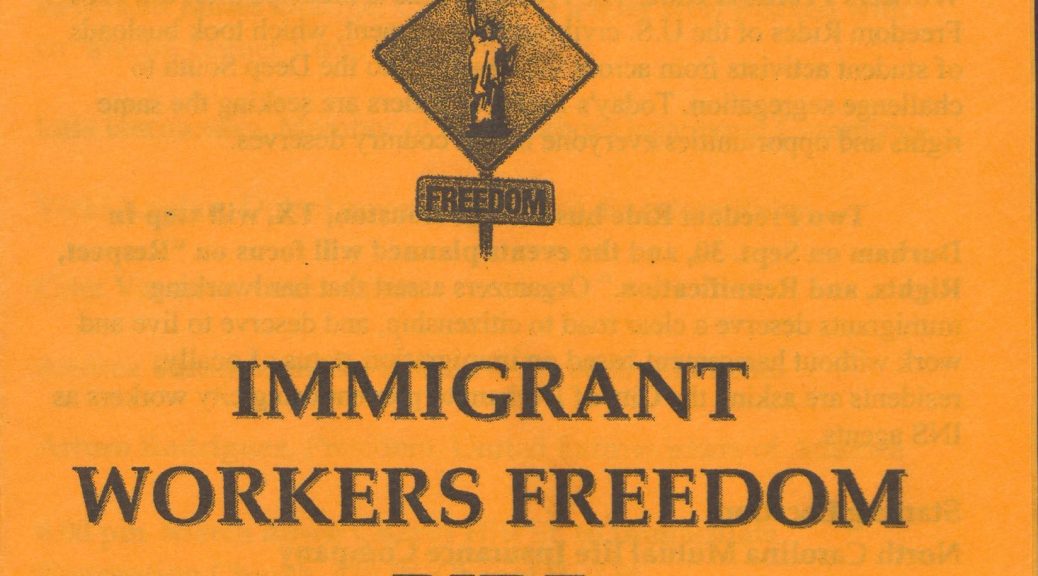
“Immigrant Workers Freedom Ride” flyer, September 30, 2003, illustrates one area of coalition building in Durham, NC, as described in Elizabeth Barahona’s dissertation research proposal. From the Joan Preiss Papers, Box 27.
Elizabeth Barahona, Ph.D. candidate, Northwestern University, “Black and Latino Coalition Building in Durham, North Carolina 1980-2010.” (Joint award with the Archive of Documentary Arts)
Diana Ruiz, Faculty, University of Washington, Seattle, “Apprehension through Representation: Image Capture of the US-Mexico Border.” (Joint award with the Archive of Documentary Arts)
Kylie Smith, Faculty, Emory University. School of Nursing, Department of History, “No Place for Children: Disability, Civil Rights, and Juvenile Detention in North Carolina.”
Harrison Wick, Faculty, Indiana University of Pennsylvania (IUP) Special Collections and University Archives, “Examination of Primary Sources related to Social Justice and Latin American Immigration in the Human Rights Archive.”
Harry H. Harkins T’73 Travel Grants for Lesbian, Gay, Bisexual, and Transgender History
History of Medicine Collections
Human Rights Archive
John Hope Franklin Research Center for African and African American History and Culture
John W. Hartman Center for Sales, Advertising & Marketing History
Sallie Bingham Center for Women’s History and Culture (Mary Lily Research Grants)
Anyone whose research would be supported by sources from the Rubenstein Library’s research centers is eligible to apply. We encourage applications from students at any level of education; faculty and teachers; visual and performing artists; writers; filmmakers; public historians; and independent researchers. For assistance determining the eligibility of your project, please contact AskRL@duke.edu with the subject line “Travel Grants.”
Eligibility
Applicants must reside beyond a 100-mile radius of Durham, N.C., and may not be current Duke students or employees.
Information Session
An online information session will be held Thursday, January 11, 2024, 2-3 pm EST. This program will review application requirements, offer tips for creating a successful application, and include an opportunity for attendees to ask questions. This program will be recorded and posted online afterwards. Register for the session here.
Timeline
The deadline for applications will be Thursday, February 29, 2024, at 6:00 pm EST.
Decisions will be announced by the end of April 2024 for travel during May 2024-June 2025. Awards are paid as reimbursement after completion of the research visit(s).
Post contributed by Rachel Ingold, Curator for the History of Medicine Collections.
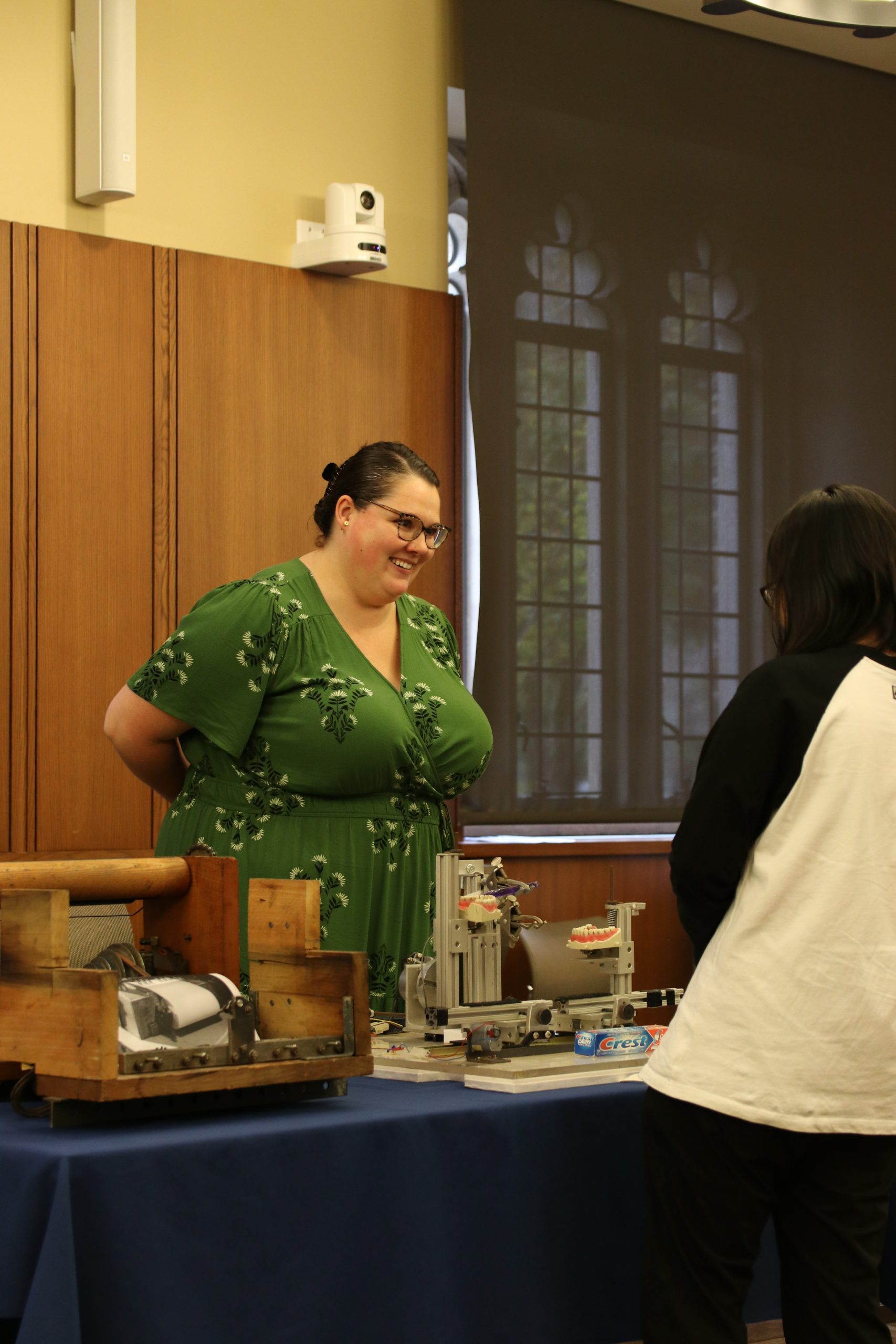
In September, the Rubenstein Library partnered with colleagues in the Natural and Engineering Sciences (NSE) for an open house event. While our Engineering Exposition targeted students, faculty, and staff from Duke’s Pratt School of Engineering, all were welcome to attend.
Faculty from the Engineering School examine works on engineering from the 16th and 17th centuries! Photo by Deric Hardy.Robin Klaus, graduate Intern in the Hartman Center for Sales, Advertising, and Marketing History talks with a student about the toothpaste testing device found in the Consumer Reports archive. Photo by Janelle Hutchinson.
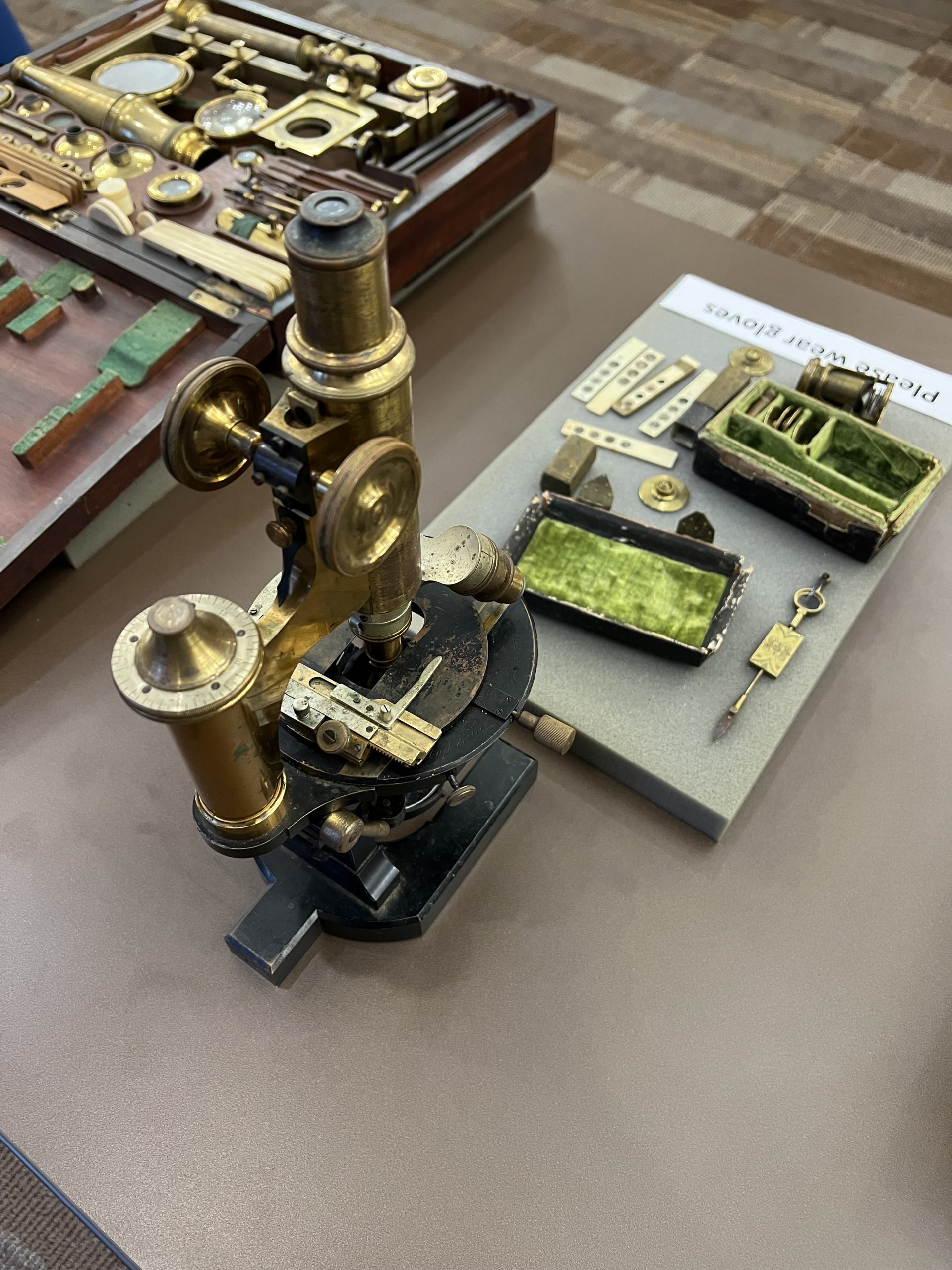
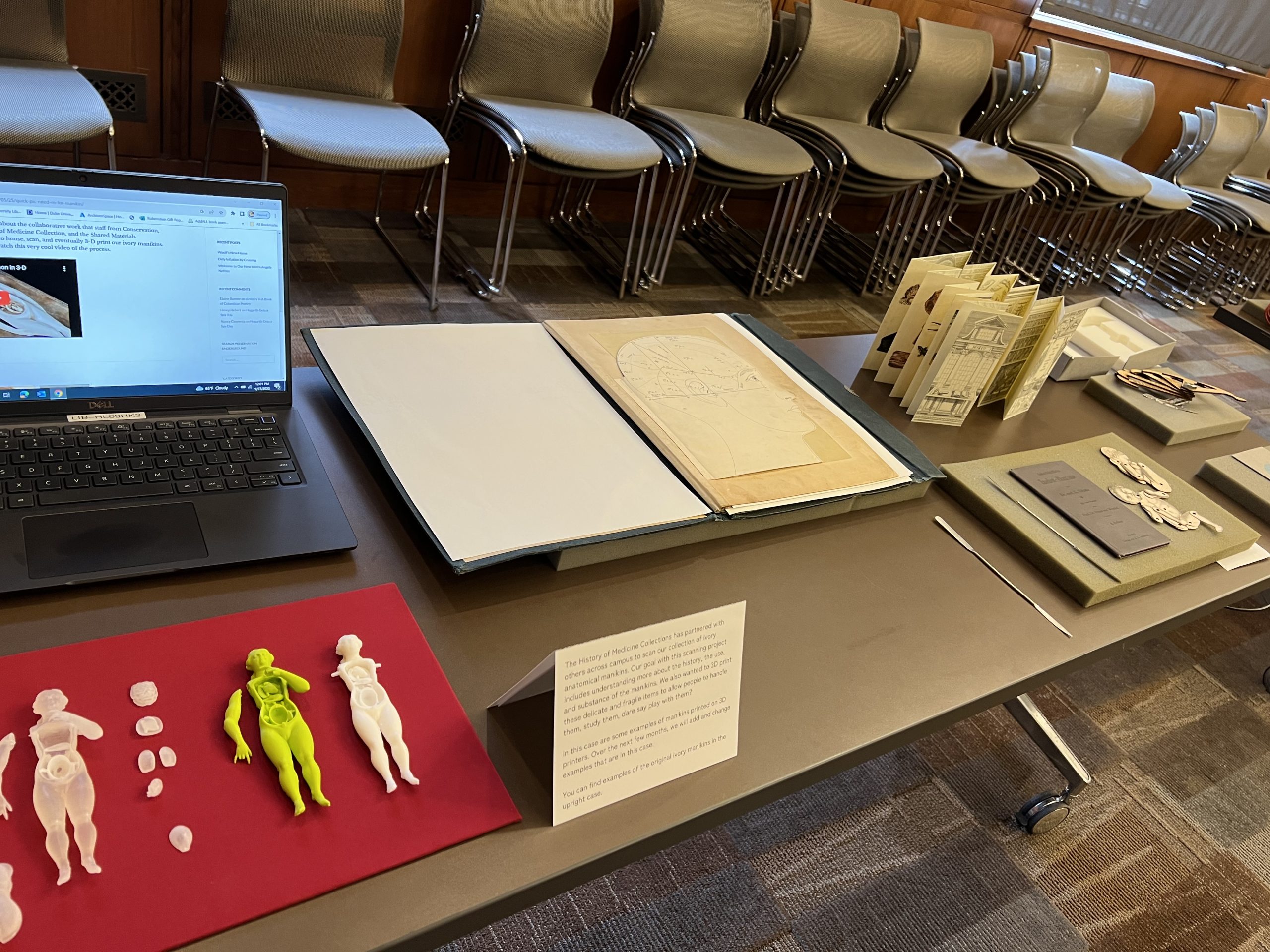
Items from a variety of collecting areas within the Rubenstein Library were available for visitors to examine and handle. Some highlights included
And much more! So much more! Including this video from the Consumer Reports lab.
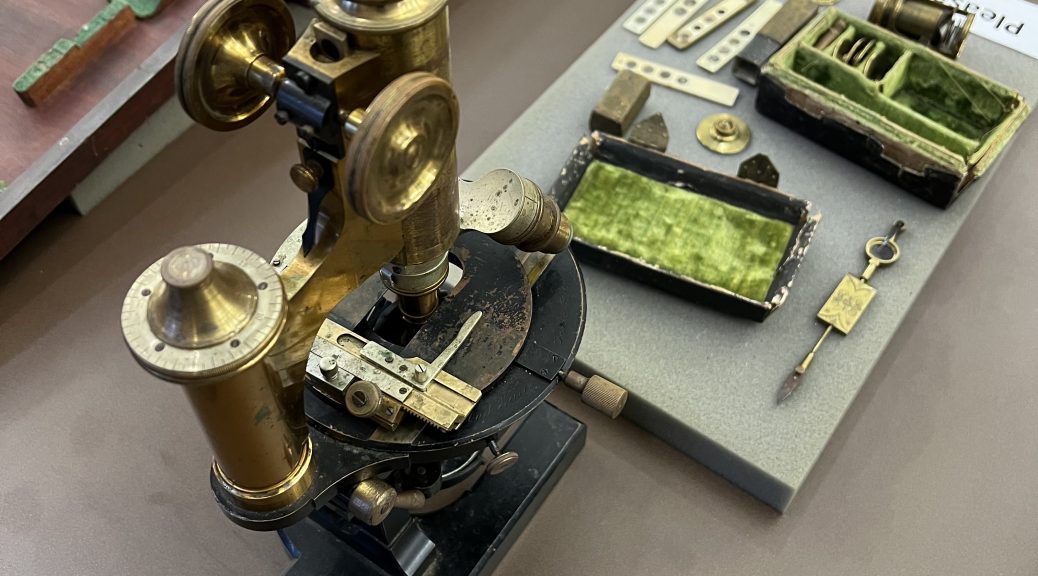
Examples of 18th and 19th century microscopes that visitors were encouraged to handle and try out! Photo by Deric Hardy.Examples of moveable books from the History of Medicine Collections and samples of 3D printed anatomical manikins made from items in our collection! Photo by Deric Hardy.Pages from an anatomical flap book where the flaps can be lifted, as shown on the right, to reveal detail about the human body. Photo by Janelle Hutchinson.
We look forward to our continued partnerships with colleagues across the Library and campus. Let us know what you might like to see at our next Engineering Exposition!
Post contributed by Robin Klaus, Graduate Intern, Hartman Center for Sales, Advertising, and Marketing History.
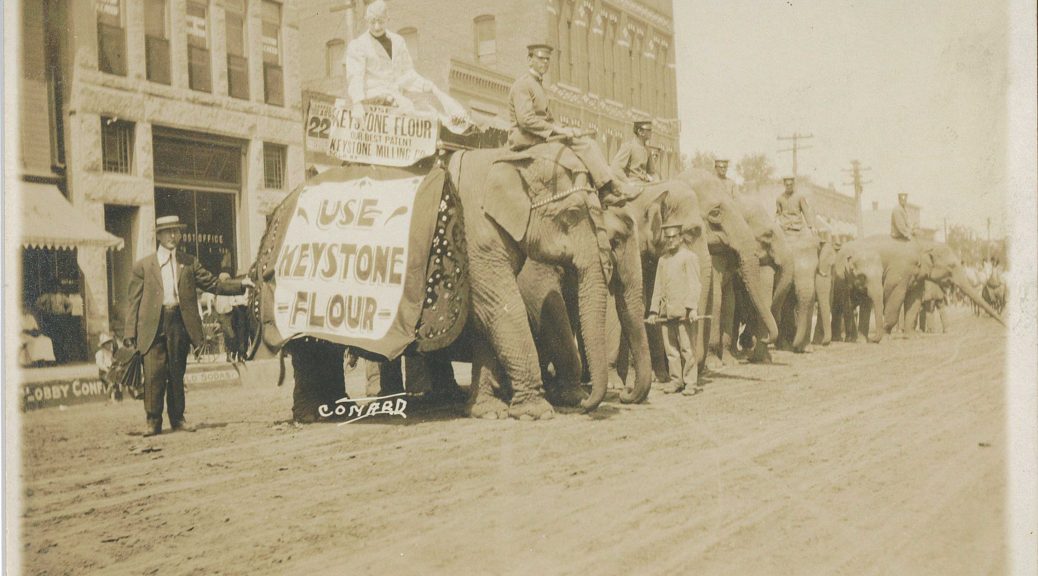
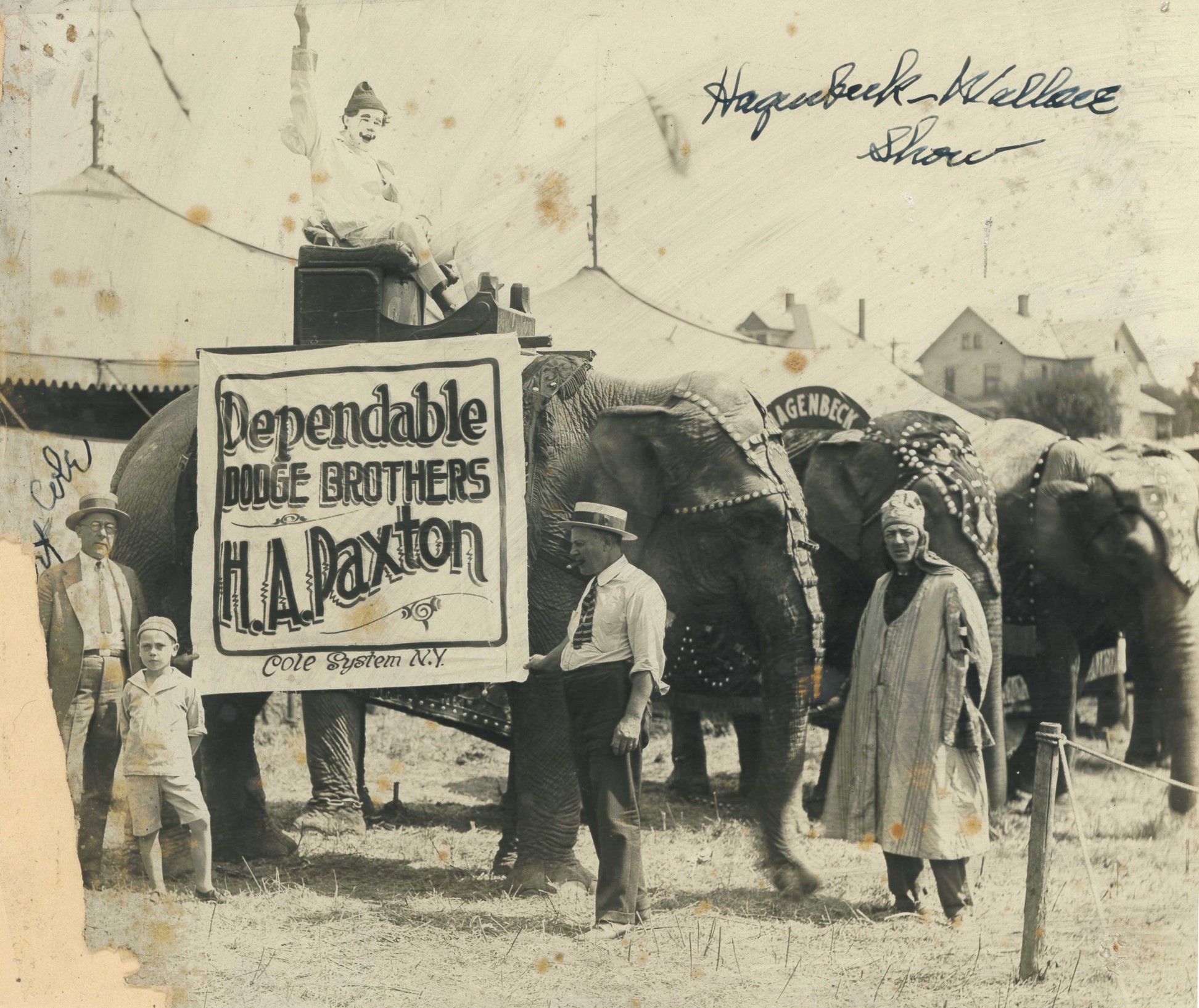
During the golden age of circuses in America, a circus performer-turned-advertiser named Bert Cole offered a unique marketing opportunity: banner advertisements draped across the sides of circus elephants. Cole capitalized on the massive spectatorship of the circus, as well as the elephant’s identity as a symbol of the spectacle, to transform elephants into walking billboards promoting retailers, services, and consumer goods of all kinds. The Rubenstein Library’s Bert Cole Collection archives this circus side hustle—a fascinating episode in the history of American advertising that provides a glimpse into the auto industry boom of the early twentieth century.
Background: The Turn-of-the-Century Circus
The traveling circus was a ubiquitous cultural presence in the United States at the dawn of the twentieth century. Upcoming shows advertised months in advance with eye-catching posters plastered on every surface in town—brightly colored images of wild animals and scantily clad performers advertised the eroticism, exoticism, and danger to come. “Circus Day” became an unofficial holiday as stores closed, schools cancelled, factories shut down, and enormous crowds gathered to watch the free parade and attend the show.
The turn-of-the-century circus owed its success to a unique combination of social and economic factors. The construction of a transnational railroad network after the Civil War accompanied the Western expansion of the nation (ten new states were admitted to the Union from 1889-1912). Circuses relied on these routes to transport their shows to small towns and urban centers, also taking advantage of new markets across the growing nation. Meanwhile, industrialization brought advances that transformed the economic landscape—incomes increased, costs of living decreased, and the number of hours in a standard workweek was its lowest in decades. Newfound time and discretionary income led to the rise of national leisure culture, also accompanied by an explosion of consumer goods, services, and mass media advertisements for them.
With the film industry still in its infancy (the “golden age of Hollywood” was during the 1930s and 40s), circuses became the preeminent form of mass entertainment—and the circus elephant played an essential role. The actual production of the circus relied on labor that elephants performed; only elephants had the strength to raise the masts of the largest circus tents, for example, or dislodge heavy circus wagons when they became stuck in mud. The elephant was also visually significant as a symbol of the American circus; everyone agreed that a show could not be a circus without an elephant. Consequently, the circus elephant was a mainstay in the cultural imagination of early-twentieth-century America.
Collection Spotlight: Elephant Advertising and the American Auto Industry
Photographs from the Bert Cole collection document how Cole leveraged the popularity of the circus and the elephant as a potent cultural symbol to develop a hallmark advertising strategy. Little is known about Cole, but circus route books (much like theater playbills) reveal that he was a drum corps member for the Walter L. Mains Circus in the 1890s. The collection’s earliest photograph dates from this era (1897), likely when Cole began experimenting with elephant advertisements while still primarily a circus performer. Banner ads from this early period tend to feature specific sales promotions (“Worsted Suits from $6.87 to $12”) or directly associate the client with the elephant icon (“Webster’s Market Owns This Elephant Today”). As time went on, the advertisements began to include more traditional signage with product slogans and recognizable branding.
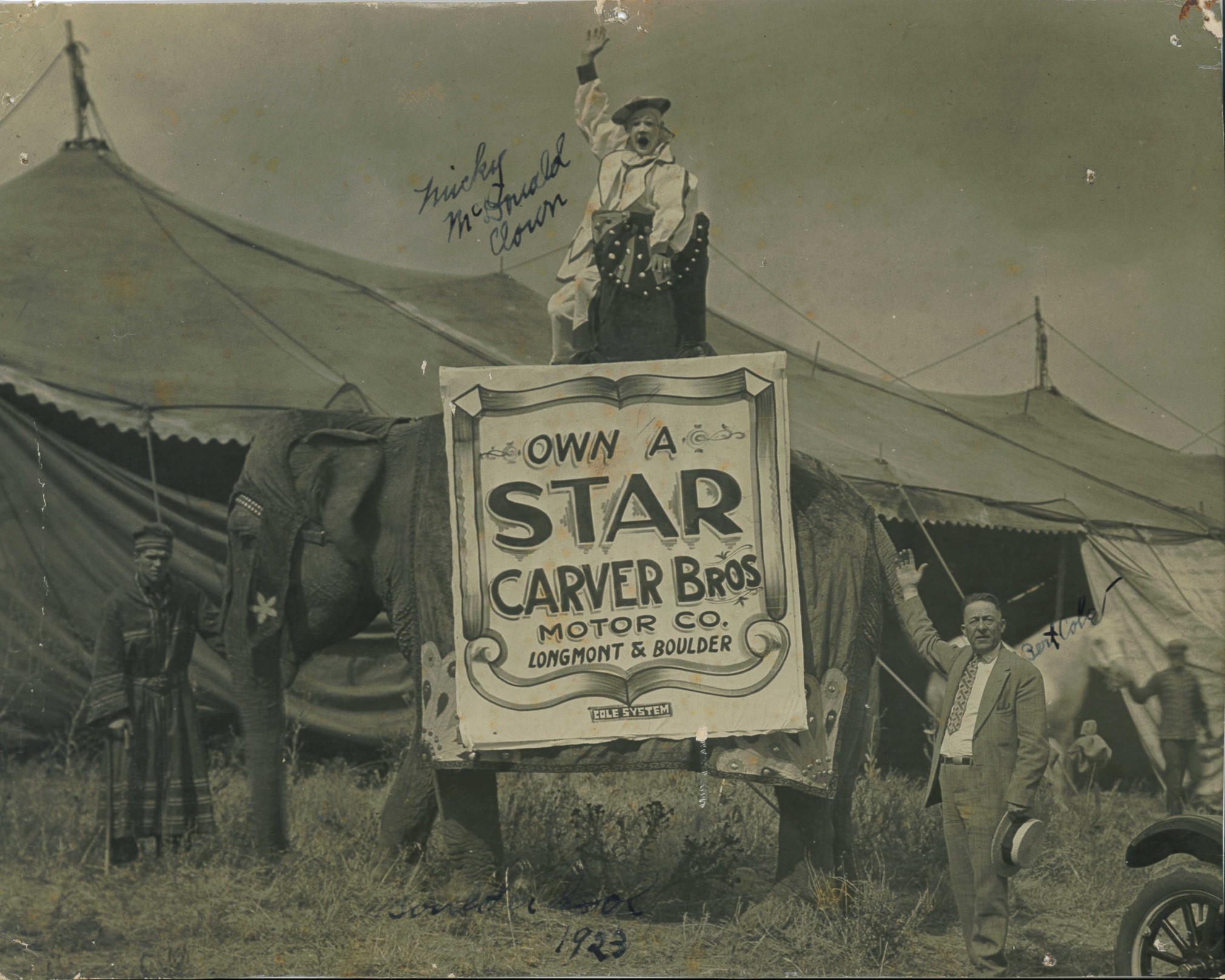
By the early 1920s, Bert Cole had an official advertising job with the Hagenbeck-Wallace Circus. Collection photographs show that Cole started to promote his elephant billboards as an actual system of advertising around this time. “Cole System N.Y.” appears at the bottom of a banner advertisement from 1921, becoming just “Cole System” by 1923.
Bert Cole with elephant advertisement, “Cole System N.Y.” at bottom, 1921Bert Cole with elephant advertisement, “Cole System” at bottom, 1923
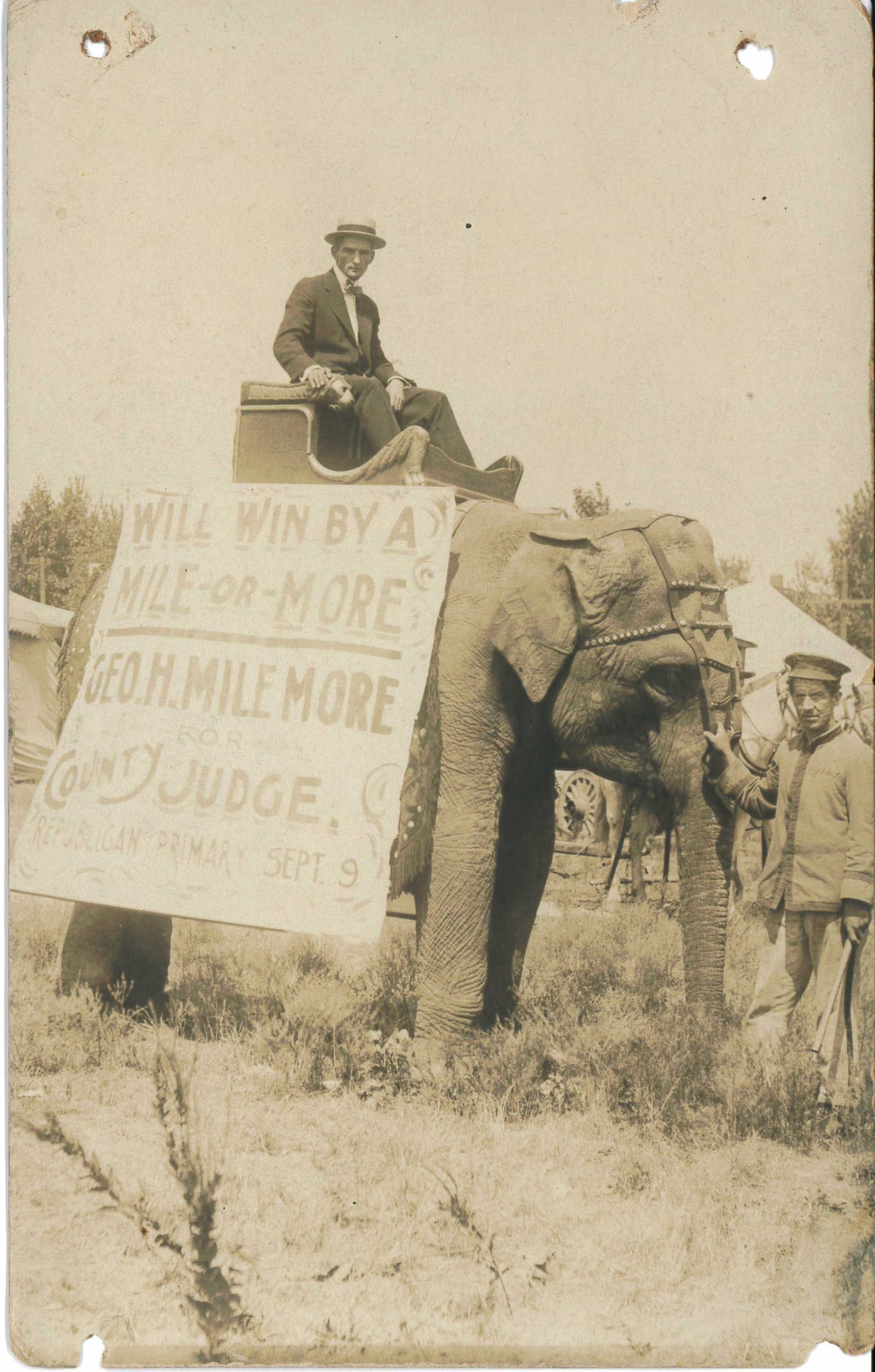
The collection documents a range of consumer goods and services advertised by the Cole System, including flour brands, furnaces, banks, and retail stores. Cole even dabbled in political advertising, as seen in a Republican primary campaign ad for George H. Milemore for County Judge—a rider, presumably the candidate himself, sits atop an elephant with a banner declaring that Milemore, “will win by a mile or more.”
Elephant campaign advertisement for George H. Milmore for County Judge, circa 1910s.
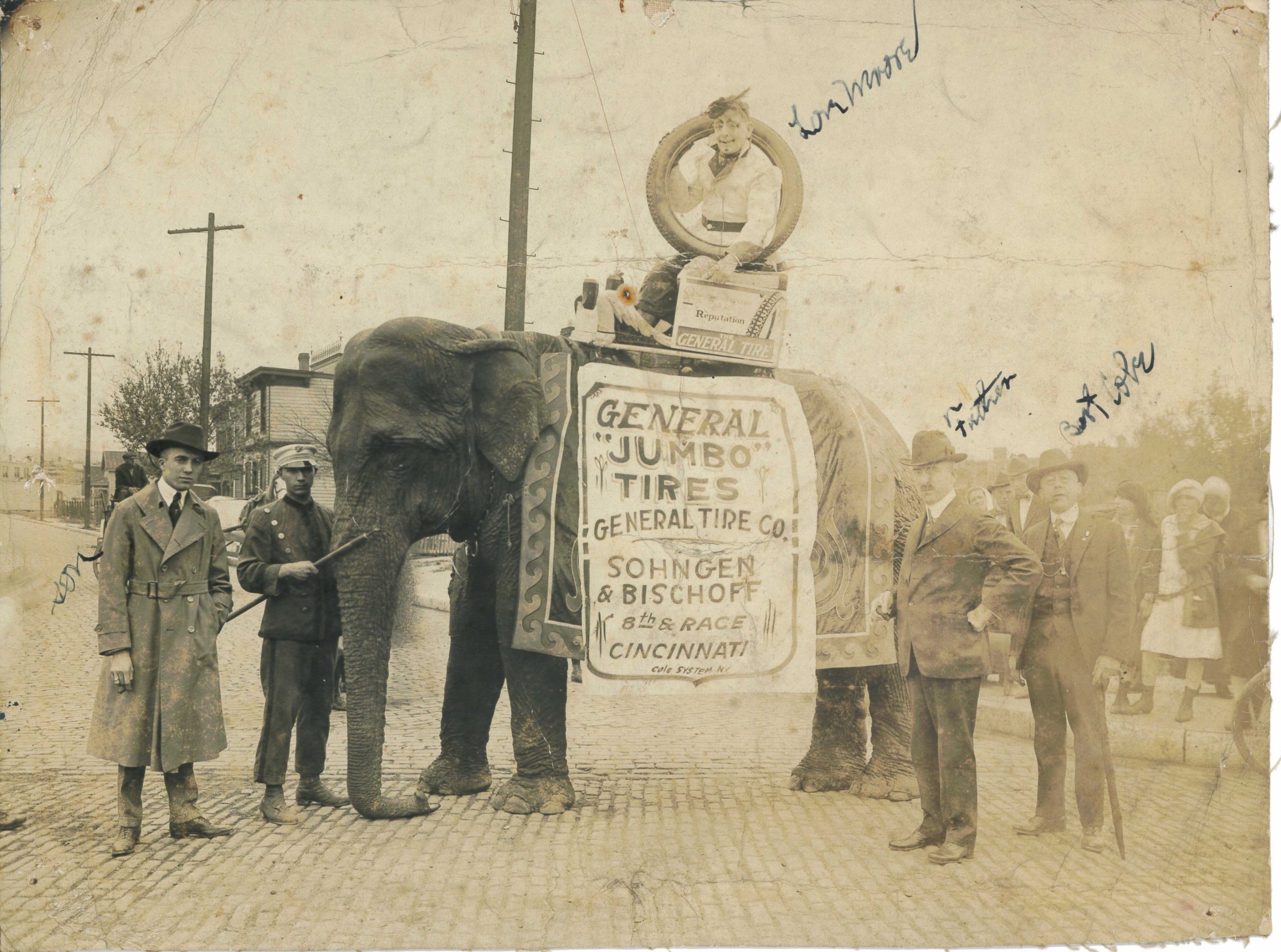
Interestingly, the most popular category of elephant advertisements in the collection are those for cars, tires, and auto shops.
Lou Moore, a clown with the Hagenbeck-Wallace Circus, wears a car tire while riding an elephant advertising General “Jumbo” Tires in Cincinnati, OH, circa 1920.
In fact, nearly half of the brands and products in the collection relate in some way to the American automobile industry—frequently appearing as partnerships between local dealerships and national brands. Car companies appearing in the collection include Chevrolet, Dodge, Ford, Hupmobile, Oldsmobile, Star, Studebaker, and Willys-Knight.
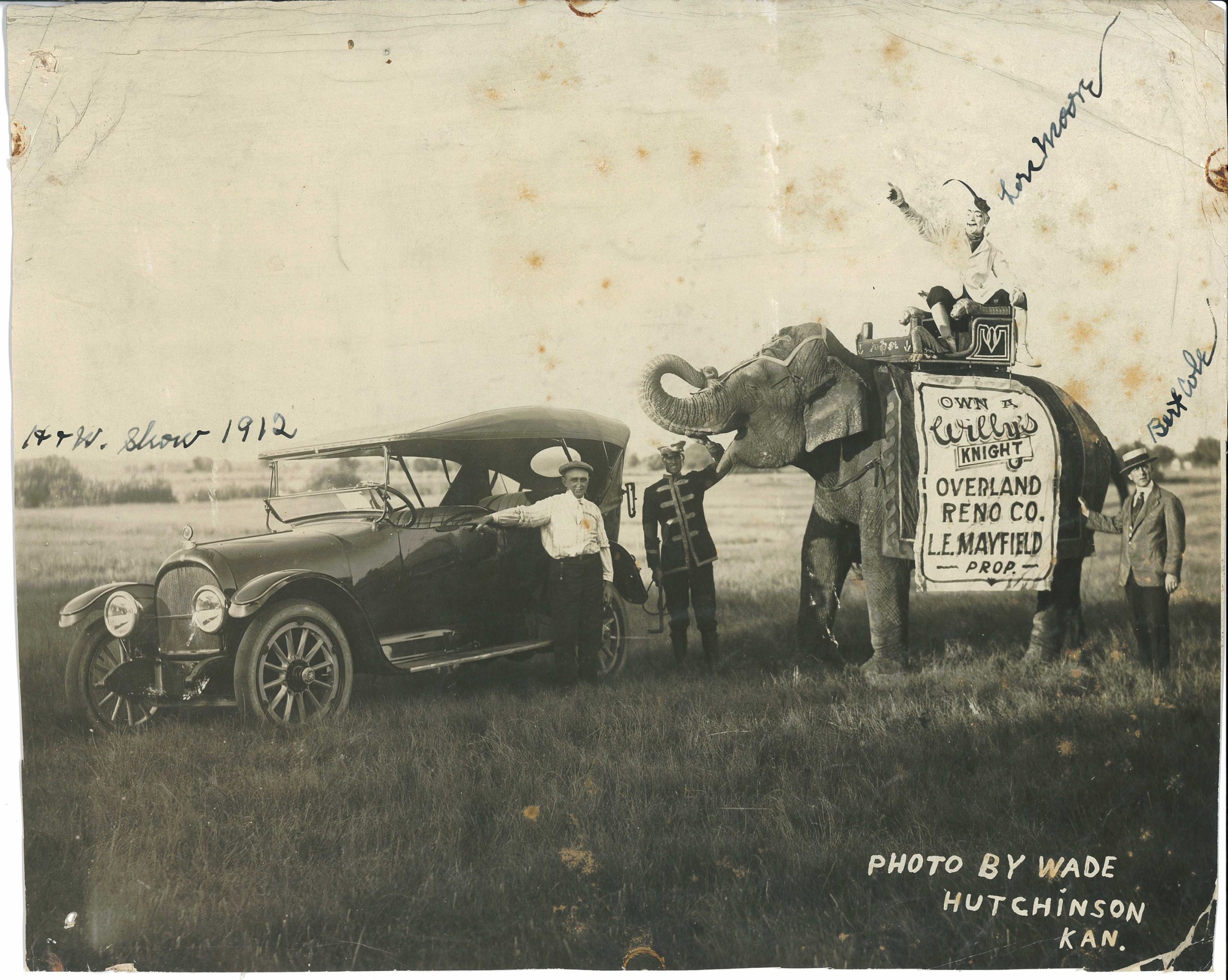
Unlike other products advertised on elephants, collection photographs show that new car models were often staged alongside their elephant ads on circus grounds, showcasing the industry’s latest designs to a massive audience.
Bert Cole (right) and Lou Moore (top) with a Willy’s-Knight ad and automobile at the Hagenbeck-Wallace Circus in Hutchinson, Kansas, 1912.
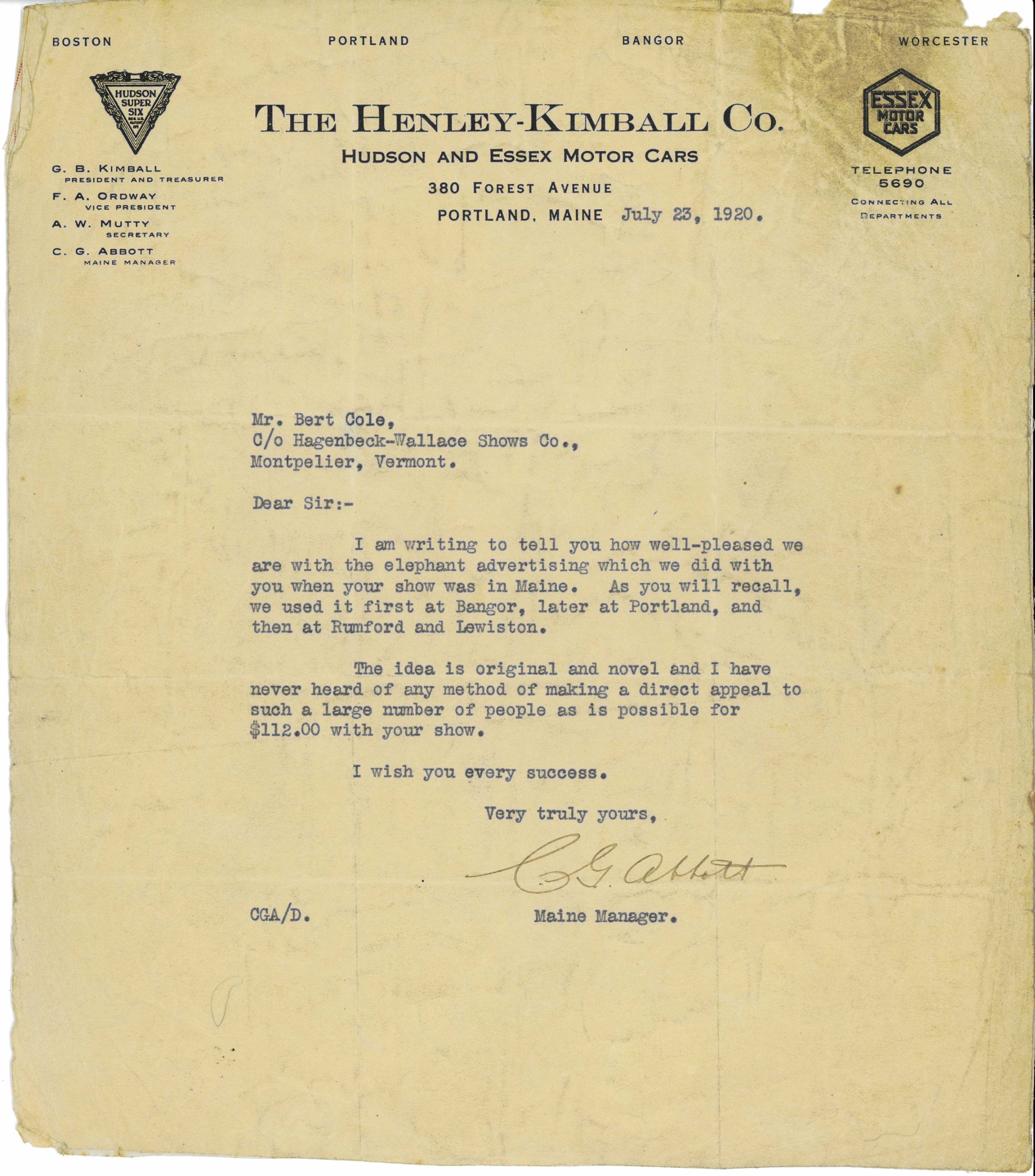
The collection also includes several letters from satisfied clients—all motor company executives expressing their enthusiasm for the incredible reach of Cole’s elephant advertising. One wrote, “The idea is original and novel and I have never heard of any method of making a direct appeal to such a large number of people as is possible for $112.00 with your show.”
Letter from a Hudson and Essex Motor Car dealership in Portland, Maine, 1920
An identifiable market trend within an advertising platform as niche as circus elephants speaks to the dominance of the American automobile industry at this historical moment. Annual automobile sales in the United States rose from 130,000 vehicles in 1909 to over 2 million in 1920. As industry production and advertising shifted their focus from initial demand to replacement demand, novelty became an important selling factor; car companies concentrated on annual model changes and product innovations to compete with the emerging used car market—evidence of which can be seen throughout the Bert Cole collection.
For more insights into the unique intersection of circus mania, advertising history, and the American automobile industry in the early twentieth century, see the collection at Duke University’s Rubenstein Library.
Dassbach, Carl H. A. “The Social Organization of Production, Competitive Advantage and Foreign Investment: American Automobile Companies in the 1920s and Japanese Automobile Companies in the 1980s.” Review of International Political Economy (Autumn 1994) 1, no. 3: 489-517.
Davis, Janet. Circus Age: Culture and Society Under the American Big Top. Chapel Hill, NC: The University of North Carolina Press, 2002.
Langlois, Richard N. and Paul L. Robertson. “Explaining Vertical Integration: Lessons from the American Automobile Industry.” The Journal of Economic History (June 1989) 49, no. 2: 361-375.
Nance, Susan. Entertaining Elephants: Animal Agency and the Business of the American Circus. Baltimore: Johns Hopkins University Press, 2013.
Post contributed by Joshua Larkin Rowley, Reference Archivist, John W. Hartman Center for Sales, Advertising & Marketing History.
The January 1962 issue of Consumer Reports, the flagship publication of the consumer education and advocacy non-profit of the same name, included a much-anticipated article titled “The Fallout Shelter: A review of the facts of nuclear life and the variables that bear on the effectiveness of a shelter.” Cold War consumers were eager for guidance from a trusted source of product evaluation. However, Consumer Reports essentially took a pass. According to the organization, all the variables that might make a shelter effective or ineffective were simply unknowable and unpredictable. While the organization side-stepped recommending specific shelters, the Technical Department, the unit responsible for creating testing procedures, methods, and reports, retained forwarded letters documenting reader reactions to the article. For a moment, the fallout shelter article became a flashpoint for the hopes, fears, and anxieties of Cold War citizens.
Consumer Reports cover, January 1962
Some readers applauded the article as the most objective and thorough review of the facts regarding the effectiveness of fallout shelters. Others were not so complimentary. A professor of architecture at the University of Florida and self-described instructor in “Fallout Shelter Analysis,” accused the organization of using the same tactics as cigarette advertisers, “arguing from a conclusion using pseudo-technical jargon.”[1] Another agreed that Consumer Reports had not “..lived up to its own standards in discharging the awesome responsibility…of giving advice that might mean life or death to large numbers of people.”[2] Some took an optimistic something-is-better-than-nothing stance. “You apparently cannot admit that a partial solution is better than no solution at all,” wrote one subscriber.[3] Yet another reader relays that he is often asked by friends and acquaintances whether he is afraid that the shelter he is currently constructing might not work. His reply, he shares, is always: “No—My greatest fear has been that it (nuclear war) might happen, and I would be faced with the knowledge that I hadn’t even tried or made the effort.”[4]
Other readers felt the article reinforced their own principled stance concerning nuclear armament. A letter from a couple from Bellaire, Ohio included their own vision of Civil Defense titled Civilization Defense: A Creed, in which they lay out a list of principled teachings that they plan to instill in their children amid the omnipresent threat of nuclear war which concludes: “This creed is the only shelter I will build for my children.”[5] A research psychologist at the University of Michigan argued that the greatest threat posed by the fallout shelter fad was not their inadequacy, but their “psychological and political consequences during a time when an attack might still be prevented.” He goes on to argue that shelter programs are but “a step in the long chain of events” that could actually provoke a nuclear war. Lynn and Michael Phillips of Berkley, CA, agreed, commending the article’s importance in “preventing people from making the deadly mistake of accepting nuclear war” as a means to rid the world of Communism and survive. In the mind of the Phillips’s the only way to protect a nation’s people from nuclear war was disarmament.
Civilization Defense: A Creed, 1962
Consumer Reports was also critical of companies eager to leverage the demand for fallout shelters. In an article titled “Enter the Survival Merchants,” the magazine characterized the “survival business” as a natural home for “fly-by-night operators, high pressure salesman, and home improvement racketeers” and accused the industry of preying on people’s fear as well as their patriotism. A letter from an executive at KGS Associates, later to be revealed as a civil defense merchandiser, accused the publication of intentionally setting out to discredit the civil defense industry. In the case of a nuclear attack, the writer wondered “how fast the Consumer Reports staff…will run for the shelters, eat the food, and drink the water provided by the men they have described as hungry, callous, and even a bit shady.” Another shelter defender pointedly stated, “your implication that all shelter designers are out to fleece the public is untrue and not up to the high standards I have always looked for in Consumer Reports.”[6] The organization did not let large corporations off the hook either. General Mills, the processed foods manufacturer, also came under fire for their marketing of Multi-Purpose Food (MPF), a shelf-stable nutritional supplement designed specifically to stock fallout shelters and meant to be mixed with other foods. Brochures for the product were often displayed alongside fallout shelters at civil defense trade shows, piggybacking on the shelter craze.
Multi-Purpose Food brochure, General Mills, September 1961.
Looking back on the controversial issue two years removed from its publication, Consumer Reports staff took time for an LOL moment. In an internal memo, a staff member noted an article published in the New York Post that day about fallout shelters that cited a local company “…buying up prefabricated fallout shelters for conversion to hot dog stands and cabanas. ‘Swords into plowshares’” he quipped.[7]
[1] King Royer to Consumers Union, 12 January 1962. Consumer Reports. Technical Department Records, Box 54
[2] Jack Hirshleifer to Irving Michelson, Director of Public Service Projects, 15 March 1962, Ibid.
[3] John F. Devaney to Dexter Masters, Director, Consumers Union, 11 January 1962 Ibid.
[4] Thomas McHugh to Consumer Reports, 8 April 1962. Consumer Reports. Technical Department Records, Box 54.
[5] Charlotte Levine to Consumer Reports, 14 January 1962, Consumer Reports. Technical Department Records, Box 54.