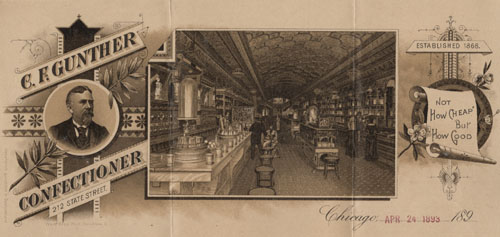
From the Richard Harvey Wright papers, 1870-1967.
(At the upper left, you’ll see evidence of the reason why archivists use stainless steel paperclips.)


From the Richard Harvey Wright papers, 1870-1967.
(At the upper left, you’ll see evidence of the reason why archivists use stainless steel paperclips.)
Date: 13 January – 3 April 2011
Location and Time: Perkins Library Gallery during library hours
Contact Information: Mary Samouelian, 919-660-5912 or mary.samouelian(at)duke.edu
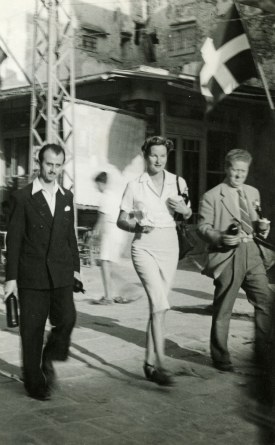
Who was Doris Duke? Her public persona was that of the glamorous, yet eccentric, heiress who named her butler the executor of her estate, but privately she was determined not to be defined by social expectations or her vast wealth.
The materials on display in “Philanthropist, Environmentalist, Collector: Doris Duke and Her Estates” reveal a much different and more complex story of James Buchanan Duke’s only child. On the surface these artifacts are seemingly unassuming—inventories of furniture, a security ledger, and architectural drawings are amongst the objects in the exhibit—but in fact they paint a picture of an adventurous, intelligent and independent woman, who in many ways was considered ahead of her time. Throughout her life, Doris Duke continued her family’s quiet but innovative pattern of philanthropy, eagerly advocated for the protection of the environment, and pursued her lifelong passion as both a collector and patron of Islamic art.
During your next visit to Perkins-Bostock Library, be sure to stop by the Perkins Library Gallery to see the exhibit on display. Also featured in this exhibit are Doris Duke’s home movies and an interactive map of a journey she made to the Middle East in 1938. If you can’t visit in person, you can enjoy the online exhibit!
Also, please join curators Mary Samouelian and Molly Bragg for a gallery talk and screening of Doris Duke’s home movies on Thursday, February 24th from 4:00-5:00 PM in the Rare Book Room. Stay tuned to The Devil’s Tale for more details about this event!
Update: Listen to Duke Today’s podcast featuring the exhibit curators!
Post contributed by Mary Samouelian, Doris Duke Collection Archivist.


Letterhead from two letters (March 3, 1881 and November 13, 1882, respectively) from Clara Barton to her friend Mary Norton. From the Mary Norton Papers, 1852-1895.
(NB: The letter with the Dansville, NY letterhead was actually written in Washington, D.C. The letter with the Washington, D.C. letterhead was actually written in Dansville, NY.)
The third season of the popular Rights! Camera! Action! film series begins tomorrow evening with Citizen King, which traces the final five years of Dr. Martin Luther King, Jr’s life, starting with his momentous 1963 “I Have a Dream” speech.

We’ll provide free drinks and popcorn, as well as a panel discussion following the film!
The Rights! Camera! Action! film series, which is sponsored by the Archive for Human Rights, the Archive of Documentary Arts, the Duke Human Rights Center, the Franklin Humanities Institute, and Screen/Society at Duke’s Arts of the Moving Image Program, features documentaries on human rights themes that were award winners at the annual Full Frame Documentary Film Festival. The films are archived at the RBMSCL, where they form part of a rich and expanding collection of human rights materials.
For more about Rights! Camera! Action!’s Spring 2011 season, as well as details about tomorrow’s screening, click below.
It’s National Letter Writing Week—and the RBMSCL has no shortage of letters, be they handwritten, typed, telegraphed, or e-mailed. We’re going to celebrate with some great examples of letterhead from our collections!
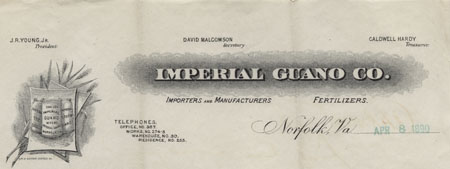
From the A. J. Parker and Benjamin J. Parker papers, 1840-1895 and undated.

100 years ago today, near tragedy struck campus as fire destroyed the Washington Duke Building, one of the seven original buildings constructed after the college moved from Randolph County to Durham. The multi-purpose building held lecture halls and offices, as well 56 dorm rooms. With coal heating and rooms lit by candle and kerosene lamp, the returning students must have tried to heat up the building too quickly that cold January 4th. Fortunately, all escaped uninjured.
Plans were already in place to replace the building and the new West Duke Building had just been completed. East Duke Building would be completed the following year on roughly the same spot as the original Washington Duke Building.

Additional Resources:
Post contributed by Tim Pyatt, Duke University Archivist.

The Battle of Hampton Roads, fought on March 9, 1862, marks the first time two ironclads engaged in battle: the USS Monitor and the CSS Virginia (formerly the USS Merrimack). While both warships escaped destruction that day, neither would survive the year intact. The CSS Virginia was destroyed by the Confederacy in May rather than risk its capture by Union forces. On December 31st, the USS Monitor sank off the coast of Cape Hatteras, North Carolina during a heavy storm. Duke University has ties to both.
In 1973, John G. Newton, Marine Superintendent for the Duke University Marine Laboratory, led a team that discovered the wreckage of the Monitor. Artifacts recovered from the site are currently on display at the Mariners’ Museum in Newport News, Virginia. However, the Duke University Archives might have a piece of the Virginia/Merrimack in its possession.
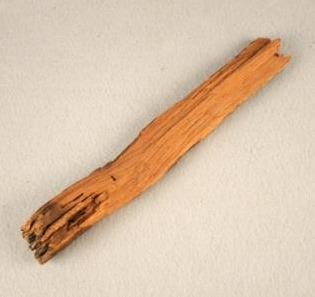
Earlier this year, the University Archives curated “‘As Far As Possible from Forgetfulness’: The Trinity College Historical Society.” Precursor to the University Archives, the Society was established in 1892, with the objective of collecting material illustrative of the history of North Carolina and the South. The exhibit included artifacts and documents that once belonged to the Society. One of the most popular pieces displayed was a non-descript piece of wood. My co-curators and I found no mention of this item’s identity or significance in the Society’s records, yet we felt strongly that the piece of wood should be included in the exhibit: at some point in the history of the Society, someone believed that piece of wood had historical significance.
On the day of the gallery talk on the exhibit, I delved deeper into resources available in the University Archives in hopes of uncovering any tidbits on the piece of wood. In the Christian Educator (a predecessor, in some respects, to the Chronicle), I found a reference to two pieces of wood donated to the Society in 1896. One was said to be from Libby Prison in Richmond and the other was said to be from the CSS Virginia/USS Merrimack. I mentioned these references at the gallery talk and also stated that a RBMSCL colleague with a background in archaeology noted the piece of wood appeared to have been in water at some point, leading me to speculate that this particular piece of wood might be from the ironclad.
Professor Emeritus of Botany and former director of the Sarah P. Duke Gardens Richard White attended the gallery talk and graciously offered to submit a sample of the piece of wood to a lab in Wisconsin that could potentially identify its species. We were able to obtain a loose sample from the artifact which was then submitted to the Center for Wood Anatomy Research for testing. The lab determined the wood to be of the white oak group.
Further research shows that white oak was often used in the construction of Civil War ironclads, including the Virginia/Merrimack. Is it possible that the mystery of the piece of wood’s identity and significance has been solved?
Post contributed by Kim Sims, Technical Services Archivist for the Duke University Archives.
 I’m a history Ph.D. candidate, so I knew something about working in archives when I started my internship with Technical Services at Duke’s Rare Book, Manuscript, and Special Collections Library (RBMSCL), but not a lot about processing paper records, never mind electronic ones. However, as I started processing several collections acquired through the Archive for Human Rights, I discovered that electronic files were often just as important to the collection as paper ones. When I started working on the Common Sense Foundation Papers, I faced over 16,000 electronic files in addition to 34 boxes of paper records! A North Carolina think-tank active from 1994 to 2008, the Common Sense Foundation (CSF) worked on initiatives such as the death penalty, testing in public schools, and LGBTQ rights.
When I met with Paula Jeannet Mangiafico (Senior Processing Archivist), Seth Shaw (Electronic Records Archivist), and Patrick Stawski (Human Rights Archivist) to discuss the collection, we decided to integrate the electronic and paper files in the finding aid since the content overlapped and the volume was about equal. A researcher interested in the death penalty will thus find both electronic and paper records described in the Criminal Justice Subseries, which contains letters written by incarcerated people, a survey of capital defense lawyers, research on specific death-row inmates, and documents reflecting the daily work that occurred in CSF’s office surrounding this policy initiative.
Just as when working with paper documents, I screened the electronic files for sensitive information, such as personal, financial, and medical records. I then used the original path of the networked drive to describe the electronic files in the finding aid and used both the number of files and the megabyte size to indicate the physical extent. That way, researchers interested in a particular aspect of CSF’s work will know which electronic folders to request from RBMSCL staff, just as they would request a physical box by its number.
The RBMSCL has acquired almost 200 collections with electronic records in the past few years. Hopefully, my work with the CSF Papers will serve as model for processing future collections with strong electronic components.
Post contributed by Liz Shesko, Technical Services Processing Intern.
The Common Sense Foundation Papers are currently being processed. The finding aid will be published and the collection will be available for use in January 2011. For more information, contact the RBMSCL at special-collections(at)duke.edu.