Category Archives: Franklin Research Center

The African Americans: Rubenstein Recap #5

Each Tuesday, PBS is showing the next installment of a six-part series, The African Americans: Many Rivers to Cross. Written and narrated by Dr. Henry Louis Gates, Jr., the documentary traces African American history from the shores of West Africa to the election of Barack Obama. Join us each week as we feature documents from the John Hope Franklin Research Center that resonate with the previous week’s episode.

From the outbreak of war in Europe to the chants of black power in Mississippi, Episode 5: Rise! (1940 – 1968), told the story of how African Americans came together in a mass movement for freedom. During World War II, black citizens used the rallying cry of patriotism to demand both victory abroad and victory at home over racism. However, Jim Crow followed black soldiers overseas, while the South’s commitment to white supremacy only grew deeper.

In 1940, Claudia Jones, a black woman and a member of the communist party, wrote about the United States’ history of racial discrimination and its influence on the war in Jim Crow in Uniform.  Claudia Jones. Jim Crow in Uniform. New York: New Age Publishers, 1940.
In 1940, Claudia Jones, a black woman and a member of the communist party, wrote about the United States’ history of racial discrimination and its influence on the war in Jim Crow in Uniform. Claudia Jones. Jim Crow in Uniform. New York: New Age Publishers, 1940.

But the mobilization of black veterans and activists fueled new possibilities. Shortly after the 1954 Brown v. Board of Education decision struck down segregation, black men and women in Montgomery took to the streets, demanding an end to racial discrimination on the city’s buses.
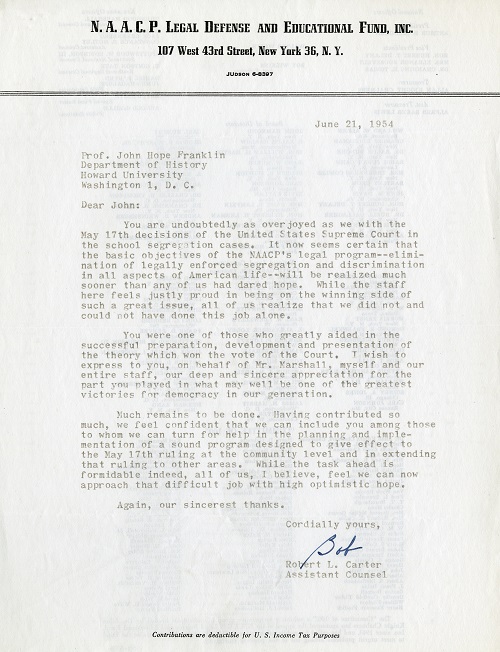
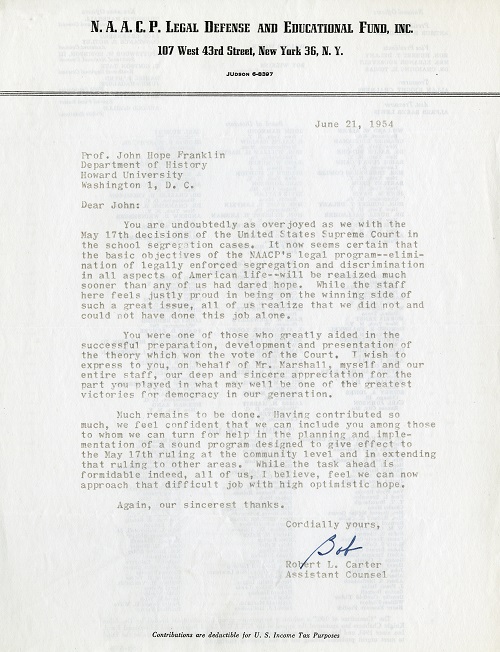
Brown v. Board decision marked the culmination of nearly two decades of effort by the NAACP to legally dismantle segregation. In this June 1954 letter to historian John Hope Franklin, the assistant counsel of the NAACP expresses his thanks to Franklin as one of the many who contributed to the landmark decision. John Hope Franklin papers.
Brown v. Board decision marked the culmination of nearly two decades of effort by the NAACP to legally dismantle segregation. In this June 1954 letter to historian John Hope Franklin, the assistant counsel of the NAACP expresses his thanks to Franklin as one of the many who contributed to the landmark decision. John Hope Franklin PapersClick to Enlarge.

With Martin Luther King Jr. and the Student Nonviolent Coordinating Committee (SNCC) serving key leadership roles, nonviolent protests and voter registration drives spread across the South.
AAMR, 5, FranklinJohnHope002
Faith Holsaert, a white SNCC member, was an organizer in Southwest Georgia during the early 1960s. In this letter to a friend, she describes the multitude of difficulties – personal, physical, and political – that movement activists faced in the rural South. Faith Holsaert PapersClick to Enlarge.

The brutal retaliation against protesters was broadcast into America’s living rooms. For the first time since Reconstruction, the federal government stood to protect the civil rights of black Americans. As nonviolence and federal action failed to uproot black poverty and exclusion, a rising consciousness of black power in the late sixties pushed the freedom struggle in new directions.
AAMR, 5, HolsaertFaith001
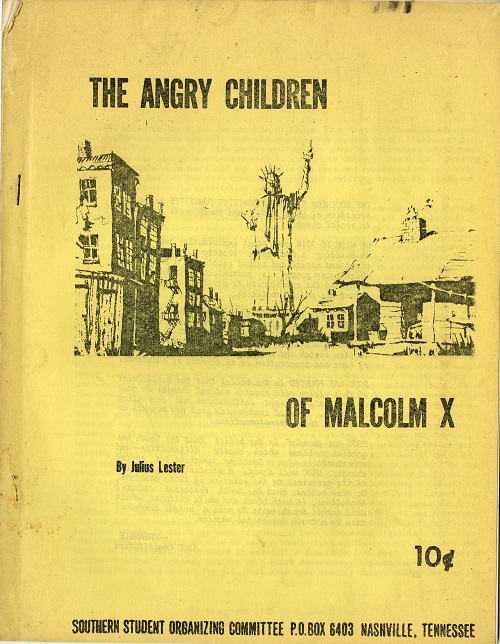
In The Angry Children of Malcolm X (1966), Julius Lester discusses the failure of nonviolence and argues that black power, or self-sufficiency and self-government for black people, was the only direction for African Americans to turn. Faith Holsaert papers.

Post contributed by Karlyn Forner, John Hope Franklin Research Center, Graduate Intern
Time to Travel!

Trying to find a way to visit the Rubenstein Library to use our collections? You’re in luck! The David M. Rubenstein Rare Book & Manuscript Library is now accepting applications for our 2014-2015 travel grants.

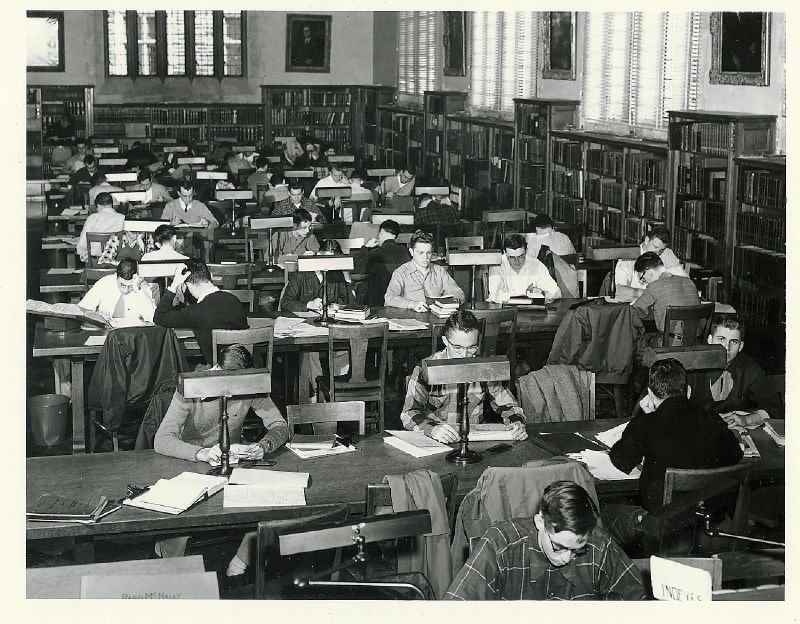
The reference room for the General Library, now known as the Gothic Reading Room.
Want to be as cool as these gentlemen? Apply for a travel grant and come visit us!

This year are pleased to add another collecting area to our list of travel grant programs. The History of Medicine Collections joins the Sallie Bingham Center for Women’s History and Culture, the John Hope Franklin Research Center for African and African American History and Culture, and the John W. Hartman Center for Sales, Advertising & Marketing History in offering travel grants of up to $1,000 for researchers whose work would benefit from access to our holdings.

The grants are open to undergraduate and graduate students, faculty, independent scholars, artists, and activists who live more than 100 miles from Durham, NC, and whose research projects would benefit from access to collections held by one of the centers and collecting areas.

The deadline for applications is January 31, 2014. Announcement of grant recipients will be no later than March 28, 2014. Travel grants must be used between April 2014 and June 2015.

Another change this year – our application process is now online. You can find more details including the online application on our travel grant website.

The African Americans: Rubenstein Recap #3

Each Tuesday, PBS is showing the next installment of a six-part series, The African Americans: Many Rivers to Cross. Written and narrated by Dr. Henry Louis Gates, Jr., the documentary traces African American history from the shores of West Africa to the election of Barack Obama. Join us each week as we feature documents from the John Hope Franklin Research Center that resonate with the previous week’s episode.

Episode 3: Into the Fire (1861 – 1896) traced the tumultuous journeys of African Americans from slavery to freedom in the second half of the nineteenth century. The Civil War opened as a battle to preserve the Union, but as enslaved men and women flocked to Union lines searching for freedom, their actions transformed the war into one for emancipation.

Kate Foster, a white woman from Adams County, Mississippi, kept a diary during the Civil War. In this entry from July 16th, 1863, she writes about the slaves who abandoned their masters in pursuit of freedom with the union army.

AAMR 3 FosterKate003blog
“The negroes are flocking to the enemy in town and the Yanks are cussing them and saying they wished they had never seen a negro. They are an ungrateful set and we are all tired of them.” (Kate D. Foster Diary)

At the conclusion of the war, freed black men and women set out to build new lives learning to read, buying land, building institutions, and raising families.

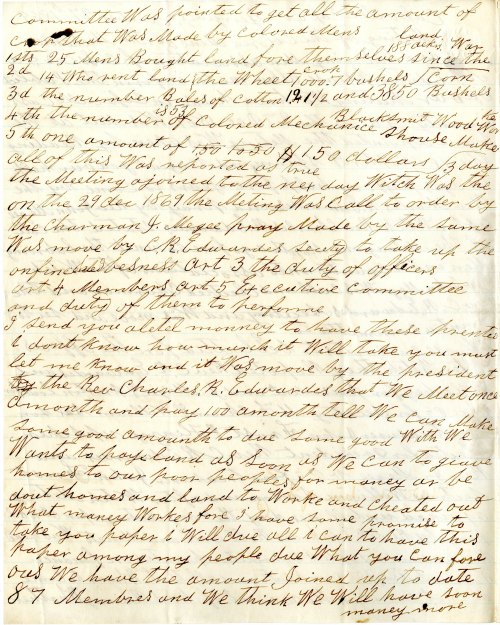
In this 1869 letter, African American minister Charles R. Edwardes introduces the Colored Men of the Mechanics and Laboring Men Association to John Emory Bryant, editor of radical Republican newspaper in Georgia. Rev. Edwardes explains how the organization wanted to help freed people buy land and homes.

John Emory Bryant Papers

After the 15th Amendment guaranteed black citizens’ right to vote, they used the ballot to elect African American city councilmen, state legislators, and congressmen to office. But white southern Democrats swiftly retaliated against these challenges through lynch mobs and violence at the ballot box, eroding African Americans’ newfound citizenship.

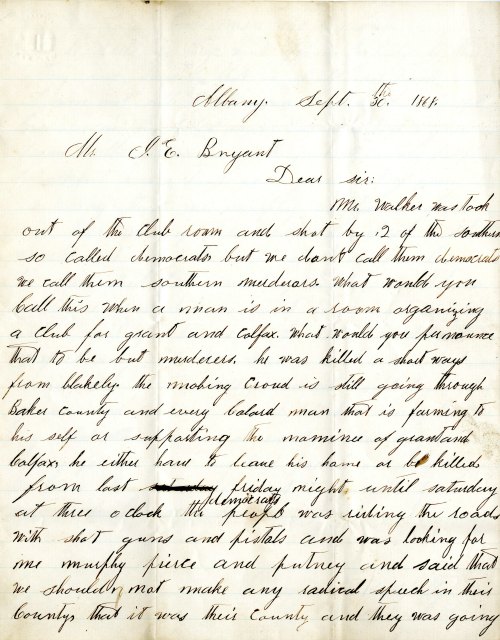
Mr. P. Joiner writes to Editor John Bryant in 1868 reporting the shooting of a black man by white democrats near Albany, Georgia. The white mob then continued on a rampage through the countryside, warning African Americans that it was “their country and they was going to rule it.” (John Emory Bryant Papers)

Mr. P. Joiner writes to Editor John Bryant in 1868 reporting the shooting of a black man by white democrats near Albany, Georgia. The white mob then continued on a rampage through the countryside, warning African Americans that it was “their country and they was going to rule it.” (John Emory Bryant Papers)
John Emory Bryant Papers

The 1890s brought a wave of state constitutional conventions across the South, aimed at systematically disfranchising black residents. These actions were buttressed by the Supreme Court’s Plessy v. Ferguson 1896 decision, supporting the principal of a separate but equal society and paving the way for legal racial segregation. As the twentieth century dawned, the full citizenship black Americans had so briefly experienced seemed like a distant hope.

Charles Hunter was born a slave in Raleigh in 1851 and spent his life pushing for the advancement of African Americans. In 1889, Hunter writes to the Postmaster General in Washington, D.C., protesting the white Raleigh postmaster’s refusal to appoint Hunter due to his race.

Charles N. Hunter Papers

Post contributed by Karlyn Forner, John Hope Franklin Research Center Graduate Student Intern and John Gartrell, John Hope Franklin Research Center Director.


The African Americans: Rubenstein Recap #2

Each Tuesday, PBS is showing the next installment of a six-part series, The African Americans: Many Rivers to Cross. Written and narrated by Dr. Henry Louis Gates, Jr., the documentary traces African American history from the shores of West Africa to the election of Barack Obama. Join us each week as we feature documents from the John Hope Franklin Research Center that resonate with the previous week’s episode.

Last Tuesday’s episode  focused on the slavery at its height in the American South. Episode 2: The Age of Slavery (1800 – 1860) began at the end of the Revolutionary War, a time when slavery was still legal in all thirteen states. While the demands of enslaved African Americans for freedom and mounting moral appeals helped end human bondage in the North, the exploding international demand for cotton only deepened the South’s reliance on slave labor.

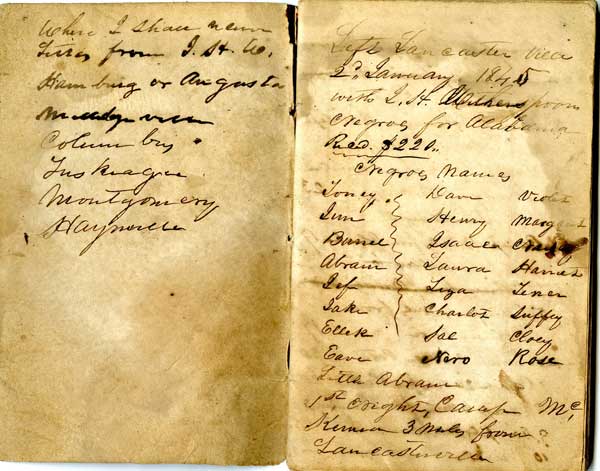
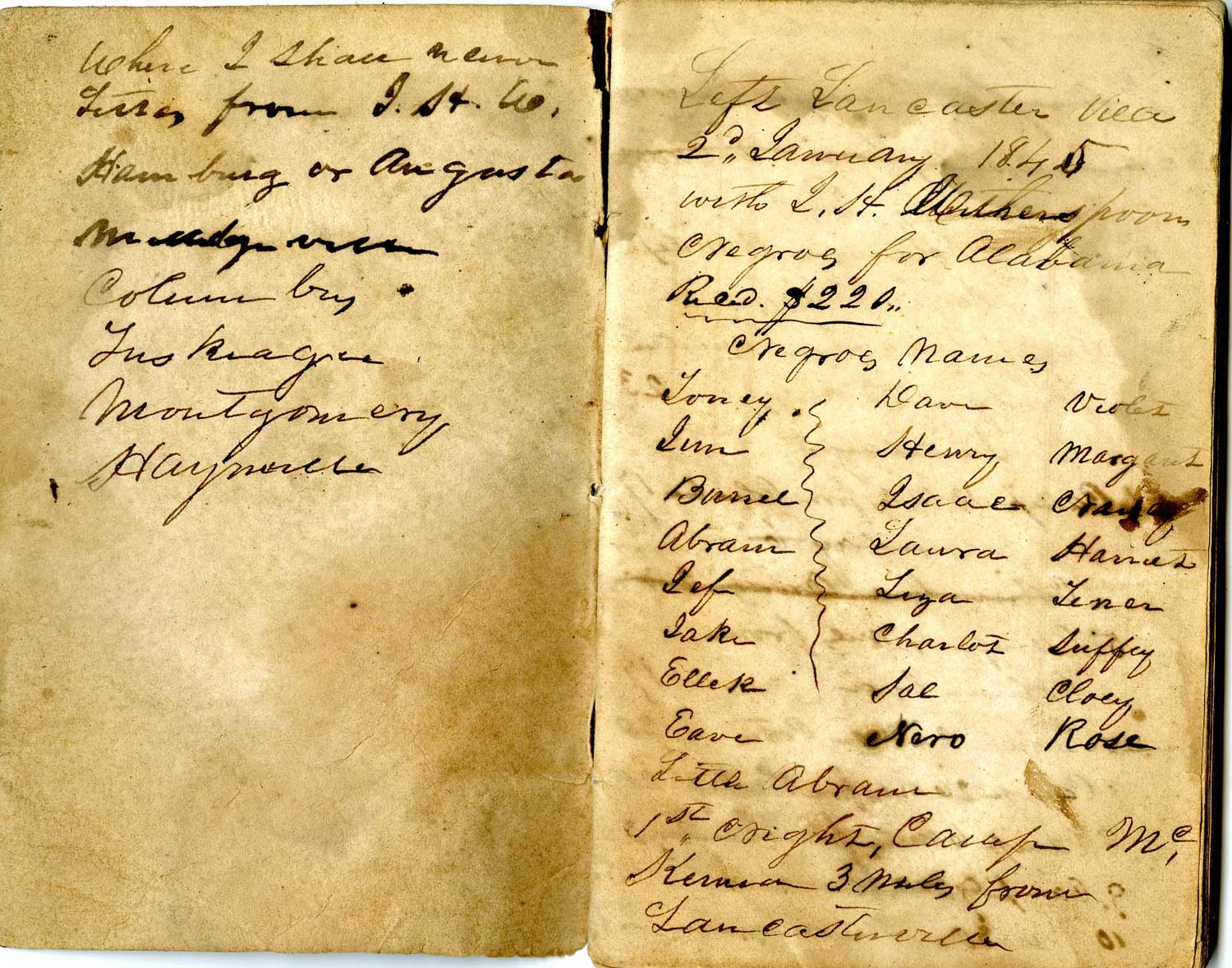
The notebook of a slave transporter who delivered twenty-five slaves from Lancaster, South Carolina to Montgomery, Alabama in 1845.
The notebook of a slave transporter who delivered twenty-five slaves from Lancaster, South Carolina to Montgomery, Alabama in 1845. (Slave transporter’s notebook, 1845). Click to enlarge.


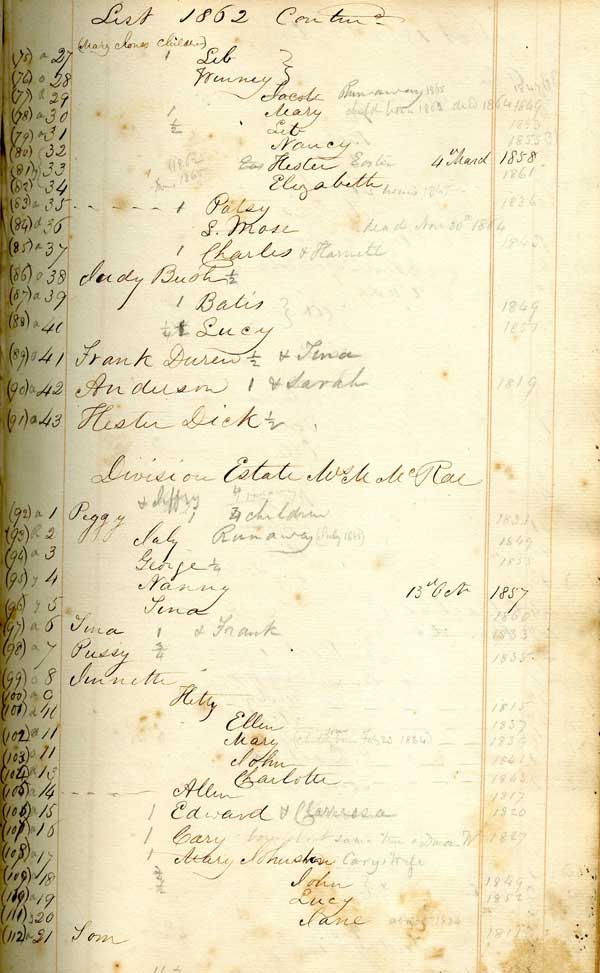
Lineage of slave families on the McRae Plantation near Camden, South Carolina in the 1800s. Jacob and July are noted as runaways.
Lineage of slave families on the McRae Plantation near Camden, South Carolina in the 1800s. Jacob and July are noted as runaways. (Plantation Memorandum Book, McRae Plantation)

Enslaved men and women ran away, revolted, and resisted this brutal system in any way they could. The luckiest made their way to freedom in Canada, but the vast majority had little chance of escaping the cotton fields.

List of black men and women emigrating from Essex County, Canada to Haiti in 1861.
List of black men and women emigrating from Essex County, Canada to Haiti in 1861. Alexander Proctor and his wife Margaret were born free in the South and migrated to Ohio before moving to Canada and finally Haiti. Also on the list is William Turner, who is noted as a fugitive. (Alexander Proctor Papers, 1837-1895).
Click to enlarge.

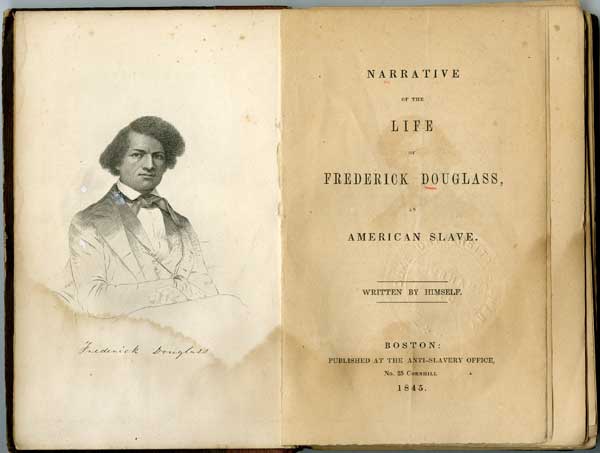
By the mid-19th century, abolitionists and free black citizens, like escaped slave Frederick Douglass, had launched a passionate battle to end slavery in the United States.

Narrative of the Life of Frederick Douglass, an American Slave (1845)

Post contributed by Karlyn Forner, John Hope Franklin Research Center Graduate Student Intern and John Gartrell, John Hope Franklin Research Center Director

The African Americans: Rubenstein Recap

Last Tuesday, PBS premiered the first episode of the six-part series, The African Americans: Many Rivers to Cross. Written and narrated by Dr. Henry Louis Gates, Jr., the documentary traces African American history from the shores of West Africa to the election of Barack Obama. Join us as we feature documents from our Rubenstein Library that resonate with the previous week’s episode.

Episode 1: The Black Atlantic (1500 – 1800) began with the complicated routes of the transatlantic slave trade connecting ports across three continents from Africa to the West Indies, London to South Carolina. The dehumanizing conditions of the Middle Passage and the capital made from human bondage were just some of the factors that made the institution of slavery in the western world so different from any other in world history.

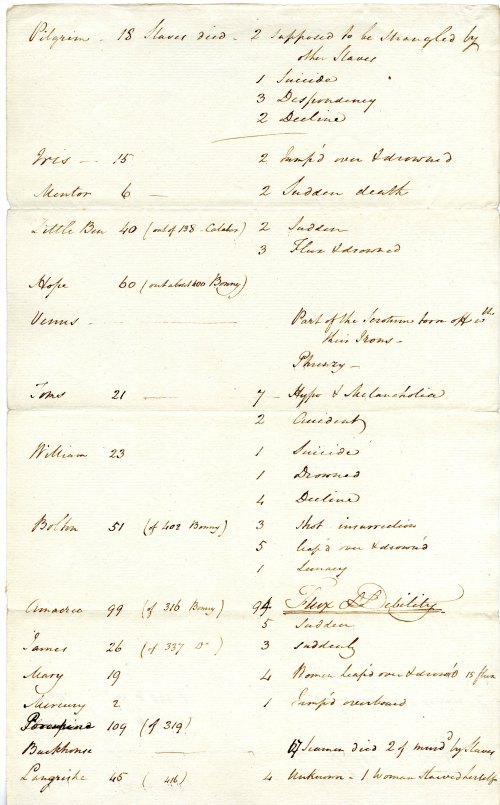
A list of slave ships from the 1790s, detailing the number of slaves that died in route to the western world. (l to r, name of Ship, number of slaves dead, special cause of death):

 William Smith papers, 1785-1860., Box 3, Miscellaneous Papers, Printed Material “Pilgrim - 18 slaves died”
William Smith papers, 1785-1860., Box 3, Miscellaneous Papers, Printed Material “Pilgrim – 18 slaves died”


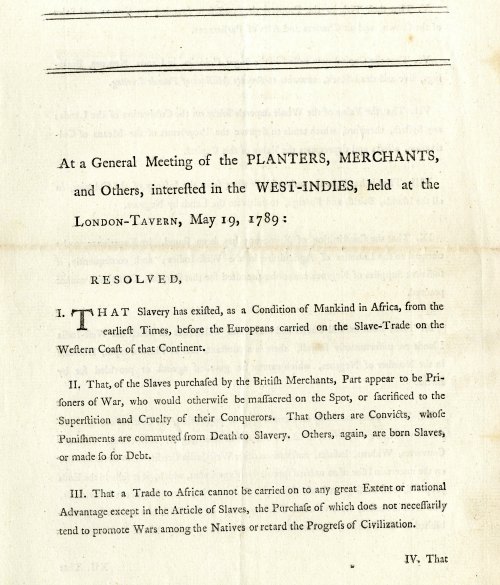
Arguments for the continuation of the African slave trade:

Resolutions West Indies Planters & Merchants, 1789 of why slave trade should be continued (arguments for property rights, capital reasons, European “constitutions” not be adapted to clearing agricultural land), William Smith Papers, Box 3, Folder (Printed Material, 1788 - 1822)
Resolutions West Indies Planters & Merchants, 1789 of why slave trade should be continued (arguments for property rights, capital reasons, European “constitutions” not be adapted to clearing agricultural land), William Smith Papers, Box 3, Folder (Printed Material, 1788 – 1822)


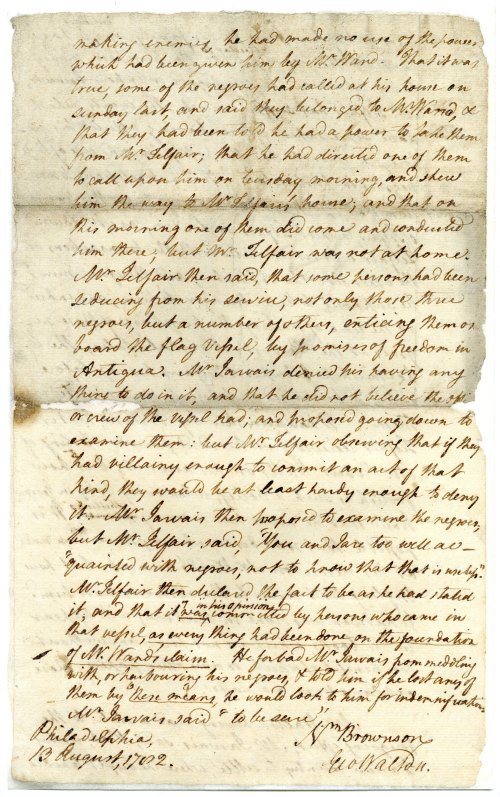
Episode 1 concluded by contextualizing the importance of the American, French, and Haitian Revolutions. The rhetoric of liberty and freedom at the heart of these movement ignited the entire Atlantic world in the late 18th century, especially the lives of enslaved African Americans, slaves wanted some of that freedom for themselves. This letter from the Edward Telfair papers details an incident where Telfair accuses a white man from British Antigua of “enticing” his slaves away with promises of freedom. Telfair fails to understand that the 3 slaves had reasons enough of their own, especially with liberty in the air.

Edward Telfair Papers
Edward Telfair Papers, Box 2, Folder 1780 – 1783, Letter on Aug. 13, 1782 from N. Brownson & E. Walton: “Mr. Telfair then said that some persons had been seducing from his service, not only those three negroes, but a number of others, enticing them on board the flag vessel, by promises of freedom in Antigua. Mr. Jarvais denied his having any thing to do in it, and that he did not believe the officers or crew of the vessel had; and proposed going down to examine them: but Mr. Telfair observing that if they had villainy enough to commit an act of that kind, they would be at least handy enough to deny it.[…] [Mr. Telfair] forbade Mr. Jarvis from meddling with or harbouring his negroes, and told him if he lost any of them by those means, he would look to him for indemnification. Mr. Jarvis said, ‘to be sure.’

Post contributed by Karlyn Forner, John Hope Franklin Research Center Graduate Student Intern and John Gartrell, John Hope Franklin Research Center Director

“Soul & Service”: The North Carolina Mutual Life Insurance Company, 115 Years and Counting

MutualJohnMosesAveryBlogExhibit Dates: October 24-December 20, 2013
Opening Reception: October 24, 2013, 6:00 p.m.-8:00 p.m.
Location: The Porch of the Center for Documentary Studies, 1317 West Pettigrew Street, Durham (directions)
Contact: John B. Gartrell, john.gartrell(at)duke.edu

The John Hope Franklin Research Center for African and African American History and Culture and North Carolina Mutual Life Insurance Company present, “Soul & Service,” a historical exhibition celebrating the 115th anniversary of North Carolina Mutual. This Durham institution is the nation’s oldest and largest insurance company with roots in the African American community. The photos and documents featured in the presentation were drawn from the North Carolina Mutual Company Archives, jointly held by the Rubenstein Library and the University Archives and Records Special Collections at North Carolina Central University. “Soul & Service” will be on display of the porch of the Center for Documentary Studies from October 24-December 20, 2013.

Author Waldo E. Martin Jr. to speak on the Black Panther Party

Bloom&Martin_compREV.inddDate: Thursday, October 3, 2013
Time: 4:00 – 6:00 p.m.
Location: Rubenstein Library, Perkins 318 (PDF Map)
Contact: John Gartrell, john.gartrell@duke.edu

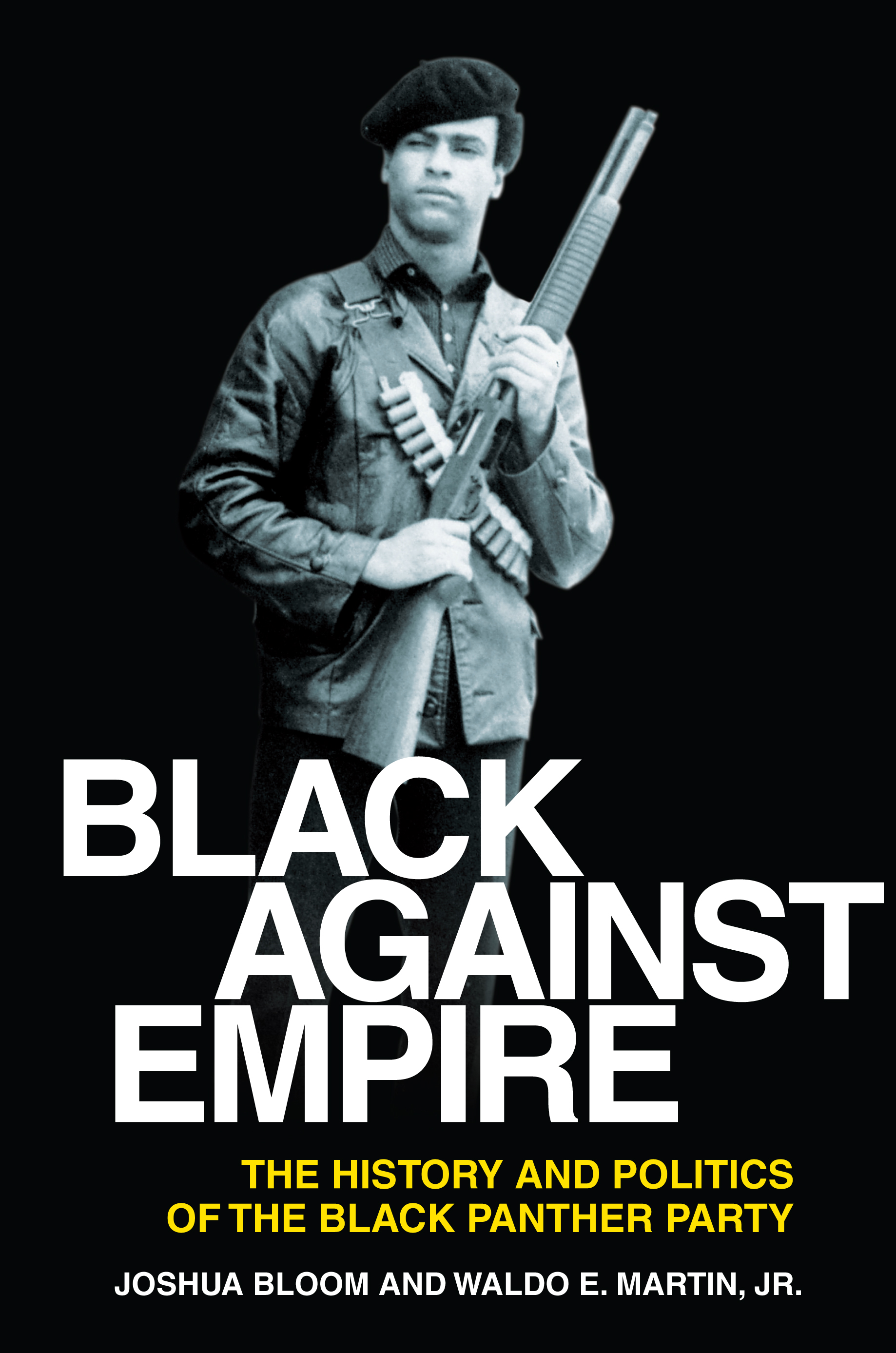
Black Against Empire: the History and Politics of the Black Panther Party traces the rise and fall of the Black Panther Party against the backdrop global revolution. Co-authors Waldo E. Martin Jr. and Joshua Bloom argue that the Black Panther Party rejected fighting for full citizenship within the U.S. and instead, joined the global struggle against U.S. imperialism. In this comprehensive overview, the authors examine why so many young black people across the country risked their lives for the revolution, why the Party grew most rapidly during the height of repression, and why allies abandoned the Party at its peak of influence.

Dr. Waldo E. Martin Jr., joins us to discuss and sign copies of his new book, Black Against Empire: The History and Politics of the Black Panther Party, co-authored with Joshua Bloom.  


Women in the Movement Part One: Reflections Unheard: Black Women in Civil Rights

Date: Thursday, September 26, 2013
Time: 5:30-8:00 p.m.
Location: FHI Garage, Bay 4, Smith Warehouse (directions & parking information)
Contact: John Gartrell, john.gartrell(at)duke.edu

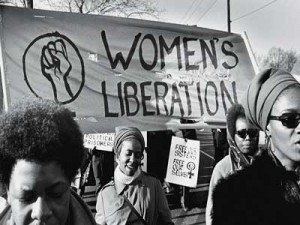
reflections_imageReflections Unheard: Black Women in Civil Rights focuses on black women activists and their marginalization within the Black Power and Feminist movements of the 1960s and 1970s. Filmmaker Nevline Nnaji looks at how each movement failed to fully recognize black women’s overlapping identities and include them as both African Americans and women. Through interviews and archival footage, Reflections Unheard tells the story of these black female activists’ political mobilization and fight for recognition.

The screening will be followed by a discussion with producer and director, Nevline Nnaji.

Part 1 of 2 in the Women in the Movement series is co-sponsored by John Hope Franklin Research Center, the Department of African & African American Studies, the Center for Documentary Studies, the Sallie Bingham Center for Women’s History and Culture, the Center for African and African American Research, the Franklin Humanities Institute, and the Program in Women’s Studies.


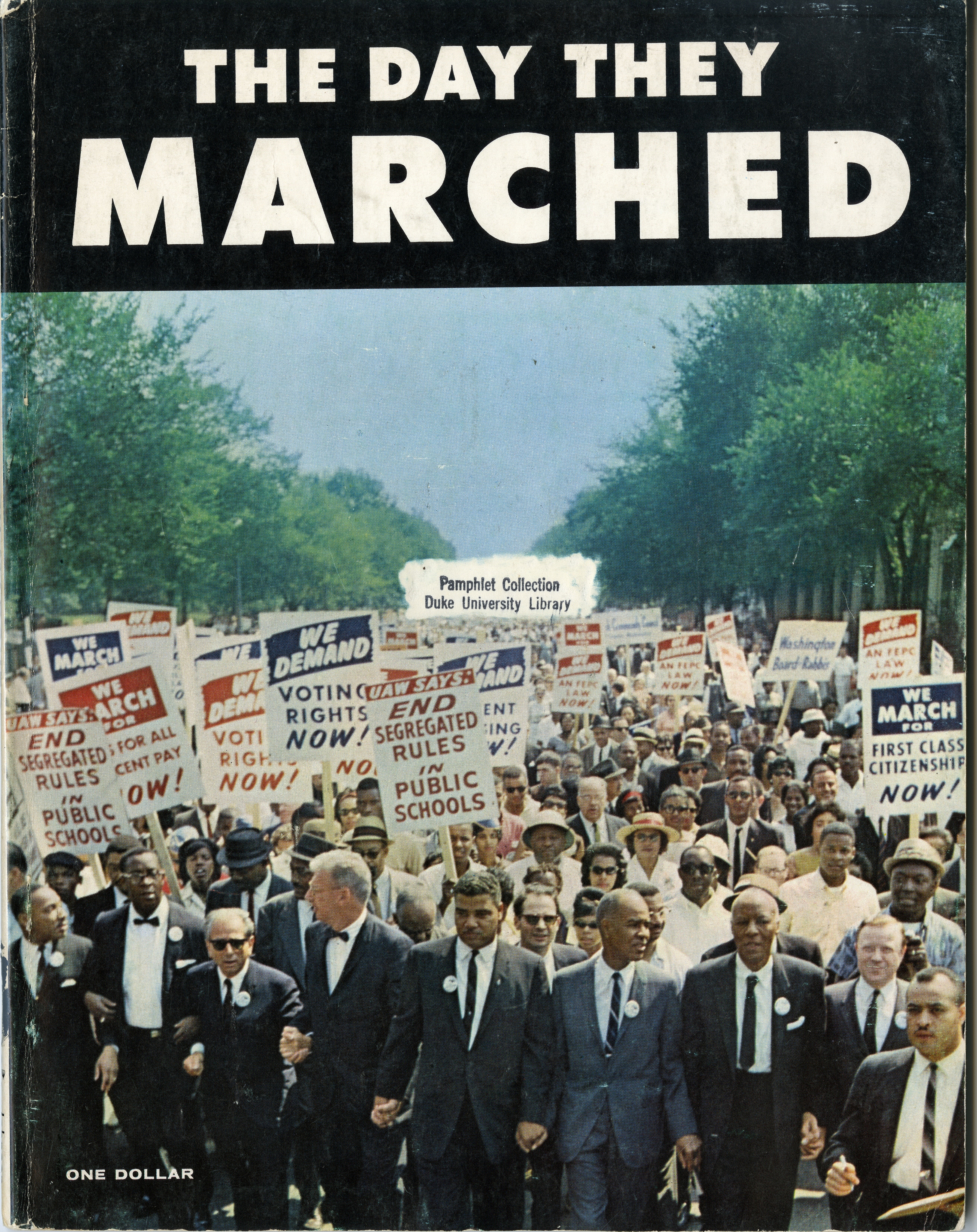
Remembering the March before the “March”

As the nation pauses and acknowledges the 50th anniversary of the August 28, 1963 March on Washington for Jobs and Freedom, it is important to remember that this was not the first African American organized mass march movement on the National Mall. The leaders of the March on Washington of ’63, Bayard Rustin, Andrew Young, Roy Wilkins, and others, used a blueprint established by another notable African American leader, A. Phillip Randolph, only a generation before them.

Bennett Lerone_mow_005While serving as head of the Brotherhood of Sleeping Car Porters, Randolph proposed a March on Washington on July 1, 1941 to protest the lack of opportunities given to African Americans in a recovering American economy. As World War II waged in Europe and Asia, American industry saw remarkable growth as suppliers of arms and supplies to their diplomatic allies, but African Americans were largely shut out of both federal and private jobs. Randolph believed that a march on the nation’s capital would provide a stage to give voice to African Americans suffering from both economic and social prejudice. As the March on Washington movement grew, Randolph threatened President Franklin Roosevelt that close to 100,000 people would descend on the nation’s capital if change did not occur. The March was ultimately called off by Randolph after Roosevelt passed Executive Order 8801, ordering the prohibition of discrimination in defense industries.

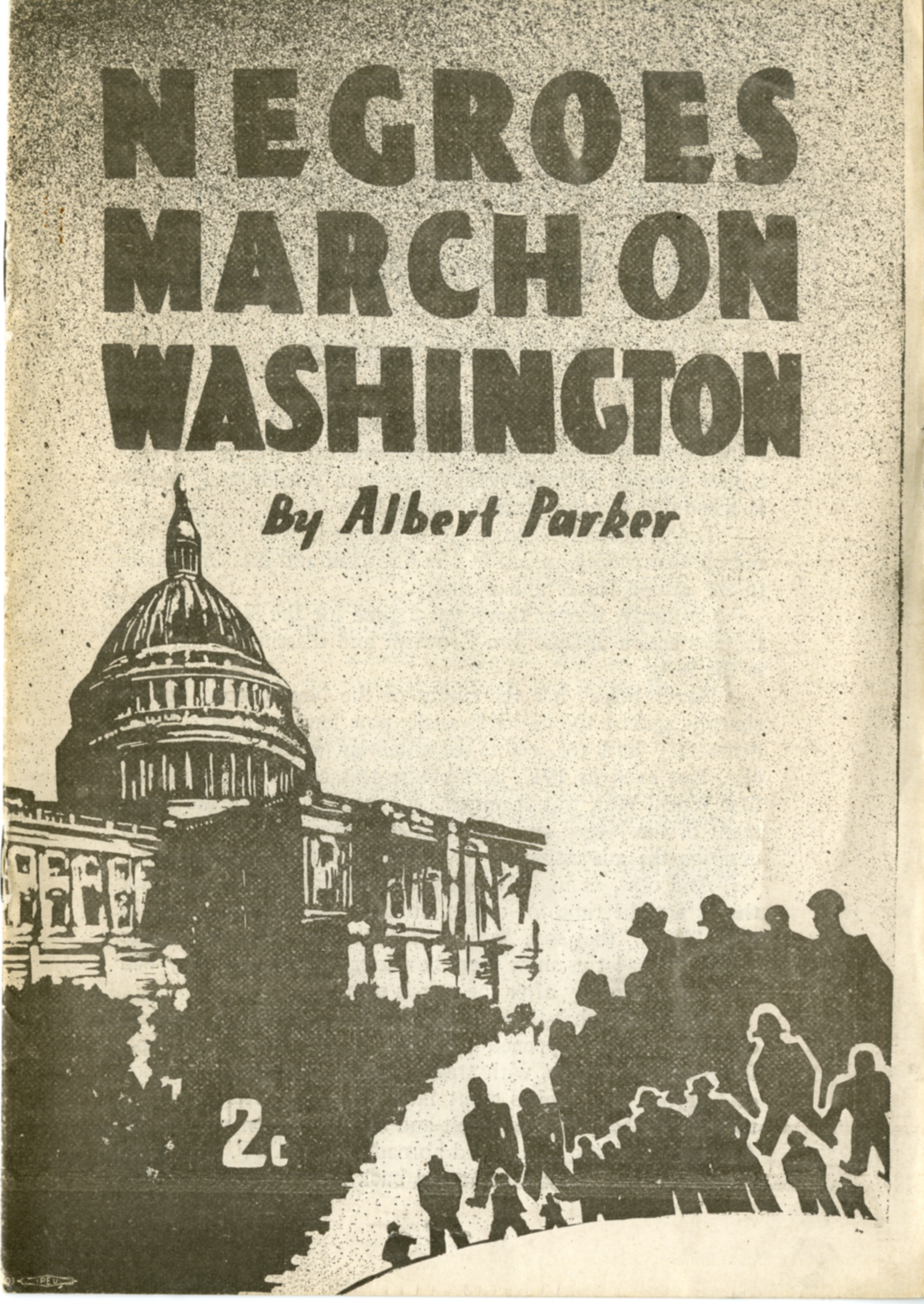
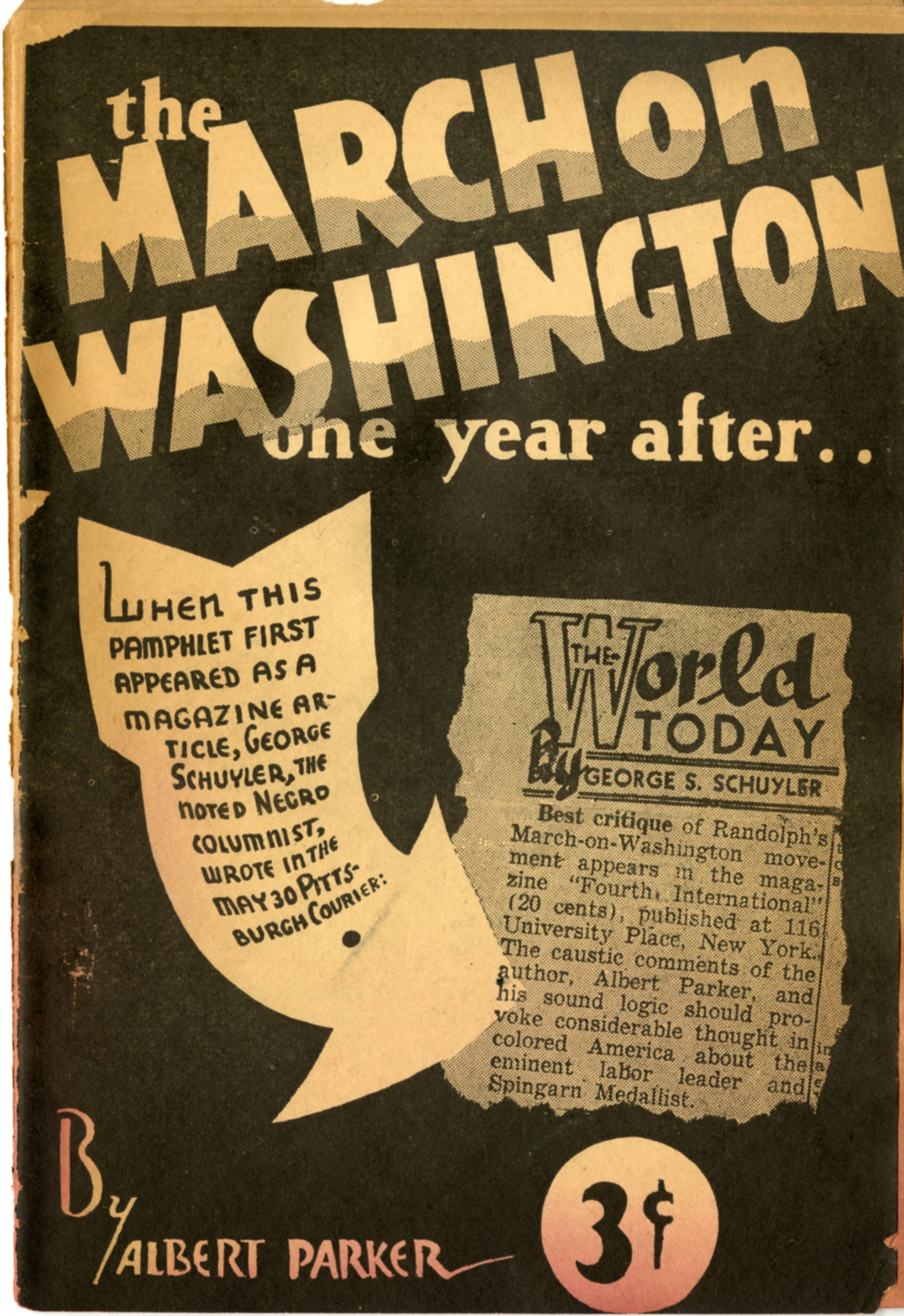
LSC 6865_004E Pam 12mo_12551_003Albert Parker’s Negroes March on Washington (1941) and The March on Washington, One Year After (1942), recount the MOW movement from that time. Parker, a staunch socialist, was indeed excited at the prospects of the March in 1941 and continual organization of African Americans against the federal government. But his 1942 publication reflected disappointment with Randolph’s actions in cancelling the march and acceptance of the Executive Order that was slow to desegregate the military and open jobs in the private sector.

Post contributed by John Gartrell, John Hope Franklin Research Center Director.

A Cartoon Version of John Hope Franklin

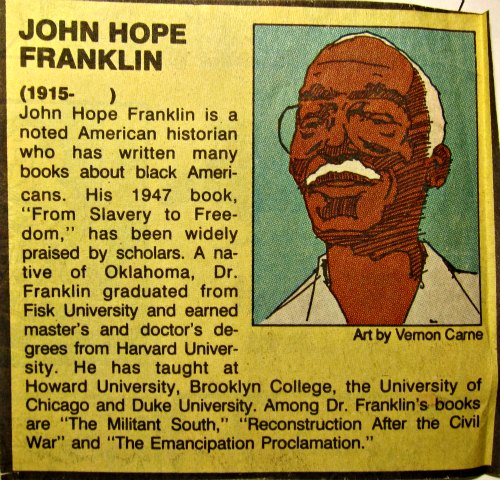
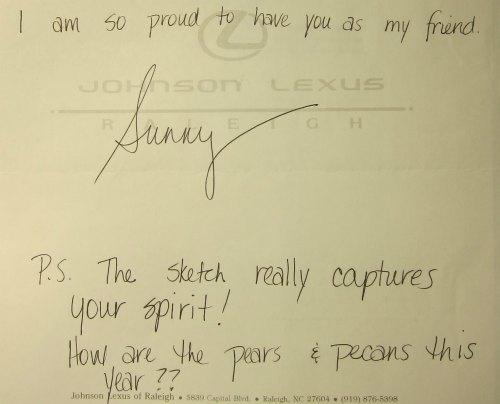
We are wrapping up processing on the John Hope Franklin Papers — more on that soon! — but I couldn’t let this project end without sharing a bit of its lighter side. Newspaper drawings and cartoons of Franklin popped up throughout processing, often having been clipped and sent to Franklin by his friends and admirers. Here is a case where we see Franklin’s reaction to one of his cartoons, shared with him by a friend in Raleigh.

IMG_1116

The sketch in question appears to have been published as part of a syndicated comic strip in newspapers around the country.

IMG_1117

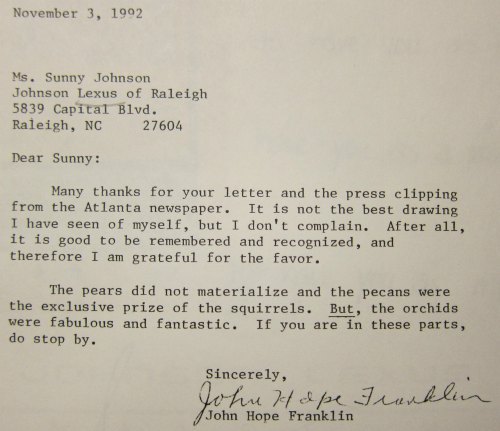
Here is Franklin’s response:

IMG_1114

“It is not the best drawing I have seen of myself, but I don’t complain.” Understatement of the year, maybe? Franklin’s friendly good humor is prevalent throughout his papers, which has made them particularly enjoyable to process over the past year. Stay tuned for more information about the conclusion of the Franklin Papers processing project.

Post contributed by Meghan Lyon, Technical Services Archivist.