Category Archives: Events

Reading by Jonathan Katz, 2013 WOLA-Duke Human Rights Book Award Winner

the-big-truck-that-went-by-how-the-world-came-to-save-haiti-and-left-behind-a-disasterDate: November 6, 2013
Time: 5:00 p.m.
Location: FHI Garage at the Smith Warehouse, Bay 4
Contact: Patrick Stawski, 919-660-5823 or patrick.stawski@duke.edu

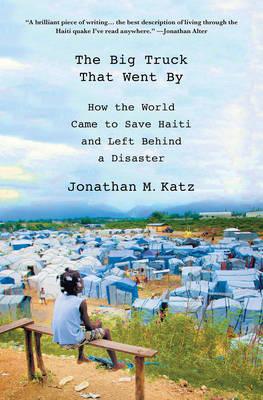
The Washington Office on Latin America (WOLA) and Duke University have named Jonathan Katz’s book The Big Truck that Went by: How the World Came to Save Haiti and Left Behind a Disaster (Palgrave Macmillan, 2013) as the winner of the 2013 WOLA-Duke Human Rights Book Award.

On November 6 at 5:00pm, Katz will be in Durham, North Carolina to do a reading of his book at the FHI Garage at the Smith Warehouse, Bay 4. An award presentation is planned for March 2014 in Washington, DC.

Katz, who currently lives in Durham, NC,  was a correspondent for the Associated Press on January 12, 2010, when the deadliest earthquake ever recorded in the Western Hemisphere struck the island nation of Haiti. The Big Truck that Went By recounts Katz personal experience when the earthquake hit, and—drawing on his groundbreaking reporting during the period that followed—traces the relief response that poured from the international community and where those efforts went tremendously wrong.

Award judge Roger Atwood states that “Katz’s book brings together everything a winner of this award should have: brave and groundbreaking research, lucid writing, freshness in both form and content, and (best of all) genuine policy applications.”

Describing the book, Dr. Kathryn Sikkink—a member of the 2013 judging panel and winner of the 2011 WOLA-Duke Human Rights Book Award—says that “Katz has written a gripping, well-written book, full of moving stories of the people of Haiti and the tragedies and triumphs of their life during the adversity of the earthquake and the cholera epidemic, and vivid cameos of the very mixed bag of foreigners who seemed compelled to try to make things better there.”

According to Leonor Blum, the chair of this year’s award judging panel and emerita professor of history and political science at Notre Dame of Maryland University, explains that “[Katz’s] easy style, his dramatic presentation of  Haiti’s devastating earthquake, his deep understanding of Haiti and its problems, his willingness to criticize Haiti’s governments as well as the international governmental and non-governmental community, all make The Big Truck that Went By worthy of the WOLA/Duke prize.”

According to judge Holly Ackerman, Librarian for Latin America and Iberia at Duke University Libraries, “The book is a crucial case study of what is wrong with current NGO process and international donor councils. It offers lessons on what is happening with aid/investment but, most important, it unplugs myths for the general public who sent their dollars to the Red Cross and similar organizations at the time of the quake and naturally ask, “Why is Haiti not progressing despite so much aid?”

The judges also listed an honorable mention for Kimberly Theidon’s Intimate Enemies: Violence and Reconciliation in Peru.

About the Award:

Started in 2008, the WOLA-Duke Human Rights Book Award is a joint venture of Duke University and WOLA, a leading advocacy organization based in Washington, DC. The award honors the best current, non-fiction book published in English on human rights, democracy, and social justice in contemporary Latin America. The books are evaluated by a panel of expert judges drawn from academia, journalism, and public policy circles. The 2013 judging panel included:

Holly Ackerman, Librarian for Latin America and Iberia, Duke University
Roger Atwood, Journalist, Author, and Former Communications Director, WOLA
Leonor Blum, WOLA Board Member and Emerita Associate Professor, History and Political Science, Notre Dame of Maryland University
Robin Kirk, Faculty Co-Chair, Duke Human Rights Center at the Franklin Humanities Institute, Duke University
Kathryn Sikkink, Professor of Political Science at the University of Minnesota

Previous WOLA-Duke Human Rights Book Award recipients include: Hector Abad for Oblivion: A Memoir in 2012; Katherine Sikkink for The Justice Cascade in 2011; Victoria Bruce and Karin Hayes, with Jorge Enrique Botero for Hostage Nation in 2010; Ambassador Heraldo Muñoz for The Dictator’s Shadow: Life Under Augusto Pinochet in 2009; and Francisco Goldman for The Art of Political Murder: Who Killed the Bishop? in 2008.

Contact:

Kelly McLaughlin, WOLA
202-797-2171
kmclaughlin@wola.org

Patrick Stawski, Duke University Libraries
919-660-5823
patrick.stawski@duke.edu
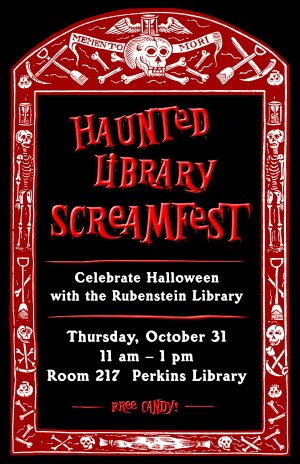
Prepare for Terror: Haunted Library Screamfest II

Halloween4blogDate: October 31, 2013
Time: 11:00 a.m.-1:00 p.m.
Location: Perkins Library, Room 217
Contact: Rachel Ingold, 919-684-8549 or rachel.ingold(at)duke.edu

Stop by for a special Halloween “eeeks”-ibit and open house featuring some of the creepiest and most macabre items from the shadowy depths of the Rubenstein Library’s vaults. Will you dare to:

  • Gaze in awe at a box full of glass eyeballs?
  • Feel your head spin as you read letters describing the case that inspired The Exorcist (from the Parapsychology Laboratory Records)?
  • Quoth nevermore after experiencing Gustave Doré’s illustrations for The Raven?
  • Steel yourself to view a medieval amputating saw?
  • Cackle frightfully at seventeenth-century accounts of witchcraft?
  • Sink your teeth into images of vampires, werewolves, the living dead, and Frankenstein’s monster?

These and many other spook-tacular books, photographs, comics, diaries, letters, artifacts, and more will be on display!

Oh, and did we mention that there will be free candy?

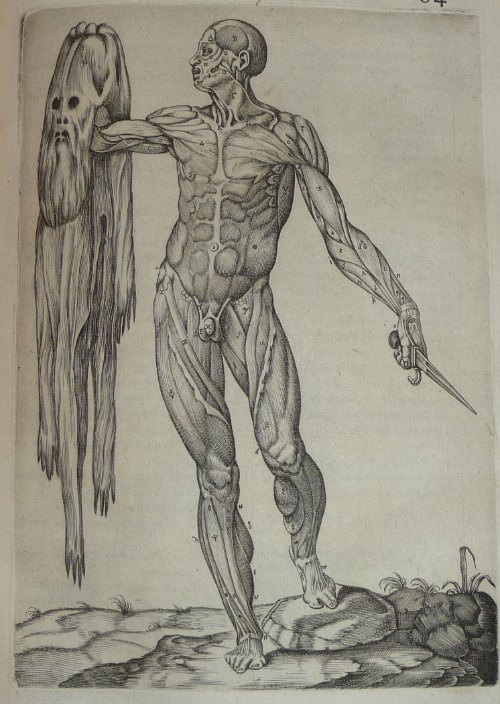
A man holding his own flayed skin will be there. Will you? (From Juan Valverde de Amusco, Anatomia del Corpo Humano, 1560, in the History of Medicine Collections.
A man holding his own flayed skin will be there. Will you? (From Juan Valverde de Amusco, Anatomia del Corpo Humano, 1560, in the History of Medicine Collections.)


“Soul & Service”: The North Carolina Mutual Life Insurance Company, 115 Years and Counting

MutualJohnMosesAveryBlogExhibit Dates: October 24-December 20, 2013
Opening Reception: October 24, 2013, 6:00 p.m.-8:00 p.m.
Location: The Porch of the Center for Documentary Studies, 1317 West Pettigrew Street, Durham (directions)
Contact: John B. Gartrell, john.gartrell(at)duke.edu

The John Hope Franklin Research Center for African and African American History and Culture and North Carolina Mutual Life Insurance Company present, “Soul & Service,” a historical exhibition celebrating the 115th anniversary of North Carolina Mutual. This Durham institution is the nation’s oldest and largest insurance company with roots in the African American community. The photos and documents featured in the presentation were drawn from the North Carolina Mutual Company Archives, jointly held by the Rubenstein Library and the University Archives and Records Special Collections at North Carolina Central University. “Soul & Service” will be on display of the porch of the Center for Documentary Studies from October 24-December 20, 2013.

Jeremy Greene to Lecture on History of Pharmaceutical Trademarks

faculty-jeremy-greene blogsizeDate: Wednesday, October 23, 2013
Time: 5:30 p.m.
Location: Room 217, Perkins Library, Duke University
Contact: Rachel Ingold, (919) 684-8459 or rachel.ingold(at)duke.edu

Join the History of Medicine Collections for our fall Trent History of Medicine Lecture Series event to be held on Wednesday, October 23, 2013, in Room 217 of Perkins Library on Duke University’s West Campus. Jeremy Greene, M.D., Ph.D., will be presenting “The materiality of the brand: Form, function and the pharmaceutical trademark.”

Dr. Greene’s talk will explore the limits of patents and trademarks in the sphere of pharmaceutical intellectual property, and illuminate a century of controversy over the clinical, public health, and financial value of “look-alike drugs,” generic drugs that imitated their brand-name counterparts down to exact parameters of size, shape, and color. His historical analysis addresses thorny questions about which qualities of a brand-name drug are considered private property and whether parts of a drug other than its active ingredients (e.g., pill color) can affect its clinical function.

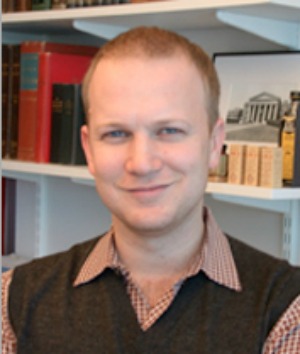
Dr. Greene is Associate Professor, Elizabeth Treide and A. McGehee Harvey Chair in the History of Medicine at the Johns Hopkins University’s Institute for the History of Medicine. His broader research interests focus on the history of disease, the history of global health, and the relationship between medicine and the marketplace. Dr. Greene also practices internal medicine at the East Baltimore Medical Center and the Johns Hopkins University Hospital. He has published on a wide variety of topics and his most recent book with Elizabeth Siegel Watkins is, Prescribed: Writing, Filling, Using, and Abusing the Prescription in Modern America, Johns Hopkins University Press, 2012.

Please note Dr. Greene will also be giving a talk at noon on October 23 on Imitation and Innovation: A Brief History of ‘Me-Too’ Drugs. This talk will be held from 12:00-1:00 pm in the Great Hall of the Mary Duke Biddle Trent Semans Center for Health Education at the Duke University Medical Center.

Sponsored by the History of Medicine Collections, the John W. Hartman Center for Sales, Advertising & Marketing History, and the Trent Center for Bioethics, Humanities & History of Medicine.

Rights! Camera! Action!: The Undocumented (Director’s Cut)

Date: Tuesday, October 8, 2013
Time: 7:00 p.m.
Location: Full Frame Theater on the American Tobacco Campus (directions & parking information)
Contact: Patrick Stawski, patrick.stawski(at)duke.edu

Marcos Hernandez lives and works in Chicago. He came to the United States from Mexico, after a life-threatening border crossing through the Sonora Desert in southern Arizona. Each month, he sends money to his mother in Mexico City to buy medicine for his brother, Gustavo, who needs a kidney transplant. The Undocumented, by acclaimed filmmaker Marco Williams, is Marcos’s story—as well as the story of countless other migrants.

Chronicling Arizona’s deadliest summer months, award-winning documentary and fiction film director Marco Williams (Banished, Two Towns of Jasper, In Search of Our Fathers) weaves Marcos’s search with the efforts of humanitarians and Border Patrol agents who are fighting to prevent migrant deaths, the medical investigators and Mexican Consulate workers who are trying to identify dead border crossers, and Mexican families who are struggling to accept the loss of a loved one.

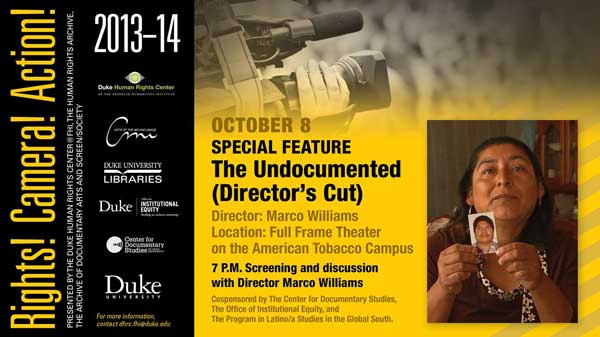
Poster for Screening of The Undocumented

In true cinéma vérité style, The Undocumented (91:00 TRT; 2013 Full Frame Honorable Mention for Kathleen Bryan Edwards Award for Human Rights) reveals the ongoing impact of immigration laws and economic policies on the very people who continue to be affected by them. By going beyond politics, the film also tells a story that is deeply personal.

The screening, which is free and open to the public, will be followed by a panel discussion featuring director Marco Williams and Duke University professor Charlie Thompson.

Rights!Camera!Action! is sponsored by the Archive of Documentary Arts and the Human Rights Archive in the Rubenstein Library, the Duke Human Rights Center @ FHI, and the Program in the Arts of the Moving Image.

Author Waldo E. Martin Jr. to speak on the Black Panther Party

Bloom&Martin_compREV.inddDate: Thursday, October 3, 2013
Time: 4:00 – 6:00 p.m.
Location: Rubenstein Library, Perkins 318 (PDF Map)
Contact: John Gartrell, john.gartrell@duke.edu

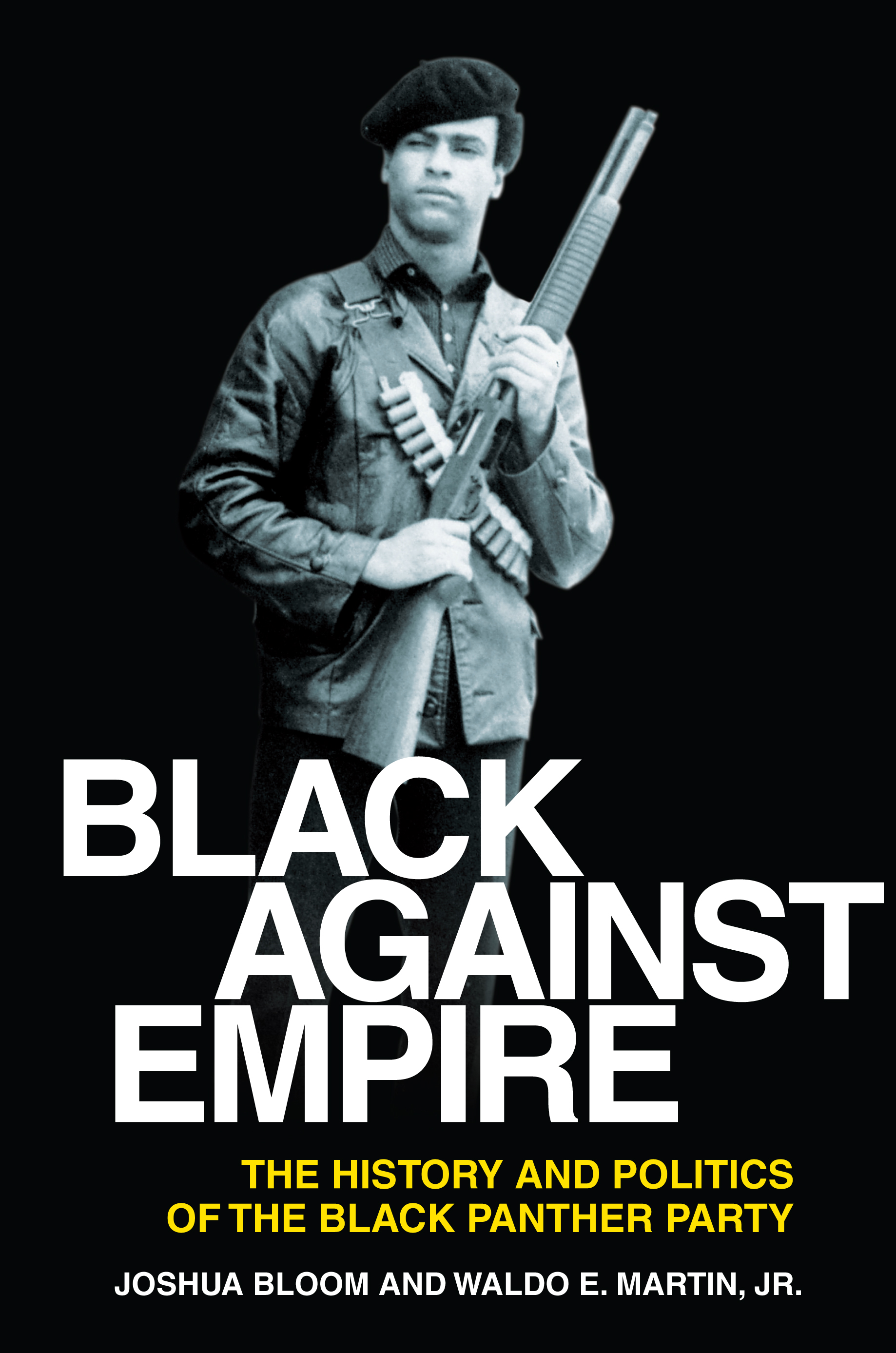
Black Against Empire: the History and Politics of the Black Panther Party traces the rise and fall of the Black Panther Party against the backdrop global revolution. Co-authors Waldo E. Martin Jr. and Joshua Bloom argue that the Black Panther Party rejected fighting for full citizenship within the U.S. and instead, joined the global struggle against U.S. imperialism. In this comprehensive overview, the authors examine why so many young black people across the country risked their lives for the revolution, why the Party grew most rapidly during the height of repression, and why allies abandoned the Party at its peak of influence.

Dr. Waldo E. Martin Jr., joins us to discuss and sign copies of his new book, Black Against Empire: The History and Politics of the Black Panther Party, co-authored with Joshua Bloom.  


Women in the Movement Part One: Reflections Unheard: Black Women in Civil Rights

Date: Thursday, September 26, 2013
Time: 5:30-8:00 p.m.
Location: FHI Garage, Bay 4, Smith Warehouse (directions & parking information)
Contact: John Gartrell, john.gartrell(at)duke.edu

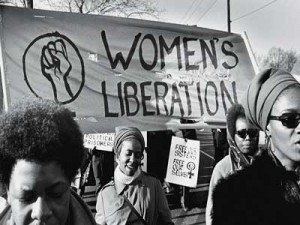
reflections_imageReflections Unheard: Black Women in Civil Rights focuses on black women activists and their marginalization within the Black Power and Feminist movements of the 1960s and 1970s. Filmmaker Nevline Nnaji looks at how each movement failed to fully recognize black women’s overlapping identities and include them as both African Americans and women. Through interviews and archival footage, Reflections Unheard tells the story of these black female activists’ political mobilization and fight for recognition.

The screening will be followed by a discussion with producer and director, Nevline Nnaji.

Part 1 of 2 in the Women in the Movement series is co-sponsored by John Hope Franklin Research Center, the Department of African & African American Studies, the Center for Documentary Studies, the Sallie Bingham Center for Women’s History and Culture, the Center for African and African American Research, the Franklin Humanities Institute, and the Program in Women’s Studies.


Rights! Camera! Action!: We Still Live Here / Âs Nutayuneân

Date: Thursday, September 19, 2013
Time: 7:00 p.m.
Location: FHI Garage, Bay 4, Smith Warehouse (directions & parking information)
Contact: Patrick Stawski, patrick.stawski(at)duke.edu

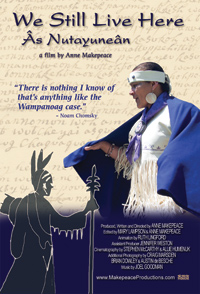
Poster for We Still Live HereWinner of the Full Frame Inspiration Award, We Still Live Here/ Âs Nutayuneân (TRT 56:00) tells the story of the revival of the language of the Wampanoag people of New England. All speakers of the language had died out when in 1994 Jessie Little Doe, a Wampanoag social worker, began to wonder if it could be recovered.

With M.I.T. linguist Ken Hale, with whom she earned a Master’s degree, she and other linguists pieced the language together from old documents and related Native American languages. Through community-wide efforts among the Aquinnah and Mashpee Wampanoag, the language is being spoken again, and Jessie’s young daughter is the first native speaker of Wampanoag in more than a hundred years.

The screening will be followed by a panel discussion featuring Dr. Liliana Paredes and Dr. Benjamin Frey.

Dr. Liliana Paredes is Associate Professor of the Practice of Spanish and Director of the Duke Spanish Language Program. She holds expertise in the areas of sociolinguistics, minority languages, and Amerindian languages.

Dr. Benjamin Frey is a Fellow in the Carolina Postdoctoral Program for Faculty Diversity at UNC. He completed his Ph.D. in Germanic linguistics at the University of Wisconsin – Madison in August 2013. His research examines language shift among minority communities in the United States from their traditional languages to English, with specific focus on German in Wisconsin and Cherokee in North Carolina. Frey is a member of the Eastern Band of Cherokee Indians.

Rights!Camera!Action is sponsored by the Archive of Documentary Arts and the Human Rights Archive in the Rubenstein Library, the Duke Human Rights Center @ FHI, and the Program in the Arts of the Moving Image.

Post contributed by Patrick Stawski, Human Rights Archivist.

Revisiting the Allen Building Takeover

In 2013, Duke University is commemorating the 50 year anniversary of its first black undergraduate students. Events, exhibits, and performances have been taking place over the year, and will culminate during the weekend of October 3-6.

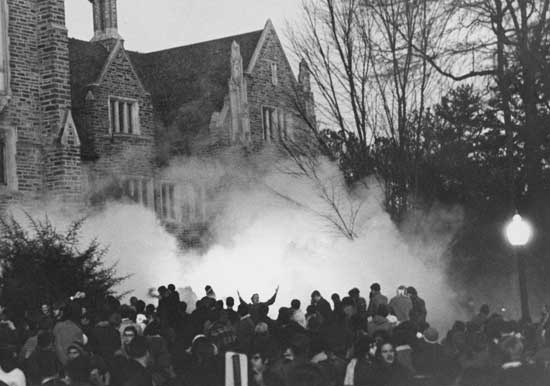
As we reflect on the milestone of integration, we must also consider the challenges faced by African American students at Duke, especially during the 1960s. This upcoming February will mark 45 years since the Allen Building Takeover of 1969. The Takeover was a seminal event in which nearly 100 black students occupied the administrative building for a day, demanding changes to a number of policies. After leaving peacefully, a crowd gathered outside the building confronted police, and teargas was fired on the crowd.

Allen Building Takeover, 1969

A new exhibit on the Takeover, curated by Caitlin M. Johnson, Trinity ’12, is now on display on the first floor of the Allen Building. Thirty panels describe the build-up to the protest, the events of that day, and the outcome of the Takeover. Featuring many images from the University Archives and the Durham Morning Herald and Durham Sun, Johnson’s exhibit forms a powerful narrative about Duke’s path toward real integration.

An opening reception for the exhibit will be held on Thursday, September 12 from 3:30 to 5:00 p.m. in the Allen Building.

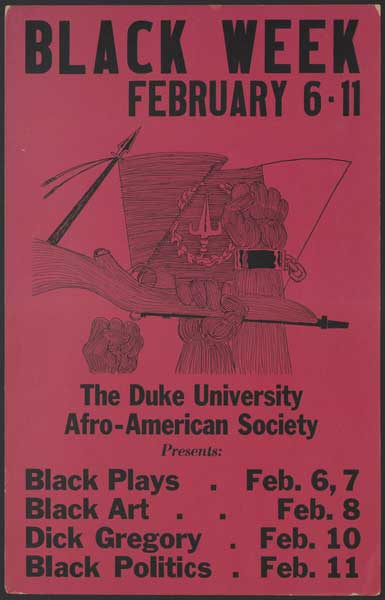
At 6:00 p.m. that evening, Dr. Jack Preiss, Professor Emeritus at Duke, will be speaking at the School of Nursing about desegregation at the University. Dr. Preiss was intimately involved in encouraging the Board of Trustees to change its policies on admissions. The University Archives holds a collection of his papers, including this poster from Black Week, which immediately preceded the Allen Building Takeover.

Black Week Poster, 1969

Email sharon.caple@duke.edu to RSVP for the Sept. 12 exhibit reception or the talk by Dr. Preiss.

Post contributed by Val Gillispie, University Archivist.

Transforming Knowledge: A Reading with Dr. Jean Fox O’Barr

Date: Tuesday, September 17, 2013
Time: 6:00 p.m.
Location: Thomas Room, Lilly Library, Duke University East Campus (directions to Lilly Library)
Contact Information: Kelly Wooten, kelly.wooten(at)duke.edu

Jean Fox O'Barr Dr. Jean Fox O’Barr will read from her new book, Transforming Knowledge: Public Talks on Women’s Studies, 1976-2011. This collection chronicles her personal journey, which unfolded alongside the women’s movement and the evolution of Women’s Studies. Now retired, Dr. O’Barr founded and led the Duke University Women’s Studies Program for two decades. Her records are preserved at the Sallie Bingham Center.

Read more about this book or order online from She Writes Press.  This event, which is free and open to the public, is co-sponsored by the Sallie Bingham Center for Women’s History and Culture at Duke University Libraries and the Resource Center for Women and Ministry in the South.

RSVP for this event (optional).

Post contributed by Kelly Wooten, Research Services and Collection Development Librarian for the Bingham Center.