Category Archives: Events

March 29: Wikipedia Editathon – Women of Science and Philosophy

When: Tuesday, March 29, 6-9pm
Where: The Edge Workshop room, Bostock Library
Wikipedia Meetup Page
Facebook Event

Please join us for an opportunity to learn how to edit Wikipedia articles for a global audience, and to help record the hidden history of women in science and philosophy. This event will help document women’s achievements in the fields of science and philosophy, drawing on the Lisa Unger Baskin Collection and Project Vox.

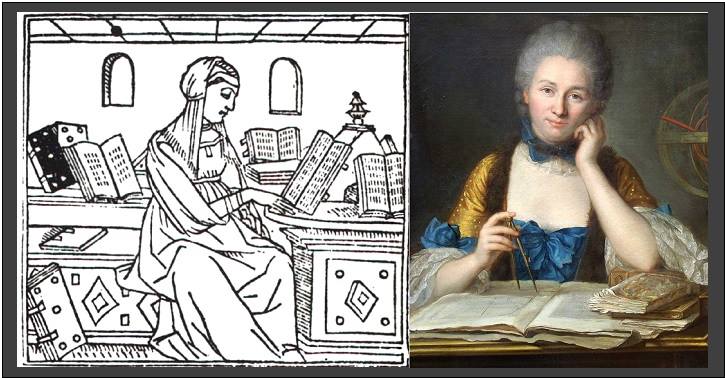
From labor, science and activism, to art and philosophy, the Lisa Unger Baskin Collection and Project Vox document the many ways women have been productive, creative, and socially engaged over more than five hundred years. A wealth of rare documentary materials in the Lisa Unger Baskin Collection sheds light on the long history of women’s involvement in a variety of scientific disciplines. Project Vox is an online platform developed by scholars at Duke for discovering and discussing the forgotten contributions made by women to philosophy and science during the early modern period. The goal of this Edit-a-thon is to raise awareness about the key intellectual figures whose works are featured in the collections by creating and contributing to entries on Wikipedia.

Put your knowledge and intellectual curiosity into action by creating, editing, or translating Wikipedia entries that document the lives and contributions of women in philosophy and science. By collaborating together we can disseminate this important information to the broader public. This event is part of a worldwide movement to increase the percentage of women editors and woman-focused articles within Wikipedia. Bring your laptop if you have one, or use one of ours. You can also participate from anywhere in the world!

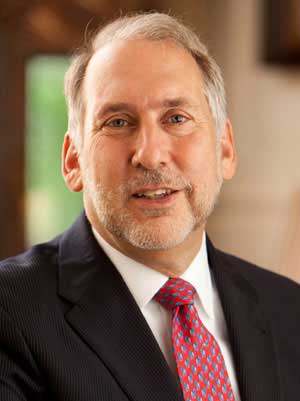
Jane S. Richardson, a James B. Duke Professor of Biochemistry, who developed the ribbon-diagram as the first 3-D representation of protein structures, and a noted Wikipedia contributor, will inaugurate the Edit-a-thon. Refreshments will be provided.


Sponsored by Duke University Libraries, the Sallie Bingham Center for Women’s History and Culture, University Archives, the Italian Program at Duke, and the Duke Medical Center Archives.
A Conversation With SNCC Veterans: March 9th

Our Stories, Your Legacy:  A Conversation with SNCC Veterans

Date: March 9, 2016

Time: 6:30-8:00PM

Location: Franklin Humanities Institute, Amadieh Family Lecture Hall (FHI Garage)

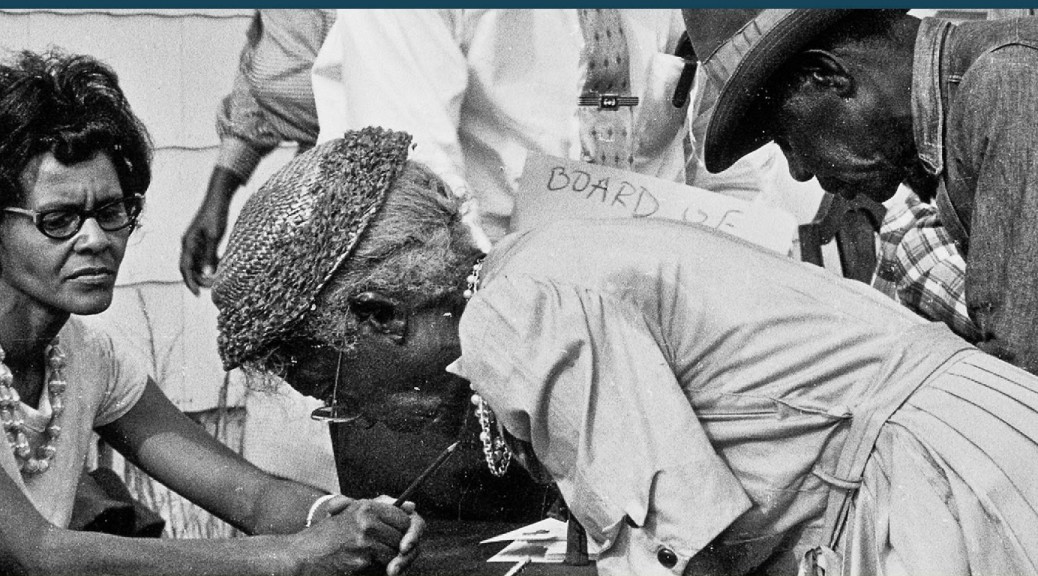
2016 03 09_SNCCEventFlyer_cropJoin us for a converation with three veterans of the Student Nonviolent Coordinating Committee (SNCC) as they discuss their work as activists and reflect on how telling the story of the Movement has evolved over time. Charlie Cobb (journalism), Judy Richardson (film), and Maria Varela (photography) will highlight how SNCC taught them the importance of capturing experieinces in the moment. The panel will also discuss the current efforts towards story-telling SNCC’s history using archival materials and comment on ways that modern activists can document their own work.

Trent Lecture on the Brooklyn Interns Hazing Episodes: March 7th

Date: Monday, March 7, 2016
Time: 5:30 PM
Location: Holsti-Anderson Family Assembly Room, Room 153, Rubenstein Library
Contact: Rachel Ingold, rachel.ingold@duke.edu, (919) 684-8549

Dr. Ed Halperin, M.D., M.A.Please join the History of Medicine Collections for our next Trent History of Medicine Lecture Series event. Dr. Ed Halperin, M.D., M.A., will present “This is a Christian institution and we will tolerate no Jews here”:  The Brooklyn Interns Hazing Episodes.

Anti-semitism in U.S. medical education rarely flared into acts of violence, except in Brooklyn. Presenting the results of recently completed research, Dr. Halperin will describe the assaults on the Jewish interns of Kings County Hospital in 1916 and 1927 and the implications of these assaults for the contemporary debate on immigration and higher education.

Dr. Halperin is Chancellor  and Chief Executive Officer at New York Medical College and Professor of Radiation Oncology, Pediatrics, and History as well as Provost for Biomedical Affairs at Touro College.

This event is open to the public.

Post contributed by Rachel Ingold, Curator of the History of Medicine Collections.

Virginia Woolf: Writing Surfaces and Writing Depths, March 3

Woolf-Desk-700x500
Virginia Woolf’s custom-made writing desk, recently acquired as part of the Lisa Unger Baskin Collection, is currently on display in the Rubenstein Library’s Michael and Karen Stone Family Gallery.

What: Virginia Woolf: Writing Surfaces and Writing Depths, with Dr. Leslie Kathleen Hankins
Date: Thursday, March 3 Time: 4:00-5:00 p.m.
Where: Holsti-Anderson Family Assembly Room, Rubenstein Library

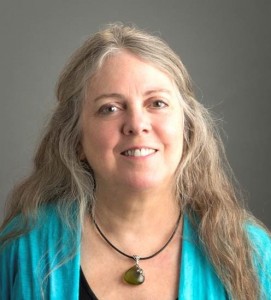
Hankins-head-shot-271x300
Dr. Leslie Kathleen Hankins

Dr. Leslie Kathleen Hankins is a professor in the department of English and Creative Writing at Cornell College and past president of the International Virginia Woolf Society. She will give a talk on the various writing surfaces used by Woolf throughout her life, including the desk now on display in the Rubenstein Library that was acquired as part of the Lisa Unger Baskin Collection. How did this desk shape the apprenticeship of Virginia Stephen into a writer? What did she write at this desk? How did it launch her career? In addition to the desk at Duke, Hankins will discuss Woolf’s decorated writing table in Cassis, as well as an overstuffed chair and lap board in a storage room at Hogarth Press and in Woolf’s writing shed. Along the way, she will consider how Woolf’s desk selections demonstrate a nuanced negotiation of gender performance and the writing profession as she crafted an innovative writing space through standing/walking/and shabby chic desk strategies.

Free and open to the public. Reception to follow.

Upcoming Talk: Scientists, Midwives, & Healers in the Lisa Unger Baskin Collection

Date: Tuesday, February 9, 2016
Time: 4:00 PM
Location: Holsti-Anderson Family Assembly Room, Rubenstein Library Room 153
Contact: Laura Micham, laura.m@duke.edu
RVSP (optional) via Facebook

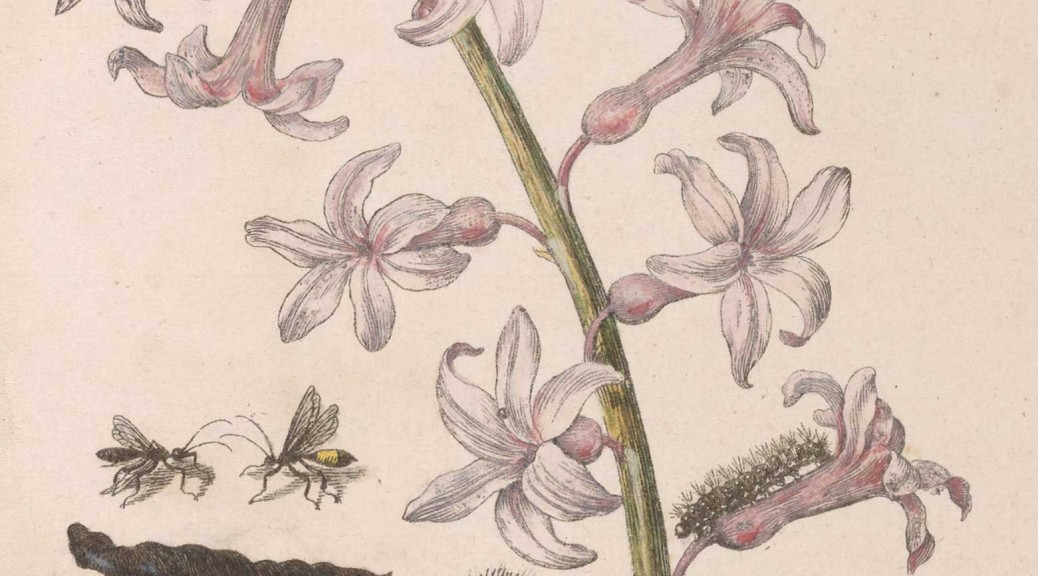
Maria Sibylla Merian. De europische insecten. Tot Amsterdam: by J.F. Bernard, [1730].
Maria Sibylla Merian. De europische insecten. Tot
Amsterdam: by J.F. Bernard, [1730].
Join the staff of the Bingham Center as Duke History Professor Thomas Robisheaux gives a lecture on the Lisa Unger Baskin Collection, highlighting his use of works by naturalist and artist Maria Sibylla Merian. The lecture is free and open to the public; light refreshments will be served.

In celebration of:

Heralding the Way to a New World: Exploring Women in Science and Medicine through the Lisa Unger Baskin Collection

On display in the Michael and Karen Stone Family Gallery from January 20th to April 1st, 2016

From the first entomologist to capture the stages of metamorphosis of the butterfly (1705) to the author who published the first comprehensive volume on contraception (1923), the women in this exhibit were pioneers in science and medicine. Whether self-trained or classically educated, they not only made groundbreaking contributions to their fields, but also helped open the way for future generations to follow in their footsteps. Despite their accomplishments, most of these women remain overlooked or under-recognized.

This exhibition highlights the stories of seven revolutionary women in science and medicine and celebrates the arrival of the Lisa Unger Baskin Collection, from which these materials were selected.

The Lives and Voices of Guantanamo: The Work of the Witness to Guantanamo Project

Date: January 21, 2016
Time: 6:00-7:00pm
Location: Holsti-Anderson Family Assembly Room (Rubenstein Library Room 153)
Contact: Patrick Stawski (patrick.stawski@duke.edu)

January 22nd will mark the 6th anniversary of Obama’s promise to close Guantanamo. On Thursday Jan 21st, 2016, The Human Rights Archive at Duke’s Rubenstein Library will be hosting a presentation by Peter Jan Honigsberg, “The Lives and Voices of Guantanamo: The Work of the Witness to Guantanamo Project.”

W2G_logo

The Witness to Guantanamo project has filmed in-depth interviews of 136 people who have lived or worked or have been involved in the Guantanamo Bay, Cuba detention center. No one else in the world is doing this kind of work. Interviewees include not only detainees, but also prison guards, interrogators, interpreters, chaplains, medical personnel, habeas lawyers, prosecutors, journalists, high-ranking military and government officials, and family member of the detainees. The project has filmed more than 250 hours of video in 20 countries.

Peter Jan Honigsberg is professor at the University of San Francisco, School of Law, and the founder and director of the Witness to Guantanamo project. Professor Honigsberg has written books, law review articles and blog pieces on Guantanamo and on post 9/11 issues. He was recently invited to speak to the United Nations Human Rights Council in Geneva. Professor Honigsberg is the author of Our Nation Unhinged (University of California Press, 2009). He is currently working on a book on his research and work with the Witness to Guantanamo project.

Co-sponsored by the Duke Human Rights Center @ FHI.

New Exhibit! Malignant Fever: Benjamin Rush and the 1793 Epidemic in Philadelphia

Please visit our new exhibition Malignant Fever: Benjamin Rush and the 1793 Yellow Fever Epidemic in Philadelphia, curated by Mandy Cooper, PhD candidate in Duke University’s History Department. The exhibition will be on display in the Mary Duke Biddle Room through March 11, 2016.

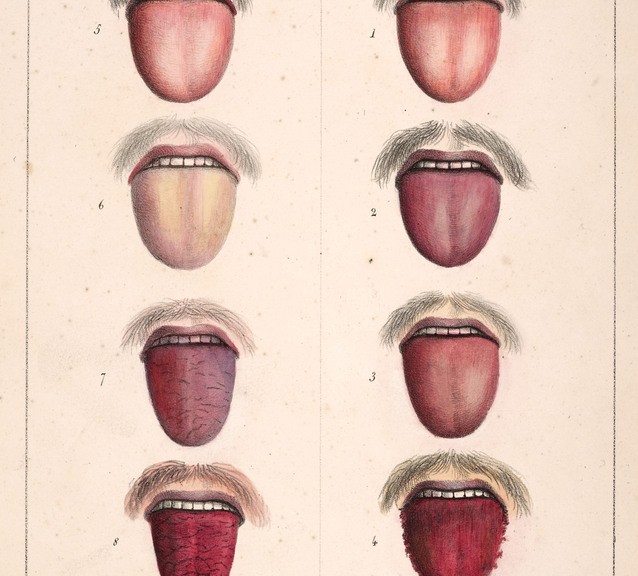
This exhibit highlights the effects of epidemic diseases on society by examining one of the most famous outbreaks in U.S. history – the 1793 yellow fever epidemic in Philadelphia. Drawing chiefly on letters written by Dr. Benjamin Rush, an eighteenth-century physician and U.S. Founding Father, to his wife Julia Stockton Rush, the exhibit examines the timeline of the outbreak, early responses, stages and symptoms, and the “cure” for yellow fever that Rush developed. Finally, the exhibit looks at the anatomy of an epidemic, focusing on the social and psychological effects exemplified by Rush’s emotion-filled letters, as well as stories that emphasize the fear, panic, and mental anguish that accompany epidemic disease outbreaks even today.

Coinciding with this exhibition is a new digital collection of the Benjamin and Julia Stockton Rush papers held by the History of Medicine Collections in the Rubenstein Library.  We encourage you to visit the exhibition and check out the new digital collection as well.

A gallery talk led by Mandy Cooper will be held on Friday, February 26, at 2 pm in the Mary Duke Biddle Room. All are welcome to attend. Light refreshments will be served.

Post contributed by Rachel Ingold, Curator of the History of Medicine Collections

“From Sit-Ins to Hashtags” on Display at Perkins Library

Culture Clash is a series of exhibits, created by the Center for Multicultural Affairs (CMA), traditionally hosted in the Alcove outside of the CMA Lounge. Culture Clash aims to provide multicultural and social justice education to build and/or strengthen bridges between different communities at Duke and beyond. The exhibit provides members of the Duke community and guests of the CMA the opportunity to explore the intricacies of the human experience with the focus on building sustainable, authentic, and healthy relationships and communities.

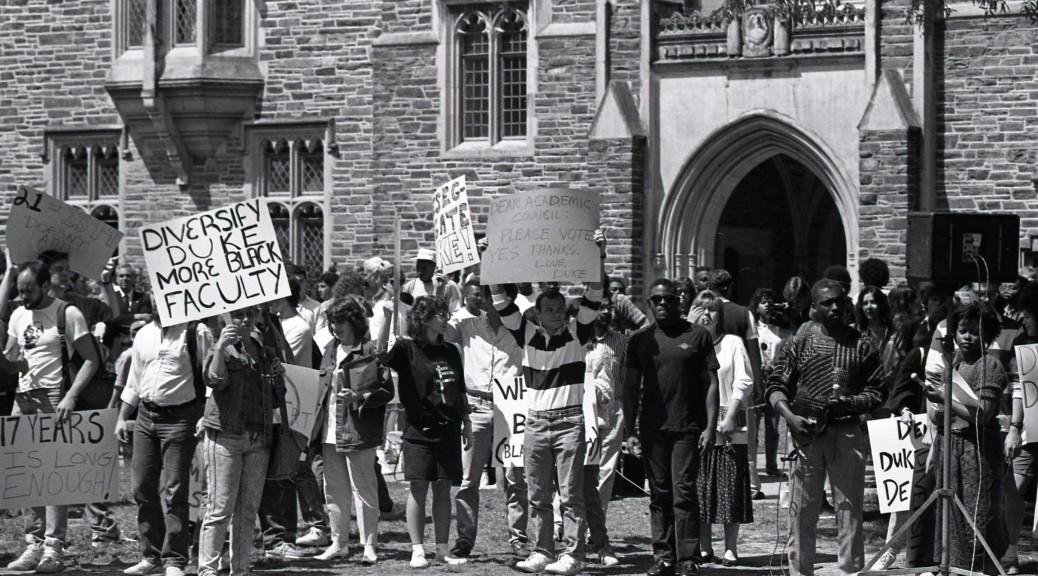
This year’s culture clash, which is on display through February 1st, 2016 at Perkins Library’s Campus Club Wall, is entitled “From Sit-Ins to Hashtags”. The exhibit explores the patterns of student social justice work and activism both at Duke and beyond throughout history. The photos depict different trends and styles of activism in the different decades.

Students protest in favor of the Black Faculty Initiative, April 1988.
Students show support for the Black Faculty Initiative, April 1988.

Curating Culture Clash has been a wonderful learning experience. I have a new appreciation for museums and exhibits; until now I never really realized how much thought and effort goes into a project of this nature. From beginning to end, this project has been about learning. The research aspect of the project was fairly intuitive because here at Duke we are always doing research. Finding movements to document and represent wasn’t overly challenging. Even finding an equal representation of photos from each decade was a fairly smooth process due to the help of the University Archives.

The challenge in this project came with deciding on how to visually present all of the photos. Juggling some 70 odd photos and 19 photo frames and 126 square feet of wall space was an experience. For me especially, I struggle with visualizing; I need something concrete to look at. The later part of the curation process involved a lot of cutting paper models and trying to learn how to visualize the small picture within the big picture. However, teamwork makes the dream work here at the Center. As a team, we made all the pieces come together in the end. We are very happy with the final outcome of the project.

We hope that from this exhibit students can understand how student social justice work has transpired in the past, and perhaps find inspiration to be an advocate for a cause that moves them.

We would like to give a special thanks to Margaret Brown, E. Rhodes and Leona B. Carpenter Foundation Exhibits Coordinator, and Amy McDonald, Assistant University Archivist, for all of their help throughout the curation process.

Related Resources:

Post contributed by Vanessa Lusa, Class of 2018 and Center for Multicultural Affairs Student FACE.

Seen and Heard in the Rubenstein Library – The Emancipation Proclamation

Seen and Heard in the Rubenstein Library – The Emancipation Proclamation

Date: Tuesday, January 19, 2016

Time: 12:00 PM

Location: Hosti-Anderson Family Assembly Room, Rubenstein Library 153

cobb580_cropPlease join us for a showcase of new exhibits in the Rubenstein Library. Professor Jasmine Nichole Cobb will share reflections on the Emancipation Proclamation. Visitors are encouraged to view the exhibitions on display in the Mary Duke Biddle Room including a rare State Department copy of the 1863 Emancipation Proclamation on loan from David M. Rubenstein (T’70). Light lunch will be served.

Celebrating the 13th Amendment

“Neither slavery nor involuntary servitude, except as a punishment for crime whereof the party shall have been duly convicted, shall exist within the United States, or any place subject to their jurisdiction.”

December 6, 2015, marks the 150th anniversary of the ratification of the 13th Amendment to the U.S. Constitution. This amendment ended slavery in the United States and marked the first substantive change to America’s conception of its liberties since the Bill of Rights was ratified in 1791. Its passage permanently freed four million African Americans (almost a third of population of the Southern States) from involuntary bondage.

David M. Rubenstein (T’70) has loaned a manuscript copy of the amendment to the Duke Libraries, and it will be on display in the Mary Duke Biddle Room in the Rubenstein Library until December 13, 2015.

IMG_3300
The 13th Amendment as part of our “Dreamers and Dissenters” exhibit

On the day the amendment was passed by Congress, several Congressmen had clerks engross souvenir copies, which were then passed around for the signatures of those who had voted for its approval.  This is one of those copies, and it was signed by 34 Senators and 93 Congressmen.  In the confusion of the moment, several of them signed the page more than once.

The 13th amendment was the first of three amendments passed in the wake of the Civil War that significantly expanded American civil rights.  The 14th amendment (1868) granted citizenship to “all persons born or naturalized in the United States,” including those recently freed from slavery.  The 15th amendment (1870) declared that no man could be denied the right to vote based on “race, color, or previous condition of servitude.”