Dearest readers, do you ever feel that there’s not enough Rubenstein Library in your social media day? True, we’re on Facebook, and we have this wonderful blog, and many of our collecting centers also have extensive social media presences (check out the list in the right-hand column) . . . but what if you could follow our every rare-book-and-manuscript action on Twitter?
Well, do we have good news for you! We’ve joined the twitterverse! Come follow us @rubensteinlib, let us know about your research projects and your latest special collections discoveries, and get a behind-the-scenes look at how we spend our working days (and sometimes our non-working days).
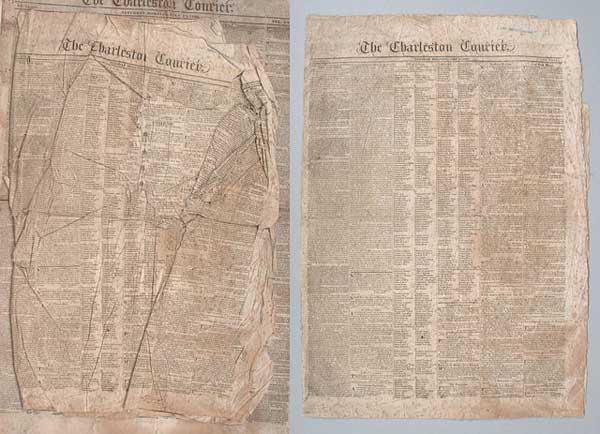
My most recent project in the conservation lab has been a set of 32 newspapers, issues of the Charleston Courier from 1815 to 1851. Some time in the past, they had been damaged by water, mold, insects, and dirt. All of them had tears, and many also had large losses and were exceedingly fragile. When they arrived in the lab, I could tell immediately that they were going to require a lot of work, but that they would also be fun and rewarding. While modern newspapers are made of wood pulp which quickly degrades, turning brittle and yellow, old newspapers were printed on rag paper made from textile fibers like cotton and linen, and thus they are much more resilient and pleasant for a conservator to work with.
Charleston Courier newspapers before treatment
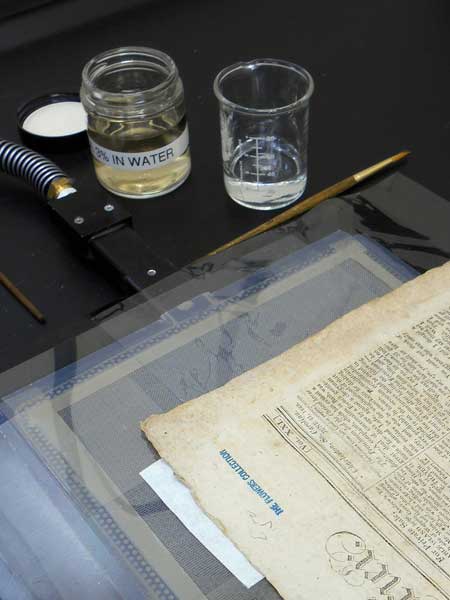
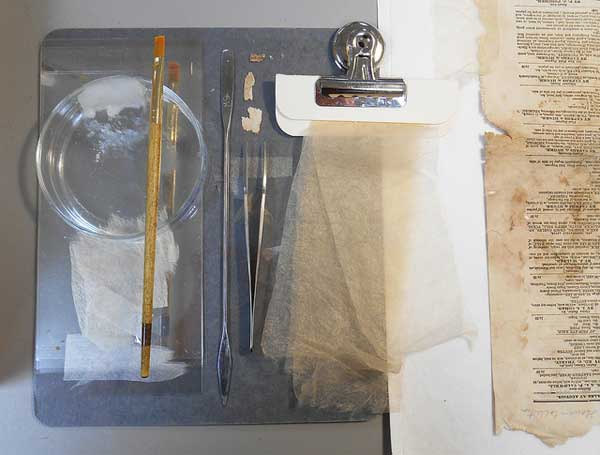
I knew I would need to do aqueous treatments, so, after cleaning off the surface dirt, I tested the inks to make sure they would not be soluble in water. While the black printing ink was stable, most of the papers had a collection stamp in turquoise ink that was sensitive to water. However, I was able to find three ionic fixatives, chemicals that are used to make certain dyes insoluble. I tested all three, and one (Mesitol NBS) turned out to be exactly what this ink needed. I used a brush to apply a small amount to the blue inked area, working over the suction platen to pull the chemical all the way through the paper, and then my newspapers were ready to wash.
Fixing soluble ink
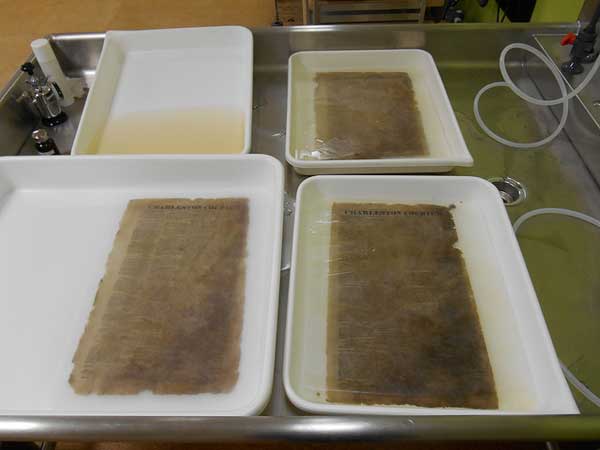
Each newspaper was immersed in a bath of deionized water. Extensive discoloration and degradation products were washed out, turning the water peachy yellow. I changed the water in each tray until it stayed clear, signaling that washing was complete. It was rewarding to see what a visual and physical difference there was between the washed and unwashed papers.
Aqueous treatment to remove discoloration and degradation products. The upper left tray shows the extent of discoloration removed from a page in its first bath.Comparison of newspapers before and after washing
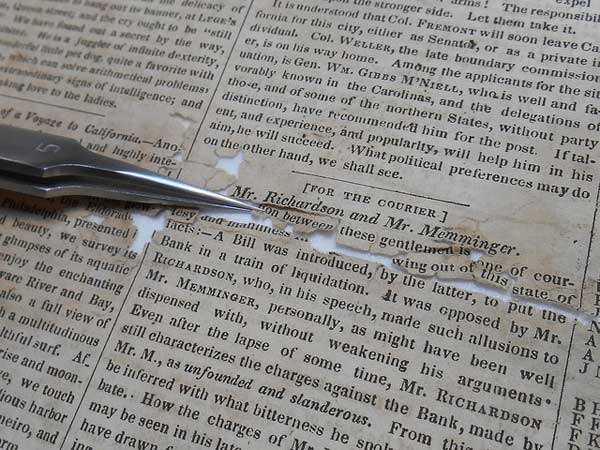
After washing and drying, I had many hours of mending to do, and many little puzzle pieces of newspaper to put in place. For my mends I used wheat starch paste and very thin Japanese papers which are almost transparent so as not to obscure the text on the newspapers. I did not fill all of the numerous losses, but I made the newspapers more stable for researchers to handle.
Aligning tears to prepare for mendingMending materials: wheat starch paste and lightweight Japanese paper
While working on the repairs, I was often confronted with fragments that would say something like “General / troops / fired” on one side and “congress / voted / article” on the back, and thus I would find myself reading the papers to know where the pieces might belong, which is something I rarely get the chance to do beyond a quick perusal. The earlier newspapers had battle reports, as the war of 1812 was still going on. The articles were fascinating, and the advertisements even more so. Many were similar to modern ads: houses for rent, job postings, theater listings, lost and found, dubious medical cure-alls, and sales of merchandise, often accompanied by decorative printed icons. Some were a little more unusual and interesting, like an ad for “Daguerreotype Paintings” or a woman offering her service as a wet nurse. But I was surprised to see ads for slaves, either for sale or wanting to buy, and many alerts for runaways. The runaways were the most intriguing as they gave personal details of the individuals, and I found myself wondering what happened to them, applauding their escape and hoping that they found a better life.
Advertisements including a young girl for sale and a runaway slave
When the mending was finished, I housed each of the newspapers in a clear Mylar sleeve so they can be handled with greater ease and safety. Even after treatment many of them are still fragile, but now they can be handled and used by researchers with much less risk of damage. And I hope they will be used, as they are fascinating! To see more images of treatment and examples of interesting advertisements, see our Flickr page.
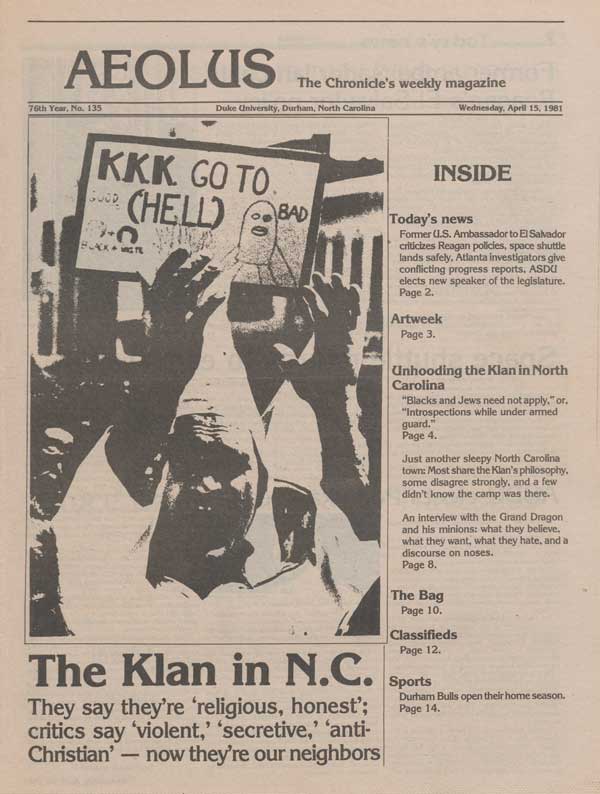
The shocking shootings in Kansas City during the past weekend have brought renewed attention to Glenn Miller (Glenn Cross), a longtime white supremacist with ties to North Carolina. In Monday’s Washington Post, Robert Satloff, Trinity College class of 1983, wrote about his harrowing experience interviewing Miller in 1981 and the Chronicle article that resulted.
The first-hand account, from the April 15, 1981 issue of the Aeolus (the Chronicle’s weekly magazine of the period) is a frightening glimpse into Miller’s mindset. Satloff wrote, “Perhaps I didn’t think that such close-minded, violent, intolerant people still exist. Perhaps I am naïve. I’m not anymore.”
Read the chilling article below. This issue of the Aeolus, and other Chronicle issues from 1980 to February 1989, will soon be added to the Libraries’ Chronicle digital collection.
UPDATE: The April 15, 1981 issue is now available in full in our Chronicle digital collection.
Click to enlarge.
Click to enlarge.Click to enlarge.Click to enlarge.
Post contributed by Valerie Gillispie, Duke University Archivist.
Wednesday, April 23 at 12:00pm: A Conversation with Vincent Cianni and Mariette Pathy Allen, Center for Documentary Studies, 1317 W. Pettigrew Street, Durham, N.C. Lunch will be provided.
Thursday, April 24 at 6:00pm: Artist Talk and Presentation, SPECTRE Arts green space, 1004 Morning Glory Ave., Durham, N.C.
Friday, April 25 at 6:00pm: Book Signing and Opening Exhibit, Daylight Project Space, 121 West Margaret Lane, Hillsborough, NC
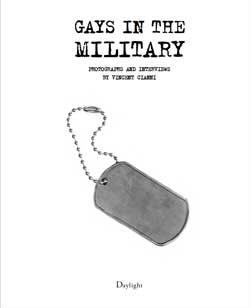
The series will culminate in a book signing and exhibition of work by the artists to celebrate the release of the artists’ monographs TransCuba and Gays in the Military. The book signing and exhibit will take place at the Daylight Project Space on April 25 from 6 to 9pm. Refreshments will be served and the artists will be on hand to sign books and answer questions. More information at www.daylightbooks.org
About the Artists:
Through compelling photographs and interviews made over three years on road trips across the US, Vincent Cianni (born 1952) has created an important historical record of the struggles of gay and lesbian veterans and service members in the US military. As the Human Rights Commission attests, the US military has a long history of civil rights abuses against homosexuals, with harassment and discrimination frequently resulting in lost careers. In many cases, these men and women—highly skilled, well educated, patriotic, courageous and productive—had attained high rank, received numerous medals and held top-level jobs essential to the military. With essays by Alison Nordstrom, Don Bramer and Alan Steinman shedding light on the cultural, personal and political consequences of the ban on homosexuality, this volume tells the stories of men and women who served in silence and oftentimes were penalized and prohibited from receiving the benefits accorded them for serving in the military.
For more than 30 years, New York based photographer and painter Mariette Pathy Allen has been documenting transgender culture worldwide; in 2004 she won the Lambda Literary Award for her monograph The Gender Frontier. In her new publication, TransCuba, Allen focuses on the transgender community of Cuba, especially its growing visibility and acceptance in a country whose government is transitioning into a more relaxed model of communism under Raúl Castro’s presidency. This publication therefore records a cultural watershed within Cuba. In addition to color photographs and interviews by Allen, the book also includes a contribution from Raúl Castro’s daughter, Mariela Castro, who is the director of the Cuban National Center for Sex Education in Havana. In 2005, Castro proposed a project, which became law three years later, to allow transgender individuals to receive sex reassignment surgery and change their legal gender.
Post contributed by Kirston Johnson, Curator of the Archive of Documentary Arts.
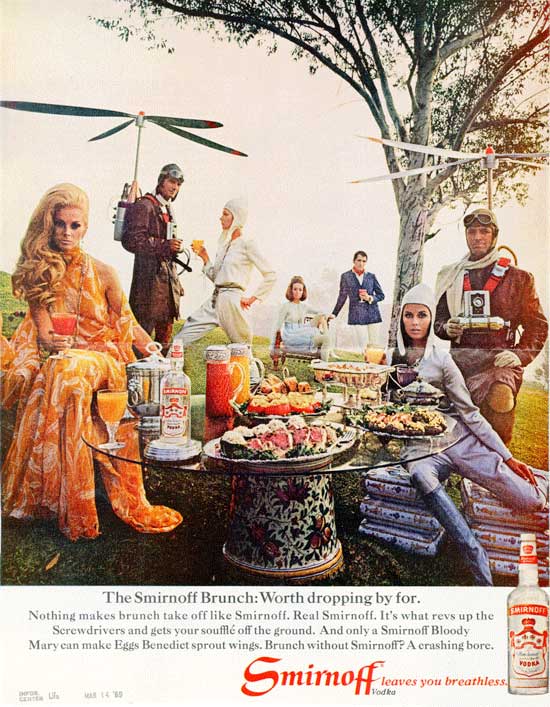
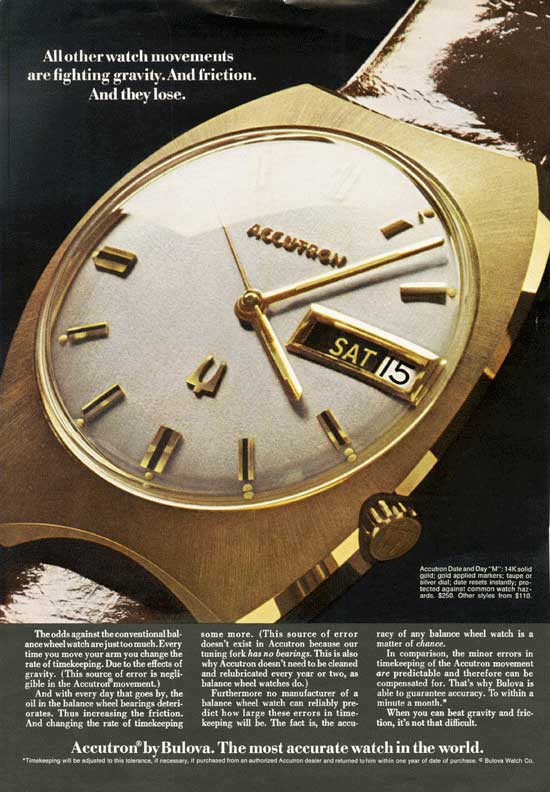
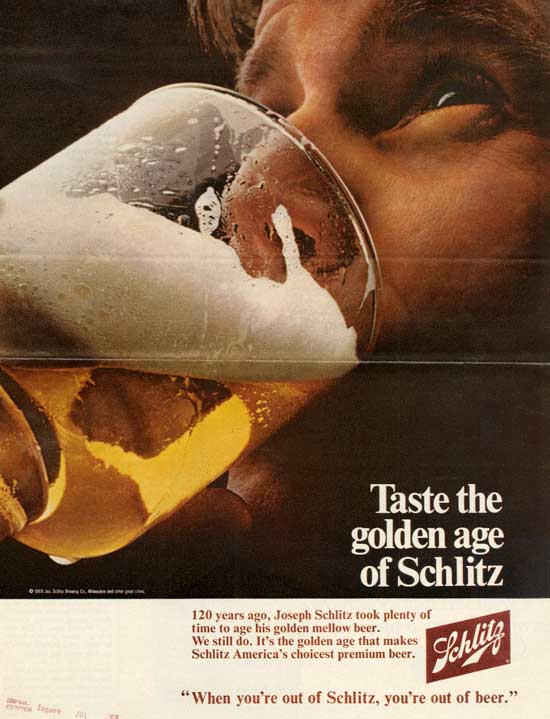
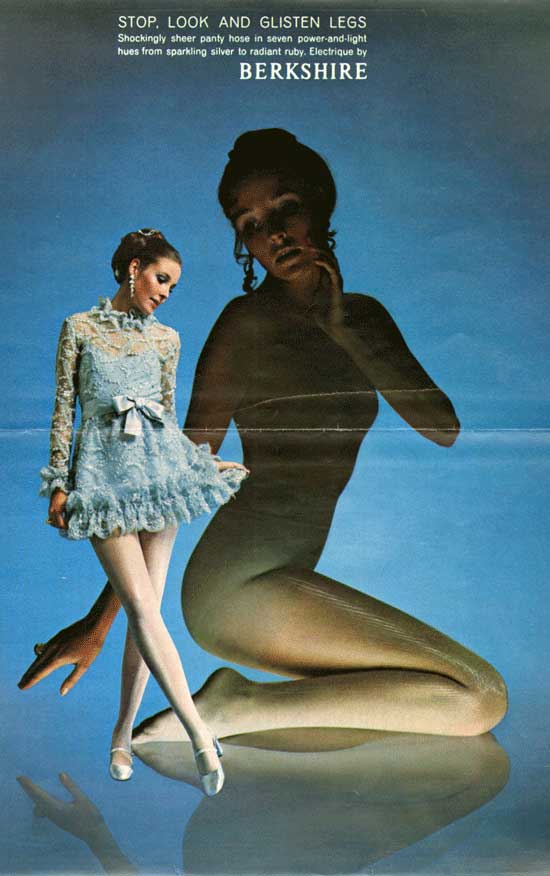
Everyone’s favorite ad men and women are back with Season 7 of Mad Men! Join the Hartman Center as we look back at some ads that resonate with each episode of the new season in what we call Mad Men Mondays.
The episode begins in January 1969 with freelancer Freddy Rumsen pitching a commercial for Accutron watches to an enthusiastic Peggy. Later Peggy pitches a variation on the same ad to new SC&P creative director Lou Avery and is disappointed when he opts for a blander slogan.
Roger wakes up amongst a group of naked sleeping people on the floor of his messy hotel room when his daughter calls to invite him to brunch. A harried and overworked Ken asks Joan to meet with a representative from Butler Footwear in his stead.She quickly realizes that Butler’s marketing director intends to move all advertising in-house and dismiss SC&P.
Don visits Megan in Los Angeles for the weekend and they have a series of awkward encounters. Don also meets up with a happy, suntanned Pete, who shows him around the new office and brings him up to speed on SC&P gossip. Peggy and Ted have an awkward exchange when he visits the New York office. Joan meets with a Columbia University business professor to get an analysis of Butler Footwear’s plans.The professor’s ideas help Joan keep Butler’s account from firing SC&P right away.
Roger’s daughter forgives him for all of his transgressions over brunch, which doesn’t seem to sink in with him until later when he lies down with his lover and another man. Don meets a woman on the plane back to New York and they have a candid conversation about their lives, but he declines her offer of more. Peggy has to deal with her tenant’s toilet problems and is frustrated with her life.
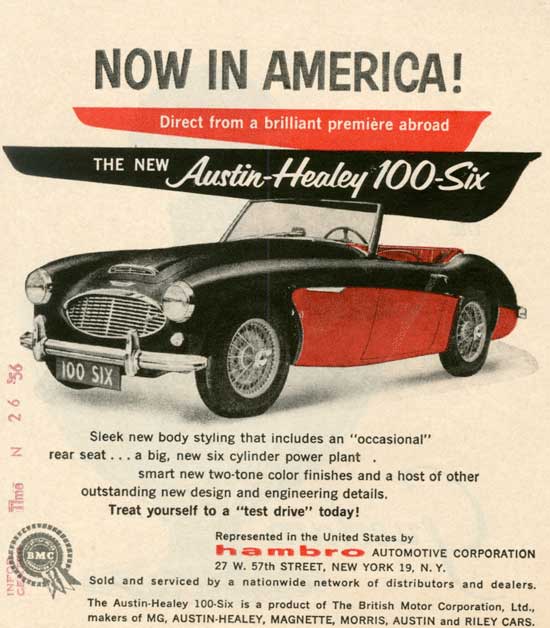
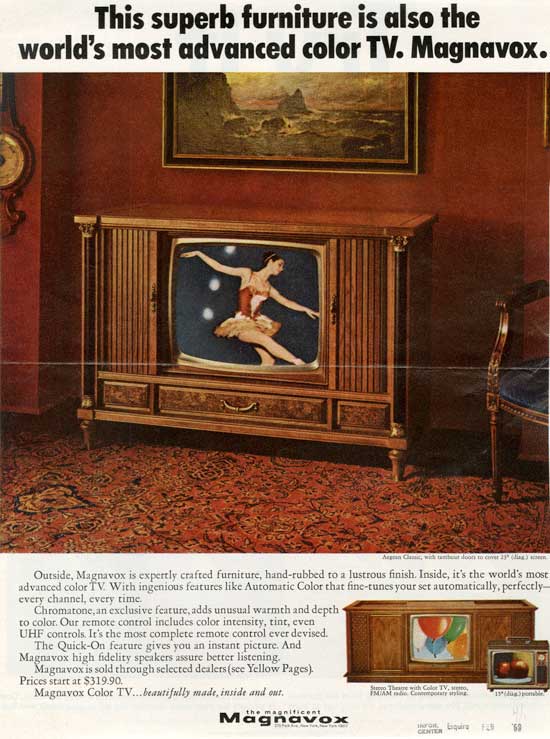
Last night’s episode featured references to Accutron watches, Austin Healy, brunch, vodka, and sliding doors, among other things.Enjoy our selection of highlighted ads that reflect the brands and themes that Mad Men characters interacted with last night.
Charles “Chuck” Stone Jr. died on April 6 at the age of 89. Stone was a pioneering journalist, a long-time columnist with the Philadelphia Daily News, and co-founder and first president of the National Association of Black Journalists.
Among his notable career accomplishments, Stone was a Tuskegee Airmen during World War II, served as special assistant to Congressman Adam Clayton Powell Jr. from 1965-67, and was a key mediator between alleged criminals and the Philadelphia Police Department. Stone served as Walter Spearman Professor of Journalism at the University of Carolina-Chapel Hill from 1991-2005.
The Chuck Stone Papers were donated to the John Hope Franklin Research Center for African and African American History and Culture in 2004.
Post contributed by John Gartrell, Director of the John Hope Franklin Research Center for African and African American History and Culture.
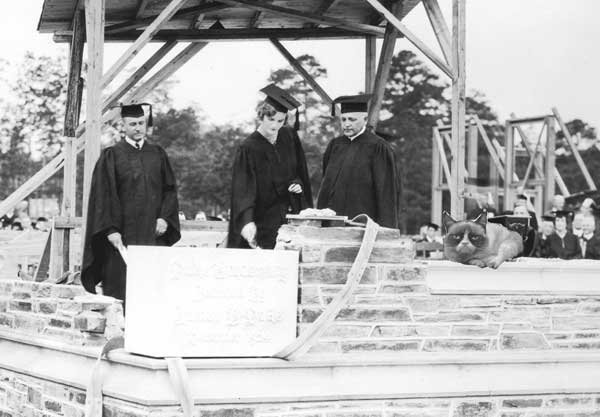
During renovations to the Rubenstein Library, a new carving was discovered in a remote corner of the stacks. The image of a fairly grumpy looking cat is a tribute to a campus friend named Steven Frownington McWhiskers—affectionately known as Steve.
Steve was a local farm cat who took a great interest in the construction on West Campus between 1927 and 1932. Present for everything from the placement of the cornerstone in the Union to the erection of the Chapel spire, Steve was a steadfast friend and critic. His smoldering glare reminded the stonecarvers that even a single errant stone would mar the beauty of the campus. With a low growl and a hiss, Steve reminded all that he watched over them—and did not approve of anything short of perfection.
We fondly remember Steve today for his efforts to ensure that Duke University would be a place of great beauty for people and cats alike.
Post contributed by Valerie Gillispie, Duke University Archivist.
Date: Monday, March 31, 2014 Time: 5:30 p.m. Location: Room 102, Duke Medical Center Library Contact: Rachel Ingold, rachel.ingold@duke.edu or 919-684-8549
Please join the History of Medicine Collections for our spring Trent History of Medicine Lecture Series event. We are pleased Dr. Edward C. Halperin, M.D., M.A., will be presenting, “A Defense of the Humanities in Medical Education.” In his lecture, Dr. Halperin will distinguish between medical humanism and the medical humanities, discuss the role of the medical humanities in medical education with particular emphasis on the role of medical history, and provide some specific examples of the value of the humanities in the education of physicians.
Dr. Halperin was on the faculty at Duke from 1983 to 2006. He was the LR Prosnitz Professor of Radiation Oncology and the RJ Reynolds Professor of Medical Education. From 2006 to 2012 Dr. Halperin was dean of the School of Medicine, Ford Foundation Professor of Medical Education, and professor of radiation oncology, pediatrics, and history at the University of Louisville and university vice provost.
Dr. Halperin’s research has focused on pediatric cancer and the history of racial, religious, and gender discrimination in higher education. He is the co-author/editor of the first five editions of the textbook Pediatric Radiation Oncology and of the fifth and sixth editions of Principles and Practice of Radiation Oncology. He has published more than 200 articles in the peer-reviewed scientific, historical, education, and ethics literature.
Dr. Halperin is currently Chancellor for Health Affairs and Chief Executive Officer at New York Medical College and Professor of Radiation Oncology, Pediatrics, and History as well as Provost for Biomedical Affairs at Touro College.
Date: Thursday, March 27, 2014 Time: 6:00 p.m. Location: Room 217, Perkins Library Contact: Kelly Wooten, kelly.wooten@duke.edu
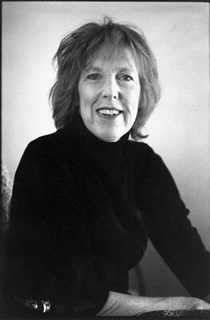
In honor of its 25th anniversary, the Sallie Bingham Center for Women’s History and Culture will host an evening with author, playwright, teacher, and feminist activist, Sallie Bingham, who will reflect on 25 years of documenting women’s history at Duke and offer her vision for the Center’s next 25 years.
Rachel Seidman, Associate Director, Southern Oral History Program, at UNC-Chapel Hill and visiting lecturer in Women’s Studies at Duke University, will begin the program with her perspective on Bingham Center contributions to preservation, teaching, and activism.
In 1988, the Women’s Studies Archivist position was created thanks to the generosity of author, playwright, teacher and feminist activist Sallie Bingham. In collaboration with pioneering historian Anne Firor Scott, Duke Women’s Studies’ Founding Director Jean Fox O’Barr and then head of Special Collections Robert Byrd, Sallie Bingham determined that Duke was the right place to create a new archive for women’s history. The center was permanently endowed in 1993 and named the “Sallie Bingham Center for Women’s History and Culture” in 1999 to honor Bingham’s vision and legacy.
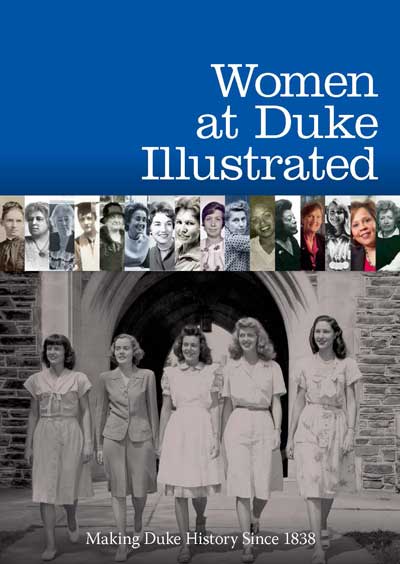
In 2011, the Duke University Archives published Duke Illustrated: A Timeline of Duke University History, 1838-2011. This 80-page, full-color history of the events, traditions, and people that have made Duke one of the world’s leading research universities is the product of almost four decades of research by University Archives staff.
This year, we are happy to announce the publication of a companion volume focusing on the particular contributions of women at Duke, written and compiled by Bridget Booher ’82, A.M. ’92, associate editor of Duke Magazine. The new book, Women at Duke Illustrated, was published to coincide with the 2014 Duke Women’s Weekend, “Find Your Moxie: Duke Women Creating Change,” February 20-22, 2014.
Copies of Duke Illustrated and Women at Duke Illustrated are available for sale by the Gothic Bookshop for $27.50 each. Both books make perfect gifts for Duke men and women of all ages.
The book was published with support from all ten of Duke’s schools, as well as the Duke University Libraries and Duke Athletics.
Dispatches from the David M. Rubenstein Rare Book and Manuscript Library at Duke University