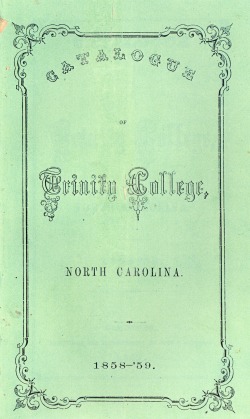
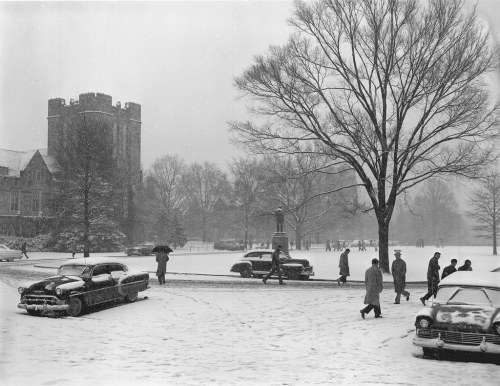
Now, the yearly catalogs, known as Bulletins, are being digitized thanks to the Internet Archive’s Scribe machine located here at the Duke University Libraries. These newly-searchable resources provide more and better access to historical information about Duke University. The catalogs include information like courses offered, of course, but they are also full of other useful facts.
For instance:
What was the Trinity College undergraduate tuition for the 1892-1893 academic year (the college’s first year in Durham)? ($25.00 per term)
How many bound volumes did the Library contain at the end of the 1923-1924 academic year? (71,520)
Who was the Director of Physical Education and Athletics for the 1947-1948 academic year? (Edmund “Eddie” Cameron)
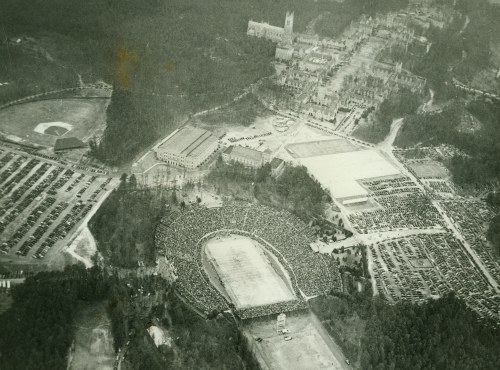
In addition, there were specialized catalogs for graduate and professional education, so that someone researching the School of Medicine, for example, can learn more about that program in particular. There are even fun extras like aerial views of campus from the 1930s.
Virtually turning the pages of these historical catalogs provides a wealth of information. In the 1934-1935 Law School bulletin, for example, it lists the current students. One, Richard Milhous Nixon of Whittier, California, was a first-year student at the time. We can also tell from the catalog that school started on September 19 that year, and that “in addition to concert programs, recitals, and lectures, motion pictures are shown in the campus auditorium twice a week.” Sounds like a pretty interesting place to get an education!
Find links to Chanticleers and Bulletins at the Duke University Archives section of the Internet Archive. Additional Bulletins will be digitized in the near future, along with other Duke University resources.
Post contributed by Val Gillispie, Duke University Archivist.
We note with sadness the passing of Mary Duke Biddle Trent Semans. Mrs. Semans was the great-granddaughter of Washington Duke, and the granddaughter of Benjamin Duke. She came to Duke University as a 15 year-old freshman in 1935, and was an alumna of the class of 1939 of the Woman’s College. She remained a tireless advocate for Duke University throughout her life, serving as a longtime trustee and supporter of numerous projects on campus. These include the Mary Duke Biddle Rare Book Room, named for Mrs. Semans’ mother.
In 1938, Mrs. Semans married Josiah Charles Trent, a Duke alumnus and later the first Division Chief of Thoracic Surgery. The couple collected rare books related to the history of medicine, and Walt Whitman materials. Dr. Trent died of lymphoma in 1948. In 1953, Dr. James Semans and Mrs. Semans were married. They were known on campus, in Durham, and throughout North Carolina as supporters of the arts, higher education, civic projects, and other charitable endeavors. Mrs. Semans was a longtime trustee of the Mary Duke Biddle Foundation (named for her mother), which has supported projects in the library, among many other grant recipients.
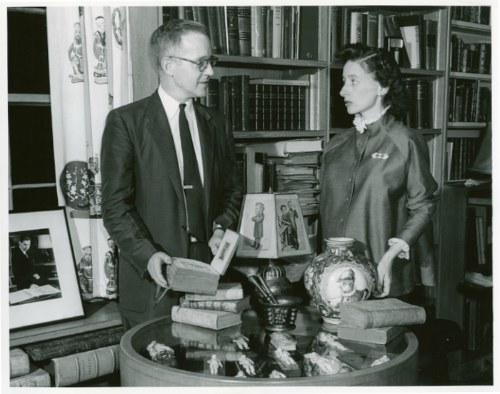
Mary Duke Biddle Trent Semans with Curator of Rare Books Thomas M. Simkins. The materials pictured are now part of the History of Medicine Collections in the Rubenstein Library. Photo from the University Archives Photograph Collection.
The Trent Collection of Whitmaniana and Trent Collection of history of medicine materials, along with Semans Family Papers, are significant parts of the Rubenstein Library today. We are grateful to the generosity of Mrs. Semans over the years, and the way she continued the legacy of philanthropy begun by her relatives. Mrs. Semans never stopped supporting the institution that her family transformed. Her contributions to the library, the institution, and our community will not be forgotten.
Post contributed by Valerie Gillispie, Duke University Archivist.
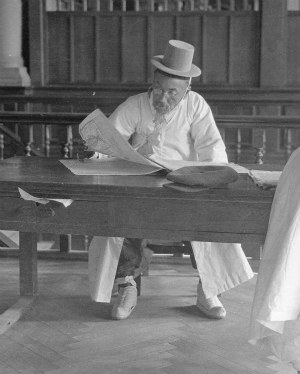
Korean Man Reading, ca. 1917-19. From the Sidney D. Gamble Photographs.
Before we dive into another exhilarating semester, it’s high time we caught up on some recent articles about the Rubenstein Library and its collections.
Neil Offen wrote an article about the exhibit “From Campus to Cockpit: Duke University During World War II.” (The exhibit will be on display until January 29!)
Date: Tuesday, January 17, 2012 Time: 6:00 PM Location: Biddle Rare Book Room Contact Information: Amy McDonald, 919-681-7987 or amy.mcdonald(at)duke.edu
Join “Voice of the Blue Devils” Bob Harris as he shares thoughts on how Duke football has changed from the legendary 1942 Rose Bowl held in Wallace Wade Stadium to today’s modern game. He will also talk about the impact of the game on campus beyond the stadium walls.
Rosemary Davis and Jessica Wood, curators of the current “From Campus to Cockpit” exhibit, will highlight photographs and other artifacts from the 1942 Rose Bowl, including archival film from the game.
Following the presentation, game day refreshments will be served, and Harris will sign copies of his autobiography, How Sweet it Is! From the Cotton Mill to the Crow’s Nest.
“From Campus to Cockpit” is on display in the hallway cases outside the Biddle Rare Book Room through January 29th. An online exhibit—including the complete film of the game recorded by Duke’s coaching staff—is also available.
Searching for the perfect gift for that special Duke fan on your list?
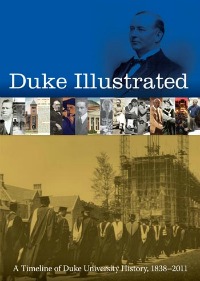
We’d like to suggest the Duke University Archives’ new book, Duke Illustrated: A Timeline of Duke University History, 1838-2011. This beautiful, 80-page, full-color history of the events, traditions, and people that have made Duke one of the world’s leading research universities is the product of almost four decades of research by University Archives staff.
Donors who contribute $50 or more to the Duke University Archives will receive a complimentary copy of Duke Illustrated (and become a member of the Friends of the Duke University Libraries)—so it’s a double gift! Not only will you be sharing Duke University history with your loved ones, you’ll be ensuring that the University Archives is able to continue its work to preserve Duke’s rich historical legacy.
Order your copy today via our secure website. We’ll send it directly from our wintry Gothic Wonderland to your or your lucky recipient’s home! (Orders placed by December 15th should be delivered in time for the holidays!)
The Internet Archive just reached an important milestone by digitizing 5,000 books at Duke. The 5,000th book, The British Album: In Two Volumes, contains poetry by “Della Crusca, Anna Matilda, Arley, Benedict, The Bard” and other writers on themes including love, horror, jealousy, and death, and is part of the general collections of the Rubenstein Library. The “Ode to Death” begins “THOU, whose remorseless rage, Nor vows, nor tears assuage, TRIUMPHANT DEATH!—to thee I raise, The bursting notes of dauntless praise!” The second volume can be found here.
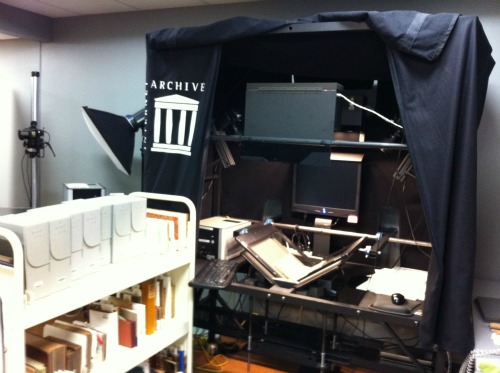
The Scribe Scanner. Photo by Rita Johnston.
The Internet Archive scanning center at Duke University has been in operation for one and a half years and has digitized materials from collections within the Rubenstein Library, including the University Archives, Utopian Literature, and Confederate Imprints. I scan about 450 pages per hour and around 50 books a week. Most books in the public domain under 11 x 13 inches in size can be digitized on the Scribe book scanner, as well as pamphlets and loose documents.
Books digitized through Internet Archive are usually available on the site by the next day, are full-text searchable, and can be read in a web browser or downloaded to a computer; e-book reader; or mobile device. You can find newly digitized Duke materials by clicking on the RSS feed link at the bottom right on this blog or by visiting the Duke University Libraries Internet Archive page. Patrons can request a book to be digitized by the Internet Archive by contacting Rubenstein Library staff.
Post contributed by Rita Johnston, Scribe scanner operator.
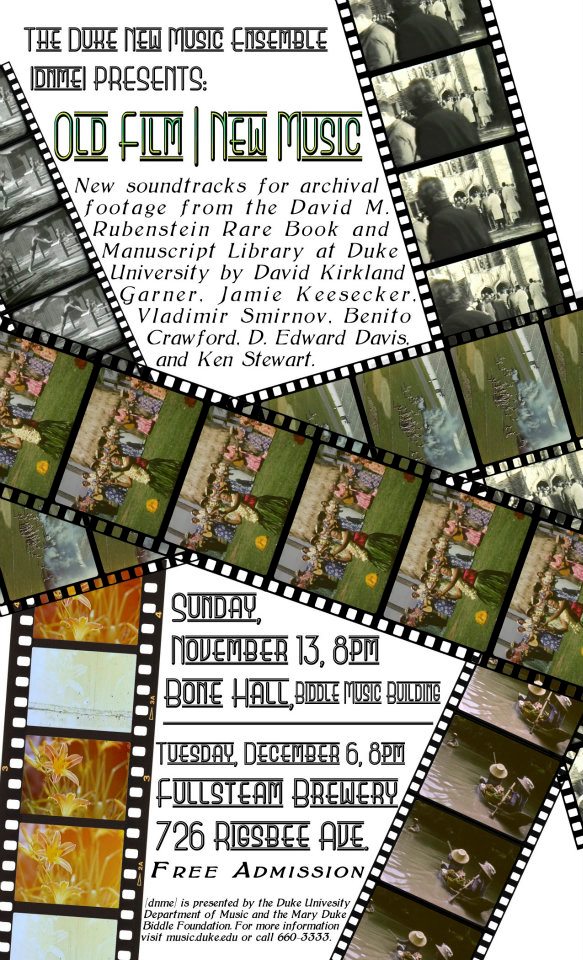
Tonight and on December 6th, the Duke New Music Ensemble will be performing new compositions written as soundtracks for films from the Rubenstein Library’s collections. We asked the dnme composers to tell us a little bit about the films they chose and how they inspired their compositions. For more details about the performances, visit the group’s Facebook page or click the poster at right to enlarge it.
David Kirkland Garner
The video I chose to use is from H. Lee Water’s “Spindale ’37” film (from the H. Lee Waters Film Collection). I chose the portions of the video having to do with the factory for Yelton’s Flour, opening with footage of the flour refining process from inside the building then turning to the procession of workers leaving the factory at the end of the day. The music I wrote is not meant to be closely synced with the video. Rather, it creates a singular mood for the film images. The music is created in two parts: a repeating groove in the keyboard, bass and 3 banjos and a slowly unfolding melody in the other instruments. At the beginning and end of the piece the ensemble uses percussion instruments to imitate the sounds of summer in rural North Carolina.
Jamie Keesecker
Margolin’s 1965 Hawaii film footage (from the Morris and Dorothy Margolin Film Collection) presents a challenge in that almost every moment captured in the footage comes from a performance that was originally accompanied by music, and the musicians themselves can be seen throughout most of the film. Seeing the musicians strumming guitars and ukeleles in unison is one of the aspects that attracted me to this film. But rather than attempting to recreate the music that would have originally accompanied the images in the video, I have written music that is merely meant to represent my own reactions to seeing the film. At the same time, I have chosen to write for a consort of mostly plucked string instruments similar to those depicted in the video. Musical gestures are at times intended to be synchronized with the musicians on film, and other times not, just as the musical material itself contains hints of Hawaiian tropes while remaining, on the whole, quite different from what would actually have been played by the musicians on film.
D. Edward Davis
My archival footage is of a student protest that occurred at Duke University in 1969 (from the Radio TV Services Records). Despite the “homemade” image quality (or perhaps because of it), the images capture the drama of the protesters in action, with the cameraman acting as a participant and not a spectator. I’m drawn to this film because of its connection with the University’s history, and I tried to mirror the intensity but also the sinister beauty of these images with my music. As students are presently (Nov 2011) involved in “Occupying Duke” in the same physical location as the 1969 protests, I love how the film has both a distant timeless quality and a captivating immediacy. Thanks to the staff of the Archives for preserving this footage and also for making it accessible to researchers and artists.
Vladimir Smirnov
The video I chose was footage of traveling down a river (the Chao Phraya, I presume?) in Bangkok from a collection of travel footage by former Duke Professor Margolin (from the Morris and Dorothy Margolin Film Collection). I myself have never traveled to Thailand, and the video drew me in with its images of a very exotic world and with its slow hypnotic pace. I tried to create a musical atmosphere that the video suggested to me with very gentle and exotic sounds—muted piano, bowed vibes, slow swells on the guitar and bass, flute that is sung into at the same time as it’s played, banjo, and very sparse strings. I didn’t really think too much that I was working with archive film when writing, I just focused on the images and atmosphere.
Kenneth David Stewart
The footage I selected is of the Sarah P. Duke Gardens from 1937 (from the Radio TV Services Records). What moves me about this footage is how striking the color of the flowers appears as captured by the Kodachrome film. It is interesting how this footage from 1937 is just two years after Kodak made this kind of film commercially available—in fact, the famous color scenes in the Wizard of Oz were shot with this same film. This captured color, to me, almost has its own texture independent of the hue itself.
The written music for the instruments is based on the live ensemble playing the role of three choirs simultaneously ‘singing’ different music, but at the same time each contributing to a larger, composite texture. In addition to this, there is an electronic track with supporting harmony and the sounds of a typical journey in the rain from my home to the Biddle Music Building recorded onto microcassette.
The process used to construct the visual narrative is based on whether the camera shot is close to the flowers themselves or farther, panning across the gardens. At the same time a ‘chord progression’ of color directs the footage from yellow to orange to red to pink to white to ivory and back to yellow again to repeat the cycle. None of these textures are more important than another and in this way, the whole is truly greater than the sum of its parts.
My mother, a former professional horticulturalist, instilled in me a love of plants and flowers at a young age. Some of my fondest childhood memories are of my mother and I outside planting flowers and vegetables in our family garden. This piece is dedicated to her.
Post contributed by the members of the Duke New Music Ensemble.
Date: October 26, 2011-January 22, 2012 Location and Time: Rare Book Room cases during library hours Contact Information: Valerie Gillispie, 919-684-8929 or valerie.gillispie(at)duke.edu
Did you know that Duke hosted the only Rose Bowl played outside of Pasadena, CA?
Did you know that Duke chemistry students and professors created special bullets for training soldiers?
Did you know that Duke women played a pivotal role in wartime service and morale-raising?
Did you know that the Tarheels once liked the Blue Devils so much they were willing to loan them their football bleachers?
You can learn more about all these things (and even more!) by visiting “From Campus to Cockpit: Duke during World War II,” currently on display in the hallway cases outside the Rare Book Room.
The exhibit documents the academic, military, and humanitarian accomplishments of the Duke University community during World War II. Photographs, papers, artifacts, and archival film footage tell the story of the university’s spirited efforts to support the nation during a turbulent time of war—including hosting the 1942 Rose Bowl, expanding the possibilities for women in the academic realm, and cooperating with the city of Durham to host fundraising events.
Highlights of the exhibition include images of the first women engineering students at Duke, an original 1942 Rose Bowl ticket, a Red Cross bandage, memorabilia from “Rose Bowl Week” in Durham, and a variety of 1940’s-era military patches and insignia.
If you can’t stop by the display, you can also see many of the artifacts—along with Rose Bowl game footage, bonus materials and research resources—in our online exhibition.
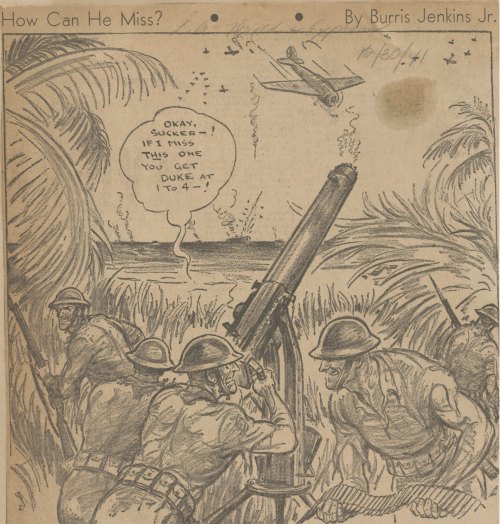
Editorial cartoon from the Los Angeles Herald & Express, December 30, 1941.
Post contributed by exhibit curators Rosemary K. J. Davis, Isobel Craven Drill Intern, and Jessica Wood, William E. King Reference Intern.
Date: Halloween, Monday, October 31, 2011 Time: 11:00 AM-1:00 PM Location: Rare Book Room Contact Information: Rachel Ingold, 919-684-8549 or rachel.ingold(at)duke.edu
Have you ever wandered around a library’s stacks in the dark? Or wondered what might go bump in an archival box?
Stop by the Rubenstein Library’s Rare Book Room for a special Halloween “eeeks”-ibit and open house. We’ll be dragging out some of the creepiest and most macabre items from the shadowy depths of the library’s vaults—including the thirteen unlucky items below.
This event is free and open to the living and the dead. There will be candy. Lots and lots of candy.
49 Glass Eyeballs. From the History of Medicine Collections.
1. A travel diary written by John Buck, a young American who found himself face-to-face with Bram Stoker (before he wrote Dracula)
2. Letters to Duke University’s Parapsychology Laboratory describing the 1949 poltergeist case that became the basis for The Exorcist
3.Opera Omnia Anatomico-Medico-Chirurgica by 18th century Dutch anatomist Frederik Ruysch, featuring illustrations of fetal skeletons playing instruments among “trees” made of veins and arteries and “rocks and stones” that are actually organs, gallstones, and kidney stones
4. An entire box of glass eyeballs (49, to be exact)
5. “Jack the Ripper” and “Cthulhu by Gaslight,” two board games from the Edwin and Terry Murray Role Playing Game Collection
6. Artists’ books Mountain Dream Tarot by Bea Nettles and Femmes Fatales by Maureen Cummins. Tarot cards and pictures of medieval torture devices!
7. Brochures and advertisements for coffins and other funeral-related paraphernalia from the Advertising Ephemera Collection
8.Two copies of Henry Milner’s 1826 melodramatic adaptation of Mary Shelley’s Frankenstein, with the very first illustration of (the actor portraying) “the Monster”
9. Bela Lugosi’s signature
10. Maps and photographs of the Rigsbee Graveyard (yes, the graveyard in the Blue Zone)