Category Archives: Do Your Research

The Anatomy of Anatomy Day

Monday was the annual Anatomy Day visit to the History of Medicine Collections. This is one of my favorite times of the year!

In the fall, all of the first year medical students here at Duke—about one hundred of them—visit the History of Medicine Collections to view historical anatomical atlases. This is a chance for them to see how anatomy has been represented over hundreds of years, and also provides stimulating and interesting texts that they can compare to what they are seeing in the dissection lab.

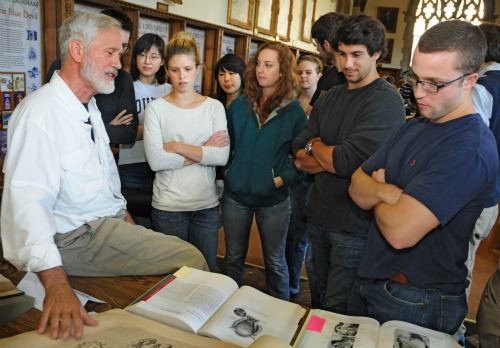
Curator Rachel Ingold talks with medical students at Anatomy Day.
Curator Rachel Ingold talks with medical students at Anatomy Day. Photo by Angela Mace.

Faculty and staff contribute to Anatomy Day by engaging with students and asking questions about the texts on display. This year, participants included the main coordinator of the event, Dr. Jeff Baker, along with Dr. Ara Tourian, Dr. Rick Madden, Professor Valeria Finucci, Professor Shannon Withycombe, and Rubenstein Library staff members Laura Micham, Kate Collins, Andy Armacost, and Jessica Janecki. Materials on display ranged from a 17th century copy of a 14th century illuminated Islamic medical manuscript to the controversial Pernkopf atlases from the mid-twentieth century.

The comments I heard this year were “awesome,” “I love anatomy so I loved everything,” and “overall, this experience was great and I liked to see the progression of anatomical representations.” I overheard students have serious ethical discussions about dissection and talk about the variety of ways they learn about the human body. I also talked to a student who told me that the greatest tool out of all the tools a student could have in the anatomy lab is the hand.
Dr. Rick Madden talks with medical students at Anatomy Day.
Dr. Rick Madden talks with medical students at Anatomy Day. Photo by Mark Zupan.

I’m already looking forward to next year’s Anatomy Day and talking with students about the array of anatomical texts here at the History of Medicine Collections!

For more photos, visit the “Anatomy Day 2011” set on our Flickr photostream!

Post contributed by Rachel Ingold, Curator for the History of Medicine Collections.
Researching the Civil War?

This has been the most terrific days battle since commincement. The enemy made a terrible charge over our Breastworks with re-inforcementz & succeeded in charging some of our men out of them, capturing many of our Division. All our Regiment that were left from the first days fight were captured.
—from the Henry Beverige Diary, Thursday, May 12, 1864.

Beverige, a soldier and hospital steward with the 25th Virginia Regiment of the Confederate States of America, describes one of the many terrifying, bloody days of the American Civil War. His diary is one of the numerous first person accounts available in the Rubenstein Library. Other perspectives on life during the conflict are offered by fiery teenager Alice Williamson;  Confederate spy Rose O’Neal Greenhow, African Americans such as Edgar Dinsmore, and the many others who experienced the loneliness, losses, and deprivations—and occasional triumphs—of the conflict.

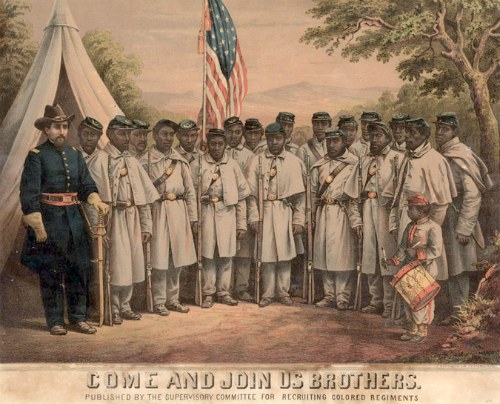
"Come and Join Us Brothers," 1863

To commemorate the sesquicentennial of the Civil War, Rubenstein Library staff have collaborated on a guide to Civil War resources that provides highlights of our rich collections. Special sections describe manuscript and print material related to military history, medicine, women, African Americans, literature, and music in the Rubenstein Library, as well as other library guides and relevant databases and websites.

We anticipate that this guide will be helpful for scholars, genealogists, and anyone with a personal interest in Civil War history. Please contact us if you have questions or comments about our collections.

Post contributed by Elizabeth Dunn, Research Services Librarian.

Open for Business: NC Mutual Archives

The North Carolina Mutual Life Insurance Company Archives (collection guide here), now available for research at the RBMSCL and North Carolina Central University’s University Archives, Records and History Center, contains nearly 100,000 items documenting more than a century of service for this prominent African American business.

This archives include corporate office files, annual statements, reports, surveys, memos, legal and financial papers, training material, programs, memorabilia, and an exceptional number of historical photographs of staff and their families, offices, buildings, and Durham scenes (including a visit from Booker T. Washington).

The collection offers a window into the inner workings of the company, the legacy of Durham’s Black Wall Street, and over a century’s worth of community and organization building. The archivists and librarians of both institutions are looking forward to the scholarship that will result from the use of the North Carolina Mutual Life Insurance Company Archives.

Group in front of The Mutual Building. From the North Carolina Mutual Life Insurance Company Archives.

Over one hundred selected digitized images, like the one above, as well as several historical documents, are also currently available in an online exhibit.

Researchers wishing to use the North Carolina Mutual Life Insurance Company Archives should note that the entire collection is stored in our off-site storage facility. Please contact the University Archives, Records and History Center at North Carolina Central University or the RBMSCL (“Ask a Question” website) at Duke University at least 48 hours before your visit so that staff can request the material you would like to see.

For more information about the North Carolina Mutual Life Insurance Company Archives, check out the Duke University Libraries’ press release.

Post contributed by Jennifer Thompson, John Hope Franklin Research Center Librarian.

My RBMSCL: Screen Printed Mural in Perkins

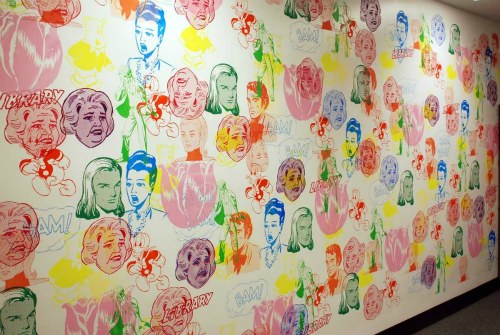
When most people think of screen printing they usually visualize Warhol’s “Marilyn” or an indie rock gig poster or a pastel colored beachscape print, but not many folks know that screen prints can also be found printed directly on walls. This summer I had the opportunity to make a mural on a wall in Perkins library (in a hallway leading to the Gothic Reading Room) using a vertical screen printing technique that I’ve been researching. The project is the culmination of a Collaboration Development Grant from the Duke Council for the Arts. The grant also involved bringing Dutch artist Stefan Hoffmann to Duke to share his highly-developed vertical screen printing methods with me; students; staff; and Duke Art, Art History and Visual Studies professor Merrill Shatzman.

Bill Fick's Screen Printed Mural
Close-Up of Bill Fick's Mural

Beyond applying newly developed vertical screen printing techniques, the mural also gave me the opportunity to take advantage, and bring attention, to the RBMSCL’s Edwin and Terry Murray Comic Book Collection. In the past four years I’ve been using the Murray Collection as a teaching tool and resource for my Art of the Comic Book and Zines class. The mural design used appropriated images taken from an assortment of comics found in the collection. These included Marge’s Little Lulu and Tubby, Classics Illustrated – The Black Tulip, The Mark of Zorro and Walt Disney’s Donald Duck. I also used images taken from books found in the Lilly Library comics and graphic novels section (A Steve Ditko monograph and Love and Rockets, New Stories No. 1 by the Hernandez brothers). The images ranged from faces/heads to a standing figure to a tulip flower. I really wasn’t thinking about content but more about interesting shapes and forms—although I did use some text that related to the location of the piece.

The concept for the mural was to make a colorful and active design that used pop culture and street art/graffiti strategies (practiced by contemporary artists like Shepard Fairey, Faile, and Bäst and pioneered by artists like Polke, Rauschenberg, Lichtenstein, and Warhol). This included layering, repetition, and patterning, which can be easily implemented using the vertical screen printing method—one image per screen applied to the wall over and over again. This method also yields unexpected relationships between content and shapes that I find very exciting. The viewer can make their own narrative or allow it to be purely decorative. For this reason, the mural is untitled.

For more information about this project and other vertical screen printing information go to www.verticalscreenprinting.com.

Post contributed by Bill Fick, Visiting Assistant Professor of the Practice of Visual Arts. Thanks to Will Hansen, Assistant Curator of Collections, for coordinating this post.

All in a Day’s Processing

As the archivist that handles accessioning, I receive collections into the RBMSCL’s Technical Services department that range in condition from “perfectly arranged upon arrival” to “dumped in a box and shaken up a bit in transit.” The Hypes Family Papers, an expansion upon a small collection of World War I photographs by Samuel Loomis Hypes, came to us in envelopes and a box that had seen better days.

To begin processing the collection, I first had to find out what it contained. Each envelope revealed another surprise—various family photographs, including a daguerreotype; tickets from the World’s Columbian Exposition in 1893; postcards the family collected from their trips around the world; family history research; and a lot of Y.M.C.A. materials (at least two generations of Hypes men worked for the organization). By the time I had spread it all out to sort it, my table was looking particularly messy.

I decided to arrange the collection by family member, which allowed me to keep it in basic chronological order while still grouping each person’s activities together within the collection. Photographs and tickets were sleeved, clippings were photocopied, and the daguerreotype was housed in its own envelope for protection. Things were looking much better on my processing table.


Next, I created a finding aid for the collection, folding in the original collection of World War I photographs. Using the collection’s family history materials, I was able to loosely reconstruct the family tree. An updated catalog record finished up the collection. Now ready to use, the Hypes Family Papers offer a fascinating glimpse into one family’s activities around the world in the late nineteenth and early twentieth centuries.

Post contributed by Meghan Lyon, Accessioning Associate.

Unnatural Intimacies

Date: Friday, August 12, 2011
Time: 3:00 PM
Location: Rare Book Room
Contact Information: Kelly Wooten, 919-660-5967 or kelly.wooten(at)duke.edu

Join the staff of the Sallie Bingham Center for Women’s History and Culture for a discussion, titled “Unnatural Intimacies: Deviance, Sexuality, and the Historical Relationships of Lesbians and Prostitutes, 1935-1965,” with Marika L. Cifor, the recipient of a Mary Lily Research Grant.

Ms. Cifor is a candidate for a Masters of Arts in History and a Masters of Science in Library and Information Science, with a concentration in Archives Management, at Simmons College. During her research visit, she will be studying the Bingham Center’s lesbian pulp fiction collection. Light refreshments will be served.

Post contributed by Kelly Wooten, Research Services and Collection Development Librarian for the Sallie Bingham Center for Women’s History and Culture.

Today is Zine Library Day!

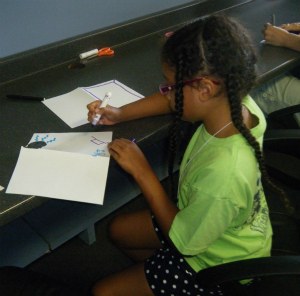
Making Zines at Girls Rock CampAnd we’ve been celebrating by making zines!

Future rock stars at NC Girls Rock Camp made zine pages in a workshops led by Kelly Wooten, Tali Beesley, and Alex Krensky of the Sallie Bingham Center for Women’s History and Culture; Erin Hammeke, conservator for Special Collections; and Rosemary Davis of the Duke University Archives. This is the fifth year our librarians have led zine workshops for NC Girls Rock Camp!

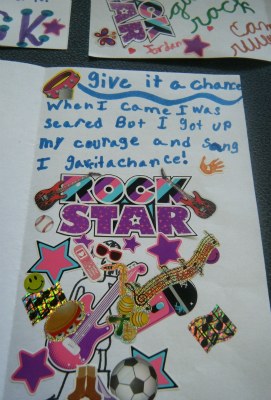
A Completed Zine PageYou can celebrate our anniversary and Zine Library Day by downloading the Bingham Center’s fun new mini-zine and making your own!

You’ll find more pictures from this year’s workshops—and past ones, too—at the Bingham Center’s Flickr photostream.

Learn more about Zine Library Day on this wiki.

Post contributed by Kelly Wooten, Research Services and Collection Development Librarian for the Sallie Bingham Center for Women’s History and Culture.

What She Wore

Mary Lily Travel Grant recipient Julie R. Enszer recently completed her second visit to the Sallie Bingham Center for Women’s History and Culture to conduct research for her dissertation project, which investigates the production of lesbian-feminist print culture in the United States between 1969 and 1989.

While Julie was here, she used materials from these collections:

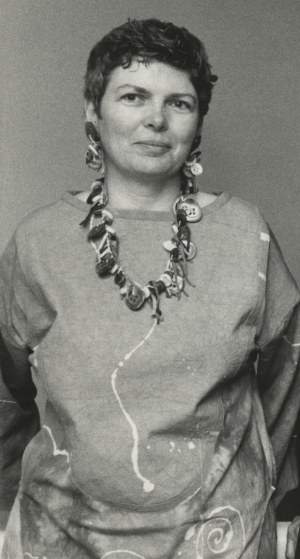
Minnie Bruce Pratt at the Academy of American Poets awards ceremony, May 16, 1989.
Minnie Bruce Pratt at the Academy of American Poets awards ceremony, May 16, 1989. From the Minnie Bruce Pratt Papers. Photo by Dorothy Alexander.

Reflecting on her research experience, Enszer writes that the Minnie Bruce Pratt Papers were “one of the most exciting collections that I worked with. This may be in part because I have been a fan of Pratt’s poetry and writing since the late 1980s, but it is also certainly due to the fact that this is an extensive and thorough collection.”

She continues, “One aspect of my dissertation focuses on the literary appraisals of lesbian writing and a significant portion of the chapter discusses the Lamont Prize [given by the Academy of American Poets] in 1989 given to Minnie Bruce Pratt for Crime Against Nature. There are extensive documents on this event in the archive, but my favorite archival item is the outfit that Pratt wore to the award ceremony at the Guggenheim: a two-piece, cotton Batik. The shirt is light green with a lavender smock on the front edged by pink. It is both festive and feminine while distinctly conveying ‘lesbian.’”

Thanks to Dorothy Alexander for letting us use her photo of Minnie Bruce Pratt at the 1989 Academy of American Poets awards ceremony in this post. You can see more of her work on her website.

Post contributed by Kelly Wooten, Research Services and Collection Development Librarian for the Sallie Bingham Center for Women’s History and Culture , with thanks to Julie R. Enszer.

Instruction is Sweet!

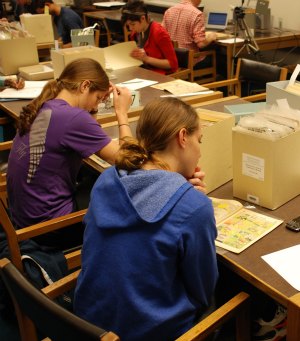
Bill Fick's "Art of the Comic Book and Zines" Class
Photo by Bill Fick.

85 classes! The RBMSCL had another packed semester of instruction, as our librarians welcomed a group of fledgling Walt Whitman scholars from North Carolina State University, two classes from the Trinity School, and even a local Girl Scout troop—in addition to scores of Duke undergraduate and graduate students. We couldn’t have been more pleased when a student from Bill Fick’s “Art of the Comic Book and Zines” class (pictured at right) observed, “this place is like a candy shop—only it’s free!”

Here’s a goodie grab bag of some of the classes we taught this past semester:

  • Architectural Theory from Antiquity to the Renaissance
  • Art of the Comic Book and Zines
  • Cannibalism to Anorexia:  Embodying Social Meaning (Writing 20)
  • Digital Durham
  • Documenting the South
  • The Family in Documentary Photography
  • From Huck Finn to Miley Cyrus: Children’s History Through Popular Culture (Writing 20)
  • History of Punk
  • Introduction to Contemporary Latin America
  • Introduction to Oral History
  • Language in Immigrant America
  • Legal Documents: Yesterday & Today (Writing 20)
  • Looking In, Looking Out: The Language of Photographic Texts (Writing 20)
  • Major Italian Authors
  • Maps, Exploration, and Empire
  • Martin Luther King, Jr.
  • Photographing South Africa
  • Play, Games, and Culture (Writing 20)
  • Reading the Qur’an
  • Religion and Politics
  • Russian Art and Politics
  • Staging Sexualities
  • Suburbs, Malls, Office Buildings
  • Weimar and Nazi Germany
  • Women as Leaders

Wondering if the RBMSCL could support your Fall 2011 course? Send us an e-mail at special-collections(at)duke.edu!

The Cleanest Books Around

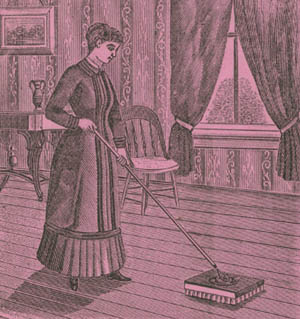
I-XL Pump Co.'s New Scrubbing BrushThe RBMSCL’s reading room is going to be closed on Monday, May 9th so that we can devote a few hours to a careful cleaning and ordering of our stacks. We’ll reopen again on Tuesday, May 10th at 9:00 AM with everything sparkling and tidy!

(Incidentally, doesn’t this homemaker look thrilled with her I-XL Pump Co. Scrubbing Brush? According to the advertising circular, it “takes the cake.” Which we don’t doubt, because who isn’t equally a fan of cake and cleaning products?)

To get ourselves ready for cleaning day, we thought we’d take a look at the suggestions for cleaning and caring for books and libraries that have been offered to industrious homemakers and housekeepers over the years.

Please note that the RBMSCL doesn’t actually use any of these cleaning and care practices, nor do we recommend that you use them on your own books or manuscripts.

To Prevent Moulding in Books, Ink, Paste and Leather: Collectors of books will not be sorry to learn that a few drops of oil of lavender will insure their libraries from this pest.”

—From The Skillful Housewife’s Book, 1846.

“When a parlor with handsome furniture is to be swept, cover the sofas, centre-table, piano, books, and mantel-piece, with old cottons, kept for the purpose. . . . Dust ornaments, and fine books, with feather brushes, kept for the purpose.”

—From Miss Beecher’s Housekeeper and Healthkeeper, 1873.

To Preserve Books: Bindings may be preserved from mildew by brushing them over with the spirits of wine. . . . Russia leather which is perfumed with the tar of the birch-tree, never molds or sustains injury from damp. The Romans used oil of cedar to preserve valuable manuscripts.”

and

To Remove Ink Spots on Books: A solution of oxalic acid will remove them without injuring the print.”

—From Practical Housekeeping, 1883. (With regard to the second piece of advice: now you know why we use pencils!)

“As the library . . . often knows the scent of cigar smoke we would refrain from adding upholsteries to catch and retain the odor, which, while it may not be objectionable at first, is certainly not enjoyable when stale.”

—From Home-Making and Housekeeping, 1889.

“Glazed bookcases are quite unnecessary. . . . Books do not suffer, but rather benefit, by coming into contact with the air. . . . Even if the [library] is not in regular daily use, a fire should be lighted frequently, especially in damp weather; otherwise the books will inevitably be attacked by mildew, and ruined sooner or later.”

—From The Book of the Home, 1900.

“Gum camphor laid among books on the shelves will keep the mice away.”

—From Putnam’s Household Handbook, 1916. (We would like to note how happy we are that we don’t have this problem!)