Category Archives: Rare Books

The Cleanest Books Around

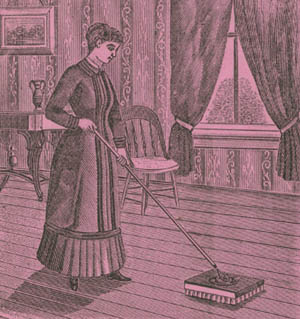
I-XL Pump Co.'s New Scrubbing BrushThe RBMSCL’s reading room is going to be closed on Monday, May 9th so that we can devote a few hours to a careful cleaning and ordering of our stacks. We’ll reopen again on Tuesday, May 10th at 9:00 AM with everything sparkling and tidy!

(Incidentally, doesn’t this homemaker look thrilled with her I-XL Pump Co. Scrubbing Brush? According to the advertising circular, it “takes the cake.” Which we don’t doubt, because who isn’t equally a fan of cake and cleaning products?)

To get ourselves ready for cleaning day, we thought we’d take a look at the suggestions for cleaning and caring for books and libraries that have been offered to industrious homemakers and housekeepers over the years.

Please note that the RBMSCL doesn’t actually use any of these cleaning and care practices, nor do we recommend that you use them on your own books or manuscripts.

To Prevent Moulding in Books, Ink, Paste and Leather: Collectors of books will not be sorry to learn that a few drops of oil of lavender will insure their libraries from this pest.”

—From The Skillful Housewife’s Book, 1846.

“When a parlor with handsome furniture is to be swept, cover the sofas, centre-table, piano, books, and mantel-piece, with old cottons, kept for the purpose. . . . Dust ornaments, and fine books, with feather brushes, kept for the purpose.”

—From Miss Beecher’s Housekeeper and Healthkeeper, 1873.

To Preserve Books: Bindings may be preserved from mildew by brushing them over with the spirits of wine. . . . Russia leather which is perfumed with the tar of the birch-tree, never molds or sustains injury from damp. The Romans used oil of cedar to preserve valuable manuscripts.”

and

To Remove Ink Spots on Books: A solution of oxalic acid will remove them without injuring the print.”

—From Practical Housekeeping, 1883. (With regard to the second piece of advice: now you know why we use pencils!)

“As the library . . . often knows the scent of cigar smoke we would refrain from adding upholsteries to catch and retain the odor, which, while it may not be objectionable at first, is certainly not enjoyable when stale.”

—From Home-Making and Housekeeping, 1889.

“Glazed bookcases are quite unnecessary. . . . Books do not suffer, but rather benefit, by coming into contact with the air. . . . Even if the [library] is not in regular daily use, a fire should be lighted frequently, especially in damp weather; otherwise the books will inevitably be attacked by mildew, and ruined sooner or later.”

—From The Book of the Home, 1900.

“Gum camphor laid among books on the shelves will keep the mice away.”

—From Putnam’s Household Handbook, 1916. (We would like to note how happy we are that we don’t have this problem!)
Spying on Galileo

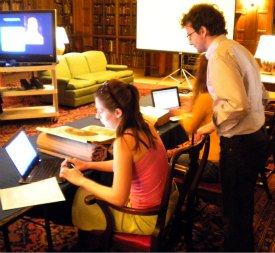
Professor Begali's class in the Rare Book RoomOn Friday, April 8th, Professor Matteo Gilebbi’s Italian 22 course, offered by the Romance Studies Department, held a special lesson at the RBMSCL. The class was led by guest speaker Professor Mattia Begali. While Professor Begali’s expertise centers on the Baroque period, Professor Gilebbi’s research focuses on the use of new technologies in the fields of literature and pedagogy. This unique collaboration sought to facilitate student learning processes through the merger of old and new media.

This particular lesson aimed to utilize the RBMSCL as a pedagogic and engaging space for students interested in Italian culture and language. The class focused on the intellectual network of scholars who were active in Rome during Galileo’s affair. By using both ancient editions available in the RBSMCL’s collections and online sources, students were able to explore the visual rhetoric presented in works of authors such as Roberto Bellarmino and Tommaso Campanella, while endeavoring to understand their role and position in Galileo’s entourage.

“Animated Anatomies: The Human Body in Anatomical Texts”

Date: 6 April-18 July 2011
Location and Time: Perkins Library Gallery during library hours
Contact Information: Meg Brown, 919-681-2071 or meg.brown(at)duke.edu

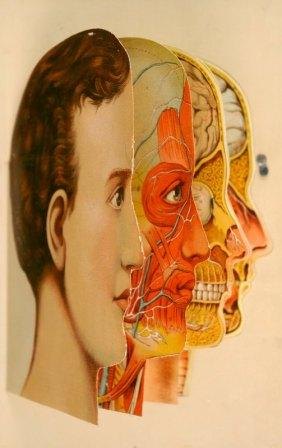
Physicians' Anatomical Aid, ca. 1880-1890

Animated Anatomies explores the visually stunning and technically complex genre of printed texts and illustrations known as anatomical flap books.

This exhibit traces the flap book genre beginning with early examples from the sixteenth century, to the colorful “golden age” of complex flaps of the nineteenth century, and finally to the common children’s pop-up anatomy books of today. The display—which includes materials from the RBMSCL, the Duke Medical Center Library & Archives’ History of Medicine Collections, and from the private collections of the curators of the exhibit—highlights the history of science, medical instruction, and the intricate art of bookmaking.

The exhibit is curated by Professor Valeria Finucci, Department of Romance Studies, and Maurizio Rippa-Bonati, Department of History of Medicine at the University of Padua, with the assistance of Meg Brown, Duke University Libraries exhibits coordinator, and Rachel Ingold, Curator of the History of Medicine Collections. Items will be exhibited in both the gallery of Perkins Library on Duke’s main campus as well as outside the History of Medicine Reading Room at Duke’s Medical Center Library.

In addition to the exhibit, an opening reception will be held Monday, 18 April, at 10 AM at the History of Medicine Collections, followed by a symposium of renowned scholars in history, medicine, and medical history in Perkins Library. The exhibit and the symposium, both free and open to the public, aim to address a diverse public including those interested in the medical field, history, cultural studies, visual studies, and material studies.

To learn more about the symposium, exhibit, see photos of anatomical flap books, and watch videos of them in action, visit the exhibit website.

Post contributed by Rachel Ingold, Curator of the History of Medicine Collections.

An Anonymous Author Unveiled, 125 Years Later

Title Page of The Fall of the Great Republic
Title Page of The Fall of the Great Republic.

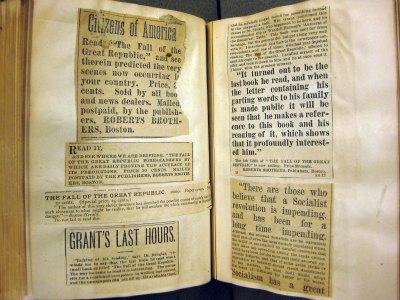
It’s not often that we acquire two copies of the same work at the Library.  Sometimes, however, a second copy can have unique characteristics that make it nearly irresistible—as in the case of a copy of The Fall of the Great Republic recently acquired for the Glenn R. Negley Collection of Utopian Literature, which may have solved the 125-year-old mystery of its author’s identity.

A well-known anti-socialist and xenophobic dystopian work published in 1885 and foretelling the demise of the United States, the book was published under the pseudonym Henry Standish Coverdale.   The copy now at Duke seems to establish the author as New Lebanon, N.Y. newspaperman Abner Hitchcock (1851-1936).  The volume comes from his library, bears the ownership signature “Hitchcock,” and includes a penciled note in the rear, dated from August 1924, stating that “Authorship [was] kept a complete secret.”

The specially-bound volume contains clippings and reviews of the work from across East and parts of the Midwest, including a suspiciously positive review from the Boston Journal, a paper for which Hitchcock wrote.   Of the various reviews, the owner has written in the volume: “The most striking thing about it is in the illustration the pasted-in comments give of the impression it made on different readers. – One sees in me an ass, and one a prophet. I suspect there is some basis for both judgements.”

Clippings pasted into The Fall of the Great Republic
Clippings pasted into The Fall of the Great Republic.

The volume was discovered by a bookseller cleaning out of the attic of the Hitchcock House in New Lebanon, now a bed-and-breakfast inn.  It has now found its permanent home at Duke, where it will remain a one-of-a-kind resource for future generations of scholars.

Special thanks to Garrett Scott for permission to quote from his description of this item.

Post contributed by Will Hansen, Assistant Curator of Collections.

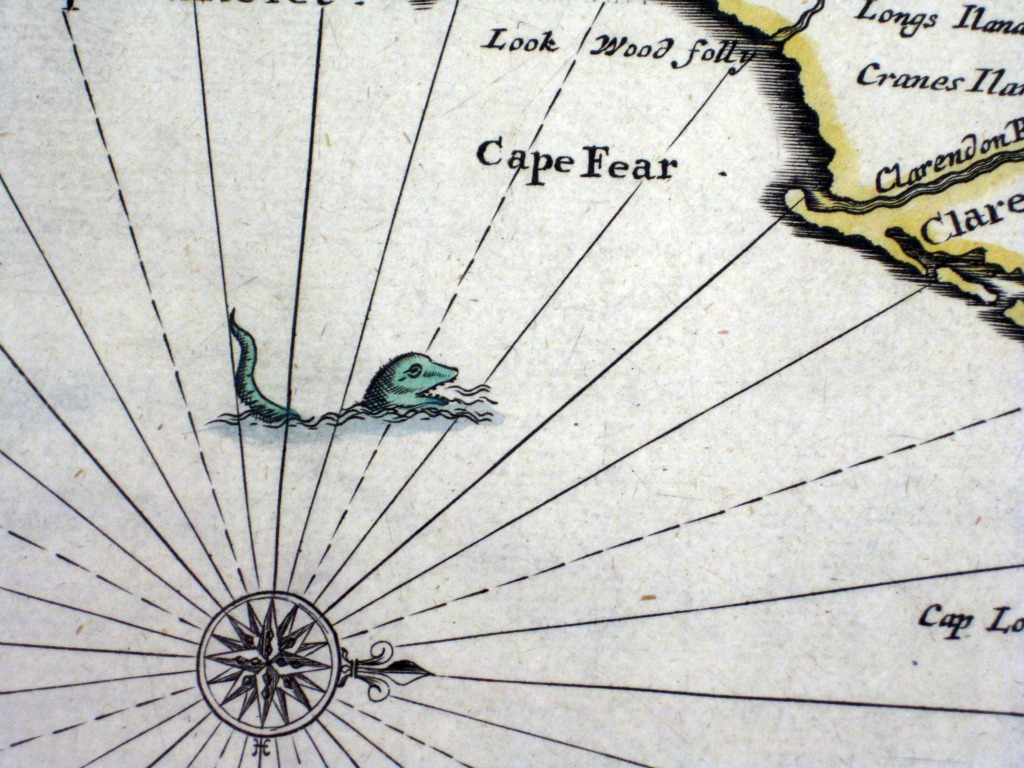
Choose Your Own Adventure: High Seas

You are the captain of a ship bound for Carolina. As you near the coastline, your normally brave crew begins to mutter about treacherous waters—and possible mutiny.

What do you decide to do?

Onward! The sea is no place for cowards!

Turn around and head for safe harbor!

(Details from A New Discription [sic] of Carolina, ca. 1671.)

Should you be lucky enough to make it to land, our friends at Preservation Underground reveal the terrors that await you!

RBMSCL Travel Grants: $$$ to Visit Us!

Photo by Mark Zupan.

Good news, researchers! The RBMSCL is now accepting applications for our 2011-2012 travel grants.

The Sallie Bingham Center for Women’s History and Culture, the John Hope Franklin Research Center for African and African American History and Culture, and the John W. Hartman Center for Sales, Advertising & Marketing History will award up to $1,000 per recipient to fund travel and other expenses related to visiting the RBMSCL. The grants are open to undergraduate and graduate students, faculty, independent scholars, artists, and activists living outside a 100-mile radius from Durham, NC with research projects that would benefit from access to the centers’ collections.

More details—and the grant application—may be found on our grants website. Applications must be postmarked or e-mailed no later than 5:00 PM EST on January 31, 2011. Recipients will be announced in March 2011.

We’re also excited to announce that the RBMSCL will be offering three new grants this year for scholars interested in using our German Studies and Judaica collections. Additional information about applying for one of these three grants will be available on our grants website soon. These new grants will have a later deadline.

O Pioneers!

Seth reads the Book of Mormon. Photo by Beth Doyle.

For many members of the Church of Jesus Christ of Latter-Day Saints, the experience of holding and reading a first edition copy of the Book of Mormon—including one of the two held at the RBMSCL—elicits reverence and profound emotion.

According to the church, the Book of Mormon is the record of ancient Americans and their relationship to God, and includes a visit from Christ after his resurrection. Joseph Smith, under God’s direction, received and translated the work before its 1830 publication in Palmyra, New York, and reestablished the priesthood and Christ’s church.

While the information contained within the Book of Mormon can be found in any of the over one hundred million copies (in 108 different languages), a copy of the first edition represents a physical connection to a prophet, the church’s origins, and God. Indeed, it is among the most requested of our holdings.

From the start, the church suffered intense persecution, moving several times from New York to Kirtland, Ohio to Missouri to Nauvoo, Illinois. This persecution eventually resulted in the death of Joseph Smith and the start of a great western migration lead by religious leader Brigham Young (in time, Young would be sustained as a prophet and Joseph Smith’s successor as the president of the church).

Beginning in April of 1847, Young lead approximately 70,000 pioneers on a western migration from Illinois. On July 24th of that year, weary pioneers arrived in the Great Salt Lake Valley, their new home and the future capital city of Utah. This day is celebrated annually by the Latter-Day Saints as Pioneer Day.

Brigham Young prayed that God would grant the pioneers 10 years of peace, which they received almost to the day. In 1857, based on fictitious reports of a “Utah Rebellion,” President James Buchanan appointed Alfred Cumming to replace Young as governor of Utah Territory and sent 2,500 soldiers to quell the supposed uprising. Upon arrival, Cummings discovered a people fearful of attack but respectful of his new position as governor. This experience is documented in the correspondence between Young and Cumming found in the RBMSCL’s Alfred Cumming Papers. These letters, like the first edition copies of the Book of Mormon, represent a relationship to a prophet and a history and are available for you to come see.

Post contributed by Seth Shaw, Electronic Records Archivist. Thanks to Kelly Wooten, Research Services and Collection Development Librarian, for suggesting this post and to Beth Doyle, Collections Conservator, for the photograph.

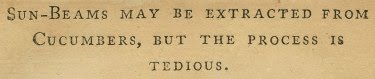
The Star-Spangled Cucumber

As archivists, we know that we’re supposed to mark the Fourth of July with a remembrance of that most celebrated of documents, our Declaration of Independence. We think, though, that we’ll leave the remembering and celebrating to our fine colleagues at the National Archives, and give some attention to a document of a completely different sort—a pamphlet bearing one of the most wonderful titles we’ve ever come across:

Lest you think we’re joking, here’s a link to the catalog record. The pamphlet reprints an oration delivered by David Daggett to the citizens of New Haven, Connecticut on the Fourth of July, 1799.

Of course, at the risk of spoiling the fun, we have to note that the title is actually a reference to Jonathan Swift’s Gulliver’s Travels. Since Swift was a pretty funny guy himself, we’re hoping you’ll forgive us.

Happy Fourth of July from the RBMSCL!

Thanks to Beth Ann Koelsch, who brought this treasure to our attention many years ago.

New Audubon Birds on Display

We’ve just turned the pages of our double elephant folio edition of John James Audubon’s Birds of America.

This month, stop by the RBMSCL’s reading room (103 Perkins) during open hours to view these new prints:

Red-headed Woodpecker (Picus erythrocephalus)
Hooping Crane (Grus americana; at left)
Rough-legged Falcon (Buteo lagopus)
Blue Jay (Corvus cristatus)

Visit this earlier blog post for a brief explanation of the monthly page turning.

New Audubon Pages on Display

Stacks Manager Josh Larkin-Rowley and Duke Law student Amanda Pooler examine Audubon's Raven.

Every month, RBMSCL staff members turn the pages of the four volume double elephant folio set of John James Audubon’s Birds of America. This keeps the rare volumes from developing “preferential openings”—tendencies to open to one particular page that often result when books are on display for long periods of time.

Duke Law student Amanda Pooler, making her first visit to the Rare Book Room, helped select the new openings. She chose the Brown Pelican (Pelicanus Fuscus), the state bird of her native Louisiana, as well as the Raven (Corvus Corax); the Carolina Parrot (Psittacus Carolinensis); and the Kittiwake Gull (Larus Tridactylus).

Stop by the RBMSCL reading room (103 Perkins) during open hours to view these gorgeous prints.

Thanks to Beth Doyle, Collections Conservator, for helping with this post. Check out Beth’s own post on the Audubons over at Preservation Underground.