Category Archives: News and Features

Dorothy Allison Papers Arrive at Duke

In the early 1990s Ginny Daley, then director of the Sallie Bingham Center for Women’s History and Culture, was convinced that Duke should acquire Dorothy Allison’s papers. “I saw her as the quintessential Southern writer,” Daley wrote recently. “Her personal papers and literary works fit well with Duke’s collections of Southern literature and women’s culture, while bringing fresh perspectives on queer culture and truth-telling to the mix.” Through campus visits and other seed-planting efforts, Ginny Daley introduced Ms. Allison to the possibility of Duke as the permanent home for her collection.

Photo by Brett Hall.

Now, after a nearly twenty year period of considering this momentous decision, Dorothy Allison, author of Bastard Out of Carolina and other works and renowned activist in the LGBTQ community, has selected the RBMSCL to be the repository for her papers. Bingham Center and literary curatorial staff collaborated on the initial acquisition of nearly 60 boxes of Allison’s papers, including drafts of her writings, extensive correspondence and research files, personal journals documenting her life and creative process, and more. For Allison, a South Carolina native now living in California, it’s a relief to have the papers at the RBMSCL: “All I know is that now I feel that all that . . . I saved is going to be safe and of use. Since we are entering high summer here with 90 degree temperatures and high risk of fire, I can also stop worrying that a wildfire might sweep through the redwoods and erase all that history. Safe and of use is infinitely preferable.”

The papers will be a rich resource for those interested in Allison’s life and work, as well as for researchers exploring the development of LGBT and Southern literatures, lesbian communities and families, and the history of American sexuality, among many other topics. Materials will be added to the collection as Allison continues to write and publish (a new book of short stories and a novel coming soon!).

A preliminary finding aid for the collection is now available here. In the coming months staff will review, process, and revise the finding aid for the collection to make it available for research. Researchers interested in using the papers should contact the Bingham Center staff to discuss their availability.

Post contributed by Will Hansen, Assistant Curator of Collections.

Hostage Nation Receives WOLA-Duke Book Award for Human Rights in Latin America

Hostage Nation: Colombia’s Guerrilla Army and the Failed War on Drugs, written by Victoria Bruce, Karin Hayes and Jorge Enrique Botero, has won the third annual WOLA-Duke Book Award for Human Rights in Latin America.

The book, published last month by Alfred A. Knopf, is the story of three American contractors and Colombian presidential candidate Ingrid Betancourt held hostage by the FARC (Revolutionary Armed Forces of Colombia) for over five years before their rescue in 2008. The book draws on Botero’s exclusive interviews with the American contractors, as well as extensive research on the FARC and the Colombian drug trade, to illustrate the impact of Colombia’s war and the U.S. war on drugs in Colombia.

The Washington Office on Latin America and Duke University created the prize to honor the best current, non-fiction book published in English on human rights, democracy and social justice in contemporary Latin America.The WOLA-Duke Book Award aims to draw the general public’s attention to good writing on contemporary Latin America. Francisco Goldman won the first award in 2008 for his book, The Art of Political Murder. Heraldo Muñoz’s The Dictator’s Shadow was last year’s winner.

Later this fall, the authors will visit the Duke University Libraries for an event co-sponsored by the Archive for Human Rights at the RBMSCL and the Duke Human Rights Center. We’ll have all the event details as they are announced here at The Devil’s Tale!

To read the entire press release from the Washington Office on Latin America, click here.

“Deena Stryker: Photographs of Cuba, 1963-1964″

Date: 31 August-12 December 2010
Location and Time: Special Collections Gallery during library hours
Contact Information: Karen Glynn, 919-660-5968 or karen.glynn(at)duke.edu

Journalist and photographer Deena Stryker’s black-and-white photographs of Revolutionary Cuba open a window into an unsettled time in that country’s history, after the Bay of Pigs and before Che Guevara’s departure for the Congo, when Fidel Castro was solidifying his control over the new revolutionary government.

A woman watching a military parade, Havana, January 1964. From the Deena Stryker Photograph Collection.

This new exhibit of thirty gelatin silver prints from the Archive of Documentary ArtsDeena Stryker Photograph Collection documents this extraordinary change, bearing witness to both the vitality of Cuba’s leadership and the optimism of the Cuban people. The exhibit is curated by Holly Ackerman, Librarian for Latin America and Iberia, and Heather Settle, visiting scholar in Cultural Anthropology.

Can’t visit the exhibit in person? Check out the virtual exhibit, which includes an additional eleven photos from the Deena Stryker Photograph Collection.

Keep up with The Devil’s Tale for news about the exhibit’s opening reception on Thursday, September 16th at 4:00 PM in the Rare Book Room. Deena Stryker, the exhibit’s curators, and several local experts on Cuba will come together to discuss the photographs and place them in their historical context.

From the RBMSCL Wire

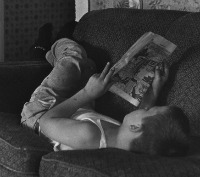
Boy lying on couch, reading comics. From the William Gedney Photographs and Writings, 1950s-1989.

Sure, you could lie on a couch and read comic books, but why not have a look at some of the articles and blog posts about the RBMSCL that have been published recently?

A profile of Susie King Taylor appears at TheAtlantic.com. (Read the post here). Taylor’s Reminiscences of My Life in Camp is part of the John Hope Franklin Research Center for African and African American History and Culture’s Black Voices Collection.

Our new exhibit, “‘As Far as Possible from Forgetfulness’: The Trinity College Historical Society,” found itself on the front page of the Durham Herald-Sun. (Read the article online.)

And Hartman Center travel grant recipient Ari Samsky wrote about his two-week research visit to the RBMSCL for web magazine Splice Today. You’ll find his essay—which makes us glad that Durham’s cooled off considerably in the past few days—here.

Let us know if you find any other mentions of the RBMSCL during your wanderings across the Internet and through print.

Photo Op with the AOTUS

During the recent Society of American Archivists (SAA) meeting in Washington, D.C., several RBMSCL staff members received a very special tour of the National Archives. Former Duke University Librarian and current Archivist of the United States, David Ferriero, gave the group a personal tour of his office.The group (click photo to enlarge) is gathered here under the portrait of Franklin Delano Roosevelt, which hangs in Ferriero’s office. (The National Archives began during Roosevelt’s administration.)

Ferriero, who has been AOTUS since last November, regaled the group with stories of great documents housed in the Archives. He recently examined Walt Whitman’s federal employee file (he was briefly employed by the Bureau of Indian Affairs). In the file was a five page letter of reference—written by Ralph Waldo Emerson.

Post contributed by Tim Pyatt, Duke University Archivist.

In the Lab: Boxing the Blue Devil

I love the sort of projects that start with a co-worker saying, “We have something special we want you to box,” because I always know it’ll be anything but a regular book. When I saw this little Blue Devil Doll, I knew a fun project lay ahead.

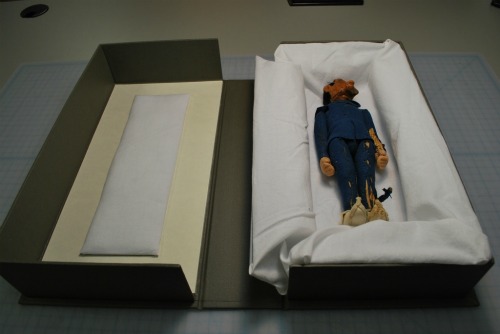
This doll was donated to the Duke University Archives this spring. It was purchased on campus in 1938 and is made of straw with a wax (I think) head and dressed in a smart blue felt outfit. The devil’s tail has floral wire wrapped around it to provide stiffness. The doll itself is in fair condition but, as you can see below, it has sustained some damage to the felt, most likely from insect activity.

Because of its condition, I wanted to make a sturdy box that had a cushioned interior to protect the fragile doll. The end result would be a drop-spine box, also called a cloth-covered clamshell. Before constructing the outer box, I would have to make an inner box with a cushioned interior.

The inner box is constructed of buffered corrugated board, lined with polyester quilt batting with a cotton fabric liner. The fun part was making the side bolsters to keep the doll from rolling around. These are made from rolled up polyester batting and then encased in a polyethylene pocket using our CoLibri book cover machine to make tubes. These provide enough structure to hold their shape but are still soft should the doll shift. Who knew that all my sewing experience would come in handy this way?

Blue Devil Doll in His Box

Once done with the inner tray, I constructed a clamshell box around it. The final enclosure is sturdy and keeps the doll firmly in place. The creative use of the CoLibri pockets worked really well. I’ll remember that should another devil cross my path.

For more photos of the Blue Devil Doll in his new home, visit the Conservation Lab’s “Boxing the Devil” set on Flickr!

Post contributed by Beth Doyle, Collections Conservator, as part of our ongoing “In the Conservation Lab” series.

New and Improved AdViews!

Just in time for the premiere of the fourth season of Mad Men, the last batch of 3,200 newly digitized D’Arcy Masius Benton & Bowles (DMB&B) commercials has been uploaded to AdViews!

More commercials than ever! Now there are almost 8,800 commercials in AdViews.

Essential new products! New ads for Oreo, Continental Airlines, Raisin Bran, Mattel, Fresca, Pop Rocks, Legos, Clearasil, Volkswagen, Budweiser, Hardee’s and so much more!

Act now and see expert interviews! Professors Jason Chambers of the University of Illinois and Peggy Kreshel of the University of Georgia give context to advertising targeted towards African Americans and women.

But wait, there’s more! Highlighted content includes a 20-minute film about the creation of a 1970s Post Grape Nuts commercial featuring Euell Gibbons.

After you’ve checked out AdViews, stop back here and let us know your favorite commercials!

Dear Diary: Girls Rock!

7/13/10

Dear Zine Diary,

Today was one of my favorite days of the year: zine workshop day at Girls Rock Camp. Amy and I spent the morning doing a zine workshop for about 45 young girls at Durham’s Girls Rock Camp. The day started with everyone standing in a circle, holding hands, and then turning to the person beside them and telling them “You rock!” What a way to start the day. We were able to talk with the girls about zines, as well as more about the Sallie Bingham Center for Women’s History and Culture and how they can come and look at zines in our collection. The girls were so excited to work on their own zine pages. We brought tons of markers, stickers, stamp pads, magazines, and glue sticks for them to make their own zine pages, and they did not disappoint! The zine pages they created included lots of things, such as their band names (Black Lizards, Beach Girls, 24/7, and The Flaming Moonshiners) and stickers proclaiming their love of music (and animals), and included statements like “I want to be a singer, an actress, and an architect.” I was asked how to spell words like “appreciate” and “different.” It was so great. Oh Zine Diary, every day should be like this!

Until next year. . .
Rachel


7/14/10

Dear Zine Diary,

Kelly and I spent yesterday morning at Girls Rock Camp in Chapel Hill. I was amazed at how eager, smart, and enthusiastic the girls were to learn about women’s history and zine-making! We went around the room and introduced each other and Kelly and I found out the names of the girls’ bands. We talked about the three waves of feminism and we even did the wave! We also talked about female stereotypes and how we can fight them together. Then the girls got down to business with markers, stickers, magazines, glue sticks, and stamps. They made pages for their bands as well as individual pages, and as Rachel mentioned, their pages were creative and inspiring. I was so excited to hear the girls talk about everyday injustices and how they want to fix them. Kelly told them that since they are part of the Third Wave they are the future of feminism and will help to decide the future for women. After yesterday, I’m glad to know the future is in good hands.

Rock on,
Alex

For more photos from Girls Rock Camp, visit the Bingham Center’s Flickr photostream!

Post contributed by Rachel Ingold, former Bingham Center intern and Conservation Technician, and Alex Krensky, Bingham Center intern.

Commercials in the Classroom

[youtube=http://www.youtube.com/watch?v=BxFv29qzEGc]

How have TV commercials changed over time? The answer to part of that question is found in this video about AdViews. Five Duke undergraduates discuss their small group project using commercials found in AdViews as primary sources for a fall 2009 Markets & Management Studies class taught by George Grody.

Using AdViews, the students compared a number of historic 1960s and 1970s commercials with corresponding ones from today. The students analyzed commercials for Hardees, Schick, Bounce, Pledge, and perfume, finding both interesting similarities and drastic contrasts that reflect the branding strategies of each time period.

AdViews, a digital archive of over 8,000 vintage television commercials dating from the 1950s to the 1980s, is one of the newest resources available from the Hartman Center for Sales, Advertising & Marketing History.

The Hartman Center collects and provides access to commercials, print ads, books, and other documents chronicling the advertising and marketing of products from the mid 19th century to the present. Our staff also provides targeted presentations to a wide range of classes each semester, helping to integrate primary source material into subjects ranging from Anthropology to History to Visual Studies, and most anything in between. Students are able to discover not only how TV commercials have changed, but how advertising tracks the evolution of not only the ad industry but also of society itself.

If you are interested in learning more about AdViews, classroom presentations, or research assistance, please contact the Hartman Center Reference Archivist at hartman-center(at)duke.edu or 919-660-5827.

Post contributed by Lynn Eaton, Hartman Center Reference Archivist.

A Jazz Master’s Papers Come to Duke

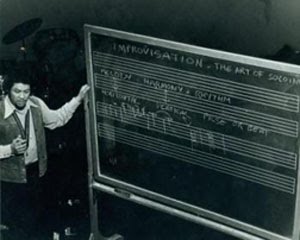
Frank Foster, ca. 1970s. From the Frank Foster Papers.

The Jazz Archive at Duke University announces the recent arrival of the Frank Foster Papers. Foster is one of the leading jazz saxophonists, big band leaders, and composer/arrangers of the post-World War II era. While serving as the primary arranger for the Count Basie Orchestra since the 1950s, Foster continued to compose and arrange for a variety of ensembles, receiving two Grammy Awards in the 1980s for his work. In 2002, Foster received the Jazz Masters Award from the National Endowment for the Arts.

The papers (which range from 1927 to 2009) reveal Foster’s personal and professional lives. Scores and parts composed or arranged by Foster for jazz big bands, as well as business records, publicity, reviews, and news clippings documenting Foster’s career, are complemented by personal correspondence, photographs, and a variety of Foster’s own prose writings. There are also roughly fifty hours of concert recordings featuring various bands Foster performed in.

While portions of the papers are currently open for research, the entire collection should be processed and available for use by the fall of 2010. If you’d like to arrange a visit to view the collection, or if you have any questions, please e-mail us at special-collections(at)duke.edu.

Post contributed by Jeremy Smith, Jazz Archivist.