Category Archives: New at the Rubenstein Library

New Acquisitions: Unique Depictions of the Human Body

In June and July we’re celebrating the beginning of a new fiscal year by highlighting new acquisitions from the past year. All of these amazing resources will be available for today’s scholars, and for future generations of researchers in the Rubenstein Library! Today’s post features a new collection in the Library’s History of Medicine Collections. Check out additional posts in the series here.
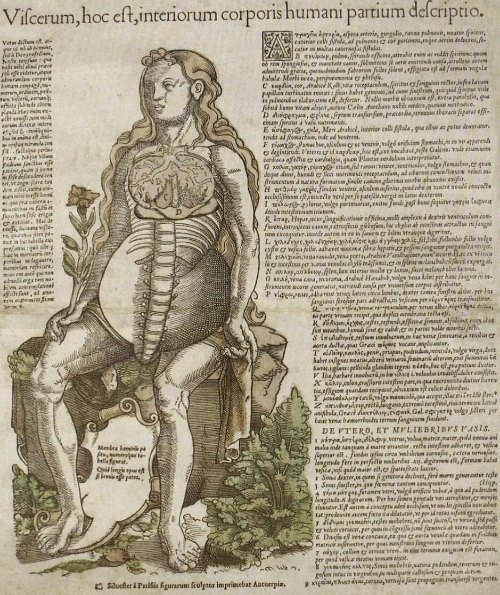
fugitive sheet female

The History of Medicine Collections has acquired two anatomical fugitive sheets, elevating our holdings to now include ten of these magnificent items. Anatomical fugitive sheets are single sheets, similar to broadsides, that are printed on one side. Illustrations of the human body accompany text that was written in Latin, and later in the vernacular. Dating from the sixteenth century, this pair of fugitive sheets, titled Viscerum hoc Est Interiorum Corporis Humani Partium Descriptio and published in Antwerp in the sixteenth century, includes hand colored illustrations with accompanying text in Latin.

Besides being incredibly rare—these are the only known copies of these sheets—the sheets are noteworthy for many reasons, including the depiction of the human body using three-dimensional flaps that lift to reveal internal organs, as the title suggests.  This particular pair of fugitive sheets has lost most of its flaps. While the male figure only retains a fragment of one flap, the female figure retains one full flap of the inner organs in entirety. Such loss is common since most of these fugitive sheets date to the sixteenth and seventeenth centuries and were printed as single sheets.

Theories abound as to who would own such items. Were they created for physicians, barber surgeons, or the lay person wanting to know more about the human body? Were they hung in apothecaries, medical university classrooms, or the gentleman’s library? Any sheets that remain today are incredibly rare and worthy of study and analysis. These appeal not only to the medical student who wants to see what inaccuracies exist, but to those interested in the history of science, printing history, and art history.

Post contributed by Rachel Ingold, Curator, History of Medicine Collections.
New Acquisitions: Advertising Aucas

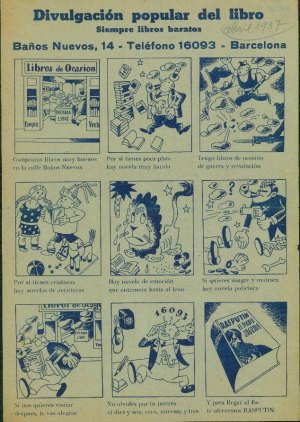
Auca for a Barcelona bookstore, 1937.

In June and July we’re celebrating the beginning of a new fiscal year by highlighting new acquisitions from the past year. All of these amazing resources will be available for today’s scholars, and for future generations of researchers in the Rubenstein Library! Today’s post features a new collection in the Library’s Hartman Center for Sales, Advertising, and Marketing History. Check out additional posts in the series here.

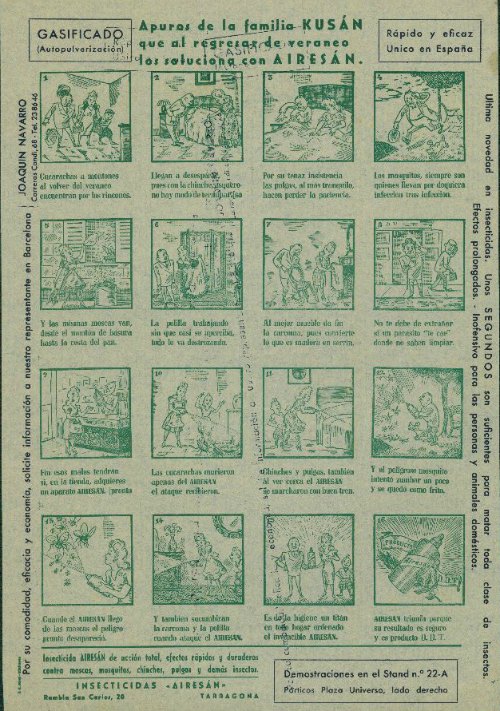
Since being banned as a tool for gambling in the seventeenth and eighteenth centuries, the auca has become one of the cultural touchstones of the Catalonia region of Spain.  Aucas are a kind of comic strip with a standardized format of panels (often 48, or another multiple of four) accompanied by rhyming verse.  The Hartman Center recently acquired a collection of more than fifty of these original broadsides, all produced and distributed for the purposes of advertising products or communicating a service. Aucas were traditionally used for communication of religious, literary, or civic information, but advertisers saw the value in taking the broadside format and using it for commercial purposes.

Auca for an insecticide containing D.D.T., Tarragona, ca. 1960.

The numerous examples here of aucas published in Barcelona or nearby cities in the Catalan language during the 1940s and 1950s, run counter to the accepted belief that the Franco regime had completely suppressed the Catalan language. As these aucas show, the language still had a public presence (and perhaps the Regime tolerated its use in this particular fashion because the aucas were intended to generate commerce, which Spain desperately needed).

Wense Grabarek in the First Person

The 50th anniversary of a key moment in the desegregation of Durham, North Carolina came and went largely without fanfare last month.  It was in May 1963 that, amid growing racial discord in the city, Mayor Wense Grabarek prevailed upon business and community leaders, black and white alike, to cooperate in desegregating the city. The mayor was in an unusual position: having held office for less than a day when a series of sit-ins around Durham resulted in 130 arrests, Grabarek’s first task upon being sworn in was to stop a riot at the jail. Achieving this by letting supporters deliver sandwiches and cigarettes to the jailed protesters, he then turned his attention to the NAACP and CORE, who promised mass demonstrations in the wake of the arrests. Jean Anderson, in Durham County: A History of Durham County, North Carolina, tells the story this way:

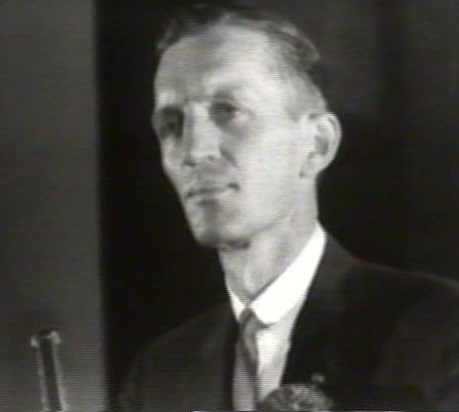
He went in person, a slight, dapper man, always with a red carnation in his lapel, to a meeting of protesters, one thousand strong, held at Saint Joseph’s A.M.E. Church.  Habitually soft-spoken and immensely polite, he asked permission to enter and address them.  Then, pointing out that by their demonstrations they had informed the community of their deeply felt grievances, he spoke about the danger of racial tension and division and promised to take positive steps to respond to their complaints.  Finally, he asked for their support and understanding.  Impressed by his coming, his tone, his words, they accepted his sincerity and promised to halt demonstrations and give the mayor time to act on his promises.

Mayor Grabarek formed the Durham Interim Committee to reconcile the community’s opposing groups, in so doing acknowledging the damage of segregation and the real possibility that Jim Crow could prevent Durham from realizing its potential, particularly given the economic promise of the newly formed Research Triangle Park. The efforts of Grabarek and of the leaders appointed to the Committee allowed Durham a degree of progress that eluded many other southern cities.

Wense Grabarek addressing the congregation at St. Joseph's AME Church, May 1963.
Wense Grabarek addressing the congregation at St. Joseph’s AME Church, May 1963.

A modest man and a successful accountant who continues to work full time six days a week, Wense Grabarek is now 93 years old and eager to add his perspective to the history of Durham, the adopted hometown that called him mayor from 1963 to 1971. To this end he has donated to the Rubenstein Library a number of recorded interviews he has given since the early 2000s, as part of a larger collection of papers that he is gathering for donation later this summer. You can check out the finding aid for the interviews here.

Wense Grabarek in conversation with Tim Tyson, Sept. 2011

The recordings include an interview with Steven Channing for his documentary Durham: A Self Portrait, an 8-hour conversation with author and scholar Tim Tyson detailing his work as mayor, and, presented here, with the permission of WTVD, an interview with Angela Hampton on the events of May 1963:

An oral history has been scheduled with Mr. Grabarek in July, and this time the interviewer will be the Rubenstein Library. We hope to learn more about the mayor’s life before and after the 1960s, including his experiences as a soldier in World War II and the philanthropic work he and his wife have done over the years in education.

Post contributed by Craig Breaden, Audiovisual Materials Archivist in the Technical Services Dept.

New Acquisitions: Family Letters from the Segregated Armed Forces

In June and July we’ll celebrate the beginning of a new fiscal year by highlighting new acquisitions from the past year.  All of these amazing resources will be available for today’s scholars, and for future generations of researchers in the Rubenstein Library! Today’s post features a new collection in the Library’s John Hope Franklin Research Center for African and African American History and Culture.  Check out additional posts in the series here.

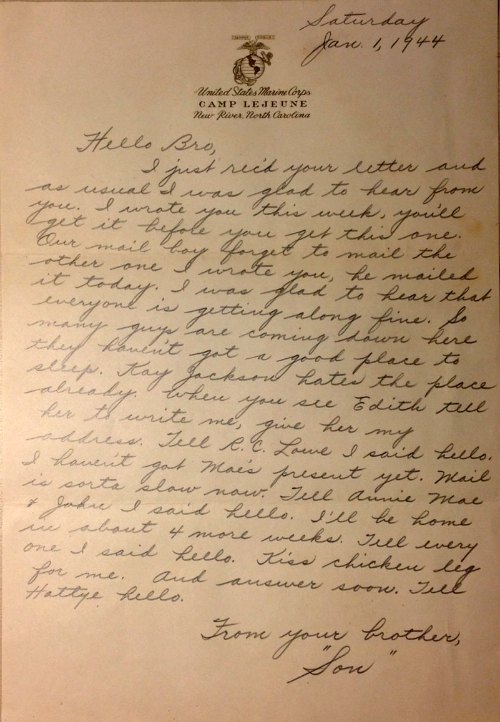
The Dykes Family Letters are an intimate exchange of correspondence between two African American servicemen during World War II. Nearly 40 letters from Private Leo Dykes, 5th Marine Ammunition Company to his brother Lawyer Dykes of Akron, Ohio describe his experiences serving from Camp Lejeune, NC to San Francisco to the Asian Pacific Islands from 1943-1945. The collection is augmented by a separate batch of 26 letters from Corporal Benjamin Peavy, 51st Aviation Squadron, to his sister Hattie Dykes, wife of Lawyer Dykes, while stationed at the Greenville Army Flying School in Greenville, MS from 1942-1944.

Letter from Private Leo Dykes to Lawyer Dykes, 1 January 1944.

The letters are an exceptional display of the close familial ties shared by both men to their relatives back at home during a time of war. Though neither Dykes nor Peavy saw active duty during the war, the two share their experiences serving as African Americans in a still segregated military.

Post contributed by John Gartrell, Director, John Hope Franklin Research Center.


New Acquisitions: Icons of Civil War Photography

In June and July we’ll celebrate the beginning of a new fiscal year by highlighting new acquisitions from the past year.  All of these amazing resources will be available for today’s scholars, and for future generations of researchers in the Rubenstein Library! Check out additional posts in the series here.

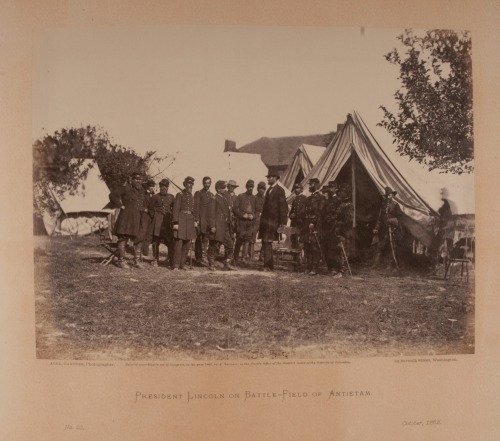
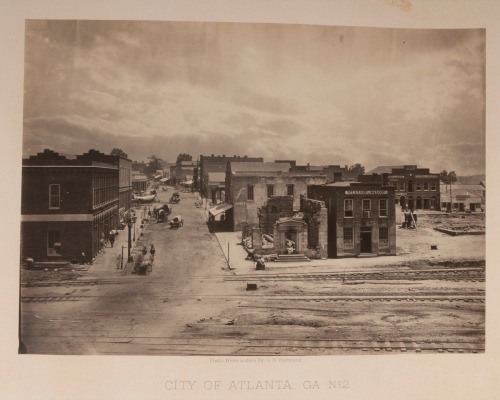
Some of the most celebrated, recognizable, and graphic images of the American Civil War come from Alexander Gardner’s Photographic Sketch Book of the Civil War and George N. Barnard’s Photographic Views of Sherman’s Campaign, both published in 1866. Among the most important pictorial records of the conflict, together they shed a stark light on the destruction witnessed during the war and its aftermath. As legendary examples of early American photography these albums also help us to understand the history of documentary photography and the emergence of the widespread documentation of war.  Look for a feature on these important new additions to the Library’s Archive of Documentary Arts in the next issue of RL Magazine!

Alexander Gardner, "President Lincoln on Battle-Field of Antietam," 1862.
Alexander Gardner, “President Lincoln on Battle-Field of Antietam,” 1862, from Gardner’s Photographic Sketch Book of the Civil War.
George Barnard, "City of Atlanta no. 2," from
George Barnard, “City of Atlanta no. 2,” from Barnard’s Photographic Views of Sherman’s Campaign.

The Rubenstein Library is grateful to the B. H. Breslauer Foundation for their generous support of the acquisition of Gardner’s Sketch Book.

Post contributed by Kirston Johnson, Curator of the Archive of Documentary Arts.

New Acquisitions: Human Rights in the New World

In June and July we’ll celebrate the beginning of a new fiscal year by highlighting new acquisitions from the past year.  All of these amazing resources will be available for today’s scholars, and for future generations of researchers in the Rubenstein Library! Today’s post features a key early work in the development of the concept of human rights.

Bartolomé de las Casas, a Dominican friar and one of the first Spanish colonists in the Caribbean, is best known today for his exposé of the horrifying treatment of indigenous peoples by Spanish settlers during the first decades of colonization.  First published in a 1550s series of tracts in Seville, the tracts represented the first argument for the rights of American Indians to be treated as fellow human beings, the first argument for the abolition of slavery in the New World, and one of the first attempts to appeal to a universal code of human rights.

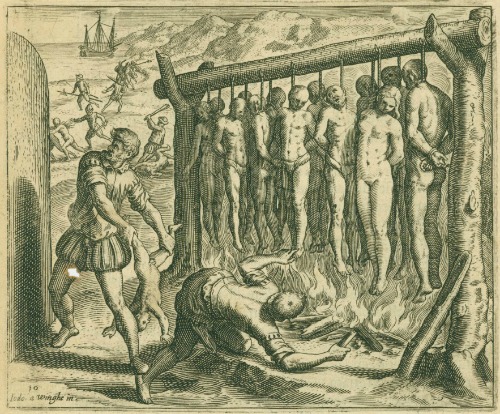
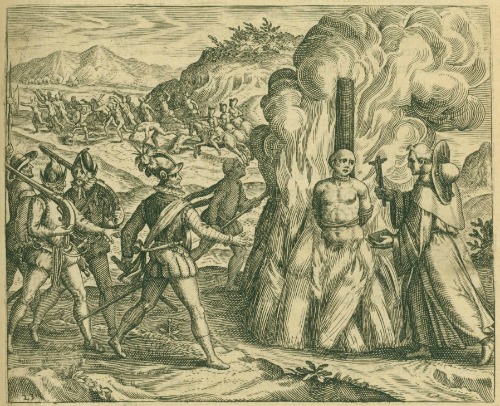
The tracts, especially the sensational details of torture, abuse, and murder, spread throughout Europe as evidence of the Spanish abuse of power in the New World.  The Library’s new acquisition is the first Latin translation and first illustrated edition of Las Casas’ text, entitled Narratio Regionum Indicarum per Hispanos Quosdam Devastarum Verissimi…published in Frankfurt in 1598.  The work features a powerful series of eighteen copper engravings by Theodor de Bry, depicting abuses of the native peoples.

casas-narratio_regionvm-1598-02blog
Image courtesy Dorothy Sloan Books.

De Bry never visited the New World, and the images can be seen as prime examples of the “Black Legend” of sensationalistic, anti-Spanish (and anti-Catholic) propaganda used to curb the might of the Spanish empire.  This edition of the work of Las Casas advocating for basic human rights for the native populations of the Americas was wildly popular and influential, thanks in part to the images, which retain some of their original power to shock and provoke thought about the treatment of the original inhabitants of the New World.

casasburning
Image courtesy Dorothy Sloan Books.

Post contributed by Will Hansen, Assistant Curator of Collections.

New Acquisition: Adventures in Negro History

This year, Duke commemorates the 50th anniversary of racial integration at the university, when in 1963 five African American students matriculated into the undergraduate program. Also in 1963, Pepsi sponsored the production of a record album, “Adventures in Negro History,” recently acquired by the John W. Hartman Center as part of the Douglass Alligood Papers. Alligood was one of the first black executives in the advertising industry, and is currently a Senior Vice President at BBDO agency. Long a champion for minority inclusion in the advertising business, Alligood chairs the BBDO’s Diversity Council, which advises management on diversity policies. He has also worked at RCA and for the minority-owned agency UniWorld Group. The record album contains dramatic readings by Detroit-based actors, including Jerry Blocker, Burniece Avery and Jiam Desjardins, which depicts the contributions of people of color to American history. Included are both the famous (Crispus Attucks, Phyllis Wheatley, Ralphe Bunche) and lesser known figures: Christopher Columbus’s pilot, Pedro Nino; Revolutionary War hero Salem Poor; and philanthropist Paul Cuffe.

adventures in negro history in alligoodPost contributed by Rick Collier, Technical Services Archivist.

A Birthday Present for Walt Whitman

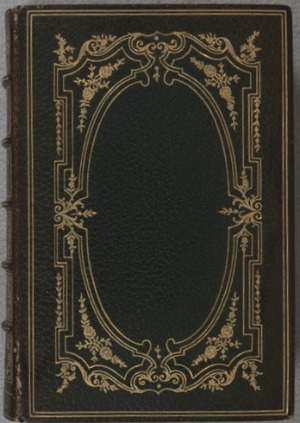
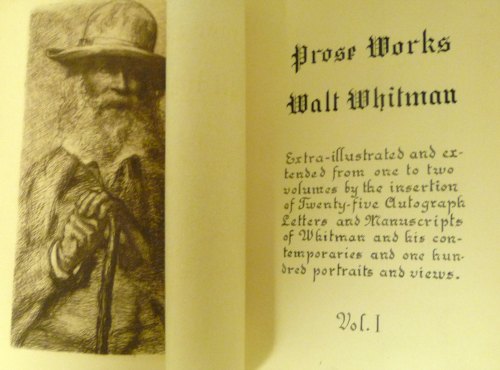
ExtraIllFrontBoardresizedToday, 31 May 2013, is the 194th birthday of Walt Whitman.  The Trent Collection of Whitmaniana in the Rubenstein Library is one of the largest collections of Whitman’s manuscripts and printed works in the world.  Just in time to celebrate the Good Gray Poet’s birthday, a beautifully “wrapped” new addition to the collection is available for research.

From an otherwise unremarkable edition of Whitman’s Prose Works, the copy newly arrived at the Library was lavishly extra-illustrated and expanded into two leather-bound volumes by an early owner, with the addition of 26 autograph letters and manuscripts and one hundred portraits and views.  Extra-illustration, also known as Grangerization, involves the addition by a collector of separately produced items such as portraits and manuscripts to a printed text.  Controversial today because it involves dismantling and transforming books, the practice was quite popular in the nineteenth century; this example is from the early twentieth century, perhaps the 1920s.

ExtraIllTitle
Added title page and frontispiece etching of Whitman in Prose Works.

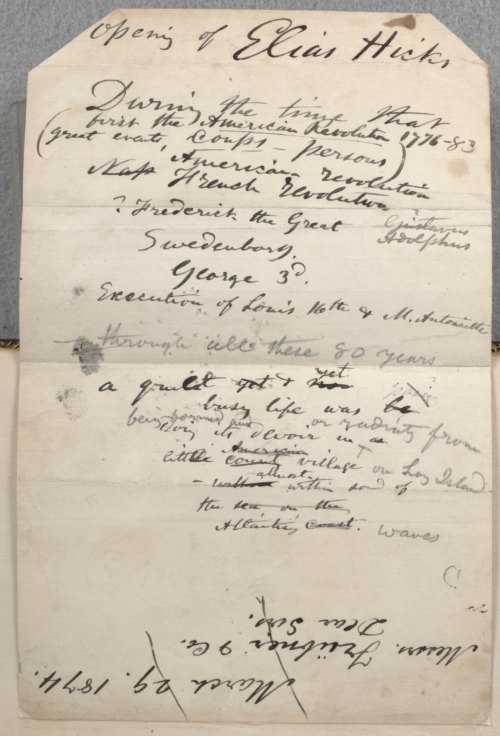
Many of the added items are of interest, including a manuscript slave deed and letters by Whitman friends and notables such as John Burroughs, John Swinton, William Cullen Bryant, Henry Wadsworth Longfellow, and General William T. Sherman.  Most importantly for Whitman scholars, the first volume contains a page of Whitman’s manuscript notes on the Quaker preacher Elias Hicks.   The manuscript had fallen into three pieces due to being folded into the binding; thanks to the work of Conservator for Special Collections Erin Hammeke, it has been repaired and remounted.

ExtraIllHicksEssayAfterresized

While we cannot say with certainty who created these extra-illustrated volumes, the second volume bears the bookplate of Mary Young Moore, a Papal countess for whom a high school on Staten Island, New York is named.  Given the connections of both Whitman and Hicks to New York City, this manuscript fragment may have especially appealed to Countess Moore.

Post contributed by Will Hansen, Assistant Curator of Collections, Rubenstein Library.

Southern Poverty Law Center Donates Extremist Literature Collection to Rubenstein Library

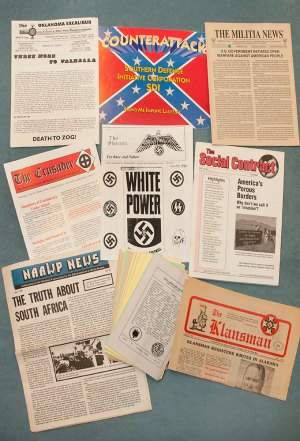
SPLCblogThe Southern Poverty Law Center’s Intelligence Project has donated its extensive collection of materials documenting extremist and hate groups in the United States to the David M. Rubenstein Rare Book & Manuscript Library at Duke University.

The collection includes nearly 90 boxes of periodicals, pamphlets, flyers and other documents intended for distribution to group members and recruits over the past 30 years.

At the Rubenstein Library, the collection will allow researchers to examine the histories of hate groups and efforts to monitor and infiltrate them adding to the Library’s Human Rights Archive, its rich collections for social movements in the United States, and its large existing collection of materials documenting the Ku Klux Klan from the 1860s to the present day.

The SPLC collection includes materials on many types of extremist groups such as neo-Nazis, the Ku Klux Klan, white nationalists, neo-Confederates, racist skinheads, black separatists, border vigilantes and others.

“We are very excited that Duke University’s David M. Rubenstein Rare Book & Manuscript Library has decided to house the extremist materials we’ve been collecting for decades,” said Heidi Beirich, director of the SPLC’s Intelligence Project. “We are especially pleased that these relatively rare materials will finally be made available to scholars who research America’s radical right. We look forward to learning from their scholarship.”

The collection will be made available to researchers after being prepared for use by the Rubenstein Library staff.

The SPLC Intelligence Project has been called “one of the most respected anti-terror organizations in the world” by National Review. It monitors hate groups and other extremists throughout the United States and exposes their activities to law enforcement agencies, the media and the public. The project posts its investigative findings online, on the Hatewatch blog and in the Intelligence Report, an award-winning quarterly journal. The Project has crippled some of the country’s most notorious hate groups by suing them for murders and other violent acts committed by their members.

This post previously appeared on Duke Today.


Newly Rediscovered Papers of a Game Theory Pioneer

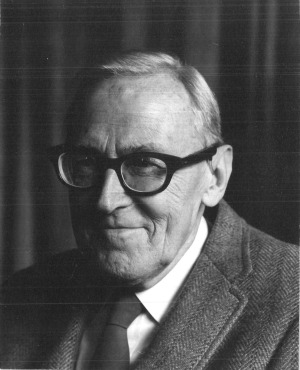
Oskar Morgenstern, n.d., from the Oskar Morgenstern Papers.

A project on the history of Mathematica Policy Research recently unearthed a historical treasure — a cache of personal papers, professional files, and correspondence by celebrated economist and mathematician Oskar Morgenstern, a founder of Mathematica.  They will now join the existing collection of Morgenstern Papers in the Economists’ Papers Project at the Rubenstein Library.

The newly rediscovered papers are linked to Morgenstern’s longstanding connection to Mathematica.  Along with several other Princeton University economists and mathematicians, Morgenstern founded Mathematica and served as chairman of its board.  He maintained an office at the company’s Princeton headquarters until his death in 1977.  “The materials, which we believe are from his Mathematica office, were recently discovered in our archives when we began compiling a history of the firm,” explained Paul Decker, president and CEO of Mathematica.

The additional papers comprise seventeen boxes of Morgenstern’s files and correspondence dating from 1940 through 1970.  The discovery of these new materials serendipitously matched a period of research on Morgenstern’s travels and correspondence conducted by his daughter, Karin Papp, who assisted in transferring the files from Mathematica’s offices to the Rubenstein Library.  The remainder of Morgenstern’s papers were donated to the Rubenstein Library by his widow Dorothy in the late 1980s.  Among his many achievements, Morgenstern’s Theory of Games and Economic Behavior, co-authored with John von Neumann, is a pioneering work on game theory.

This addition fills an important gap in the Morgenstern Papers, and will be made available for research use after being prepared by our staff.

Post contributed by Will Hansen, Assistant Curator of Collections, adapted from a press release prepared by Mathematica Policy Research.