The David M. Rubenstein Rare Book & Manuscript Library is now accepting applications for the 2026 – 2027 Research Travel Grant Programs, offering awards of up to $1,500 to support research projects associated with the following collecting Centers, subject areas, and collection holdings:
Archive of Documentary Arts General Grant
Archive of Documentary Arts Sidney Gamble Travel Grant
Doris Duke Foundation Travel Grant
Eve Kosofsky Sedgwick Travel Grant
Harry H. Harkins, Jr. T’73 Travel Grant
History of Medicine Collections
Human Rights Archive
John Hope Franklin Research Center for African and African American History
John W. Hartman Center for Sales, Advertising & Marketing History
Sallie Bingham Center for Women’s History and Culture (Mary Lily Research Grants)
Anyone whose research would be supported by resources from the Rubenstein Library’s research centers is eligible to apply. We encourage applications from students at any level of education; faculty and teachers; visual and performing artists; writers; filmmakers; public historians; and independent researchers.
For assistance determining the eligibility of your project, please contact AskRL@duke.edu with the subject line “Travel Grants.”
Eligibility
Applicants must reside beyond a 100-mile radius of Durham, N.C., and may not be current Duke students or employees.
Information Session
An online information session will be held Wednesday, January 14, 2026, 2-3 PM EST. This program will review application requirements, offer tips for creating a successful application, and include an opportunity for attendees to ask questions of staff involved with the travel grant program. This information session will be recorded and posted online afterwards. You can register for the session here.
Timeline
The deadline for application will be Friday, February 27, at 8:00 PM EST. Decisions will be announced by the end of April 2026 for travel during May 2026 – June 2027. Awards are paid as reimbursements for personal expenses after completion of the research visit(s).
Submitted by Mattison H. Bond, Movement History Initiative Coordinator
February is traditionally associated as the month in which we focus on the history and achievements of African Americans within the United States. But as information becomes more accessible and widespread more people have realized that Black history cannot be contained within a single month, and August is just as important a month for the Black community as February is.
What is Black August?
The origins of Black August began during the later end of the Black liberation movement, during the 1960s and 70s. As the nonviolent, peaceful mobilizations of the Civil Rights Movement began to transform into the direct-action campaigns of the Black Power Movement (sparked by SNCC’s Stokely Carmichael one hot night in Greenwood, MS, nearing the end of the Meredith March for Freedom), the formation of the nascent Black Panther Party come to the forefront of the movement bringing with them renewed energies toward self-sustainability and revolutionary theories and practices.
George Jackson, revolutionary and member of the Black Panther Party became a symbol of resistance while in prison. Incarcerated at a young age in 1961, Jackson was exposed to radical liberation politics by fellow inmates. Emboldened by this philosophy , he and his comrades dedicated themselves to organizing within the prison system, leading study groups and even starting a chapter of the Black Panther Party within the San Quentin Prison.
It was in 1971, a year after the killing of his brother, Jonathan, and other political prisoners, that George Jackson was assassinated by a prison guard within Soledad Prison. The death of these two brothers, along with the death of other political prisoners sparked widespread organizing and advocacy within the prison system.
Black August was celebrated for the first time in 1979 within San Quentin prison, where George Jackson and his comrades breathed their last breath. In remembrance of their lives and the decade of the liberation struggle within prisons, a moment of connection to centuries of Black resistance that served as a precedent, Black August came to symbolize a broader struggle for liberation and justice, particularly in response to enduring racial and social inequities.
How Can You Participate?
When Black August was first celebrated within the walls of the California San Quentin prison, prisoners in solidarity wore black armbands on their left arms and dedicated time to study books about revolutions and liberation, specifically focusing on the writings of George Jackson. In that same spirit, Black August continues to be a month of remembrance, education, and meditation toward the fight for liberation. During the month, celebrators dedicate their time to “study, fast, train, [and] fight.”
A Black August Booklist, But Make it SNCCY!
With an emphasis on STUDY here are some books written by members of the Student Nonviolent Coordinating Committee of the 1960s. Dedicated to the liberation of all people by means of impowering local people and communities, with education and nonviolent/political training, there is much to be learned about the fight for liberation between the pages of these featured books.
“This Nonviolent Stuff will Get you Killed” by Charlie Cobb“The Making of Black Revolutionaries” by James Forman“Hands on the Freedom Plow” Editor Judy Richardson“Ready for Revolution” by Stokely Carmichael“I’ve Got the Light of Freedom: The Organizing Tradition and the Mississippi Freedom Struggle” by Charles Payne“The Courage to Hope: How I Stood Up to the Politics of Fear” by Shirley Sherrod
Want to read more from the veterans of the Student Nonviolent Coordinating Committee? Check out the SNCC 60th Anniversary program agenda[SNCC-Agenda-v6.pdf] (start on p. 27) for more books by SNCC veterans.
And for a deeper context, check out the “Meet the Authors: A Legacy of Excellence in SNCC Literature – 19 Authors, 1 Movement” [Meet the Authors of the SNCC 60th Anniversary Conference – SNCC Legacy Project] videos, where 19 authors gather for one-on-one interviews to talk about their experiences within organizing that lead to their written materials.
Post contributed by Michael Ortiz-Castro, PhD, Lecturer, Department of History, Bentley University. Micheal was a recipient of the John Hope Franklin Research Center Travel Grant & Elon Clark History of Medicine Travel Grant.
Life insurance seems, perhaps, like one of the duller aspects of adulthood. For late 19th century Americans, life insurance represented and marshalled a number of concerns and anxieties about value, life, and community. Coming to force in the mid to late 1800s, life insurance—acquiring it, maintaining it, using it, and its meaning—all intertwined with questions about race, nation, and community—not surprising given that life insurance dealt with some of the most intimate aspects of individuals’ lives—their health, the health of their families, and the economic and social wellbeing.
As a historian of citizenship, my research discusses the history of life insurance as part of a broader analysis of the transformation of ideas of citizenship in the wake of the civil war. My book project, presently titled Acts of Citizenship: Belonging and Biology in Post-Reconstruction America, discusses life insurance in the context of the language companies used to sell policies to Americans, how folks in and outside the industry discussed the business of calculating the value of human lives, and the industry’s associated practices. These practices had a vision of citizenship yoked to ideas of biology and racial purity and helped shape the culture of life insurance—which would come to center round keywords like race, family, and citizen. At its intellectual heart was a project of racial differentiation, materialized in Irving Hoffman’s “Race Traits and Tendencies of the American Negro”. Written in his capacity as Statistician for the Prudential Life Insurance Company, the tract used mortality rates to not only advocate for denying insurance policies to black Americans, but to popularize the “extinction thesis”, a theory that black Americans were simply biologically unfit for equality.
What did black Americans make of this evolving discourse? With the generous support of the History of Medicine Collections and the John Hope Franklin Research Center at the Rubenstein Library, I began to answer this question by consulting the records of the North Carolina Mutual Life Insurance Company, the largest black-owned life insurance company in the nation. Their records highlight the complicated place of black life insurance companies in the economic landscape; they highlight the complicated ways in which black Americans sought to both prove their fitness for citizenship and resist the terms that condemned death to permanent exclusion.
**
Black life insurance companies like North Carolina Mutual grew in a lacuna. The first black insurance companies came up to help black Americans cover funeral costs; North Carolina Mutual marketed itself as a life-oriented project; like other life insurance companies, the stated goal of North Carolina Mutual was to “help Negroes … accumulate … a fortune in life”, to make burial insurance unnecessary. Though life insurance companies faced significant headwinds in their early days due to the perceived sacrilege of putting a value to human life, they participated in and benefitted from a cultural transformation that saw it worthwhile to invest in one’s own life.
North Carolina Mutual’s insistence that black lives could yield value for the user was complicated for two reasons. The first reason was that, according to white insurers, black lives were too risky to include in the risk pool—better to keep them out, for no value or benefit could be generated for the community. In constructing their own risk pool, North Carolina Mutual posited a different vision of the community. However, the notion that black lives could yield value for their owner drew eerie parallels to the slave insurance policies of the antebellum era—it had been commonplace for owners to ensure the lives of their slaves and receive payment in the case of death. In attempting to both affirm and challenge the prevailing association between value, appreciation, and race, North Carolina Mutual affirmed that black lives were appreciable assets—and could be a boon when that wealth was owned by the individual themselves. This logic seems to have been a motivating factor for other black-owned business companies—for example, as seen below, the Atlanta Life Insurance Company similarly sold its mission as “a dream to develop economic independence” among black Americans.
North Carolina Mutual insisted on more than just that black lives could be considered appreciable assets. At the heart of their industry was the assumption that black lives were insurable to begin with—that is to say, a good risk. To do so, it had to assert that black lives were not, say, any riskier than white customers. One bulletin from Clyde Donnell, the Medical Director, makes the logic clear. An excerpt of the document, which discussed tuberculosis mortality rates among black Americans, can be seen below. Below that, you can see another piece, also written by Donnell, which discusses the issue of finding enough black Americans to ensure.
The doctor’s argument in both documents once more ambivalently positions black American’s health to that of their white counterparts. White insurance executives, like Hoffman, argued that high mortality rates across diseases between black and white Americans was indicative of innate biological inferiority. Black intellectuals like W.E.B. DuBois often tried to argue that these disparities were the result of racist measurements and biases; in his magisterial The Health and Physique of the Negro American, DuBois used modern sociological methods to prove that, in aggregate, mortality rates were consistent across race according to class. This was not the strategy of North Carolina Mutual—they affirmed the notion that black folks did in fact have higher mortality rates. However, rather than cast these higher mortality rates as evidence of biological inferiority, Dr. Donnell instead asserts that this means that white folk should become more invested in the uplift of black Americans—“the negro means much to the economic welfare of the southern white man”. In the latter, Donnell references the environmental factors DuBois preferred while maintaining the fact of disparate health outcomes according to race. In tying their destinies together, Donnell’s logic resisted the idea that a white America was the inevitable result.
As materially important as it was for black Americans to have access to life insurance and the financial means to support themselves through death and emergencies, like other life insurance companies, North Carolina Mutual understood that its project was not just about securing the financial wellness of its members—no, the goal was to secure the political and economic uplifting of the people
This can be seen below, where the writings double as political mission: “it is better not to have lived, than to have lived and not contributed anything to the success of any one else’s life”.
At the time of its founding, North Carolina Mutual found itself serving a community that had achieved massive cultural victories alongside the entrenchment of Jim Crow in the South. As a business that believed in racial uplift, it relied on the language of progress and assimilation evinced by leading intellectuals by Booker T Washington. However, as a business oriented towards the advancement of black Americans in the face of racism, it had to take a stand on discourses of racial inferiority. Life insurance singularly combined questions of individual health and the future of the community that animated many of the driving cultural transformations of the late 19th century—the records of NC Mutual prove useful in understanding how black Americans navigated their place in the nation, and how the fight for equality extended to the domain of health, wellness, and the everyday.
Post contributed by Mattison Bond, Coordinator, Movement History Initiative
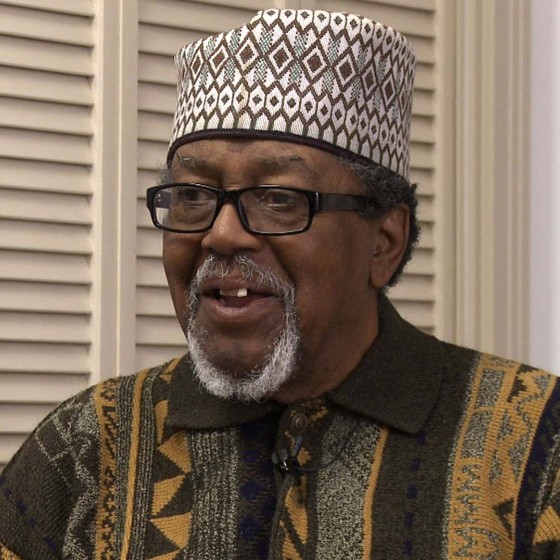
Photo of Worth Long taken from SNCClegacyproject.org
On May 8, 2025 Worth Westinghouse Long Jr., Folklorist and Student Nonviolent Coordinating Committee (also known as SNCC) Veteran passed away. The Franklin Research Center and Rubenstein Library mourns this lost and remembers his contributions as not only an activist, but also as a cultural archivist and true Durham native.
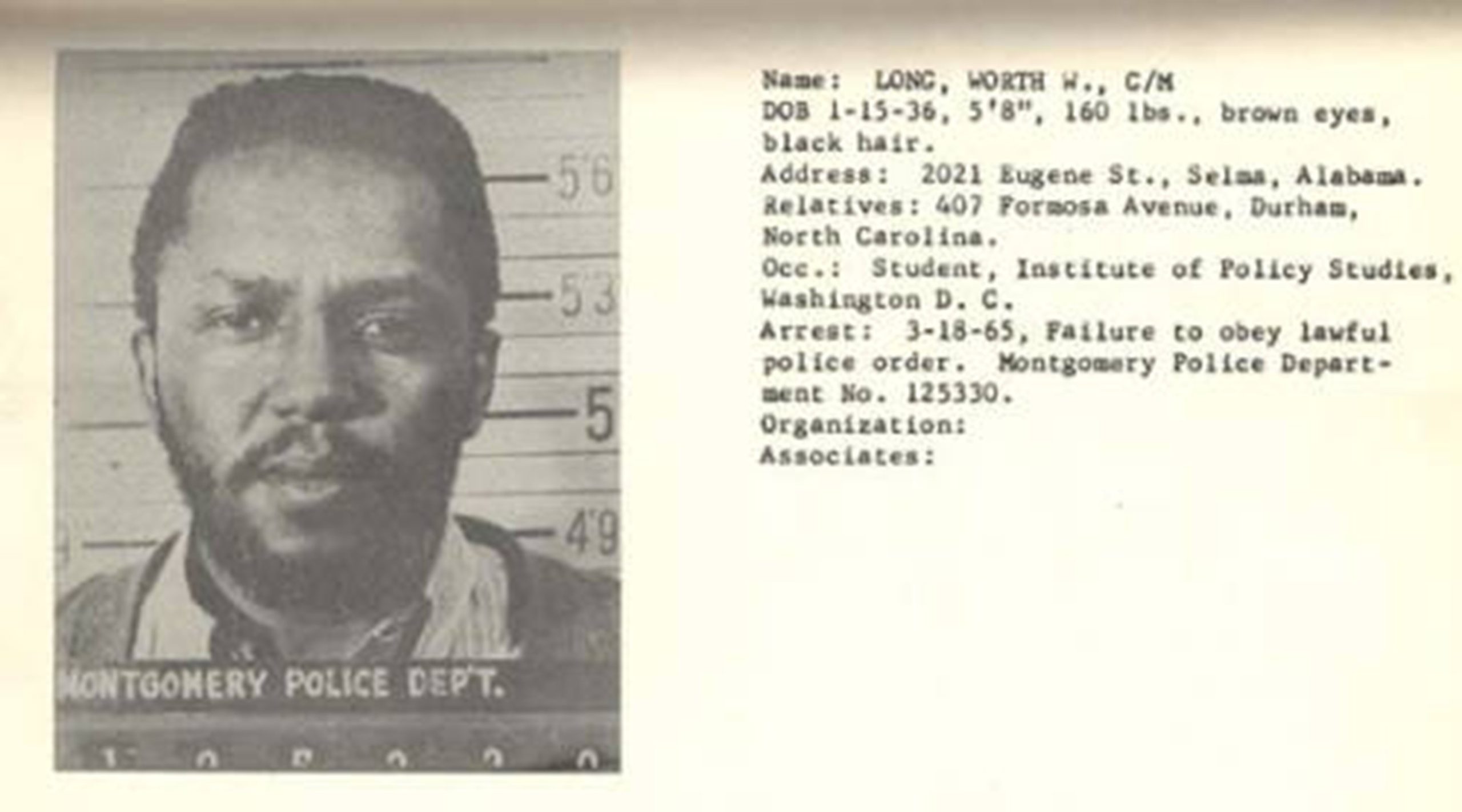
Worth Long’s Alabama State Police file, undated, Alabama Photographs and Pictures Collection, ADAH. Photo found at https://snccdigital.org/people/worth-long/
Long joined the Student Nonviolent Coordinating Committee (SNCC) in 1963, organizing in Selma, Alabama, during a pivotal time in the Civil Rights Movement. He would later become a nationally recognized folklorist, committed to preserving and celebrating Black cultural traditions. His work with the Smithsonian Institution, the National Endowment for the Arts, and the Library of Congress helped amplify the voices, music, and stories of Black communities across the South.
A proud son of Durham’s Hayti community, Long’s legacy bridges activism and cultural memory. We are grateful for his life and his enduring contributions to justice and history.
Civil Rights History Project Interview completed by the Southern Oral History Program under contract to the Smithsonian Institution ’s National Museum of African American History & Culture and the Library of Congress, 2015 https://www.crmvet.org/nars/long_w.pdf
Post contributed by Ama Kyereme, Curatorial Intern for the Archive of Documentary Arts (24-25) and curator of “Movement and Memory Through the Lens of Danny Lyon.” The exhibit is on display in the Rubenstein Library Photography Gallery through November 2, 2025.
In 1962, Danny Lyon, then a college student at university of Chicago, hitchhiked from Chicago to Cairo, Illinois, to document segregation to document segregation, and to join the Civil Rights Movement. Brought in by James Forman to work as the first staff photographer for the Student Nonviolent Coordinating Committee (SNCC), Lyon traveled across the U.S. South documenting the conditions that initially prompted him to action. Armed with his camera, he made his way into spaces that his Black colleagues typically couldn’t go. From the Leesburg Stockade in Virginia to the Toddle House diner sit-in in Atlanta, the photographs Lyon made captured the ethos of the civil rights era. Facing hostile police and armed guards wielding bayonets, Lyon often placed himself in the middle of action to represent in photographs what he was experiencing.
Peaceful protests are foundational to the Civil Rights Movement, but violence is inextricable to the Movement’s history. That violence, both visible and invisible, is on full display in several photographs selected for this exhibition, from protests arrests to the funeral for the girls bombed in Birmingham, AL. While Lyon did not hold back from documenting the volatility of the revolution as he witnessed it, he focused his camera on capturing the Movement as it was to him and those around him. He directed the camera just as much towards moments of stillness, depicting the reality of the Movement within the image, as well as between and beyond the frame. He made evidence of organizing, protesting, rest, grief, and celebration, all equally deliberate actions towards an investment in an imagined future. Many of the images Danny created during this period became synonymous with SNCC and the Civil Rights Movement, and through their circulation were key in bringing about social and political change. The images of the young girls imprisoned in the Leesburg Stockade in Virginia were critical in making the public aware of the condition these girls were in, and ultimately led to their release. In this way, there is a cycle of action that Danny’s photographs take part in. Danny’s impulse to follow the action leads him to take photographs, and in turn he takes action through the intervention of taking a photograph. The photograph then goes on to act as a catalyst for other social and political action based on the content of the image. In addition to the iconic and spectacular images of the era, this exhibit includes images that provide a more comprehensive narrative of SNCC activism, through depictions of the South as a geographic hub, the role of women and youth, and the involvement of the church and religion as equally critical parts of the Civil Rights Movement.
The Rubenstein Rare Book & Manuscript Library is pleased to announce the recipients of the 2025-2026 travel grants. Our research centers annually award travel grants to students, scholars, and independent researchers through a competitive application process. We extend a warm congratulations to this year’s awardees. We look forward to meeting and working with you!
The travel grants for the Archive of Documentary Arts and Human Rights Archive have been paused for the 2025-2026 cycle.
Doris Duke Archives
Joan Marie Johnson, Northwestern University, “Doris Duke and the Business of Philanthropy”
Richard Treut, “Doris Duke’s Stewardship of Duke Farms”
Elon Clark History of Medicine Travel Grants
Jessica Brabble, Ph.D. Candidate, College of Willilam & Mary, “Her Best Crop: Eugenics, Agricultural Programming, and Child Welfare, 1900-1964”
Michael Ortiz-Castro, Lecturer, Department of History, Bentley University, “Acts of Citizenship: Belonging and Biology in the Post-Reconstruction US.”
John Hope Franklin Research Center
Irene Ahn, Faculty, American University, “Bridging Divides through Local Reparations: Examining How Communities Repair Racial Injustices”
Emmanuel Awine, Ph.D. Candidate, Johns Hopkins University, “The Socio-Political History of the Raided Communities in Northern Ghana and Southern Burkina Faso 1800-2000”
Carlee Migliorisi, M.A. Candidate, Monmouth University, “Asbury Park Uprising: Race, Riots, and Revenue”
Maria Montalvo, Faculty, Emory University, “Imagining Freedom”
Michael Ortiz, Faculty, Bentley University, “Acts of Citizenship: Belonging and Biology in the Post Reconstruction US”
Summer Perritt, Ph.D. Candidate, Rice University, “A Southern Reclamation: Understanding Black Identity and Return Migration to the American South in the Post-Civil Rights Era, 1960-2020”
McKenzie Tor, Ph.D. Candidate, University of Missouri, “The Black Temperance Movement in Nineteenth Century America”
Hartman Center for Sales, Advertising & Marketing History
John Furr Fellowship for JWT Research
Raffaella Law, “Global Branding, Local Tastes: Nestle and the Rise of Internet-Age Food Advertising in the 1990s”
Joseph Semkiu, “Wartime Advertising and Radio Voices: Selling Masculinity On and Off the Radio to the 1940s US Home Front”
Alvin A. Achenbaum Travel Grants
James Bowie, “The 20th-Century Development of the Logo as a Cultural Object”
Bryce Evans, “Marketing Abundance: JWT’s Creative and Strategic Approach to the Pan Am Account”
Townsend Rowland, “Supplementation, Radiation, Mutation: Food and Scientific Authority in Postwar America”
Mark Slater, “Big Tobacco and Blackness: American Advertising, Black Culture, and Cigarettes in Post-WW2 America”
Sallie Bingham Center for Women’s History and Culture Travel Grant Awardees
Mary Lily Travel Grant
Daniel Belasco, Independent Researcher, Al Held Foundation, “Total Revolution: The Origins of the Feminist Art Movement, 1963-1969”
Ayumi Ishii and Kate Copeland, Independent Researchers, Pacific Northwest College of Art, “Compleat and Infallible Recipes”
Chloe Kauffman, Graduate Student, University of Maryland, College Park, “’If women are curious, women also like to speak’: Unmarried Women, Sexual Knowledge, and Female Mentorship in the Eighteenth-Century Anglo-Atlantic”
Lucy Kelly, Graduate Student, University of Sussex, Sussex Center for American Studies, “’I want to fight the fight. I want my rightful place’: Queer Worldmaking in the American South, 1970-2000”
Lina-Marie Murillo, Faculty, University of Iowa, Gender, Women’s and Sexuality Studies, and History, “The Army of the Three and the Untold History of America’s Abortion Underground”
Melissa Thompson, Graduate Student, West Virginia University, “Redefining and Recreating the Meaning of Family, 1929 – 2010s”
Eve Kosofsky Sedgwick Travel Grant
Stephanie Clare, Faculty, University of Washington, Seattle, “Eve’s Pandas: Queer Futurity and the More-Than-Human”
Julien Fischer, Postdoctoral Fellow and Lecturer, Stanford University, Feminist, Gender, and Sexuality Studies, “Writing the Incurable: Eve Kosofsky Sedgwick on Love and the Impossible”
Archive of Documentary Arts Sidney Gamble Travel Grants
Doris Duke Foundation Research Travel Grants
Eve Kosofsky Sedgwick Travel Grants
History of Medicine Collections
Human Rights Archive
John Hope Franklin Research Center for African and African American History and Culture
John W. Hartman Center for Sales, Advertising & Marketing History
Sallie Bingham Center for Women’s History and Culture (Mary Lily Research Grants)
Anyone whose research would be supported by sources from the Rubenstein Library’s research centers is eligible to apply. We encourage applications from students at any level of education; faculty and teachers; visual and performing artists; writers; filmmakers; public historians; and independent researchers.
For assistance determining the eligibility of your project, please contact AskRL@duke.edu with the subject line “Travel Grants.”
Eligibility
Applicants must reside beyond a 100-mile radius of Durham, N.C., and may not be current Duke students or employees.
Information Session
An online information session will be held Wednesday, January 15, 2025, 2-3 pm EST. This program will review application requirements, offer tips for creating a successful application, and include an opportunity for attendees to ask questions. This program will be recorded and posted online afterwards. Register for the session here.
Timeline
The deadline for applications will be Friday, February 28, 2025, at 6:00 pm EST.
Decisions will be announced by the end of April 2025 for travel during May 2025-June 2026. Awards are paid as reimbursement after completion of the research visit(s).
Last month in October we observed both American Archives Month and Informational Literacy Awareness Month. Within the proclamation, President Obama acknowledges the challenges that everyday citizens face as the amount of information we receive and process on a regular basis has increased exponentially over the years. He encourages us to “recognize the important role information plays in our daily lives, and appreciate the need for a greater understanding of its impact.”
Read President Obama’s National Information Literacy Awareness Month Proclamation Here [https://www.govinfo.gov/content/pkg/FR-2009-10-07/pdf/E9-24290.pdf]
And who better to highlight in this blog post than those who continually care for the information literacy of others than the librarians within the Behind the Veil Collection.
_____________
When using the occupation filter, you will find that there are a total of thirty-four librarians within the collection. One of them an archivist [link to the last blog post], others are also classified as teachers, a lawyer, and even a school librarian. Most of the oral histories belonging to these chief information officers can be found under the North Carolina location tag, with Louisiana coming in as a close second. You may find when searching through these librarians (as well as other parts of the collection) that some of these librarians cannot be accessed, such as Joan Coco’s interview and Carnell Clay, but don’t worry! You can always submit a request to receive a digital copy of the file and if you need some help submitting the request you can contact rlrepro@duke.edu.
There is much to be learned from the librarians within the collection. Much like the archivists, there are not many people that know specifically what librarians do. We often imagine them within libraries, finding and placing books on a shelf, but the interviews within the collection tell us more. Listeners learn not only about the different task that librarians did a various job, the condition of public schools during the time of segregation, and their lives outside of librarianship.
For example, Georgia Sutton who was born in New Bern, North Carolina in 1929 became what was known as a teacher librarian. She attended North Carolina College in Durham (later known as North Carolina Central) because it was one of the only Black colleges that offered a degree in Library Science. This was also the case for Arabelle Bryant who grew up in a small neighborhood not far from Rocky Mount, North Carolina. Bullock explains that when she attended the school in the early 40s, that the Library Science degree was only offered as a minor and thus those who wanted to graduate with it had to choose another major.
Part 1 43:35 “…I majored in Mathematics and minored in Library Science, which was kind of an odd combination because usually it was English or Social Studies or something like that as a major, but I didn’t want either one of those. What I really wanted to do was—my sister was a Home Economics teacher and I wanted to major in Home Economics and minor Library Science, but you couldn’t do that. So, I had to choose. I chose Mathematics. So, my major was really in mathematics. And later they did eventually break up to a full library science program. So I had to go back summers and get my degree in Library Science” (Arabelle Bulluck Bryant)
Condescendingly, after graduating Bryant went to New Bern to work within the school system and Sutton landed her first job in Quitman, Georgia. Instead of going back home, Sutton decided to go to Georgia because they paid year-round, versus in North Carolina where they only paid 9 months out of the year.
Sutton and Bryant both speak about the conditions of public schools during their tenure as teacher librarians. Bryant in New Bern mentions that the newspapers were “all showing how bad the white schools were, old, run-down toilets and things… And so, you know if the whites were like that, imagine what the Black schools were like.” She began teaching at West Street, the only public school as a librarian and math teacher, teaching only math during her first year. She did not work in the library until the current librarian left the school a year later. This is because in North Carolina, as well as all over the south, many schools did not hire full time librarians. Sutton, who also taught math was working during the time of the Brown vs. Board of Education decision. And while she could not remember her feelings toward the decision, she did look forward to Black students being “exposed to all the things that White children were exposed to because under segregation, especially in the South, there was a tremendous difference in how the schools were set up or the materials that were used or given.” Sutton would also teach world history and social studies, speaking to the challenges of being able to teach her children history that pertained to their own heritage. When Rhonda Mawhood, one of the interviewers asked Georgia Sutton whether she was able to teach her students Black history, Sutton answered bluntly:
Part 38:54 “The only way you were going to would do that, you’d have to sneak that in Now. It was just never included in textbooks. Some teachers did it. It was a part of their curriculum but not of the schools… I do know something about my cultural heritage and whatever. But the children today know very little. I will tell you why. For one thing, the White teachers are not knowledgeable of African-American history and they don’t want to be. The majority of them could care less about a Black child’s heritage and he’s being cheated. I feel very strongly about that.” (Georgia Sutton)
And while there are a lot of similarities between the two librarians, one component that sticks out from Sutton’s interview, that was not found in Bryant’s was her mentioning the reason she wanted to become a librarian.
Part 2 34:24: “You must remember there were not many avenues open to us. Teaching was one of them. In fact, it was the main one. As I told you, it was prestigious to be a teacher in the community. You were looked up to. Then too, to tell you the truth, I really liked children. I always have liked to read, and that’s why I went into library science. It was that book thing that got me involved in that, and I still read a great deal” (Georgia Sutton)
Similarly, Sandra Moye Wilson [Sandra Wilson interview record, 1994 June 09 / Behind the Veil / Duke Digital Repository, a Durham native born in 1945, spoke about her love for books and the joy that she found at the library. While she does not plainly state this is what led her into the librarianship, she does state that she knew she was an adult at the age of 10 because “I could take my other brothers and sister and walk them to the library by myself.” Wilson was listed as a librarian but does not talk much about her career. Yet, she does mention that she was active in the NAACP at an early age, helping with voter registration and protests.
Anne McKay Ducan [Anne Duncan interview recording, 1993 June 02 / Behind the Veil / Duke Digital Repository] also has a shorter interview and mentions she too participated in organizations outside of her profession. She was a member of Delta Sigma Theta and a part of the Hampton Alumni Association. She graduated from Hampton University in 1934, double majoring in English, after attending a high school in Fayetteville, North Carolina where she was born.
2:46 “Hampton was a beacon during that time. There seemed to be two choices among the young people who grew up in Fayetteville, Howard University and Hampton Institute. And if you didn’t make it to either one of those, then you were more than apt to remain at home and go Fayetteville State. It was called State Normal then. It’s now Fayetteville University.” (Anne Mackay Ducan)
Ducan would attend college at the age of fifteen, graduating at the age of nineteen. She worked as a teacher for about ten years and then obtained another bachelor’s degree, this time in Library Science from Atlanta. Within her career she would serve as a librarian at the Avery Institute in Charleston, SC and then receive her Master’s in Library Science from Catholic University in Washington. She would work at North Carolina Central’s law library for 25 years, where she enjoyed her occupation the most.
Sadie Hughley slides: On the steps of Stanford Warren Library (segregated), Durham, N.C.: Mrs. Hughley, left rear, Mrs. Merrick, right rear, 1940s [https://repository.duke.edu/dc/behindtheveil/btvst007021001
She began working at the Standofrd Warren Library in the mid-40s and from her interview you can tell that she truly enjoyed her time there. She recalled that there was a public school that was down the block from library, but it was important that they as librarians reached the parents first in order to get to the children, a common sentiment within many of these interviews that involve education.
Part 2 22:40 “But the children would come from school and the parents who were interested in helping their children, they knew that the library was the first stopping place. And we did a library, very, very wonderful things with the children…: I would take them in and develop programs for the children there— Then we decided that we should give the Children’s Library a name. And I put on a contest of the children to come up with things that they would like for their library to be. And one little girl came up with Key Corner, which was perfect. And she won first prize. So, it’s still the children’s library there for the children’s room. It’s called Key Corner.”
A group of children gather around a librarian at the desk in the Key Korner. [https://durhamcountylibrary.org/exhibits/slw/archive/sw252.php]
She would continue working at the Stanford Warren Library for eleven years and then transition over to North Carolina Central, gaining her master’s degree in Library Science at the institution and working there for twenty-one years. She would work at the library within administration but mentions that she really enjoyed working with the children at the public library.
Part 2 19:57 “I enjoyed working with children very much. I really did. But I liked books and it meant that getting into more academic part of it was good for me.”
Hughley would work at North Carolina Central for twenty-one years. In that time, she would serve as the President of the Durham Library Association, serve on the National Board of Women’s International, she was a member of the Democratic National Committee and an honorary board member of the United Nations board of directors for the Orange Counties.
These are just a few of the librarians whose impactful stories can be found within the Behind the Veil Collection. Their legacies have shaped the history of Black librarianship and also serve as inspiration for future and present-day librarians. Here at the John Hope Franklin Research Center, we encourage you to delve deeper into this rich collection, where each narrative reflects a journey of resilience and historical relevance!
Sadie Hughley, seated at her desk, assists a young boy in checking out books. [https://durhamcountylibrary.org/exhibits/slw/archive/sw245.php]
Post contributed by Mattison Bond, Outreach and Research Associate, John Hope Franklin Research Center
Behind the Veil: American Archives Month and the Celebration of Libraries
While the first thing that may come to people’s mind about the month of October is Halloween, pumpkin spice, and the beginning of the holiday season. But the month of October is also American Archives Month. Meant to remind and celebrate the importance of archives and those who protect them, American Archives Month is also the time to give a big thank you to those who work hard to protect, enhance, and make the archives accessible to everyone.
And since the Behind the Veil collection is considered a digital archive, its only right to highlight the only archivist within the collection. Florence Borders, born 1924 (in New Iberia, LA) is not just any oral history interview. Florence Edwards Borders was an influential black archivist that left a legacy not only through her papers but also through her recorded oral history which can be found here: https://repository.duke.edu/dc/behindtheveil/f0174cbd-e7f1-418d-89dc-1134add4debc
Image of Florence Borders found at https://obits.nola.com/us/obituaries/nola/name/florence-borders-obituary?id=1741328
Born Florence Edwards, Borders oral history is rich with details about her family as they were living in New Orleans during a time of segregation. Har father, a teacher instilled a love for education within all of his children, regardless of the discrimination going on around them. After striving to obtain his own education, he began to focus on making sure his children received a decent education while learning to navigate through the period of Jim Crow segregation.
Part 1 8:30 “So, I had learned to read early. And as I would be going to Drive Street with my father…. I would spell out words. And one word that I kept seeing was C-O-L-O-R-E-D. And I was trying to sound out the word, and I said, “Colored. What is Colored?” He told me, “That’s Colored, and it means you.” And I was looking at things that were marked for my use that looked different from things that had W-H-I-T-E over them, and I always wanted to know why these things didn’t look as nice, why the lunch counter in the ten cent store that had Colored on it was at the back and were smaller and just less attractive in general…And so my father was trying to help me understand the kind of society in which I had to live. And he just told me that no matter what labels other people placed on me, I determined what I was. And so, I didn’t really fret a great deal about going to public schools that didn’t have enough textbooks and that did not want to let us have new ones at any rate. I got to think that the people who made these decisions were kind of stupid…”
Her love for reading and books would increase because of her father. He would collect books while he was in college and afterward begin to subscribe to Black papers and magazines. She mentions that while they did not have a library to hold all the materials, her father would continue to grow their collection. And while the materials and lessons that she received from the public school were not up to standard, her father would continue to make sure she had new books every school year. Perhaps it was during this time in her life that Borders was influenced the most to pursue a career in librarianship.
She would attend the historic McDonogh 35, the first and only four-year public high school for African Americans during that time, during her 10th and 11th grade years. After graduation she would start college at her father’s alma mater, Southern University in Baton Rouge. At the beginning of World War II, she would start her freshman year. She recalls listening to the radio to hear about the bombing of Pearl Harbor. This would affect the college experience for many students as many of the young men begin to start preparing to leave for war. “A lot of the girls cried, sometimes because the young men involved were tehri boyfriends… This was a goodbye, and our paths might never cross again. So instead of all the joy that I had expected for my freshman year of college, within a few more weeks, the country was at war.” (Part 3 1:34)
Another effect of the war was the marriage of many of the female college grads to their male classmates as they returned from the war and re-enrolled in school under the G.I. Bill. An increase of students on college campuses also meant that that were a need for more staff. And so, after finishing library school, with a slew of jobs that needed filling in front of her, Borders, decided to work at Bethune Cookman College. It was here that she met and married her husband, James. B. Borders III, a G.I. that was returning to gain his education as well.
But Borders was not concerned about the returning G.I.s when it came to picking where she would work.
Part 3 13:15 “So I could have had my pick of jobs just about because librarians were very much in demand. And so, I chose to go to Bethune Cookman College because of Mrs. Bethune. I looked forward to meeting her, and I hoped that I was going to meet Zora Neale Hurston, who had once been employed on the campus. And I did not know that she was no longer employed there, so about the first thing I wanted to know when dawn came—I arrived in the middle of the night—where is Zora Neale Hurston?”
This would only be one of the many institutions that Borders would share her expertise with. She would serve as a catalog librarian at Tennessee State University and then a move to Grambling State University after the sudden death of her husband. The longest part of her career was spent at the Amistad Research Center where she was first considered an archivist. It was here that Borders would leave a lasting impression by constantly championing and uncovering the lives of Black women within the collection. She would retire from the Amistad in 1989.
Borders would publish papers and articles that would highlight the lives of Black women in Louisiana and their legacies. She would also create a group called the Chicory Society in 1983 that would continue to honor the contributions of African American in Louisiana. She would consult on documentaries and televisions programs. “She appeared in Liberty Street Blues, a documentary movie about the history of New Orleans jazz, and worked as a researcher for The Rise and Fall of Jim Crow. The late filmmaker Marlon Riggs drew on her expertise for his documentary, Black Is, Black Ain’t, and she was consulted for the film House Divided…” (Source)
And even as she continuously worked within her passion as a researcher, writer and archivist, she was still dedicated to the people around her, wanting to bring more young black professionals into her field.
Part 4 9:39“Now I’m hoping that I can influence some of out students to become archivist because there are not that many African American archivists. We have a little what we call third world archivist within the Society of American archivist and I’d like to see more of our young people come into the pression. I’m hoping that Ill influence a couple of kids from SUNO to choose that as profession”
The Black Librarians Project [https://lhrt.news/honoring-black-women-librarians/]
“Florence E. Borders: Archivist, Librarian, and Scholar (1924-2018)” [https://lhrt.news/wp-content/uploads/2022/03/borders-florence-e.docx.pdf]
Neal, Kathryn M. “Borders on Excellence: Florence Borders Carves Out Career in Libraries and Archives.” Archives & Archivists of Color Newsletter 12, no. 1 (Spring 1998). [https://files.archivists.org/groups/aac/newsletter/AACv12n1.pdf]
Dispatches from the David M. Rubenstein Rare Book and Manuscript Library at Duke University