Post contributed by Nestor Lovera Nieto, Part-time Research Scholar for the Economists’ Papers Archive and Visiting Scholar at the Center for the History of Political Economy.
The Jack L. Treynor papers are now open for research as part of the Economists’ Papers Archive, which is a collaboration between the Rubenstein Library and the Center for the History of Political Economy. Jack Lawrence Treynor (1930-2016) was a white American economist who was born in the railroad town of Council Bluffs, Iowa. He graduated with a bachelor’s degree in mathematics from Haverford College in 1951 and a Master of Business Administration (with distinction) from Harvard Business School in 1955. Between these two degrees, he was drafted during the Korean War and served for two years with the US Army Signal Corps in New Jersey.
Treynor was one of the first to explore the capital asset pricing model (CAPM) in “Market Value, Time, and Risk” in 1961. Although part of this writing was not published until 1999, it was mimeographed and widely circulated throughout the profession by colleagues who recognized its value. In fact, some of Treynor’s colleagues speculate that had he published his work on CAPM, he might have been a Nobel Prize laureate. In 1990, William F. Sharpe was awarded the Nobel Memorial Prize in Economics for his role in developing CAPM, which he had done independently of Treynor around the same time and published in 1964.
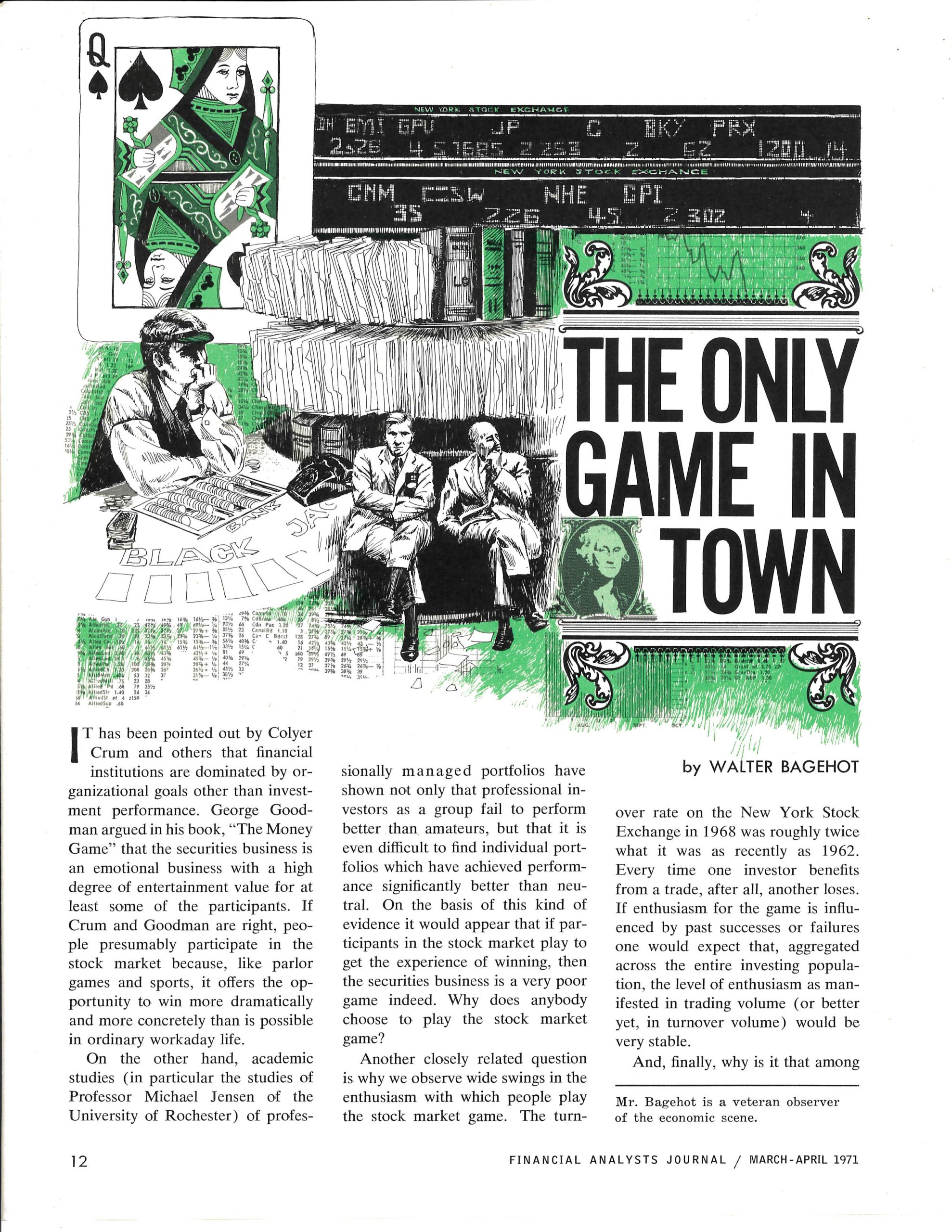
Treynor not only published under his own name but the names of two notable 19th-century economists: Walter Bagehot and Alf(red) Marshall. In fact, one of Treynor’s most cited articles, “The Only Game in Town” (1971), was written under Bagehot rather than Treynor. His motivations for using these pseudonyms and why he specifically chose these two remain a mystery yet to be unraveled.
First page of “The Only Game in Town” (1971)
The material in this collection came from Treynor’s home, which doubled as his office for Treynor Capital Management (TCM) after it was established in 1985, and two women from his family directly supported his professional career. His wife Elizabeth “Betsy” Treynor served as TCM’s administrative assistant and played a significant role as the creator or co-creator of many records, including most of the electronic ones. Additionally, there are printouts of emails intended for Jack but addressed to Betsy, with her responding either on his behalf or in her own capacity.
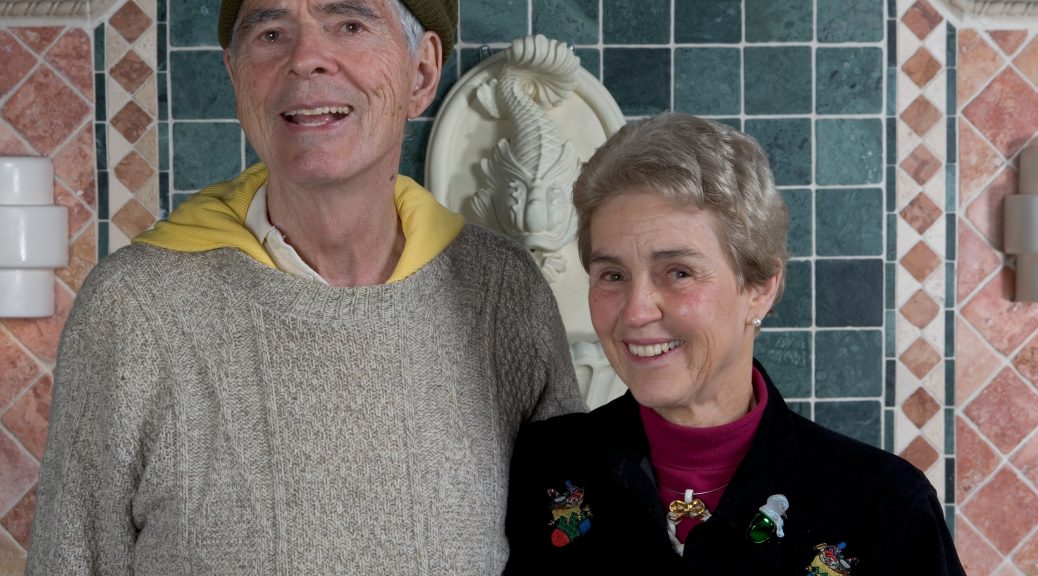
“Betsy” and Jack Treynor outside their home in Palo Verde Estates, California.
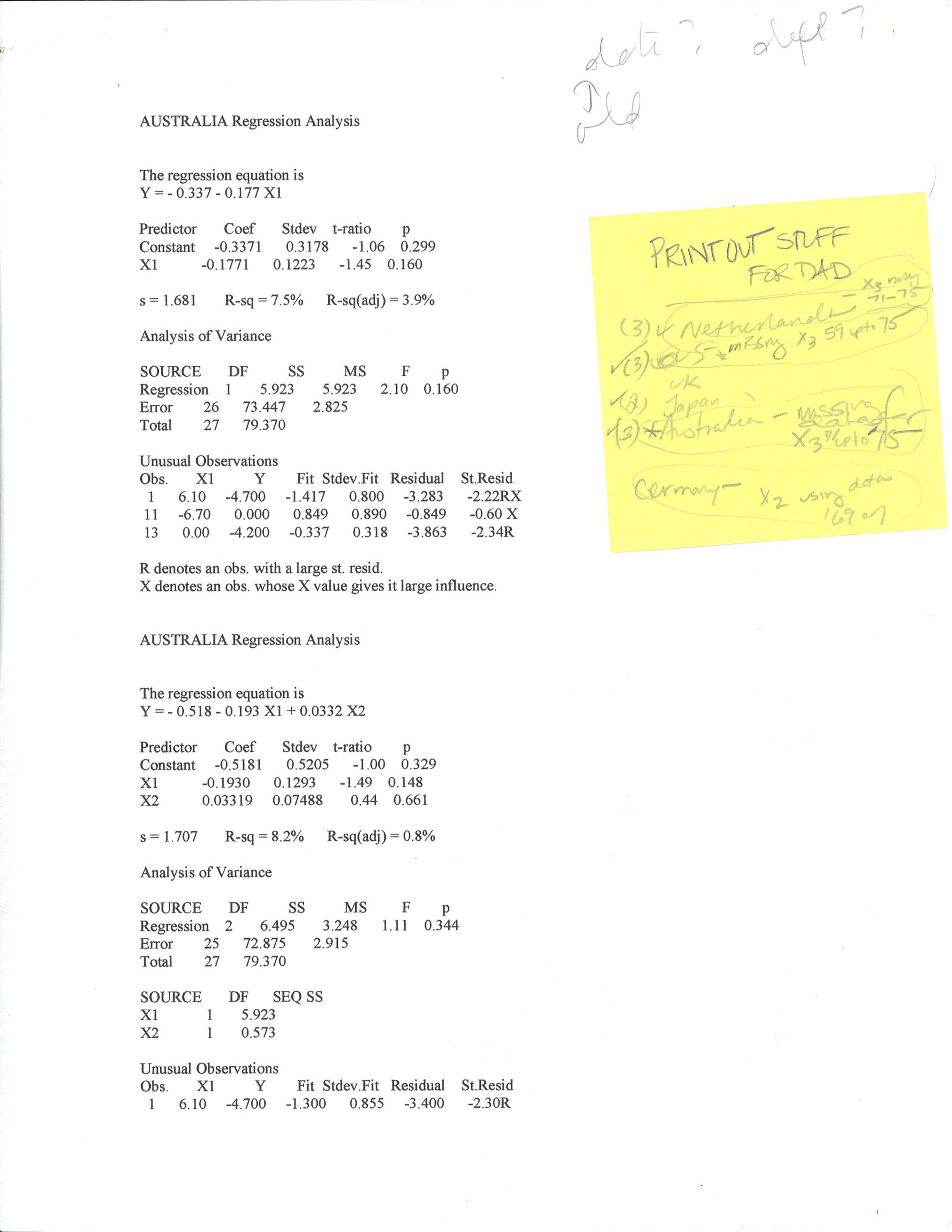
His daughter Wendy Treynor, who double-majored in economics and mathematics before pursuing a career in social psychology, annotated drafts of articles and conducted regression analysis.
Regression analysis conducted by Wendy Treynor.
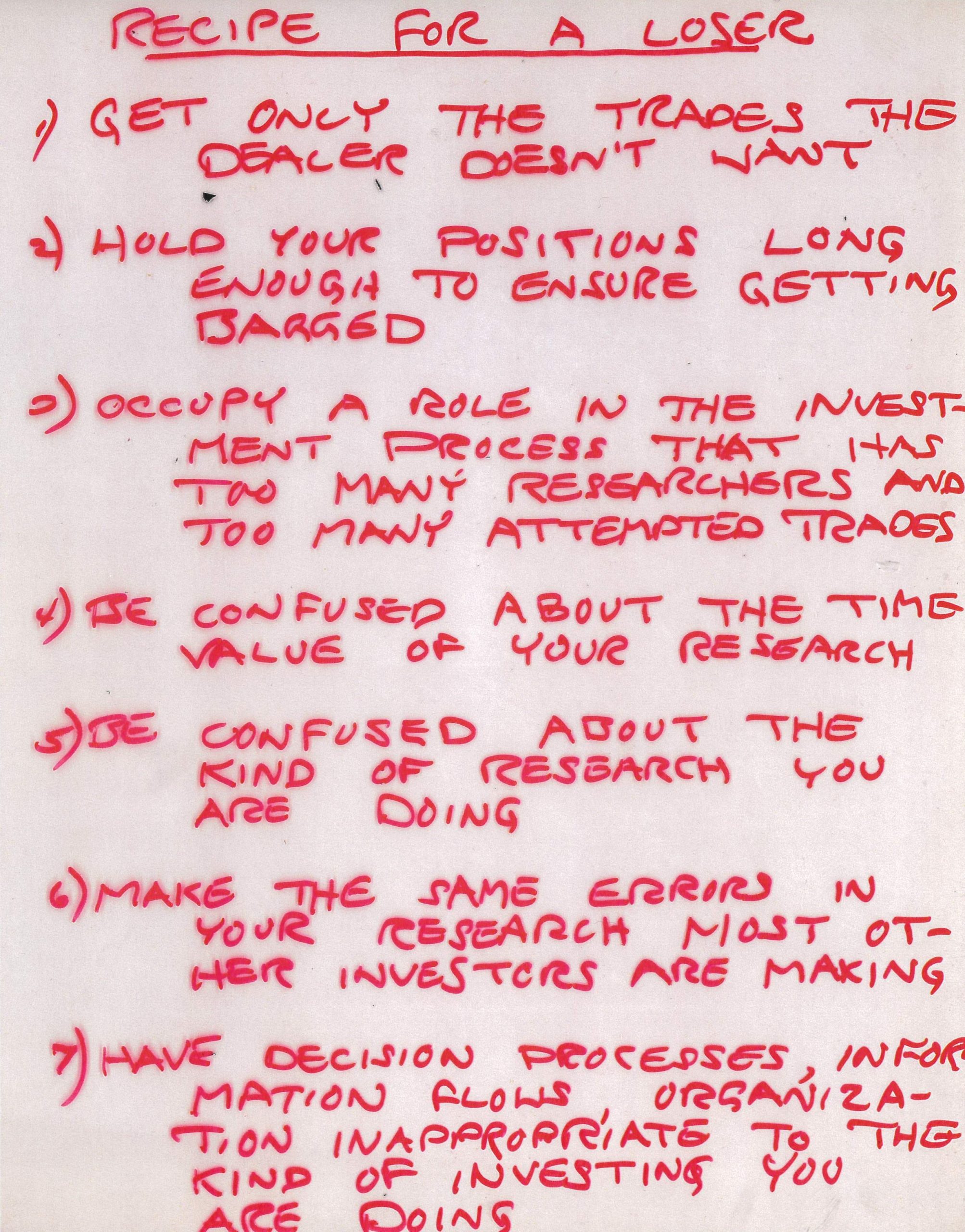
One unique aspect of this collection is the abundance of handwritten items, including over 50 letter-size notepads and hundreds of transparencies (the originals of which have been photocopied and subsequently discarded; preservation photocopies have been retained in the collection).
“Recipe for a Loser,” written in ink on a transparency.
Unlike most other economists represented in the Economists’ Papers Archives, Treynor was not a lifetime academic, having spent only 1985 to 1989 as a visiting professor at two institutions. Instead, his day job was as a financial analyst, with his research and writing on the side.
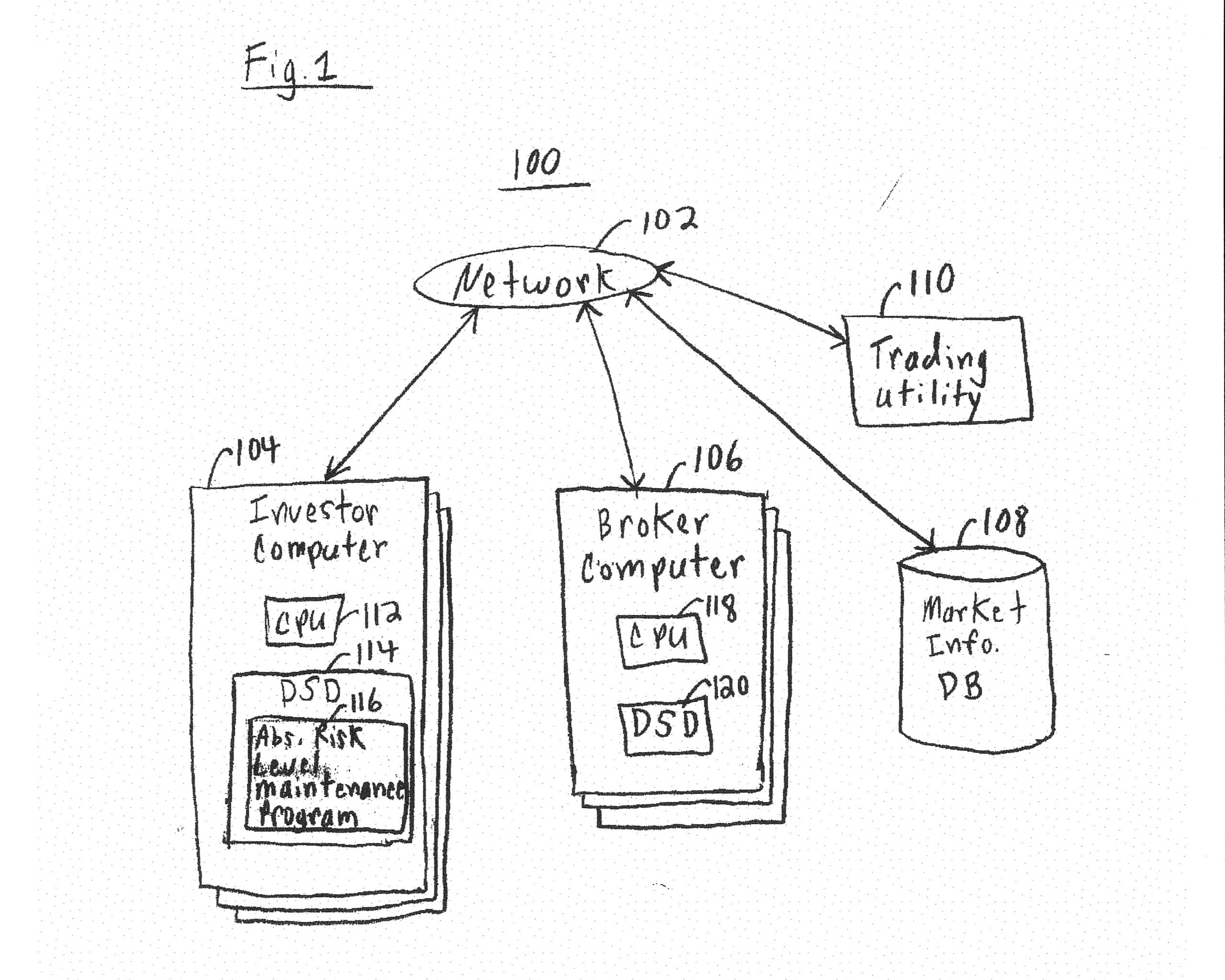
Treynor made significant contributions to the field of financial analysis, such that his peers in professional associations recognized him as having “changed the direction of the profession.” Demonstrating his innovative spirit, Treynor also registered a patent in 2004 for a “Method for maintaining an absolute risk level for an investment portfolio.”
Draft of a diagram for Treynor’s patent application.
Although the above diagram might leave us scratching our heads, it is undeniably cool because it is so well-drawn. Speaking of cool, Treynor was also an avid model train collector and layout builder (a nod to his hometown roots) and enjoyed writing plays in his spare time.
Intricate model train layout in Treynor’s two-car garage.
Post contributed by Mattison Bond, Project Research and Outreach Associate, John Hope Franklin Research Center
We at the John Hope Franklin Research Center are back again with another blog post to highlight some of the unique oral histories that can be found in the Behind the Veil Digital Collection. Last week’s post featured interviews from folks from Kansas, Louisiana, and Michigan. This week, we take a deeper look into the collection by focusing on the interesting items that can be found from Mississippi, New Jersey, North Carolina, and South Carolina.
Also all the oral histories that will be featured this week focus on the lives and experiences teachers!
Mississippi
When using the Mississippi location filter, you will find a total of 71 items that are listed in the collection. But using the search bar will let you into another part of the collection that is just as valuable and interesting. It would be a disservice to the researcher to not point to the Mississippi Self-Portrait file that contains a total of 42 pictures of men and women from the 1950s. Flip through the collection to see the faces of graduates, families, couples, and even a Santa Clause.
The oral history that is highlighted today is accompanied with just as many interesting photos. Lucinda Gulledge, born on a farming community in 1913 in Hernando, Mississippi. Along with being a teacher assistant, Gulledge was active within the Civil Rights Movement. The first time she began to take part was when she boycotted the Liberty Cash grocery store because they would not allow Blacks within the facility.
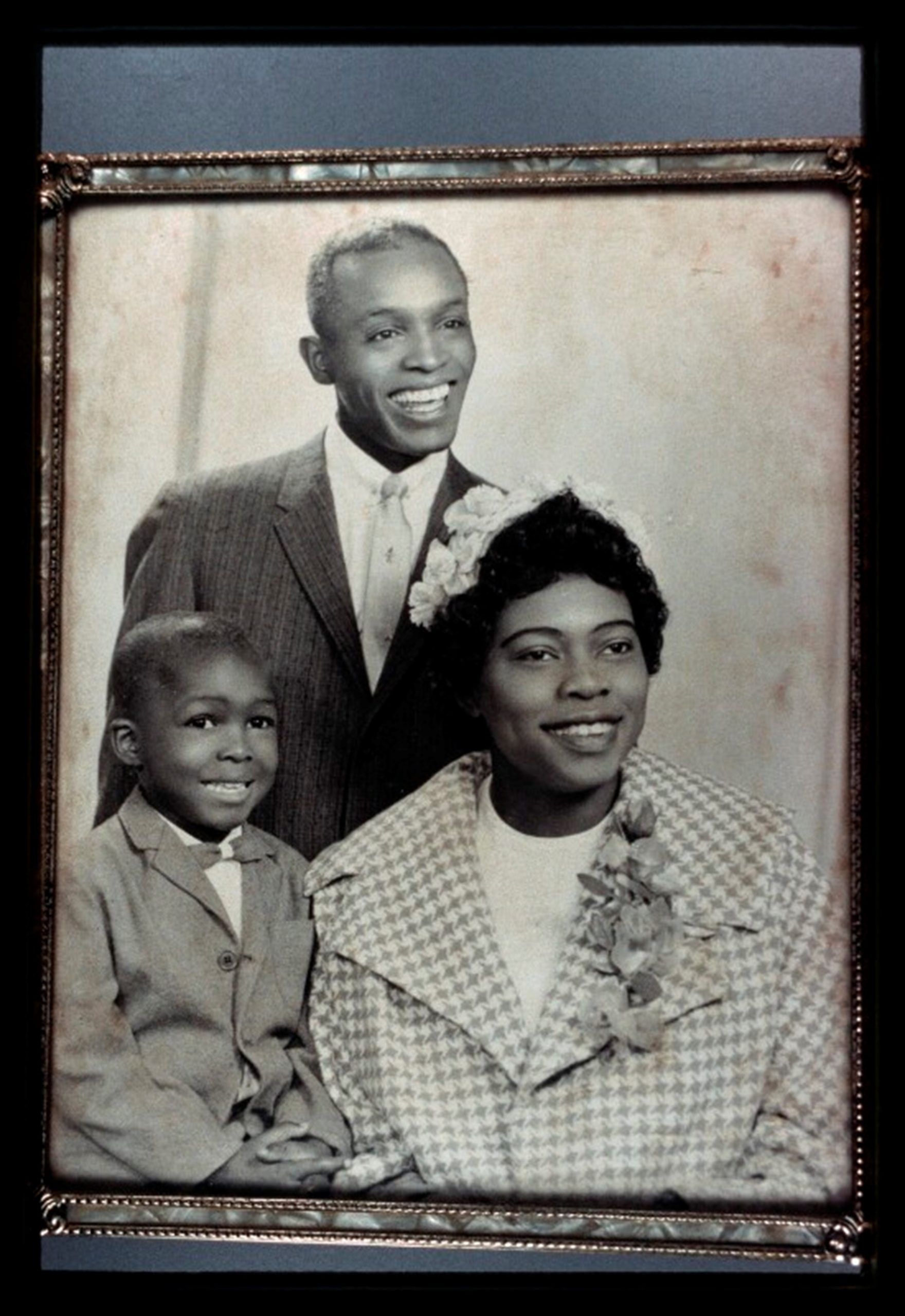
Lucinda Gulledge slides: Family portrait, 1940s https://repository.duke.edu/dc/behindtheveil/btvst008001007
Lucinda could be described as fearless and resilient, as she boldly stated on multiple occasions that she did things other people were afraid to do. Such as driving a woman and her children to an integrated school:
Part 2 00:00“People were just plain scared. And so I don’t guess you could blame them for it. They was plain scared. And this one lady and my son and her daughter was the only two kids in my integrated that school. She wouldn’t carry her daughter over there unless I went with her, she was just plain scared. Some people just had that fear, but I never was. Never was. And so when they went from Davis to Greenwood High, I’d get in my car, I’d go over there and pick both of them up. Pick both of them up, bring them on home.”
And housing some of the white protesters that were coming down to participate in the movement.
Part 1 7:40 “See, I wasn’t like the rest of the Colored people, scared. “No, he ain’t coming to my house.” A lot of them didn’t let them come in their houses. I said, “They can come here.” They come here, and I ain’t never did have to trouble. They stayed as long as they want. Stayed all night. Yeah, they stayed all night. Sure did. When I didn’t cook for them, they would get up and go in there, and fix something their self. Even I had some white ladies to come. Sure did. It was rough, but we made it through.”
Like many folks Gulledge participated in the movement by attending boycotts and marches, even attending a march to see Martin Luther King Jr. She would provide a place to stay to local and sometimes well know civil rights activist like Marian Evelyn Wright, children’s rights activist. She would work with organizations like SNCC and SCLC and help organize voter registration.
New Jersey is another one of the smaller location filters within the collection. There is only one oral history within this part of the collection and it belongs to Dolores Bradley, who is actually a North Carolina native from Northampton County.
From Bradley’s interview, researchers gain insight into how the civil rights movement impacted her hometown in rural North Carolina, where she attended Northampton County Training School. She recalls that one of their early fights was for transportation for Black children to attend school. Her father, a principal, and community members organized the NAACP, successfully obtaining buses for Black students and a gym for the school.
Part 1, 12:07 “There weren’t any Black buses originally, I don’t think, when I first started to school, because I can remember my older cousin who was almost 10 years older than me, and his friends. He would wait for them, and they came from a little town, it’s called Pleasant Hill, which was two miles beyond where we lived. They had to walk up almost five miles into town. Then, I can remember a man named Mr. Buffalo, and my dad, Mr. Earl, who was the principal at that time. I guess I must have been between eight and 10 or 11 years old, because I vividly remember when they fought to get the school buses for the Black students to ride. They had meetings and what have you, and basically, that was the same group of people that organized the NAACP in our county”
When Bradley moved to New Jersey, she was originally under the impression that things would be better. She admits to feeling freer in the South than she did up north.
Part 2, 3:41”…I had heard the myth of the North and had bought it. And then, when I moved there, after I was grown and out of college or what have you, I realized that I was no more free than I was in the South. In fact, I think I felt freer, because I was younger and maybe more—Again, I was in that kind of shelter thing in the South. So in some ways, I felt freer than I did in New Jersey.”
She provides listeners with an intimate view of her life as she tries to pursue education, travels to Norfolk, VA, and enjoys holiday celebrations with her family.
When opening the location filter, you will notice that the first state listed, indicating that it is the largest part of the collection comes from North Carolina. With a total 338 items, the materials within the North Carolina collection span audiocassettes, oral histories, and pictures. Not listed under the location filter are two videos from the Duke University Center for documentary Studies [https://documentarystudies.duke.edu/] that features teachers from Wilmington NC.
These videos detail black education in New Hanover County, giving viewers information about the history of education within the county and the thoughts of different educators about their jobs. For example, Educator Lavinia E. Sneed believed that
Video 2, 7:17 “teaching gave me good full life, and it was because of my opportunity to help develop my students that I feel like my life has been fulfilled. I’m praising the pression of teaching, because it has been the best thing that I have known.
Some would speak on their experiences dealing with desegregation, attending programs to learn about the problems of desegregation sponsored by UNC Chapel Hill and pushing for it within their own schools. Bertha Boykin Todd, a media specialist spoke about trying to purchase books and materials that taught about desegregation.
Video 2, 1:41:50 “I was reprimanded several times for ordering too many books on the desegregation and integration topics. Of course, that didn’t stymie us too much. We continued to provide for our students what we thought was best.”
While there are many teachers to be found under the North Carolina location filter, these videos allow viewers to connect a face to the voice, and to experience first hand the passion and resilience of educators as they strive to make a difference during Jim Crow.
There are a total of 123 items within the collection that can be found under the South Carolina location filter. Fittingly, there were more educators interviewed within this part of the collection and thus we will end this blog post with highlighting educator Lula Homes.
Earnestine Atkins, Lula Holmes, and Louise Nesbit slides: Lula Holmes with four generations of women (Lula Holmes in standing, with her grandmother, mother, and daughter present), 1930s-1992
Throughout Holmes recollections, the oral history provides a vivid picture of the what it was like attending the historic Penn School, located on Saint Helena Island. She speaks about the classes that were offered and which ones especially piqued her interest.
Part 2, 1:17 “Let’s see. English, literature, math, biology, chemistry. I’m trying to think now. And then, we had the industrial. We had Home ec, sewing…My favorite class would be chemistry. I like history. Ancient history or just plain history.”
There was a clear difference in the what was taught between the boys and girls within the school. Regardless, the Penn school provided opportunities for the children to learn skills that would be helpful to not only them, but the surrounding community. She recalls participating in what was called the “better home day” where,
Part 2, 21:08 “the home ec class would take a building in the community that was in disrepair and they would use it as a project. And the girls, the boys would do the woodwork, put in new interiors…the girls would go and we’d make draperies, we’d make the— Even if the bed was an old bed, either we would find somebody who would give a bed. Some of the stores or some White family would donate a bed or some Black family who had an extra bed or an extra table or an extra, not lamp. Well, oil, kerosene lamp then. And the boys would make, if they had a fireplace, they’d make [indistinct 00:23:06] iron, and so that it would be nice looking. And anything in the house that needed repairs was done. And the boys would take old furniture and refinish it. And then we would have a big day, a celebration where the public could go in and out and see what can be done with little or no money. And that involved both the boys and girls in our industrial work. They saw some of the things that we learned at Penn in our classes. That was a big day.”
While there are no photos directly linked to the oral history, searching for “Lula Holmes” on the webpage provides access to photos of Penn students and campus buildings from another part of the collection.
St. Helena Island, South Carolina, Penn School and Penn Center: Prints https://repository.duke.edu/dc/behindtheveil/btvst035019Earnestine Atkins, Lula Holmes, and Louise Nesbit slides: Girls with vegetable sign, Farmer Fair, Penn School, St. Helena Island, S.C., 1939 https://repository.duke.edu/dc/behindtheveil/btvst009001001
Post contributed by Mattison Bond, Project Research and Outreach Associate, John Hope Franklin Research Center
Highlighting Oral Histories by State Part 3
We at the John Hope Franklin Research Center are back again with another blog post to highlight some of the unique oral histories that can be found in the Behind the Veil Digital Collection. Last week’s post featured interviews from folks from Georgia, Illinois, Kentucky. This week, we take a deeper look into the collection by focusing on the interesting items that can be found from Kansas, Louisiana, Michigan.
There is only one oral history that falls under the Kansas location tag. This oral history belongs to Ulysses Marshall, factory worker and sharecropper. Marshall was born and raised in St. Louis Missouri until he turned thirteen when his family moved southward to Fargo, Arkansas. When asked about his experience in Fargo, Marshall simply states, “It was bad.” This same sentiment would be repeated throughout the oral history as Marshall recalls his experience living within the South during Jim Crow.
When recalling his first experience with racism:
Part 1, 14:23 “I was pointing at this here White man. It was something I was pointing to, because I was trying to show my mother and father about it, and my daddy, he knows that could be an offense to point at the White man. That was a bad thing, because he may even think you was talking or making fun of him. He said, “Don’t do that. Don’t never do that. Don’t point at that man,” or something like that. “You could get us all in trouble.” It was just that bad.”
Or when describing police brutality: “Brutalities were bad. Bad. Real bad”
And even when he was recalling his experience as a Navy man:
Part 1, 32:17 “Well, yeah, they would about the prejudices, the hatred, and stuff like that. And this is one reason I couldn’t make a career out of it. Some of them made a career out of it. I said it wasn’t much freedom back here, but it wasn’t no freedom at all, back there, because to me, it was just you’re confined in a prison or something like that. It was just completely, totally discrimination, during that time. So that’s why I got out, and I could never see—well, they tell me the Army was a little better, but it was bad, because my brother, he retired from the Army and he was telling me some of the experiences that he went through, something like that. But they was bad, real bad.”
Marshall would end up in Kansas for the same reason that his father would leave St. Louis, Missouri, in search for work. After a long search for work in California with no success, Marshall would find work at a steel mill in Gary, Indiana. He would then be laid off that would lead to him finding work in Kansas at an airplane factory, where he would retire from.
The oral history of Ulysses Marshall may be bleak to most that take the time to listen to it. His life, filled with struggle and constant racism since moving South, is a reflection and example of the horrors that Jim Crow inflicted on the lives of everyday African Americans. But, as with many of the accounts within the collection, Marshall is still able to leave listeners with true and encouraging words. Interviewer Paul Ortiz would ask Marshall, what was it that “kept [him] going and striving through all the difficult” moments. Marshall, inspired by President Floyd Brown, founder of the Fargo Agricultural School would respond:
Part 2, 9:02 “I got a lot of inspiration from President Brown. Like he said, like his motto used, “work will win,” and to me, I’m a stronger believer in that. I think if a person wants something bad enough and go ahead to work and pursue it, I think he can accomplish. I think a man could reach about any goal that he strive for if he go—you got to put something into it because nothing going to come there and fall in your lap. I mean, if somebody think that, they just fooling theyself. So I kind of like that motto, “work will win.
The Louisiana location filter is the second largest in the collection, with a total of 138 items. When looking for a unique story in this part of the collection, the easiest option would be choosing the oral history of the only cytologist. Michael Gourrier was born and raised in New Orleans. He moved to Columbus, Ohio in 1962 to go to graduate school and then to Indianapolis. It was not until 1969 that he moved to Texas to work as a laboratory supervisor for the United States Public Health Service.
Interestingly enough, listeners do not learn this information, or much information about this particular occupation until closer to the end of the interview. Gourrier’s oral history focuses more on the history and contributions of African Americans to music, particularly Jazz. His early exposure to all types of music would set the tone and theme of the oral history as one of the first questions he answers is how Jim Crow shaped his life, and the music scene of New Orleans.
Part 1, 8:56 “New Orleans was a segregated society to an extent. It still is today. But from my perspective, music is a language that transcends all races, ethnic backgrounds and laws, whether legal or illegal…. Well, the other areas of activity around the city as far as the housing and the general accommodations and all, they might not have been able to live up to that particular adage. But as far as music is concerned, I think that it is definitely one of that you could say was really separate but equal, if not better.”
Within the interview, Gourrier provides listeners with a comprehensive history of race relations both outside and inside the music scene of New Orleans. While he believes that “Music has no color. I mean, it’s not black, it’s not white, it’s not red, it’s not green,” he acknowledges that Jim Crow laws significantly influenced the development of musicians, particularly in the South.
Part 1 31:51 “… the backwardness of the South, they were always behind and they were just slow in evolving. And then because of the segregation, Blacks were extra slow in being exposed and afforded the opportunity to be involved in this particular aspect. So I think this was one of the big factors as far as why everything here was, and shall we say, a later stage of development than it were other places. Because I mean, if you go back and you look at the period called the Harlem Renaissance. What were we doing down here? I guess you could say we were just one step past the menstrual shows during that particular period down here”
Gourrier’s passion for educating and sharing his love for Jazz would grow throughout time. He even mentions that after he retires, he hopes to become a jazz historian. Still alive today, he is better known as Mr. Jazz, radio host of WRIR-FM RDIO in Richmond, Virginia.
Picture of Michael Gourrier, source: “Word and Image: Michael J. “Mr. Jazz” Gourrier Jazz Director at WRIR- Style Weeklyhttps://www.styleweekly.com/word-image-michael-j-mr-jazz-gourrier-jazz-director-at-wrir/
The Michigan location filter has only two oral histories. Both interviews were conducted in two different cities and while each is unique, one stands out for several reasons. Alex Byrd, the interviewer of both oral histories had the pleasure of interviewing his own father, Sanford Byrd!
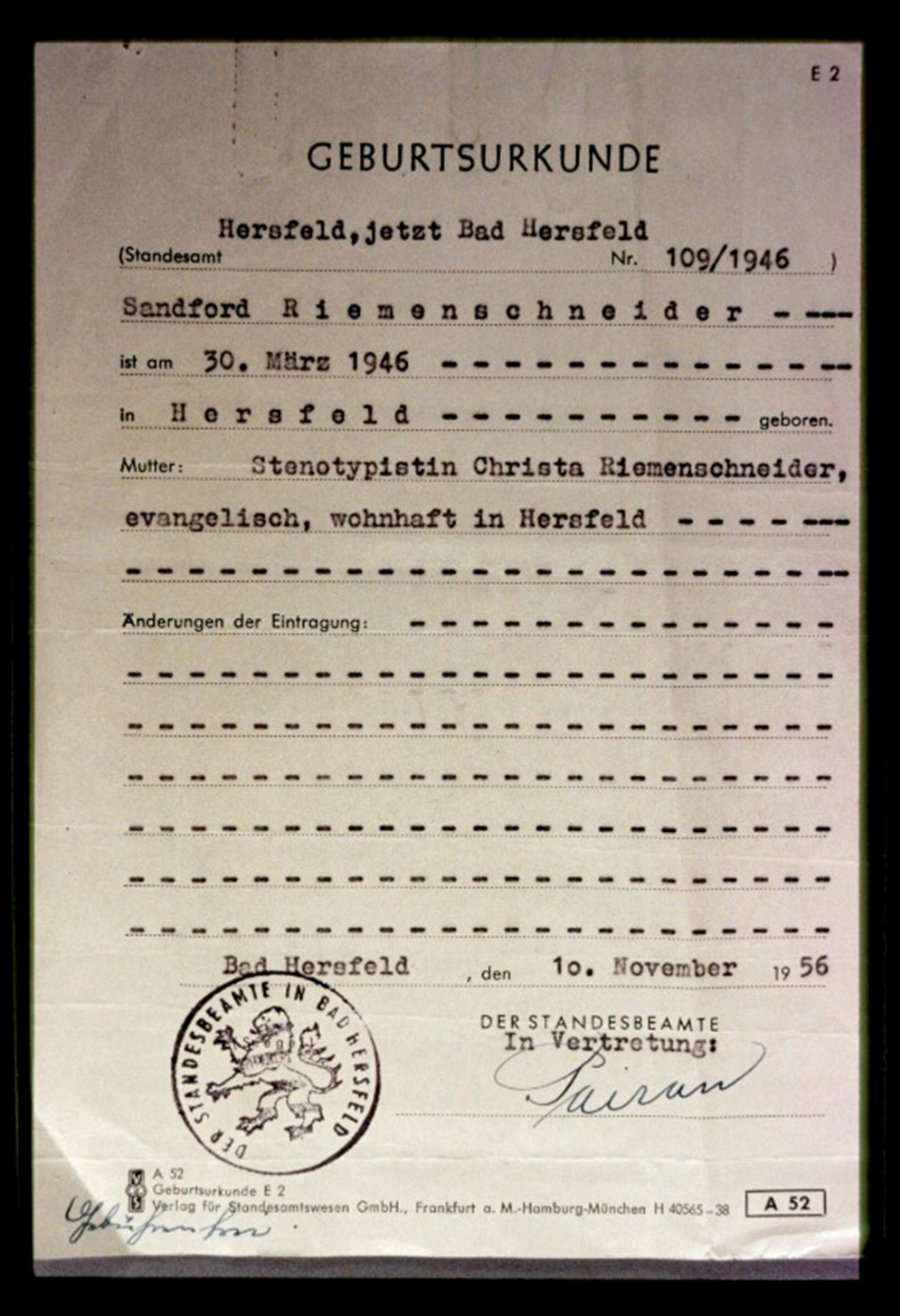
Sanford Byrd’s earliest memories are within an orphanage in Essen and Bad-Herzfeld, Germany. He did not know his biological parents and he also mentions that Sanford is not his actual name. He also is unsure whether the date listed on his birth certificate is correct or not.
Sanford Riemenschneider’s (Byrd) birth certificate, 1946 March 30 Alex Byrd slides: Sanford Riemenschneider’s (Byrd) birth certificate, 1946 March 30 / Behind the Veil / Duke Digital Repository
Part 1, 8:58 “But my name in Germany was Franz. That’s F-R-A-N-Z, which I think the English interpretation is Frank. Franz Xavier, which is a Saint’s name since I was Catholic. Well, they told me I was Catholic. I was too young to have any religious beliefs. Xavier and Maria, which really in Germany wasn’t unusual for a boy to have a girl’s name, especially if was a saint, a patron saint. And then Riemschneider. Okay. Riemschneider is spelled R-I-E-M-S-C-H-N-E-I-N-D-E-R. Riemschneider, which literally translated means belt tailor. Riem being a belt, and Schneider is a tailor”
Throughout the oral history Sanford recalls his time within the orphanage and how being black in Germany was much different than being black within the United States. Broken into three parts, listeners are able to travel with Sanford across the states, learn and listen to the German language, and listen to the light banter between father and son as he recalls his personal history.
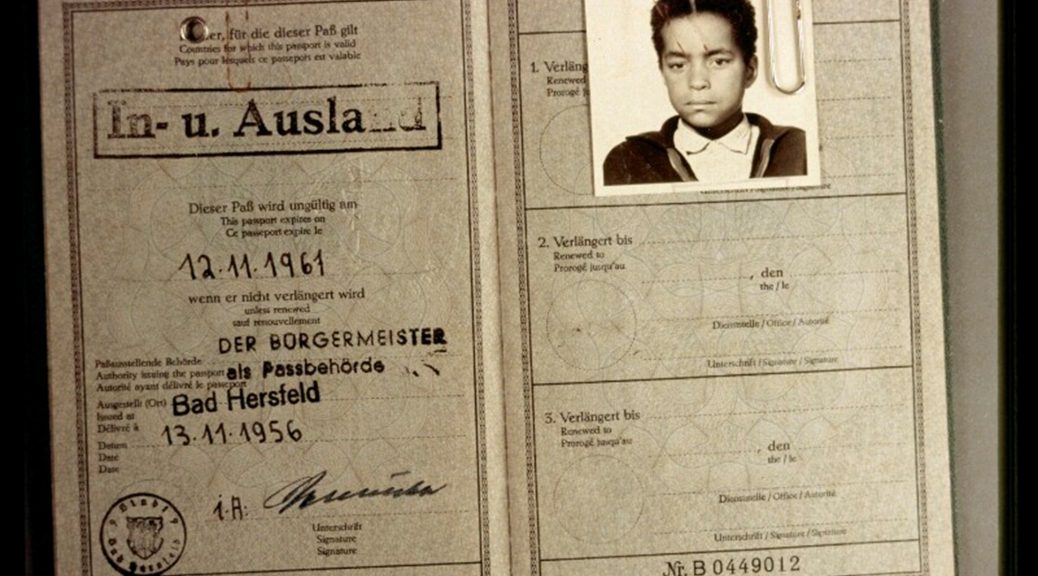
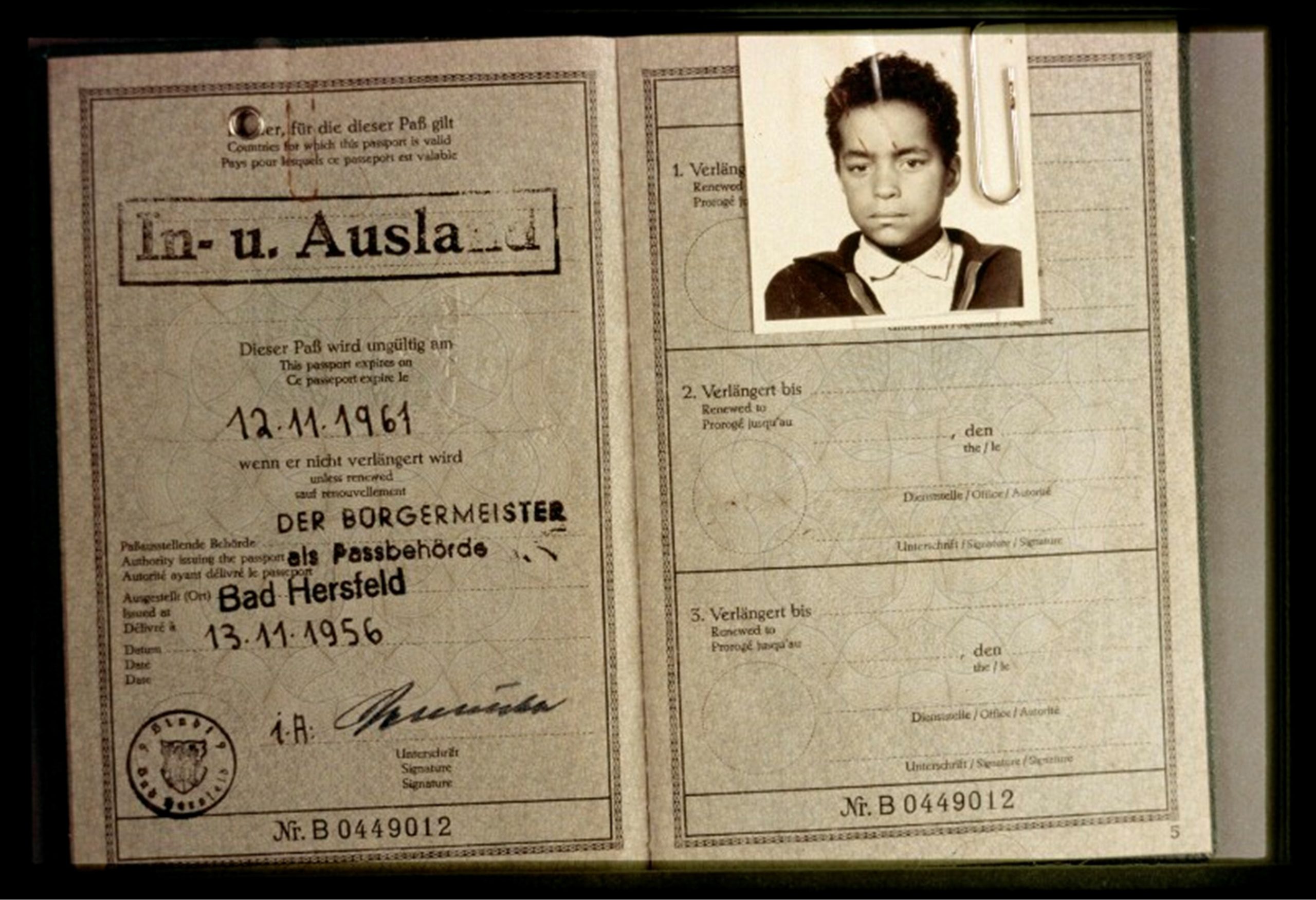
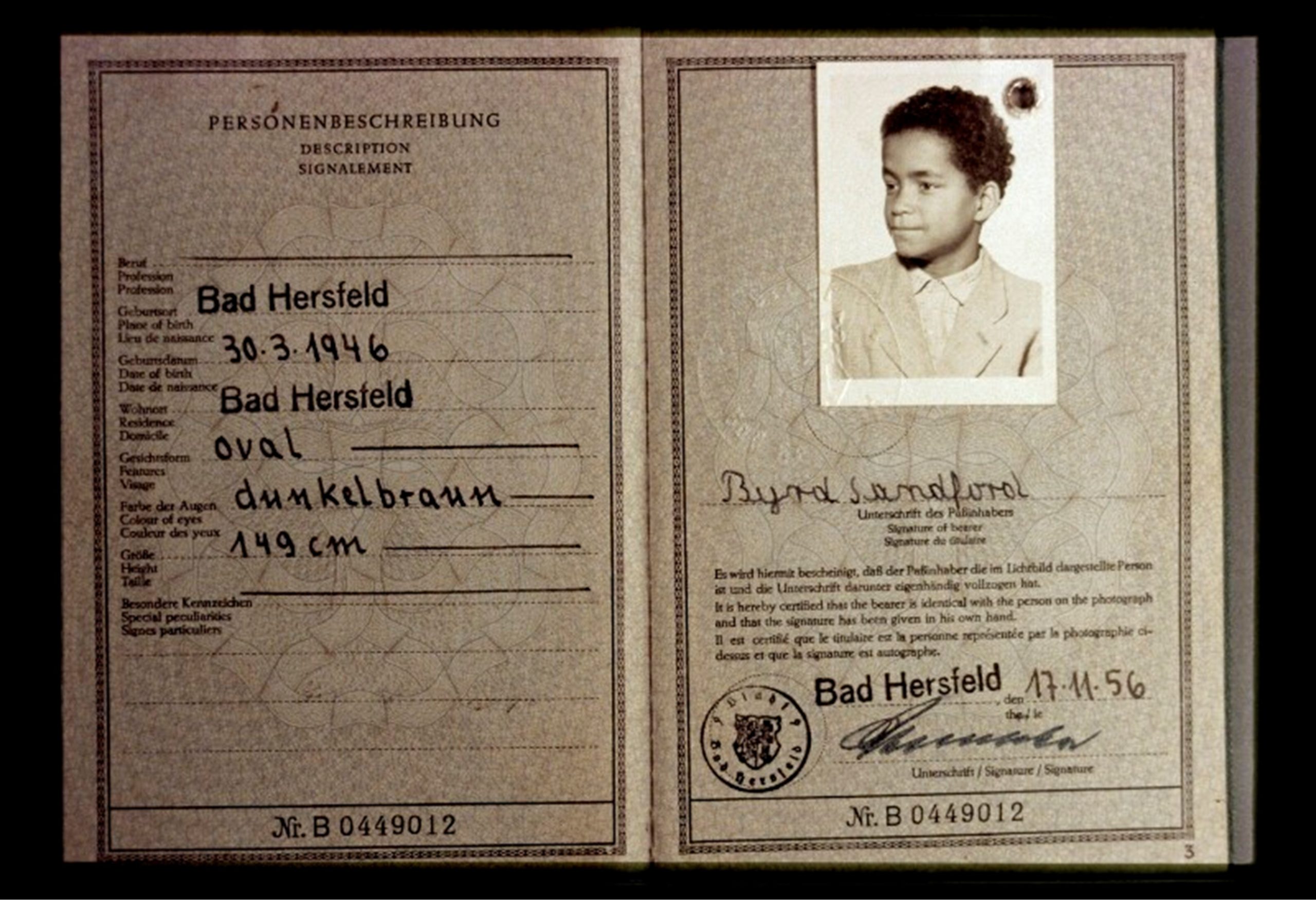
By searching for Sanford’s interview in the search bar at the top of the page, researchers and listeners are also able to come across Sanford’s German adoption files and pictures of young Sanford from his passport.
Inside of Sanford Byrd’s passport, 1956 Alex Byrd slides: Inside of Sanford Byrd’s passport, 1956 / Behind the Veil / Duke Digital Repository
Inside of Sanford Byrd’s passport, 1956 Alex Byrd slides: Inside of Sanford Byrd’s passport, 1956 / Behind the Veil / Duke Digital Repository
Post contributed by Mattison Bond, Project Research and Outreach Associate, Jon Hope Franklin Research Center
Highlighting Oral Histories by State Part 2
We at the John Hope Franklin Research Center are back with another blog post to highlight some of the unique oral histories that can be found in the Behind the Veil Digital Collection. Last week’s post featured interviews from folks from Alabama, Arkansas, and Florida. This week, we take a deeper look into the collection by focusing on the interesting items that can be found from Georgia, Illinois, and Kentucky.
While searching through the collection using the Georgia location filter, you will find two women that share similar names but different lives, Carolyn Johnson King and Carol Johnson King.
Carolyn King, born in 1948 on what was once a plantation. The Keaton Quarter was owned by a white doctor, had a white overseer, and held multiple black families that worked on the land. Her oral history starts with detailing life in rural Georgia and the relationship that she had with the other families:
Part 1, 13:05 “It was great. Everybody just was quiet and people got together and went to church and we had to go to Sunday school every Sunday… Most people were kin, we were all kin people, one thing. We were all related. All family people, we really were. Like if someone would have a baby, like if my mother had a baby, a lady in another household would come and cook for us and wash for us maybe one or two weeks until my mother able to get up and go and do what she could do, until she got better…If anybody got sick, people would just go to that house and just really take over until that family got better…Everybody, just one happy family. We didn’t have much, but we had a whole lot of love, that was one thing.”
Interestingly she also goes into details about her time as a minster, detailing some of the visions that she experienced in her life time.
Part 3, 1:58 “If I sit down, this angel would sit down. If I get up, it would get up. It followed me around the house for a couple of months… I would see blood. The walls would be covered in blood…And I know some of this that I seen was the devil. The devil was showing some of these things, I know that now.”
About a month before, Sally Graham, who also interviewed Carolyn King, had a conversation with Carol Johnson King. Carol was an educator and the first director of a federally funded Head Start program within the southeastern part of the country. Her oral history details her time as not only an educator and director, but also being apart of the Dougherty County School Board, an activist, community organizer and the wife of famous civil rights lawyer C.B. King.
Along with her story, Carol’s oral history is unique because it has 34 related items that contain the photos of the autograph books of her in-laws Margaret (Maggie) Slater and Clennon King when they attended the Tuskegee Institute. Carolyn recalls that “Daddy King” drove horse and buggy for Booker T. Washington and that George Washington Carver wrote a note in “Mama King’s” graduation book.
Carol King slides: Clennon King’s autograph book – note from T.V. Gaunt, 1916 April 17 https://repository.duke.edu/dc/behindtheveil/btvst007006004Carol King slides: Maggie Slater’s autograph book – note from C. Valentine, 1912 April 20 https://repository.duke.edu/dc/behindtheveil/btvst007006023
It is important to note that both interviews are titled “Carol King”. By paying attention to the “Item Info” found below the interview transcript you can distinguish between the interviews, paying attention to the description info and the occupation. Or you can use these links to find them here!
There are only three oral histories found under the Illinois location filter. All three interviews were recorded in Chicago, Illinois and each interviewee was born in Arkansas. Today we focus on the life of Christine Trailor , one of the seventeen beauticians that can be found in the whole collection.
Christine Trailor was born January 5, 1928, in Crittenden County, Arkansas. Within the interview, she shares her experience learning how to do her own hair and how she came to be a beautician.
“I learned by doing—Well, I always have had to do my own since I was six years old, so I used to have a lot of hair, so sometime a girl would stop on the way to school, and help me do my hair. It was real thick and long. And then I started, when I came here, I guess it was a, well, passing time, and I just started doing hair. Actually, I didn’t play basketball because—I liked playing basketball, but every time I would start to play, it was a girl that didn’t like me. She would come and just ring the ball out of my hand, and that just turned me off. And I started going to the hut, I guess was a way of passing the time, keep from being bored. So that’s when I started doing hair.”
She migrated to Chicago, IL in 1951 after finishing college at Arkansas AM&N. Once there she worked at two tailoring shops, pursuing a career in cosmetology after. Two years later she opened her own shop. At the time of the interview, she was operating her second shop for 22 years.
Within her oral history, researchers can learn not only her experience of being a beautician but also her experience migrating northward to Chicago.
By clicking on the Kentucky location filter, you will find the only five oral histories of “coal miners” within the collection. From those five, you can learn more about James “Jim” “Red” Eaves, the only federal mine inspector in the collection. Within his oral history, listeners can learn about the family of Eaves, back to his grandmother,
Part 1, 10:43 “And she was an old woman then because she had a Barker stick about four foot long, I guess, where she’d walk with. And she would follow you upside the head with that stick. I had a little old wheel I rolled around the house. She was sitting out in the yard, had a pipe in her mouth, smoking. She told me, said, “Boy, you get on out there if you want to roll that wheel. Don’t roll that around here near me.” I got out there. A few minutes later, I got back close to her. Next thing I know, that stick went upside in my head. The wheel went one way and I went the other. But she didn’t play now. When she told you something, she meant business.”
James Eaves started working in the coal mines around the age of 18. In the later half of his interview, listeners can learn more about his time within the coal mines as one of the few federal mine inspectors that were black. By searching deeper within the collection, you can also view his Foreman of Coal Mines Certificate.
Alex Byrd slides: First Class Certificate Foreman of Coal Mining for James Eaves, 1966 https://repository.duke.edu/dc/behindtheveil/btvst010008036
Mr. Eaves also makes an appearance in the oral history of Sydney Gilmore, another coal miner.
The John Hope Franklin Research Center for African and African American History & Culture is pleased to announce the launch of the Behind the Veil digital collection, now accessible in the Duke Digital Repository – https://repository.duke.edu/dc/behindtheveil.
Behind the Veil digital collection homepage
Behind the Veil: Documenting African American Life in the Jim Crow South was an oral history project conducted from 1992-1995 by the Center for Documentary Studies at Duke University. The 3-year digitization project, funded by the National Endowment for the Humanities in 2021, expands access to this archive of oral histories, photographs, and video recordings of African Americans who remained in the US South through the period of Jim Crow (see grant announcement here – https://blogs.library.duke.edu/rubenstein/2021/07/05/neh-implementation-grant-to-duke-libraries-will-increase-access-to-african-american-oral-histories/).
Olivia Cook and family, New Orleans, 1940sThree schoolboys, Wilmington, NC 1920s
The digital collection has over 4,200 items, highlighted by over 1,100 fully transcribed interviews and over 1,700 photographic slides. This archive represents the largest repository of stories authored by African Americans from the American South during the period of Jim Crow. In the coming weeks we will be sharing more of the interviews and supporting materials in Behind the Veil through a special blog series.
Behind the Veil Project Staff, 1990s
Use these links for more resources on Behind the Veil:
Post submitted by John B. Gartrell, Director John Hope Franklin Research Center
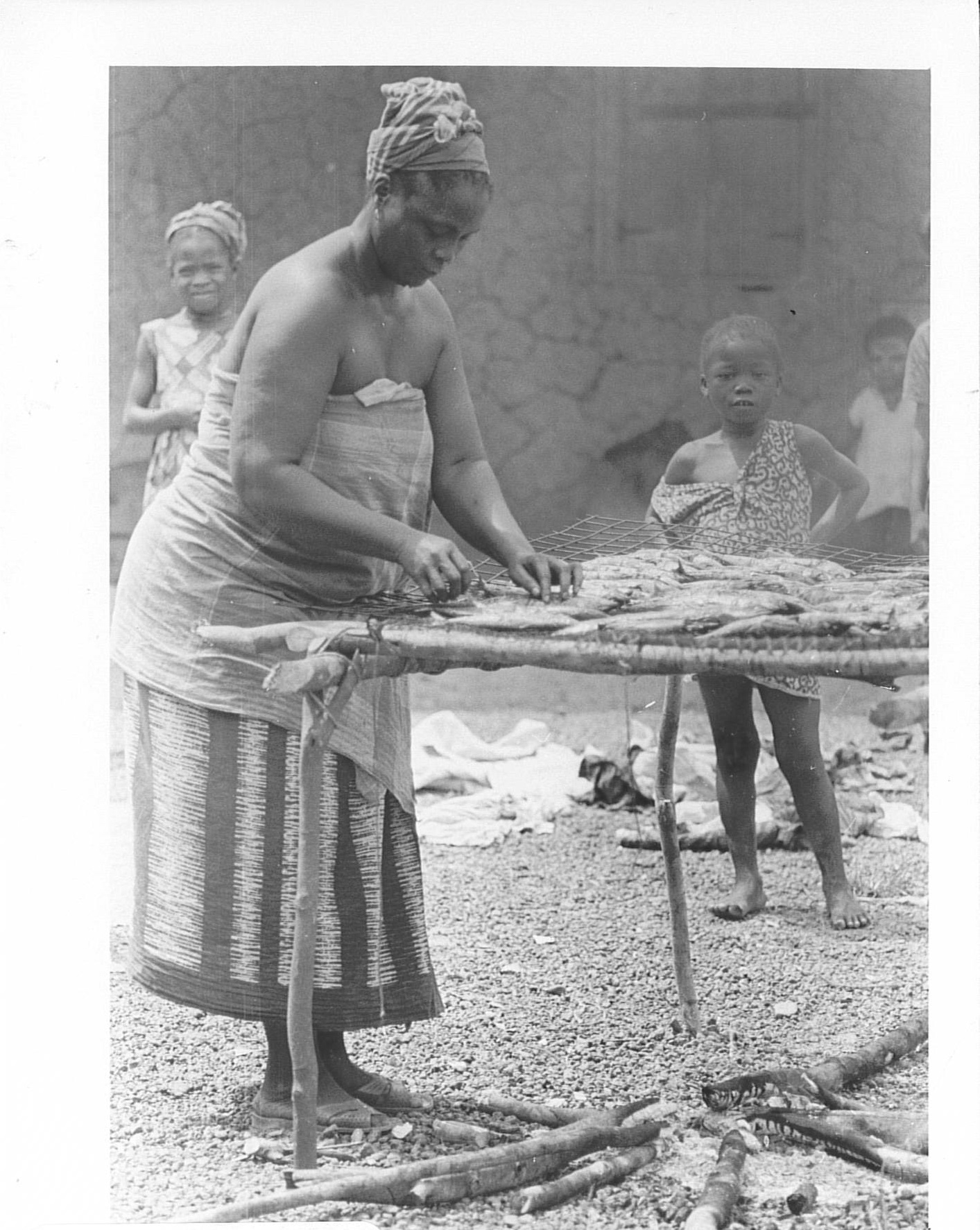
The John Hope Franklin Research Center is happy to share the acquisition of the Celeste and Reggie Hodges Photograph Collection. The collection documents nearly two decades of their life in West Africa, after they joined the Peace Corps in the late 1960s. While there, the Hodges’ worked as teachers and for international agencies but spent years applying their love of amateur photography to document the everyday life of their neighbors and friends with a unique look at the local customs from fishing, basket weaving, husbandry, religious and rites of passage ceremonies. Over that same time, they were also gifted a number of masks, instruments and other artifacts that have been donated to a number of museums over the last few years (https://nasher.duke.edu/stories/a-personal-gift-2/). Both Celeste and Reggie worked behind the camera and developed their film in a makeshift darkroom when they had access to electricity and water in their village. The photographs display African life before the devastation of wars and Ebola in the 1990s affected the people and places where the Hodges’ lived. The materials now in the Franklin Research Center include their photo negatives, original prints and digital scans, along with printed materials including artwork done by their students. This body of materials provides an intimate, firsthand perspective of this period and people. The collection will be made available once processing is completed.
Post contributed by Matilde Manara, Postdoc Fellow at Institut Lethica, Université de Strasbourg, France. Manara received an Eve Kosofsky Sedgwick Research Travel Grant, 2023-2024.
I approached the materials held in Eve Kosofsky Sedgwick’s Papers as part of a larger project on feminist models of writing, behavior, and knowledge to be found in Marcel Proust’s A la Recherche du TempsPerdu. I am particularly interested in understanding how readers can acknowledge a literary model such as A La Recherche, recognizing its importance in their life and/or art, without necessarily embracing its esthetic, moral, or epistemological foundations (and even by openly rejecting them). Along with Sedgwick’s Works in Fiber, Paper and Proust (2005), I delved into Chantal Akerman’s La Captive (2000), Jacqueline Rose’s Albertine (2001) and Anne Carson’s The Albertine Workout (2014). An important part of this research deals with questions raised by Sedgwick herself in her writings on Proust. In the final chapter of Epistemology of the Closet, she notably writes:
I was reading Proust for the first time during just the short stretch of years during which it occurred to me to have ambitions that were not exclusively under the aspect of eternity: to want to publish visibly, know people, make a go it, get a run for my money. Oddly, of course, it was reading Proust that made me want these adventures and think I could find them. The interminable meditation on the vanity of human wishes was a galvanizing failure for at least one reader: it was, if anything, the very sense of the transparency and predictability worldly ambitions that gave me the nerve and skill to have worldly ambitions of my own. Like, I believe, most young women, I never had a shred of identification with JuIien Sorel or the nineteenth-century French male plot of conquering the capital – until after the years of Proust-reading; then both the hero’s airy ambition and his concomitant uncritical adoption of a master text became intelligible and engaging traits (Sedgwick 1990, 241).
In preparing my visit to Duke, I had planned to explore this potential identification by dividing the materials I expected to consult into two categories: those related to Sedgwick’s academic work (syllabi from the seminars she held on Proust from around 1998 up to 2009, notes and drafts for Epistemology of the Closet and The Weather in Proust, scattered articles, and records of conferences) on the one hand, and those related to her artistic work (textile art, artists’ books, pieces from her 2005 exhibition, Works in Fiber, Paper and Proust) on the other. The days spent at Duke made me realize how much my plan was naive, even somewhat paradoxical, for these two practices are deeply intertwined and connected to each other in the same “fractal” way she suggests Proust’s novel should be read (Sedgwick 2011, 90-93).
Proust Box notebook with notes on paper dolls, hexaflexagons (first pages), Eve Kosofsky Sedgwick Papers, Box 40.
Proust Box notebook with notes on paper dolls, hexaflexagons (first pages), Eve Kosofsky Sedgwick Papers, Box 40.
I was most struck by two aspects of the materials I had the chance to consult in the archive. First, to see how Proust’s novel, in both its material dimension (the printed paper) and its virtual dimension (the hypertextual lattice we discover when not following a linear progression), becomes itself the object of a découture (witnessed by pages and pages of copied, printed and collaged quotations organized by Sedgwick under thematic headings such as Weather, Interior-outside, Albertine, Happiness, Anxiety, etc.), thus allowing the book’s complex architecture to emerge, while at the same time making it possible to detach from it, or even build it anew. Second, to observe how these shredded fragments feed into Sedgwick’s vast and increasingly central reflection on immanence (drawn on Proust as much as on Buddhism or the philosophy of Plotinus) to such an extent that the underlined pages of the many (including some multilingual) versions of A la recherche she uses over the years bear testimony to this gradual convergence, revealing how transformative reading the novel could have been for her.
My time at Rubenstein library has certainly given me the opportunity to enrich my project, helping me to better understand how Sedgwick reads, writes and seals in Proust – and not on, as she meant by the title of her exhibition at Harvard in 2005, “Works in Fiber, Paper, and Proust.” But it has also, and most importantly, touched me on a personal level, made my Proustian reader self fully and enthusiastically agree with her when she notices that:
It is harder to say in what this truth-effect of Proust consists. AII the paradoxes of a more traditionally conceived vraisemblance are especially active here: molecularly, there are relatively few individual propositions in or arising from the book that it would make sense to consider true; and even at the molar level, propositions or “values” or “attitudes” (erotic or political pessimism, for instance) that could be extracted from Proust do not necessarily seem true to me, to whom, nonetheless, “Proust” seems so “true”. Plainly, classically, it can be said that the coherence and credibility of the work, its vraisemblance in the usual senses, depend on an internal structuration of materials and codes that can only as relation, as structure, be interdigitated with or tested against the relational structures of a “reality” that surrounds and interleaves and thus mutually constitutes it. The truth-effect I am describing goes beyond questions of the work’s coherence and credibility, however. It has to do with the use of the literary work, its (to sound censorious) expropriability by its readers, its (to sound, in a different vocabulary, celebratory) potential for empowering them. For, unmistakably, the autobiographical parable I have just encapsulated as “the years of Proust-reading” represents both a prolonged instance of textual abuse and a story of empowerment. (Sedgwick 1990, 241).
Contributed by Adam Kocurek, PhD Candidate, History, The City University of New York Graduate Center.
With the assistance of a Harry H. Harkins, Jr. T’73, Travel Grant, I visited the Rubenstein Library in the summer of 2023 to carry out research for my dissertation, a history of LGBTQ+ faculty activism and community building in American higher education from the late 1960s through the late 1990s. During my visit, I explored several collections, ranging from institutional records to the personal papers of LGBTQ+ faculty members.
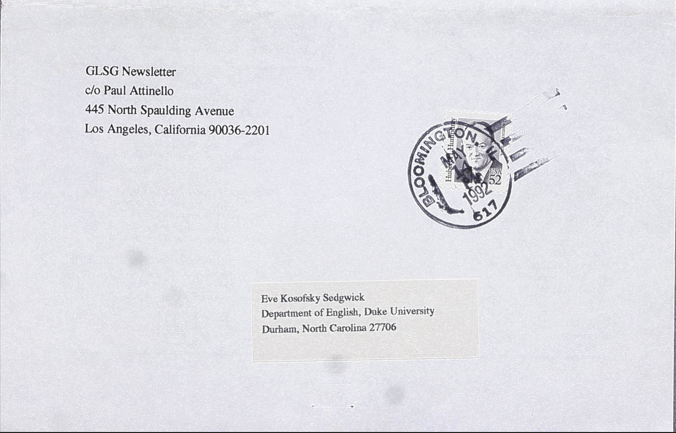
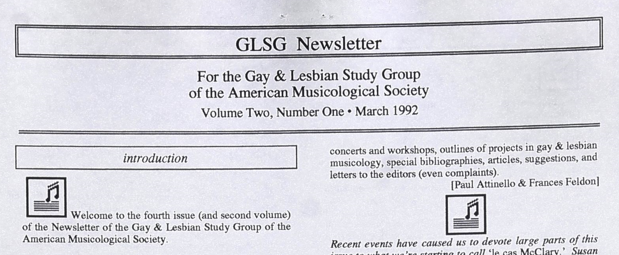
GLSG Newsletter
During my visit, I engaged with many magnificent sources that will feature in my dissertation. One such source from the Eve Kosofsky Sedgwick Papers, is volume 2 issue 4 of the Gay and Lesbian Study Group of the American Musicological Society “GLSG Newsletter,” published in March 1992. As a Ph.D. candidate at The CUNY Graduate Center, an institution at which Sedgwick worked and made important scholarly contributions, I found it to be an almost surreal and emotional experience going through her collection at Duke University. While Sedgwick was employed at Duke, she spearheaded LGBTQ+ issues at the university, serving as consultant on the University Coordinating Committee for Lesbian, Gay, and Bisexual Studies, as well as being an active member of the Modern Language Association’s Gay and Lesbian Caucus. Through her scholarly and activist networks, she amassed ephemera from around the country, providing amazing insights into the state of LGBTQ+ faculty’s political and social organizing during the 1980s and 1990s.
The GLSG Newsletter provides a fascinating snapshot of a transitionary period in the history of LGBTQ+ faculty organizing for their rights and recognition within higher education. In the wake of the Stonewall Uprising in 1969, lesbian and gay academics formed the Gay Academic Union (GAU) in 1973, the first group of out academics who strove to transform academia into an industry more accepting of LGBTQ+ scholarship and workers. The GAU grew to be a multidisciplinary national network, though within four years, it began to fragment and ultimately dissolve due to a number of factors, including sexism within the organization that alienated lesbian members, chronic funding and outreach issues, and the challenges of maintaining a nation-wide vision for LGBTQ+ faculty organizing. While initially fueled by the energy of the Gay Liberation movement, by the late 1970s, many of the organization’s most radical members had splintered away. By the 1980s, its president, Jonathan Dunn-Rankin, was struggling to bring GAU’s chapters together. While Gay Academic Unions persisted into the 1990s, they were no longer part of a national radical movement, and instead isolated often into specific campus chapters.
By the 1980s and 1990s, discipline-specific LGBTQ+ faculty organizations began to proliferate across the United States, such as the Society of Lesbian and Gay Anthropologists (SOLGA) which formed in 1979, and the GL/Q Caucus for the Modern Languages (GLQCML). The Gay & Lesbian Study Group (GLSG) of the American Musicological Society, established in 1991, is part of this legacy, and its newsletters provide insights into its vision for LGBTQ+ issues in higher education.
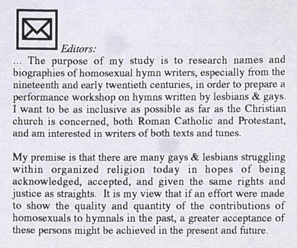
Letter to the editor in GLSG
The March 1992 GLSG newsletter states that their objectives include “promoting communication among lesbian & gay music scholars, increasing awareness of issues in sexuality and music in the academic community, and establishing a forum for the presentation of lesbian & gay music studies,” as well as “to provide an environment in which to examine the process of coming out in academia, and to contribute to a positive political climate for gay & lesbian affirmative action and curricula.” While professional development and networking were key prerogatives for the GLSG, with letters to the editor frequently soliciting help with research and studies, it is very clear that this organization also serves a social function. The GLSG held meetings during the AMS conventions to encourage LGBTQ+ faculty and students to engage with one another. These letters reveal repeated acknowledgment of the importance of forging community, not only for individual professional advancement or to contribute to the vitality of lesbian and gay studies, but to combat loneliness and isolation experienced by LGBTQ+ academics and to share the progressive changes others were working towards at their home campuses. One such contributor, Patrick Brannon from the University of Northern Iowa, writes, “It’s always good to connect with people from afar – eases the isolation that we here in the Midwest feel from time to time… Some of us have been working on passage of a human rights amendment to the University of Northern Iowa’s charter that will provide protection based on sexual orientation.” Similarly to LGBTQ+ faculty organizations rooted in other disciplines, the GLSG attended to a variety of professional, personal, and intellectual needs faced by LGBTQ+ academics in the early 1990s.
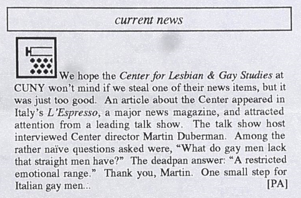
News item in GLSG borrowed from the Center for Lesbian & Gay Studies at CUNY.
Something that I find fascinating and have loved exploring with my dissertation is the degree to which these organizations often operated, at least initially, on a very ad hoc basis, openly experimental with their aims and organizing strategies. Many of these groups formed because of the intrepid bravery of a handful of LGBTQ+ faculty who, working without funds and institutional support, were nonetheless able to cater to the needs of LGBTQ+ faculty in their scholarly disciplines. They relied heavily on parallel organizations to provide helpful models and actionable strategies to reach their goals. In this newsletter, under its “News” section, the writers of the GLSG state, “We hope the Center for Lesbian & Gay Studies at CUNY won’t mind if we steal one of their news items, but it was just too good,” later adding, “The same Center for Lesbian & Gay Studies at CUNY, commonly known as CLAGS, has inspired graduate students to request and even push for classes in lesbian & gay studies… This is an interesting model: graduate students requesting and negotiating for classes in gay & lesbian musicology might also be successful elsewhere.”
The early 1990s was a tumultuous period in the history of LGBTQ+ activism. Driven by the desperate conditions of the AIDS crisis, in the wake of earlier organizations like the GAU, LGBTQ+ academics strove for recognition of LGBTQ+ studies as worthy of scholarly validation, for their right to equal treatment and protection from discrimination within the academy, and for community outside of campus boundaries. The GLSG newsletter is an artifact that perfectly captures this dynamic moment in LGBTQ+ history and the history of higher education.
Sarah Bernstein is our 2023-2024 Josiah Charles Trent History of Medicine Intern.
Tell us a little about yourself.
My name is Sarah and I am currently a student in the dual degree program, pursuing both a M. A. in public history at North Carolina State University and a M. S. in library science at the UNC School of Information and Library Science. My background is in the sociology and history of medicine, studying unorthodox and fringe medicine in the United States and England to gain insight into the creation of medical legitimacy and establishment of medical authority. I currently research the ethics of human remains on display in medical collections, museums, and related contexts.
What do you find interesting about working in libraries, especially our History of Medicine Collections?
As someone who studies the history of medicine, I was thrilled for an opportunity to work closely with the History of Medicine Collections at the Rubenstein Library! The idea of being able to hold, teach with, and introduce others to the manuscripts, materials, and artifacts that I have read about and researched was incredibly exciting.
I changed from a history career track to libraries and archives because I was interested in making history come alive and more accessible to people and the public. As a history student, I have always enjoyed research and working with archival materials, and working in libraries and archives felt like the natural next step. The fact that working in libraries enables me to be around a variety of materials, both those related to my interests and especially those that I would not have sought out myself, is a bonus.
What is a memorable experience from your internship?
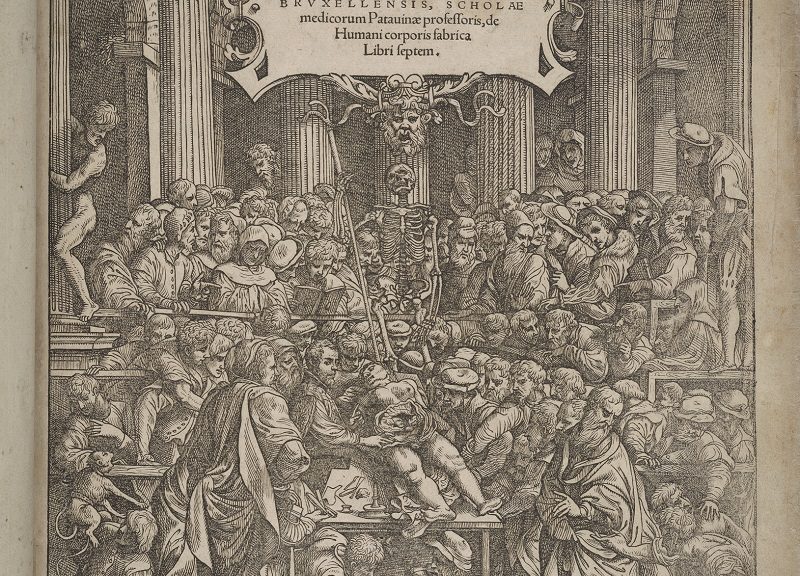
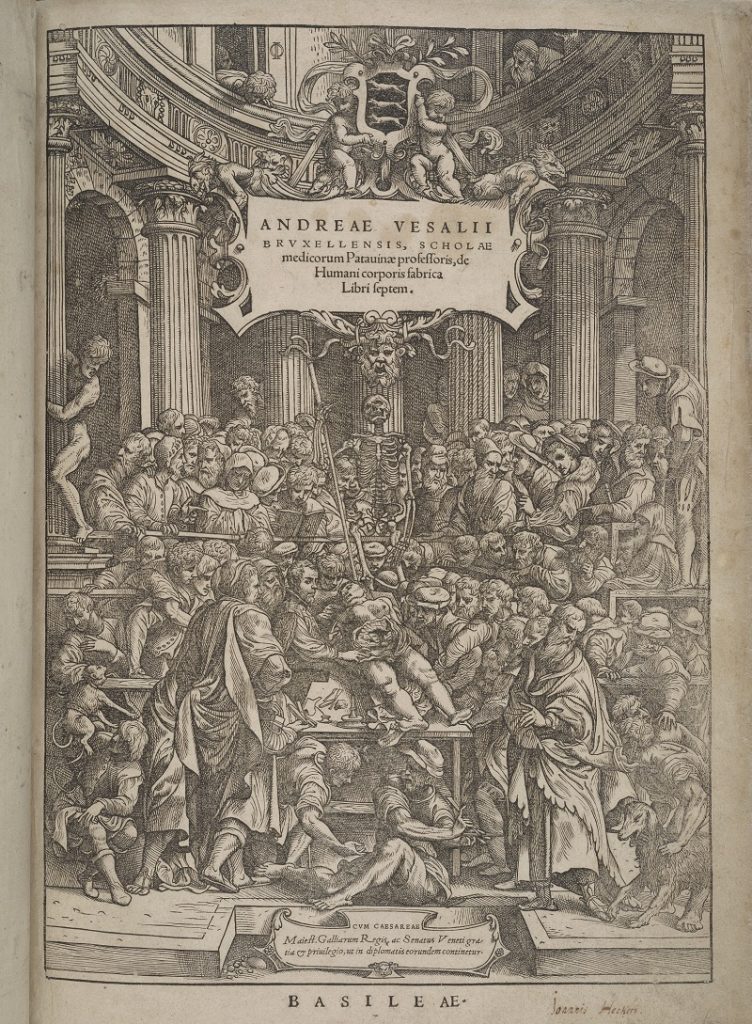
Title page of Vesalius’s De Humani Corporis Fabrica
My first time pulling and handling the first edition De Humani Corporis Fabrica (On the Fabric of the Human Body) by Andreas Vesalius was especially memorable. This title is considered a major advance in the history of anatomy and reflects a deep connection between medicine and art. The illustrations in the book are not only impressive because of their anatomical accuracy, but also because of the minute details which were produced by the artists and printers involved. It was incredibly cool to be in the same room as such a historically significant object that I had learned about in my previous coursework.
The entire experience of curating an exhibition for the Trent History of Medicine Room has also been memorable, and I will never be able to look at a display, exhibition, or museum the same way again. It has been an invaluable learning opportunity to work with Rachel Ingold, curator of the History of Medicine Collections, Meg Brown, the head of Exhibitions Services and E. Rhodes and Leona B. Carpenter Foundations Exhibits Librarian, and Yoon Kim, Senior Library Exhibition Technician, on the exhibition and they all were incredibly helpful as I navigated tasks like creating a cohesive narrative for the items to writing exhibition text.
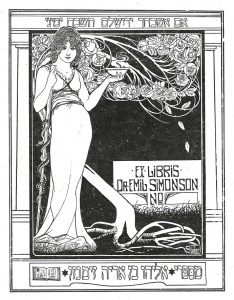
Here is one of my favorites from the collection: an art nouveau bookplate for Dr. Emil Simonson that was designed by the illustrator and printmaker Ephraim Moses Lilien. The bookplate includes a woman who holds a bowl with vapor rising from it, leaning on a staff with one snake wrapped around (likely an allusion to the Staff of Aesculapius, Greek god of medicine). Lilien incorporated Hebrew above and below the image in the border. The top text is Psalm 137:5 while the bottom reiterates that it is Dr. Emil Simonson’s property using his Jewish name, Aliyahu ben Aire Zimon.
Although I chose a rectangular black and white bookplate for this post, the collection includes numerous sizes, shapes, colors, and styles. The medical bookplate collection contains over 450 medically related bookplates and I have had such a great time going through the binders and seeing the various styles that are represented and how the same symbols of medicine and death are portrayed in both similar and different ways.
The Rubenstein Rare Book & Manuscript Library is pleased to announce the recipients of the 2024-2025 travel grants. Our research centers annually award travel grants to students, scholars, and independent researchers through a competitive application process. We extend a warm congratulations to this year’s awardees. We look forward to meeting and working with you!
Archive of Documentary Arts
Elizabeth Barahona, Ph.D. candidate, Northwestern University, “Black and Latino Coalition Building in Durham, North Carolina 1980-2010.” (Joint award with the Human Rights Archive)
Diana Ruiz, Faculty, University of Washington, Seattle, “Apprehension through Representation: Image Capture of the US-Mexico Border.” (Joint award with the Human Rights Archive)
Sallie Bingham Center for Women’s History and Culture
Mary Lily Research Travel Grants
Taylor Doherty, Ph.D. candidate, University of Arizona, Department of Gender and Women’s Studies, “Minnie Bruce Pratt’s Anti-Imperialist Lesbian Feminist ‘Longed-for but Unrealized World.’”
Thalia Ertman, Ph.D. candidate, University of California, Los Angeles Department of History, “U.S. Feminist Anti-Nuclear Activism and Women’s Bodies, 1970s-1990s.”
Samuel Huber, Faculty, Yale University, Department of English. “A World We Can Bear: Kate Millett’s Life in Feminism.”
Alan Mitchell, Ph.D. candidate, Cambridge University, Faculty of Art History and Architecture, “Redefining Phoebe Anna Traquair through the lenses of historicism and intersectionality.”
Emily Nelms Chastain, Ph.D. candidate, Boston University, School of Theology, “The Clergywoman Question: The International Association of Women Preachers and Ecclesial Suffrage in American Methodism.”
Ana Parejo Vadillo, Faculty, School of Creative Arts, Cultures and Communications, Birkbeck, University of London, “Bound: The Queer Poetry of Michael Field.”
Carol Quirke, Faculty, American Studies, SUNY Old Westbury, “Feminism’s ‘Official Photographer:’ Bettye Lane, News Photography and Contemporary Feminism, 1969-2000.”
Paula Ramos, Independent Researcher, “Spatiality and gender: spatial circumstances of the creative process of feminist artists in the 1970s and 1980s.”
Dartricia Rollins, Graduate Student, University of Alabama, School of Library and Information Studies, “‘You Had to Be There:’ Charis’ 50-Year History as the South’s Oldest Independent Feminist Bookstore.”
Eve Kosofsky Sedgwick Research Travel Grants
Ipek Sahinler, Ph.D. candidate, University of Texas Austin, “A Portrait of Young Women as Proto-Queer Thinkers: Eve Sedgwick vis-à-vis Gloria Anzaldúa.”
David Seitz, Faculty, Harvey Mudd College, “‘No Less Realistic’ but with ‘Different Ambitions’: Reparative Reading, Human Geography, and a Return to Sedgwick.
Doris Duke Foundation Travel Grants
Olivia Armandroff, Ph.D. candidate, University of Southern California, “Volcanic Matter: Land Formation and Artistic Creation.”
Cameron Bushnell, Faculty, Clemson University, Department of English. “‘The Invisible Orient’ in Orientalism Otherwise: Women Write the Orient.”
John Hope Franklin Center for African and African American History and Culture
Thomas Blakeslee, Ph.D. candidate, Harvard University, History Department, “Domestic Disturbances: The Resistant Masculinity of Black Fatherhood from Anti-Slavery to Civil Rights.”
Mara Curechian , Ph.D. candidate, School of English, University of St Andrews, “Acting Like Family: Performing Kinship in the Literature of the Civil War and Reconstruction.”
Michelle Decker, Faculty, Scripps College, English Department, George Washington Williams’s and Amanda B. Smith’s Appalachian Origins and African Explorations.”
Timothy Kumfer, Postdoctoral Fellow, Georgetown University, 2023-2024 Mellon Sawyer Seminar, “Counter-Capital: Grassroots Black Power and Urban Struggles in Washington, D.C.”
Hunter Moskowitz, Ph.D. candidate, Northeastern University, “Race and Labor in the Global Textile Industry: Lowell, Concord, and Monterrey in the Early 19th Century.”
Summer Sloane-Britt, Ph.D. candidate, Institute of Fine Arts, New York University, “Visions of Liberation: Gender and Photography in the Student Nonviolent Coordinating Committee, 1960-1970.”
Mila Turner, Faculty, Clark Atlanta University, “Bridging Histories: Connecting the Atlanta Student Movement with College Student Activism throughout the Southeast”
Harry H. Harkins T’73 Travel Grants for Lesbian, Gay, Bisexual, and Transgender History
Kadin Henningsen, Ph.D. candidate, University of Illinois at Urbana-Champaign, “Walt’s Companions.”
Julie Kliegman, Author, book-length exploration of transgender pioneers.
John W. Hartman Center for Sales, Advertising, and Marketing History
John Furr Fellowship
Hannah Pivo, Ph.D. candidate, Columbia University, Department of Art History and Archaeology, “Charting the Future: Graphic Methods and Planning in the United States, c. 1910-60.”
Lewis Smith, Faculty, Brunel University London, Brunel Business School, Division of Marketing, “Marketing the State”: J. Walter Thompson Company and the Marketing of the Public Sector in Britain.”
Alvin Achenbaum Travel Grants
Warren Dennis, Ph.D. candidate, Boston University, “Hard Power Paths: Gender and American Energy Policy, 1960-2000.” (Joint award with History of Medicine with support from the Louis H. Roddis Endowment)
Dan Du, Faculty, University of North Carolina at Charlotte, Department of History, “U.S. Tea Trade and Consumption after the American Revolution.”
Will Mari, Faculty, Louisiana State University, Manship School of Mass Communication, “Selling the computer to women media workers: gendered ads during the Cold War.”
Janine Rogers, Ph.D. candidate, University of California Los Angeles, Theater Department, “Performance, Militarization, and Materialisms: Canned Goods in Asian America”.
Foare
Jonathan MacDonald, Ph.D. candidate, Brown University, Department of American Studies, “Psychology Hits the Road: Driving Simulators, Billboards, and Hypnosis on the Highway.”
History of Medicine Collections
Warren Dennis, Ph.D. candidate, Boston University, “Hard Power Paths: Gender and American Energy Policy, 1960-2000.” (With support from the Louis H. Roddis Endowment; Joint award with the Hartman Center)
Ava Purkiss, Faculty, University of Michigan, Ann Arbor, Department of Women’s and Gender Studies, “After Anarcha: Black Women and Gynecological Medicine in the Twentieth Century.”
Baylee Staufenbiel, Ph.D. candidate, Florida State University, Department of History, “The Seven-Cell Uterus: De Spermate and the Anatomization of Cosmology.”
Brian Martin, Ph.D. candidate, University of Alabama, History Department, “Racial Theory and African American Medical Care in the U.S. Civil War.”
Human Rights Archive
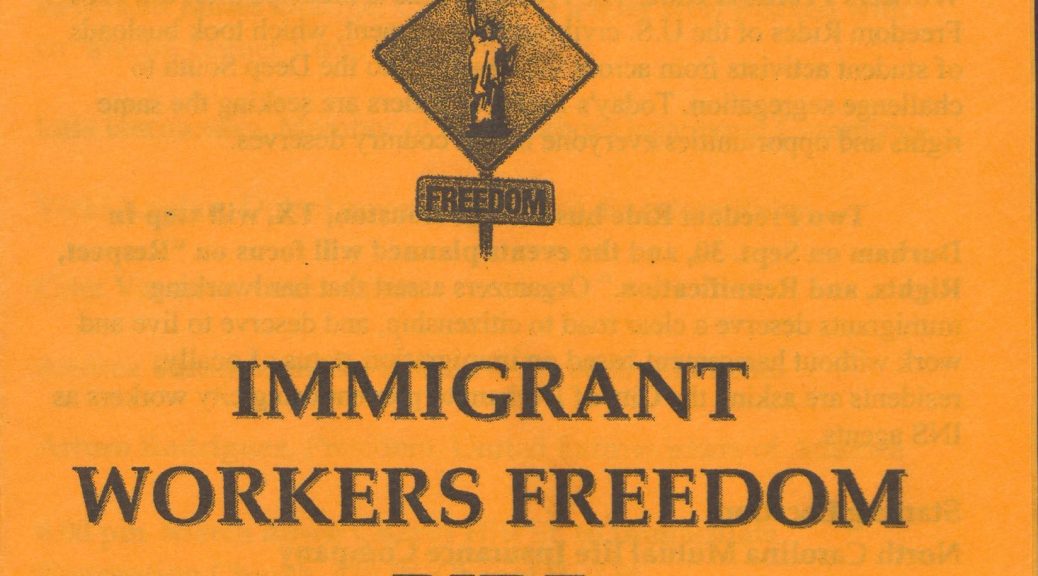
“Immigrant Workers Freedom Ride” flyer, September 30, 2003, illustrates one area of coalition building in Durham, NC, as described in Elizabeth Barahona’s dissertation research proposal. From the Joan Preiss Papers, Box 27.
Elizabeth Barahona, Ph.D. candidate, Northwestern University, “Black and Latino Coalition Building in Durham, North Carolina 1980-2010.” (Joint award with the Archive of Documentary Arts)
Diana Ruiz, Faculty, University of Washington, Seattle, “Apprehension through Representation: Image Capture of the US-Mexico Border.” (Joint award with the Archive of Documentary Arts)
Kylie Smith, Faculty, Emory University. School of Nursing, Department of History, “No Place for Children: Disability, Civil Rights, and Juvenile Detention in North Carolina.”
Harrison Wick, Faculty, Indiana University of Pennsylvania (IUP) Special Collections and University Archives, “Examination of Primary Sources related to Social Justice and Latin American Immigration in the Human Rights Archive.”
Dispatches from the David M. Rubenstein Rare Book and Manuscript Library at Duke University