Today, we’re starting a new feature: mini-essays from friends of the RBMSCL on the collections they’ve used and treasured. Below, Sharon Holland’s mini-essay about Dorothy Allison was inspired by the RBMSCL’s recent acquisition of Dorothy Allison’s papers.
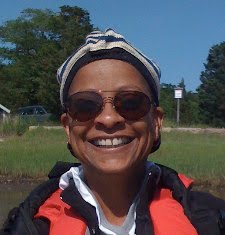
Photo courtesy of Sharon Holland.
I first encountered Dorothy Allison’s major work, Bastard Out of Carolina, on an overnight train (the Orient Express, no less) from Vienna to Paris. I wasn’t prepared for what would eventually happen in the book and when I got to the fateful scene in the car outside the hospital, I impulsively threw the book out of the window—it is still in a field somewhere along the train line. My reaction is a testament to the importance of the scene of violation that Allison wanted to construct for the reader—it was real, and sudden and devastating. I purchased the book upon my return to the United States and it has been one of my favorites since. Acquiring her papers is a serious accomplishment for Duke. Thank you for preserving the work and ultimately the memory of one of the most important feminist authors of the 20-21st century.
Post contributed by Sharon Holland, Associate Professor, English and African and African American Studies, Duke University.
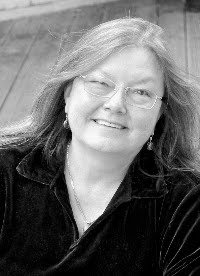
In the early 1990s Ginny Daley, then director of the Sallie Bingham Center for Women’s History and Culture, was convinced that Duke should acquire Dorothy Allison’s papers. “I saw her as the quintessential Southern writer,” Daley wrote recently. “Her personal papers and literary works fit well with Duke’s collections of Southern literature and women’s culture, while bringing fresh perspectives on queer culture and truth-telling to the mix.” Through campus visits and other seed-planting efforts, Ginny Daley introduced Ms. Allison to the possibility of Duke as the permanent home for her collection.
Photo by Brett Hall.
Now, after a nearly twenty year period of considering this momentous decision, Dorothy Allison, author of Bastard Out of Carolina and other works and renowned activist in the LGBTQ community, has selected the RBMSCL to be the repository for her papers. Bingham Center and literary curatorial staff collaborated on the initial acquisition of nearly 60 boxes of Allison’s papers, including drafts of her writings, extensive correspondence and research files, personal journals documenting her life and creative process, and more. For Allison, a South Carolina native now living in California, it’s a relief to have the papers at the RBMSCL: “All I know is that now I feel that all that . . . I saved is going to be safe and of use. Since we are entering high summer here with 90 degree temperatures and high risk of fire, I can also stop worrying that a wildfire might sweep through the redwoods and erase all that history. Safe and of use is infinitely preferable.”
The papers will be a rich resource for those interested in Allison’s life and work, as well as for researchers exploring the development of LGBT and Southern literatures, lesbian communities and families, and the history of American sexuality, among many other topics. Materials will be added to the collection as Allison continues to write and publish (a new book of short stories and a novel coming soon!).
A preliminary finding aid for the collection is now available here. In the coming months staff will review, process, and revise the finding aid for the collection to make it available for research. Researchers interested in using the papers should contact the Bingham Center staff to discuss their availability.
Post contributed by Will Hansen, Assistant Curator of Collections.
Date: Wednesday, August 11, 2010 Time: 3:00 PM Location: Rare Book Room Contact Information: Kelly Wooten, 919-660-5967 or kelly.wooten(at)duke.edu
Tibbie Roberts and B Holt at the 75th Anniversary of the NC Council of Churches. Courtesy of Jeanette Stokes.
Please join the staff of the Sallie Bingham Center for Women’s History and Culture for an afternoon honoring women of faith who have contributed their papers to the Center’s growing collection of materials documenting women’s religious experiences and activities, particularly personal spiritual struggles and women’s involvement in Protestant religious organizations.
Today was one of my favorite days of the year: zine workshop day at Girls Rock Camp. Amy and I spent the morning doing a zine workshop for about 45 young girls at Durham’s Girls Rock Camp. The day started with everyone standing in a circle, holding hands, and then turning to the person beside them and telling them “You rock!” What a way to start the day. We were able to talk with the girls about zines, as well as more about the Sallie Bingham Center for Women’s History and Culture and how they can come and look at zines in our collection. The girls were so excited to work on their own zine pages. We brought tons of markers, stickers, stamp pads, magazines, and glue sticks for them to make their own zine pages, and they did not disappoint! The zine pages they created included lots of things, such as their band names (Black Lizards, Beach Girls, 24/7, and The Flaming Moonshiners) and stickers proclaiming their love of music (and animals), and included statements like “I want to be a singer, an actress, and an architect.” I was asked how to spell words like “appreciate” and “different.” It was so great. Oh Zine Diary, every day should be like this!
Until next year. . .
Rachel
7/14/10
Dear Zine Diary,
Kelly and I spent yesterday morning at Girls Rock Camp in Chapel Hill. I was amazed at how eager, smart, and enthusiastic the girls were to learn about women’s history and zine-making! We went around the room and introduced each other and Kelly and I found out the names of the girls’ bands. We talked about the three waves of feminism and we even did the wave! We also talked about female stereotypes and how we can fight them together. Then the girls got down to business with markers, stickers, magazines, glue sticks, and stamps. They made pages for their bands as well as individual pages, and as Rachel mentioned, their pages were creative and inspiring. I was so excited to hear the girls talk about everyday injustices and how they want to fix them. Kelly told them that since they are part of the Third Wave they are the future of feminism and will help to decide the future for women. After yesterday, I’m glad to know the future is in good hands.
Rock on,
Alex
For more photos from Girls Rock Camp, visit the Bingham Center’s Flickr photostream!
Post contributed by Rachel Ingold, former Bingham Center intern and Conservation Technician, and Alex Krensky, Bingham Center intern.
The United Nations Conference on International Organization officially convened between April 25 and June 26, 1945 in San Francisco. On 26 June 1945, delegations from 50 countries signed the United Nations Charter, a constituent treaty by which all member nations are bound in an international body and in which organization’s mission and commitment to peaceful resolution are defined.
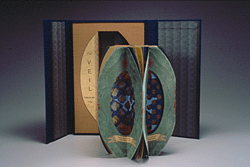
Over fifty years later, book artist Julie Chen wove the text of the famously eloquent Preamble into her 2002 free-standing concertina, The Veil. This carousel book offers the artist’s reflections on the political conflicts in the Middle East through both words and abstract visual meditations which unfold over the text of the charter. The Veil will be featured in the Sallie Bingham Center for Women’s History and Culture’s Book + Arts Exhibit this October.
Post contributed by Christine Well, UNC SILS graduate student volunteer, Sallie Bingham Center for Women’s History and Culture.
Date: Tuesday, June 15, 2010 Time: 3:30 PM Location: Rare Book Room Contact Information: Kelly Wooten, 919-660-5967 or kelly.wooten(at)duke.edu
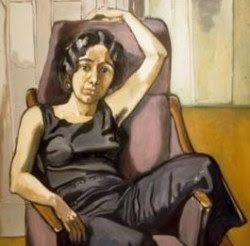
Detail of portrait of Irene Peslikis by Alice Neel. From the Irene Peslikis Papers.
The summer research project season is in full swing!
Next Tuesday, Katie Anania, graduate student in Art History at the University of Texas-Austin and recipient of a Mary Lily Research Grant, will discuss her research on the feminist adoption of drawing as an intimate means of artistic expression.
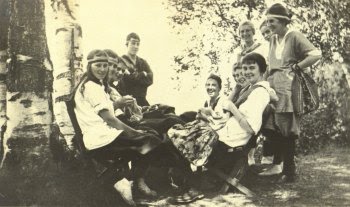
“Canoeing at Camp Teconnet.” From the New England Girls’ Summer Camps Photograph Album.
These days are filled with happiness, Encouragement, and zest. Companionship we never lack, Or chance to play—or rest; No silly rules there are, and yet, No doubt of loving care. Each girl has opportunities To serve, enjoy, and share.
—From a 1917 brochure about Camp Teconnet
In 2008, we made a lucky find in a rare book dealer’s catalog: a lovely New England girls’ summer camp photograph album. We were utterly charmed by this album of black and white photos of girls at Camp Mascoma, in New Hampshire in 1916 and Camp Teconnet Maine in 1917. The unidentified teenage girl who created this album clearly had a wonderful time swimming, canoeing, and sitting around campfires with the friends she made, each with her own nickname like “Parsnips.”
The album also included material clipped from a promotional brochure about Camp Teconnet, which described camp life as “the wisest and sanest solution of the vacation problem for girls.” The brochure also proclaimed, “Physical measurements are taken at the beginning of the season for each camper and from these the ‘Missus’ and councilors form the foundation for the work with the individual, encouraging here and holding back there, so that the end of the season may bring its own reward in better health and physique.” These girls certainly do look healthy and fit!
You’ll find a detailed description of this album here. If you’d like to look through the album yourself and reminisce about your own days at camp (or if you have any questions about the album), e-mail us at special-collections(at)duke.edu.
Post contributed by Kelly Wooten, Research Services and Collection Development Librarian for the Sallie Bingham Center for Women’s History and Culture.
“Waiting for Dinner.” From the New England Girls’ Summer Camps Photograph Album.
Lori Brown, Associate Professor of Architecture at Syracuse University, will also present her examination of relationships between space, abortion, and issues of access to reproductive health services based on research using our women’s health clinic records.
Light refreshments will be served.
Post contributed by Kelly Wooten, Research Services and Collection Development Librarian for the Sallie Bingham Center of Women’s History and Culture.
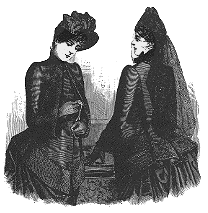
Rebecca Mitchell will present her findings on the proto-feminist aspects and eroticism of Victorian mourning attire. Mitchell is Assistant Professor of English at the University of Texas-Pan American.
Michelle Moravec will speak about feminist art activism as a U.S. social movement. Moravec is Assistant Professor of History and Women’s Studies at Rosemont College.
These two diverse topics will be sure to spark a lively conversation! Light refreshments will be served.
The Trial of Sylvia Likens by Kate Millett, 1978. Photo by Mark Zupan.
For the first time since its initial exhibition in 1978, Kate Millett’s chilling installation, The Trial of Sylvia Likens, has been reassembled. On Monday, the staff of the Sallie Bingham Center for Women’s History and Culture and Art History instructor Laurel Fredrickson joined with filmmakers Sophie Keir-Thompson and Mary Beth Ross to film the piece for a documentary about Millett’s life. The installation forms part of the Kate Millett Papers, which are held by the Bingham Center.
The installation marks Millett’s response to the horrific 1965 torture and murder of sixteen-year-old Sylvia Likens by the Baniszewski family and their neighborhood friends. Called “the most terrible crime ever committed in the state of Indiana,” the story of the murder and subsequent trial transformed Millett, laying the groundwork for her revolutionary work, Sexual Politics. Fredrickson writes, “For Kate, the case of Sylvia Likens exemplified in a very potent way how women are taught to accept punishment for real and imagined digressions from the cultural and social roles imposed upon them by patriarchal societies.”
In the photo essay below, Kelly Wooten, the Bingham Center’s Research Services and Collection Development Librarian, narrates Monday’s recreation.
The first step in reconstructing The Trial of Sylvia Likens was locating all the various mannequin parts, clothing, and panels, and then loading everything onto book trucks to convey to Room 217 in Perkins Library.
Once we delivered all the materials to Room 217 and the filmmakers set up their equipment, it was time to assemble the five defendants and get them dressed for court. Technical Services Archivist Megan Lewis and Art History instructor Laurel Fredrickson are putting on Johnnie’s jacket.
After all of the characters were ready, filmmakers Mary Beth Ross and Sophie Keir took shots of each mannequin in front of a green screen. This is Gertrude Baniszewski.
Filmmaker Mary Beth Ross prepares to capture images of the mannequins seated at the table.
For the original installation, Kate Millett created a death mask of her own face and dressed a mannequin in her own clothing to be arranged on a mattress as an embodiment of empathy for the victim, Sylvia Likens, who was found on a mattress in the family’s basement.
The trickiest part of this re-creation was hanging the panels that formed the backdrop in the original courtroom scene without damaging the library walls. Fortunately, Laurel Fredickson’s partner, Brad Johnson, is the Chief Preparator at the Nasher Museum of Art and had the time and the tools to hang the large newspaper reproductions.