Category Archives: Bingham Center

Instruction Round-Up!

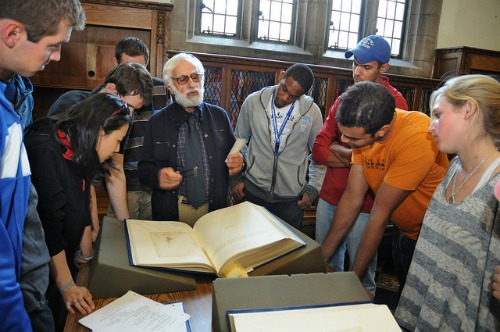
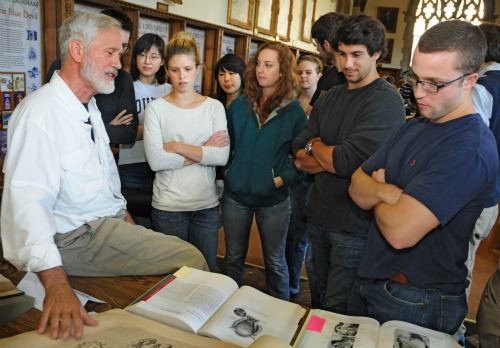
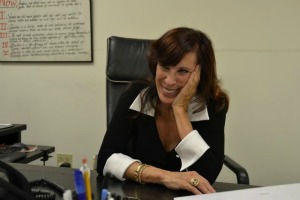
Dr. Ara Tourian and students
Dr. Ara Tourian presenting at Anatomy Day

This was another busy semester for Rubenstein librarians, who taught or co-taught more than 70 classes between September and early December! The classes ranged widely in subject, from feminist comics to medical history.

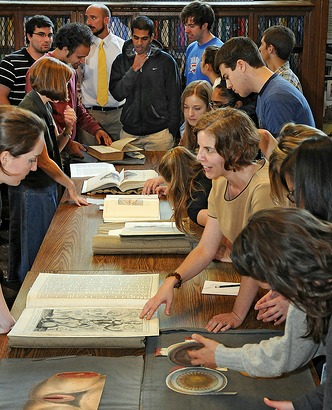
One exciting event, nicknamed “Anatomy Day,” brought 100 medical students to the Gothic Reading Room to investigate historical anatomical atlases and other books and manuscripts from the History of Medicine Collections. Rachel Ingold, Curator of the History of Medicine Collections, led a team of Rubenstein librarians in presenting these treasures to the students.

Rachel Ingold and students
Rachel Ingold, Curator of the History of Medicine Collections

A few of the Duke classes that met in the Rubenstein Library this past semester are:

  • Beyond Wonder Women: Comic and Graphic Novel Feminisms
  • History of Photography, 1839 to the Present
  • Documentary Photography and the Southern Culture Landscape
  • Early Soviet Culture 1917-1934
  • American Slavery/Emancipation
  • Accelerated Intermediate Italian
  • On the Boundaries of Medicine
  • The Physician in History
  • Hidden Children
  • Dante and the Afterlife of the Book

We also hosted classes from North Carolina State University and the University of North Carolina – Chapel Hill.

The Rubenstein staff offers a vast array of class instruction and support options. Please contact us to learn more about what the Rubenstein staff can do for your class!

Gift Endows Directorship of Sallie Bingham Center for Women’s History and Culture

A $1 million pledge to endow the directorship of the Sallie Bingham Center for Women’s History and Culture at Duke University has been made by journalist, activist and women’s health care pioneer Merle Hoffman, President Richard H. Brodhead announced Thursday.

“The Bingham Center is one of the leading women’s history research centers in the U.S., documenting centuries of women’s public and private lives, including education, literature, art and activism,” Brodhead said. “We at Duke are grateful for this generous gift by Merle Hoffman, which will help further the Bingham Center’s mission to preserve and promote the intellectual and cultural legacy of women from all walks of American life.”

The center, part of the David M. Rubenstein Rare Book & Manuscript Library, is home to many of Hoffman’s papers.

After abortion laws were liberalized in New York state in 1970, Hoffman founded Choices Women’s Medical Center, one of the first ambulatory surgical centers for women, which has become one of the largest and most comprehensive women’s medical facilities in the U.S.

In 2000, the Bingham Center acquired both Hoffman’s papers and the records of Choices Women’s Medical Center. Since then, the center has collected the papers of numerous other providers, clinics and reproductive rights organizations that document the work of activists, health care workers, attorneys and others involved in reproductive health.

The center also has a large body of works that documents four centuries of political activity surrounding women’s reproductive rights, thanks in part to several generous gifts from Hoffman, said Deborah Jakubs, Rita DiGiallonardo University Librarian and vice provost for library affairs.

“Associating Merle Hoffman’s name with the directorship creates an enduring connection between the Bingham Center’s leadership and Hoffman’s outstanding contributions to the health, safety and empowerment of women everywhere,” Jakubs said.

Hoffman is also the publisher and editor-in-chief of On the Issues Magazine, and her autobiography, Intimate Wars: The Life and Times of the Woman Who Brought Abortion from the Back Alley to the Board Room, is set to be published in January 2012.

Hoffman said she decided to endow the center’s directorship as a way “to continue to support the visionary efforts by Duke University to honor and document the many courageous women who have fought their own ‘intimate wars’ in the long struggle for reproductive justice. I hope that the Bingham Center will become the bridge between theory and practice that will catalyze future generations to joyfully go further and deeper in the continual battles for women’s equality.”

Center director Laura Micham said Hoffman’s latest gift “will enable us to expand our activities and impact, bringing us closer to our goal of building one of the premier research centers for women’s history and culture in the world.”

The Sallie Bingham Center for Women’s History and Culture was established in 1988 to acquire, preserve and provide access to published and unpublished materials that reflect the public and private lives of women, past and present. It is named in honor of author, playwright, teacher and feminist activist Sallie Bingham.

For more information, contact Aaron Welborn or Laura Micham.

Travel Grant Season is Open!

Wish you were here? We do too! The David M. Rubenstein Rare Book & Manuscript Library is now accepting applications for our 2012-2013 travel grants.

The Sallie Bingham Center for Women’s History and Culture, the John Hope Franklin Research Center for African and African American History and Culture, and the John W. Hartman Center for Sales, Advertising & Marketing History will award up to $1,000 per recipient to fund travel and other expenses related to visiting the Rubenstein Library.

The grants are open to undergraduate and graduate students, faculty, independent scholars, artists, and activists living outside a 100-mile radius from Durham, NC with research projects that would benefit from access to the centers’ collections.

More details—and the grant application—may be found on our grants website. Applications must be postmarked or e-mailed no later than 5:00 PM EST on January 31, 2012. Recipients will be announced in March 2012.

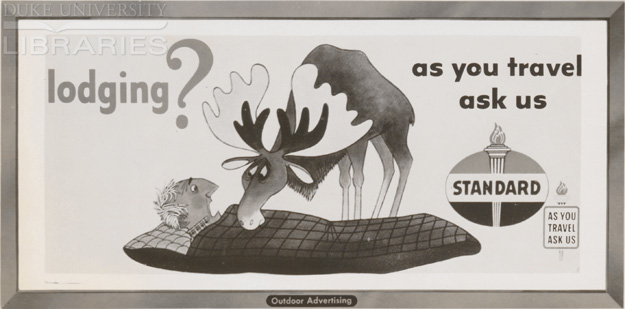
Standard Gas Stations Billboard Proof.
Standard Gas Stations Billboard Proof. From the Outdoor Advertising Association of America Archives.

Some of last year’s recipients include:

At the Sallie Bingham Center for Women’s History and Culture:

  • Marika Cifor, a master’s student in History and Library and Information Science at Simmons College, who used the Bingham Center’s lesbian pulp fiction collection for master’s thesis research on the historical relationships of lesbians and prostitutes in the United States, 1869-1969.
  • Jennifer Nelson, Associate Professor of Women’s and Gender Studies at University of Redland, visited the Bingham Center to conduct research for a book on community health reform movements from the mid-1960s to the present using the Feminist Women’s Health Center Records.
  • Emily Thuma, a Visiting Scholar at the Center for Race and Gender at University of California, Berkeley is visiting this week for post-doctoral research to revise her dissertation, “Not a Wedge, But a Bridge”: Prisons, Feminist Activism, and the Politics of Gendered Violence, 1968-1987. (Check out this blog post for details about Emily Thuma’s upcoming talk.)

At the John Hope Franklin Research Center for African and African American History and Culture:

  • Ira Dworkin, Assistant Professor, Department of English and Comparative Literature, The American University in Cairo, for research on African Americans in the Congo, particularly George Washington Williams.
  • Nina Ehrlich, master’s student, Department of History, Colorado State University, for a study of relationships between black and white women during the Civil Rights Movement.
  • Tyler D. Parry, Ph.D. candidate and master’s student, Department of History, University of South Carolina, for dissertation and article exploring slave kinship in the Antebellum South.

At the John W. Hartman Center for Sales, Advertising, and Marketing History:

  • Leif Frederickson, an independent researcher from Missoula, MT for research on “From Public Pedagogy to Business Branding: The Development of Green Advertising, 1950-1995.”
  • Janet Golden Professor at the Department of History, Rutgers University to research “The History of American Babies.”
  • Laura Phillip, a Ph.D. candidate at the Corcoran Department of History, University of Virginia for research on “Marketing of the Fair Trade Message.”

Post contributed by Kate Collins, Bingham Center intern.

Scholars’ Tea with Emily Thuma

Date: Thursday, November 3, 2011
Time: 3:30 PM
Location: Rare Book Room
Contact Information: Kelly Wooten, 919-660-5967 or kelly.wooten(at)duke.edu

Tea KettleEmily Thuma, recipient of one of this year’s Mary Lily Research Grants awarded by the Sallie Bingham Center for Women’s History and Culture, will discuss her post-doctoral research to revise her dissertation, “Not a Wedge, But a Bridge”: Prisons, Feminist Activism, and the Politics of Gendered Violence, 1968-1987.

She received her Ph.D. in American Studies from New York University and is currently a Visiting Scholar at the Center for Race and Gender at University of California, Berkeley.

Light refreshments will be served. This event is co-sponsored by the Program in Women’s Studies as part of the “Future of the Feminist 1970s” series.

Post contributed by Kelly Wooten, Research Services and Collection Development Librarian for the Sallie Bingham Center for Women’s History and Culture.

Haunted Library Screamfest

Date: Halloween, Monday, October 31, 2011
Time: 11:00 AM-1:00 PM
Location: Rare Book Room
Contact Information: Rachel Ingold, 919-684-8549 or rachel.ingold(at)duke.edu

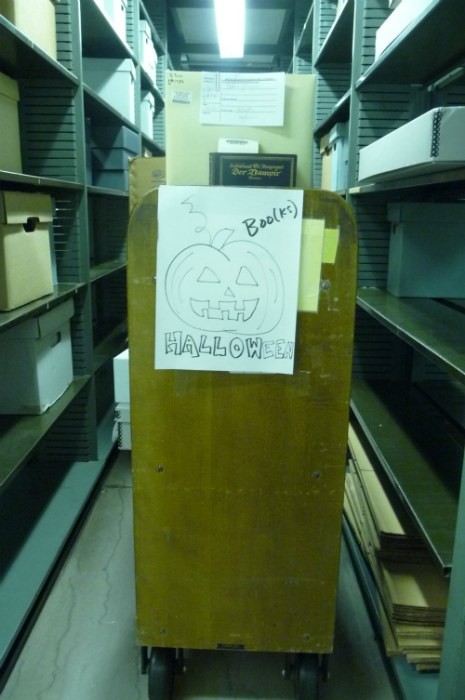
Have you ever wandered around a library’s stacks in the dark? Or wondered what might go bump in an archival box?

Stop by the Rubenstein Library’s Rare Book Room for a special Halloween “eeeks”-ibit and open house. We’ll be dragging out some of the creepiest and most macabre items from the shadowy depths of the library’s vaults—including the thirteen unlucky items below.

This event is free and open to the living and the dead. There will be candy. Lots and lots of candy.

49 Glass Eyeballs
49 Glass Eyeballs. From the History of Medicine Collections.

1. A travel diary written by John Buck, a young American who found himself face-to-face with Bram Stoker (before he wrote Dracula)

2. Letters to Duke University’s Parapsychology Laboratory describing the 1949 poltergeist case that became the basis for The Exorcist

3. Opera Omnia Anatomico-Medico-Chirurgica by 18th century Dutch anatomist Frederik Ruysch, featuring illustrations of fetal skeletons playing instruments  among “trees” made of veins and arteries and “rocks and stones” that are actually organs, gallstones, and kidney stones

4. An entire box of glass eyeballs (49, to be exact)

5. “Jack the Ripper” and “Cthulhu by Gaslight,” two board games from the Edwin and Terry Murray Role Playing Game Collection

6. Artists’ books Mountain Dream Tarot by Bea Nettles and Femmes Fatales by Maureen Cummins. Tarot cards and pictures of medieval torture devices!

7. Brochures and advertisements for coffins and other funeral-related paraphernalia from the Advertising Ephemera Collection

8.Two copies of Henry Milner’s 1826 melodramatic adaptation of Mary Shelley’s Frankenstein, with the very first illustration of (the actor portraying) “the Monster”

9. Bela Lugosi’s signature

10. Maps and photographs of the Rigsbee Graveyard (yes, the graveyard in the Blue Zone)

11. Comics Review #1, 1965, which includes  Stephen King’s first published story, “I Was a Teenage Grave Robber,”  from the Edwin and Terry Murray Fanzine Collection

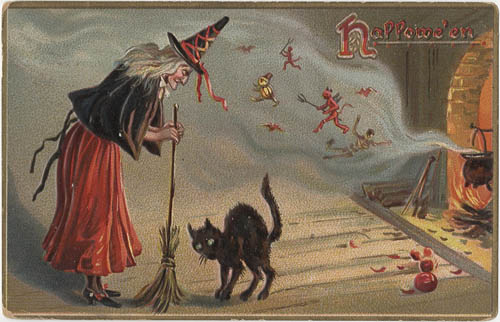
12. Halloween postcards (complete with spooky messages . . . or invitations to Halloween parties) from our Postcard Collection

13. Trixie Belden and the Mystery of the Whispering Witch by Kathryn Kenny, 1980

Which one will give you nightmares come the witching hour?

Halloween Postcard, 1908.
Halloween Postcard, 1908. From the Postcard Collection.

The Anatomy of Anatomy Day

Monday was the annual Anatomy Day visit to the History of Medicine Collections. This is one of my favorite times of the year!

In the fall, all of the first year medical students here at Duke—about one hundred of them—visit the History of Medicine Collections to view historical anatomical atlases. This is a chance for them to see how anatomy has been represented over hundreds of years, and also provides stimulating and interesting texts that they can compare to what they are seeing in the dissection lab.

Curator Rachel Ingold talks with medical students at Anatomy Day.
Curator Rachel Ingold talks with medical students at Anatomy Day. Photo by Angela Mace.

Faculty and staff contribute to Anatomy Day by engaging with students and asking questions about the texts on display. This year, participants included the main coordinator of the event, Dr. Jeff Baker, along with Dr. Ara Tourian, Dr. Rick Madden, Professor Valeria Finucci, Professor Shannon Withycombe, and Rubenstein Library staff members Laura Micham, Kate Collins, Andy Armacost, and Jessica Janecki. Materials on display ranged from a 17th century copy of a 14th century illuminated Islamic medical manuscript to the controversial Pernkopf atlases from the mid-twentieth century.

The comments I heard this year were “awesome,” “I love anatomy so I loved everything,” and “overall, this experience was great and I liked to see the progression of anatomical representations.” I overheard students have serious ethical discussions about dissection and talk about the variety of ways they learn about the human body. I also talked to a student who told me that the greatest tool out of all the tools a student could have in the anatomy lab is the hand.

Dr. Rick Madden talks with medical students at Anatomy Day.
Dr. Rick Madden talks with medical students at Anatomy Day. Photo by Mark Zupan.

I’m already looking forward to next year’s Anatomy Day and talking with students about the array of anatomical texts here at the History of Medicine Collections!

For more photos, visit the “Anatomy Day 2011” set on our Flickr photostream!

Post contributed by Rachel Ingold, Curator for the History of Medicine Collections.

The Literary Ladies’ Guide to the Writing Life

Date: Thursday, October 20, 2011
Time: 7:00 PM
Location: The Regulator Bookshop (720 9th Street, Durham)
Contact Information: Kelly Wooten, 919-660-5967 or kelly.wooten(at)duke.edu

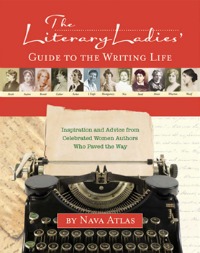
Cover of The Literary Ladies' Guide to the Writing LifeNava Atlas will discuss and sign copies of her new book, The Literary Ladies’ Guide to the Writing Process: Inspiration and Advice from Celebrated Women Authors Who Paved the Way.

Filled with more than 100 archival images, The Literary Ladies’ Guide to the Writing Life presents twelve celebrated women authors (including Louisa May Alcott, Jane Austen, Anaïs Nin, and Virginia Woolf), drawing on their diaries, letters, memoirs, and interviews to create inspiring portrayals of their views on the craft of writing.

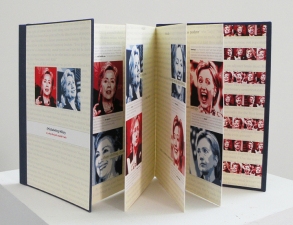
Nava Atlas is a visual artist and the author and illustrator of many well-known vegetarian and vegan cookbooks, as well as two previous books of humor, Expect the Unexpected When You’re Expecting and Secret Recipes for the Modern Wife. The Sallie Bingham Center’s artists’ books collection contains two of her artists’ books, Love and Marriage and (Mis)labeling Hillary.

(Mis)labeling Hillary
(Mis)labeling Hillary, 2008.

Researching the Civil War?

This has been the most terrific days battle since commincement. The enemy made a terrible charge over our Breastworks with re-inforcementz & succeeded in charging some of our men out of them, capturing many of our Division. All our Regiment that were left from the first days fight were captured.
—from the Henry Beverige Diary, Thursday, May 12, 1864.

Beverige, a soldier and hospital steward with the 25th Virginia Regiment of the Confederate States of America, describes one of the many terrifying, bloody days of the American Civil War. His diary is one of the numerous first person accounts available in the Rubenstein Library. Other perspectives on life during the conflict are offered by fiery teenager Alice Williamson;  Confederate spy Rose O’Neal Greenhow, African Americans such as Edgar Dinsmore, and the many others who experienced the loneliness, losses, and deprivations—and occasional triumphs—of the conflict.

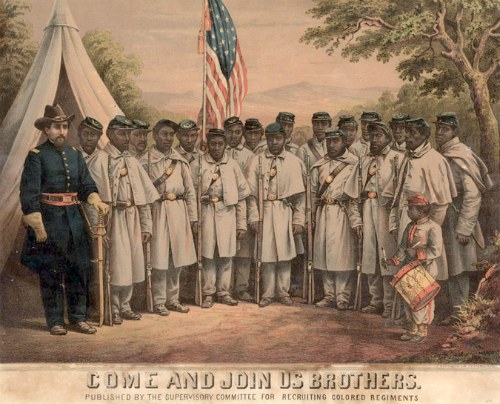
"Come and Join Us Brothers," 1863

To commemorate the sesquicentennial of the Civil War, Rubenstein Library staff have collaborated on a guide to Civil War resources that provides highlights of our rich collections. Special sections describe manuscript and print material related to military history, medicine, women, African Americans, literature, and music in the Rubenstein Library, as well as other library guides and relevant databases and websites.

We anticipate that this guide will be helpful for scholars, genealogists, and anyone with a personal interest in Civil War history. Please contact us if you have questions or comments about our collections.

Post contributed by Elizabeth Dunn, Research Services Librarian.