Duke Jazz Ensemble Celebrates Frank Foster

Date: Friday, 1 October 2010
Time: 8:00 PM
Location: Baldwin Auditorium (map and directions)
Contact Information: Jeremy Smith, 919-660-5839 or jas5(at)notes.duke.edu

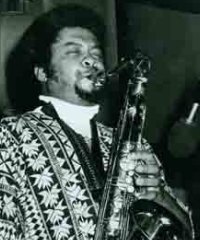
Frank Foster, ca. 1970s. From the Frank Foster Papers.

The Duke University Jazz Ensemble, led by John Brown, presents a concert celebrating living jazz legend Frank Foster.

This concert will include Foster’s new arrangements of compositions by North Carolina musicians, completed to commemorate his association with Duke University. Duke Jazz Studies Program alums and past guest artists will join the performance with the Duke Jazz Ensemble.

Foster’s papers were recently acquired by the RBMSCL’s Jazz Archive. A Grammy Award-winning composer and saxophonist, Foster was a member of the Count Basie Orchestra,  and lead the group from 1986 to 1995. In 2002, he was presented with a Jazz Master Award from the National Endowment for the Arts.

For more details, including information about purchasing tickets, visit the Duke Department of Music’s event webpage.

Rights! Camera! Action!: After Innocence

Date: Thursday, 23 September 2010
Time: 7:00 PM
Location: Rare Book Room
Contact Information: Patrick Stawski, 919-660-5823 or patrick.stawski(at)duke.edu, or Kirston Johnson, 919-681-7963 or kirston.johnson(at)duke.edu

The Rights! Camera! Action! film series begins its fall season with this screening of After Innocence, the compelling story of seven men wrongfully imprisoned for decades and finally exonerated after DNA evidence proved their innocence. The men—including a police officer, an army sergeant, and a young father—are thrust back into society with little or no support from the system that put them behind bars. After Innocence shows that the human toll of wrongful imprisonment can last far longer than the sentences served.

The film will be followed by a panel discussion featuring recently-exonerated Shawn Massey and Theresa Newman, co-chair of Duke School of Law’s Wrongful Convictions Clinic.

The Rights! Camera! Action! film series, which is sponsored by the Archive for Human Rights, the Archive of Documentary Arts, the Duke Human Rights Center, the Franklin Humanities Institute, and Screen/Society at Duke’s Arts of the Moving Image Program, features documentaries on human rights themes that were award winners at the annual Full Frame Documentary Film Festival. The films are archived at the RBMSCL, where they form part of a rich and expanding collection of human rights materials.

Alabama v. Duke

This Saturday’s football game with Alabama recalls the historic ties between our two programs. In 1930, shortly before the opening of the new Gothic West Campus, President William Few sought the advice of the celebrated Alabama coach Wallace Wade on potential names for a football coach and director of athletics. Wade, who had led Alabama to two Rose Bowls and a record of 51-13-3, surprised Few by replying that he would be interested in the vacancy. Wade brought his Alabama success to Duke, leading the Blue Devils to two Rose Bowls as well. He would post a record of 110-36-7 in his sixteen years as coach at Duke.

Sugar Bowl Coin Toss
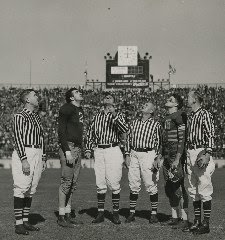
The Coin Toss. From the Edmund M. Cameron Records.

While Wade served in the U.S. Army as major during World War II, his assistant Eddie Cameron took over as head coach and continued the Blue Devils’ gridiron success. He led the 1944 team to a Sugar Bowl showdown with Alabama on January 1, 1945. In what sportswriter Grantland Rice called “one of the greatest thrillers of all time” Duke edged the Tide 29 to 26. Cameron kept a scrapbook filled with images from the game, which now forms a part of the Edmund M. Cameron Records.

Duke’s connections to Alabama continue with current Coach David Cutcliffe, an Alabama native and graduate of the University of Alabama who also served as an intern to legendary Alabama coach Bear Bryant. Duke fans will be hoping that Coach Cutcliffe will rekindle some of that “Sugar Bowl magic” and will lead us to another thrilling victory over Alabama this Saturday!

Post contributed by Tim Pyatt, Duke University Archivist.

Opening Reception for “Deena Stryker: Photographs of Cuba, 1963-1964″

Date: Thursday, 16 September 2010
Time: 4:00 PM
Location: Rare Book Room
Contact Information: Karen Glynn, 919-660-5968 or karen.glynn(at)duke.edu

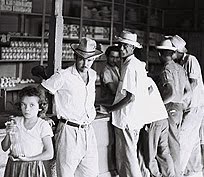
A café and store in Birán, Fidel Castro’s home town, Holguín Province, December 1963. From the Deena Stryker Photograph Collection.

Photographer and journalist Deena Stryker brings her reminiscences of the Cuban Revolution to this opening celebration for “Deena Stryker: Photographs of Cuba, 1963-1964,” on display through 12 December 2010 in the Special Collections Gallery.

Following Stryker’s remarks, exhibit curators Holly Ackerman and Heather Settle will lead a panel of several local experts on Cuba in discussing the photographs and placing them in their historical context. Panelists include:

  • Lars Schoultz, William Rand Kenan, Jr. Professor of Political Science, University of North Carolina at Chapel Hill
  • Monika Gosin, Program in Latino/a Studies in the Global South, Duke University
  • Linda Howe, Department of Romance Languages, Wake Forest University

A reception and gallery tour, led by Stryker, will follow.

Can’t visit the exhibit in person? Check out the virtual exhibit, which includes an additional eleven photos from the Deena Stryker Photograph Collection, part of the RBMSCL’s Archive of Documentary Arts.

My RBMSCL: Reading Dorothy Allison

Today, we’re starting a new feature: mini-essays from friends of the RBMSCL on the collections they’ve used and treasured. Below, Sharon Holland’s mini-essay about Dorothy Allison was inspired by the RBMSCL’s recent acquisition of Dorothy Allison’s papers

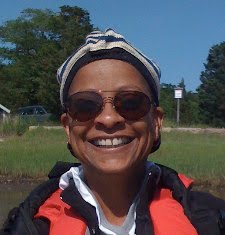
Photo courtesy of Sharon Holland.

I first encountered Dorothy Allison’s major work, Bastard Out of Carolina, on an overnight train (the Orient Express, no less) from Vienna to Paris. I wasn’t prepared for what would eventually happen in the book and when I got to the fateful scene in the car outside the hospital, I impulsively threw the book out of the window—it is still in a field somewhere along the train line. My reaction is a testament to the importance of the scene of violation that Allison wanted to construct for the reader—it was real, and sudden and devastating. I purchased the book upon my return to the United States and it has been one of my favorites since. Acquiring her papers is a serious accomplishment for Duke. Thank you for preserving the work and ultimately the memory of one of the most important feminist authors of the 20-21st century.

Post contributed by Sharon Holland, Associate Professor, English and African and African American Studies, Duke University.

Interested in contributing a mini-essay? E-mail me at amy.mcdonald(at)duke.edu!

Dorothy Allison Papers Arrive at Duke

In the early 1990s Ginny Daley, then director of the Sallie Bingham Center for Women’s History and Culture, was convinced that Duke should acquire Dorothy Allison’s papers. “I saw her as the quintessential Southern writer,” Daley wrote recently. “Her personal papers and literary works fit well with Duke’s collections of Southern literature and women’s culture, while bringing fresh perspectives on queer culture and truth-telling to the mix.” Through campus visits and other seed-planting efforts, Ginny Daley introduced Ms. Allison to the possibility of Duke as the permanent home for her collection.

Photo by Brett Hall.

Now, after a nearly twenty year period of considering this momentous decision, Dorothy Allison, author of Bastard Out of Carolina and other works and renowned activist in the LGBTQ community, has selected the RBMSCL to be the repository for her papers. Bingham Center and literary curatorial staff collaborated on the initial acquisition of nearly 60 boxes of Allison’s papers, including drafts of her writings, extensive correspondence and research files, personal journals documenting her life and creative process, and more. For Allison, a South Carolina native now living in California, it’s a relief to have the papers at the RBMSCL: “All I know is that now I feel that all that . . . I saved is going to be safe and of use. Since we are entering high summer here with 90 degree temperatures and high risk of fire, I can also stop worrying that a wildfire might sweep through the redwoods and erase all that history. Safe and of use is infinitely preferable.”

The papers will be a rich resource for those interested in Allison’s life and work, as well as for researchers exploring the development of LGBT and Southern literatures, lesbian communities and families, and the history of American sexuality, among many other topics. Materials will be added to the collection as Allison continues to write and publish (a new book of short stories and a novel coming soon!).

A preliminary finding aid for the collection is now available here. In the coming months staff will review, process, and revise the finding aid for the collection to make it available for research. Researchers interested in using the papers should contact the Bingham Center staff to discuss their availability.

Post contributed by Will Hansen, Assistant Curator of Collections.

Hostage Nation Receives WOLA-Duke Book Award for Human Rights in Latin America

Hostage Nation: Colombia’s Guerrilla Army and the Failed War on Drugs, written by Victoria Bruce, Karin Hayes and Jorge Enrique Botero, has won the third annual WOLA-Duke Book Award for Human Rights in Latin America.

The book, published last month by Alfred A. Knopf, is the story of three American contractors and Colombian presidential candidate Ingrid Betancourt held hostage by the FARC (Revolutionary Armed Forces of Colombia) for over five years before their rescue in 2008. The book draws on Botero’s exclusive interviews with the American contractors, as well as extensive research on the FARC and the Colombian drug trade, to illustrate the impact of Colombia’s war and the U.S. war on drugs in Colombia.

The Washington Office on Latin America and Duke University created the prize to honor the best current, non-fiction book published in English on human rights, democracy and social justice in contemporary Latin America.The WOLA-Duke Book Award aims to draw the general public’s attention to good writing on contemporary Latin America. Francisco Goldman won the first award in 2008 for his book, The Art of Political Murder. Heraldo Muñoz’s The Dictator’s Shadow was last year’s winner.

Later this fall, the authors will visit the Duke University Libraries for an event co-sponsored by the Archive for Human Rights at the RBMSCL and the Duke Human Rights Center. We’ll have all the event details as they are announced here at The Devil’s Tale!

To read the entire press release from the Washington Office on Latin America, click here.

Nell Irvin Painter Reflects

Date: Monday, 13 September 2010
Time: 4:00 PM
Location: Rare Book Room
Contact Information: Amy McDonald, 919-681-7987 or amy.mcdonald(at)duke.edu

Photo by Robin Holland.

With a career that has stretched from top public universities and the Ivy League to institutions in Italy, Ghana, and France, Nell Irvin Painter brings her rich experience to a personal consideration of African American women in academia. In “Alone and Together: One African American Woman’s Experiences in the Academy,” Dr. Painter will reflect upon her professional successes and challenges, as well as her career-long exchanges with several fellow African American women scholars.

Dr. Painter’s professional and personal papers, which are held by the John Hope Franklin Research Center for African and African American History and Culture, have recently been opened to public research. For more information about her papers, visit the collection inventory or contact special-collections(at)duke.edu.

This program, part of a year-long celebration of the 15th anniversary of the John Hope Franklin Research Center for African and African American History, is the first in a series of two events co-sponsored by the Franklin Research Center and the John Hope Franklin Humanities Institute.

For more information about the second event, hosted by the Franklin Humanities Institute the following day, please visit the event’s webpage.

“Deena Stryker: Photographs of Cuba, 1963-1964″

Date: 31 August-12 December 2010
Location and Time: Special Collections Gallery during library hours
Contact Information: Karen Glynn, 919-660-5968 or karen.glynn(at)duke.edu

Journalist and photographer Deena Stryker’s black-and-white photographs of Revolutionary Cuba open a window into an unsettled time in that country’s history, after the Bay of Pigs and before Che Guevara’s departure for the Congo, when Fidel Castro was solidifying his control over the new revolutionary government.

A woman watching a military parade, Havana, January 1964. From the Deena Stryker Photograph Collection.

This new exhibit of thirty gelatin silver prints from the Archive of Documentary ArtsDeena Stryker Photograph Collection documents this extraordinary change, bearing witness to both the vitality of Cuba’s leadership and the optimism of the Cuban people. The exhibit is curated by Holly Ackerman, Librarian for Latin America and Iberia, and Heather Settle, visiting scholar in Cultural Anthropology.

Can’t visit the exhibit in person? Check out the virtual exhibit, which includes an additional eleven photos from the Deena Stryker Photograph Collection.

Keep up with The Devil’s Tale for news about the exhibit’s opening reception on Thursday, September 16th at 4:00 PM in the Rare Book Room. Deena Stryker, the exhibit’s curators, and several local experts on Cuba will come together to discuss the photographs and place them in their historical context.

Selling a Coke and a Smile

Photo by Mark Zupan.

As the adage goes, Coca-Cola sells itself. The John W. Hartman Center for Sales, Advertising and Marketing History’s recently-acquired Coca-Cola Star Salesman Kit might just suggest otherwise. This collection of training materials—including scripted manuals, 35mm film strips with accompanying phonographs, and other training memorabilia housed in a special green suitcase—was created by the Coca-Cola Company’s Sales Promotion Department between 1949 and 1951. The company encouraged route managers to purchase the Star Salesman Kit as a subscription program to educate their salesmen in the latest marketing techniques.

Designed as a series of one hour sessions, the Star Salesman Kit covers eight topics relevant to the company’s goal of increasing route sales, such as merchandising (“It’s Got to Be Sold”), and advertising (“What’s on Your Mind”). In addition, the kit includes training material for best practices in stocking product, refrigeration, and the use of the “red cooler” and vending machines in various outlets.

While most of the Star Salesman Kit is geared toward increasing sales to vendors, the materials do give special attention to instructing route salesmen how to promote Coca-Cola sales to the home market—particularly to the housewife. The session, “The Woman in Your Life,” encouraged the route salesman to market directly to women through techniques such as floor displays and product placement in outlets where women shopped for the home.

The Star Salesman Kit provides a glimpse into the sales and marketing culture of the Coca-Cola Company, the organization of its sales department, training practices, and even refrigeration technology. At the same time, the Star Salesman Kit offers some insights into mid-20th-century social and cultural issues, demonstrating, perhaps, why no other consumer product is a more iconic symbol of American culture than Coca-Cola.

Post contributed by Diana Poythress, RBMSCL Technical Services graduate student volunteer. Thanks to Alexandra Bickel, RBMSCL Technical Services graduate student volunteer, for her assistance with this post.

Dispatches from the David M. Rubenstein Rare Book and Manuscript Library at Duke University