Human Rights Records, Electronically

I’m a history Ph.D. candidate, so I knew something about working in archives when I started my internship with Technical Services at Duke’s Rare Book, Manuscript, and Special Collections Library (RBMSCL), but not a lot about processing paper records, never mind electronic ones. However, as I started processing several collections acquired through the Archive for Human Rights, I discovered that electronic files were often just as important to the collection as paper ones. When I started working on the Common Sense Foundation Papers, I faced over 16,000 electronic files in addition to 34 boxes of paper records! A North Carolina think-tank active from 1994 to 2008, the Common Sense Foundation (CSF) worked on initiatives such as the death penalty, testing in public schools, and LGBTQ rights.

When I met with Paula Jeannet Mangiafico (Senior Processing Archivist), Seth Shaw (Electronic Records Archivist), and Patrick Stawski (Human Rights Archivist) to discuss the collection, we decided to integrate the electronic and paper files in the finding aid since the content overlapped and the volume was about equal. A researcher interested in the death penalty will thus find both electronic and paper records described in the Criminal Justice Subseries, which contains letters written by incarcerated people, a survey of capital defense lawyers, research on specific death-row inmates, and documents reflecting the daily work that occurred in CSF’s office surrounding this policy initiative.

Just as when working with paper documents, I screened the electronic files for sensitive information, such as personal, financial, and medical records. I then used the original path of the networked drive to describe the electronic files in the finding aid and used both the number of files and the megabyte size to indicate the physical extent. That way, researchers interested in a particular aspect of CSF’s work will know which electronic folders to request from RBMSCL staff, just as they would request a physical box by its number.

The RBMSCL has acquired almost 200 collections with electronic records in the past few years. Hopefully, my work with the CSF Papers will serve as model for processing future collections with strong electronic components.

Post contributed by Liz Shesko, Technical Services Processing Intern.

The Common Sense Foundation Papers are currently being processed. The finding aid will be published and the collection will be available for use in January 2011. For more information, contact the RBMSCL at special-collections(at)duke.edu.

A Snowy Saturday at Duke

On Saturday afternoon, Durham saw its first snowfall of the season. Sadly, most of the snow melted before we made it to the RBMSCL this morning. Lucky for us, Duke Yearlook, the Duke University Archives‘ Flickr photostream, has come to our rescue with a flurry of photos of a snowy Gothic Wonderland.

There are funny ones…

And pretty ones…

Stop by the “Winter at Duke” set on Flickr for more pictures of the campus in snow.

Charley the Bell

Visit Duke University’s West Campus any weekday at 5:00 PM and you’ll hear the 50 bells of the Duke University Chapel’s impressive carillon.

But there’s a 51st bell on West Campus. Hung in the Kilgo Quadrangle belfry sometime in October or early November of 1950, Charley came to Duke (according to legend) from Cherley Myncherry in Oxfordshire, where it had been part of this Benedictine priory’s set of bells. The bell was a gift of Furman G. McLarty (Trinity College Class of 1927 and Duke professor of philosophy from 1933 until his death in 1952), who had purchased it in 1929 while a Rhodes Scholar at Oxford University.

Perhaps overshadowed by its Duke Chapel brethren, our Charley does have one particular point of pride: with Cherley Myncherry dating from the 12th century, the bell may very well be one of the oldest in the New World. We were lucky to record a peal from this historical treasure.

[youtube=http://www.youtube.com/watch?v=gysxgMaBuSU?hl=en]

Additional Resources:

  • Duke MagazineRetrospective” on Charley by former Associate University Archivist Tom Harkins.

Rights! Camera! Action!: Rain in a Dry Land

Date: Tuesday, 16 November 2010
Time: 7:00 PM
Location: Rare Book Room
Contact Information: Patrick Stawski, 919-660-5823 or patrick.stawski(at)duke.edu, or Kirston Johnson, 919-681-7963 or kirston.johnson(at)duke.edu

Rain in a Dry Land (82 min.) chronicles the first 18 months of the new American lives of two families finally allowed to immigrate to the United States after over a decade in a Kenyan refugee camp. Beginning with “cultural orientation” classes in Kenya, where they are introduced to such novelties as electric appliances and the prospect of living in high-rise apartment buildings, the film follows the families as they learn that the streets in America are definitely not paved with gold. The families’ sponsors—Jewish Family Services in Springfield, Massachusetts, and World Relief in Atlanta—have pledged six months of support, which makes for a daunting learning curve as the families settle into their new homes.

A discussion with director Anne Makepeace and Suzanne Shanahan, Associate Director of Duke’s Kenan Institute for Ethics, will follow.

The Rights! Camera! Action! film series, which is sponsored by the Archive for Human Rights, the Archive of Documentary Arts, the Duke Human Rights Center, the Franklin Humanities Institute, and Screen/Society at Duke’s Arts of the Moving Image Program, features documentaries on human rights themes that were award winners at the annual Full Frame Documentary Film Festival. The films are archived at the RBMSCL, where they form part of a rich and expanding collection of human rights materials.

Scrapbooking for Victory

“Every Girl Pulling for Victory.” 
“Back Up the Boys.” 
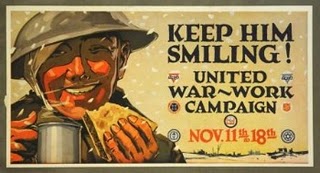
“Keep Him Smiling!” 
“Morale is Winning the War.”

These chipper slogans grace the 20 posters, handbills, brochures, stickers, song lyrics, newspaper ads, and cartoons found in a United War Work Campaign Scrapbook recently acquired by the John W. Hartman Center for Sales, Advertising & Marketing History. This collection of fundraising and morale-boosting materials was produced for a multi-institutional drive during the final months of World War I. Only one other copy is known to exist at Stanford University’s Hoover Institution Archives.

On September 9, 1918, President Woodrow Wilson wrote to Raymond Fosdick, coordinator of the War Department’s Training Camp Activities, requesting that aid organizations pool their resources on a massive single campaign to raise funds for soldier morale programs “in order that the spirit of the country in this matter may be expressed without distinction of race or religious opinion in support of what is in reality a common service.”

The campaign coordinated the efforts of seven organizations that had previously managed individual fundraising drives: the YMCA, YWCA, American Library Association, War Camp Community Service, National Catholic War Council (Knights of Columbus), Jewish Welfare Board, and Salvation Army. Each organization would continue to address their traditional demographic or service focus (for example, the Knights of Columbus worked primarily with Catholic communities, and the American Library Association sent books to soldier encampments) while organizing their activities around a central set of promotional messages.

The goal was to raise $170 million during a campaign scheduled for the week of November 11-18, 1918 (whether prescient or brilliantly planned, November 11 was also the day that Germany signed the Armistice, officially ending hostilities.) The end of the war was already in sight during the campaign-planning period, but it was estimated that the demobilization of nearly four million U.S. troops would require at least two years and a staggering sum for programs to maintain the morale of returning soldiers. With a nearly $1 million operating budget, a National Publicity Committee was formed and chaired by Bruce Barton, a journalist and magazine editor who had been an active official with the YMCA. All media would be employed: print, outdoor advertising, leaflets, stickers, lapel pins, radio spots, motion picture shorts, even a women-run telephone brigade. The campaign was a resounding success, raising over $203 million dollars that funded soldier aid programs through 1920. It was hailed in the press at the time as the largest fundraising event in human history.

As an advertising history-related aside, the United War Work Campaign may have been the launching platform for one of America’s most successful advertising agencies. Ad men Roy Durstine and Alexander Osborn worked on the campaign alongside Bruce Barton. In early 1919, just a few months after the campaign wrapped up, the three men founded ad agency Barton Durstine & Osborn, which merged in 1928 to become Batton, Barton, Durstine & Osborn (BBDO). BBDO rapidly grew to become one of the largest and most respected advertising agencies in the United States. The Hartman Center is proud to add this important scrapbook to its growing collection of war-related advertising materials.

For more photos from the scrapbook, take a look at the scrapbook’s set on the RBMSCL’s Flickr photostream.

Post contributed by Rick Collier, Technical Services Archivist for the John W. Hartman Center for Sales, Advertising & Marketing History.

Final Papers, Meet New Finding Aids

Time to get cracking on those final papers? Start your research with one of the collections described in these brand-new finding aids!

African American Miscellany, 1757-1983

This collection of approximately 400 print and manuscript items relating to African and African American history was assembled over a number of decades by the staff of the RBMSCL. These documents—largely from the southern United States—speak to the sales, escapes, and emancipations of slaves from colonial times through the Civil War, the civil rights era from 1950-1970, and to a lesser extent, the period in between the 1870s and the 1950s.

South Africa Documentary Photographs Collection, 1940s-2007 and undated

Metal artist Titus Moteyane, Atteridgeville, Pretoria, 1984. Gisele Wulfsohn. From the South Africa Documentary Photographs Collection.

Acquired as part of the Archive of Documentary Arts, the South Africa Documentary Photographs Collection consists of four series of photographs documenting South African social conditions under and after apartheid, dating from approximately the 1940s-2007: Beyond the Barricades, The Cordoned Heart, Then and Now, and Underexposed. Each series originated in an exhibition, book, or project developed jointly by Duke University and South African institutions. The collection represents work by 45 South African photographers, many of whom were members of Afrapix, a collective photography agency that was politically active in the 1980s, or were otherwise active in documenting anti-apartheid struggle.

Louanne Watley Photographs, 2002-2010

The photographs and supporting materials created by Louanne Watley depict communities of Catholic nuns in Indiana, Kentucky, North Carolina, and Virginia, and images of their religious life in those communities. She typically focuses on the women’s individual faces, hands, and feet. There are also a few images of monks and their communities as well. The formats are primarily black-and-white prints with some color prints, contact prints, Polaroids (diffusion transfer process), large color inkjet prints, and negatives. As with many Archive of Documentary Arts collections acquired in recent years, digital scans of Watley’s work are also included.

Walter McGowan Upchurch Papers, 1841-1977

Walter McGowan Upchurch, Jr. served as a member of Duke’s Board of Trustees and was senior vice-president of Shell Companies Foundation, Inc. This collection contains personal correspondence among members of the Upchurch family, including correspondence between Upchurch and his brother during World War II, when they were both serving in the U.S. Navy; professional correspondence concerning Duke University administrative affairs; and genealogical materials for the Upchurch, Daniel, and Meadows families of North Carolina. Additional materials include Shell Development Company records on personnel issues such as labor relations and salary administration at the progressive Emeryville Laboratories; and Shell Companies Foundation records from 1963 to 1974, chiefly relating to the foundation’s endowments, scholarships, grants, and donations. The Duke University Archives also holds a smaller collection of Upchurch’s papers.

Please remember that many RBMSCL collections are stored off-site in our wonderful Library Service Center and need to be requested by RBMSCL staff members at least 24 hours before your research visit. We encourage you to e-mail special-collections(at)duke.edu for assistance.

Research for Human Rights

A continuing goal of the Archive for Human Rights at the RBMSCL is to explore how archives can help sustain and nurture human rights and social justice. Over the past few months, we have had the exciting opportunity to provide our knowledge and services to the staff of the Center for Death Penalty Litigation (CDPL), a Durham, NC-based non-profit that provides post-conviction legal representation to indigent defendants accused or convicted of capital crimes in the state of North Carolina.

On August 11, 2009, Governor Bev Purdue signed into law the North Carolina Racial Justice Act, which will allow defendants facing the death penalty to present evidence of racial bias, including statistics, in court. Since the act was signed into law, CDPL lawyers have been working with the CDPL case files archived here at the RBMSCL to uncover evidence of such bias. CDPL staff easily accessed the well-arranged collection through its online finding aid to determine which boxes and files contained relevant material. They then worked with RBMSCL staff to call boxes for review in our research room and to take advantage of our duplication services.

In addition to research for the Racial Justice Act, CDPL and ACLU lawyers have been reviewing case files in our reading room to research how broader discovery and prosecutorial issues may impact future death penalty cases. We hope our services will continue to aid their efforts.

Post contributed by Patrick Stawski, Human Rights Archivist.

A Worthy 100 Years

Date: Tuesday, 9 November 2010
Time: 4:00 PM
Location: Rare Book Room
Contact Information: Tim Pyatt, 919-684-8929 or tim.pyatt(at)duke.edu

William Preston Few

On November 9, 1910, William Preston Few was inaugurated as the sixth president of Trinity College. Few accepted the presidency of Trinity College promising “to keep the future worthy of the past.” This would be no hollow promise as, over the next three decades, he would transform the strong and growing liberal arts college into a major research university.

To celebrate this pivotal moment in the history of Duke University, Michael Schoenfeld, Vice President for Public Affairs and Government Affairs and Stephen Nowicki, Dean of Undergraduate Education, will give brief remarks on Few’s legacy and lasting impact. University Archivist Tim Pyatt will introduce members of the Few family attending and talk about the materials documenting Few’s life and presidency that will be on display.

Our National Sweepstakes

In the spirit of election day, we are highlighting a new acquisition: the James Cartoons Posters, a series of political cartoon posters created by the New Process Electro Corporation in 1920 and 1921.

They are remarkable for a number of reasons—including their large size (21 x 31 inches) and their beautiful colors. Originally offered as a subscription for $1.25 per week, the posters feature not-so-subtle commentary on everything from the League of Nations, prohibition, Russian aggression, and the Ponzi scheme. One common topic is the 1920 presidential election, where Warren G. Harding challenged James Middleford Cox. One of our favorites, “The Home Stretch!,” stars Harding (riding on the GOP Elephant) and Cox (being pulled in a wagon by the Democratic Donkey) racing towards the Election Day finish line.

Detail from “The Home Stretch!”

Many of the posters reflect America’s increasing isolationism, particularly regarding Europe and the League of Nations. Harding’s campaign for a “return to normalcy” struck a chord with voters who were exhausted by World War I and disillusioned by global politics. He defeated Cox in a landslide on November 2, 1920.

The James Cartoons Posters collection has only a sampling of the originally published series, so unfortunately we don’t know what the artist had to say about Harding and the Republicans post-election.

Detail from “The Home Stretch!”

Post contributed by Meghan Lyon, Accessioning Associate.

Dispatches from the David M. Rubenstein Rare Book and Manuscript Library at Duke University