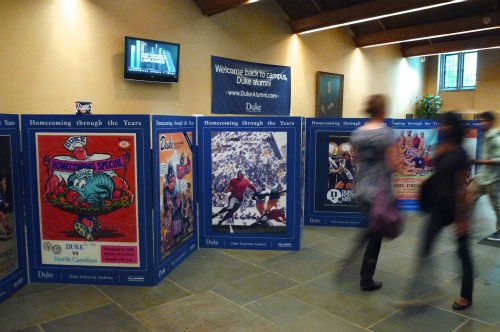
. . . for Homecoming . . . (see more Duke football program covers)
. . . and NC Pride! (event details)


. . . for Homecoming . . . (see more Duke football program covers)
. . . and NC Pride! (event details)
This year, the Duke University Archives participated in the Duke University Union’s 2nd Annual Homecoming Scavenger Hunt. The hunt was a great opportunity to bring new students into the RBMSCL and share a part of their university’s history with them.
The clue: “Take a picture with the first issue of the Chronicle.”
Answer: Vol. 1, no. 1 of The Trinity Chronicle was published on December 19, 1905, and is one of the highlights of the University Archives’ collection. It’s only recently returned to us from the Verne and Tanya Roberts Conservation Lab, where it underwent a little conservation work and acquired a new box.
Here’s our photo album of scavenger hunters!


Good luck to all of the teams and we can’t wait for next year’s hunt! E-mail additional photos of your team and The Trinity Chronicle to amy.mcdonald(at)duke.edu and we’ll share them on our Facebook page.
We’re wrapping up our celebration of this first week of classes with a final look at one of the wonderful student (well, recent graduate) employees who help make this place run. We wouldn’t know what to do without them, and we’d have a lot less fun, too. Thanks, y’all!
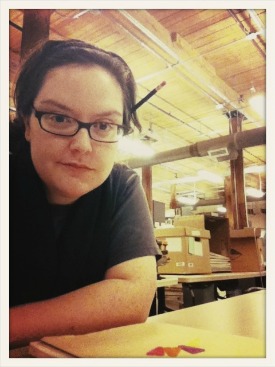 As Drill Intern in the University Archives, a lot of the work I do for the RBMSCL is behind the scenes. Since starting my position in June, my recent projects have included helping establish the University Archives social media presence and co-curating an exhibition of archival materials for the fall, but the bulk of my time has been spent processing archival collections.
And what does that even mean? Well, it means I’m the person who receives boxes full of sometimes completely jumbled records, papers, notes, journals, and ephemera. It then becomes my goal to take this mish-mosh and make it accessible through arrangement and description. I get to figure out what’s in a collection, why people want to use it, and how to make the organization logical so that researchers can actually find the items and objects they’re seeking. Or maybe even better, so that researchers can find items and objects they never expected to find in the first place.
Truth be told, I really enjoy this work. I get to play detective a little bit: researching subjects, poring over their collected history, picking out clues. Then, I get to make the collections available for others to use for scholarly research, creative projects, and simple personal edification. Plus, since the collections I’m working with pertain directly to the history of Duke University, I am getting to learn more about the buildings, traditions, and fascinating hidden stories surrounding me every day. Having just moved to Durham from Brooklyn, I feel lucky to be working in an environment where connecting with the past is part of my everyday experience.
Post contributed by Rosemary K. J. Davis, University Archives Drill Intern.
Date: Sunday, August 28, 2011
Time: 3:00 PM
Location: Big Barn Convention Center at The Shops at Daniel Boone (map and directions)
Contact Information: Historical Foundation of Hillsborough and Orange County, 919-732-2201 or info@orangeNChistory.org
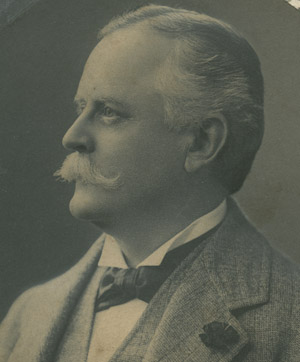
At his summer home in Hillsborough, Trinity College trustee (and donor of much of the land that is now East Campus) Julian Shakespeare Carr built a model farm that became nationally-known for its innovative farming practices.
This latest event in the “Stores and Stories” series, which is sponsored by the Historical Foundation of Hillsborough and Orange County, will focus on Carr’s Occoneechee Farm.
The dramatic presentation—which will feature Tom Stevens, Hillsborough’s mayor, as Carr—is based on Carr’s farm journal, part of the RBMSCL’s Julian Shakespeare Carr Papers. Additional stories and photos from the farm in its heyday will also be shared.
Early last week, friend of the RBMSCL and James B. Duke Professor of Economics Dr. Craufurd Goodwin came to us with an exciting discovery. He has kindly shared a few words about it, noting that “archives are where you find them.”
When my wife and I moved from Durham in 1977 to a property called Montrose on the edge of Hillsborough, a venerable green 1961 Chevrolet pickup truck was included. Legend had it that the truck had mainly gone once a week to a garbage dump on the edge of town and spent the rest of its life in its garage. It had 18,000 miles on the odometer.
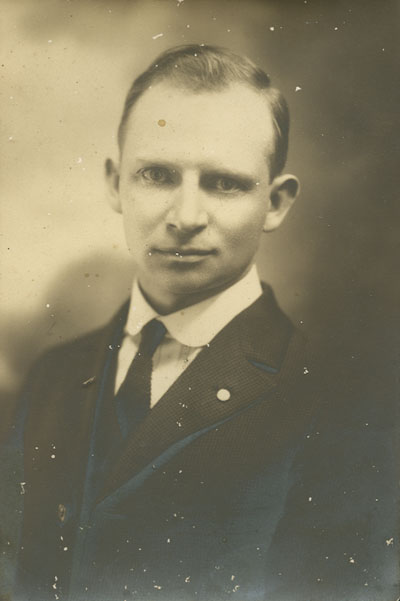
After moving most of our possessions from Durham, the old truck reverted to its traditional role and has today only 33,000 miles. But last week, on the old truck’s fiftieth birthday, it seemed appropriate to let someone else play with this toy and I sold the truck. Soon after it left the driveway, I heard from the young man who bought it that he had discovered a photograph taken by a professional studio in Durham called “Miss Johnson, Durham, N.C.” of a person described on the back as “Holland Holton, 1922.”
Holton was one of the first professors at Duke University and an administrator in various capacities; his papers are now at the Duke University Archives. There was no dated photograph of Holton in the RBMSCL’s collections until this week, but now there is.
It is a complete mystery how this picture ended up on the floor of the old truck for at least 34 years, and perhaps 50. My predecessor at Montrose and in the truck was A. H. Graham, a prominent figure in the state (Lieutenant Governor, Highway Commissioner, etc.) but Carolina all the way. How a picture of a pioneering Duke professor ended up in his farm truck we shall probably never know.
Post contributed by Dr. Craufurd Goodwin, James B. Duke Professor of Economics at Duke University.
This spring, the Flat Blue Devil has been visiting lots of fun places on campus. Here at the Duke University Archives, we have Flat Duke: that is, approximately 100 hand-drawn, 23 x 30 inch property plats detailing Duke University lands around 1925-1926. These plats helped the new university prepare for the reconstruction of East Campus and the construction of West Campus.
These five plats show the land along Anderson Street (part of which now belongs to the Sarah P. Duke Gardens):
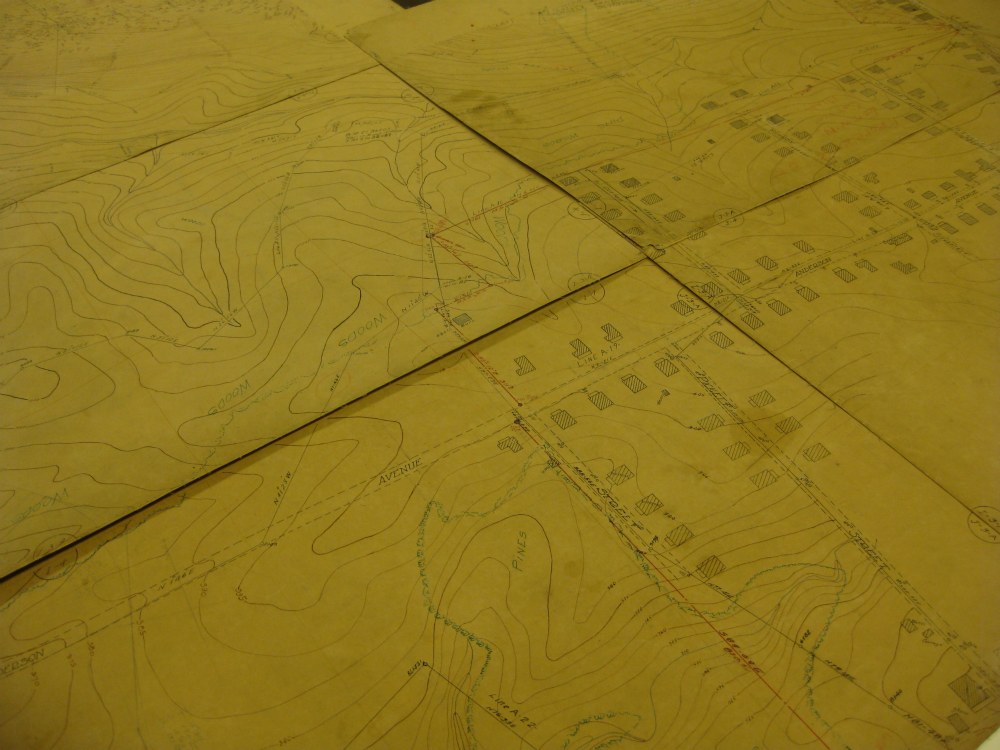
These two plats show part of East Campus:

And when we say that these are detailed, we mean detailed. For instance, there was an apple tree near Vice President of the Business Division (and future Duke president) Robert L. Flowers‘ house (located on what is now East Campus).
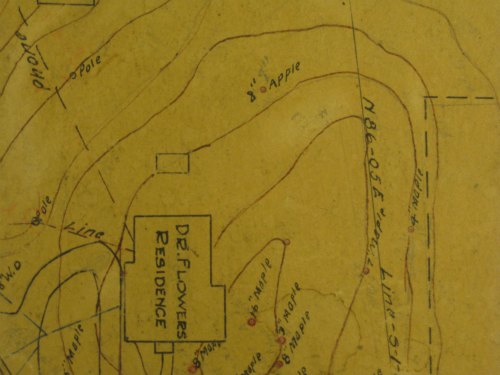
How do you piece the plats together? Match up the circles!
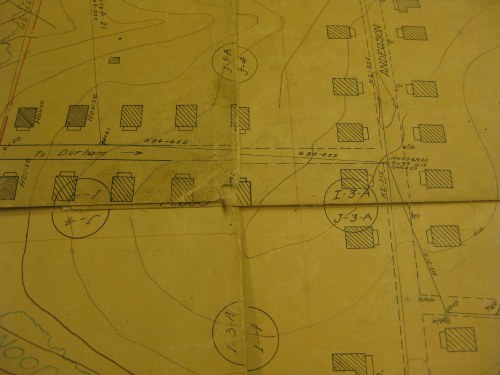
As you can imagine, we’d need a pretty sizeable flat surface to lay all of these out. We wonder if we could borrow Cameron for a day….. Stop by the RBMSCL and pore over every little detail yourself!
And you thought only children get to go on field trips?
Today, the staff of the Duke University Archives paid a visit to Maplewood Cemetery and the graves of the people whose papers we work with every day. We started with a visit to the Dukes.
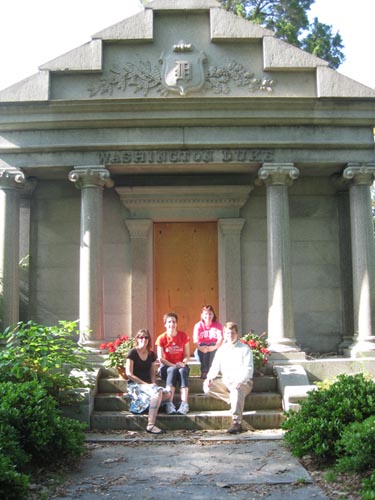
It’s very sunny on the steps of the Duke Mausoleum at 9:30 AM! From left to right are Molly Bragg, our outgoing Drill Intern; Mary Samouelian, Doris Duke Collection Archivist; Kim Sims, Technical Services Archivist; and Seth Shaw, Electronic Records Archivist. (I’m taking the photo!)
We also visited President Robert L. Flowers, Trustees James Southgate and Julian S. Carr, Chancellor (and Dean of the School of Law) A. Kenneth Pye, Coach Wilbur Card, and Professors Fritz London, William Cranford, Charles Ellwood, and Aleksandar Sedmak Vesić.
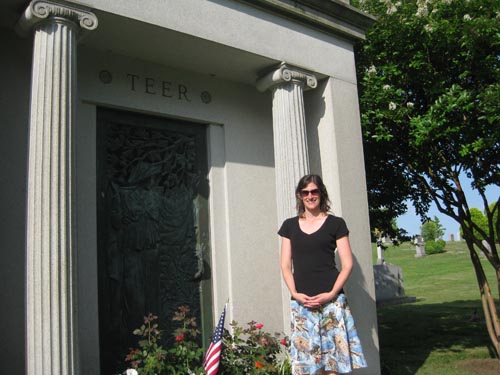
Here’s Molly at the Teer Family’s mausoleum. During her internship, Molly studied Duke University’s construction, becoming well-acquainted with Nello Teer. She wrote this article about him for Duke Magazine.
Date: Sunday, June 5, 2011
Time: 3:00 PM
Location: Durham County Library, Main Library, 300 N. Roxboro Rd. (map and directions)
Contact Information: Amy McDonald, 919-681-7987 or amy.mcdonald(at)duke.edu
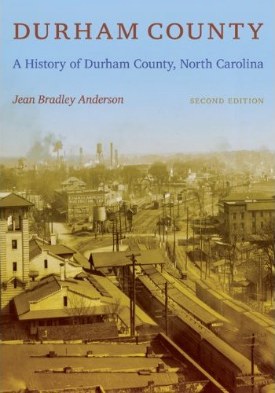
For the past twenty-one years, those of us with questions about Durham’s history have made a beeline for one book: Jean Bradley Anderson’s Durham County, first published in 1990 by our friends at the Duke University Press.
Now, Mrs. Anderson’s second edition of Durham County, released in April, tells Durham’s history up to the end of the twentieth century.
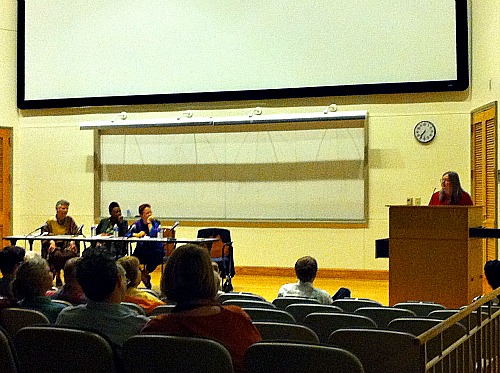
To celebrate, the Duke University Archives has joined with the Durham County Library to present an afternoon with Jean Bradley Anderson. Join us at the Durham County Library’s Main Library, where Mrs. Anderson will discuss this monumental book, as well as interesting and surprising moments in her research. She’ll also answer questions from the audience—so here’s your chance to ask the expert historian everything you’ve ever wanted to know about Durham! A book signing and refreshments will follow the discussion.
Can’t make the event? Leave us a comment and let us know what you’d like to ask Jean!
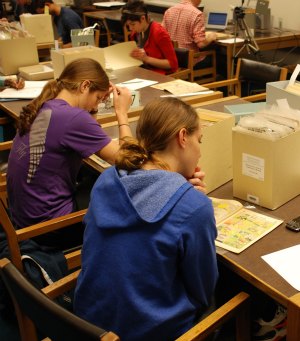
85 classes! The RBMSCL had another packed semester of instruction, as our librarians welcomed a group of fledgling Walt Whitman scholars from North Carolina State University, two classes from the Trinity School, and even a local Girl Scout troop—in addition to scores of Duke undergraduate and graduate students. We couldn’t have been more pleased when a student from Bill Fick’s “Art of the Comic Book and Zines” class (pictured at right) observed, “this place is like a candy shop—only it’s free!”
Here’s a goodie grab bag of some of the classes we taught this past semester:
Wondering if the RBMSCL could support your Fall 2011 course? Send us an e-mail at special-collections(at)duke.edu!
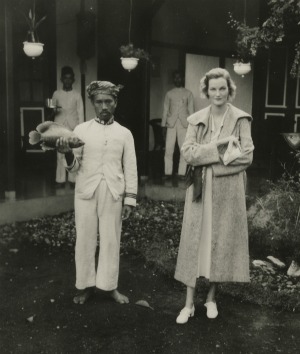 Rain, rain, go away, more great fashions are here today!
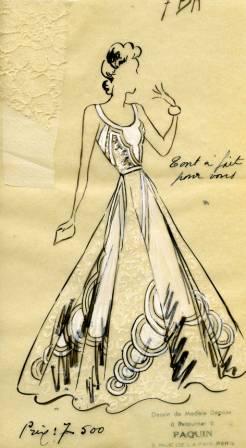
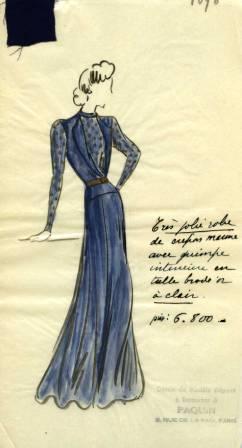
Before we present part two of our runway challenge, here are the results from last week’s evening dress challenge. And the winner is . . . Sophisticated Lady with 32.73% of the votes, slightly edging out Who Me? by one vote. And maybe gentlemen don’t prefer blondes (good news for us brunettes), as it only got one vote. Thank you to all who voted (and the poll is still open if you haven’t yet!).
Today’s runway show is day dresses. Click below to score the designs and vote for your favorite look. You get to decide which is in and which is out!