Category Archives: Rare Books

The Anatomy of Anatomy Day

Monday was the annual Anatomy Day visit to the History of Medicine Collections. This is one of my favorite times of the year!

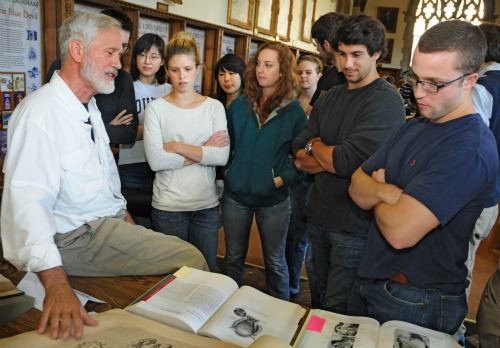
In the fall, all of the first year medical students here at Duke—about one hundred of them—visit the History of Medicine Collections to view historical anatomical atlases. This is a chance for them to see how anatomy has been represented over hundreds of years, and also provides stimulating and interesting texts that they can compare to what they are seeing in the dissection lab.

Curator Rachel Ingold talks with medical students at Anatomy Day.
Curator Rachel Ingold talks with medical students at Anatomy Day. Photo by Angela Mace.

Faculty and staff contribute to Anatomy Day by engaging with students and asking questions about the texts on display. This year, participants included the main coordinator of the event, Dr. Jeff Baker, along with Dr. Ara Tourian, Dr. Rick Madden, Professor Valeria Finucci, Professor Shannon Withycombe, and Rubenstein Library staff members Laura Micham, Kate Collins, Andy Armacost, and Jessica Janecki. Materials on display ranged from a 17th century copy of a 14th century illuminated Islamic medical manuscript to the controversial Pernkopf atlases from the mid-twentieth century.

The comments I heard this year were “awesome,” “I love anatomy so I loved everything,” and “overall, this experience was great and I liked to see the progression of anatomical representations.” I overheard students have serious ethical discussions about dissection and talk about the variety of ways they learn about the human body. I also talked to a student who told me that the greatest tool out of all the tools a student could have in the anatomy lab is the hand.
Dr. Rick Madden talks with medical students at Anatomy Day.
Dr. Rick Madden talks with medical students at Anatomy Day. Photo by Mark Zupan.

I’m already looking forward to next year’s Anatomy Day and talking with students about the array of anatomical texts here at the History of Medicine Collections!

For more photos, visit the “Anatomy Day 2011” set on our Flickr photostream!

Post contributed by Rachel Ingold, Curator for the History of Medicine Collections.

10 Days, 10 New Acquisitions: Day Ten

Today, we’re wrapping up our celebration of the beginning of a new fiscal year with our last feature on one of the notable items that arrived here at the RBMSCL in the past year. Get ready for announcements of many more exciting acquisitions in 2011-2012! We’d like to thank Mark Zupan, the Libraries’ graphic designer, and everyone in the Digital Production Center for their help with the images for these posts.

Le Premier [Second] Volume des Plus Excellents Bastiments de France by Jacques Androuet du Cerceau, 1576 and 1579.

A major document of Renaissance Europe, Androuet du Cerceau’s survey of French buildings includes nearly 150 engraved plates.  In two volumes, 36 palaces, castles, and other major buildings are beautifully illustrated by detailed plans and views.  In some cases, the buildings no longer stand or are now vastly different than they appeared in 16th-century France.

For more photos of our new acquisitions (and other materials from the RBMSCL’s collections), check out the “From the RBMSCL’s Collections” set on the Duke University Libraries’ Flickr photostream.

Post contributed by Will Hansen, Assistant Curator of Collections.

Previous posts:

10 Days, 10 New Acquisitions: Day Nine

We’re celebrating the beginning of a new fiscal year by reviewing some notable items and collections that arrived here at the RBMSCL in the past year. Get ready for announcements of many more exciting acquisitions in 2011-2012!

Photo of Gaza from Photographs of the Holy Land

Photographs of the Holy Land: Sinai and Palestine; Lower Egypt, Thebes, and the Pyramids; Upper Egypt and Ethiopia by Francis Frith, 1863.

In 1856-57, when the science and art of photography were still young and developing (pun intended), the Englishman Francis Frith traveled to the Middle East to photograph the great sites of antiquity.  A work of monumental proportions and importance to the early history of documentary photography, Francis Frith’s Photographs of the Holy Land includes some of the earliest published photographic images of Jerusalem, as well as iconic views of Egypt’s monuments and ruins, some now lost or much more decayed. The 111 albumen photographs are mounted in three folio volumes, and the set acquired by Duke this year is notable for the fine condition of the photographs.

From the Archive of Documentary Arts.

For more photos of our new acquisitions (and other materials from the RBMSCL’s collections), check out the “From the RBMSCL’s Collections” set on the Duke University Libraries’ Flickr photostream.

Post contributed by Will Hansen, Assistant Curator of Collections.

Previous posts:

10 Days, 10 New Acquisitions: Day Seven

We’re celebrating the beginning of a new fiscal year by reviewing some notable items and collections that arrived here at the RBMSCL in the past year. Get ready for announcements of many more exciting acquisitions in 2011-2012!

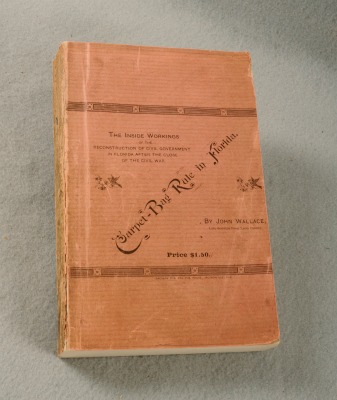
Cover of Carpet Bag Rule in Florida

Carpet Bag Rule in Florida: The Inside Workings of the Reconstruction of Civil Government in Florida After the Close of the Civil War by John Wallace, 1888

John Wallace (1842-1908) was born a slave in North Carolina, served in the Union army during the Civil War, and settled in Florida at the end of the war.  He served in the Florida state House of Representatives and Senate during the Reconstruction era as a Republican, the longest political tenure of any black man in Florida; however, his book, published in 1888, is very critical of his fellow Republicans and Reconstruction rule.  Doubts about Wallace’s authorship emerged quickly, both because of his race and his stance against the Republicans, but proof that the book is not by him remains unfound.

From the John Hope Franklin Research Center for African and African American History and Culture.

For more photos of our new acquisitions (and other materials from the RBMSCL’s collections), check out the “From the RBMSCL’s Collections” set on the Duke University Libraries’ Flickr photostream.

Post contributed by Will Hansen, Assistant Curator of Collections.

Previous posts:

10 Days, 10 New Acquisitions: Day Five

We’re celebrating the beginning of a new fiscal year by reviewing some notable items and collections that arrived here at the RBMSCL in the past year. Get ready for announcements of many more exciting acquisitions in 2011-2012!

Unsterblicher Tugend-Schatz durch gute Handelschafft erworben von der weyland durchleuchtigsten Chur-Fürstin … Elisabetha Amalia Magdalena verwittibten Pfaltz-Gräfin bey Rhein, und Chur-Fürstin in Bayrn …bey drey-tägiger Leich-Begängnus in einer Lob-Rede by Nicolaus Staudacher, 1710

A memorial volume produced in Augsburg, Germany, after the death of the Countess of Pfalz-Neuburg (1635-1709), showing engraved versions of the 25 giant emblematic paintings created for the funerary ceremonies by the Countess’s court painter, Franz Haagen. A very rare book, it complements the outstanding collection of German emblem books in the RBMSCL.

For more photos of our new acquisitions (and other materials from the RBMSCL’s collections), check out the “From the RBMSCL’s Collections” set on the Duke University Libraries’ Flickr photostream.

Post contributed by Will Hansen, Assistant Curator of Collections.

Previous posts:

10 Days, 10 New Acquisitions: Day Four

We’re celebrating the beginning of a new fiscal year by reviewing some notable items and collections that arrived here at the RBMSCL in the past year. Get ready for announcements of many more exciting acquisitions in 2011-2012!

The Penny Pickwick by Thomas Peckett Prest. Edited by Bos, ca. 1837-42

Charles Dickens’s Pickwick Papers (1836-37) was so popular that it almost immediately generated a flurry of piracies, travesties, and plagiarisms.  One of the first of these was the Penny Pickwick, so called for its being issued weekly in 112 parts, each costing one English penny.  The set now at the RBMSCL contains 108 of the 112 original parts, now very hard to find in their original state (since most sets were read and discarded or bound together).  While its claims to artistic merit are few and far between, Prest’s work nevertheless provides a fascinating glimpse of London’s popular culture at the dawn of the Victorian era and the workings of its publishers, hack writers, and illustrators.  The Penny Pickwick is also an early example of the “penny dreadfuls” that swept through England in the nineteenth century: cheap, sensational fiction aimed at lower-class audiences, and important works in the development of genres such as mystery, science, and horror fiction.

For more photos of our new acquisitions (and other materials from the RBMSCL’s collections), check out the “From the RBMSCL’s Collections” set on the Duke University Libraries’ Flickr photostream.

Post contributed by Will Hansen, Assistant Curator of Collections.

Previous posts:

10 Days, 10 New Acquisitions: Day Two

We’re celebrating the beginning of a new fiscal year by reviewing some notable items and collections that arrived here at the RBMSCL in the past year.  Get ready for announcements of many more exciting acquisitions in 2011-2012!

Metropolis, First and Second Editions

Metropolis by Thea van Harbou, 1st and 2nd editions, 1926 and 1927

The first (at right) and second editions of Thea van Harbou’s Metropolis are notable additions to the Glenn Negley Collection of Utopian Literature.  Iconic as the basis for the 1927 expressionist film by Fritz Lang (von Harbou’s husband), the early editions are also notable for the striking graphic design of their covers.  The second “photoplay” edition also features stills from the film.  The editions were acquired as part of a large collection of German science fiction and fantasy from the nineteenth and twentieth centuries.

For more photos of our new acquisitions (and other materials from the RBMSCL’s collections), check out the “From the RBMSCL’s Collections” set on the Duke University Libraries’ Flickr photostream.

Post contributed by Will Hansen, Assistant Curator of Collections.

Previous posts:

A Revolutionary North Carolinian’s Reading List

On a quest for some Fourth of July inspiration, I began browsing the thousands of volumes that comprise our rare book collection when I found a copy of Thomas Jefferson’s A Summary View of the Rights of British America, his lesser known indictment of British transgressions of colonial rights written in 1774—a time when Jefferson, among other future revolutionaries, still felt possible “fraternal love and harmony throughout the whole [British] empire.”

Bound with A Summary View are several other political tracts from the revolutionary era, The Justice and Necessity of Taxing the American Colonies, Demonstrated, 1766; An Answer to the Declaration of the American Congress, a British response to the American Declaration of Independence; and, finally, Letters from General Washington to Several of his Friends in the Year 1776, published in 1777.

My interest in this modest volume was piqued by the gilt-stamped initials “J. G.” found on the cover and the name “J. Gillespie” scrawled on the title page. Could this J. Gillespie be North Carolina’s own revolutionary, James Gillespie? James Gillespie was born in 1747, owned a plantation in Kenansville, North Carolina, and, during the American Revolution, fought with a N.C. militia regiment. He later served in the state senate, attended the state’s constitutional conventions, and later sat in the U.S. House as a Federalist.

If you are also in need of a dose of revolutionary spirit come to the RBMSCL (tomorrow—we’re closed today!) and explore the ideological origins of the American Revolution through these tracts, the same ones that were perhaps perused by a revolutionary North Carolinian.

Post contributed by Josh Larkin-Rowley, Research Services Assistant.

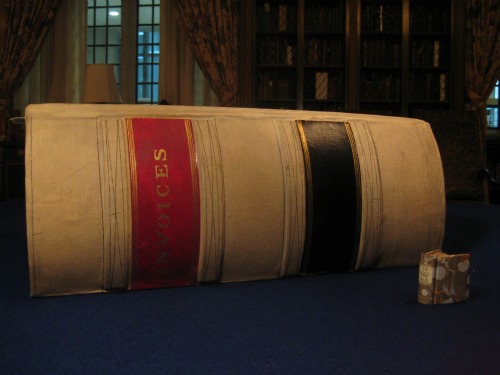
Big Book, Little Book

Big Book, Little Book

Wandering through the stacks earlier this week, we found ourselves a bit goggle-eyed upon discovering this enormous volume of newspaper clippings from the George Tinkham Papers. For comparison, we’ve placed it next to The Bible in Miniature, or, A Concise History of the Old and New Testaments, an 1805 volume from our miniature books collection.

P.S. These aren’t the biggest or littlest books in our collections.

P.P.S. Surprisingly, the big book is not as heavy as it might seem.

Instruction is Sweet!

Bill Fick's "Art of the Comic Book and Zines" Class
Photo by Bill Fick.

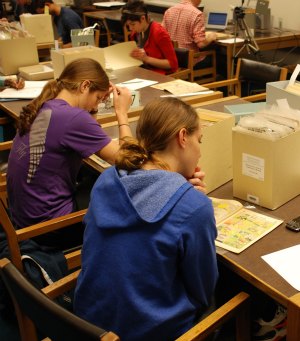
85 classes! The RBMSCL had another packed semester of instruction, as our librarians welcomed a group of fledgling Walt Whitman scholars from North Carolina State University, two classes from the Trinity School, and even a local Girl Scout troop—in addition to scores of Duke undergraduate and graduate students. We couldn’t have been more pleased when a student from Bill Fick’s “Art of the Comic Book and Zines” class (pictured at right) observed, “this place is like a candy shop—only it’s free!”

Here’s a goodie grab bag of some of the classes we taught this past semester:

  • Architectural Theory from Antiquity to the Renaissance
  • Art of the Comic Book and Zines
  • Cannibalism to Anorexia:  Embodying Social Meaning (Writing 20)
  • Digital Durham
  • Documenting the South
  • The Family in Documentary Photography
  • From Huck Finn to Miley Cyrus: Children’s History Through Popular Culture (Writing 20)
  • History of Punk
  • Introduction to Contemporary Latin America
  • Introduction to Oral History
  • Language in Immigrant America
  • Legal Documents: Yesterday & Today (Writing 20)
  • Looking In, Looking Out: The Language of Photographic Texts (Writing 20)
  • Major Italian Authors
  • Maps, Exploration, and Empire
  • Martin Luther King, Jr.
  • Photographing South Africa
  • Play, Games, and Culture (Writing 20)
  • Reading the Qur’an
  • Religion and Politics
  • Russian Art and Politics
  • Staging Sexualities
  • Suburbs, Malls, Office Buildings
  • Weimar and Nazi Germany
  • Women as Leaders

Wondering if the RBMSCL could support your Fall 2011 course? Send us an e-mail at special-collections(at)duke.edu!