Category Archives: News and Features

$999.99 More Than a Penny for Your Thoughts

Just think how many loads of laundry you could do or how many cases of . . . soda you could buy with $1,000.

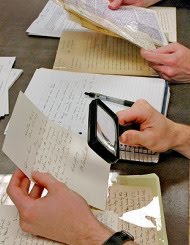
If you, like the gentlemen on the left, have pored over RBMSCL manuscripts, books, broadsides, maps, etc. (with or without a magnifying glass) and turned your brilliant discoveries into a brilliant paper, why not submit it for a chance to receive one of two Chester P. Middlesworth Awards?

The two awards, one for an undergraduate and one for a graduate student, each carry a cash prize of $1000.00. The awards will be given at a reception held during Parents’ and Family Weekend (October 22-24, 2010).

Click here for our post about last year’s happy recipients!

A few stipulations:

  • Your paper must have been prepared to meet requirements of a course in any academic department at Duke University or of an independent study project for credit at Duke University.
  • Your paper must be based largely or wholly on sources in the RBMSCL.

Oh, and the deadline for submissions is Saturday, May 15th!

2010-2011 Franklin Research Center Travel Grants Awarded

John Hope Franklin. From the John Hope Franklin Papers.

The John Hope Franklin Research Center for African and African American History and Culture is pleased to announce the recipients of this year’s travel grants. These grants allow scholars to travel to Durham to conduct research using the Franklin Research Center’s collections.

  • Shanna G. Benjamin, Department of English, Grinnell College, for work on a biography of the late Nellie Y. McKay, Bascom Professor of English and Afro-American Studies at the University of Wisconsin-Madison.
  • Derek Charles Catsam, Department of History, University of Texas of the Permian Basin, for a chronicle of the events of 1985 in South Africa, a tumultuous year in that country’s history.
  • Jametta Davis, Department of History, Howard University, for research for her dissertation detailing the effects of New Deal policies and programs on African American women.
  • Jacob S. Dorman, Department of History, University of Kansas, for an examination of the formation and development of black Jewish religions in the past 45 years.
  • Elizabeth Herbin, Department of History, St. John’s University, for an analysis of racial conflicts and segregation among small Southern farmers from 1900 to 1945.
  • Karen Kossie-Chernyshev, Department of History, Geography, and Economics, Texas Southern University, for an account of “boomerang migration”: the return of African American Southerners from their new homes in the North to participate in social and political uplift activities during the Jim Crow era.
  • Deborah Lee, independent scholar, for a study tracing the networks of anti-slavery activists in the Potomac River basin from 1810 to 1870.
  • Joseph Moore, Department of History, University of North Carolina at Greensboro,for research on the 1850 trial of George Grier, an enslaved South Carolina man, for seditious speech, with emphasis on an exploration of the community of Abbeville County, South Carolina.

Watch The Devil’s Tale for news about upcoming discussions with several of the travel grant recipients from the Bingham, Hartman, and Franklin Research Centers.

RBMSCL Photos: It’s MayDay!

Today, archives and other cultural heritage institutions across the country will be celebrating MayDay, our annual reminder to re-examine our strategies for protecting our valuable collections in the event of an emergency. To honor the day, we’re posting this picture of a range of pH-neutral archival boxes and papers, just waiting to house our new acquisitions. Proper housing is one of the many steps that the RBMSCL takes to ensure that our collections will be around for generations.

Over at Preservation Underground, our colleagues in the Preservation department have prepared a handy list of online resources on library emergency planning.

2010 Hartman Center Travel Grants Awarded

The John W. Hartman Center for Sales, Advertising & Marketing History is pleased to announce the recipients of this year’s Hartman Center Travel Grants. These grants allow scholars to travel to Durham to conduct research using the Hartman Center’s collections.

JWT Fellows:

  • Ferdinando Fasce: Department of Modern and Contemporary History, University of Genoa
    “JWT Italy between Reconstruction and the First Oil Shock, from the late 1940s through the 1970s”
  • Eva von Wyl: Social and Economic History, University of Zurich
    “Rationalization, Self-Service and American Way of Life: American Eating Habits in Postwar Switzerland (1950-1970)”

Faculty Recipients:

  • Shannan Clark: Department of History, Montclair State University
    “The Creative Class: White-Collar Workers and the Making of America’s Culture of Consumer Capitalism”
  • Liza Featherstone: Journalism School, New York University; School of International and Public Affairs, Columbia University
    “Behind The Mirror: Focus Groups and What They Reveal, 1930s to present”
  • Michelle Ferranti: Division of Fine and Performing Arts, Marymont Manhattan College
    “History of Women’s Motivations for Douching following the Medicalization of Birth Control in the U.S.”
  • Ann McDonald: Department of Art Design, Northeastern University
    “The Role of Publically Displayed Information Visualization in Eliciting Individual and Communal Action”
  • Ari Martin Samsky: Global Health Studies Program, University of Iowa
    “Working Through Responsibility: Advertising, Medicine and The Social Good, World War II-the Present”

Student Recipients:

  • Abby Bartholomew: College of Journalism and Mass Communications, Advertising Department, University of Nebraska-Lincoln
    “JWT’s Application of Psychological Principles to Advertising, the Work of John B. Watson and his Behaviorist Theories”
  • Rebecca Burditt: Program in Visual and Cultural Studies, Department of Art and Art History, University of Rochester
    “Seeing Difference: Postwar Hollywood and the Commercial Delay”
  • Berti Kolbow: Institute for Economic and Social History, Georgia Augusta University Goettingen
    “Transatlantic Transfers of Marketing Concepts between Eastman Kodak and Agfa, 1880-1945”
  • Shawn Moura: Department of History, University of Maryland
    “Target Market Brazil: Postwar Advertising and Consumer Culture in the Country of the Future”
  • Cory Pillen: Department of Art History, University of Wisconsin-Madison
    “WPA Posters: A New Deal for Design, 1936-1943”
  • Elizabeth Spies: Department of English, University of California, Riverside
    “Advertising Stigmatas: The Evolution of Poetic Advertising throughout the Twentieth Century, 1890-1980”

Watch The Devil’s Tale for news about upcoming discussions with several of the travel grant recipients from the Hartman, Bingham, and Franklin Research Centers.

RBMSCL Photos: The Scribe is Here!

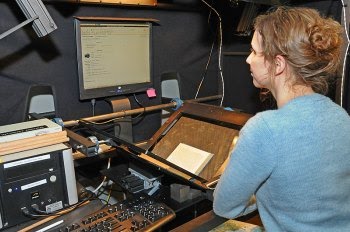
Above, Abigail, who is on loan to us from the Internet Archive, begins our Scribe scanning project. Over the next few months, we’ll be digitizing our collections of Utopian Literature and Confederate imprints—and so much more! Remember to visit The Devil’s Tale often for more news about the Scribe.

And have a look at Beth Doyle’s post about the Scribe installation over at Preservation Underground. We’re glad they finally got the Scribe through the doorway.

Photo by Mark Zupan.

2010-2011 Mary Lily Research Grants Awarded

Duke University cheerleaderThe Sallie Bingham Center for Women’s History and Culture is pleased to announce the recipients of this year’s Mary Lily Research Grants. These grants allow scholars to travel to Durham to conduct research using the Bingham Center’s collections.

  • Katie Anania, Art History, University of Texas-Austin, for dissertation research on the rise of feminism as a framework for evaluating contemporary art.
  • Lori A. Brown, Architecture, Syracuse University, for research for a book examining the relationships between space, abortion, and issues of access.
  • Kate Eichhorn, Culture and Media Studies, The New School, for research comparing zines and scrapbooks as archival collections of ephemera.
  • Julie Enszer, Women’s Studies, University of Maryland, for an examination of lesbian-feminist print culture in Durham, NC, 1969-1989 as part of a historical narrative of lesbian-feminist publishing.
  • Karen Garner, Historical Studies, SUNY Empire State College, for an examination of U.S. global gender policy in the 1990s.
  • Rebecca N. Mitchell, English, University of Texas – Pan American, for research for an article examining the proto-feminist aspects and eroticism of Victorian mourning attire.
  • Michelle Moravec, History and Women’s Studies, Rosemont College, for research on feminist art activism as a U.S. social movement, 1967-1991.
  • Whitney Strub, Women’s Studies and American Studies, Temple University, for research for a book examining the relationships between queer sexuality, LGBT activism, and antigay activity in post-WWII United States.

Watch The Devil’s Tale for news about upcoming discussions with several of the travel grant recipients from the Bingham, Hartman, and Franklin Research Centers.

Patricia Derian Papers Coming to Duke

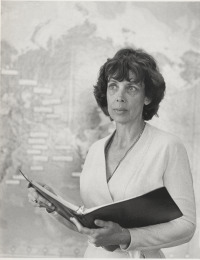
The Archive for Human Rights has signed an agreement with Patricia Murphy Derian to serve as the repository for her papers, which document her long career in human rights.

Patt, as she is known to friends and family, was involved in the civil rights struggles in Mississippi prior to being tapped by President Jimmy Carter to head the newly-minted Bureau for Human Rights and Humanitarian Affairs. In 1977, she became the nation’s very first assistant secretary for human rights.

Her papers consist of country files, general files, correspondence, and a collection of audio and video interviews. Processing of the collection will begin immediately and should be complete by summer of 2010. If you’d like to arrange a visit to view the collection, or if you have any questions, please e-mail us at special-collections(at)duke.edu.

Post contributed by Patrick Stawski, Human Rights Archivist.

Q & A with Andrew Kahrl

Tomorrow, the Franklin Research Center will host Dr. Andrew Kahrl, who will present”Losing the Land: African American Ownership of Coastal Property.” We asked him a few questions in anticipation of his talk, which is based on his research in our Behind the Veil oral histories collection.

Q: Could you give us a preview of your talk?

Andrew: I’m going to trace the history of African American coastal land ownership from the late 19th century to the present in order to better understand the relationship between race and real estate development in the making of the modern Sunbelt South and the long civil rights movement.

I plan to discuss the rise of coastal black landownership in the post-emancipation era; African Americans’ economic and emotional investment in coastal property and leisure space under Jim Crow; and the impact of changes to the region’s political economy on black landownership and notions of land-based empowerment. I’ll highlight some of the more revealing interviews in the Behind the Veil collection that speak to the struggle of African Americans to acquire and defend coastal property under Jim Crow and the role of black-owned leisure spaces in shaping class and culture behind and along the color line, as well as the various strategies of expropriation black coastal landowners faced—and continue to face—at the hands of real estate developers, the courts, and public officials from the 1970s to the present.

Overall, I hope to use the story of African American beachfront property to offer new insights into the intertwined stories of Jim Crow, civil rights, and the making of the Sunbelt, and to stimulate discussions on the spatiality of race, wealth, and privilege in modern America.

Q: Tell us more about your research in the Behind the Veil oral histories. Have you made any surprising discoveries?

Andrew: I have made some fascinating discoveries in the Behind the Veil collection. Two years ago, I listened to a small sampling of interviews conducted with residents of coastal cities. Interviewees recounted stories of the places that are the subject of my research that I simply could not have found elsewhere, and offered clues to the hidden history of places and cases of land acquisition and expropriation that led me to pursue other records and, in the end, make fascinating discoveries. In particular, their personal stories of the different strategies real estate developers and their allies in public office employed to seize valuable, black-owned coastal property have helped me piece together a broader set of land-use practices and legal strategies that transformed America’s coastlines in the second half of the 20th century.

The Behind the Veil Collection offers rich and moving stories of African Americans’ struggles to carve out spaces for pleasure and relief under Jim Crow, and reinforces, in my mind, the importance of land ownership in the black freedom struggle and the impact of African Americans’ steady loss of land in recent decades on relations of political and economic power in the South and the nation.

Thanks, Andrew!

RBMSCL Scholars: Emily Herring Wilson

We’re beginning a new feature today! We’ve asked some of the wonderful authors and scholars that the RBMSCL has hosted over the years to contribute a few words on their new books and research projects. We’re going to start with an essay from Emily Herring Wilson, editor of the newly-released Becoming Elizabeth Lawrence: Discovered Letters of a Southern Gardener.

Years of research for a life of North Carolina garden writer Elizabeth Lawrence (1904-1985) led me many places, but none more inviting than my trips to Duke’s Special Collections Library, where I found hundreds of letters in the Ann Preston Bridgers Papers that brought Lawrence to life as no other materials, including interviews with family and friends who had known her. As I went through box after box of letters from Elizabeth to Ann (all beautifully catalogued by Janie Morris), I discovered a collection that not only informed the biography I wrote about Lawrence (No One Gardens Alone) but gave vivid testament to the importance of women’s friendships. (Bridgers, a successful playwright and a founder of the Raleigh Little Theatre, was teaching young Elizabeth how to write and how to live, all vividly revealed in the letters.) This month John F. Blair, Publisher, released my edited collection, Becoming Elizabeth Lawrence: Discovered Letters of a Southern Gardener. Among the books I have been privileged to write or edit, it is my favorite because of the charm and intelligence of a private life.

These letters from Elizabeth to Ann are lively with gossip, anecdote, reflection, regret, aspiration, and love—the love of friends, the love of gardens, and the love of literature. I still regard it as a miracle that they were not destroyed after Ann’s death in 1967 but ended up in the Bridgers Papers. I hope that you will read them and enjoy them as much as I did.

New Audubon Birds on Display

We’ve just turned the pages of our double elephant folio edition of John James Audubon’s Birds of America.

This month, stop by the RBMSCL’s reading room (103 Perkins) during open hours to view these new prints:

Red-headed Woodpecker (Picus erythrocephalus)
Hooping Crane (Grus americana; at left)
Rough-legged Falcon (Buteo lagopus)
Blue Jay (Corvus cristatus)

Visit this earlier blog post for a brief explanation of the monthly page turning.