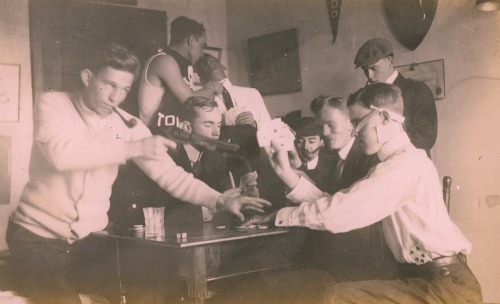
It’s been a long and fun year. We’re counting down to LDOC with Duke University Archives photos of Duke students having a good time! (Click the photo to see it on our Flickr photostream, Duke Yearlook.)
Think these 1940s co-eds are just relaxing with some bon-bons at the end of a tough day of classes? Not at all: this is actually a high-level meeting to plan a holiday dance!
It’s been a long and fun year. We’re counting down to LDOC with Duke University Archives photos of Duke students having a good time!
The photo above comes from Trinity College student Charles Bagley’s scrapbook, which documents school life from 1907 to 1913. You’ll find a digitized version of the scrapbook on the Duke University Archives’ Flickr photostream.
(Thanks to University Archives student assistant Crystal Reinhardt for helping with photo selection!)
Date: 6 April-18 July 2011 Location and Time: Perkins Library Gallery during library hours Contact Information: Meg Brown, 919-681-2071 or meg.brown(at)duke.edu
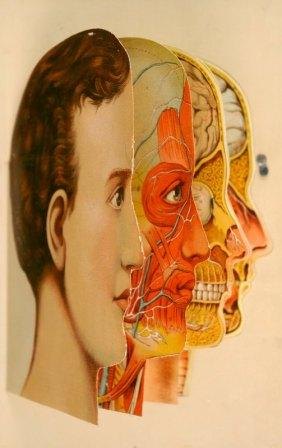
Physicians' Anatomical Aid, ca. 1880-1890
Animated Anatomies explores the visually stunning and technically complex genre of printed texts and illustrations known as anatomical flap books.
This exhibit traces the flap book genre beginning with early examples from the sixteenth century, to the colorful “golden age” of complex flaps of the nineteenth century, and finally to the common children’s pop-up anatomy books of today. The display—which includes materials from the RBMSCL, the Duke Medical Center Library & Archives’ History of Medicine Collections, and from the private collections of the curators of the exhibit—highlights the history of science, medical instruction, and the intricate art of bookmaking.
The exhibit is curated by Professor Valeria Finucci, Department of Romance Studies, and Maurizio Rippa-Bonati, Department of History of Medicine at the University of Padua, with the assistance of Meg Brown, Duke University Libraries exhibits coordinator, and Rachel Ingold, Curator of the History of Medicine Collections. Items will be exhibited in both the gallery of Perkins Library on Duke’s main campus as well as outside the History of Medicine Reading Room at Duke’s Medical Center Library.
In addition to the exhibit, an opening reception will be held Monday, 18 April, at 10 AM at the History of Medicine Collections, followed by a symposium of renowned scholars in history, medicine, and medical history in Perkins Library. The exhibit and the symposium, both free and open to the public, aim to address a diverse public including those interested in the medical field, history, cultural studies, visual studies, and material studies.
To learn more about the symposium, exhibit, see photos of anatomical flap books, and watch videos of them in action, visit the exhibit website.
Post contributed by Rachel Ingold, Curator of the History of Medicine Collections.
When I first began investigating the Robert Boyd Family Papers at Duke’s Rare Book, Manuscript, and Special Collections Library, I expected to find something that would appeal to genealogists of this family and those researching the history of Abbeville County, South Carolina. I didn’t know that I would discover a rich story about the triumphs of love and the tragedies of war. I would not have believed that two years later their story would be available to the world in The Boys of Diamond Hill: The Lives and Civil War Letters of the Boyd Family of Abbeville County, South Carolina. With the guidance of the staff at RBMSCL and my editors at McFarland Publishers, that is exactly what has happened.
The backbone of this work can be found in the 86 letters of the five Boyd brothers and the husband of their eldest sister lovingly preserved in the RBMSCL. With the additional research of this family and the units they served in, their full story slowly emerged. In April 1861, brothers Daniel and Pressley Boyd joined the Confederate army. Soon the war would sweep the other three Boyd brothers—William, Thomas and Andrew—as well as their brother-in-law Fenton Hall, away from their farm in Abbeville County, South Carolina. Researching this collection uncovered warmth, humor, horror and loss of four long years of war.
I understand from descendants of Fenton Hall that a number of letters from this family had been lost in a house fire. They were thrilled to learn that those destroyed did not constitute the entire body of the brothers’ letters. It is so wonderful that Duke has preserved these surviving letters so the fascinating lives of these young men would not be lost to history. The helpful staff and wonderful facilities made the marathon sessions with this collection a joy and their support through the preparation for the publication process was invaluable.
To learn more about the book, as well as Keith’s other research projects, visit his website!
P.S. We’re still collecting responses for our reader feedback poll. Please click the orange button at the right to tell us your thoughts about The Devil’s Tale. Thanks!
Date: Thursday, 31 March 2011 Time: 3:30 PM Location: Rare Book Room Contact Information: Karen Glynn, 919-660-5968 or karen.glynn(at)duke.edu
Graeme Williams, Cape Town, 2005.
Karen Glynn, the RBMSCL’s Visual Materials Archivist, will give an historical overview of the South African Documentary Photography collections in the Archive of Documentary Arts from 1986 until today. Paul Weinberg, photographer and Senior Curator of Visual Archives in the Manuscripts and Archives Library at the University of Cape Town, will pick up the thread and describe the process of building a documentary photography archive in South Africa today.
Twenty of Weinberg’s photos are available online at the website for Then and Now, an exhibit on South African documentary photography that he curated for the Archive of Documentary Arts in 2008.
Weinberg’s photographs are archived at the RBMSCL. You can view the finding aid for his collection here.
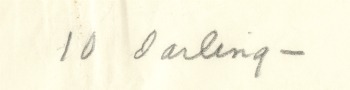
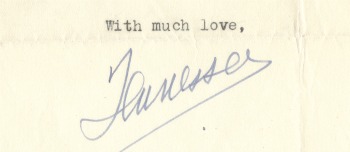
Today, March 26, 2011, would be the hundredth birthday of Tennessee Williams, one of America’s great playwrights. The Carson McCullers Papers here at Duke contain many letters between McCullers and Williams, most from the late 1940s, shortly after Williams had written McCullers a fan letter and the two had immediately become close friends. The letters are full of passionate discussion of their work, travels, and deep affection for each other.
On behalf of McCullers and all lovers of American theatre and literature: Happy birthday, “10 Darling.”
Post contributed by Will Hansen, Assistant Curator of Collections.
P.S. If you haven’t yet, please take our survey by clicking on the orange button on the right. We are collecting information from our readers so that we can make our blogs better and more informative. It won’t take long—just five easy questions. Thanks!
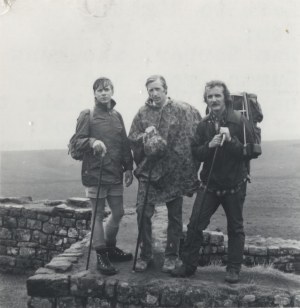
During the summer of 1970, four remarkable American writers and editors paid a visit to 70 year old Northumbrian poet Basil Bunting in his home in Corn Close, Yorkshire, England. The leader of this group was Jonathan Williams, poet and founder of North Carolina’s the Jargon Society, which published the works of innovative poets such as Charles Olson, Denise Levertov, and Duke alumnus Guy Davenport.
Williams asked his companions to stop and pose for the camera “near the end of the trek up the Pennines,” a low-rising mountain range separating the North West of England from Yorkshire. “Quite a rough go, by the way.”
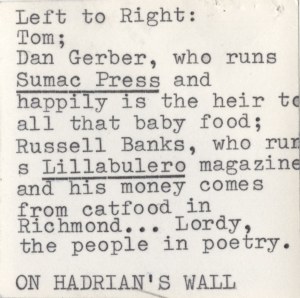
On Hadrian's Wall, back of photograph.
Williams helpfully typed on the back of this small (2 ½ inch square) photo the names of those pictured. From the left is Williams’ life partner, the poet and translator Thomas Meyer; Dan Gerber, co-founder of the Michigan-based little magazine Sumac; and Russell Banks, then a recent graduate of UNC-Chapel Hill (BA ‘67), and now the prominent novelist and author of The Sweet Hereafter, Affliction, and other acclaimed books.
He then sent the snapshot to R. Philip Hanes, an executive at Hanes Dye and Finishing Company, who was a founding board member of the Jargon Society.
The photo comes from the R. Philip Hanes Papers. Hanes’ papers provide a rich and entertaining look at one small, North Carolina publisher’s fund raising efforts. Williams’ wit and garrulousness shows in the letters. He has many names for money, for instance, names like “lucre,” “lolly,” “moola,” “smackers,” and plenty of others. “I’m apparently not doing as a fund-raiser. But, us mountain boys is a mess, that’s been true for hundreds of years.”
We also learn about some of Hanes’ interests: “Dear Morchella Esculenta,” Williams writes in August 1971, “One suspects there will be a conglutination of those fearsome fungi of yourn this year. Lots of showers here lately too. Everything grows heavily—the pollens, the tourists, anglophobia, anglophilia—the lot.”
That is, Hanes hunted mushrooms.
Post contributed by David Pavelich, Head of Research Services.
P.S. If you haven’t yet, please take our survey by clicking on the orange button on the right. We are collecting information from our readers so that we can make our blogs better and more informative. It won’t take long—just five easy questions. Thanks!
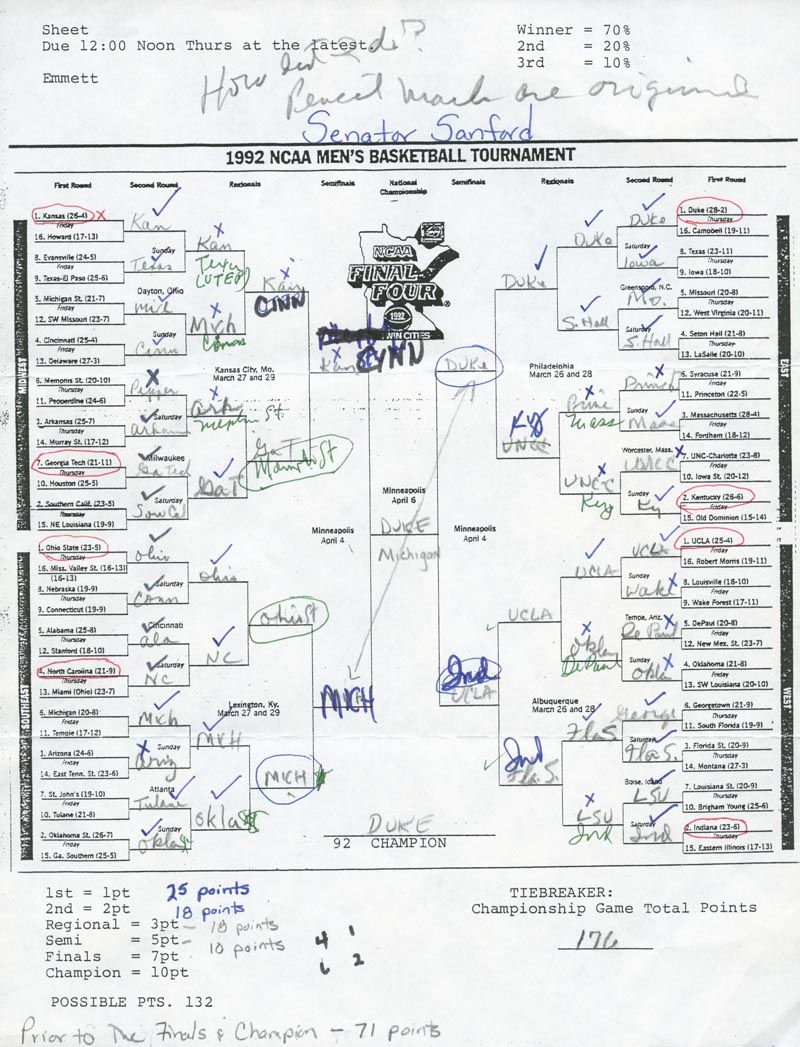
On any ordinary Monday morning in 1992, then-North Carolina Senator and former President of Duke University Terry Sanford began his week attending to the public’s business. However, this particular Monday in March happened to be the day after Selection Sunday and, like so many of us, Senator Sanford contemplated his blank NCAA Men’s Basketball Tournament bracket at the expense of perhaps more pressing work.
Among the hundreds of linear feet of Terry Sanford’s records and papers held in the RBMSCL (his senatorial papers) and University Archives (records from his Duke presidency) is his 1992 NCAA Tournament bracket. Although he couldn’t have foreseen Christian Laettner’s last second turnaround jumper against Kentucky and Duke’s trouncing of Michigan’s “Fab-5” in the tournament final, the man that the Duke Student body fondly referred to as “Uncle Terry” chose Duke to repeat as NCAA champions. Will they do it again in 2011?
Post contributed by Josh Larkin-Rowley, Research Services Assistant.
P.S. Through Friday, April 15th, we’ll be gathering responses as part of our first-ever reader feedback poll! Click the orange button in the sidebar to participate, or visit this blog post to learn more.
This flier is from a 1973 event sponsored by the Atlanta Anti-Imperialist Coalition celebrating International Women’s Day. From the flier: “International Women’s Day dates back over 100 years of struggle to March 8, 1857, when women garment and textile workers went on strike in New York. . . . People have continued to celebrate International Women’s Day on March 8 since 1910.”
Activists have used this holiday to celebrate the achievements of notable women in history as well as to advocate for women’s equality, particularly labor issues such as better child care, maternity leave, and equal pay for equal work.
It’s not often that we acquire two copies of the same work at the Library. Sometimes, however, a second copy can have unique characteristics that make it nearly irresistible—as in the case of a copy of The Fall of the Great Republic recently acquired for the Glenn R. Negley Collection of Utopian Literature, which may have solved the 125-year-old mystery of its author’s identity.
A well-known anti-socialist and xenophobic dystopian work published in 1885 and foretelling the demise of the United States, the book was published under the pseudonym Henry Standish Coverdale. The copy now at Duke seems to establish the author as New Lebanon, N.Y. newspaperman Abner Hitchcock (1851-1936). The volume comes from his library, bears the ownership signature “Hitchcock,” and includes a penciled note in the rear, dated from August 1924, stating that “Authorship [was] kept a complete secret.”
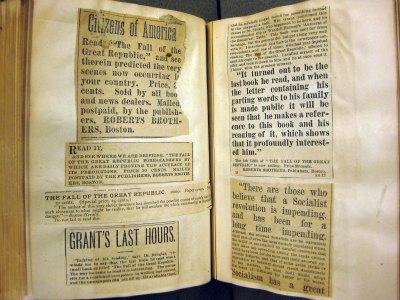
The specially-bound volume contains clippings and reviews of the work from across East and parts of the Midwest, including a suspiciously positive review from the Boston Journal, a paper for which Hitchcock wrote. Of the various reviews, the owner has written in the volume: “The most striking thing about it is in the illustration the pasted-in comments give of the impression it made on different readers. – One sees in me an ass, and one a prophet. I suspect there is some basis for both judgements.”
Clippings pasted into The Fall of the Great Republic.
The volume was discovered by a bookseller cleaning out of the attic of the Hitchcock House in New Lebanon, now a bed-and-breakfast inn. It has now found its permanent home at Duke, where it will remain a one-of-a-kind resource for future generations of scholars.
Special thanks to Garrett Scott for permission to quote from his description of this item.
Post contributed by Will Hansen, Assistant Curator of Collections.
Dispatches from the David M. Rubenstein Rare Book and Manuscript Library at Duke University