“It is an old complaint,” wrote the eighteenth-century Swiss physician Samuel-André-Auguste-David Tissot, “that study, though essentially necessary to the mind, is hurtful to the body.” Student health is the subject of a new exhibit entitled “A Sound Mind in a Sound Body: Health Advice for Scholars and Students,” now on display in the Josiah Charles Trent History of Medicine Room.
Since antiquity, scholars and students have been bombarded with warnings about the potential health hazards associated with a life of sedentary study, the medical side effects of which have been said to range from a loss of vision, cramped posture, and consumption to melancholia, bad digestion, and even hemorrhoids. Heeding these warnings, scholars and students have for centuries turned to medical guides for advice on how best to counteract the effects of “hard study.” While such guides often vary as to specifics, all commend some form of attention to diet, exercise, and regimen as means to a long and healthy life, urging adherence to an ancient ideal: mens sana in corpore sano, a sound mind in a sound body.
“Health and Strength,” Wilbur Wade Card Papers, Duke University Archives, David M. Rubenstein Rare Book & Manuscript Library, Duke University.
The items in the exhibit trace the history of medical advice written specifically for scholars and students and reflect the wide range of approaches to scholarly health. The exhibit, on display in the Josiah Charles Trent History of Medicine Room, runs through July 16, 2017.
A Sound Mind in a Sound Body is curated by Thomas Gillan, Josiah Charles Trent History of Medicine Intern
Date: March 31, 2017 Time: 2:00-3:30pm Location: Rubenstein Library Room 150 (Beckstett Classroom) Register Now
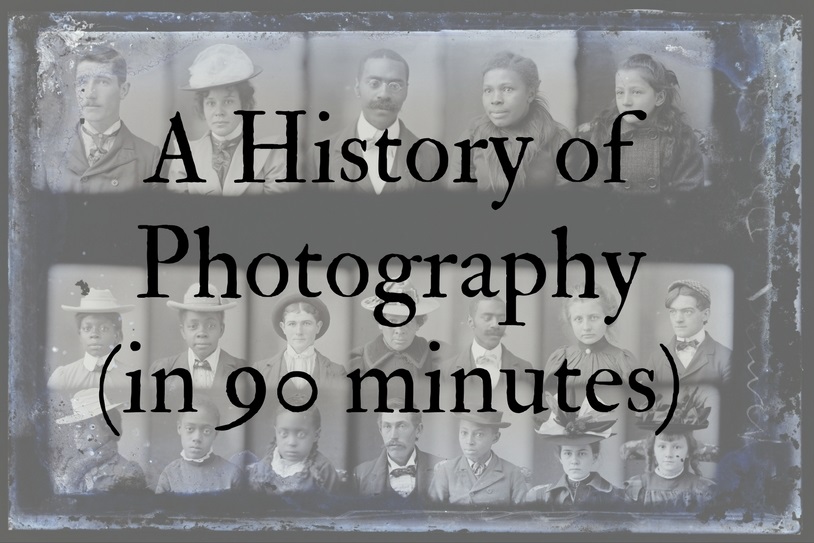
Join us for a crash course in the history of photography from daguerreotypes to digital files. Participants will learn about photographic technology, formats, artists, and movements through the Rubenstein Library’s extensive collection of photographs. The workshop will be taught by Lisa McCarty, Curator of the Rubenstein Library’s Archive of Documentary Arts.
Date: Wednesday February 22
Time: 3:30 to 4:30 PM
Location: Holsti-Anderson Family Assembly Room, Rubenstein Library 153 Optional Facebook RSVP
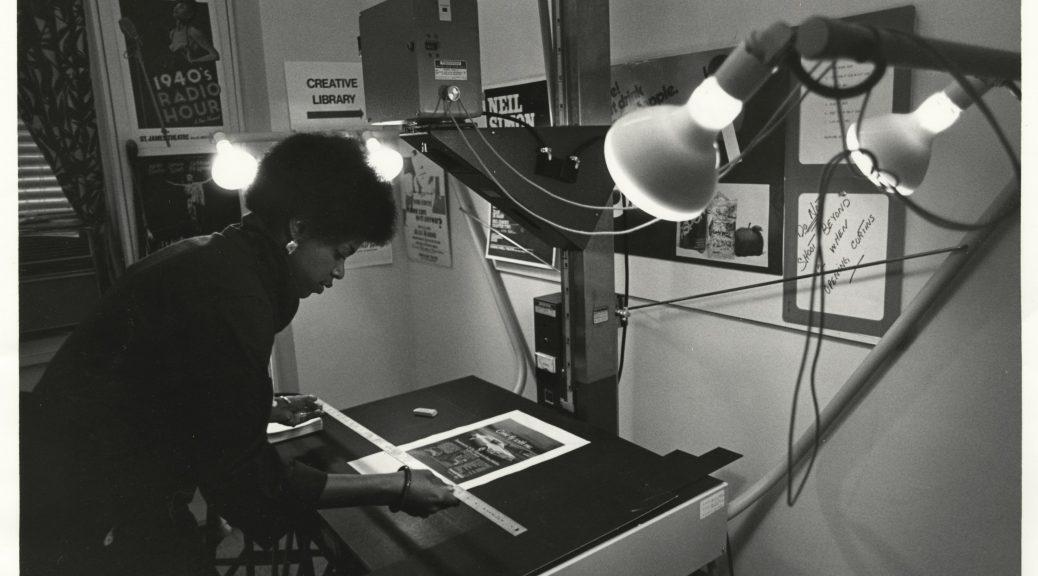
Dr. Judy Foster Davis of Eastern Michigan University’s College of Business will present on her research into the history of African-American women who have worked in the advertising industry. She has recently published a new book on this topic, Pioneering African-American Women in the Advertising Business, Biographies of MAD Black WOMEN. Her research focuses on marketing communications strategies and policies in corporate and entrepreneurial settings and historical and multicultural marketing topics. This event is part of the Hartman Center’s 25th Anniversary lecture series focusing on women in advertising and is co-sponsored by the Baldwin Scholars and African & African American Studies.
In March 2017, the David M. Rubenstein Rare Book & Manuscript Library will welcome Carlos Sandoval as the fourth Barbaralee Diamonstein-Spielvogel Visiting Filmmaker. Named in honor of Dr. Diamonstein-Spielvogel, a prolific author, interviewer, curator, and champion of the arts, this program provides an opportunity for internationally recognized filmmakers to interact with students and the public through a variety of programming including lectures, conversations, screenings.
Carlos Sandoval’s films include The State of Arizona (with Catherine Tambini, Independent Lens 2014, Emmy Nomination, CINE Golden Eagle), A Class Apart (with Peter Miller, American Experience 2009, Imagen Award, optioned by Eva Longoria) and Farmingville (with Catherine Tambini, P.O.V. 2004, Sundance Special Jury Prize).
A writer and sometime lawyer, Sandoval’s essays have appeared in several publications, including The New York Times. Sandoval worked on immigration and refugee affairs as a member of the U.S. delegation to the United Nations, and as a program officer for The Century Foundation. He is a Sundance and MacArthur Fellow and an advisor for Firelight Media. Sandoval is currently Co-Executive Director of Next Generation Leadership, a professional development diversity fellowship funded by The Corporation for Public Broadcasting and produced by WGBH and The Partnership, Inc. Of Mexican American and Puerto Rican descent, Sandoval grew up in Southern California and is a graduate of Harvard College and of the University of Chicago School of Law.
Sandoval will be in residence at Duke March 2 & 3. During this time, Sandoval will meet with scholars, students and staff.
The public conversation on March 2 is free and open to the public and made possible through the generous support of Dr. Barbaralee Diamonstein-Spielvogel.
Strong People: SNCC and the Southwest Georgia Movement
Saturday, February 4, 2017
5:00PM
Great Hall, North Carolina Central University School of Law
Please join us for a conversation with five veterans of the Civil Rights Movement in Southwest Georgia. In 1961, field secretaries from the Student Nonviolent Coordinating Commitee (SNCC) came to Albany, GA to begin orgainzing around voting rights. Born in Southwest, Georgia, Janie Cuthbert Rambeau, Annette Jones White and Shirley Sherrod joined SNCC’s work and helped build what became an ongoing and locally-sustained movement for justice. Together with northern SNCC staff, Faith Holseart and Larry Rubin, these young activist played a critical role in SNCC’s organizing efforts in the Southwest Georgia region. Participants in this panel will discuss each of their experiences in the Movement and reflect on what made the movemnt in Southwest Georgia so strong. Charlie Cobb, a fellow SNCC organizer, will facilitate the conversation.
Date: Thursday, January 12, 2017 Time: 2:00-4:00 PM Location: Gothic Reading Room, Rubenstein Library, Duke West Campus (map) Contact: Valerie Gillispie, valerie.gillispie@duke.edu
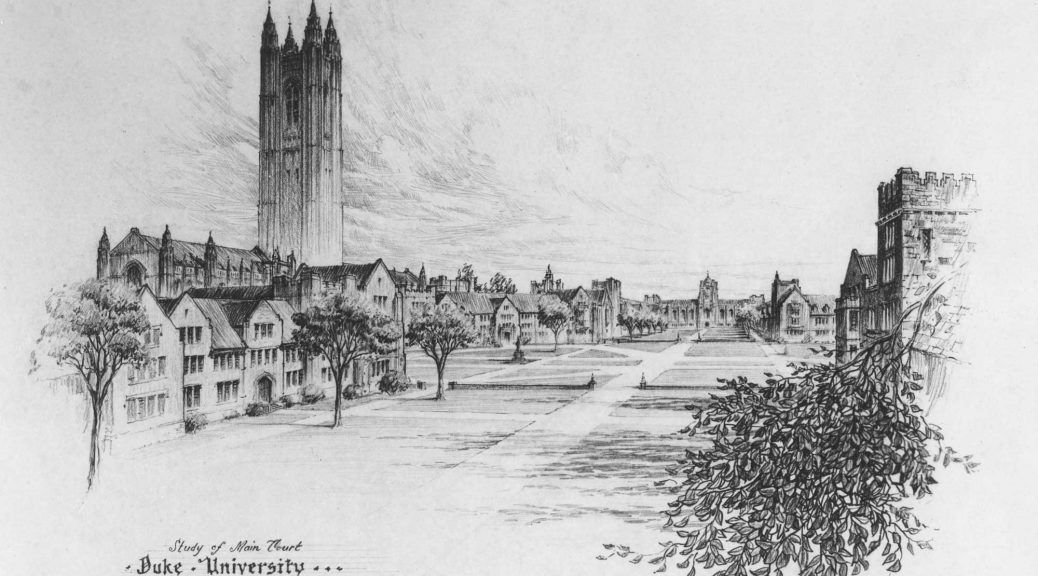
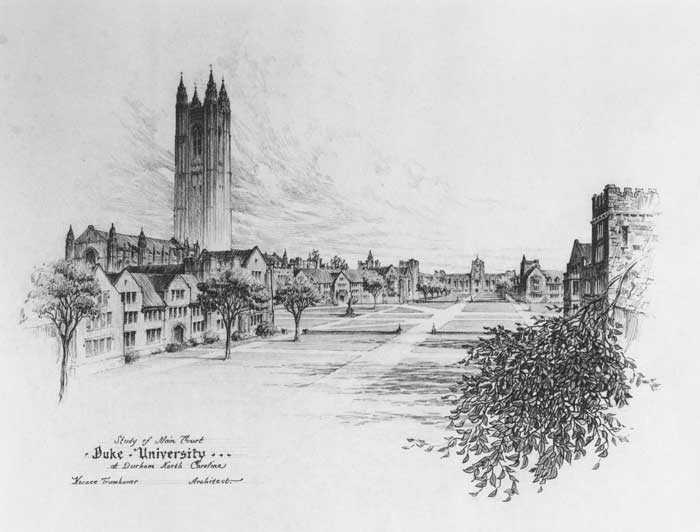
The Duke University Archives and the Facilities Management Department invite you to visit the Gothic Reading Room on Thursday, January 12th and see some of the original drawings, blueprints, and plans of Duke’s campus.
Chief designer Julian Abele of the Horace Trumbauer firm has recently been recognized at Duke with the naming of the main quad, and the open house will allow visitors to examine the details of the plans and admire the vision that Abele brought to his work.
This event will be an open house, and visitors are welcome to drop in any time. This event is being held in collaboration with the Duke University Dr. Martin L. King, Jr. Commemoration Committee.
Post contributed by Valerie Gillispie, University Archivist.
When: Wednesday, November 30, 2016 Time: 3:00 – 5:00 p.m., reception to follow Where: Holsti-Anderson Family Assembly Room (room 153) of the Rubenstein Library
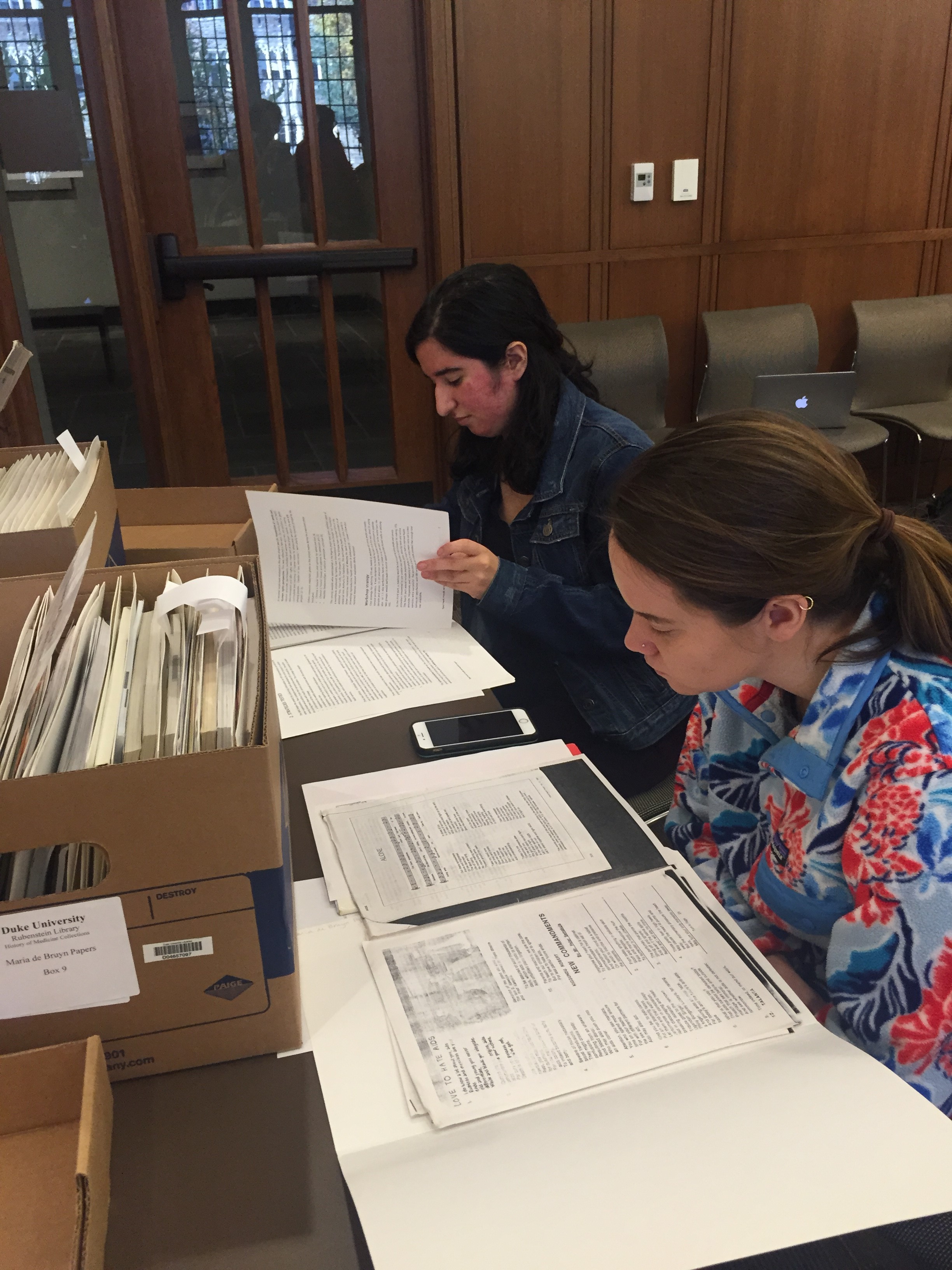
This semester, Global Health Professor Kearsley Stewart’s HIV/AIDS Narratives class is tackling a new project using Rubenstein Library collections. Working with poet and writer Kelley Swain, students are exploring the Maria de Bruyn Papers, a rich collection of global health materials related to de Bruyn’s work as a medical anthropologist globally addressing HIV/AIDS.
Students in Stewart’s HIV/AIDS Narratives explore the de Bruyn papers.
Students are delving into the de Bruyn papers as they work with Kelley Swain and learn more about the Humement project, based on the work of artist Tom Phillips, and apply this to their class. You can find details about their work in a recent DGHI newsletter. (A very important note: Original materials were not altered. Students spent an afternoon selecting original documents to scan and reproduce for their projects.)
In conjunction with the work of Professor Stewart’s class, the History of Medicine Collections is co-sponsoring an event with the Franklin Humanities Institute, the Health Humanities Lab, and the Trent Center for Bioethics, Humanities & the History of Medicine to recognize World AIDS Day. The event will be held on Wednesday, November 30, from 3:00 – 5:00 p.m. with a reception to follow, held in Room 153, the Holsti-Anderson Family Assembly Room of the Rubenstein Library. The event is free and open to the public.
Speakers will include Maria de Bruyn, Alicia Diggs of North Carolina AIDS Action Network (NCAAN), poet and writer Kelley Swain, and students from Professor Stewart’s HIV/AIDS Narratives class.
An exhibit in the Josiah Charles Trent History of Medicine Room will highlight a small sample of what can be found in the Maria de Bruyn papers. In addition, students in Professor Stewart’s class will be showcasing their work on the Student Wall in Perkins Library in December and January.
Date: Tuesday, November 15th Time: 6:15 PM Location: Holsti-Anderson Family Assembly Room (room 153) of the Rubenstein Library
Join the Hartman Center in celebrating its 25th Anniversary with its second event in the anniversary lecture series focusing on Women in Advertising. Helayne Spivak, Director of the Brandcenter at Virginia Commonwealth University, will speak about the status, achievements, and challenges women face in the advertising industry today as well as reflect on her own career and women mentors she has had.
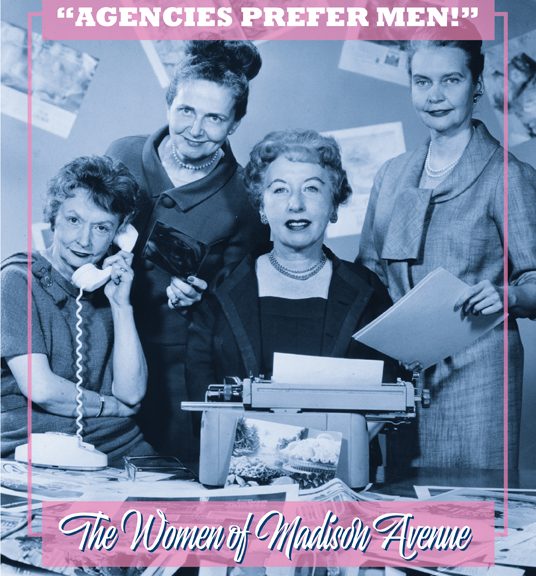
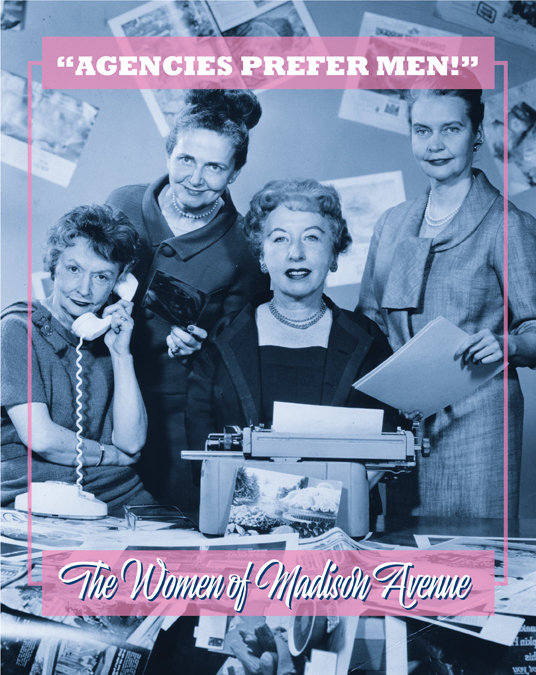
Across the hall in the Mary Duke Biddle Rare Book Room, the Hartman Center will unveil its new exhibit, “Agencies Prefer Men!”: The Women of Madison Avenue. This exhibit uses material from the Hartman Center’s collection to share the long and sometimes hidden history of women in advertising, tracing the career opportunities open to women as they progress from clerical staff to copywriting, art and market research and on to the highest positions in ad agencies as creative directors and CEOs. The exhibit will run through March 10, 2017.
Post contributed by Ashley Rose Young, a Ph.D. candidate in History at Duke University and the Business History Graduate Intern at the Hartman Center.
In the AMC hit television series Mad Men, Peggy Olson begins her career in advertising as an executive assistant whose skills and conviction enable her to become the first woman copywriter at the firm. Throughout the series, she is portrayed as a burgeoning second-wave feminist whose work ethic and determination enable her to succeed in a male-dominated industry. Although fictional, Olson’s story reflects the experiences of real women who worked on Madison Avenue in the post-WWII period. These mid-century professionals were but one generation of pathbreaking women in advertising. Unbeknownst to many viewers, women had their start in advertising long before Beatlemania hit the U.S. or the mini-skirt was in vogue. In fact, their integral contributions date back to the late nineteenth and early twentieth centuries.
In Frances E. Willard’s Occupations for Women (1897), the author dedicates an entire chapter to the integral role of women in advertising. Willard notes that women
are becoming advertising agents, taking the position in establishments in charge of the advertising department, and above all, are finding large remuneration in writing special advertisements for manufacturing firms […] So clever have women proven themselves in this special line, that hardly a manufacturer having goods toward which he wishes to attract attention, fails to avail himself of their ability. (149)
Irene Sickel Sims was one such pioneering woman. She worked as an assistant advertising manager and chief of copy for the retail advertising bureau of Marshall Field’s Department Store in Chicago. She kept a diary (1916-1917), the front page of which is inscribed with her playful handwriting, “This Then Commences the Occasionally Recorded Happenings in the Business and Social Life of Irene Sickel Sims.” The diary, written 100 years ago, details her work relationships and her day-to-day activities at the bureau, which ranged from business lunches to professional conferences. Many of her entries detail her professional relationships with men, marked by daily encounters, some of which she found frustrating and some of which inspired and motivated her.
Marshall Field’s Chicago Store, c. 1907, Detroit Publishing Company Photograph Collection, Courtesy of the Library of Congress Prints and Photographs Division. https://www.loc.gov/item/det1994015806/PP/.
As she built her reputation in the company, her colleagues regularly sought out her expertise. In August of 1916, for example, a young male co-worker came to her for help with ad revisions. She recorded the interaction in her diary:
R.V.T wrote me Saturday: “Mrs. Sims: You know so well the ways of grammar and the by-paths the trails of rhetoric. Won’t you answer this for a poor section top?” appending a criticism received on one of their signs. I decided then I’d rather have a note like that – I’d rather have all the young men in the dept. coming to me for adv. counsel and criticism than have the best of surreptition loves.
For Sims, experiencing success at work was more exciting than the thrills associated with a secret love affair popularized in literature in film at that time. She found pleasure in her career and thrived off of her abilities to mentor her colleagues, male and female alike. Sims was so successful at Marshall Field’s that other companies regularly recruited her, enticing her to join their advertising departments with formidable offers.
Irene Sickel Sims Diary, 1916-1917, John W. Hartman Center for Sales, Advertising & Marketing History, David M. Rubenstein Rare Book & Manuscript Library, Duke University.
Sims was one of many pathbreaking women to enter into the field of advertising in roles beyond that of a typist or executive assistant. Yet, the majority of employees in executive roles remained white men. It was not until the post-WWII period that significant numbers of women and people of color began taking on positions as ad executives.
You can learn more about Sims and her contemporaries via the Agencies Prefer Men! The Women of Madison Avenueexhibit, opening November 15, 2016 in the Mary Duke Biddle Room at the David M. Rubenstein Rare Book & Manuscript Library.
Date: Monday, October 31, 2016 Time: 2:00-4:00 PM Location: Holsti-Anderson Family Assembly Room Facebook Event Page
What things hide behind the Rubenstein Library’s walls?
This Halloween explore the library’s creepiest and most macabre items during our special open house. We’ll display tales of witchcraft, monsters, investigations of the paranormal, and more terrors from the Rubenstein Library’s collections.
This event is free and open to the living, the dead, and visitors from parallel dimensions. There will be candy. Lots and lots of candy.
Dispatches from the David M. Rubenstein Rare Book and Manuscript Library at Duke University




 Dr. Judy Foster Davis of Eastern Michigan University’s College of Business will present on her research into the history of African-American women who have worked in the advertising industry. She has recently published a new book on this topic,


 Join the Hartman Center in celebrating its 25th Anniversary with its second event in the anniversary lecture series focusing on Women in Advertising. Helayne Spivak, Director of the Brandcenter at Virginia Commonwealth University, will speak about the status, achievements, and challenges women face in the advertising industry today as well as reflect on her own career and women mentors she has had.



 Date: Monday, October 31, 2016