The David M. Rubenstein Rare Book & Manuscript Library is now accepting applications for the 2026 – 2027 Research Travel Grant Programs, offering awards of up to $1,500 to support research projects associated with the following collecting Centers, subject areas, and collection holdings:
Archive of Documentary Arts General Grant
Archive of Documentary Arts Sidney Gamble Travel Grant
Doris Duke Foundation Travel Grant
Eve Kosofsky Sedgwick Travel Grant
Harry H. Harkins, Jr. T’73 Travel Grant
History of Medicine Collections
Human Rights Archive
John Hope Franklin Research Center for African and African American History
John W. Hartman Center for Sales, Advertising & Marketing History
Sallie Bingham Center for Women’s History and Culture (Mary Lily Research Grants)
Anyone whose research would be supported by resources from the Rubenstein Library’s research centers is eligible to apply. We encourage applications from students at any level of education; faculty and teachers; visual and performing artists; writers; filmmakers; public historians; and independent researchers.
For assistance determining the eligibility of your project, please contact AskRL@duke.edu with the subject line “Travel Grants.”
Eligibility
Applicants must reside beyond a 100-mile radius of Durham, N.C., and may not be current Duke students or employees.
Information Session
An online information session will be held Wednesday, January 14, 2026, 2-3 PM EST. This program will review application requirements, offer tips for creating a successful application, and include an opportunity for attendees to ask questions of staff involved with the travel grant program. This information session will be recorded and posted online afterwards. You can register for the session here.
Timeline
The deadline for application will be Friday, February 27, at 8:00 PM EST. Decisions will be announced by the end of April 2026 for travel during May 2026 – June 2027. Awards are paid as reimbursements for personal expenses after completion of the research visit(s).
The 2025 Human Rights Digital Storytelling Award, presented by the Rubenstein Rare Book & Manuscript Library at Duke University, has been awarded to the podcast Inside Kabul.
Produced and originally broadcast by FRANCE INTER (French Public Radio) Inside Kabul was created and directed by Caroline Gillet in collaboration with Marwa and Raha. Inside Kabul tells the story of two young friends whose lives were upended when the Taliban returned to power in Afghanistan in the summer of 2021. As they faced an increasingly dangerous present and an uncertain future, Raha and Marwa exchanged and recorded hundreds of voice notes via WhatsApp with Gillet, a noted French journalist.
These recordings became the heart of the podcast, offering a raw, intimate, and immediate documentation of displacement. As the podcast describes:
“What emerges is a raw and incredibly intimate chronicle of two young women coming of age amidst the collapse of the world they had known. While Raha has chosen to stay in Kabul and is confronted with the violence of the new regime, Marwa has left and finds herself locked up in a refugee camp in Abu Dhabi.”
According to Caroline Gillet:
“Raha and Marwa showed immense courage when they accepted to document their lives under Taliban rule and leaving into exile. Their voice diaries are a powerful testimony of how life changed both for those who chose to leave and those who had to stay after the dramatic events of August 2021. New technologies can sometimes create unexpected proximity, and many people in Europe and in the States told me how close they felt to Raha and Marwa after hearing them. I’m very thankful that through this award, more people can get to know them and the terrible suffering of Afghan women under the terrorist rule of the Taliban.”
Patrick Stawski, Human Rights Archivist at Duke, said:
“Inside Kabul powerfully shows how audio technologies can serve to document, connect, and hope. We are intimately connected to Raha and Marwa’s stories through their voices and the sonic elements of their journey: falling rain at a refugee camp, the crinkle of a food ration wrapper, the sounds of a Taliban security checkpoint.”
Caitlin Margaret Kelly, Curator for the Archive of Documentary Arts, added:
“Being immersed in Raha and Marwa’s unedited audio diaries is to be invited into their lives in ways that bypass the usual narrative arc. In listening to the recordings, our pace is set by the two young women, and our view of unfolding events is powerfully constructed through their experiences.”
Image from Inside Kaboul animated short, by Luciano Lepinay based on works by Kubra Khademi.
In addition to the podcast, Caroline, Marwa, and Raha continue to use the audio diaries to tell their evolving story of displacement and rebuilding. A second season of the show, titled Outside Kabul, is now available in English on France Inter’s YouTube channel. In 2023, they partnered with Denis Walgenwitz to produce an animated short also titled Inside Kabul and are now working on an animated adaption of Outside Kabul. In 2025, they collaborated with Afghan performance artist Kubra Khademi to produce One’s Own Room: Inside Kabul, an immersive installation presented at the 2025 Festival d’Avignon.
Marwa, one of the three collaborators behind Inside Kabul, said:
“I began exchanging with Caroline and recording sound notes with the hope of being a voice for the people of Afghanistan—especially for women like myself who were deprived of their freedom and rights after the Taliban took over the country in August 2021. Today, Inside Kabul is part of my identity as an advocate for our rights. It is our way of resisting—of standing against this regime and the erasure of Afghan women, and against the gender apartheid in Afghanistan. This award is deeply meaningful to me, as it ensures that our voices will be preserved and accessible to researchers who can shed light on the reality of women’s lives under the Taliban’s terrorist regime.”
The Rubenstein Library’s Human Rights Digital Storytelling Award is co-sponsored by the Human Rights Archive and the Archive of Documentary Arts. It supports outstanding documentary artists and activists exploring themes of human rights and social justice. The award aims to expand the library’s digital documentary holdings while ensuring long-term preservation and access.
The award honors projects that transcend simple information sharing. It celebrates digital storytellers who create deeply contextualized, multi-sensory works that may include still images, moving images, oral histories, soundscapes, and documentary writing.
Winners receive $3,500 and are invited to present their work at Duke University, where they collaborate with archivists to preserve their materials.
The David M. Rubenstein Rare Book & Manuscript Library has a longstanding commitment to human rights and the documentary arts. Its collections represent the work of global creators and document the power of documentary to inspire action and transform the world.
Post contributed by Ama Kyereme, Curatorial Intern for the Archive of Documentary Arts (24-25) and curator of “Movement and Memory Through the Lens of Danny Lyon.” The exhibit is on display in the Rubenstein Library Photography Gallery through November 2, 2025.
In 1962, Danny Lyon, then a college student at university of Chicago, hitchhiked from Chicago to Cairo, Illinois, to document segregation to document segregation, and to join the Civil Rights Movement. Brought in by James Forman to work as the first staff photographer for the Student Nonviolent Coordinating Committee (SNCC), Lyon traveled across the U.S. South documenting the conditions that initially prompted him to action. Armed with his camera, he made his way into spaces that his Black colleagues typically couldn’t go. From the Leesburg Stockade in Virginia to the Toddle House diner sit-in in Atlanta, the photographs Lyon made captured the ethos of the civil rights era. Facing hostile police and armed guards wielding bayonets, Lyon often placed himself in the middle of action to represent in photographs what he was experiencing.
Peaceful protests are foundational to the Civil Rights Movement, but violence is inextricable to the Movement’s history. That violence, both visible and invisible, is on full display in several photographs selected for this exhibition, from protests arrests to the funeral for the girls bombed in Birmingham, AL. While Lyon did not hold back from documenting the volatility of the revolution as he witnessed it, he focused his camera on capturing the Movement as it was to him and those around him. He directed the camera just as much towards moments of stillness, depicting the reality of the Movement within the image, as well as between and beyond the frame. He made evidence of organizing, protesting, rest, grief, and celebration, all equally deliberate actions towards an investment in an imagined future. Many of the images Danny created during this period became synonymous with SNCC and the Civil Rights Movement, and through their circulation were key in bringing about social and political change. The images of the young girls imprisoned in the Leesburg Stockade in Virginia were critical in making the public aware of the condition these girls were in, and ultimately led to their release. In this way, there is a cycle of action that Danny’s photographs take part in. Danny’s impulse to follow the action leads him to take photographs, and in turn he takes action through the intervention of taking a photograph. The photograph then goes on to act as a catalyst for other social and political action based on the content of the image. In addition to the iconic and spectacular images of the era, this exhibit includes images that provide a more comprehensive narrative of SNCC activism, through depictions of the South as a geographic hub, the role of women and youth, and the involvement of the church and religion as equally critical parts of the Civil Rights Movement.
Archive of Documentary Arts Sidney Gamble Travel Grants
Doris Duke Foundation Research Travel Grants
Eve Kosofsky Sedgwick Travel Grants
History of Medicine Collections
Human Rights Archive
John Hope Franklin Research Center for African and African American History and Culture
John W. Hartman Center for Sales, Advertising & Marketing History
Sallie Bingham Center for Women’s History and Culture (Mary Lily Research Grants)
Anyone whose research would be supported by sources from the Rubenstein Library’s research centers is eligible to apply. We encourage applications from students at any level of education; faculty and teachers; visual and performing artists; writers; filmmakers; public historians; and independent researchers.
For assistance determining the eligibility of your project, please contact AskRL@duke.edu with the subject line “Travel Grants.”
Eligibility
Applicants must reside beyond a 100-mile radius of Durham, N.C., and may not be current Duke students or employees.
Information Session
An online information session will be held Wednesday, January 15, 2025, 2-3 pm EST. This program will review application requirements, offer tips for creating a successful application, and include an opportunity for attendees to ask questions. This program will be recorded and posted online afterwards. Register for the session here.
Timeline
The deadline for applications will be Friday, February 28, 2025, at 6:00 pm EST.
Decisions will be announced by the end of April 2025 for travel during May 2025-June 2026. Awards are paid as reimbursement after completion of the research visit(s).
The Rubenstein Rare Book & Manuscript Library is pleased to announce the recipients of the 2024-2025 travel grants. Our research centers annually award travel grants to students, scholars, and independent researchers through a competitive application process. We extend a warm congratulations to this year’s awardees. We look forward to meeting and working with you!
Archive of Documentary Arts
Elizabeth Barahona, Ph.D. candidate, Northwestern University, “Black and Latino Coalition Building in Durham, North Carolina 1980-2010.” (Joint award with the Human Rights Archive)
Diana Ruiz, Faculty, University of Washington, Seattle, “Apprehension through Representation: Image Capture of the US-Mexico Border.” (Joint award with the Human Rights Archive)
Sallie Bingham Center for Women’s History and Culture
Mary Lily Research Travel Grants
Taylor Doherty, Ph.D. candidate, University of Arizona, Department of Gender and Women’s Studies, “Minnie Bruce Pratt’s Anti-Imperialist Lesbian Feminist ‘Longed-for but Unrealized World.’”
Thalia Ertman, Ph.D. candidate, University of California, Los Angeles Department of History, “U.S. Feminist Anti-Nuclear Activism and Women’s Bodies, 1970s-1990s.”
Samuel Huber, Faculty, Yale University, Department of English. “A World We Can Bear: Kate Millett’s Life in Feminism.”
Alan Mitchell, Ph.D. candidate, Cambridge University, Faculty of Art History and Architecture, “Redefining Phoebe Anna Traquair through the lenses of historicism and intersectionality.”
Emily Nelms Chastain, Ph.D. candidate, Boston University, School of Theology, “The Clergywoman Question: The International Association of Women Preachers and Ecclesial Suffrage in American Methodism.”
Ana Parejo Vadillo, Faculty, School of Creative Arts, Cultures and Communications, Birkbeck, University of London, “Bound: The Queer Poetry of Michael Field.”
Carol Quirke, Faculty, American Studies, SUNY Old Westbury, “Feminism’s ‘Official Photographer:’ Bettye Lane, News Photography and Contemporary Feminism, 1969-2000.”
Paula Ramos, Independent Researcher, “Spatiality and gender: spatial circumstances of the creative process of feminist artists in the 1970s and 1980s.”
Dartricia Rollins, Graduate Student, University of Alabama, School of Library and Information Studies, “‘You Had to Be There:’ Charis’ 50-Year History as the South’s Oldest Independent Feminist Bookstore.”
Eve Kosofsky Sedgwick Research Travel Grants
Ipek Sahinler, Ph.D. candidate, University of Texas Austin, “A Portrait of Young Women as Proto-Queer Thinkers: Eve Sedgwick vis-à-vis Gloria Anzaldúa.”
David Seitz, Faculty, Harvey Mudd College, “‘No Less Realistic’ but with ‘Different Ambitions’: Reparative Reading, Human Geography, and a Return to Sedgwick.
Doris Duke Foundation Travel Grants
Olivia Armandroff, Ph.D. candidate, University of Southern California, “Volcanic Matter: Land Formation and Artistic Creation.”
Cameron Bushnell, Faculty, Clemson University, Department of English. “‘The Invisible Orient’ in Orientalism Otherwise: Women Write the Orient.”
John Hope Franklin Center for African and African American History and Culture
Thomas Blakeslee, Ph.D. candidate, Harvard University, History Department, “Domestic Disturbances: The Resistant Masculinity of Black Fatherhood from Anti-Slavery to Civil Rights.”
Mara Curechian , Ph.D. candidate, School of English, University of St Andrews, “Acting Like Family: Performing Kinship in the Literature of the Civil War and Reconstruction.”
Michelle Decker, Faculty, Scripps College, English Department, George Washington Williams’s and Amanda B. Smith’s Appalachian Origins and African Explorations.”
Timothy Kumfer, Postdoctoral Fellow, Georgetown University, 2023-2024 Mellon Sawyer Seminar, “Counter-Capital: Grassroots Black Power and Urban Struggles in Washington, D.C.”
Hunter Moskowitz, Ph.D. candidate, Northeastern University, “Race and Labor in the Global Textile Industry: Lowell, Concord, and Monterrey in the Early 19th Century.”
Summer Sloane-Britt, Ph.D. candidate, Institute of Fine Arts, New York University, “Visions of Liberation: Gender and Photography in the Student Nonviolent Coordinating Committee, 1960-1970.”
Mila Turner, Faculty, Clark Atlanta University, “Bridging Histories: Connecting the Atlanta Student Movement with College Student Activism throughout the Southeast”
Harry H. Harkins T’73 Travel Grants for Lesbian, Gay, Bisexual, and Transgender History
Kadin Henningsen, Ph.D. candidate, University of Illinois at Urbana-Champaign, “Walt’s Companions.”
Julie Kliegman, Author, book-length exploration of transgender pioneers.
John W. Hartman Center for Sales, Advertising, and Marketing History
John Furr Fellowship
Hannah Pivo, Ph.D. candidate, Columbia University, Department of Art History and Archaeology, “Charting the Future: Graphic Methods and Planning in the United States, c. 1910-60.”
Lewis Smith, Faculty, Brunel University London, Brunel Business School, Division of Marketing, “Marketing the State”: J. Walter Thompson Company and the Marketing of the Public Sector in Britain.”
Alvin Achenbaum Travel Grants
Warren Dennis, Ph.D. candidate, Boston University, “Hard Power Paths: Gender and American Energy Policy, 1960-2000.” (Joint award with History of Medicine with support from the Louis H. Roddis Endowment)
Dan Du, Faculty, University of North Carolina at Charlotte, Department of History, “U.S. Tea Trade and Consumption after the American Revolution.”
Will Mari, Faculty, Louisiana State University, Manship School of Mass Communication, “Selling the computer to women media workers: gendered ads during the Cold War.”
Janine Rogers, Ph.D. candidate, University of California Los Angeles, Theater Department, “Performance, Militarization, and Materialisms: Canned Goods in Asian America”.
Foare
Jonathan MacDonald, Ph.D. candidate, Brown University, Department of American Studies, “Psychology Hits the Road: Driving Simulators, Billboards, and Hypnosis on the Highway.”
History of Medicine Collections
Warren Dennis, Ph.D. candidate, Boston University, “Hard Power Paths: Gender and American Energy Policy, 1960-2000.” (With support from the Louis H. Roddis Endowment; Joint award with the Hartman Center)
Ava Purkiss, Faculty, University of Michigan, Ann Arbor, Department of Women’s and Gender Studies, “After Anarcha: Black Women and Gynecological Medicine in the Twentieth Century.”
Baylee Staufenbiel, Ph.D. candidate, Florida State University, Department of History, “The Seven-Cell Uterus: De Spermate and the Anatomization of Cosmology.”
Brian Martin, Ph.D. candidate, University of Alabama, History Department, “Racial Theory and African American Medical Care in the U.S. Civil War.”
Human Rights Archive
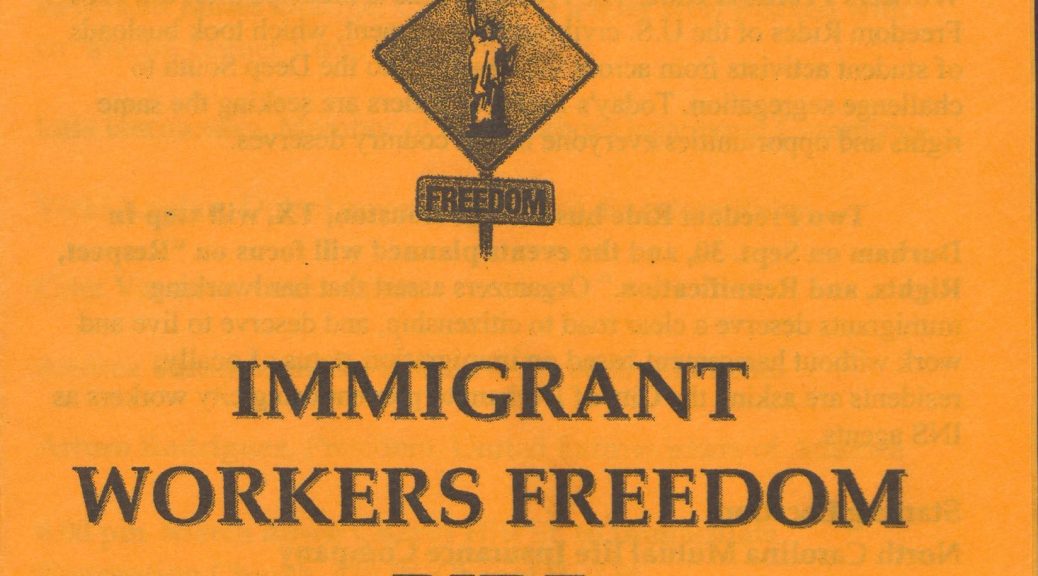
“Immigrant Workers Freedom Ride” flyer, September 30, 2003, illustrates one area of coalition building in Durham, NC, as described in Elizabeth Barahona’s dissertation research proposal. From the Joan Preiss Papers, Box 27.
Elizabeth Barahona, Ph.D. candidate, Northwestern University, “Black and Latino Coalition Building in Durham, North Carolina 1980-2010.” (Joint award with the Archive of Documentary Arts)
Diana Ruiz, Faculty, University of Washington, Seattle, “Apprehension through Representation: Image Capture of the US-Mexico Border.” (Joint award with the Archive of Documentary Arts)
Kylie Smith, Faculty, Emory University. School of Nursing, Department of History, “No Place for Children: Disability, Civil Rights, and Juvenile Detention in North Carolina.”
Harrison Wick, Faculty, Indiana University of Pennsylvania (IUP) Special Collections and University Archives, “Examination of Primary Sources related to Social Justice and Latin American Immigration in the Human Rights Archive.”
Photojournalist and documentarian Roderico “Rode” Yool Díaz is the winner of this year’s Digital Storytelling Award presented by the Rubenstein Rare Book & Manuscript Library at Duke University.
Ríos Montt durante lectura de la sentencia por Genocidio, 2013.
Yool Díaz received the award for his digital project documenting the 2012-2015 genocide trials against former Guatemalan dictator Efraín Ríos Montt. The project includes photos, video, and audio recordings of the trial proceedings, the reading of the verdict, and Ríos-Montt and his legal team reacting to the verdict.
“Time and again documentarians such as Rode remind us that impactful storytelling is contingent on being present,” said Caitlin Kelly, curator for the Rubenstein’s Archive of Documentary Arts, which co-sponsors the award. “Not just to get the shot and leave, but to hold a story with care such that one cannot put it down so easily. Rode’s work isn’t just coverage of a trial, but an unmasking of a legal performance with consequences far beyond the courtroom.”
Born and raised among Guatemala’s indigenous Maya Kaqchikel community, Roderico Yool Díaz has worked as a photojournalist for over 15 years. In Guatemala, he covers issues related to the aftermath of the internal armed conflict (1960-1996) and current economic and political pressures affecting rural campesino and indigenous communities.
As Yool Díaz notes, “This collection is part of a larger archive of five years of hearings from the genocide trial against former dictators Efraín Ríos Montt and Romeo Lucas García. While most of my photojournalistic work has focused on the survivors of the genocide, in this collection I wanted to highlight the defendants as a way of unmasking the leaders responsible for the violence suffered by hundreds of thousands during the war and genocide against the Mayan people in the 1980s.”
The project is divided into four sections: Ríos Montt appears in court for the first time (2012); Intermediate phase hearings, when the case is sent to trial (2012-2013); Genocide trial (March-May 2013); Annulment of the sentence and the second trial (2013-2018).
“Trials are such an important and integral element of the human rights movement going back to Nuremberg,” said Patrick Stawski, Human Rights Archivist at the Rubenstein Library. “The Human Rights Archive has extensive documentation on trials from around the world, but Rode’s project reminds us that trials are not just procedural. His images capture an insurgent, emotional, historical event, one that is simultaneously public yet intimate and affectively human through and through.”
A survivor of the genocide himself, Yool Díaz was born in 1975 on a Dutch-owned coffee plantation where his family had lived and worked as sharecroppers for generations. As a small child, Yool Díaz worked picking coffee and cardamom. He and his family were forced to flee in the early 1980s due to repression by the Guatemalan military. Like thousands of others, his family suffered forced disappearances and recruitment by the Guatemalan military and paramilitary forces.
Yool Díaz spent the rest of his childhood separated from his nuclear family. He worked agricultural jobs and attended night classes. He was the first in his family to attend college, where he studied anthropology, supporting forensic teams in exhumations of mass graves from the internal armed conflict.
After the peace accords in 1996, Yool Díaz witnessed continued violence by police and military against rural indigenous communities, acts that many believed to be a thing of the past. He realized he needed to document the violence to prove that it was still happening.
“I think it is important to understand a story is not just a collection of facts or the narrative of a specific event,” said Yool Díaz. “It is a human experience and has to be treated with care. It is essential not to reproduce the extractivist cycle that for so long has been applied to indigenous people and our communities.”
Since moving to North Carolina, Yool Díaz also documents resilience through culture and activism in Latin American immigrant and indigenous communities of the South.
The Rubenstein Library Digital Storytelling Award is co-sponsored by the Human Rights Archive and the Archive of Documentary Arts at the David M. Rubenstein Rare Book & Manuscript Library. The award seeks to support outstanding documentary artists/activists exploring human rights and social justice, while expanding the digital documentary holdings in the archive and ensuring long-term preservation and access to their work. The award seeks to encourage artists/activists that pull from the strengths of multi-modal documentary and digital deployment. Going beyond the core mission of transmitting information, these digital storytellers create deeply contextualized, multi-sensory projects that may include still image, moving image, oral histories, soundscapes, and documentary writing. Winners receive $2,500 and are invited to present their work at Duke University, where they collaborate with a team of archivists to preserve their work.
The David M. Rubenstein Rare Book & Library has a strong commitment to human rights and the documentary arts through collecting and making available works by creators from around the world. Our collections document the impact that organizations and individuals have, and the role documentary plays, to motivate the thinking of others and support action that will transform the world.
Harry H. Harkins T’73 Travel Grants for Lesbian, Gay, Bisexual, and Transgender History
History of Medicine Collections
Human Rights Archive
John Hope Franklin Research Center for African and African American History and Culture
John W. Hartman Center for Sales, Advertising & Marketing History
Sallie Bingham Center for Women’s History and Culture (Mary Lily Research Grants)
Anyone whose research would be supported by sources from the Rubenstein Library’s research centers is eligible to apply. We encourage applications from students at any level of education; faculty and teachers; visual and performing artists; writers; filmmakers; public historians; and independent researchers. For assistance determining the eligibility of your project, please contact AskRL@duke.edu with the subject line “Travel Grants.”
Eligibility
Applicants must reside beyond a 100-mile radius of Durham, N.C., and may not be current Duke students or employees.
Information Session
An online information session will be held Thursday, January 11, 2024, 2-3 pm EST. This program will review application requirements, offer tips for creating a successful application, and include an opportunity for attendees to ask questions. This program will be recorded and posted online afterwards. Register for the session here.
Timeline
The deadline for applications will be Thursday, February 29, 2024, at 6:00 pm EST.
Decisions will be announced by the end of April 2024 for travel during May 2024-June 2025. Awards are paid as reimbursement after completion of the research visit(s).
The David M. Rubenstein Rare Book & Manuscript Library is now accepting applications for our 2023-2024 research travel grant program. Our program is open to all kinds of researchers– artists, activists, students, and scholars—whose work would be supported by sources from the Rubenstein Library’s research centers.
Research travel grants of up to $1500 are offered by the following Centers and research areas:
Archive of Documentary Arts
Eve Kosofsky Sedgwick Travel Grants
Harry H. Harkins T’73 Travel Grants for Lesbian, Gay, Bisexual, and Transgender History
History of Medicine Collections
Human Rights Archive
John Hope Franklin Research Center for African and African American History and Culture
John W. Hartman Center for Sales, Advertising & Marketing History
Sallie Bingham Center for Women’s History and Culture (Mary Lily Research Grants)
Each grant offering is specific to the associated subject area and collection holdings, and our archivists can help you determine eligibility for your project. We encourage applications from students at any level of education; faculty and teachers; visual and performing artists; writers; filmmakers; public historians; and independent researchers. Applicants must reside beyond a 100-mile radius of Durham, N.C., and may not be current Duke students or employees. Awards are paid as reimbursement after completion of the research visit(s). The deadline for applications will be Friday, February 24, 2023, at 6:00 pm EST. Recipients should be announced by the end of April 2023, and grants will be for travel during May 2023-June 2024.
An online information session will be held Thursday, January 19, 2023, 1-2 EST. This program will review application requirements, offer tips for creating a successful application, and include an opportunity for attendees to ask questions. This program will be recorded, and posted online afterwards. Register for the session here. Further questions may be directed to AskRL@duke.edu with the subject line “Travel Grants.”
[An earlier version of this post had the incorrect date for the info session. It will be held Thursday, January 19.]
The data from detainees in Guantanamo was adapted from the ACLU website “Guantanamo by the Numbers”. In an attempt to humanize the information, the graphic was hand painted on the wall of the gallery by local artist Renzo Ortega.
Post by Caitlin Margaret Kelly, Curator of the Documentary Arts & Director of the Power Plant Gallery, and Patrick Stawski, Human Rights Archivist
On January 11, 2002, the first prisoners in America’s War on Terror arrived at Guantanamo Bay Naval Base. Roughly seven hundred and eighty detainees have been housed at the prison thus far. Most of the men were never charged with a crime, yet many were imprisoned for more than a decade. Over the past twenty years many other lives were drawn into Guantanamo: families of the detained, defense lawyers, prosecutors, doctors, interrogators, military personnel, journalists, and diplomats.
Peter Honigsberg has recorded the stories of the people who lived and worked at the naval base, voices that speak truth to power. He founded the Witness to Guantanamo (WtG) Video Collection to draw the history of Guantanamo out of the shadows and reveal its impact on the lives of individuals as well as our nation. He donated the collection to the Human Rights Archive at the Rubenstein Library in 2018.
Oral histories are displayed on televisions throughout the gallery during the Witness to Guantanamo exhibition at the Power Plant Gallery.
In January 2022, the Human Rights Archive and Archive of Documentary Arts collaborated to mount an exhibition drawn from the collection in the Power Plant Gallery in downtown Durham. The first-hand testimonies were paired with photographs by Duke professor Christopher Sims and drawings by court artist Janet Hamlin, in addition to psyops flyers, infographics and maps locating Guantanamo within both the visual and historical record.
Reflecting on his experience visiting the exhibition with his class, Zac Johnson T’22 writes, “Both pain and perseverance were noticeable in the voices of detainees. They spoke about hunger strikes, learning to build relationships with others, and losing hours of sleep every night. They spoke about being physically weak, but never losing hope for the future, even if they believed the U.S. would never hand it to them. Their voices switched back and forth across languages as they sought the right words to explain the torturous circumstances that surrounded them at Guantanamo.”
Photographs of the day to day landscapes of Guantanamo Navel Base by Christopher Sims, Associate Professor, Sanford School of Public Policy, and Undergraduate Education Director, Center for Documentary Studies, Duke University.
Another Duke student explained, “This exhibit was a great opportunity to immerse myself in a project that uses storytelling in such a unique and impactful way… the portrayal of these stories forces the viewer to confront the speaker face to face in a way that felt remarkably similar to a personal conversation. I found myself avoiding the speakers’ eyes when they shared particularly tragic or humiliating details, and I somehow felt rude removing my headphones and leaving the station while the speaker was in the middle of telling their story.”
The exhibit was accompanied by a number of virtual and in-person events, including talks by Christopher Sims and Uyghur American activist and WtG interviewee Rushan Abbas and a panel discussion with Peter Honigsberg; Cahalm MacLaughlin, Director of the Prison Memory Archive; and Duke professor Leela Prasad.
Videos and transcripts from the Witness to Guantanamo Collection are available for public viewing through the Duke Digital Repository.
The Rubenstein Rare Book & Manuscript Library is pleased to announce the recipients of the 2022-2023 travel grants. Our research centers annually award travel grants to students, scholars, and independent researchers through a competitive application process. We extend a warm congratulations to this year’s awardees. We look forward to meeting and working with you!
Archive of Documentary Arts
Rebecca Bengal, Independent Researcher, “‘Bad Roads Ruin Even the Best of Cars’: William Gedney’s Kentucky.”
Alexandra Le Faou, Independent Researcher, “James H. Karales European Exhibition.”
Sallie Bingham Center for Women’s History and Culture (Mary Lily Research Grants)
Brianna Anderson, Ph.D. candidate, Department of English, University of Florida, “‘A Smidgeon of Ecofeminism’: Envisioning Environmental Issues and Activism in Women’s Zines.”
Rachel Corbman, Faculty, Mount Holyoke College, “Conferencing on the Edge: A Queer History of Feminist Field Formation, 1969-1989.”
Benjamin Holtzman, Faculty, Lehman College, “’Smash the Klan’: Fighting the White Power Movement in the Late Twentieth Century.”
Cindy Lima, Ph.D. candidate, Northwestern University, “Transnational Latinas: A Twentieth Century History of Latina Politics.”
Molli Spalter, Ph.D. candidate, Department of English, Wayne State University, “”Feeling Wrong and Feeling Wronged: Radical Feminism and ‘Feeling Work’.”
Emily Hunt, Ph.D. candidate, Emily Hunt, Georgia State University, “‘We are a Gentle Angry People and We are Singing for Our Lives’: A Story of Women’s Music, 1975-1995.”
Felicity Palma, Faculty, Department of Film and Media Studies, University of Pittsburgh, “of flesh and feelings and light and shadows.” (Grant sponsored jointly with the Archive of Documentary Arts.)
Lara Vapnek, Faculty, Department of History, St. John’s University, “Mothers, Milk, and Money: A History of Infant Feeding in the United States.” (Grant sponsored jointly with the John W. Hartman Center for Sales, Advertising, and Marketing History.)
John Hope Franklin Center for African and African American History and Culture
William Billups, Ph.D. candidate, Department of History, Emory University, “”Reign of Terror”: Anti-Civil Rights Terrorism in the United States, 1955-1976.”
Thomas Cryer, Ph.D. candidate, Institute of the Americas, University College London, “’Walking the Tightrope’: John Hope Franklin and the Dilemmas of African American History in Action.”
Mikayla Harden, Ph.D. candidate, Department of History, University of Delaware, “Remnants: Captive African Children in the Black Atlantic World.”
Frances O’Shaughnessy, Ph.D. candidate, University of Washington, “Black Revolution on the Sea Islands: Empire, Property, and the Emancipation of Humanity.”
Emily Tran, Ph.D. candidate, University of Wisconsin-Madison, “American Reckonings: Confronting and Repressing the Racist Past and Present, 1968-1998.”
Evan Wade, Ph.D. candidate, Department of History, University of Connecticut,” Henrietta Vinton Davis: From Teacher to Black Nationalist– an examination of a Black Woman’s Politics.”
Elizabeth Patton, Faculty, Department of Media and Communication Studies, University of Maryland Baltimore County, “Representation as a Form of Resistance: Documenting African American Spaces of Leisure during the Jim Crow Era.” (Grant sponsored jointly with the John W. Hartman Center for Sales, Advertising, and Marketing History.)
Harry H. Harkins T’73 Travel Grants for Lesbian, Gay, Bisexual, and Transgender History
Mori Reithmayr, Ph.D. candidate, University of Oxford, “Community Before Liberation: Theorizing Gay Resistance in San Francisco, 1953-1969.”
Cathleen Rhodes, Faculty, Department of Women’s Studies, Old Dominion University, “Touring Tidewater: An Immersive Virtual Walking Tour of Southeastern Virginia’s Queer History.”
John W. Hartman Center for Sales, Advertising, and Marketing History (John Furr Fellowship)
Jennifer Hessler, Faculty, Department of Media, Journalism, and Film, University of Huddersfield, “Television Ratings: From Audimeter to Big Data.”
Conrad Jacober, Ph.D. candidate, Department of Sociology, Johns Hopkins University, “Debt Prophets: American Bankers and the Origins of Financialization.”
Jeannette Strickland, Independent Researcher, “Lever Brothers Advertising and Marketing, 1900-1930, in the J. Walter Thompson Archives.”
John W. Hartman Center for Sales, Advertising, and Marketing History (Alvin Achenbaum Travel Grants)
Anne Garner, Ph.D. candidate, Department of History and Culture, Drew University, “Recovering Throwaway Histories: Patent Medicine, Black Americans and the Blues in the Postbellum Piedmont.”
Rachel Plotnick, Faculty, Department of Cinema & Media Studies, Indiana University Bloomington, “License to Spill: Where Dry Devices Meet Liquid Lives.”
Elizabeth Patton, Faculty, Department of Media and Communication Studies, University of Maryland Baltimore County, “Representation as a Form of Resistance: Documenting African American Spaces of Leisure during the Jim Crow Era.” (Grant sponsored jointly with the John Hope Franklin Center for African and African American History and Culture.)
Lara Vapnek, Faculty, Department of History, St. John’s University, “Mothers, Milk, and Money: A History of Infant Feeding in the United States.” (Grant sponsored jointly with the Sallie Bingham Center for Women’s History and Culture.)
History of Medicine Collections
Jessica Dandona, Faculty, Minneapolis College of Art and Design, “Skeletons in the Drawing Room: Popular Consumption of Flap Anatomies, 1880-1900.”
Jeremy Montgomery, Ph.D. candidate, Department of History, Mississippi State University, “‘Look To Your Map’: Medical Distinctiveness and the United States, 1800-1860.”
Haleigh Yaspan, Master’s candidate, School of Medicine and Dentistry, University of Rochester, “Forceps, Women’s Rights, and Professional Turf War: Pregnancy and Childbirth in the United States, 1914-1962.”
Human Rights Archive
Molly Carlin, Ph.D. candidate, School of Media, Arts and Humanities, University of Sussex, “How to Jail a Revolution: Theorising the Penal Suppression of American Political Voices, 1964-2022.”
Tyler Goldberger, Ph.D. candidate, Department of History, College of William & Mary, “”Generalísimo Franco is Still Alive!”: Transnational Human Rights and the Anti-Fascist Narrativization of the Spanish Civil War and Francisco Franco Dictatorship within the United States, 1936-Present.”
Thomas Maggiola, Master’s candidate, Department of Latin American Studies and History, University of California San Diego, “Guatemala’s Transnational Civil War, 1970-1996.”
Eve Kosofsky Sedgwick Research Travel Grants
Jennifer Doyle, Faculty, University of California Riverside, “Alethurgy’s Shadows: Harassment, Paranoia, and Grief.”
Annie Sansonetti, Ph.D. candidate, Department of Performance Studies, New York University, “Feminine Boyhood and Trans Girlhood Onstage.”
Post compiled by Roshan Panjwani, Staff Assistant, Rubenstein Library
Dispatches from the David M. Rubenstein Rare Book and Manuscript Library at Duke University