Post Contributed by – Molly Carlin, Ph.D. candidate, School of Media, Arts and Humanities, University of Sussex, 2022 Marshall Meyer Human Rights Travel Grant Recipient
My research centers around the suppression of political voices in US prisons. Through archival research I am identifying the principal mechanisms employed by prison officials to prevent political organization and expression within institutions from 1964 onwards. Much of the earlier period looked at in my work has been focused on the Black Power movement, and the use of solitary confinement, tactical transfers and censorship to prevent key political activists in the movement from organizing within prisons. Many of these practices can be seen to continue throughout the period into the twenty-first century, and have been used, albeit less explicitly, to separate politically outspoken prisoners and establish obstacles to their activism.
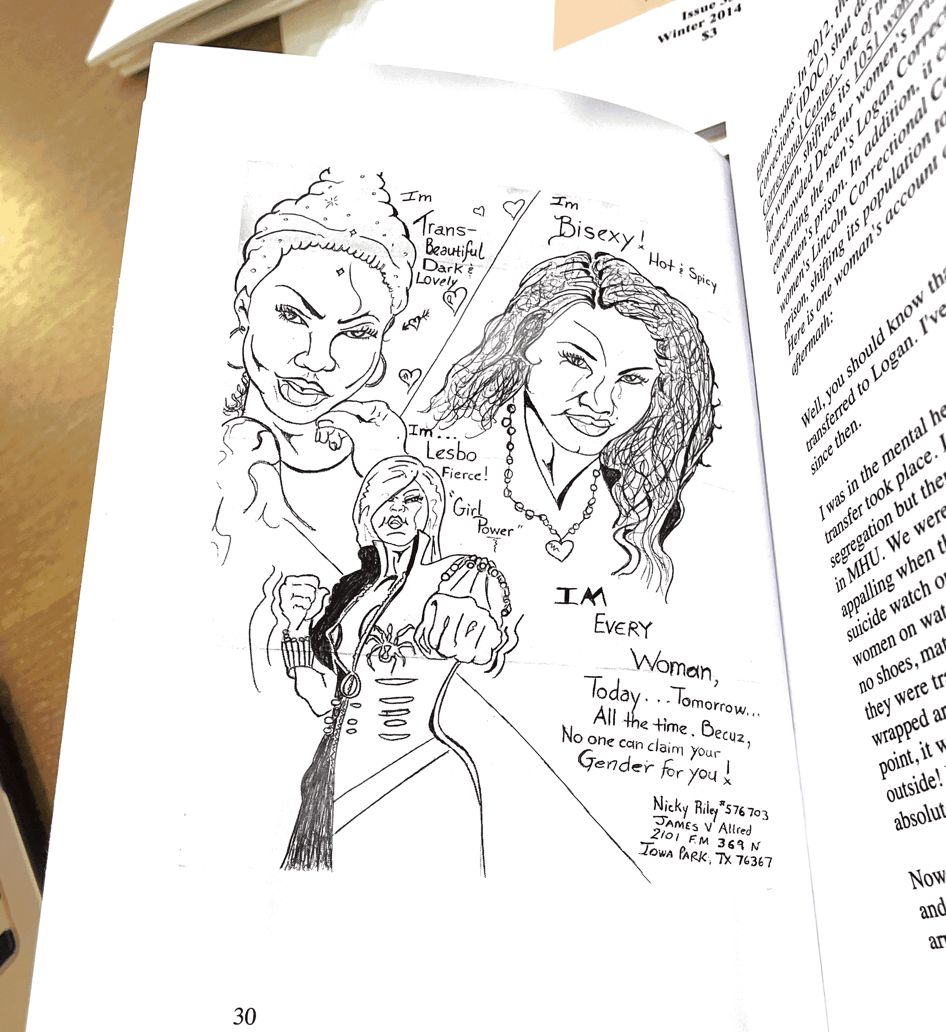
Tenacious Zine, Issue 29, 2013
The Rubenstein Human Rights Archive’s collection of incarceration zines elucidates varied prison experiences, and in particular the institutional responses to political writing. The recently acquired Tenacious Zine collection has provided an invaluable insight into the experiences and writing of incarcerated women and non-binary people. Commonalities in incarcerated experiences of ableism, discrimination against LGBTQIA+ people, and the difficulties of parenthood are evident across the country. These collections have been pivotal to my research on two counts: firstly, in exposing shared contemporary experiences of prisoners over the past twenty years, and secondly, in prioritizing the voices of marginalized identities within prison activism.
Primarily, what can be drawn from the hundreds of experiences recounted in the Tenacious Zine Collection, the Inside-Outside Alliance Records, and the Incarceration Zine Collection at the Rubenstein, is a resounding and unrelenting commitment to fight back against the systemic oppression seen in the carceral state. These sources come from prisons across the country, and from the 1960s right through to the 2020s, yet exhibit similarly oppressive experiences despite continued efforts to organize. Incarcerated activists have started writing campaigns, hunger strikes, work stoppages, and collaborated with ‘outside’ protesters to form a robust prisoners’ rights movement over the years. This chain of personal knowledge exchange moving within and stemming from prisons combines political theory and understanding of systemic oppression with communication of everyday lived experience.
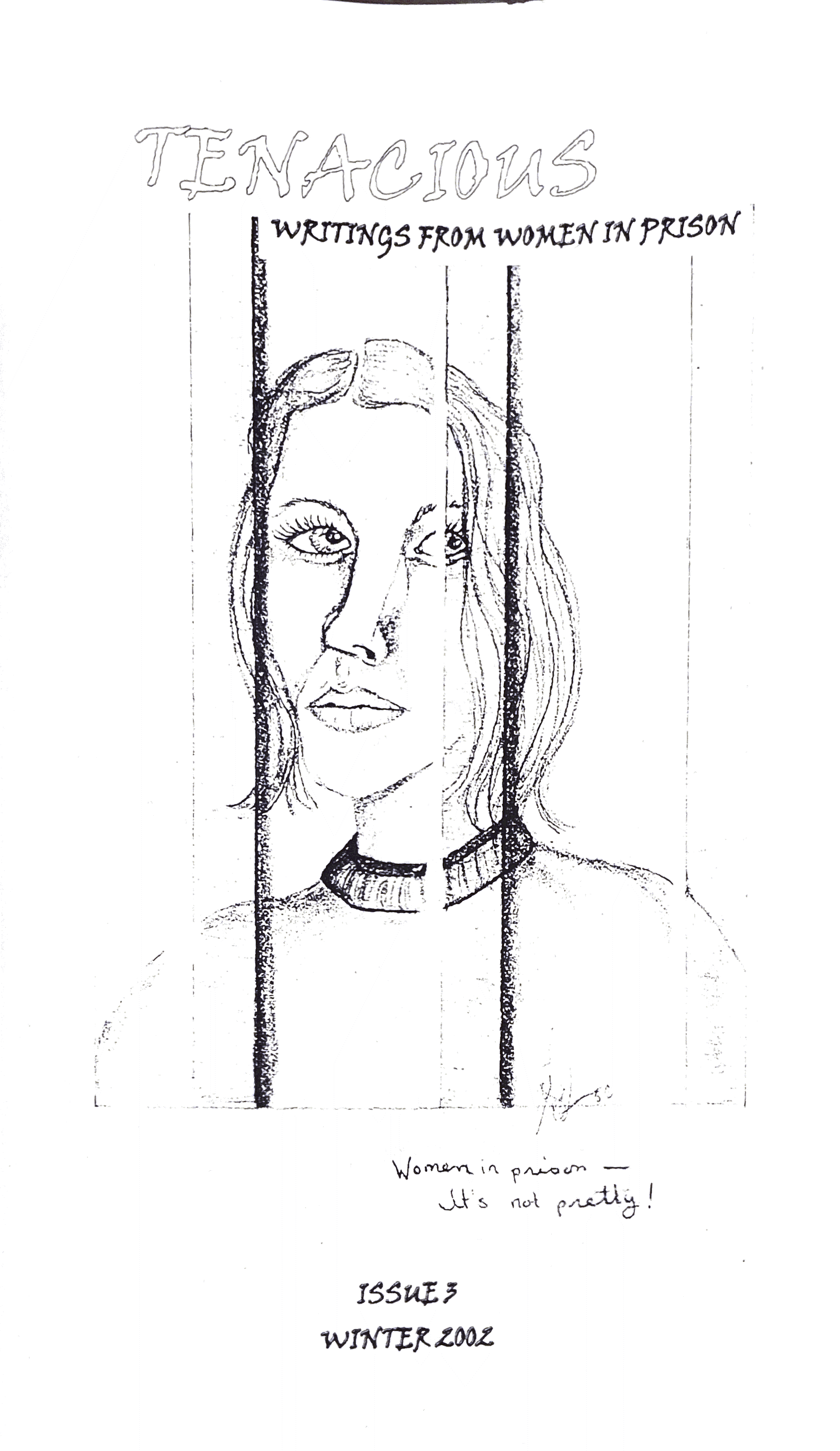
Tenacious Zine, Issue 3, Winter 2002
Rachel Galindo wrote in Tenacious Zine in 2011: ‘Over these years of incarceration, I have realized the value in writing with the purpose of sharing with others my experiences in a women’s prison. I hope my stories stand as examples that can be applied to a broader consideration of the role of prisons—locally, nationally, and globally—and their collective effort.’ She continued ‘This is the importance of writing. It is neither static nor a one-sided activity. It lends a forceful hand of connection through reaching out and receiving. In reading others’ writing, I am provoked, informed and inspired. This dynamic exchange is a part of our ongoing exploration and forward movement as a people… When we write we are participants engaged in change and building something better together.’[i]
Galindo’s perception of writing as a valuable tool to engage activists outside and build community amongst prisoners with shared experiences reflects long-standing approaches to prison protest from decades prior. Another Tenacious Zine writer recalled realizing that ‘just because we are in prison doesn’t mean that we don’t have a voice,’ when formerly incarcerated poet and writer Jimmy Santiago Baca came to visit at Mabel Bassett Correctional Center.[ii] Baca’s influence here exhibits the vital impact of activist networks and writerly collaboration, and the importance of words as a tool for organization, community, and resistance within the constraints of the penal system.
Yet this political writing, and activists’ repeated demands for core rights and respect have been met consistently with resistance and suppression from prison authorities. Vocal dissenters have been repeatedly placed in extensive periods of solitary confinement, hunger strikers force fed, labour strikers inadequately fed, visitations stopped, activists transferred, letters withheld and reading censored. Patterns in prison responses focus on blocking political activism and knowledge exchange through physical barriers and manipulation. The zine collections at the Rubenstein have unveiled these barriers, with writers exposing the ‘immediate surveillance,’ interception and censorship of prison writing.
One account in Tenacious Zine exposed escalating responses from prison officials to their writing on prison abuse. Beginning with interception of mail containing a drawing for a manuscript on sexual assault in prison, Barrilee Bannister recounted continued efforts by prison staff to prevent their writing from leaving the prison. Officers filed misconduct reports, searched Bannister’s bunk to find the manuscript, faked allegations of violent threats, removed privileges and transferred Bannister to an increased security wing.[iii] Bannister’s experience marks just one in a sustained effort to inhibit political expression and freedom in writing from prison, with many other instances recounted in the Rubenstein’s collections and beyond. On 26th September 2022, thousands of Alabama prisoners began a labor strike to protest understaffing, violence, sexual assault and unpaid labor within the carceral system.[iv] Prison authorities responded with withheld meals and visitation stoppages, and prisoners were forced to mobilize outside communities to help fundraise for commissary supplies to ensure protesters were fed.
Prisons continue to remove all but the most basic of rights and necessities from those within, and so the need for adequate avenues for political expression remains pivotal. Yet what has been seen in varied forms throughout this period is a system which functions to prevent this and which ignores or prohibits prisoners’ voices from being heard. The rise of mass incarceration coupled with the growth of supermax prisons has vastly increased the scale of this issue, to the point where this can now be seen as widespread political suppression. As prisoners across the country continue to take action against these injustices, it is important to identify the mechanisms that have long been employed to silence incarcerated political voices and how these have shifted.
*Molly Carlin’s grant project for the 2022 Marshall Meyer Human Rights Travel Grant is entitled, “How to Jail a Revolution: Theorising the Penal Suppression of American Political Voices, 1964-2022.”
Post contributed by John B. Gartrell, Director, John Hope Franklin Research Center
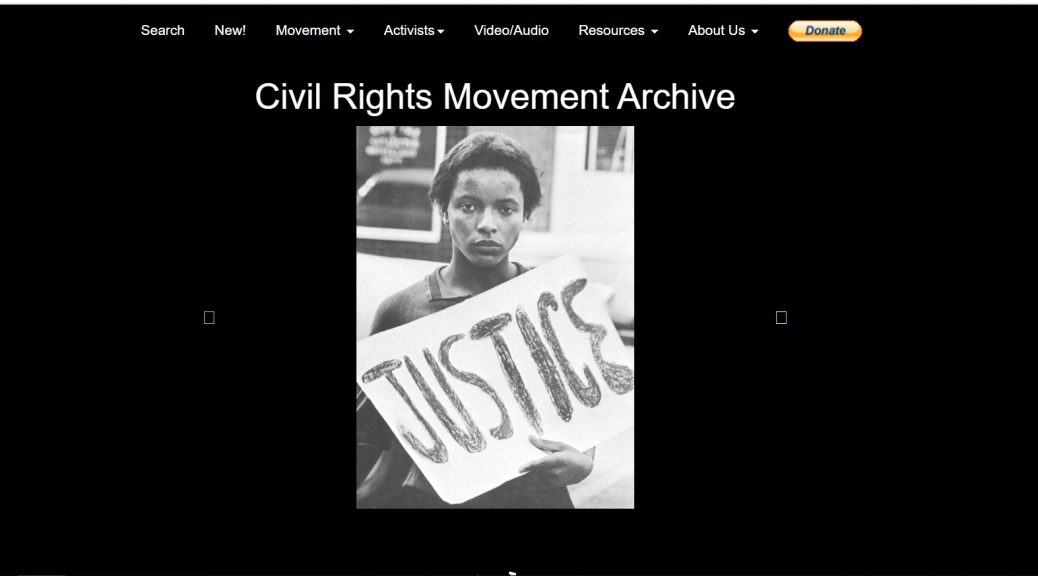
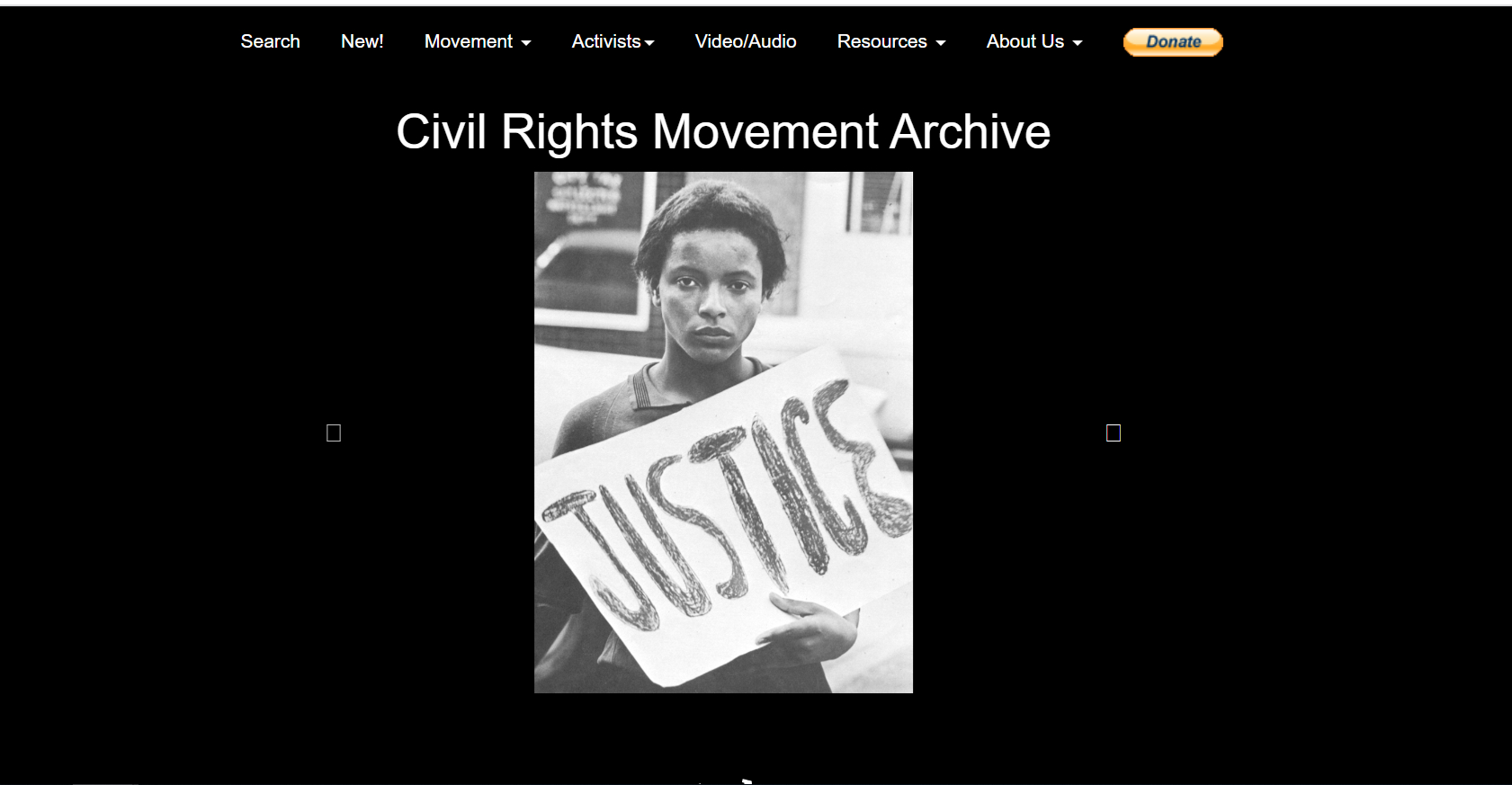
Duke University Libraries is pleased to announce the signing of a Memorandum of Understanding with the Civil Rights Movement Archive (CRMA) that designates the Duke Libraries as the stewards who will preserve and sustain the CRMA when the current managers are no longer able to carry the work forward. The Civil Rights Movement Archive is accessible at www.crmvet.org and was established by the Bay Area Veterans of the Civil Rights Movement in 1999 as a web-based platform that is an active social network for movement veterans and a primary resource for those interested in the history of the Civil Rights Movement from the 1950s-1960s. The site is populated by a roll call, reflections, documents and images all contributed by movement participants. There are also teaching resources and bibliographic sources designed to assist visitors with teaching and understanding this period. The CRMA recently launched a CRMA Video Channel on Vimeo to provide videos created by Freedom Movement veterans (or their immediate families). The site is visited by nearly 350,000 visitors annually, peaking during the school year, proving the value of the site as a research destination.
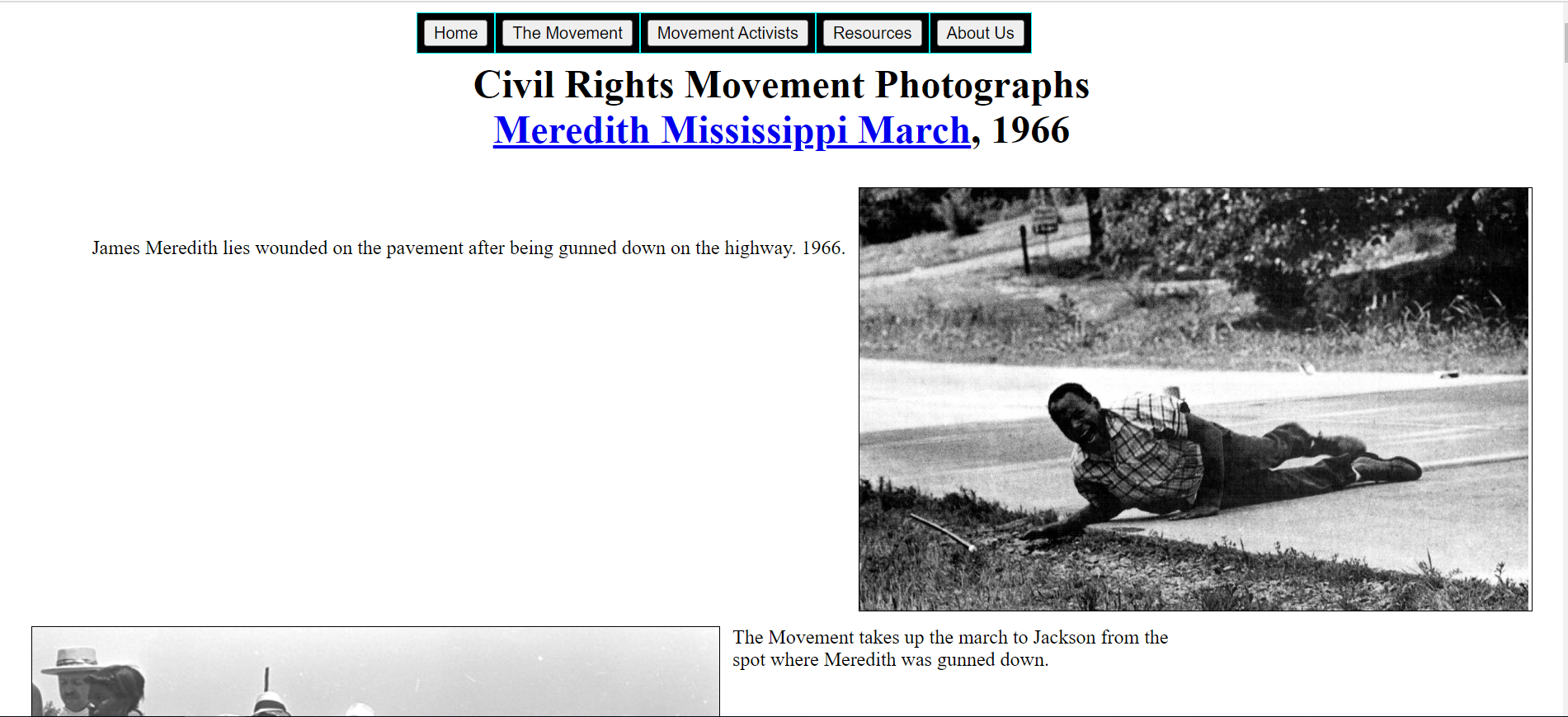
CRMA Homepage
The John Hope Franklin Research Center will be the curatorial home for the CRMA. This partnership with CRMA is part of the Center’s commitment to preserving the history of grassroots organizing. The Franklin Research Center is a partner in the Movement History Initiative and also stewards the SNCC Digital Gateway.
Under the terms of the MOU, Duke Libraries is committed to maintaining the site as a free source of Freedom Movement materials and information that is open to all with no paywall, commercial advertising, login requirements or subscription to continue documenting the Civil Rights Movement from /up-from-the-bottom/ and /inside-out/ perspectives and viewpoints.
Post submitted by Taelore Marsh, Behind the Veil Processing Intern, Franklin Research Center
Over the course of the past nine months, I had to pleasure of being added to the Documenting African American Life in the Jim Crow South: Digital Access to the Behind the Veil Project Archive project team as a processing intern. The project is a three-year grant funded by the National Endowment for the Humanities. Tasked with working on the Behind the Veil oral histories to re-process, digitize and publish a digital collection in the Duke Digital Repository.
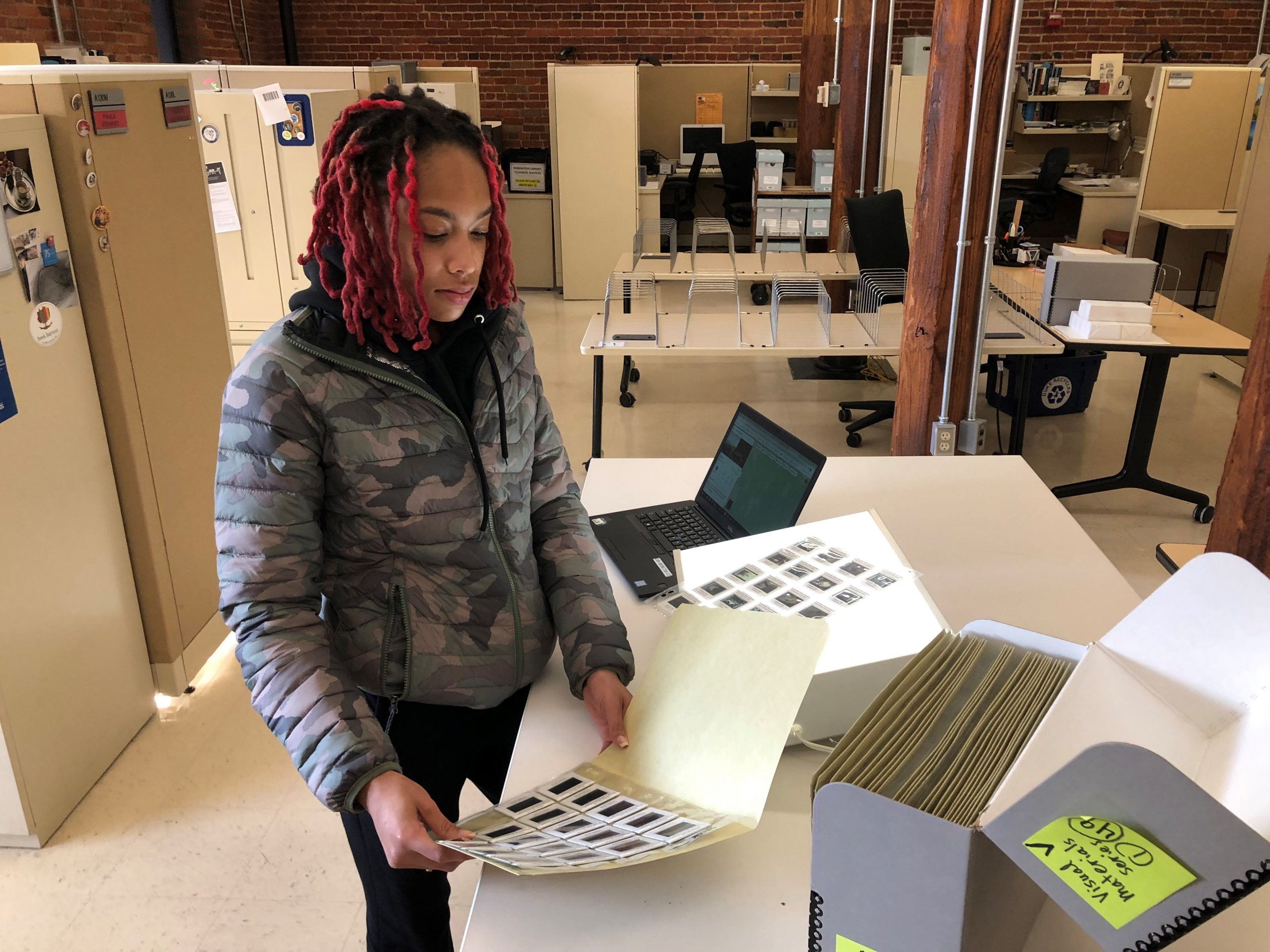
Taelore Marsh, working through the Behind the Veil photograph slides
The Behind the Veil collection has immense research value for historians and lay researchers who want to know about the lived experience of African Americans during the period of Jim Crow segregation. This collection of rich, personal narratives adds nuance to the long freedom struggle by broadening the localized perspectives from varying cities offering insight into Black communities beyond normative civil rights narratives. That allows listeners to gather a new perspective of the movement and leaders.
As the processing intern, I have had the pleasure of going through the Behind the Veil photograph, A/V, and administrative project files. Simply going through the records of each interview offers insight into the person’s life and the effects of Jim Crow. I noticed that although the interviews were collected in the 1990s, many interviewees were still fearful of retaliation for speaking about their experiences from the early to mid-twentieth century. The records also show that the narrative of Black life portrayed in textbooks and movies as subservient and second-class citizens are not necessarily actual lived experiences. Many of the interviewees were well-educated, owned businesses, and community leaders.
Examining slides to identify images
Looking at the records of each interview also expands the discourse of different facets of the long struggle for freedom. For example, they capture complex layers of the Great Migration, revealing how passing –Black people who assimilated into whiteness –affected the nuclear family. Additionally, the records expand our knowledge on Black Wall Streets’ throughout the United States and highlight the dilemma of integration v. desegregation v. equalization. Perhaps most importantly, Behind the Veil exudes the need for a localized approach to history and how everyday people make a change, and why the project in its entirety should be available to the public.
The process of collecting oral histories is not an easy task. Still, as a historian, I get the pleasure of using my sneak peek to draw new connections for my research while thinking of the new connections future scholars will uncover.
Submitted by Caitlin Margaret Kelly, Curator, Archive of Documentary Arts
The Archive of Documentary Arts is pleased to announce the 2021-2022 Collection Awards. We will be adding four projects related to environmental (in)justice to the Archive, including three photographic portfolios and one video.
Alphabetically the awardees are:
Crystal Z. Campbell, A Meditation on Nature in the Absence of an Eclipse, 2020, Digital Video
Photo: Film still
A Meditation on Nature in the Absence of an Eclipse is a poetic glimpse of how centuries of extraction, racism, pollution, and commoditizing nature has altered our relationship to sacred land and resources. How has nature been historically shaped and imaged for pleasure, status, and control by many hands of invisible labor? Constellated and intersectional histories and source material include testimony from a Water Protector at Standing Rock protesting the Dakota Access Pipeline, contaminated water in Flint Michigan, original footage of Hierve el Agua near Oaxaca, Mexico revered for its healing properties, archival images of gardens and hands of artists who resided in Tulsa, Oklahoma and children brushing their teeth––a reflection of the innocuous ways which contaminated water and resources shapes the lives of individuals completing banal, daily, routine tasks.
Critical to the film is the intentional use of unlicensed footage, bearing a brand across the center that detracts from what’s happening in the actual footage, and becomes a viewfinder for how that footage is read or deemed important enough to view because there is a branded stamp of approval. Historically, the watermark is used to connote ownership and authenticity. The film is a consideration of how documentary practice can be another form of resource extraction, of which this filmmaker is implicated. Licensing fees are an example of the barriers to access, ultimately deciding who will control critical narratives of environmental racism and discourse. Originally commissioned by Wave Hill Public Garden & Cultural Center, the work was made in 2017 and reedited in 2020.
Crystal Z Campbell (they/them) is currently a 2021–22 UB Center for Diversity Innovation Distinguished Visiting Scholar, multidisciplinary artist, experimental filmmaker, and writer of Black, Filipinx, and Chinese descents. A 2021 Guggenheim Fellow in Fine Arts, Campbell finds complexity in public secrets—fragments of information known by many but undertold or unspoken. Using archival material, recent works revisit counternarratives of the 1921 Tulsa Race Massacre, questions of immortality and medical ethics with Henrietta Lacks’ “immortal” cell line, ponder the role of a political monument and displacement in a Swedish coastal landscape, and salvage a 35mm film from a demolished Black activist theater in Brooklyn as a relic of gentrification.
Bio:
Their work in film/video, performance, installation, sound, painting, and text, has been exhibited and screened at The Drawing Center, MOMA, Nest, ICA-Philadelphia, Bemis, Studio Museum of Harlem, SculptureCenter, and SFMOMA. Honors and awards include a 2021 Guggenheim Fellowship, with Pollock-Krasner Award, MAP Fund, MacDowell, Skowhegan, Rijksakademie, Whitney ISP, Franklin Furnace, Tulsa Artist Fellowship, UNDO Fellowship, and Flaherty Film Seminar. Campbell’s writing has been featured in World Literature Today, Monday Journal, GARAGE, and Hyperallergic. Campbell, a former Harvard Radcliffe Film Study Center & David & Roberta Logie Fellow, was recently named a Creative Capital Awardee, and is founder of the virtual programming platform archiveacts.com. Campbell lives and works in New York and Oklahoma.
Stacy Kranitz, Fulcrum of Malice, 2017, Photographs
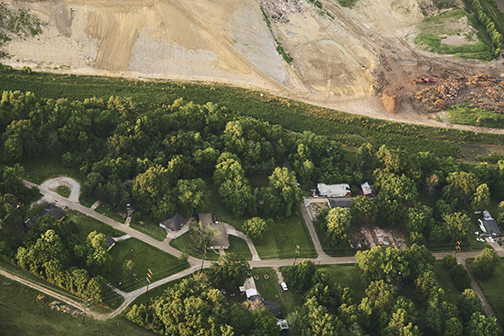
The Ronaldson Field Debris Landfill Within just a few years of the closing of the Rollins toxic waste facility, a local businessman named Sid Brian purchased a plot of land in the center of Alsen. Because of the rezoning of the community, Brian was able to secure a construction debris landfill permit and began taking in debris from old abandoned homes being torn down across Baton Rouge as part of an initiative to rid the city of its blight. Soon after the landfill opened, Alsen experienced an infestation of rats, termites, and snakes inside homes. The swampland that had been used by the community for hunting and fishing for many generations was now overrun by mountains of rotting debris that caused the air to stink throughout the community. In 2016, after historic rain flooded huge sections of the city, an emergency order required that the landfill take in 900,000 cubic yards of rotten and moldy housing debris. The residents were never notified of this emergency order. They only realized something was happening when debris trucks began causing traffic jams on the main street through Alsen. Eventually the piles of rotten debris grew so high that they looked like they were about to topple over onto homes just 300 feet away. The Enviromental Protection Agency warns of potential danger from construction and demolition waste, due in part to the fact that construction dust is particulate matter that is difficult to breathe especially if you are very young or old or have breathing problems already. There are also concerns that rotting dry wall emits dangers levels of dioxane into the air. These problems are exacerbated by the heat and humidity so endemic to Louisiana’s climate.
Fulcrum of Malice is the story of one community’s fight against the 25 polluting facilities that surround them. For more than fifty years, Alsen, LA has been caught in an environmental discrimination struggle that disproportionately burdens it with environmental hazards unparalleled in nearby white communities. Within a four-mile radius there are 11 petrochemical plants, 3 Superfund sites, 5 hazardous waste pits, 2 city garbage dumps, and 3 privately owned waste facilities surrounding them. Residents first began complaining of breathing problems, spontaneous nose bleeds, and headaches in the late 1970’s. High cancer rates, asthma, birth defects, stillbirths, and miscarriages continue to plague the community to this day. Many of the historic African American neighborhoods along the 140-mile Cancer Alley petrochemical corridor were developed after the Civil War when the government established small land grants for former slaves working on sugar cane plantations along the Mississippi River.
Alsen was established in 1872 as a small agrarian community on the outskirts of Baton Rouge. The environmental threats first began in the early 1900s when Louisiana politicians enticed large petroleum companies to the region with lenient environmental policies. In the 1950s, the government voted to rezone the farmland around Alsen from agriculture to industry. The rezoning faced little opposition since there were very few registered voters in Alsen at the time and no elected officials of color in the parish. The petrochemical industry became the backbone of the state’s economy and government officials were eager to bring in more companies. They did this by relaxing industrial zoning regulations near low-income Black communities along the Mississippi river. This method has been used to justify and grow petrochemical corridors around the world. This work is a testament to what has happened. Even if the government and industry continue to refuse to address this problem, the community itself deserve a visual record of the damage that details those responsible for it. This work is for them. And this work is for the rest of us because it is time, we all take responsibility and collectively acknowledge our complicit role in this pattern of systemic racism. The portfolio will be accompanied by a book containing the complete series of images and an investigative narrative detailing the histories of the 25 polluting facilities surrounding the community of Alsen.
Bio:
Stacy Kranitz’s work explores representation and otherness within the documentary tradition. Her work focuses on the complex relationship between land and people. Kranitz was born in Kentucky and currently lives in the Appalachian Mountains of eastern Tennessee. She has received funding support from the Michael P. Smith Fund for Documentary Photography, Southern Documentary Fund, Magnum Foundation and the National Geographic Society. In 2019 her work was shortlisted for the Louis Roederer Discovery Award. She has presented solo exhibitions of her photographs at the Diffusion Festival of Photography in Cardiff, Wales and the Rencontres d’Arles in Arles, France. Her work has been written about in the Columbia Journalism Review, British Journal of Photography, Journal of Appalachian Studies, Time, The Guardian, Liberation, and the Royal Photographic Society Journal. Her photographs are included in permanent collections at the Harvard Art Museums and the Museum of Fine Art, Houston. She works on assignment as a photographer for publications including Time, Vanity Fair, The New York Times and National Geographic. For the past twelve years, she has been working on a project called As it was Give() to Me. A monograph of this work will be published by Twin Palms in 2022.
Emilio Nasser, La Cornuda de Tlacotalpan, 2016, Photographs
Prints of La Cornuda de Tlacotalpan
“Times have changed and the story of La Cornuda de Tlacotalpan has been disappearing. People say that when you don’t believe in something, it ceases to exist”
This project re-imagines the story of La Cornuda de Tlacotalpan in the face of its possible disappearance through collaboration with the community of Tlacotalpan, Mexico. La Cornuda is the mysterious being who lives in the depths of the Papaloapan River in Veracruz Mexico, who appears to disappear, frightens, scares away and explains the unexplained.
Through a collective, playful and participatory re-construction, La Cornuda is reinvented. In its attempt to survive the forgetfulness of modern times, it makes a decision that requires courage. Leaving the river, crossing the threshold of the shore, transforming itself, and entering into Tlacotalpan. While La Cornuda walks around invisible to the eyes of the community, the photographic lens reveals its new life.
La Cornuda de Tlacotalpan documentary project is part of an ongoing series called Memory is a Swamp (2016-ongoing), focused on myths, urban legends, local stories and oral histories that adopt, retell and re-interpret these narratives in a changing contemporary world, opening a space for experimental visions, re-framings and collaborative working contexts.
Bio:
Through photographic practice, video, drawing and diverse collaborative strategies, Emilio Nasser’s projects have been attempted to navigate the infinite and multiple possibilities in visual narratives. Embarking on different paths, his works are based on and with local histories, re-visited myths, oral memories, identities, belonging, imagination, community, and some other things that are still complicated to explain with words on a conscious level. Graduated in Photography at Spilimbergo School of Applied Arts in Argentina. Then, at the outbreak of the 2001 socio-economic crisis, he became a cook. While living between Latin America and Europe, he has engaged in multiple educational experiences; such as Criticae-Max Pinkers, Folio Phmuseum, Laura El-Tantawy-Sybren Kuiper, Experimental’s Photobook-Julián Barón, 20Fotógrafos, Estudio Marcos López, Rodrigo Fierro-Gabriel Orge, among others. Currently in ISSP Masterclass-Rhizoma: Political Constellations with Lisa Barnard. Exhibited at spaces like Phmuseum Days (IT), Verzasca Foto Festival (CH), Emergentes International Photography Award-Encontros da Imagen (PT), Valongo Festival Da Imagen (BR), Yet-Magazine (CH), PHEspaña (ES), SCAN PhotoBooks (ES), Ojo de Pez (ES). Twice awarded grants by the Fondo Nacional del Arte (AR).
Lawrence Sumulong , “No Longer Can I Stay; It’s True.” The Marshallese in Springdale, Arkansas, 2016, Photographs
A display outside of one of the few Marshallese owned businesses in Springdale, AR
No longer can I stay; it’s true. No longer can I live in peace and harmony.
No longer can I rest on my sleeping mat and pillow
Because of my island and the life I once knew there. The thought is overwhelming
Rendering me helpless and in great despair. My spirit leaves, drifting around and far away
Where it becomes caught in a current of immense power –
And only then do I find tranquility
-The Bikinian Anthem (1946) by Lore Kessibuki (1914-1994)
In 2016, I looked at daily life in Springdale, Arkansas, where the largest community of Marshallese in the United States currently resides. Specifically, I focused on the traumatic history of the Bikinians, a community of about 5,000+ Pacific Islanders, whose homeland in the Bikini Atoll remains radioactive and uninhabited due to years of deadly US nuclear testing.
The Bikinians have lived in exile on the islands of Kili and Ejit in the Marshall Islands for 76 years. Currently, there are only a few remaining Bikinians out of the original 167 who were asked to leave their homeland in 1946 by the US military.
The relatively recent emigration to the United States entails yet another significant move away from their ancestral homeland. Their migration was motivated by the ability to live, work, and study in the United States according to the Compact of Free Association. However, as a new immigrant and historically exploited community, the Marshallese American livelihood remains entwined with blue collar work in the poultry industry of Northwest Arkansas.
Pre and post covid-19 pandemic, the successes and struggles of both the Bikinian and general Marshallese population offer a complicated look into what it means to be a part of American society. I wanted to learn from an adjacent and related ethnic experience, to foster empathy across cultures, and understand who we are as Americans in this new administration and era. To that end, I saw the use of printing on banana fibre paper to be a visual way of connecting my own heritage with the Marshallese experience in that it is a crop endemic to both the Marshall Islands and the Philippines.
Bio:
I am a Filipino American photographer based in Brooklyn, New York City. I also run a commercial studio with my wife, Sarah, and our two Siamese-Maine Coon cats, Miko and Oliver. My personal work looks for ever-shifting approaches to documentary storytelling and imagery as a means of both questioning my own point of view as well as depicting reality. My perspective reflects how particular historical moments alter, disrupt, and shape one’s society and sense of self. Despite the United States existing as both my place of residence and birthplace, my work for over a decade had focused exclusively on my relationship to the Philippines. Most recently, I’ve been documenting emerging Asian American and Pacific Islander communities at a time where it feels absolutely necessary to depict the nuances within the panoply of AAPI experiences and histories, while also thinking about intersections.
Join the Rubenstein Library as we open our collections for “I Got a Story to Tell: Black Voices in Print.”
Visitors will be able to browse special selections from our collections, chat with Rubenstein Library staff, and explore Black primary source materials. From rare first editions by Sojourner Truth and Frederick Douglass to published works exploring Black life in Durham to publications by Black students at Duke, the event will give attendees a hands-on experience with the richness of Black print culture!
This event is open to the public. Please register for a free timed-entry pass for attendance, but visitors are welcome to stay for the duration of the event. Space is limited so reserve yours today.
Date: Monday, April 4, 2022 Time: 11am-2pm Location: Gothic Reading Room, Rubenstein Library, West Campus Contact: John Gartrell (franklin-collection@duke.edu)
Post contributed by John B. Gartrell, Director, John Hope Franklin Research Center for African and African American History & Culture
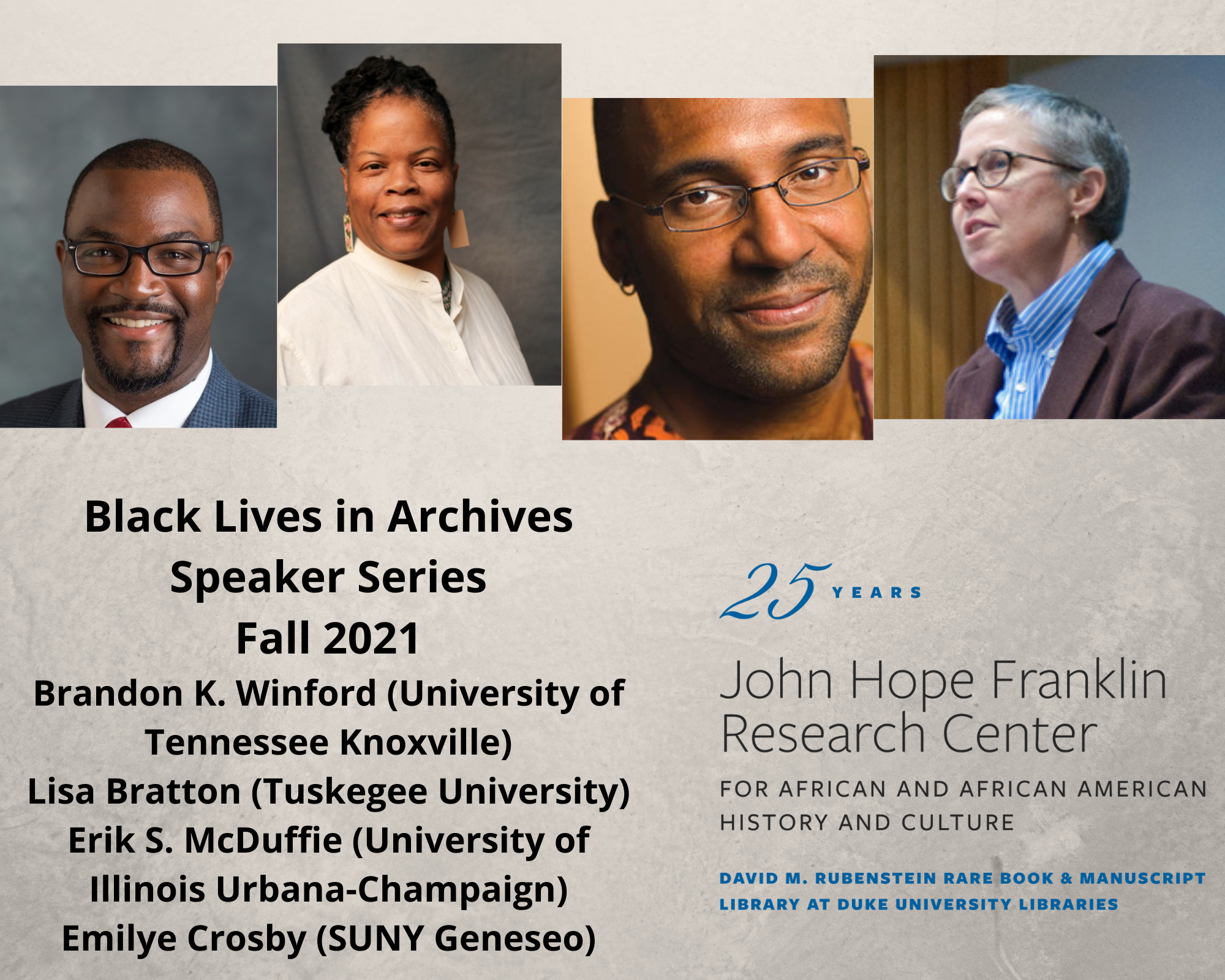
The 2021-2022 academic year marks the 25th anniversary of the John Hope Franklin Research Center for African and African American History & Culture. The Franklin Research Center, which is based in the David M. Rubenstein Rare Book & Manuscript Library, will use the theme “Black Lives in Archives” as the thread for a slate of programming and projects that will build upon the center’s mission of advancing scholarship on the history and culture of people of African descent.
The anniversary will begin on September 14 with a virtual lecture by Dr. Emilie Boone, Assistant Professor of African American Studies at New York City College of Technology, CUNY. Her talk will respond to the exhibition James Van Der Zee and Michael Francis Blake: Picturing Blackness in the 1920s, currently on display in the Rubenstein Library’s Photography Gallery. The exhibit highlights resonances between the work of James Van Der Zee and Michael Francis Blake, two African American photographers working in the 1920s at the height of the “New Negro Movement.” Register for this event here.
James Van Der Zee and Michael Francis Blake: Picturing Blackness in the 1920s. On display in the Rubenstein Library
Emilie Boone will lead a virtual lecture entitled, “Visualizing a Shared Ethos: Van Der Zee and Blake as Peers” on Sept. 14
Additional programs this semester will include a Black Lives in Archives virtual speaker series featuring four scholars who were previously awarded research travel grants to come to the Rubenstein Library and utilize the center’s collections. This “return to the archive” by each scholar will highlight the critical importance of Black collections as a foundation for new directions in the field of African and African American Studies. The tentative schedule includes:
September 22 – Brandon K. Winford, Associate Professor, University of Tennessee Knoxville
October 27 – Lisa Bratton, Assistant Professor, Tuskegee University
November 9 – Erik S. McDuffie, Associate Professor, University of Illinois Urbana- Champaign
December 8 – Emilye Crosby, Professor of History, SUNY-Geneseo
Earlier this summer, the center announced two exciting projects that will continue to drive the work of preserving the Black archives. “Documenting African American Life in the Jim Crow South: Digital Access to the Behind the Veil Project Archive” is a National Endowment for the Humanities grant-funded initiative to digitize and publish the Behind the Veil archive. The Behind the Veil project, which was led by the Center for Documentary Studies 1992-1995, was one of the largest oral history archives documenting the African American experience of living in the American South during the early to mid-twentieth century. The project will digitize analog cassette tapes containing close to 1,200 interviews with African American elders from twenty distinct communities. In Spring 2022, there will be a virtual gathering of Behind the Veil project staff and interviewers to reflect on their work and the impact of the collection.
The second project is a three-year Mellon Foundation funded project entitled, “Our Stories, Our Terms: Documenting Movement Building from the Inside Out,” which extends the partnership between Duke University Libraries and the SNCC Legacy Project through the Movement History Initiative. Our Stories, Our Terms will document how movement veterans from the Student Nonviolent Coordinating Committee and today’s activists built their social and political movements. The project will also build capacity for archival practice among current activist organizations and share documentary pieces from inter- and intra-generational conversations among activist and organizer communities.
In 1995, Dr. John Hope Franklin, the James B. Duke Professor Emeritus of History at Duke University, donated his own personal archive to Duke. In his honor, the Duke University Libraries founded the John Hope Franklin Research Center for African and African American Documentation as a designated collecting area specializing in rare book and primary sources documenting people of African descent, with endowment funding from GlaxoWellcome Inc. Franklin’s archive and his scholarship have been the guiding lights of the center’s engagement in public programming, teaching, exhibitions, and collaborations. This celebration of “Black Lives in Archives” will honor the center’s role as a premiere destination for researchers near and far over the last twenty-five years.
This post was contributed by John B. Gartrell, Director, John Hope Franklin Research Center
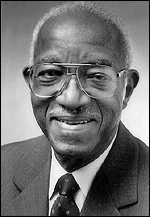
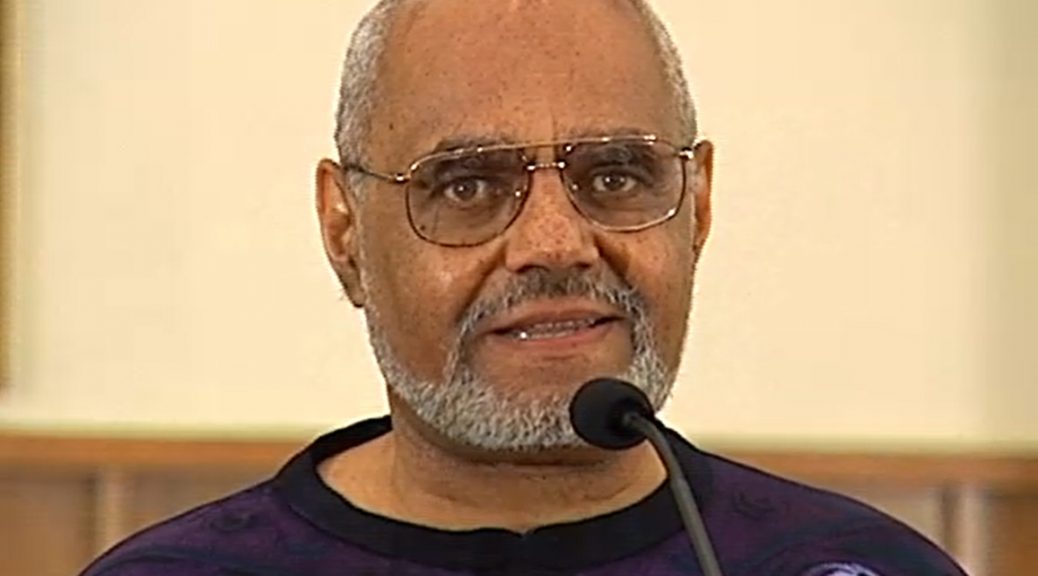
The Franklin Research Center and Rubenstein Library mourns the loss of Robert “Bob” Parrish Moses, who passed away on July 25, 2021. Moses was giant in the fight for civil and human rights, who began working with the Student Nonviolent Coordinating Committee (SNCC) as an organizer soon after the organization’s founding in 1960. He worked in tirelessly on a range of issues including voter registration and community organizing in the Deep South, particularly Mississippi, Alabama, and Southwest Georgia. He would later found the Algebra Project in the 1980s, which was evolution of his work with SNCC, using mathematics as an organizing tool while seeking to expand access to a quality education in the United States.
Bob Moses speaking at SNCC 40th Anniversary Conference, Shaw University
You can use the following resources in our archives and supporting projects like the SNCC Digital Gateway to learn more about Moses’ life and experiences in the struggle for freedom –
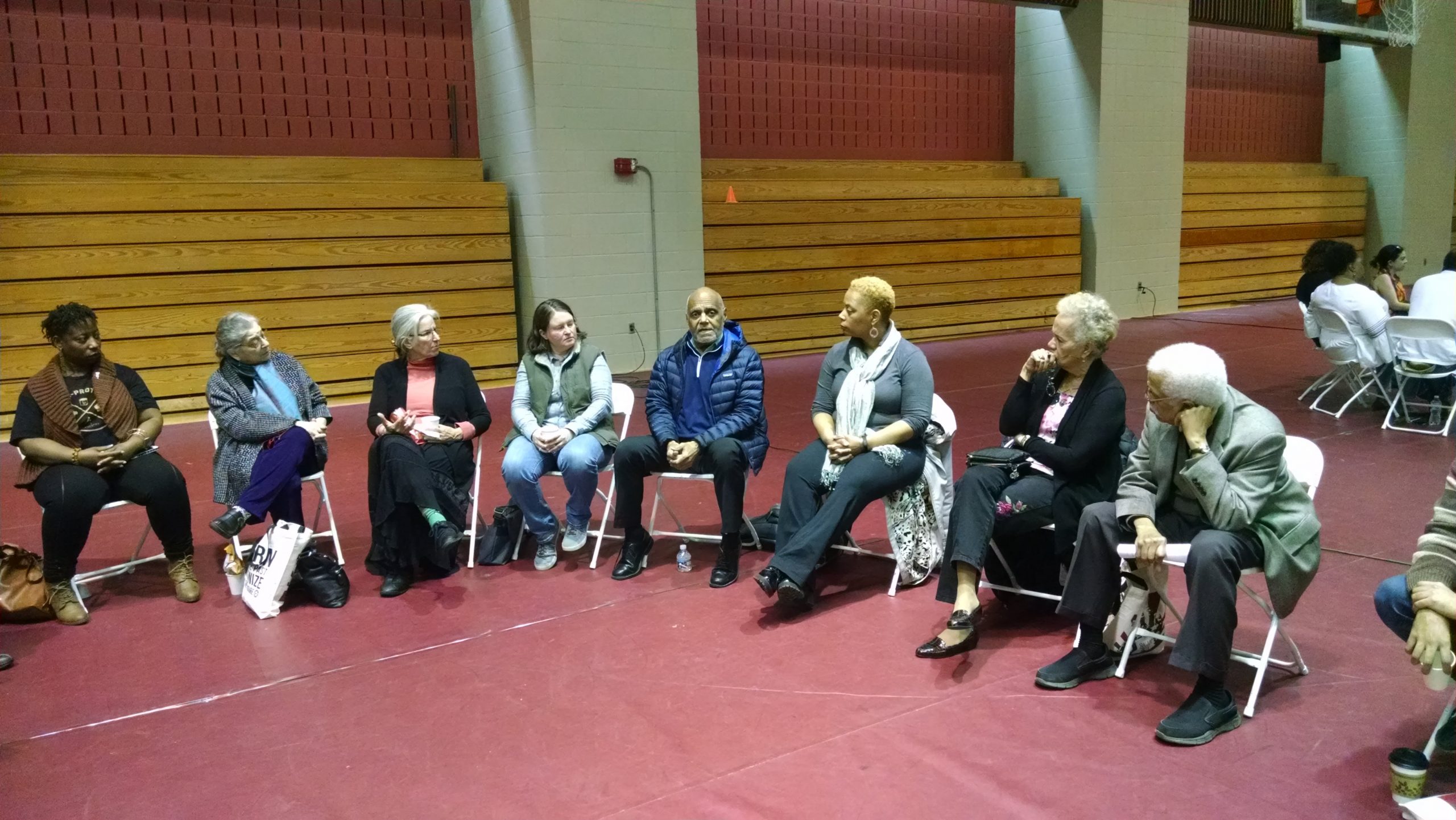
Bob Moses (center, blue coat) leading discussion at SNCC Digital Gateway Closing Conference, 2018 (photo courtesy of Kim Johnson, SNCC Legacy Project)
Duke University has had the honor of working Moses and his SNCC comrades for decades. This work continues today through the collaborative work of the Movement History Initiative. May he rest in power.
Post contributed by John B. Gartrell, Director, John Hope Franklin Research Center
This summer Duke University Libraries will launch a project to provide expanded digital access to the Behind the Veil: Documenting African-American Life in the Jim Crow Southoral history collection, housed in the David M. Rubenstein Rare Book & Manuscript Libraries and curated by the John Hope Franklin Research Center for African and African American History & Culture. The project, titled “Documenting African American Life in the Jim Crow South: Digital Access to the Behind the Veil Project Archive,” received a $350,000 Humanities Collections and Reference Resources Implementation grant supported by the National Endowment for the Humanities (NEH).
Behind the Veil (BTV) was undertaken by the Center for Documentary Studies at Duke University (CDS) from 1992–1995 and co-directed by Drs. William Chafe, CDS co-founder and Alice Mary Baldwin Distinguished Professor Emeritus of History, Robert Korstad, Professor Emeritus of Public Policy, and the late Raymond Gavins, the first African American faculty member in Duke’s Department of History. Chafe, Korstad, and Gavin’s vision for and title of the project refer to the concept of the “veil” introduced by scholar and activist W.E.B. DuBois in his iconic book The Souls of Black Folk (1913). In that work, DuBois discussed the metaphorical concept of the veil as “separating the two worlds of white and black,” designed to protect African Americans who had to balance comporting their lives as subservient and compliant in front of a White dominated society while simultaneously living free in their own community.
Henderson, Larry – Birmingham, Behind the Veil Collection
BTV was a groundbreaking documentary project for its time that recorded and preserved the living memory of African American life during the age of segregation in the American South. Over the span of three summers, cohorts of graduate students and early career scholars from universities across the country received training with the project’s scholarly board and then resided in selected locales for two weeks to conduct oral histories. The team conducted interviews with more than one thousand community elders who shared their memories from the Jim Crow Era of legal segregation. Nineteen distinct communities were identified for interviews: Albany, GA; rural Arkansas; Birmingham, AL; Charlotte, NC; Durham, NC; Enfield, NC; New Bern, NC; LeFlore County, NC; Memphis, TN; Muhlenberg, KY; New Iberia, LA; New Orleans, LA; Norfolk, VA; Orangeburg, SC; St. Helena, SC; Summerton, SC; Tallahassee, FL; Tuskegee, AL; and Wilmington, NC.
All of the BTV project files were transferred to the John Hope Franklin Research Center in subsequent years after the project’s completion. The BTV collection encompasses a number of formats including over 1,200 taped audio cassette interviews and 3,000 photographic strips, slides and prints, manuscript project files, training materials, administrative records, and born-digital files. The grant work will focus on the digitization and transcription of the oral histories, scanning of the photographic materials, and sharing the collection’s contents with students, educators, and the wider public through virtual programs and webinars. The digital collection will be published in the Duke Digital Repository, where 410 BTV interviews are currently accessible for research. Funds will also allow the project team to hire graduate level interns for archival processing, digitization, and outreach.
John B. Gartrell, director of the John Hope Franklin Research Center and principal investigator for the grant noted, “The Behind the Veil collection is one of the most used collections in the Franklin Research Center. These oral histories truly broaden our understanding of the everyday lives of African Americans during the early-to-mid twentieth century. They represent one of the largest bodies of scholarship on African American life documenting that time, and I’m excited to share the depth of these stories and honor the scholars who recorded them.” Gartrell will be joined by co-principal investigator Giao Luong Baker, who serves as Duke Libraries’ Digital Production Services Manager. Together they will lead the digitization efforts in collaboration with library colleagues over the course of the next three years (2021–2024).
Post Contributed by Patrick Stawski, Human Rights Archivist
Annoncement Date: June 1st, 2021
What is audio documentary? How do recording technologies, sonic vernaculars, activism, and dissent come together in a documentary art form that engages with our ears?
This new award, sponsored by the Human Rights Archive and the Archive of Documentary Arts at the David M. Rubenstein Rare Book & Manuscript Library, seeks to support outstanding documentary artists exploring human rights and social justice and expand the audio holdings in the Archive for long-term preservation and access. The awardee will receive a $2,500 honorarium and be invited to give a talk at Duke.
In our inaugural year we will focus on works that explore language. Books are burned, buildings are bull-dozed, bodies are buried…and people escape with only their language and the memory work it will enable. How can spoken language serve as a form of sonic resistance to colonialism and cultural genocide? How does language persevere even when individuals and entire communities are disappeared? How do the language practices of the indigenous, the displaced, the incarcerated, and the oppressed buttress memory, build community and identity, and demand social justice and human rights?
Why should I apply?
The David M. Rubenstein Rare Book & Library has a strong commitment to human rights and the documentary arts through collecting and making available works by creators from around the world. Our collections document the impact that organizations and individuals have, and the role documentary plays, to motivate the thinking of others, and the influence that has on private and government policies.
We encourage submissions from individuals or groups from across the globe, whose work is not already in the collections of the Rubenstein Library. Documentarians working in their own communities are encouraged to apply, and we are particularly interested in submissions from communities underrepresented in the archives. We are not accepting submissions from employees of Duke University, or those currently enrolled in a degree-granting program.
Patrick A. Stawski, Human Rights Archivist, patrick.stawski@duke.edu, and Caitlin Margaret Kelly, Curator, Archive of Documentary Arts & Director Power Plant Gallery, caitlin.kelly@duke.edu
Post Contributed by John B. Gartrell, Director, John Hope Franklin Research Center
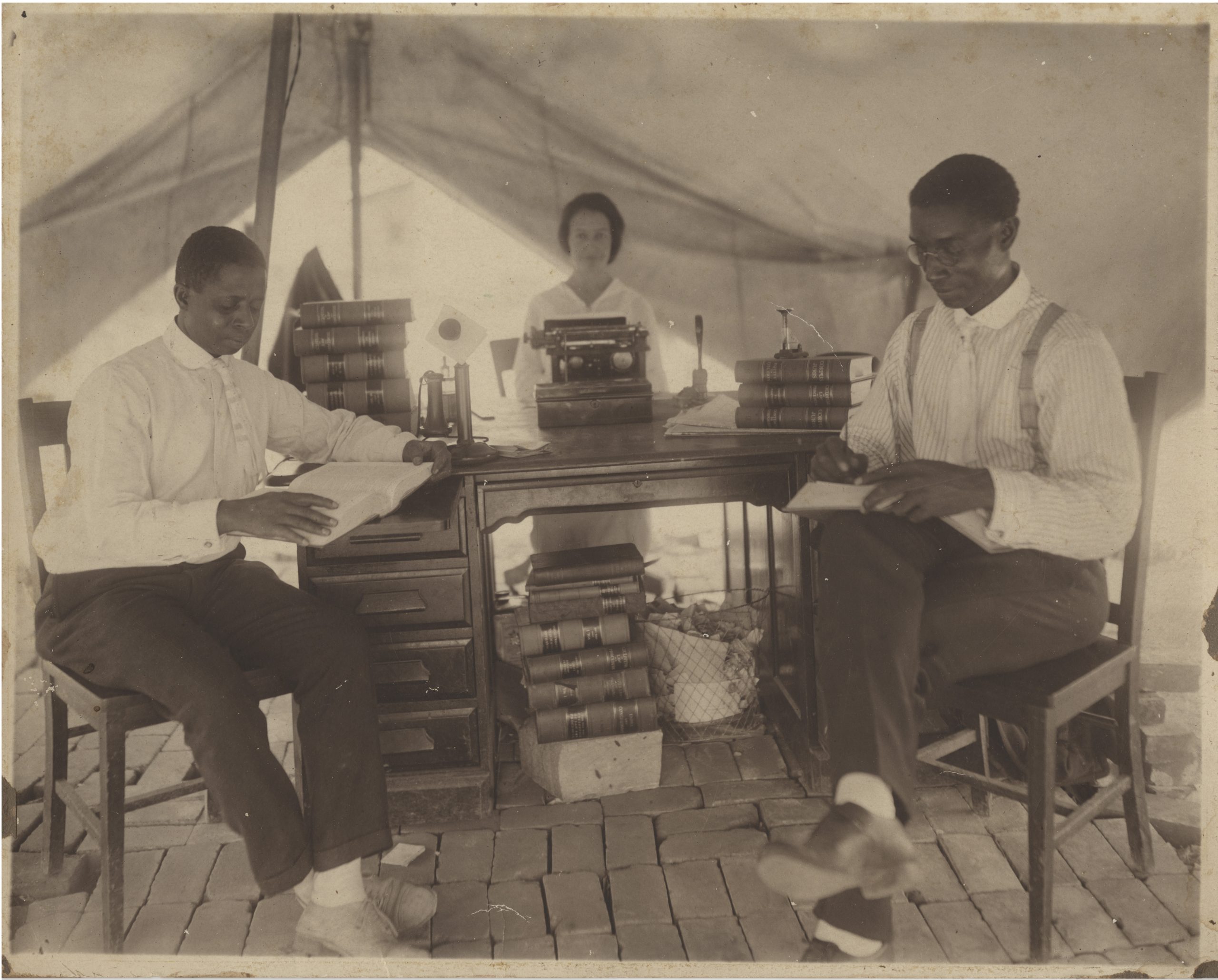
From May 31-June 1, 1921, the Tulsa Race Massacre took place in the Greenwood District of Tulsa, OK. Greenwood was one of the most economically prosperous African American communities in the country and earned the name “Black Wall Street.” The events of that day were said to have been sparked by the actions of a mob comprised of White Tulsa citizens that wanted to exact “justice” on a young black teen who had allegedly assaulted a White woman; which at the time was considered an affront to the Jim Crow power structure designed to keep African Americans in Tulsa, and throughout the country, in a subservient social class. The actions of that mob resulted in the looting and burning of businesses, churches, and homes, and the death of anywhere between 100 and 300 African American residents of Tulsa.
Among the victims during those tumultuous days was Buck Colbert Franklin, father of Dr. John Hope Franklin. Buck Franklin had relocated to Tulsa a few months prior to the massacre to grow his law practice. When the violence occurred, his offices, like so many other buildings in the Greenwood District, were burned and also delayed the arrival of his wife and children to join him in Tulsa for four years. As one the few practicing African American lawyers in the state of Oklahoma, Buck Franklin took up the lawsuits of the African American citizens as they attempted to seek insurance payments, civil and criminal settlements for the events that took place.
Buck C. Franklin working in a tent after the Tulsa Massacre
Some of the archival legacy of the Tulsa Race Massacre can be located in the collections of the Rubenstein Library and the John Hope Franklin Research Center. The following materials document what took place and the history of community members seeking justice, reparation, and reconciliation for two of the darkest days in our country’s history:
Writings Series, contains a number of writings by John Hope Franklin and others on the race riots
Personal Series, Franklin family photographs including images of Buck Franklin
Service Series, contains article clippings of news stories on the riots, also materials related to a 2003 Tulsa Race Riot lawsuit, Franklin’s participation in the Tulsa Race Riots Reconciliation Committee
Audiovisual Series, VHS, The Greenwood Blues: The Tulsa Race War of 1921 (1983)
13 interviews conducted in 1978 by Scott Ellworth for his study Death in the Promised Land: The Tulsa Race Riot, 1921
Interviews with: B.E. Caruthers, Nathaniel Duckery, Robert Fairchild, Victor H. Hodge, Mozella Franklin Jones, Mr. and Mrs. I.S. Pittman, Henry Whitlow, N.C. Williams, Seymour Williams, William D. Williams