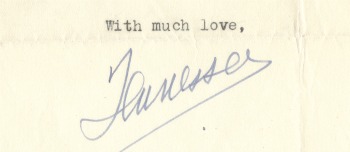
Today, March 26, 2011, would be the hundredth birthday of Tennessee Williams, one of America’s great playwrights. The Carson McCullers Papers here at Duke contain many letters between McCullers and Williams, most from the late 1940s, shortly after Williams had written McCullers a fan letter and the two had immediately become close friends. The letters are full of passionate discussion of their work, travels, and deep affection for each other.
On behalf of McCullers and all lovers of American theatre and literature: Happy birthday, “10 Darling.”
Post contributed by Will Hansen, Assistant Curator of Collections.
P.S. If you haven’t yet, please take our survey by clicking on the orange button on the right. We are collecting information from our readers so that we can make our blogs better and more informative. It won’t take long—just five easy questions. Thanks!
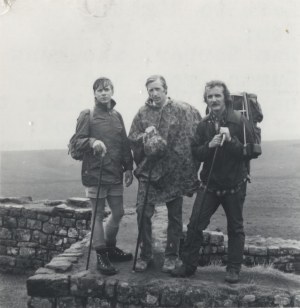
During the summer of 1970, four remarkable American writers and editors paid a visit to 70 year old Northumbrian poet Basil Bunting in his home in Corn Close, Yorkshire, England. The leader of this group was Jonathan Williams, poet and founder of North Carolina’s the Jargon Society, which published the works of innovative poets such as Charles Olson, Denise Levertov, and Duke alumnus Guy Davenport.
Williams asked his companions to stop and pose for the camera “near the end of the trek up the Pennines,” a low-rising mountain range separating the North West of England from Yorkshire. “Quite a rough go, by the way.”
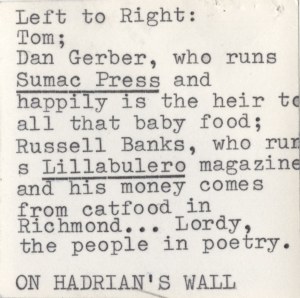
On Hadrian's Wall, back of photograph.
Williams helpfully typed on the back of this small (2 ½ inch square) photo the names of those pictured. From the left is Williams’ life partner, the poet and translator Thomas Meyer; Dan Gerber, co-founder of the Michigan-based little magazine Sumac; and Russell Banks, then a recent graduate of UNC-Chapel Hill (BA ‘67), and now the prominent novelist and author of The Sweet Hereafter, Affliction, and other acclaimed books.
He then sent the snapshot to R. Philip Hanes, an executive at Hanes Dye and Finishing Company, who was a founding board member of the Jargon Society.
The photo comes from the R. Philip Hanes Papers. Hanes’ papers provide a rich and entertaining look at one small, North Carolina publisher’s fund raising efforts. Williams’ wit and garrulousness shows in the letters. He has many names for money, for instance, names like “lucre,” “lolly,” “moola,” “smackers,” and plenty of others. “I’m apparently not doing as a fund-raiser. But, us mountain boys is a mess, that’s been true for hundreds of years.”
We also learn about some of Hanes’ interests: “Dear Morchella Esculenta,” Williams writes in August 1971, “One suspects there will be a conglutination of those fearsome fungi of yourn this year. Lots of showers here lately too. Everything grows heavily—the pollens, the tourists, anglophobia, anglophilia—the lot.”
That is, Hanes hunted mushrooms.
Post contributed by David Pavelich, Head of Research Services.
P.S. If you haven’t yet, please take our survey by clicking on the orange button on the right. We are collecting information from our readers so that we can make our blogs better and more informative. It won’t take long—just five easy questions. Thanks!
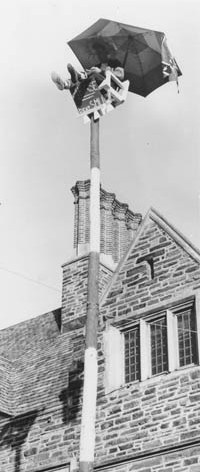
Flagpole Sitter, 1956. From the Duke University Archives.
We’re librarians: we like information. For the next month, The Devil’s Tale will be gathering information from you, our reader, in our first-ever feedback poll!
This is your chance to tell us a little bit about your blog-reading habits and what you’d like to see when you visit The Devil’s Tale. In the sidebar you’ll see an orange button that links to our short survey—we hope you’ll take a few minutes to help us learn how to create a better, more informative blog. Of course, your responses and comments will be submitted anonymously, so click away!
We’ll be gathering responses through Friday, April 15th, and we’ll be sure to let you know what we’ve learned once the results are tabulated.
All of the other Duke University Libraries blogs will be running the exact same poll, so head over to the other blogs that you read and leave some feedback for them, too.
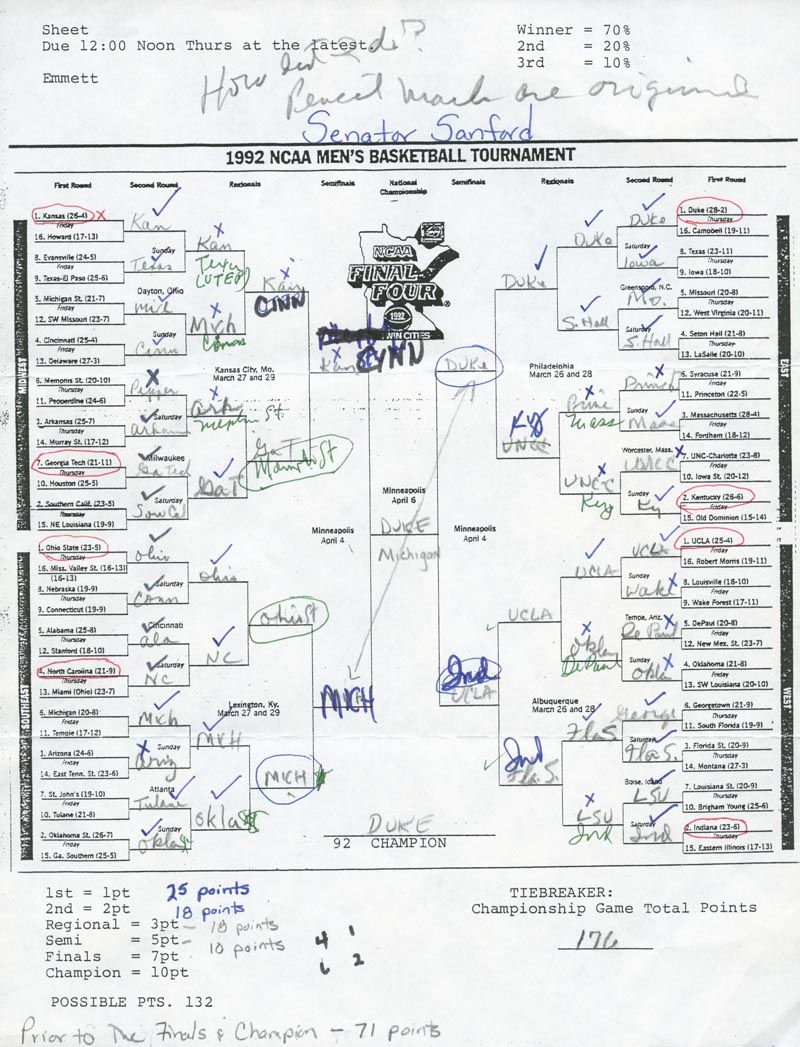
On any ordinary Monday morning in 1992, then-North Carolina Senator and former President of Duke University Terry Sanford began his week attending to the public’s business. However, this particular Monday in March happened to be the day after Selection Sunday and, like so many of us, Senator Sanford contemplated his blank NCAA Men’s Basketball Tournament bracket at the expense of perhaps more pressing work.
Among the hundreds of linear feet of Terry Sanford’s records and papers held in the RBMSCL (his senatorial papers) and University Archives (records from his Duke presidency) is his 1992 NCAA Tournament bracket. Although he couldn’t have foreseen Christian Laettner’s last second turnaround jumper against Kentucky and Duke’s trouncing of Michigan’s “Fab-5” in the tournament final, the man that the Duke Student body fondly referred to as “Uncle Terry” chose Duke to repeat as NCAA champions. Will they do it again in 2011?
Post contributed by Josh Larkin-Rowley, Research Services Assistant.
P.S. Through Friday, April 15th, we’ll be gathering responses as part of our first-ever reader feedback poll! Click the orange button in the sidebar to participate, or visit this blog post to learn more.
Date: Thursday, 17 March 2011 Time: 3-4 PM Location: Rare Book Room Contact Information: Jennifer Thompson, 919-660-5922 or jennifer2.thompson(at)duke.edu
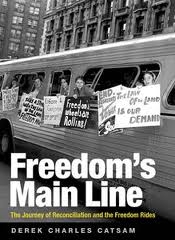
Dr. Catsam’s talk, “Tired Feet, Rested Souls and Empty Pockets: Bus Boycotts and the Politics of Race in the U.S. and South Africa,” will examine comparative aspects of these movements in the United States and South Africa.
During his research visit to the RBMSCL, Dr. Catsam will be studying our collections related to apartheid South Africa.
(More details about Derek Catsam’s book Freedom’s Main Line: the Journey of Reconciliation and the Freedom Rides and his research interests can be found on his departmental website.)
Post contributed by Jennifer Thompson, John Hope Franklin Research Center Librarian.
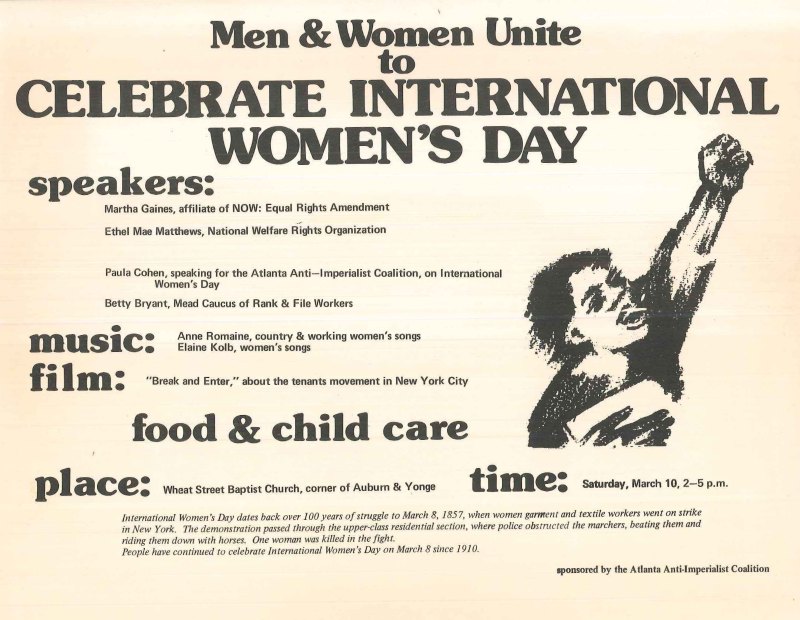
This flier is from a 1973 event sponsored by the Atlanta Anti-Imperialist Coalition celebrating International Women’s Day. From the flier: “International Women’s Day dates back over 100 years of struggle to March 8, 1857, when women garment and textile workers went on strike in New York. . . . People have continued to celebrate International Women’s Day on March 8 since 1910.”
Activists have used this holiday to celebrate the achievements of notable women in history as well as to advocate for women’s equality, particularly labor issues such as better child care, maternity leave, and equal pay for equal work.
It’s not often that we acquire two copies of the same work at the Library. Sometimes, however, a second copy can have unique characteristics that make it nearly irresistible—as in the case of a copy of The Fall of the Great Republic recently acquired for the Glenn R. Negley Collection of Utopian Literature, which may have solved the 125-year-old mystery of its author’s identity.
A well-known anti-socialist and xenophobic dystopian work published in 1885 and foretelling the demise of the United States, the book was published under the pseudonym Henry Standish Coverdale. The copy now at Duke seems to establish the author as New Lebanon, N.Y. newspaperman Abner Hitchcock (1851-1936). The volume comes from his library, bears the ownership signature “Hitchcock,” and includes a penciled note in the rear, dated from August 1924, stating that “Authorship [was] kept a complete secret.”
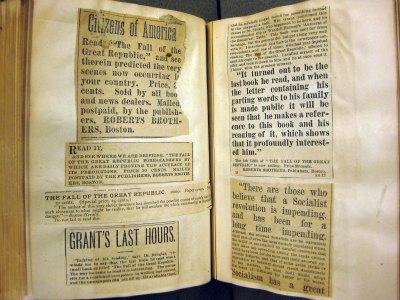
The specially-bound volume contains clippings and reviews of the work from across East and parts of the Midwest, including a suspiciously positive review from the Boston Journal, a paper for which Hitchcock wrote. Of the various reviews, the owner has written in the volume: “The most striking thing about it is in the illustration the pasted-in comments give of the impression it made on different readers. – One sees in me an ass, and one a prophet. I suspect there is some basis for both judgements.”
Clippings pasted into The Fall of the Great Republic.
The volume was discovered by a bookseller cleaning out of the attic of the Hitchcock House in New Lebanon, now a bed-and-breakfast inn. It has now found its permanent home at Duke, where it will remain a one-of-a-kind resource for future generations of scholars.
Special thanks to Garrett Scott for permission to quote from his description of this item.
Post contributed by Will Hansen, Assistant Curator of Collections.
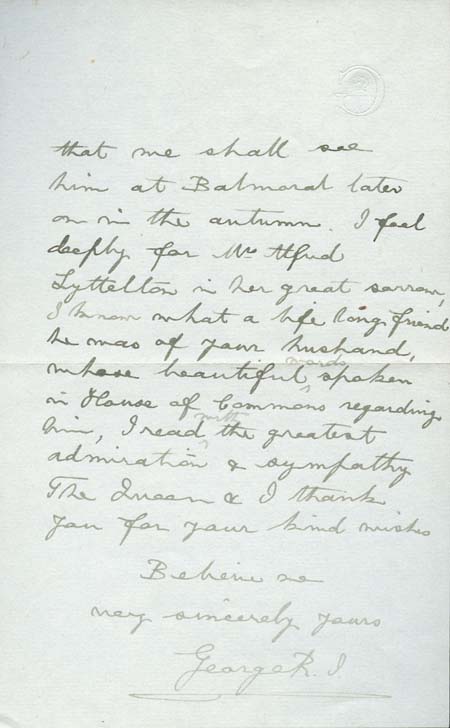
The King’s Speech, the film dramatizing King George VI’s efforts to conquer his stutter, is thrilling cinephiles, history buffs, and Colin Firth admirers. On Sunday, the film received four Oscars: Best Picture, Best Actor in a Leading Role (Firth), Best Directing (Tom Hooper), and Best Original Screenplay (David Seidler). It was nominated for an additional eight Oscars, making it the most-nominated film this year.
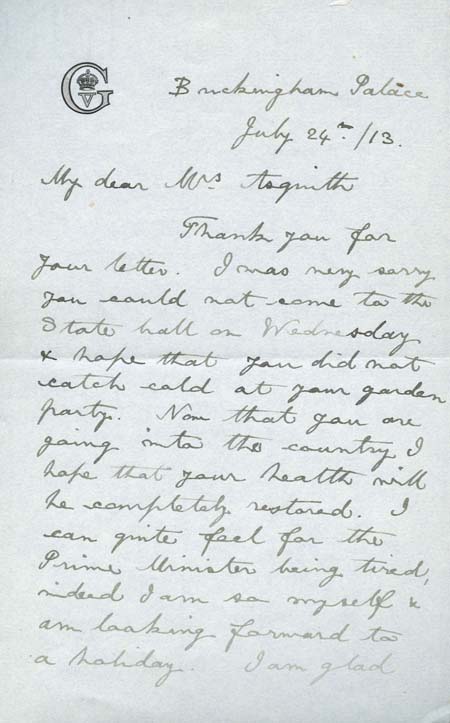
Our Herbert Henry Asquith Papers contain letters written to this former Prime Minister and his second wife, Emma, by George VI’s father, King George V (played in the film by Michael Gambon), and brother, Prince George, the Duke of Kent. We’d like to share a letter from King George V to Emma Asquith, written from perhaps one of the more recognizable home addresses in the RBMSCL’s collections.
Post contributed by Elizabeth Dunn, Research Services Librarian. With special thanks to Sam Hammond, Original Cataloger of Rare Materials.
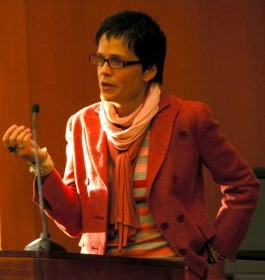
Dorothy Q. Thomas will speak about recovering a legacy of progressive Americanism for contemporary women’s rights activists, drawing on her on-going research for a book that chronicles the lives of some of her female ancestors, including descendants of former presidents John Adams and John Quincy Adams and mother of the American Revolution Dorothy Quincy Hancock. Thomas is currently a research associate at the School of Oriental and African Studies at the University of London. She was previously a visiting fellow at the London School of Economics and was founding director for the Human Rights Watch Women’s Division.
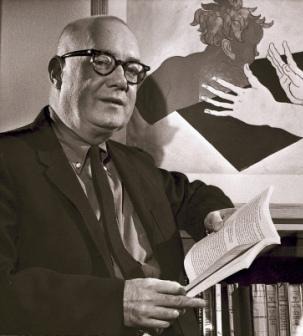
Wallace Fowlie in 1968. From the University Archives Photograph Collection.
“Cleaning my apartment,” wrote Wallace Fowlie (1908-1998) in his memoir Aubade, “means discarding each week an object, a book, and even a notebook that has served its purpose.” In other words, the influential Duke faculty member destroyed many of his own manuscripts.
Still, something of Fowlie’s archive was recovered from his Durham home at Valley Terrace Apartments and survives in the Wallace Fowlie Papers, a modest collection of his correspondence and later manuscripts.
Fowlie arrived in Durham in 1964 and taught French literature at Duke until his death in 1998; he was named the James B. Duke Professor of French in 1968. Fowlie is best known for his critical readings and translations of Rimbaud, Baudelaire, Cocteau, and other French writers.
The Wallace Fowlie Papers include highlights from his correspondence, such as letters from Jean Cocteau, Anaïs Nin, and other important literary figures.
Letter from Jean Cocteau to Wallace Fowlie, 1957. From the Wallace Fowlie Papers.
Two spiral notebooks—apparently the only notebooks not discarded by the self-described “eccentric” scholar—contain Fowlie’s notes on Marcel Proust, Dante, and other writers. Most notable, perhaps, is Fowlie’s personal reminiscence of his relationship with the novelist Henry Miller.


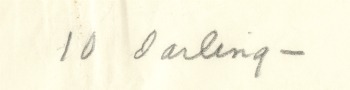 Today, March 26, 2011, would be the hundredth birthday of Tennessee Williams, one of America’s great playwrights. The Carson McCullers Papers here at Duke contain many letters between McCullers and Williams, most from the late 1940s, shortly after Williams had written McCullers a fan letter and the two had immediately become close friends. The letters are full of passionate discussion of their work, travels, and deep affection for each other.
 On behalf of McCullers and all lovers of American theatre and literature: Happy birthday, “10 Darling.”