Category Archives: News and Features

Big News!

We have a new name!

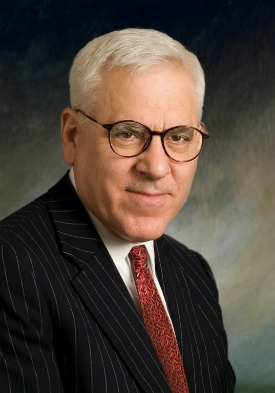
David M. RubensteinDavid M. Rubenstein (T ’70) has pledged $13.6 million to the Duke Libraries in support of the RBMSCL—the largest gift in the Duke Libraries’ history. In recognition of this historic commitment, we are pleased to announce that we will become the David M. Rubenstein Rare Book & Manuscript Library, following approval by the Board of Trustees. (Here’s the official press release.)

Our director, Naomi Nelson, is excited about what this gift means for Duke. “David Rubenstein’s generous gift gives this world-class library a very distinguished name. We couldn’t be more thrilled. His support will allow us to move forward rapidly with renovation plans to transform Duke’s historic library buildings into a proper home for the Rubenstein Library. We will be able to welcome more classes, better serve local and international researchers, and host a greater number and variety of public programs. What makes this gift particularly special is that David Rubenstein once worked as a student in the very stacks we will be renovating. We are extremely grateful for his vision and for his continued commitment to Duke.”

David Rubenstein is the co-founder and managing director of the Carlyle Group, a private equity firm with 36 offices around the world. A native of Baltimore, he graduated magna cum laude from Duke and was elected Phi Beta Kappa. In 2003, he was elected to the Duke Board of Trustees, and he currently serves as the Board’s vice-chair. His gift to the Duke Libraries is part of his larger commitment to philanthropy. He serves on many boards, including those of the Lincoln Center, the Smithsonian, and the Kennedy Center for the Performing Arts. His largest previous gifts to Duke supported the growth of the Sanford School of Public Policy. Rubenstein and his wife, Alice Rogoff Rubenstein, have three grown children.

You may have seen the news stories covering Rubenstein’s purchase of the Magna Carta and his decision to loan this historic document to the National Archives so that it could be shared with the public. This was one of several seminal historical documents that he has purchased over the years to share with the American people. (See, for example, this profile in Duke Magazine. ).

Architect's Sketch of the Rubenstein Library Reading Room
Architect's Sketch of the Rubenstein Library Reading Room.

We look forward to welcoming you to the new David M. Rubenstein Rare Book & Manuscript Library. We’ll post updates about the renovation plans here on The Devil’s Tale, so watch this space. We have already started planning for the grand reopening in early 2015!

Sleep In on Wednesday

This Wednesday, August 17th, the Rare Book, Manuscript, and Special Collections Library will be opening promptly at 10:00 AM.

You know what this means for you, our researchers, right? One extra hour for this:

"Leaning on pillow, baby sleeps on carpeted floor." From William Gedney Photographs and Writings, 1940s-1989.

Doesn’t that baby look comfy?

So take an extra hour’s break on Wednesday. We’ll look forward to seeing your bright, shiny faces and helping you with your bright, shiny research at 10 AM. Of course, please call us at 919-660-5822 or e-mail us at special-collections(at)duke.edu with your questions or concerns.

An Artist’s Adventures with the Supernormal

Date: Thursday, August 18, 2011
Time: 3:30 PM
Location: Rare Book Room
Contact Information: Elizabeth Dunn, 919-660-5824 or elizabeth.dunn(at)duke.edu

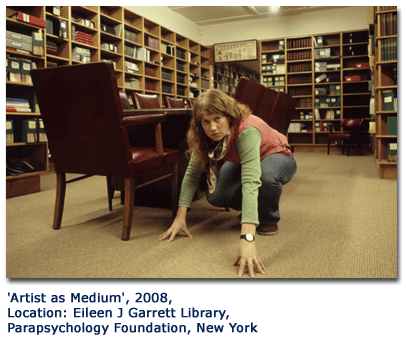
"Artist as Medium," 2008Video and installation artist Susan MacWilliam will speak about her archivally-based art, which focuses on the world of the paranormal, the tradition of psychical research, the supersensory, and ideas about perceptual phenomenon.

This summer, she is studying the experimental and groundbreaking ESP and telepathy research of Dr. J. B. Rhine through materials in the RBMSCL (focusing on the Parapsychology Laboratory Records) and at the Rhine Research Center. Susan MacWilliam’s residency in Durham is supported through funding from the Arts Council of Northern Ireland.

For Thursday’s talk, she will show some of her video pieces and discuss the ways that she transforms her archival discoveries and interviews into artistic creations.

Light refreshments will be served.

For more background on Susan MacWilliam’s work, please visit her website.

Post contributed by Elizabeth Dunn, Research Services Librarian.

Decorating the RBMSCL

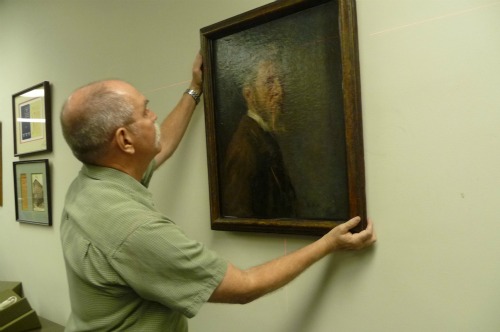
Along with print items, manuscripts, and artifacts, the History of Medicine Collections include works of art. On Friday, thanks to Peter Geoffrion, three pieces of artwork were hung in the RBMSCL.

In the RBMSCL’s reading room, we now have a portrait of Hans Horst Meyer, a German physician and pioneer in anesthesia. The portrait was a gift from his grandson, Professor J. Horst Meyer, Fritz London Professor Emeritus of Physics here at Duke University.

In the Trent Room (part of the Mary Duke Biddle Rare Book Room), a portrait of Valentine Mott and a framed ivory skeleton sculpture, or Memento Mori, were hung.

The Memento Mori piece is one of the most exquisite items in the History of Medicine Collections. A gift of Mrs. Mary D. B. T. Semans from the collection of her late husband, Dr. Josiah Charles Trent, this sculpture is carved from a single piece of ivory. Reminiscent of the illustrations from the famed Vesalius anatomical work, De Fabrica (1543), Memento Mori displays a variety of material goods splayed at the feet of the skeleton. Looking at this, one is reminded, that in the end, we’re all mere mortals.

Post contributed by Rachel Ingold, Curator for the History of Medicine Collections.

Another Wednesday at the RBMSCL

So, you ask, what did your friends at the RBMSCL do on Wednesday? Well, we helped some researchers and we added some new materials to our collections and we encoded a few finding aids.

And then there was this.

Bake-Off Treats!

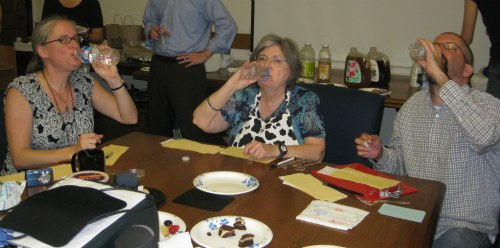
Yes, on Wednesday afternoon, Team Smith and Team Perkins matched baking skills in the First Annual All-RBMSCL Bake-Off.

Our three esteemed judges sampled 37 desserts from four categories (cakes, pies, cookies and bars, and “other”) and assigned scores for presentation, taste, and creativity.

Cleansing Their Palates

They were a little overwhelmed.

Feeding Frenzy

While the scores were being totaled, we got down to some serious eating (note our serious eating faces).

Our Winners:

  • Pies Category: Patrick Stawski, Human Rights Archivist
  • Cakes Category: Mary Samouelian, Doris Duke Collection Archivist
  • Cookies and Bars Category: Elizabeth Dunn, Research Services Librarian
  • “Other” Category: Paula Jeannet Mangiafico, Senior Processing Archivist (for tiramisu!)

Elizabeth Dunn won “Best in Show” for her Heart-Shaped Dark Chocolate Brownies.

Best in Show

Although Team Smith won the categories 3 to 1, Team Perkins scored the higher average of points per entry. We’re calling it a draw. For now, the trophy—the Golden Recipe Box—will reside at Perkins in the RBMSCL’s reading room. Comparisons to the Stanley Cup are, we think, inevitable:

The Golden Recipe Box

We haven’t tried drinking champagne out of it, though.

For more Bake-Off photos, visit the “2011 RBMSCL Bake-Off” set on our Flickr photostream.

A Well-Traveled Padlock

The Returned Padlock and its Envelope

Here at the RBMSCL, we ask our researchers to put everything they won’t need for their research in lockers, and we present them with their very own padlock to use during their visit. (Other special collections libraries do this, too, as it helps to keep our unique materials safe and secure.)

Occasionally, a padlock doesn’t make it back to us at the end of a research visit—and we have extras, so we don’t fret. But a very kind and conscientious patron discovered one of our padlocks at the bottom of her bag upon her return to the United Kingdom and sent it all the way back to us here in Durham. Thanks, lovely patron, and come visit us again soon!

Thanks to Josh Larkin-Rowley, Research Services Assistant, and Rachel Ingold, Curator for the History of Medicine Collections, for suggesting this post and to Beth Doyle, Head of Conservation Services and editor of Preservation Underground, for taking the photograph!

Medical Move Mondays: Home, Sweet Home

It’s the fifth and final week of our series on the History of Medicine Collections‘ move from the Medical Center Library on Duke’s medical campus to the RBMSCL on West Campus.

And the move, we are pleased to announce, is complete. Through a true team effort, including staff from the Medical Center Library & Archives, RBMSCL, and Perkins Library, the move happened smoothly. Professional movers handled most of the items from the collections, and transferred them with extreme care from the Medical Center Library to their new location.

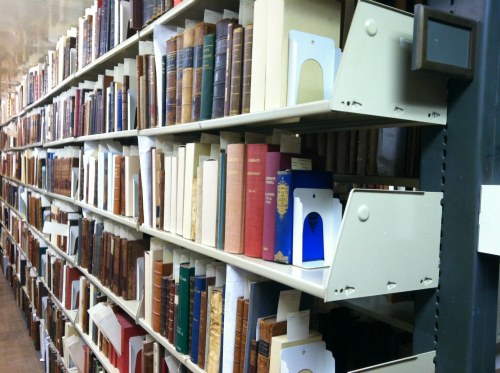
History of Medicine Books in Their New Home

With this relocation come expanded hours as RBMSCL has weekend and evening hours. Researchers will find opportunities to discover overlapping collections within RBMSCL as well. There are many collections that complement the History of Medicine’s holdings from the Sallie Bingham Center for Women’s History and Culture, the John Hope Franklin Research Center for African and African American History and Culture, and the John W. Hartman Center for Sales, Advertising, and Marketing History. Topics such as women’s health, minority health, medical advertising, and innovations in health care are represented in the collections held at RBMSCL.

No appointment is necessary and all are welcome, so please be sure to visit the History of Medicine Collections in its new home.

Post contributed by Rachel Ingold, Curator for the History of Medicine Collections.

What She Wore

Mary Lily Travel Grant recipient Julie R. Enszer recently completed her second visit to the Sallie Bingham Center for Women’s History and Culture to conduct research for her dissertation project, which investigates the production of lesbian-feminist print culture in the United States between 1969 and 1989.

While Julie was here, she used materials from these collections:

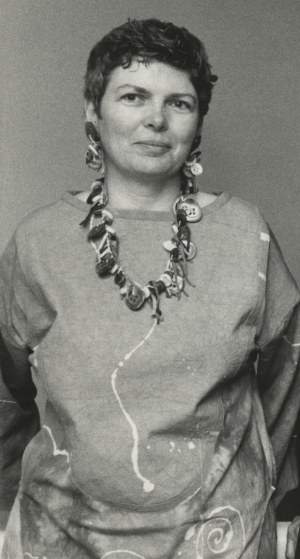
Minnie Bruce Pratt at the Academy of American Poets awards ceremony, May 16, 1989.
Minnie Bruce Pratt at the Academy of American Poets awards ceremony, May 16, 1989. From the Minnie Bruce Pratt Papers. Photo by Dorothy Alexander.

Reflecting on her research experience, Enszer writes that the Minnie Bruce Pratt Papers were “one of the most exciting collections that I worked with. This may be in part because I have been a fan of Pratt’s poetry and writing since the late 1980s, but it is also certainly due to the fact that this is an extensive and thorough collection.”

She continues, “One aspect of my dissertation focuses on the literary appraisals of lesbian writing and a significant portion of the chapter discusses the Lamont Prize [given by the Academy of American Poets] in 1989 given to Minnie Bruce Pratt for Crime Against Nature. There are extensive documents on this event in the archive, but my favorite archival item is the outfit that Pratt wore to the award ceremony at the Guggenheim: a two-piece, cotton Batik. The shirt is light green with a lavender smock on the front edged by pink. It is both festive and feminine while distinctly conveying ‘lesbian.’”

Thanks to Dorothy Alexander for letting us use her photo of Minnie Bruce Pratt at the 1989 Academy of American Poets awards ceremony in this post. You can see more of her work on her website.

Post contributed by Kelly Wooten, Research Services and Collection Development Librarian for the Sallie Bingham Center for Women’s History and Culture , with thanks to Julie R. Enszer.

Medical Move Mondays: Conserving the Collections

It’s week three of our series on the History of Medicine Collections‘ move from the Medical Center Library on Duke’s medical campus to the RBMSCL on West Campus.

Wrapping Materials before MovingLast week, I mentioned that Jessica found the occasional book with the cover falling off of it. Enter Conservation! The staff of the Duke University Libraries’ Conservation Services Department (all six of them!) have been spending a good deal of time with the History of Medicine Collections assessing materials and making protective enclosures for items that are too damaged to move in their current state. They have been quite busy placing items in protective envelopes, measuring books for protective enclosures, and creating lots of custom-made enclosures.

The Conservation Services Department has provided over 2,217 enclosures in five weeks for the History of Medicine Collections. Along with protective envelopes, Conservation has custom-made tuxedo boxes, blue clamshell enclosures, phase boxes, and even a cloth-covered clamshell box for an extremely brittle, unique Sanskrit book. This is quite a feat—considering they did not have much time and made the enclosures at a different location than the books!

Measuring Items for EnclosuresMeasurements were made at the History of Medicine Collections’ former space, located in the Medical Center Library. Boxes were then constructed in Conservation’s beautiful lab space in Perkins Library. Once enclosures were complete, the boxes were brought to the books at the History of Medicine for their fitting. Their hard work and dedication have ensured that the damaged and fragile items in this collection will withstand the move. Thank you, Conservation!

For photos of the move from start to finish, visit the “HOM Collections Move” set on the Duke University Libraries’ Flickr photostream.

Next week: Shipping and Receiving moves some very carefully-packed book trucks.

Post contributed by Rachel Ingold, Curator for the History of Medicine Collections.

Medical Move Mondays: Introduction

Rachel Ingold, Curator of the History of Medicine CollectionsHi! I’m Rachel Ingold, Curator for the History of Medicine Collections. This summer, the History of Medicine Collections will be moving from the Medical Center Library on Duke’s medical campus to the RBMSCL on West Campus. For the next five weeks, join me every Monday here at The Devil’s Tale. I’ll be walking you through the move step-by-step.

This week, a little background: The History of Medicine Collections consists of over 20,000 rare and unique medical books and journals. Along with these print items are 4,500 manuscripts and numerous medically-related instruments, artifacts, prints, photographs, and ephemera. The collection is particularly strong in the areas of anesthesia, human sexuality, materia medica, pediatrics, psychiatry, vivisection, and yellow fever.

Two major gifts helped form the HOM Collections. In 1931, the Georgia Medical Society of Savannah donated its library of 8,000 volumes to Duke University. Another major donation which brought a new level and depth to the collection was the 1956 donation of the Trent Collection by Mrs. Mary Duke Biddle Trent Semans.

History of Medicine Collections Brochure CoverSo, how does one go about moving a collection with so many rare print items and manuscripts, as well as a variety of instruments and artifacts including curiosities such as amputating saws, ivory anatomical manikins, and glass eyeballs? The answer: very carefully. And with a team of wonderful people.

I’m grateful to be working with a great group of folks from the Medical Center Library & Archives and Perkins Library. So many people have been involved in making this move happen. And I hope this series of blog posts will highlight some of the work they have done to help and how we are going about this move.

For photos of the move from start to finish, visit the “HOM Collections Move” set on the Duke University Libraries’ Flickr photostream.

Next week: Technical Services gets to work!

Post contributed by Rachel Ingold, Curator for the History of Medicine Collections.