Category Archives: From Our Collections

Alabama v. Duke

This Saturday’s football game with Alabama recalls the historic ties between our two programs. In 1930, shortly before the opening of the new Gothic West Campus, President William Few sought the advice of the celebrated Alabama coach Wallace Wade on potential names for a football coach and director of athletics. Wade, who had led Alabama to two Rose Bowls and a record of 51-13-3, surprised Few by replying that he would be interested in the vacancy. Wade brought his Alabama success to Duke, leading the Blue Devils to two Rose Bowls as well. He would post a record of 110-36-7 in his sixteen years as coach at Duke.
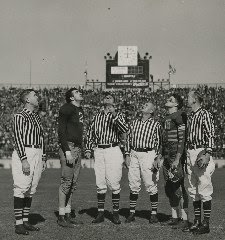
Sugar Bowl Coin Toss
The Coin Toss. From the Edmund M. Cameron Records.

While Wade served in the U.S. Army as major during World War II, his assistant Eddie Cameron took over as head coach and continued the Blue Devils’ gridiron success. He led the 1944 team to a Sugar Bowl showdown with Alabama on January 1, 1945. In what sportswriter Grantland Rice called “one of the greatest thrillers of all time” Duke edged the Tide 29 to 26. Cameron kept a scrapbook filled with images from the game, which now forms a part of the Edmund M. Cameron Records.

Duke’s connections to Alabama continue with current Coach David Cutcliffe, an Alabama native and graduate of the University of Alabama who also served as an intern to legendary Alabama coach Bear Bryant. Duke fans will be hoping that Coach Cutcliffe will rekindle some of that “Sugar Bowl magic” and will lead us to another thrilling victory over Alabama this Saturday!

Post contributed by Tim Pyatt, Duke University Archivist.

Opening Reception for “Deena Stryker: Photographs of Cuba, 1963-1964″

Date: Thursday, 16 September 2010
Time: 4:00 PM
Location: Rare Book Room
Contact Information: Karen Glynn, 919-660-5968 or karen.glynn(at)duke.edu

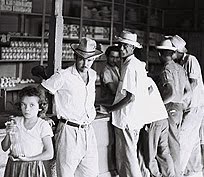
A café and store in Birán, Fidel Castro’s home town, Holguín Province, December 1963. From the Deena Stryker Photograph Collection.

Photographer and journalist Deena Stryker brings her reminiscences of the Cuban Revolution to this opening celebration for “Deena Stryker: Photographs of Cuba, 1963-1964,” on display through 12 December 2010 in the Special Collections Gallery.

Following Stryker’s remarks, exhibit curators Holly Ackerman and Heather Settle will lead a panel of several local experts on Cuba in discussing the photographs and placing them in their historical context. Panelists include:

  • Lars Schoultz, William Rand Kenan, Jr. Professor of Political Science, University of North Carolina at Chapel Hill
  • Monika Gosin, Program in Latino/a Studies in the Global South, Duke University
  • Linda Howe, Department of Romance Languages, Wake Forest University

A reception and gallery tour, led by Stryker, will follow.

Can’t visit the exhibit in person? Check out the virtual exhibit, which includes an additional eleven photos from the Deena Stryker Photograph Collection, part of the RBMSCL’s Archive of Documentary Arts.

My RBMSCL: Reading Dorothy Allison

Today, we’re starting a new feature: mini-essays from friends of the RBMSCL on the collections they’ve used and treasured. Below, Sharon Holland’s mini-essay about Dorothy Allison was inspired by the RBMSCL’s recent acquisition of Dorothy Allison’s papers

Photo courtesy of Sharon Holland.

I first encountered Dorothy Allison’s major work, Bastard Out of Carolina, on an overnight train (the Orient Express, no less) from Vienna to Paris. I wasn’t prepared for what would eventually happen in the book and when I got to the fateful scene in the car outside the hospital, I impulsively threw the book out of the window—it is still in a field somewhere along the train line. My reaction is a testament to the importance of the scene of violation that Allison wanted to construct for the reader—it was real, and sudden and devastating. I purchased the book upon my return to the United States and it has been one of my favorites since. Acquiring her papers is a serious accomplishment for Duke. Thank you for preserving the work and ultimately the memory of one of the most important feminist authors of the 20-21st century.

Post contributed by Sharon Holland, Associate Professor, English and African and African American Studies, Duke University.

Interested in contributing a mini-essay? E-mail me at amy.mcdonald(at)duke.edu!

Dorothy Allison Papers Arrive at Duke

In the early 1990s Ginny Daley, then director of the Sallie Bingham Center for Women’s History and Culture, was convinced that Duke should acquire Dorothy Allison’s papers. “I saw her as the quintessential Southern writer,” Daley wrote recently. “Her personal papers and literary works fit well with Duke’s collections of Southern literature and women’s culture, while bringing fresh perspectives on queer culture and truth-telling to the mix.” Through campus visits and other seed-planting efforts, Ginny Daley introduced Ms. Allison to the possibility of Duke as the permanent home for her collection.

Photo by Brett Hall.

Now, after a nearly twenty year period of considering this momentous decision, Dorothy Allison, author of Bastard Out of Carolina and other works and renowned activist in the LGBTQ community, has selected the RBMSCL to be the repository for her papers. Bingham Center and literary curatorial staff collaborated on the initial acquisition of nearly 60 boxes of Allison’s papers, including drafts of her writings, extensive correspondence and research files, personal journals documenting her life and creative process, and more. For Allison, a South Carolina native now living in California, it’s a relief to have the papers at the RBMSCL: “All I know is that now I feel that all that . . . I saved is going to be safe and of use. Since we are entering high summer here with 90 degree temperatures and high risk of fire, I can also stop worrying that a wildfire might sweep through the redwoods and erase all that history. Safe and of use is infinitely preferable.”

The papers will be a rich resource for those interested in Allison’s life and work, as well as for researchers exploring the development of LGBT and Southern literatures, lesbian communities and families, and the history of American sexuality, among many other topics. Materials will be added to the collection as Allison continues to write and publish (a new book of short stories and a novel coming soon!).

A preliminary finding aid for the collection is now available here. In the coming months staff will review, process, and revise the finding aid for the collection to make it available for research. Researchers interested in using the papers should contact the Bingham Center staff to discuss their availability.

Post contributed by Will Hansen, Assistant Curator of Collections.

“Deena Stryker: Photographs of Cuba, 1963-1964″

Date: 31 August-12 December 2010
Location and Time: Special Collections Gallery during library hours
Contact Information: Karen Glynn, 919-660-5968 or karen.glynn(at)duke.edu

Journalist and photographer Deena Stryker’s black-and-white photographs of Revolutionary Cuba open a window into an unsettled time in that country’s history, after the Bay of Pigs and before Che Guevara’s departure for the Congo, when Fidel Castro was solidifying his control over the new revolutionary government.

A woman watching a military parade, Havana, January 1964. From the Deena Stryker Photograph Collection.

This new exhibit of thirty gelatin silver prints from the Archive of Documentary ArtsDeena Stryker Photograph Collection documents this extraordinary change, bearing witness to both the vitality of Cuba’s leadership and the optimism of the Cuban people. The exhibit is curated by Holly Ackerman, Librarian for Latin America and Iberia, and Heather Settle, visiting scholar in Cultural Anthropology.

Can’t visit the exhibit in person? Check out the virtual exhibit, which includes an additional eleven photos from the Deena Stryker Photograph Collection.

Keep up with The Devil’s Tale for news about the exhibit’s opening reception on Thursday, September 16th at 4:00 PM in the Rare Book Room. Deena Stryker, the exhibit’s curators, and several local experts on Cuba will come together to discuss the photographs and place them in their historical context.

Selling a Coke and a Smile

Photo by Mark Zupan.

As the adage goes, Coca-Cola sells itself. The John W. Hartman Center for Sales, Advertising and Marketing History’s recently-acquired Coca-Cola Star Salesman Kit might just suggest otherwise. This collection of training materials—including scripted manuals, 35mm film strips with accompanying phonographs, and other training memorabilia housed in a special green suitcase—was created by the Coca-Cola Company’s Sales Promotion Department between 1949 and 1951. The company encouraged route managers to purchase the Star Salesman Kit as a subscription program to educate their salesmen in the latest marketing techniques.

Designed as a series of one hour sessions, the Star Salesman Kit covers eight topics relevant to the company’s goal of increasing route sales, such as merchandising (“It’s Got to Be Sold”), and advertising (“What’s on Your Mind”). In addition, the kit includes training material for best practices in stocking product, refrigeration, and the use of the “red cooler” and vending machines in various outlets.

While most of the Star Salesman Kit is geared toward increasing sales to vendors, the materials do give special attention to instructing route salesmen how to promote Coca-Cola sales to the home market—particularly to the housewife. The session, “The Woman in Your Life,” encouraged the route salesman to market directly to women through techniques such as floor displays and product placement in outlets where women shopped for the home.

The Star Salesman Kit provides a glimpse into the sales and marketing culture of the Coca-Cola Company, the organization of its sales department, training practices, and even refrigeration technology. At the same time, the Star Salesman Kit offers some insights into mid-20th-century social and cultural issues, demonstrating, perhaps, why no other consumer product is a more iconic symbol of American culture than Coca-Cola.

Post contributed by Diana Poythress, RBMSCL Technical Services graduate student volunteer. Thanks to Alexandra Bickel, RBMSCL Technical Services graduate student volunteer, for her assistance with this post.

Books, Boys, and Beastly Bats

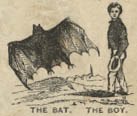
We were charmed by this advice from educator Marcius Willson’s The School and Family Primer, published in 1860 as an introductory text to his series of four readers for children. It sounds very much like the advice we give to our researchers on a daily basis. (Click on the image to view a larger version.)

(We’re also agog at the two pictures chosen to illustrate the letter “B.” Confronted by such a gigantic bat, the boy’s nonchalance is decidedly impressive.)

“‘As Far as Possible from Forgetfulness’: The Trinity College Historical Society”

Date: 3 August-10 October 2010
Location and Time: Perkins Library Gallery during library hours
Contact Information: Meg Brown, meg.brown(at)duke.edu

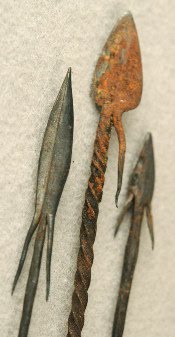
Arrows, Possibly from the Fiji Islands. From the Trinity College Historical Society Collection. Photo by Mark Zupan

The Duke University Archives is home to scores of manuscripts, records, and publications documenting Duke University’s history—and a set of fierce arrows possibly from the Fiji Islands; a pair of wooden shoe soles bought by a former slave in 1865; and two cloth-covered buttons from the clothing of Louis XVI.

These and other artifacts—along with manuscripts and historically-significant publications—once belonged to the collection of the Trinity College Historical Society, a student organization established in 1892 to encourage original research in Southern history. Their collection, the precursor to the RBMSCL and the University Archives, forms the subject of our new exhibit, “‘As Far as Possible from Forgetfulness’: The Trinity College Historical Society.”

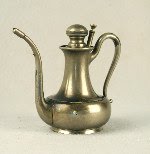
Pewter Wig Sprayer. From the Trinity College Historical Society Collection. Photo by Mark Zupan.

Assuming the leadership of the Society in 1894, professor of history John Spencer Bassett renewed the Society’s charge to collect manuscripts, books, pamphlets, and objects of enduring historical value, including those artifacts mentioned above. He addressed his undergraduate collectors and historians in 1897, telling them that they would “be doing work for eternity . . . [and] centering the eyes of the centuries on this institution.” This exhibit is proof of their legacy.

For more information about the Trinity College Historical Society and its collections, or if you won’t be able to visit the exhibit in person, visit the exhibit website. Photos of the exhibit’s installation are available on the RBMSCL’s Flickr photostream.

And remember to mark your calendars for a gallery talk with the exhibit’s curators on Tuesday, September 28 at 3:30 PM in the Rare Book Room!

In the Lab: Boxing the Blue Devil

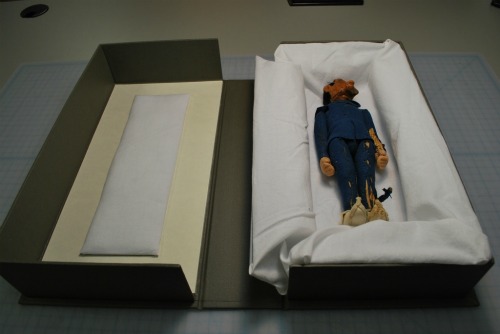
I love the sort of projects that start with a co-worker saying, “We have something special we want you to box,” because I always know it’ll be anything but a regular book. When I saw this little Blue Devil Doll, I knew a fun project lay ahead.

This doll was donated to the Duke University Archives this spring. It was purchased on campus in 1938 and is made of straw with a wax (I think) head and dressed in a smart blue felt outfit. The devil’s tail has floral wire wrapped around it to provide stiffness. The doll itself is in fair condition but, as you can see below, it has sustained some damage to the felt, most likely from insect activity.

Because of its condition, I wanted to make a sturdy box that had a cushioned interior to protect the fragile doll. The end result would be a drop-spine box, also called a cloth-covered clamshell. Before constructing the outer box, I would have to make an inner box with a cushioned interior.

The inner box is constructed of buffered corrugated board, lined with polyester quilt batting with a cotton fabric liner. The fun part was making the side bolsters to keep the doll from rolling around. These are made from rolled up polyester batting and then encased in a polyethylene pocket using our CoLibri book cover machine to make tubes. These provide enough structure to hold their shape but are still soft should the doll shift. Who knew that all my sewing experience would come in handy this way?

Blue Devil Doll in His Box

Once done with the inner tray, I constructed a clamshell box around it. The final enclosure is sturdy and keeps the doll firmly in place. The creative use of the CoLibri pockets worked really well. I’ll remember that should another devil cross my path.

For more photos of the Blue Devil Doll in his new home, visit the Conservation Lab’s “Boxing the Devil” set on Flickr!

Post contributed by Beth Doyle, Collections Conservator, as part of our ongoing “In the Conservation Lab” series.

O Pioneers!

Seth reads the Book of Mormon. Photo by Beth Doyle.

For many members of the Church of Jesus Christ of Latter-Day Saints, the experience of holding and reading a first edition copy of the Book of Mormon—including one of the two held at the RBMSCL—elicits reverence and profound emotion.

According to the church, the Book of Mormon is the record of ancient Americans and their relationship to God, and includes a visit from Christ after his resurrection. Joseph Smith, under God’s direction, received and translated the work before its 1830 publication in Palmyra, New York, and reestablished the priesthood and Christ’s church.

While the information contained within the Book of Mormon can be found in any of the over one hundred million copies (in 108 different languages), a copy of the first edition represents a physical connection to a prophet, the church’s origins, and God. Indeed, it is among the most requested of our holdings.

From the start, the church suffered intense persecution, moving several times from New York to Kirtland, Ohio to Missouri to Nauvoo, Illinois. This persecution eventually resulted in the death of Joseph Smith and the start of a great western migration lead by religious leader Brigham Young (in time, Young would be sustained as a prophet and Joseph Smith’s successor as the president of the church).

Beginning in April of 1847, Young lead approximately 70,000 pioneers on a western migration from Illinois. On July 24th of that year, weary pioneers arrived in the Great Salt Lake Valley, their new home and the future capital city of Utah. This day is celebrated annually by the Latter-Day Saints as Pioneer Day.

Brigham Young prayed that God would grant the pioneers 10 years of peace, which they received almost to the day. In 1857, based on fictitious reports of a “Utah Rebellion,” President James Buchanan appointed Alfred Cumming to replace Young as governor of Utah Territory and sent 2,500 soldiers to quell the supposed uprising. Upon arrival, Cummings discovered a people fearful of attack but respectful of his new position as governor. This experience is documented in the correspondence between Young and Cumming found in the RBMSCL’s Alfred Cumming Papers. These letters, like the first edition copies of the Book of Mormon, represent a relationship to a prophet and a history and are available for you to come see.

Post contributed by Seth Shaw, Electronic Records Archivist. Thanks to Kelly Wooten, Research Services and Collection Development Librarian, for suggesting this post and to Beth Doyle, Collections Conservator, for the photograph.