Category Archives: Events

The Henkel Physicians Exhibit at the Medical Center Library & Archives

Dates: July 15, 2013-August 24, 2013 (NLM exhibit); July 15, 2013-October 31, 2013 (MCLA/Rubenstein exhibit)
Location: Medical Center Library & Archives (see below for details)
Online Exhibit Companion: http://www.nlm.nih.gov/hmd/digicolls/henkel/
Contact Information: Jolie Braun, jolie.braun[at]duke.edu; Beverly Murphy, beverly.murphy[at]duke.edu
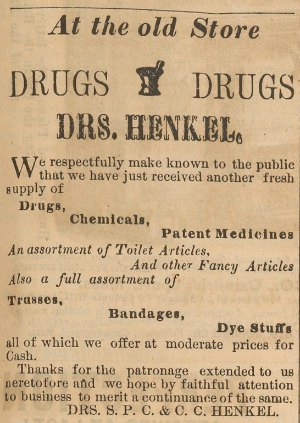
Advertisement for products sold by the Henkel physicians, from the Shenandoah Valley newspaper, 7 September 1877.

The Medical Center Library & Archives is excited to announce its new exhibit, “The Henkel Physicians: A Family’s Life in Letters.” Produced by the National Library of Medicine (NLM), the exhibit traces the daily lives of a family of physicians in the Shenandoah Valley during the nineteenth century, serving in their community, on the battleground, and in the nation’s courts of law. 

The Medical Center Library also collaborated with the Rubenstein Library on an exhibit to complement the NLM display. “From the Rubenstein Collections: The Henkel Family Physicians” features rare books and manuscripts along with materials from the History of Medicine Collections.  It includes letters written by the Henkels, books and broadsides published by the Henkel Press, and nineteenth-century medical instruments and artifacts.

The NLM Exhibit will be on display through August 24th on Level 3 of the Medical Center Library & Archives. The Medical Center Library and Rubenstein collaboration will available through October on Level 1. To learn more about the Henkel family and nineteenth-century medicine, visit the NLM’s digital companion to the display.

Vacancy: The Disquieting Beauty of Emptiness – A Conversation with Photographer Lynn Saville

Date: Thursday, May 23, 2013
Time: 1:00 PM
Location: Perkins Library, Room 217 (Click for Map)
Contact Information: Kirston Johnson, 919-681-7963, kirston.johnson@duke.edu

Please join us for a conversation with internationally renowned photographer Lynn Saville on Thursday, May 23rd from 1:00 until 2:00pm in Perkins Library Room 217. Lynn will discuss her latest project, “Vacancy: The Disquieting Beauty of Emptiness,” which focuses on New York City and the strikingly beautiful visual effects of economic turmoil.

Fine-art and documentary photographer Lynn Saville was educated at Duke University and Pratt Institute. Saville specializes in photographing both cities and rural settings at twilight and dawn, or as she describes it, “the boundary times between night and day.”

Lynn Savile, Dyckman Street, C-Print, 2011
Lynn Savile, Dyckman Street, C-Print, 2012

Lynn Saville has received numerous awards and grants and her photographs are published in two monographs: Acquainted With the Night (Rizzoli, 1997) and Night/Shift (Random House/Moncelli, 2009). Her work is represented by the Yancey Richardson Gallery in New York and her prints are included in numerous permanent collections, including the Los Angeles County Museum of Art, the George Eastman House, the Museum of Fine Arts in Houston, the International Museum of Photography, the Archive of Documentary Arts at Duke University, and many others. She lives in New York City with her husband, the poet Philip Fried.

This event is free and open to the public.

A Conversation with Photographer Edward Ranney

Moray, 1975. Toned gelatin silver print by Edward Ranney.

Date: Tuesday, May 7
Time: 1:00 p.m.
Location: Perkins Library, Room 217 (Click for map)
Contact information: Kirston Johnson, 919-681-7963, kirston.johnson@duke.edu

Edward Ranney is an internationally recognized photographer who has photographed the natural and man-altered landscape for over forty years. His work of the 1970s in the southern Andes of Peru resulted in the book Monuments of the Incas (1982), which was reprinted in an expanded edition in 2010.

Since 1985, Ranney has dedicated himself to a comprehensive photographic survey of pre-Columbian sites along the Andean Desert Coast. His recent work with Lucy R. Lippard in the Galisteo Basin, near Sante Fe, was published in Down Country in 2010.

Edward Ranney has received numerous awards, including two Fulbright fellowships for his work in Peru, a John Simon Guggenheim Memorial Fellowship, and a National Endowment for the Arts Photography Fellowship. His work has been presented in individual exhibitions at the Princeton University Art Museum, the Museum of Modern Art in New York, the Art Institute of Chicago, the University of New Mexico Art Museum, and the Centro Cultural of Miraflores in Lima, Peru. His other books include Stonework of the MayaPrairie Passage, and Pablo Neruda’s Heights of Macchu Picchu.

This event is free and open to the public.

Robin Morgan & Marie Anderson: The Women’s Pages & The Women’s Liberation Movement

Date: Thursday, April 18, 2013
Time: 3:00 p.m.
Location: Perkins Library, Room 318 (Rubenstein Library Classroom)
Contact Information: Kelly Wooten, kelly.wooten(at)duke.edu

robin morgan
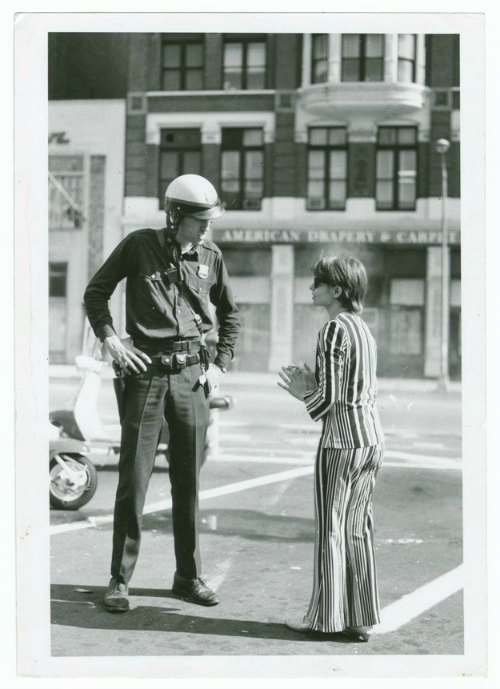
Police officer and Robin Morgan, Miss America protest, Atlantic City, 1968

Please join the staff of Sallie Bingham Center of Women’s History and Culture for a talk by Kimberly Wilmot Voss addressing the intersection of the women’s pages of newspapers and women’s liberation leaders in the 1960s and 70s, and the differences in coverage by those women journalists compared to the mainstream press.

Voss is an Assistant Professor and Area Coordinator of Journalism, University of Central Florida, and is a 2012 recipient of a Mary Lily Research Grant from the Sallie Bingham Center.

Light refreshments will be provided.

Mandy Carter, Peace Walker

Since starting my internship with the Sallie Bingham Center last August, I’ve spent time each week processing the papers of Mandy Carter, a self-described “southern out black lesbian social justice activist.”

This year Carter celebrates 45 years of social, racial, and lesbigaytrans justice organizing, and it’s almost impossible to summarize all that she has done—beginning with peace activism in the late 1960s and continuing today in her role as National Coordinator for the Bayard Rustin Commemoration Project of the National Black Justice Coalition. So instead, here’s one small peek.

Though based in Durham for much of her career, Carter has traveled up, down, and around the country in support of her activism–and in the summer of 1983, she walked from Durham, North Carolina to Seneca, New York as part of the Women’s Peace Walk.

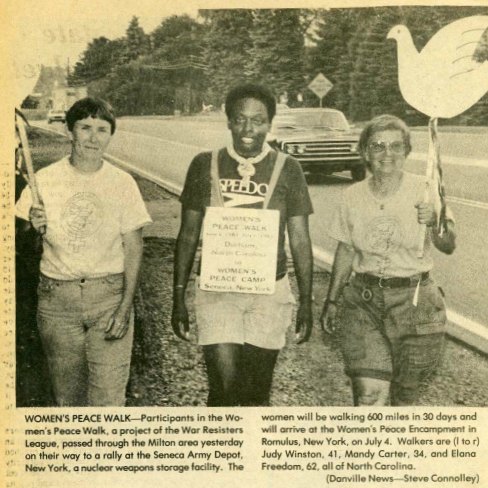
From left to right: Judy Winston, Mandy Carter, Elana Freedom. The trio completed the entire 600+ mile walk. Along the way, other women joined for a day, weekend, week, or longer. Newspaper clipping, 1983, Mandy Carter Papers
From left to right: Judy Winston, Mandy Carter, Elana Freedom. The trio completed the entire 600+ mile walk. Along the way, other women joined for a day, weekend, week, or longer. Newspaper clipping, 1983, from the Mandy Carter Papers.

Organized by the Southeast Regional Office of the War Resisters League—where Carter worked at the time—the Women’s Peace Walk aimed to draw attention to and protest the build-up of nuclear arms and specifically, the planned deployment of Cruise and Pershing II missiles to Europe later that year.

Women’s Peace Walk brochure, 1983.  From the Mandy Carter Papers.
Women’s Peace Walk brochure, 1983. From the Mandy Carter Papers.

Organizers timed the end of the walk to coincide with the beginning of the Women’s Encampment for a Future of Peace and Justice, and the destination itself held particular significance. The area was not only home to the Seneca Army Depot, a nuclear bomb and missile storage site, it was also where women of the Iroquois Nation met in 1590 to demand an end to war among the tribes and where more than 300 men and women came together in 1848 for the nation’s first women’s rights convention.

If you’re interested in learning more about Mandy Carter, her lifelong activism, and social change in Durham over the past 30 years, head down to the Durham County Library at 5:30pm on Wednesday for a panel discussion featuring Carter, Caitlin Breedlove (Co-Director, Southerners On New Ground) and Steve Schewel (Founder, Independent Weekly). Event details are available here.

Post contributed by Stephanie Barnwell, Bingham Center Intern.

Race, Gender and Identity in Artists’ Books

Date: Monday, March 25, 2013
Time: 6:30 p.m.
Location: Perkins Library, Room 318 (Rubenstein Library Classroom)
Contact Information: Kelly Wooten, kelly.wooten(at)duke.edu

The book form can become a vehicle for personal histories and obsessions. Please join us for a discussion of how Clarissa Sligh and Nava Atlas have explored their own experiences of race, gender, and identity through book arts. Both artists have placed their papers at the Sallie Bingham Center, which also has a collection of over 300 artists’ books by women.

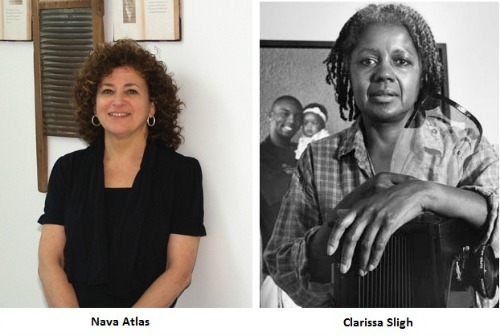
Photos of Nava Atlas and Clarissa Sligh

Clarissa Sligh  is a visual artist, writer, and lecturer. When she was 15 years old she became the lead plaintiff in the 1955 school desegregation case in Virginia. After working in math and science with NASA and later in business, she began a career as an artist, using photographs, drawings, text, and personal stories to explore themes of transformation and social justice.

Nava Atlas is known both as a vegetarian cookbook author and as a fine artist. Her artists’ books engage images, text, and structure to explore themes of social justice and women’s roles. Many of her works re-appropriate found materials and challenge the language and images used to reinforce gender roles and stereotypes.

Read more about Atlas and Sligh in the Spring 2012 issue of Women at the Center.


Post contributed by Kelly Wooten, Research Services and Collection Development Librarian, Sallie Bingham Center

The Power of This Story: Race, Class, Gender, and Sexuality in Durham 1960-1990

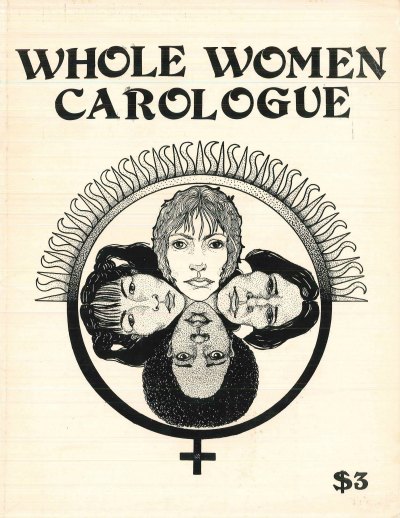
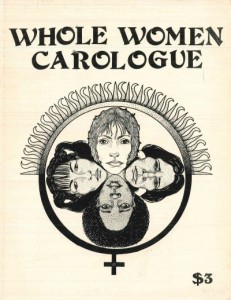
Whole Women Carologue


The Sallie Bingham Center has partnered with the Women’s Studies Senior Seminar to present a series of public conversations exploring how social change happened here in Durham. Each panel features individuals and representatives of organizations whose papers are held by the Bingham Center.  Please note the different locations for each panel.


Panel 1:

Joanne Abel, YWCA’s Women Center, Triangle Area Lesbian Feminists, and War Resisters League
Barb Smalley, Ladyslipper Music
David Jolly, NC Lesbian and Gay Health Project

Date: Wednesday, February 27, 2013
Time: 5:30-6:30 p.m. (Reception to follow)
Where: East Duke Parlors, East Campus, Duke University


Panel 2:

Jeanette Stokes, Resource Center for Women and Ministry in the South
Kat Turner, Lesbian Health Resource Center and NC Lesbian and Gay Health Project
Donna Giles, Triangle Area Lesbian Feminists and Feminary

Date: Wednesday, March 20, 2013
Time: 5:30-6:30 p.m. (Reception to follow)
Where: Perkins Library, Room 217, West Campus, Duke University


Panel 3:

Mandy Carter, Southerners On New Ground (SONG) and War Resisters League
Caitlin Breedlove, Southerners on New Ground (SONG)
Steve Schewel, Founder, Independent Weekly

Date: Wednesday, April 3, 2013
Time:  5:30-6:30 p.m. (Reception to follow)
Where: Durham County Library, 300 N. Roxboro Street, Durham, NC


Sponsored by Sallie Bingham Center for Women’s History and Culture, Rubenstein Library; Durham County Library; Duke Program in Women’s Studies; Vice Provost of Academic Affairs; the Pauli Murray Project; and in conjunction with Women’s Studies Senior Seminar.

New Exhibit Focuses on Duke University Integration

Dates: December 5, 2012-March 3, 2013
Location: Rare Book Room cases (directly outside the Biddle Rare Book Room, Perkins Library)
Online Exhibit: http://exhibits.library.duke.edu/exhibits/show/desegregation
Contact Information: Valerie Gillispie, valerie.gillispie(at)duke.edu

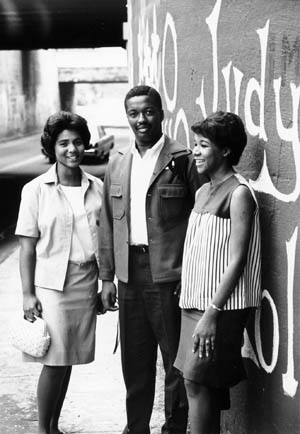
Wilhelmina Reuben-Cooke, Nathaniel White, Jr., and Mary Mitchell Harris, the first African-American undergraduates to receive degrees from Duke University.
Wilhelmina Reuben-Cooke, Nathaniel White, Jr., and Mary Mitchell Harris, the first African-American undergraduates to receive degrees from Duke University. From the University Archives Photograph Collection.

Fifty years ago, Duke University first admitted African-American students into its undergraduate classes. Drawing upon the collections of the Duke University Archives, “The Road to Desegregation at Duke” uses historic photographs, correspondence, flyers, newspapers, and more to tell the story of how Duke became a more diverse university.

The exhibit examines the contributions of African Americans at Duke prior to integration, the process of desegregation at the University, and the ways in which black students have shaped Duke since 1963.

Part of a larger, campus-wide commemoration of this milestone anniversary, “The Road to Desegregation” is a thought-provoking look at why Duke changed, and what it meant to become a truly integrated university.

If you’re not able to visit the Duke University Libraries to see the exhibit, please have a look at the online exhibit!

Post contributed by exhibit curators Valerie Gillispie, University Archivist, and Maureen McCormick, Isobel Craven Drill Intern.

Study Like It’s 1799

Date: Monday, December 10th, 2012
Time: 1:00 PM to 12:00 AM
Location: Rare Book Room suite
Contact Information: Amy McDonald, amy.mcdonald(at)duke.edu

Need we remind you, dear busy students, that next Monday is the final Reading Day before exams begin? The Rubenstein Library is convening a very special study hall to help relieve at least the stress of finding a library studying space (you’re on your own for your chemistry final).

We’ll be opening the Biddle Rare Book Room’s double doors promptly at 1:00 PM and leaving them open until midnight. You’ll be able to read over your notes on our comfy couches, review your flashcards next to the Audubons, and finish up your final paper under the History of Medicine Collection’s ever-watchful glass eyeballs. The rooms were designed to look like the library of an 18th century English manor house, so yeah . . . study like it’s 1799. With wi-fi!

And it’s your chance to say “so long” to the Rare Book Room suite before it closes for renovation on December 17th. (Wondering what renovations will take place in the Rare Book Room suite? Check out our Rubenstein Renovation FAQ!) Rubenstein Library staff will also be around to answer questions about the renovation and what research at the Rubenstein Library will look like over the next few years.

Space will be available on a first-come, first-served basis, and no food or drink will be permitted (there ARE still rare books in the room’s bookcases, after all).

There might even be a pop quiz . . . .

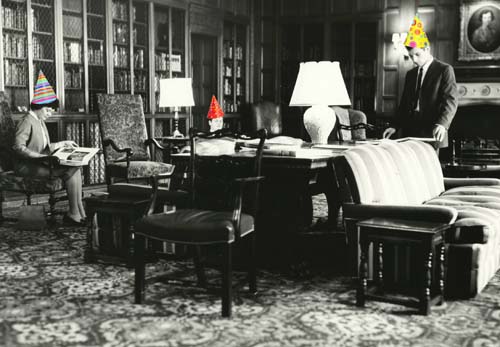
Biddle Rare Book Room, ca. 1950s. Party hats not included.

The Extravagant Shadows Screening

Date: Friday, November 30th, 2012
Time: 3:00 PM
Location: Biddle Rare Book Room, Perkins Library, Duke University
Contact Information: Kirston Johnson, kirston.johnson(at)duke.edu

Please join us this Friday at 3:00pm for a screening of The Extravagant Shadows, David Gatten’s new work of digital cinema. Gatten is an award-winning filmmaker and Guggenheim fellow, and is currently a Lecturing Fellow and Artist in Residence with Duke University’s Program in Arts of the Moving Image.  Earlier this year he was named one of the fifty best filmmakers under fifty by Cinema Scope magazine.

Still from The Extravagant Shadows

Fourteen years in the making, The Extravagant Shadows is a film concerned with libraries, reading, letters, and lovers.   It premiered at the 50th annual New York Film Festival and has received widespread acclaim.

Still from The Extravagant Shadows

“David Gatten’s first digital work, The Extravagant Shadows, undertakes the head-scratching question of what it would mean for a film to be of its textual sources. A historical narrative of love separated across space and time is embedded in various codes and correspondences, all of it pocked by ellipsis and obscurity, never unfolding so much as digressing, disclosing, doubling back.”  – Max Goldberg, Fandor 

“Gatten […] lays long excerpts, condensations, and re-writings of text upon the image itself, so that looking at the image is as much about seeing as it is reading—if these two activities can even be separated. The text tells a looping, broken and elliptical tale of love across distances, love missed and time passed, of communicating via letter, manuscript, telegraph, […] notes, novelization, monologues and memories across and within these spaces. Of the lost meanings, allusive facts and fixtures, of the supreme ambiguity of purposes, of a sense of time, of narrative to be found between, around and inside text and its transmissions to the reader.” – Daniel Kasman, Love in the Painted Image,” MUBI

This event is sponsored by the Archive of Documentary Arts, David M. Rubenstein Rare Book & Manuscript Library, and the “Thinking Cinematics Working Group” with support from the Franklin Humanities Institute and the Program in the Arts of the Moving Image at Duke University.