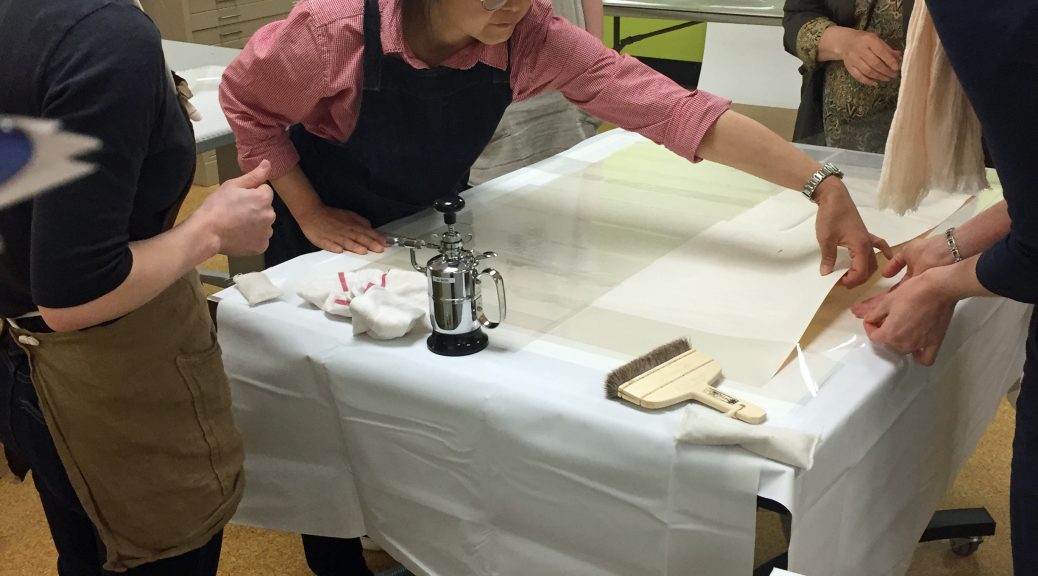
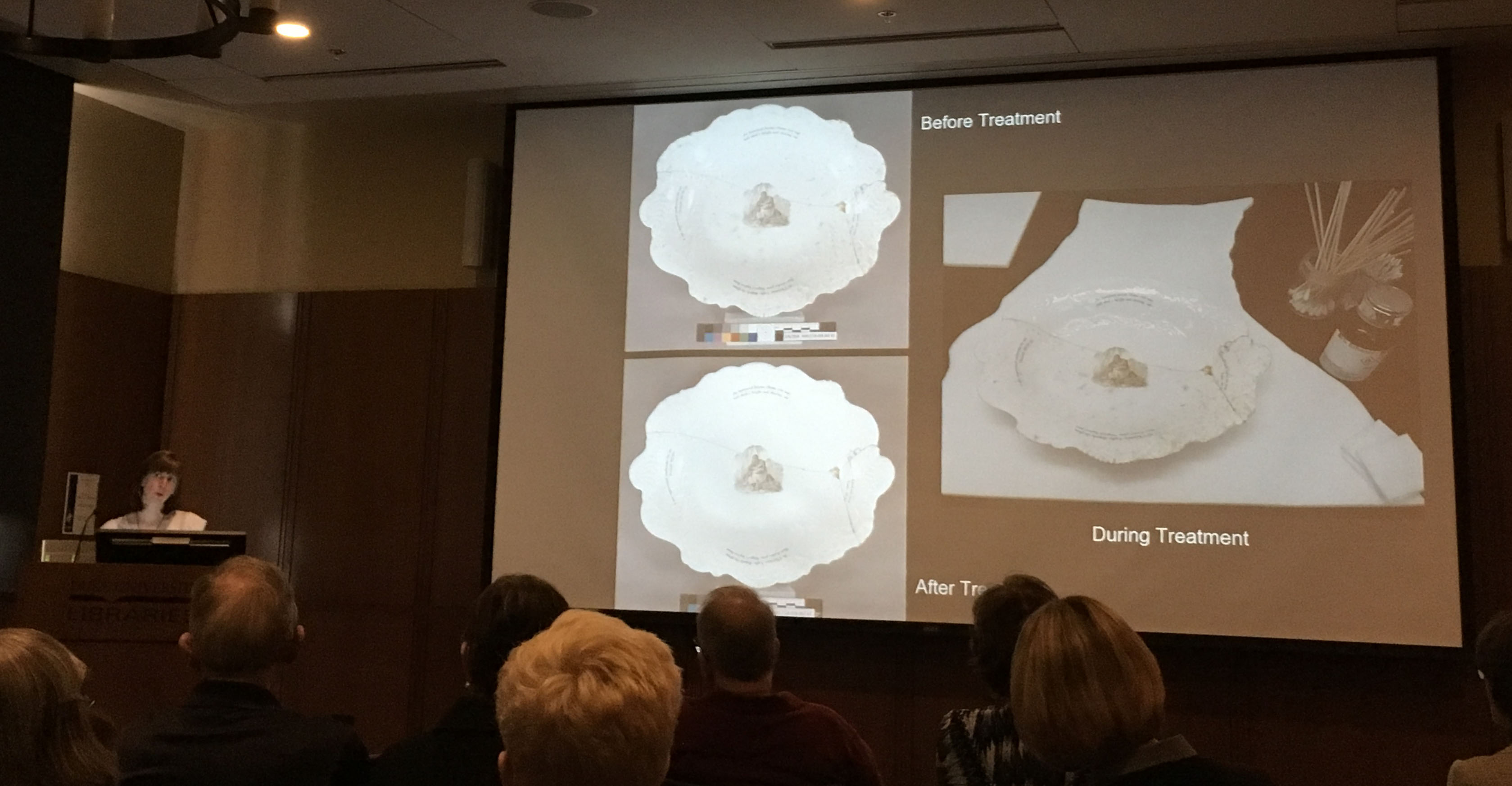
You remember we recently purchased a new suction table. Today we have the great honor of having Soyeon Choi, Head Conservator, Works of Art on Paper at the Yale Center for British Art here teaching us the tips and tricks to get the most from our new equipment.
Our colleagues Jan Paris and Rebecca Smyrl from UNC-Chapel Hill are here, as is Kesha Talbert form Etherington Conservation Center. We are all having fun and learning a lot from each other.
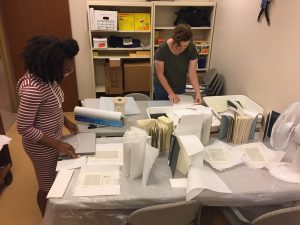
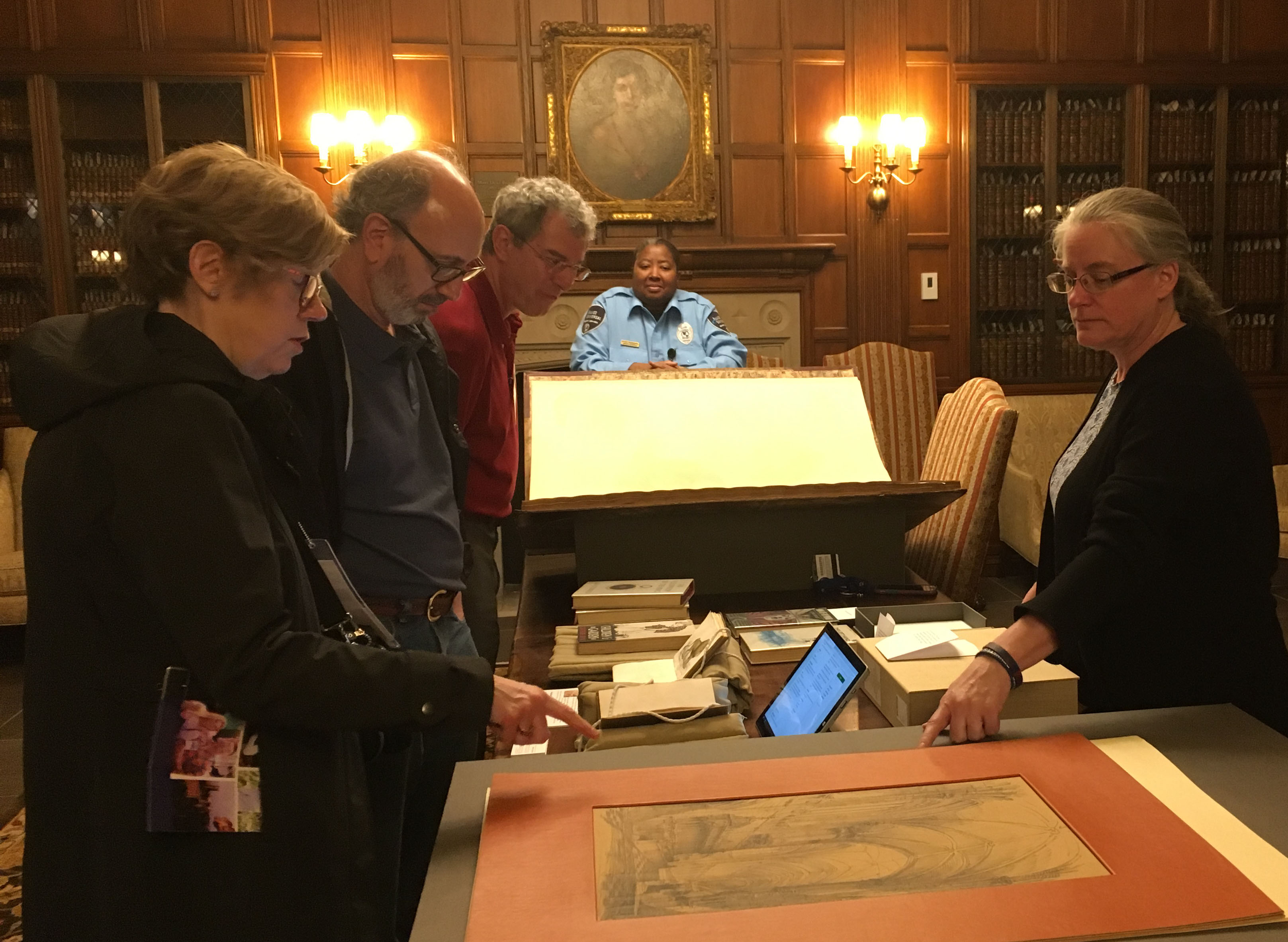
(L to R) Erin, Soyeon, Rachel, working out the kinks in vellum.(L to R) Soyeon, Mary, and Jan flattening architectural drawings.(L to R) Erin, Soyeon, Rachel, Mary, and Rebecca getting that paper flattened.
We have a bunch of discarded and found materials to work on. No actual collections are being tested today. This morning we are learning how to humidify and flatten vellum and paper. This afternoon we are talking about washing and stain reduction. It’s fun to have a day to learn new techniques and to share with our colleagues.
A few of us travelled to Connecticut this week to attend the Annual Meeting of the American Institute for Conservation (AIC). It has been a very busy couple of days, listening to talks, reading research posters, and looking at the latest in conservation equipment and materials. As always, there is so much quality programming and not enough time to see it all. I’m feeling a bit if FOMO (fear of missing out) and, by the end of the week, my brain is pretty full. I’m looking forward to our department’s recap of the conference to review my notes and further digest everything I’ve learned.
Last April we got our new freezer delivered. The first thing we did with it was to set up a table-top disaster situation* so our intern and new staff member could gain experience working with damp and wet books.
Sara (L) and Phebe (R) prepare items for the freezer.
Phebe (L) and Sara (R) recovering wet books.
That was back in July 2018. The books have been in the freezer since. This week I remembered them as I was working on this year’s internship schedule, so I went to get them out of the freezer. When I opened the door I saw this:
That is an official stalactite.
At some point a part broke, allowing the water drain to malfunction and create this frozen waterfall inside the freezer. The freezer was two weeks out of warranty (of course) but the awesome people at Fisher Scientific waived the repair fee, sent a repair person, and it is now fixed.
Lesson learned
If you don’t have a clear-glass door on your freezer, put a reminder on your calendar to look inside once in a while. We will now check inside the freezer once a month as part of our monthly staff meeting agenda.
*No actual library books were harmed during this experiment.
Happy May Day! Today is not just for dancing around the maypole and celebrating International Workers Day. May Day is also the traditional day to prepare for an emergency in your cultural institution. Are you ready?
Today we invite you to do one thing to prepare for an emergency. If you don’t know where to start, we have some ideas for you below and in previous posts. Put 15 minutes on your calendar and pick one thing to do today.
Check your disaster kit. Do you need to restock or replace anything? Do you have a pair of warm socks in there? Do your emergency clothes still fit? [trust me…you want to know this ahead of time]
Review your emergency phone tree. Are the correct people listed and the phone numbers still correct? If you don’t have a phone tree, make one today. List those critical people who need to be contacted first to get a recovery going. That might include the director, the communications director, the person who has the power to buy supplies on the spot, and a few people who can start the recovery process. It can be as simple as that. The Pocket Response Plan from the Council of State Archivists is a great customizable template and it fits in your pocket.
Review your disaster plan. What’s missing or needs updating? Are there people listed that don’t work there anymore? Have the phone numbers changed? You don’t have to make all of those changes today, but make an appointment on your calendar to do it…then DO it!
If you are not the one responsible for disaster planning or recovery in your institution, find out who is and ask for a copy of the disaster plan. And remember, if it is in electronic form, be sure to print out a copy and take it home. The internet doesn’t work when the power is out and cell phone towers are down.
And don’t forget you need a plan at home, too. The Red Cross has some good information on how to put a disaster kit together for your home and family and templates in English and Spanish to help you create a family disaster plan.
It feels good to get that done, doesn’t it? Now, off to the maypole.
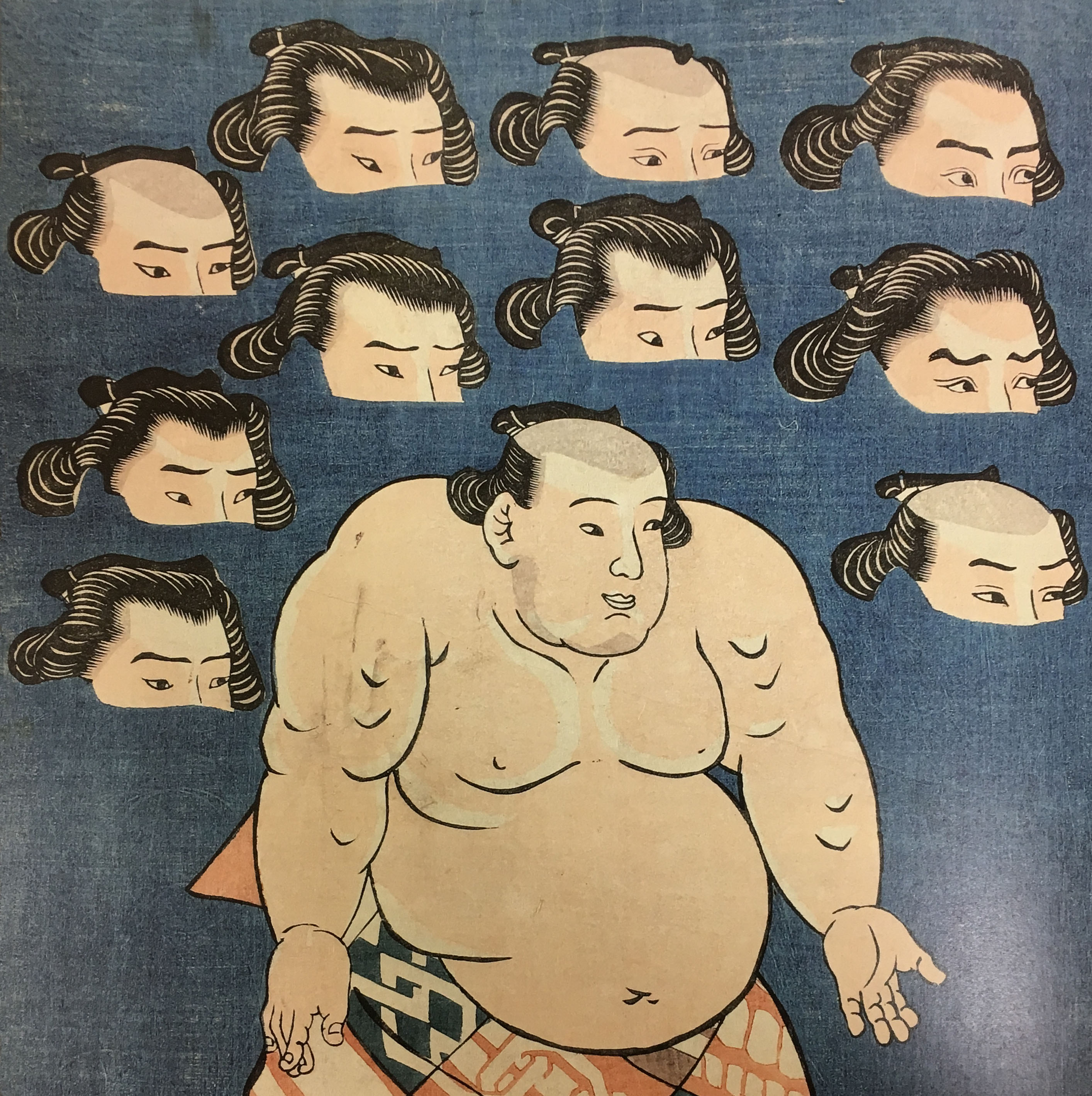
“Elegant Sumo Hairstyles” by Utagawa Kuniyoshi, Edo Period
When I see a very large book covered in silver metallic paper sitting on our shelves, of course I have to pull it down and take a look. This recently acquired catalog of prints from the Sumo Museum collection has some really wonderful images, but this one is definitely my favorite (more about the artist).
Last Friday was the start of a full weekend of activities for alumni as part of Duke Reunions and the library was a popular destination for those visiting campus. A few of us in Conservation Services were able to participate in some of the events and share our work.
In the morning, Rachel Penniman and I partnered with some of our colleagues in Research Services, Technical Services, the Digital Production Center, and Exhibitions to talk about all the behind-the-scenes work that went into preparing the items currently on display from the Lisa Unger Baskin collection.
Each speaker took a few minutes to describe their role in bringing the exhibition to life. Rachel and I discussed how we assessed and treated all of the items selected for imaging and exhibition, giving an overview of general principles of conservation treatment and some of our workflows.
Over the course of an hour, the audience was able to learn more about the complex work that goes into cataloging, preserving, and documenting the items that the library makes available for scholarship. The event was very well attended and we even had time at the end to speak with some of the alumni and answer questions.
In the afternoon, Beth Doyle and I brought some of the new items for adoption up to the Biddle exhibition suite to share with visitors of the exhibition.
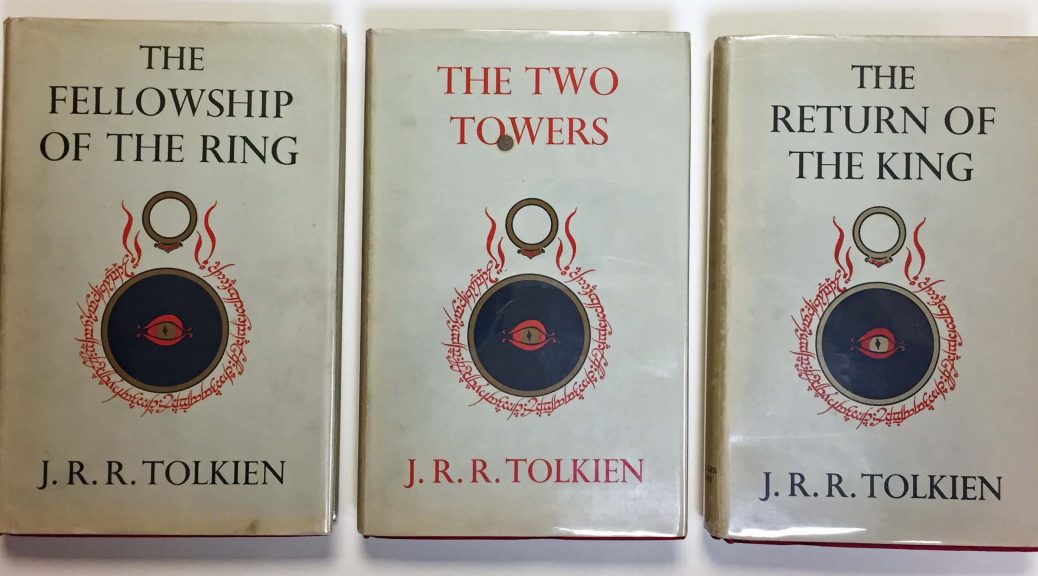
Many of the people who stopped by to talk with us had very personal connections with the items we had on the table. Several alumni commented that, even as students, they had regularly come to the library to see the “double elephant folio” copies of The Birds of America. The first editions of Tolkien were also a huge hit. We even had some items adopted on the spot!
It’s easy to get absorbed in the day-to-day challenges of supporting library projects and collections, but it is very rewarding to climb out of the basement once in a while to talk about our work with members of the campus community. I am reminded of how engaged both current and former students are with this university and their fondness for the library.
A group of wonderful titles centering on women and children…
An awesome grouping of Octavia Butler first editions…
And if you are in the mood for some really big birds, three of the Audubon elephant folios are still available for adoption. Who doesn’t fall in love with these books when you see them?
To adopt the conservation of any of these, go to our Adopt-a-Book page and simply click on the big blue button of your choice.
Why adopt?
You help Duke Libraries preserve their collections so that these titles are available to researchers and patrons for a long time. Best of all, because you receive an electronic bookplate acknowledging your gift, you don’t have to find space for a three foot book on your book shelf. Marie Kondo would approve.
We love getting new equipment. In fact, we celebrate Equipment Day on April 9th each year. This is the day that the book presses and board shear arrived from Germany in 2003, almost a year after Conservation became a unit.
Fast forward 16 years and we are still giddy about getting new equipment. A couple weeks ago we received our brand new suction table from Museum Services. It was the best of all the gift-receiving-holidays rolled into one. Big boxes, some assembly required, and a button to push to make it move. Awesomeness in three crates.
The crates arrive!
Included inside were the base, table, dome lid, vacuum unit, humidifier, and an airbrush. It also included really great assembly instructions.
One crate unpacked, two to go.
The table has a removable lid and an electric tilt function. These will come in handy if we have to move it inside the dirty room to do major solvent treatments. It also adjusts from a very low to a very high height, which means anyone can use it safely and comfortably.
Plug it in and take it for a tilt.
The table is assembled and ready for its first project. We plan on doing some refresher training later in the year. Until then we are resisting using the arm holes in the dome as an arena for epic thumb fights.
We have written here a few times about teaching bookbinding skills to local Girl Scouts so that they can get their Book Arts Badge (Post 1 and Post 2) . In addition to learning about preservation activities of cultural institutions, the workshop participants learn about the components of a book, and make three different book structures. Having done this workshop a couple of times, we thought it would be nice to change up some of the types of books that we make. Luckily, the recently acquired Lisa Unger Baskin Collection provided an object of inspiration: this movable book.
Also known as a metamorphosis or harlequinade, this item was made by Elizabeth Winspear, possibly a young woman of New England, in 1799. The book is composed of a single sheet, folded in an accordion style to form 4 panels. Each panel has a flap at top and bottom. The manuscript text and drawings tell a story using biblical figures and mythical beasts, ending with a kind of memento mori. The reader is instructed by the text to turn leaves up or down to see the transformation.
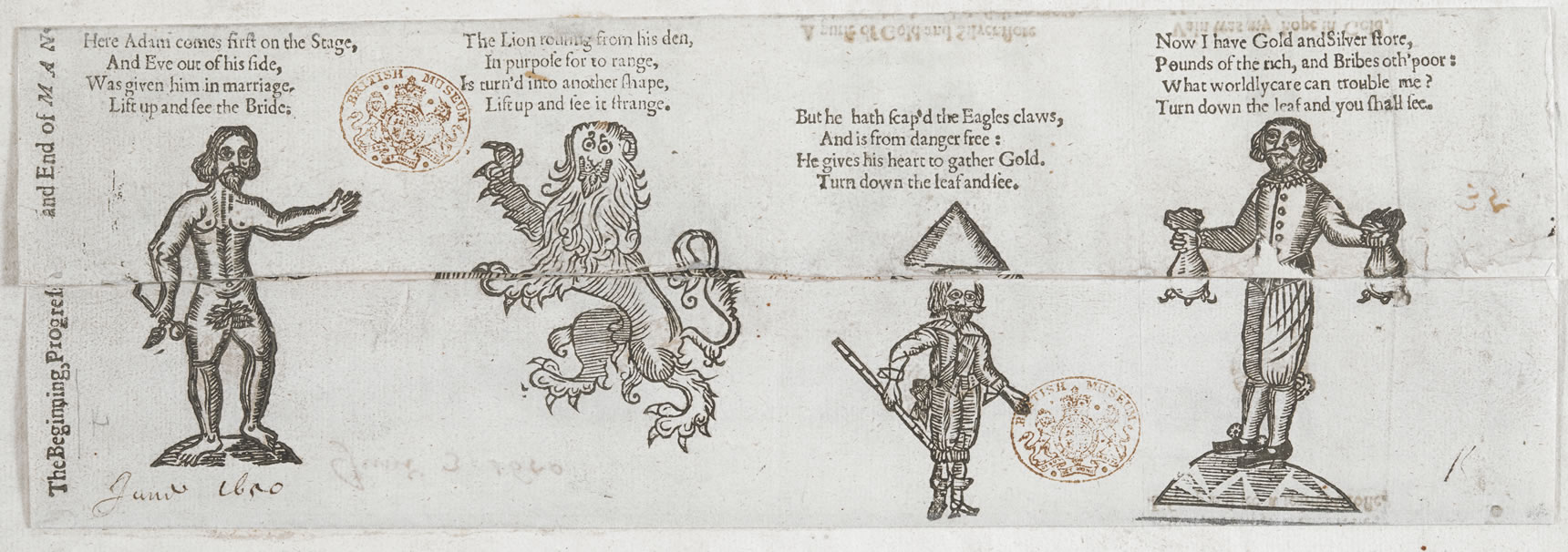
Although this item was made entirely by hand, the text and imagery are a very faithful representation of the genre. Examples of these movable books can be found from both Europe and North America, dating from the 17th to 19th centuries – and the story is remarkably consistent. See for example, this version printed in England in 1650.
The beginning, progress and end of man. (outside)(inside) London, Alsop for T. Dunster, 1650. The British Library
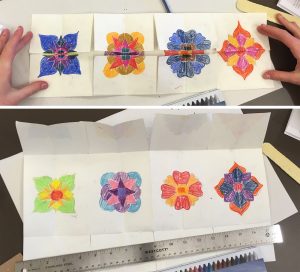
I’ve said before that the most popular part of our Book Arts Badge workshop is the last hour or so, in which the scouts have time to decorate their books. This type of movable book seemed like the perfect format to let the scouts unleash their creativity. After talking about Elizabeth Winspear’s book and showing them how to make the folds, we let them design their own metamorphoses. Here are some examples:
(Click each image to enlarge)
The scouts had a lot of fun with this structure and we really enjoyed seeing what they could do with it. It is amazing how an item produced by a young woman hundreds of years ago can inspire young women today to create book art of their own. Watching students interact with and respond to items from the library’s collection really brings the importance of preservation of cultural heritage into focus. We will definitely make more books like this in our future workshops.
If historical movable books are a topic of interest, you can see more examples of metamorphoses like this one at Learning as Play, hosted by Penn State University. Jacquiline Reid-Walsh has also written a book on the subject, titled Interactive Books: Playful Media Before Pop-Ups (2018). You may be interested in another genre of movable books, anatomical flap books, with many examples from Duke’s collection featured in this online exhibit. Highlights from the Baskin Collection are currently on display until June of this year in the Biddle exhibit suite, located just inside the main entrance of Perkins Library.
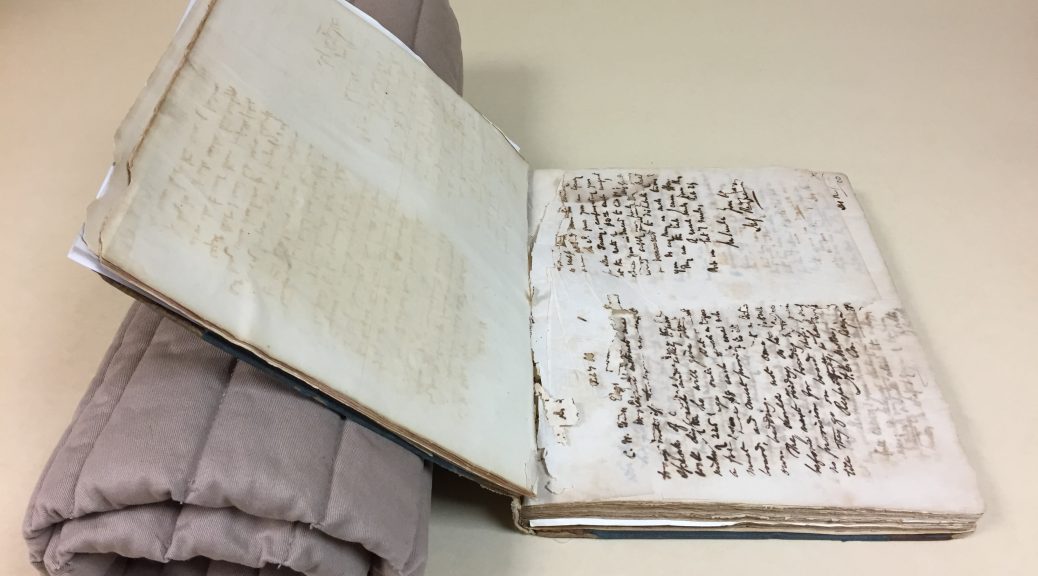
I first heard about book futons in graduate school at the University of Texas at Austin. It may be that the futon originated there. I am unsure of their provenance but I am fairly certain the conservators at the Harry Ransom Center made book supports of various kinds and likely futons were in the mix.
Making Futons
My first memory of finding instructions for making futons was in Book Displays: A Library Exhibits Handbook by Anne C. Tedeschi (Highsmith Press, 1997). Her depiction of how to make a futon was pretty good, but there were things about her futons that I wanted to change. So I embarked on a mission to make my own version. I even recruited my mother, an expert seamstress, to help. We have made a lot of futons over the years.
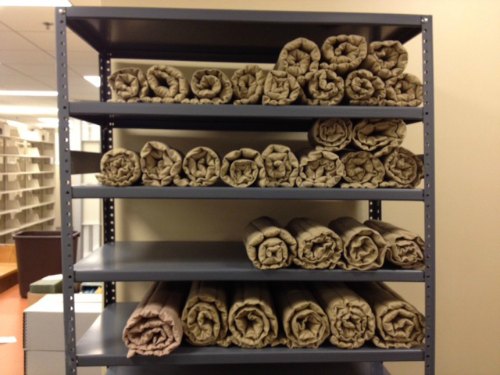
A fleet of futons ready for use in the Rubenstein Library.
Together we perfected our methods and ultimately wrote our own instructions for constructing three sizes of futons. You can access a PDF of our futon instructions here. This PDF includes sewing instructions, laundering information, and an illustrated guide on how to use them. The instructions should be easy to follow if you have a basic understanding of sewing or quilting. Feel free to email me if you have questions.
What’s So Great About A Futon?
What I like about the book futon is they are:
Fairly easy to construct, especially for those that have quilting or sewing experience
Inexpensive to make. Craft stores often have sales or issue coupons for 40-50% off fabric and batting.
Easy to use, and easy to teach patrons to use
Highly customizable
Machine washable
We use futons in the reading room, the conservation lab, the classroom, and even for temporary exhibits and show-and-tells. Do you know the history of the book futon? Have you made your own futons? Share your futon story in the comment section.