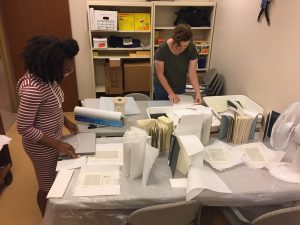
Last April we got our new freezer delivered. The first thing we did with it was to set up a table-top disaster situation* so our intern and new staff member could gain experience working with damp and wet books.
Sara (L) and Phebe (R) prepare items for the freezer.
Phebe (L) and Sara (R) recovering wet books.
That was back in July 2018. The books have been in the freezer since. This week I remembered them as I was working on this year’s internship schedule, so I went to get them out of the freezer. When I opened the door I saw this:
That is an official stalactite.
At some point a part broke, allowing the water drain to malfunction and create this frozen waterfall inside the freezer. The freezer was two weeks out of warranty (of course) but the awesome people at Fisher Scientific waived the repair fee, sent a repair person, and it is now fixed.
Lesson learned
If you don’t have a clear-glass door on your freezer, put a reminder on your calendar to look inside once in a while. We will now check inside the freezer once a month as part of our monthly staff meeting agenda.
*No actual library books were harmed during this experiment.
Happy May Day! Today is not just for dancing around the maypole and celebrating International Workers Day. May Day is also the traditional day to prepare for an emergency in your cultural institution. Are you ready?
Today we invite you to do one thing to prepare for an emergency. If you don’t know where to start, we have some ideas for you below and in previous posts. Put 15 minutes on your calendar and pick one thing to do today.
Check your disaster kit. Do you need to restock or replace anything? Do you have a pair of warm socks in there? Do your emergency clothes still fit? [trust me…you want to know this ahead of time]
Review your emergency phone tree. Are the correct people listed and the phone numbers still correct? If you don’t have a phone tree, make one today. List those critical people who need to be contacted first to get a recovery going. That might include the director, the communications director, the person who has the power to buy supplies on the spot, and a few people who can start the recovery process. It can be as simple as that. The Pocket Response Plan from the Council of State Archivists is a great customizable template and it fits in your pocket.
Review your disaster plan. What’s missing or needs updating? Are there people listed that don’t work there anymore? Have the phone numbers changed? You don’t have to make all of those changes today, but make an appointment on your calendar to do it…then DO it!
If you are not the one responsible for disaster planning or recovery in your institution, find out who is and ask for a copy of the disaster plan. And remember, if it is in electronic form, be sure to print out a copy and take it home. The internet doesn’t work when the power is out and cell phone towers are down.
And don’t forget you need a plan at home, too. The Red Cross has some good information on how to put a disaster kit together for your home and family and templates in English and Spanish to help you create a family disaster plan.
It feels good to get that done, doesn’t it? Now, off to the maypole.
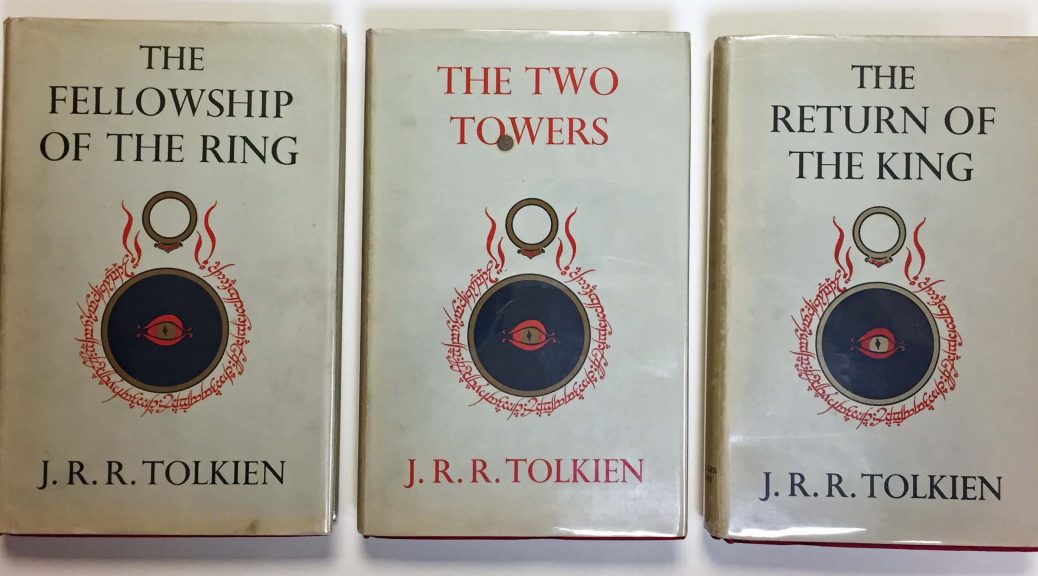
A group of wonderful titles centering on women and children…
An awesome grouping of Octavia Butler first editions…
And if you are in the mood for some really big birds, three of the Audubon elephant folios are still available for adoption. Who doesn’t fall in love with these books when you see them?
To adopt the conservation of any of these, go to our Adopt-a-Book page and simply click on the big blue button of your choice.
Why adopt?
You help Duke Libraries preserve their collections so that these titles are available to researchers and patrons for a long time. Best of all, because you receive an electronic bookplate acknowledging your gift, you don’t have to find space for a three foot book on your book shelf. Marie Kondo would approve.
We love getting new equipment. In fact, we celebrate Equipment Day on April 9th each year. This is the day that the book presses and board shear arrived from Germany in 2003, almost a year after Conservation became a unit.
Fast forward 16 years and we are still giddy about getting new equipment. A couple weeks ago we received our brand new suction table from Museum Services. It was the best of all the gift-receiving-holidays rolled into one. Big boxes, some assembly required, and a button to push to make it move. Awesomeness in three crates.
The crates arrive!
Included inside were the base, table, dome lid, vacuum unit, humidifier, and an airbrush. It also included really great assembly instructions.
One crate unpacked, two to go.
The table has a removable lid and an electric tilt function. These will come in handy if we have to move it inside the dirty room to do major solvent treatments. It also adjusts from a very low to a very high height, which means anyone can use it safely and comfortably.
Plug it in and take it for a tilt.
The table is assembled and ready for its first project. We plan on doing some refresher training later in the year. Until then we are resisting using the arm holes in the dome as an arena for epic thumb fights.
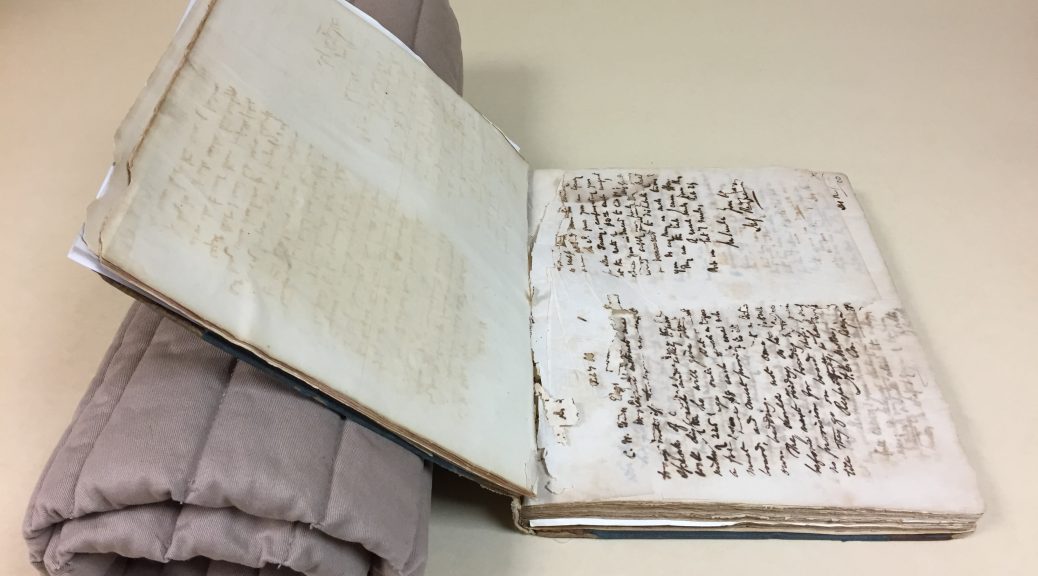
I first heard about book futons in graduate school at the University of Texas at Austin. It may be that the futon originated there. I am unsure of their provenance but I am fairly certain the conservators at the Harry Ransom Center made book supports of various kinds and likely futons were in the mix.
Making Futons
My first memory of finding instructions for making futons was in Book Displays: A Library Exhibits Handbook by Anne C. Tedeschi (Highsmith Press, 1997). Her depiction of how to make a futon was pretty good, but there were things about her futons that I wanted to change. So I embarked on a mission to make my own version. I even recruited my mother, an expert seamstress, to help. We have made a lot of futons over the years.
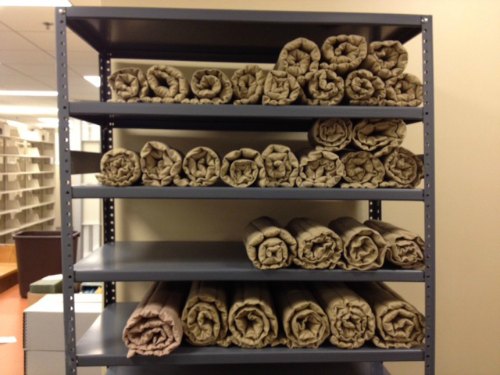
A fleet of futons ready for use in the Rubenstein Library.
Together we perfected our methods and ultimately wrote our own instructions for constructing three sizes of futons. You can access a PDF of our futon instructions here. This PDF includes sewing instructions, laundering information, and an illustrated guide on how to use them. The instructions should be easy to follow if you have a basic understanding of sewing or quilting. Feel free to email me if you have questions.
What’s So Great About A Futon?
What I like about the book futon is they are:
Fairly easy to construct, especially for those that have quilting or sewing experience
Inexpensive to make. Craft stores often have sales or issue coupons for 40-50% off fabric and batting.
Easy to use, and easy to teach patrons to use
Highly customizable
Machine washable
We use futons in the reading room, the conservation lab, the classroom, and even for temporary exhibits and show-and-tells. Do you know the history of the book futon? Have you made your own futons? Share your futon story in the comment section.
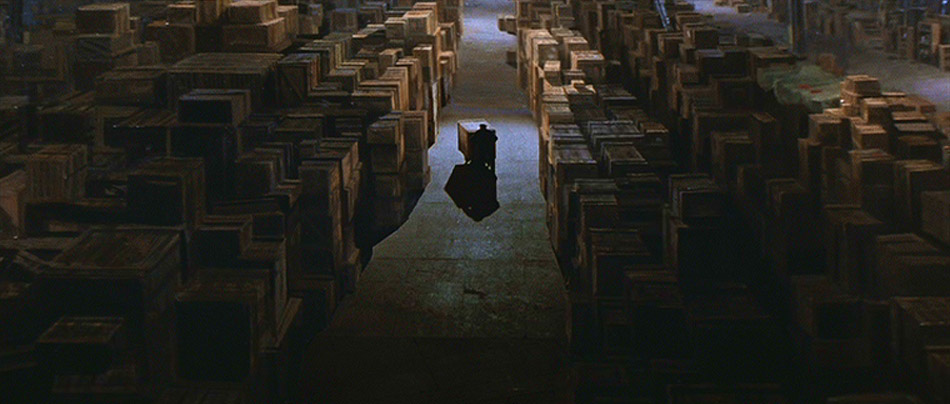
I wish I had a dollar for every time a writer used the word “bowels” to describe a library or archive. At best it conjures an image out of The Raiders of the Lost Ark. Boxes haphazardly put down anywhere on the floor just waiting for some researcher to miraculously stumble upon the one box they need to complete their research. At worst, well, I won’t finish that thought.
The New Yorker recently published a review by Sarah Blackwood (February 14, 2019) that once again trots out the familiar trope of materials disgorged from the “bowels” of the library, saved from certain obscurity or worse. The kerfuffle started with this description of the provenance of the collection:
They were rescued once, in the nineteen-seventies, only to be relegated to the back-yard greenhouse of Mangum’s nephew; they were rescued again, in the nineteen-eighties, when they were donated to Duke University. As recently as 2013, more boxes of negatives turned up, this time from the bowels of special collections and marked “discard.” The negatives have passed through the hands of family members, neighborhood activists, local photographers, librarians, archivists, and scholars.
Where to even begin unpacking this quote?
Deteriorated glass plates with dirt and paper stuck to them.
First, while we do not recommend storing family records in a chicken coop one could argue that “benign neglect” kept these important documents and images from the landfill. My guess is these plates were handed down through the family, perhaps put aside and forgotten. But for whatever reason the family did not throw them in the trash bin. As vaguely alluded to in the article eventually other people realized the importance of these plates and actively decided to find a permanent repository for them.
The original Hugh Mangum Collection came to Rubenstein Library in 1986 (now part of the Archive for Documentary Arts). Additional materials were discovered and added to the Mangum collection in two rounds. The latest came around 2013. I believe these were the ones found in the chicken coop/barn mentioned in the New Yorker article.
Paper stuck to glass plates.
These “chicken [expletive]” plates as Blackwood describes them came to Conservation sometime around 2016. The plates were very dirty, gritty, and many had paper stuck to them. We cleaned about 250 of these glass plates in house and sent several to the Northeast Document Conservation Center for more in-depth treatment. Henry Hebert, Special Collections Conservator, even consulted with and helped install a few of the Mangum plates at the Nasher. The Digital Production Centerdigitized this collection a few years ago including the 2013 addition. The people in Digital Collections and Curation Services worked on the metadata and building the website. The collection is available online and is worth looking at. The images are amazing.
People from collection development, technical services, research services, conservation, and the digital production center all played their part in making sure this collection was described, housed, and preserved so that Sartor and Harris could write about them and curate their exhibit. I won’t even start on how many Nasher staff worked on the exhibit.
Why words matter
Look, I get it. Authors need to write compelling narratives and simply finding materials already described and housed in a library isn’t very interesting to most people. Story trumps details, which can get lost or worse willfully ignored. But herein lies the problem with using “from the bowels of special collections.” There is a lot of hidden labor in libraries and archives. People more eloquent than I have writtenabout this issue. We talk a lot in Technical Services about how we can best tell our stories because what we do is often invisible to the public. Our day-to-day work isn’t sexy or glamorous. Most days are made up of very routine and frankly boring work (hello mold removal!). The work also takes its toll physically and often emotionally. Don’t even get me started on salaries in a female-dominated education-related profession. That is why it is hurtful when our work is ignored to make the story sound more miraculous than it is.
At least Sartor acknowledges (pp 157-158) many of the people that had a hand in making this collection, book, and exhibit a reality. She appropriately thanks Erin Hammeke, Senior Conservator, who spearheaded the conservation project. Except Sartor uses another sad trope, “magic,” to describe the conservation of these materials. As if the conservation of these plates weren’t done by a collective of highly skilled people but rather by the wave of a magic wand. Poof! Conservation Managed! Erin, Henry, Rachel Penniman, and Emma Kimmel, then our intern, spent many hours painstakingly cleaning and housing all those plates.
Mangum housed in the (not bowel-like) stacks.
The hero of this story is not the creators of this book and exhibit (although these are wonderful). The heroes should be the people behind the scenes working really hard every day to collect, describe, house, digitize, preserve, shelve, and retrieve collections so that when their user appears these collections can be pulled from the shelf and handed to them (hello Ranganathan!). The fact that you can walk into a library or archive, request something, and a few minutes later it shows up on your table feels like magic. I assure you it is not.
As I write these thoughts we are preparing for the grand opening of “Women’s Work,” our first exhibit of materials from the newly acquired Lisa Unger Baskin Collection. This collection focuses on women in publishing, art, medicine, literature, society, and so much more. It helps uncover work that is often unseen, unacknowledged, or simply ignored. I wish Blackwood would have taken some time to acknowledge the hard work so many have done to make sure that the Mangum collection didn’t fade into obscurity. At least Blackwood seems to be listening to the archivists on Twitter. Maybe she realizes now that repeating the phrase “it came from the bowels” is demoralizing to those of us who work behind the scenes to make our amazing collections usable now and in the future.
Interesting & useful pushback/further nuance about how I framed the genealogy of the Hugh Mangum negatives (also with link to the digitized archives of the images, which are well worth anyone's time to explore): https://t.co/md6jJ6qCXZ
Thanks to Kate Collins, Rubenstein Library Research Services Librarian, for speaking up about the Mangum Collection in response to Blackwood’s review, and for sending me a link to Blackwood’s response on Twitter.
Beth Doyle is the head of the Conservation Services Department and the Leona B. Carpenter Senior Conservator at Duke University Libraries. She can be reached via email at <b.doyle@duke.edu>.
Edward S. Curtis’ The North American Indian (1907-1930) was an ambitious project. Curtis set out to document North American indigenous peoples, capturing their lives through both photographs and narratives. This work is not without its critics in the modern era and Curtis himself is a complicated historic figure. That said, the plate volumes are filled with stunning images and are beautifully printed.
Our edition has 20 volumes of folio plates, each with an average of 36 individual plates. These are housed in portfolio-folders that are tied at the foredge. A very thin piece of tissue is in between each plate. These portfolios do not provide adequate protection from abrasion, dust, light, and heavy use. It is also very difficult to find an image within the stack of plates when a patron requests one.
Tedd is back and building boxes!
After discussion with the curators we decided we to build custom enclosures for the plate volumes . Each plate will be housed in a paper folder, and each volume would receive a custom cloth drop-spine box with a label clearly indicating the contents. This solution will provide the most protection for the plates, and will make finding a plate easy when it is needed for a class or for a patron.
The custom enclosures for “The North American Indian” plate volumes was generously supported by Jan Tore Hall (T’73) through the DUL Adopt-a-Book program. His donation was made in memory of Inger Tavernise, with thanks for the shared times in service to the University through its Library.
Mr. Hall’s donation allowed us to purchase custom folders for the prints, and bookcloth and binders board for the boxes. Rachel re-foldered and labeled each print to prepare them for boxing. We brought back Tedd Anderson to make the 20 oversized custom boxes. As readers may remember, Tedd worked in the lab for many years creating extreme enclosures for all kinds of books. We knew he could make these large boxes efficiently and beautifully. The first set is finished and labeled and ready for the shelf.
Here are some action shots of the boxes in production.
We call it “Brick Henge.”
Pressing edges using the “Duke Stool Support System (TM)” (aka the stool no one likes to sit on but is a great extension for the floor press).
That stool has found its true calling.
The new labels tell you what is in the box, a huge improvement over the old enclosures.
And here is the before and after reveal.
Original portfolios.
(top) Original portfolio and (bottom) new custom box.
“The 10 Year Challenge” is a current meme making its way across the interwebs. Whether it is a harmless bit of fun or some brilliantly concocted bit of AI facial recognition training is hard to say. But what the heck, we will play along with The Lab Edition.
About ten years ago we were nearing the end of the Perkins Project. We moved out of Perkins in January 2007 to Trent Hall, the former nurses dorm on the medical campus. Preservation occupied one hallway of the dorm. We shared the hallway with the Preservation Officer, the Bindery Unit, and the Digital Production Center. Conservation had two rooms for the lab, and one dorm room for the Collections Conservator’s office.
Trent Hall was an adventure. It allowed us to learn another side of campus and we logged a lot of steps in going back and forth to meetings in Perkins. We evicted one bird (just like in our old space), had a Chinese restaurant one floor down, and the lab had beautiful windows. The space was cramped, but we made it work.
Trent Hall lab (L) and the Verne and the renovated Tanya Roberts Conservation Lab (R).
In August 2008 we moved back to the renovated Perkins Library and into the Verne and Tanya Roberts Conservation Lab. The newly renovated space was large, bright, and chock full of ergonomic furniture and specialized conservation equipment. What a difference it was from Trent and our old original lab space. Ten years later it feels like we have been here forever, yet some days if feels like we just got here. We are so thankful for the Roberts family and their support of our lab. That support has enabled our program to grow in incredible ways. We look forward to what the next ten years will bring.
Several items came down for boxing this week. These two items are from the Lisa Unger Baskin Collection. The top is a metal “Votes for Women” sign in a delightful bluebird design. Below are two sides of a small sampler pin cushion that is stitched on the finest linen ground I’ve seen.
These objects represent two aspects of women’s work. The work of the hand, that was/is often taught as a useful life skill. And the work of women as full citizens of their country…the work of standing up for your rights and exercising your right to vote. The Baskin Collection is full of objects like these and it is a real thrill and honor to have them come to the lab for custom enclosures.
We have posted about hurricane awareness and disaster response before. With hurricane Florence on the southeast coast we wanted to round up information for those that may be affected by this storm.
For more information on state-wide emergency information:
Florence’s projected path as of Monday, September 10, 2018.
Help for Cultural Institutions
The National Heritage Responders (NHR) – formerly the American Institute for Conservation – Collections Emergency Response Team (AIC-CERT) – responds to the needs of cultural institutions during emergencies and disasters through coordinated efforts with first responders, state agencies, vendors and the public. Volunteers can provide advice and referrals by phone at 202.661.8068. Requests for onsite assistance will be forwarded by the volunteer to the NHR Coordinator and Emergency Programs Coordinator for response. Less urgent questions can also be answered by emailing info@conservation-us.org.
Cultural institutions in FEMA-designated disaster areas of Texas, Louisiana, Florida, and other impacted states and U.S. territories can apply immediately for NEH Chairman’s Emergency Grants of up to $30,000 to preserve documents, books, photographs, art works, historical objects, sculptures, and structures damaged by the hurricane and subsequent flooding. Applications for emergency grants are available here (Word Document).
Local and state organizations such as state archives, museums, university libraries, etc., will have experts on staff that can help answer collection emergency questions. Many states also have state-wide preservation groups with experts who can help (e.g. the North Carolina Preservation Consortium, LYRASIS, Texas Library Association). LRYASIS Performing Arts Readiness has experts to help performing arts organizations respond to disasters.
September is National Preparedness Month. Even if your institution was not affected by recent storms, now is a good time to review your current disaster plans and training. The Alliance for Response links cultural heritage and emergency response representatives. There may already be a local AFR network near you or you could consider forming one.
Recovery Guidelines for Collections and Personal Items
FEMA–The Heritage Emergency National Taskforce and the Smithsonian Institution have written documentation on saving personal treasures in multiple languages.
Other useful information
National Archives–If you were impacted by a hurricane and need priority service to obtain or replace proof of U.S. military service, you can contact the National Archives National Personnel Records Center. Information can be found on the NANPRC website.
FEMA–A good list of what entity you should contact if you need to replace important papers such as birth certificates, green cards, passports, etc., can be found on the FEMA website.