Filmmaker David Gatten threads 16mm prints of his films for a screening in the Rare Book Room this past Thursday.
These photos were taken by guest Michael Graziano, and we thank him for letting us share them here. (For more information about the event and the films shown, visit this earlier blog post.)
Date: 6 April-18 July 2011 Location and Time: Perkins Library Gallery during library hours Contact Information: Meg Brown, 919-681-2071 or meg.brown(at)duke.edu
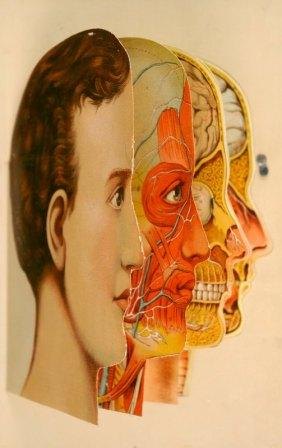
Physicians' Anatomical Aid, ca. 1880-1890
Animated Anatomies explores the visually stunning and technically complex genre of printed texts and illustrations known as anatomical flap books.
This exhibit traces the flap book genre beginning with early examples from the sixteenth century, to the colorful “golden age” of complex flaps of the nineteenth century, and finally to the common children’s pop-up anatomy books of today. The display—which includes materials from the RBMSCL, the Duke Medical Center Library & Archives’ History of Medicine Collections, and from the private collections of the curators of the exhibit—highlights the history of science, medical instruction, and the intricate art of bookmaking.
The exhibit is curated by Professor Valeria Finucci, Department of Romance Studies, and Maurizio Rippa-Bonati, Department of History of Medicine at the University of Padua, with the assistance of Meg Brown, Duke University Libraries exhibits coordinator, and Rachel Ingold, Curator of the History of Medicine Collections. Items will be exhibited in both the gallery of Perkins Library on Duke’s main campus as well as outside the History of Medicine Reading Room at Duke’s Medical Center Library.
In addition to the exhibit, an opening reception will be held Monday, 18 April, at 10 AM at the History of Medicine Collections, followed by a symposium of renowned scholars in history, medicine, and medical history in Perkins Library. The exhibit and the symposium, both free and open to the public, aim to address a diverse public including those interested in the medical field, history, cultural studies, visual studies, and material studies.
To learn more about the symposium, exhibit, see photos of anatomical flap books, and watch videos of them in action, visit the exhibit website.
Post contributed by Rachel Ingold, Curator of the History of Medicine Collections.
The Sallie Bingham Center for Women’s History and Culture is pleased to announce the recipients of this year’s Mary Lily Research Grants. These grants support the work of students, scholars, and independent researchers who will travel to Durham from all over the U.S. to make use of the Bingham Center’s rich collections. We would like to gratefully acknowledge our faculty reader, Kimberly Lamm, Assistant Professor of Women’s Studies, who offered her insights and expertise as the committee reviewed a competitive pool of 40 proposals.
This year’s grant program received additional support from the Program in Women’s Studies. Every year, the Program in Women’s Studies explores ideas and concepts from a variety of disciplines that touch on women, gender, and feminism. The theme for 2011-12 is “The Future of the Feminist 1970s.” Many of our grant recipients this year are focusing on related research questions, and we anticipate that they will help enrich the conversations on campus that will evolve in the classroom and beyond about how the multiple feminist paradigms of the 1970s continue to have an impact on feminist thought.
Marika Cifor, master’s student, History and Library and Information Science, Simmons College, for master’s thesis research that examines historical relationships of lesbians and prostitutes in the United States, 1869-1969.
Jessica Frazier, PhD candidate, History, Binghamton University, for dissertation research on Vietnamese militiawomen and the interconnections of empire, race and gender in the feminist movement, 1965-1980.
Choonib Lee, PhD candidate, History, State University of New York at Stony Brook, for dissertation research on militant women in the new left and civil rights movements in the late 1960s and early 1970s.
La Shonda Mims, PhD candidate, History, Georgia State University, for dissertation research on lesbian community and identity in the cities of Charlotte, NC and Atlanta, GA from WWII to the present.
Jennifer Nelson, Associate Professor, Women’s and Gender Studies, University of Redland, for a book on community health reform movements from the mid-1960s to the present.
Ally Nevarez, master’s student, Book Arts and Library and Information Science, University of Alabama, for an artist’s book that highlights the important role that women have in contributing to community and preserving culture.
Rose Norman, Professor Emeritus of English, University of Alabama at Huntsville, for research on lesbian feminist activism in the South, 1965-1985.
Robin Robinson, Associate Professor, History, University of Massachusetts at Dartmouth, for a book and article on transportation and transformation of female convicts as unfree labor in Colonial America.
Emily Thuma, PhD candidate, American Studies, New York University, for dissertation research on prisons and the politics of resisting gendered violence, 1968-1984.
Elizabeth York, Associate Professor, Music Therapy, Converse College, for research on Atlanta women’s music and culture, 1976-1986.
When I first began investigating the Robert Boyd Family Papers at Duke’s Rare Book, Manuscript, and Special Collections Library, I expected to find something that would appeal to genealogists of this family and those researching the history of Abbeville County, South Carolina. I didn’t know that I would discover a rich story about the triumphs of love and the tragedies of war. I would not have believed that two years later their story would be available to the world in The Boys of Diamond Hill: The Lives and Civil War Letters of the Boyd Family of Abbeville County, South Carolina. With the guidance of the staff at RBMSCL and my editors at McFarland Publishers, that is exactly what has happened.
The backbone of this work can be found in the 86 letters of the five Boyd brothers and the husband of their eldest sister lovingly preserved in the RBMSCL. With the additional research of this family and the units they served in, their full story slowly emerged. In April 1861, brothers Daniel and Pressley Boyd joined the Confederate army. Soon the war would sweep the other three Boyd brothers—William, Thomas and Andrew—as well as their brother-in-law Fenton Hall, away from their farm in Abbeville County, South Carolina. Researching this collection uncovered warmth, humor, horror and loss of four long years of war.
I understand from descendants of Fenton Hall that a number of letters from this family had been lost in a house fire. They were thrilled to learn that those destroyed did not constitute the entire body of the brothers’ letters. It is so wonderful that Duke has preserved these surviving letters so the fascinating lives of these young men would not be lost to history. The helpful staff and wonderful facilities made the marathon sessions with this collection a joy and their support through the preparation for the publication process was invaluable.
To learn more about the book, as well as Keith’s other research projects, visit his website!
P.S. We’re still collecting responses for our reader feedback poll. Please click the orange button at the right to tell us your thoughts about The Devil’s Tale. Thanks!
Date: Thursday, 31 March 2011 Time: 3:30 PM Location: Rare Book Room Contact Information: Karen Glynn, 919-660-5968 or karen.glynn(at)duke.edu
Graeme Williams, Cape Town, 2005.
Karen Glynn, the RBMSCL’s Visual Materials Archivist, will give an historical overview of the South African Documentary Photography collections in the Archive of Documentary Arts from 1986 until today. Paul Weinberg, photographer and Senior Curator of Visual Archives in the Manuscripts and Archives Library at the University of Cape Town, will pick up the thread and describe the process of building a documentary photography archive in South Africa today.
Twenty of Weinberg’s photos are available online at the website for Then and Now, an exhibit on South African documentary photography that he curated for the Archive of Documentary Arts in 2008.
Weinberg’s photographs are archived at the RBMSCL. You can view the finding aid for his collection here.
Date: Thursday, 7 April 2011 Time: 7:00 PM Location: Rare Book Room Contact Information: Kirston Johnson, 919-681-7963 or kirston.johnson(at)duke.edu
Still from “Film for Invisible Ink, case no. 323: ONCE UPON A TIME IN THE WEST”
Next Thursday, award-winning filmmaker and Guggenheim Fellow David Gatten returns to the RBMSCL to present three of his films. Gatten will introduce each film and discuss his use of historical documents, “out-dated” instructional texts and rare books as both inspiration and image in his filmmaking practice.
Over the last fifteen years, David Gatten’s films have explored the intersection of the printed word and the moving image, while investigating the shifting vocabularies of experience and representation within intimate spaces and historical documents. His films trace the contours of both private lives and public histories, combining elements of philosophy, biography and poetry with experiments in cinematic forms and narrative structures.
“Secret History of the Dividing Line” (2002) is one of the nine parts in Gatten’s ongoing investigation of the life and library of William Byrd. Torn fragments of Byrd’s official history of the 1728 dividing line expedition commingle with the privately circulated ‘secret history’ of the surveying party.
“The Matter Propounded, of its possibility or impossibility, treated in four Parts” (2011) makes use of an early 19th century system for telling one’s future. Divided into four sections—Instructions, Questions, Answers and Conclusions—the film invites viewers to draw their own conclusions about the questions we ask of the world and the answers we find for ourselves.
“Film for Invisible Ink, case no. 323: ONCE UPON A TIME IN THE WEST” (2010) is the latest in Gatten’s austerely beautiful “Invisible Ink” series. Incorporating writings by Sir Francis Bacon, lists from Western Union telegraphic codes, and phrases from wedding vows in The Book of Common Prayer, the film also includes images made using pine pollen and tiny flowering plants in extreme, swirling macro-close-ups. This moving and very personal film actually served as Gatten’s wedding vows at his July 2010 marriage.
Gatten is a Visiting Associate Professor and Distinguished Filmmaker in Residence in the Program in the Arts of the Moving Image at Duke University. His films premiere annually in the New York Film Festival and have been included twice in the Whitney Biennial. His work resides in the permanent collections of the British Film Institute, the Whitney Museum of American Art, and the Art Institute of Chicago, as well as in numerous university and private collections. Since 1997, his films have won more than twenty awards at festivals around the world. In 2005, Gatten was awarded a Guggenheim Fellowship to continue his film series investigating the library of William Byrd.
P.S. If you haven’t yet, please take our survey by clicking on the orange button on the right. We are collecting information from our readers so that we can make our blogs better and more informative. It won’t take long—just five easy questions. Thanks!
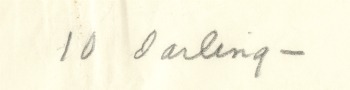
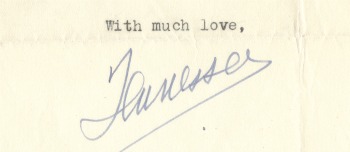
Today, March 26, 2011, would be the hundredth birthday of Tennessee Williams, one of America’s great playwrights. The Carson McCullers Papers here at Duke contain many letters between McCullers and Williams, most from the late 1940s, shortly after Williams had written McCullers a fan letter and the two had immediately become close friends. The letters are full of passionate discussion of their work, travels, and deep affection for each other.
On behalf of McCullers and all lovers of American theatre and literature: Happy birthday, “10 Darling.”
Post contributed by Will Hansen, Assistant Curator of Collections.
P.S. If you haven’t yet, please take our survey by clicking on the orange button on the right. We are collecting information from our readers so that we can make our blogs better and more informative. It won’t take long—just five easy questions. Thanks!
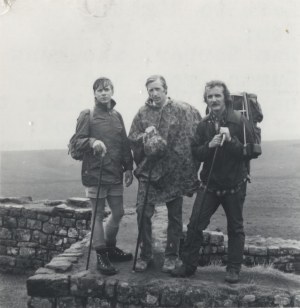
During the summer of 1970, four remarkable American writers and editors paid a visit to 70 year old Northumbrian poet Basil Bunting in his home in Corn Close, Yorkshire, England. The leader of this group was Jonathan Williams, poet and founder of North Carolina’s the Jargon Society, which published the works of innovative poets such as Charles Olson, Denise Levertov, and Duke alumnus Guy Davenport.
Williams asked his companions to stop and pose for the camera “near the end of the trek up the Pennines,” a low-rising mountain range separating the North West of England from Yorkshire. “Quite a rough go, by the way.”
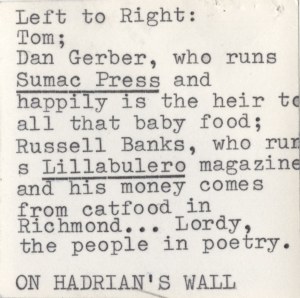
On Hadrian's Wall, back of photograph.
Williams helpfully typed on the back of this small (2 ½ inch square) photo the names of those pictured. From the left is Williams’ life partner, the poet and translator Thomas Meyer; Dan Gerber, co-founder of the Michigan-based little magazine Sumac; and Russell Banks, then a recent graduate of UNC-Chapel Hill (BA ‘67), and now the prominent novelist and author of The Sweet Hereafter, Affliction, and other acclaimed books.
He then sent the snapshot to R. Philip Hanes, an executive at Hanes Dye and Finishing Company, who was a founding board member of the Jargon Society.
The photo comes from the R. Philip Hanes Papers. Hanes’ papers provide a rich and entertaining look at one small, North Carolina publisher’s fund raising efforts. Williams’ wit and garrulousness shows in the letters. He has many names for money, for instance, names like “lucre,” “lolly,” “moola,” “smackers,” and plenty of others. “I’m apparently not doing as a fund-raiser. But, us mountain boys is a mess, that’s been true for hundreds of years.”
We also learn about some of Hanes’ interests: “Dear Morchella Esculenta,” Williams writes in August 1971, “One suspects there will be a conglutination of those fearsome fungi of yourn this year. Lots of showers here lately too. Everything grows heavily—the pollens, the tourists, anglophobia, anglophilia—the lot.”
That is, Hanes hunted mushrooms.
Post contributed by David Pavelich, Head of Research Services.
P.S. If you haven’t yet, please take our survey by clicking on the orange button on the right. We are collecting information from our readers so that we can make our blogs better and more informative. It won’t take long—just five easy questions. Thanks!
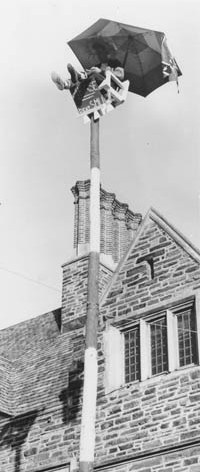
Flagpole Sitter, 1956. From the Duke University Archives.
We’re librarians: we like information. For the next month, The Devil’s Tale will be gathering information from you, our reader, in our first-ever feedback poll!
This is your chance to tell us a little bit about your blog-reading habits and what you’d like to see when you visit The Devil’s Tale. In the sidebar you’ll see an orange button that links to our short survey—we hope you’ll take a few minutes to help us learn how to create a better, more informative blog. Of course, your responses and comments will be submitted anonymously, so click away!
We’ll be gathering responses through Friday, April 15th, and we’ll be sure to let you know what we’ve learned once the results are tabulated.
All of the other Duke University Libraries blogs will be running the exact same poll, so head over to the other blogs that you read and leave some feedback for them, too.
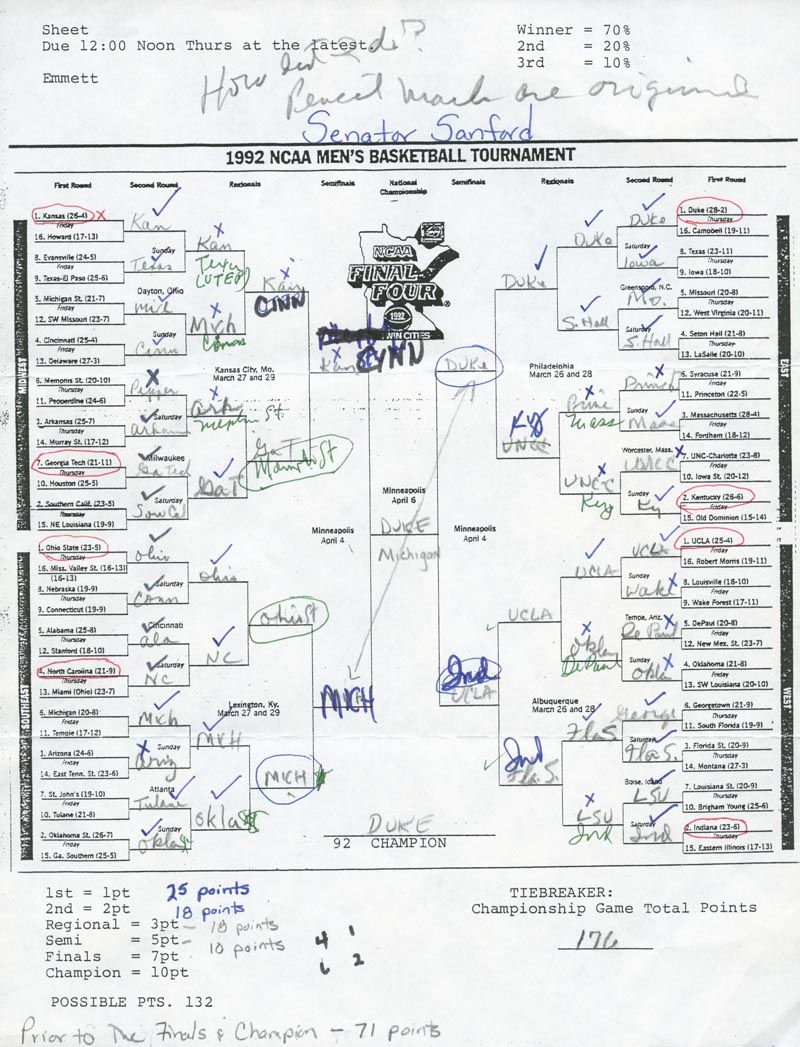
On any ordinary Monday morning in 1992, then-North Carolina Senator and former President of Duke University Terry Sanford began his week attending to the public’s business. However, this particular Monday in March happened to be the day after Selection Sunday and, like so many of us, Senator Sanford contemplated his blank NCAA Men’s Basketball Tournament bracket at the expense of perhaps more pressing work.
Among the hundreds of linear feet of Terry Sanford’s records and papers held in the RBMSCL (his senatorial papers) and University Archives (records from his Duke presidency) is his 1992 NCAA Tournament bracket. Although he couldn’t have foreseen Christian Laettner’s last second turnaround jumper against Kentucky and Duke’s trouncing of Michigan’s “Fab-5” in the tournament final, the man that the Duke Student body fondly referred to as “Uncle Terry” chose Duke to repeat as NCAA champions. Will they do it again in 2011?
Post contributed by Josh Larkin-Rowley, Research Services Assistant.
P.S. Through Friday, April 15th, we’ll be gathering responses as part of our first-ever reader feedback poll! Click the orange button in the sidebar to participate, or visit this blog post to learn more.
Dispatches from the David M. Rubenstein Rare Book and Manuscript Library at Duke University