It is with profound sadness that we share that graphic artist, mask-puppet-and-banner maker, violinist, country dance teacher, and community activist Allan Troxler passed away on October 26, 2025.
Born and raised in Greensboro, Troxler became a conscientious objector to the Vietnam War and participated in civil rights organizing and campaigns. He also worked in Boston to preserve neighborhoods threatened by urban development. Later, Troxler moved to a communal farm in rural Oregon with his partner, noted gay activist Carl Wittman. While in Oregon, Allan and Carl helped to publish RFD, a magazine for gay men living in rural America.
Returning to North Carolina in 1979, Troxler and Wittman were actively involved in arts, dance, and cultural programs throughout the region. Both devotees of English Country Dance and leaders in a national dance movement, they started Sun Assembly, its weekly dances and New Year’s celebrations in Durham weaving an egalitarian community beyond gender binaries.
Troxler and Wittman were early members of the North Carolina Gay and Lesbian Health Project, which sought to improve access to medical care and information for the gay community, particularly as it endured the spread of HIV/AIDs in the early 1980s. They were vocal activists against homophobia and the criminalization of homosexuality. Over the years they helped organize a range of community projects and protests. Wittman died of AIDS in early 1986.
Papercut broadside by Allan Troxler. Allan Troxler Papers, 1800s-2024.
Troxler’s writings, dance, artwork, and activism continued through his life. His work appeared in Southern Exposure, RFD, and local features and press. He created Camas Swale, a series of “occasional pamphlets,” along with other zines and artwork by pseudonym E. Bunny. Troxler’s work frequently expressed political views, opposing anti-gay legislation, and promoting peace and inclusivity. Much of this artwork was distributed to local friends in his community network.
Troxler was honored as an LGBT Pioneer at the Executive Mansion by Governor Roy Cooper in June 2024 along with Mandy Carter as Carolinians who “for decades led the charge for acceptance and equality.” Troxler’s artwork and papers, along with Wittman’s, reside in the Rubenstein Library.
From Troxler’s writings: “Here we be, ears ringing as some of us grieve ancient companions just gone; others meting out pills; potions in portions! Through the window cicadas rattle their ancient benedictions: Life, death. Through the curtain Sister Heavenly Light blesses us all.”
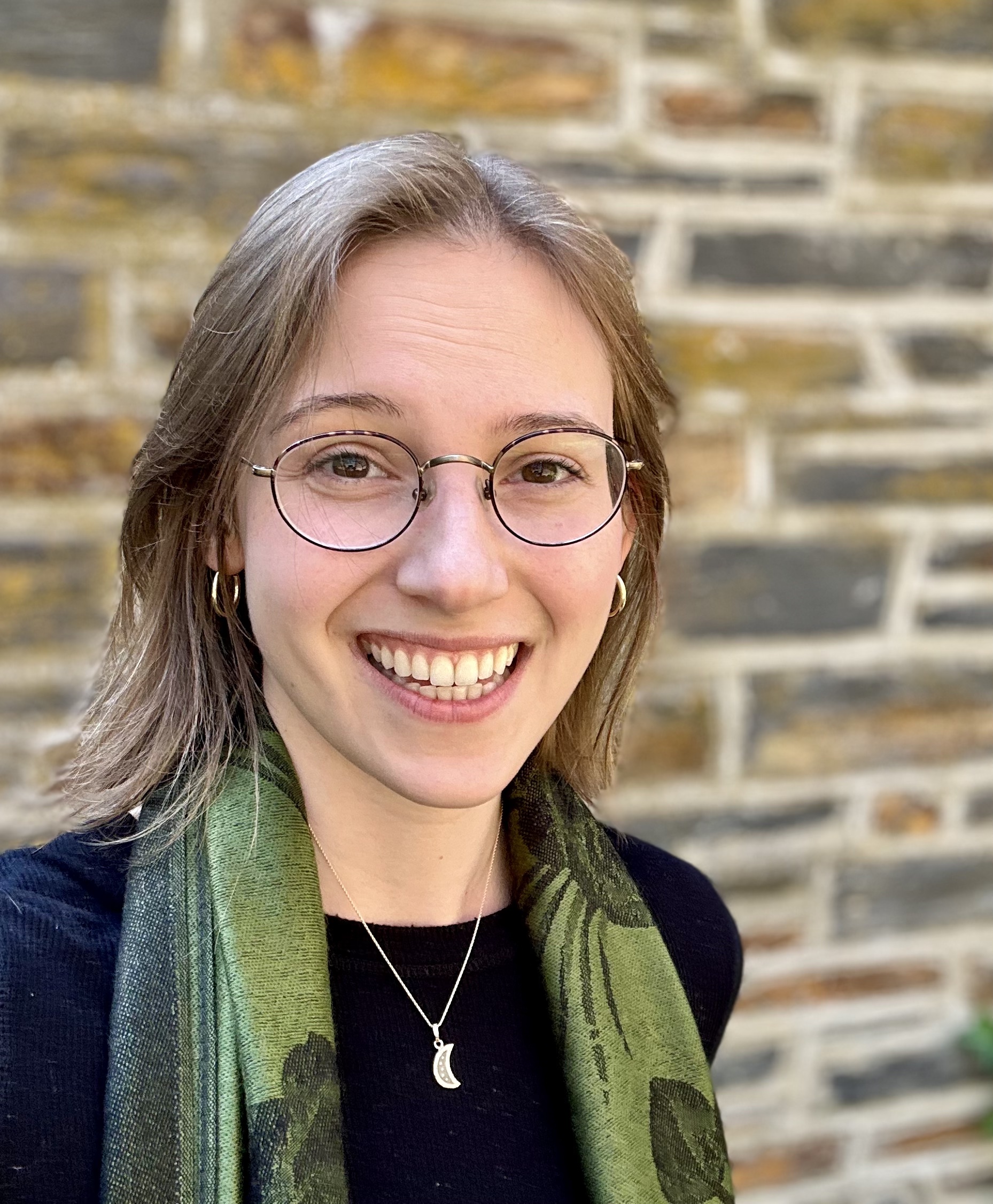
Header Image: Allan Troxler. Portrait by Annie Segrest.
The United Nations considers intellectual freedom to be a basic human right through Article 19 of the Universal Declaration of Human Rights which asserts: “Everyone has the right to freedom of opinion and expression; this right includes freedom to hold opinions without interference and to seek, receive and impart information and ideas through any media and regardless of frontiers.”
Libraries in particular value intellectual freedom as part of their mission to provide and protect access to information and ideas. According to the American Library Association intellectual freedom is an integral component of a democratic society, protecting an individual’s right to access, explore, consider, and express ideas and information as the basis for a self-governing, well-informed citizenry. Yet there is an intensification of threats to intellectual freedom across the United States, with pressure on curriculum and research, book and program challenges, and censorship attempts continuing to reach unprecedented levels.
This year’s Janie K. Long Speaker Series program will focus on the impact of challenges to intellectual freedom on higher education and the steps we can take to support students, faculty, staff, and other members of our community. We will also honor Duke Alumnus Harry H. Harkins Jr, T’73 longtime supporter of LGBTQ+ library collections, scholars, and this event series.
Speakers: Robin Koshelev, Duke undergraduate researcher, Dr. Janie K. Long, Duke faculty emerita, Dr. Joseph Salem, University Librarian, Dr. Pete Sigal, Department of History; moderated by author, journalist, and Duke alumnus Steven Petrow.
Sponsored by: Duke University Libraries, David M. Rubenstein Rare Book & Manuscript Library, Duke Department of History, and the Duke Program for Scholars and Publics.
Contributed by David K. Seitz, associate professor of cultural geography, Harvey Mudd College: Recipient of an Eve Kosofsky Sedgwick Research Travel Grant, 2024-25, supported by the Eve Kosofsky Sedgwick Foundation
The intellectual and creative legacy of Eve Kosofsky Sedgwick is so multi-layered and wide-ranging that even such adjectives scarcely do it justice. But across the many webs and folds of experience and knowledge that Sedgwick’s work interweaves, it is difficult to miss the recurrence of a particular charismatic megafauna: the giant panda.
Pandas, art historian Jason Edwards observes, were “were crucial to Sedgwick’s late style,” appearing in several of her books, poems, and craft works from 1996 onward. But Sedgwick’s panda-love, Edwards points out, began much earlier, as an attachment formed in childhood and sustained in the exchange of countless panda cards over the course of her remarkable marriage to optometry professor Hal Sedgwick. Eve Sedgwick noticed all kinds of queer possibilities and pleasures in pandas – their ambiguous gendering, cozy contentment, shyness, roundness – and in the cross-cultural encounters convened around them, as in China’s practice of “panda diplomacy.”
I came to the Rubenstein Rare Book & Manuscript Library under the auspices of the Sallie Bingham Center with a particular interest in Sedgwick’s attention to questions of race, class, and empire. Although I certainly imagined that such questions might come up in her correspondence with Richard Fung, the acclaimed Chinese-Trinidadian-Canadian queer experimental filmmaker, I had not anticipated the place of the panda in such exchanges.
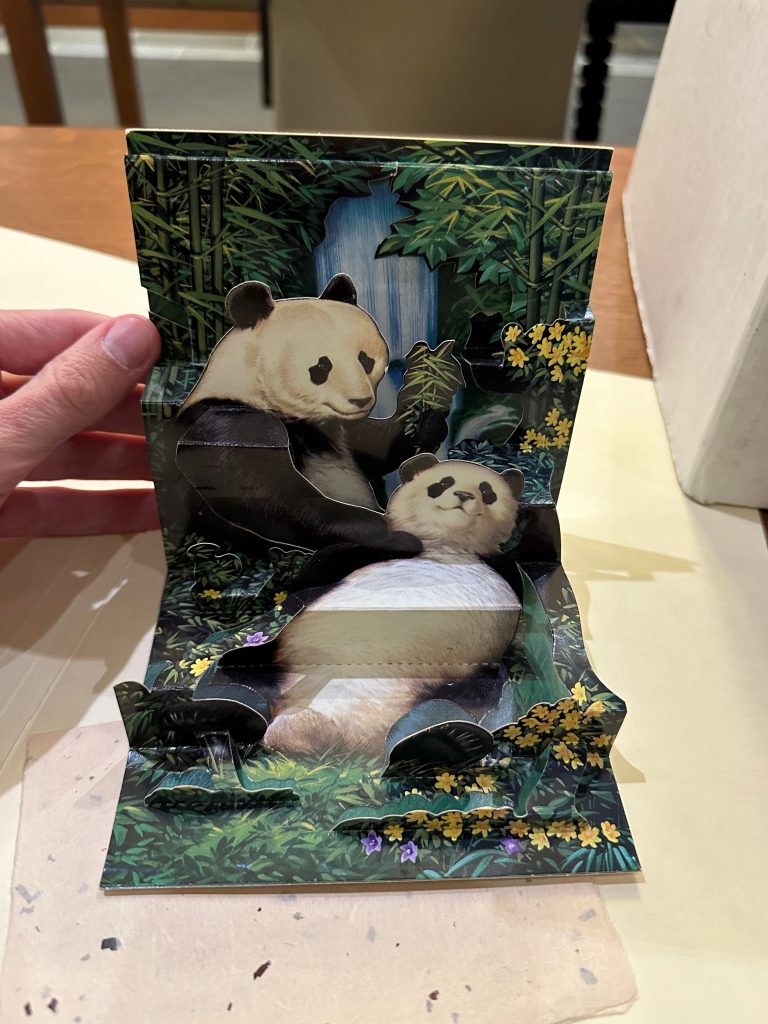
Fung’s card to Sedgwick. Courtesy of David Seitz
In March 1991, Fung visited Duke under Sedgwick’s auspices, screening his 1990 film My Mother’s Place and lecturing on questions of race, gender, and sexuality in Chinese and Caribbean diasporas. There, he met Sedgwick’s student, José Esteban Muñoz, who would later analyze “My Mother’s Place” in his germinalbook Disidentifications: Queers of Color and the Politics of Performance. Upon returning home to Toronto, Fung chose an apposite thank-you note for Eve Sedgwick’s hospitality: a pop-up card of two pandas in playful repose, sold to benefit the World Wildlife Fund.
The card must have delighted Eve, both in its imagery and in its three dimensionality, given her interest in the aesthetics of texture and touch. Fung’s postscript – “Which do you think is the girl panda and the boy panda? How do you know?” – subtly extended his longstanding, both serious and playful criticisms of Western stereotypes about Asian genders and sexualities, and must also have affected her. Two years later, in Tendencies, Sedgwick listed Fung among queer artists of color who “do a new kind of justice to the fractal intimacies of language, skin, migration, state.”
Fung’s panda card underscores the wisdom of Edwards’s advice against dismissing Sedgwick’s panda-love as “childish” or “peripheral” to her intellectual and creative contributions. If anything, the card offers an apt metaphor: it is the surprises that “pop up” in Sedgwick’s archive and in all archival encounters that often prove the most informative.
Further Reading:
Edwards, Jason, ed. Bathroom Songs: Eve Kosofsky Sedgwick as a Poet, (Santa Barbara, California: Punctum Books, 10 Nov. 2017) doi: https://doi.org/10.21983/P3.0189.1.00.
Edwards, Jason. Queer and Bookish: Eve Kosofsky Sedgwick as Book Artist, (Santa Barbara, California: Punctum Books, 03 Mar. 2022) doi: https://doi.org/10.53288/0328.1.00.
Fung, Richard, dir. My Mother’s Place (Toronto, Canada: V-Tape, 1990).
Muñoz, José Esteban. Disidentifications: Queers of Color and the Politics of Performance, (Minneapolis, Minnesota: University of Minnesota Press, 1 May 1999).
Sedgwick, Eve Kosofsky. A Dialogue on Love, (Boston, Massachusetts: Beacon Press, 9 Jun. 2000).
Sedgwick, Eve Kosofsky. The Weather in Proust, ed. Jonathan Goldberg, (Durham, North Carolina: Duke University Press, Dec. 2011) doi: https://doi.org/10.1215/9780822394921.
Archive of Documentary Arts Sidney Gamble Travel Grants
Doris Duke Foundation Research Travel Grants
Eve Kosofsky Sedgwick Travel Grants
History of Medicine Collections
Human Rights Archive
John Hope Franklin Research Center for African and African American History and Culture
John W. Hartman Center for Sales, Advertising & Marketing History
Sallie Bingham Center for Women’s History and Culture (Mary Lily Research Grants)
Anyone whose research would be supported by sources from the Rubenstein Library’s research centers is eligible to apply. We encourage applications from students at any level of education; faculty and teachers; visual and performing artists; writers; filmmakers; public historians; and independent researchers.
For assistance determining the eligibility of your project, please contact AskRL@duke.edu with the subject line “Travel Grants.”
Eligibility
Applicants must reside beyond a 100-mile radius of Durham, N.C., and may not be current Duke students or employees.
Information Session
An online information session will be held Wednesday, January 15, 2025, 2-3 pm EST. This program will review application requirements, offer tips for creating a successful application, and include an opportunity for attendees to ask questions. This program will be recorded and posted online afterwards. Register for the session here.
Timeline
The deadline for applications will be Friday, February 28, 2025, at 6:00 pm EST.
Decisions will be announced by the end of April 2025 for travel during May 2025-June 2026. Awards are paid as reimbursement after completion of the research visit(s).
Post contributed by Matilde Manara, Postdoc Fellow at Institut Lethica, Université de Strasbourg, France. Manara received an Eve Kosofsky Sedgwick Research Travel Grant, 2023-2024.
I approached the materials held in Eve Kosofsky Sedgwick’s Papers as part of a larger project on feminist models of writing, behavior, and knowledge to be found in Marcel Proust’s A la Recherche du TempsPerdu. I am particularly interested in understanding how readers can acknowledge a literary model such as A La Recherche, recognizing its importance in their life and/or art, without necessarily embracing its esthetic, moral, or epistemological foundations (and even by openly rejecting them). Along with Sedgwick’s Works in Fiber, Paper and Proust (2005), I delved into Chantal Akerman’s La Captive (2000), Jacqueline Rose’s Albertine (2001) and Anne Carson’s The Albertine Workout (2014). An important part of this research deals with questions raised by Sedgwick herself in her writings on Proust. In the final chapter of Epistemology of the Closet, she notably writes:
I was reading Proust for the first time during just the short stretch of years during which it occurred to me to have ambitions that were not exclusively under the aspect of eternity: to want to publish visibly, know people, make a go it, get a run for my money. Oddly, of course, it was reading Proust that made me want these adventures and think I could find them. The interminable meditation on the vanity of human wishes was a galvanizing failure for at least one reader: it was, if anything, the very sense of the transparency and predictability worldly ambitions that gave me the nerve and skill to have worldly ambitions of my own. Like, I believe, most young women, I never had a shred of identification with JuIien Sorel or the nineteenth-century French male plot of conquering the capital – until after the years of Proust-reading; then both the hero’s airy ambition and his concomitant uncritical adoption of a master text became intelligible and engaging traits (Sedgwick 1990, 241).
In preparing my visit to Duke, I had planned to explore this potential identification by dividing the materials I expected to consult into two categories: those related to Sedgwick’s academic work (syllabi from the seminars she held on Proust from around 1998 up to 2009, notes and drafts for Epistemology of the Closet and The Weather in Proust, scattered articles, and records of conferences) on the one hand, and those related to her artistic work (textile art, artists’ books, pieces from her 2005 exhibition, Works in Fiber, Paper and Proust) on the other. The days spent at Duke made me realize how much my plan was naive, even somewhat paradoxical, for these two practices are deeply intertwined and connected to each other in the same “fractal” way she suggests Proust’s novel should be read (Sedgwick 2011, 90-93).
Proust Box notebook with notes on paper dolls, hexaflexagons (first pages), Eve Kosofsky Sedgwick Papers, Box 40.
Proust Box notebook with notes on paper dolls, hexaflexagons (first pages), Eve Kosofsky Sedgwick Papers, Box 40.
I was most struck by two aspects of the materials I had the chance to consult in the archive. First, to see how Proust’s novel, in both its material dimension (the printed paper) and its virtual dimension (the hypertextual lattice we discover when not following a linear progression), becomes itself the object of a découture (witnessed by pages and pages of copied, printed and collaged quotations organized by Sedgwick under thematic headings such as Weather, Interior-outside, Albertine, Happiness, Anxiety, etc.), thus allowing the book’s complex architecture to emerge, while at the same time making it possible to detach from it, or even build it anew. Second, to observe how these shredded fragments feed into Sedgwick’s vast and increasingly central reflection on immanence (drawn on Proust as much as on Buddhism or the philosophy of Plotinus) to such an extent that the underlined pages of the many (including some multilingual) versions of A la recherche she uses over the years bear testimony to this gradual convergence, revealing how transformative reading the novel could have been for her.
My time at Rubenstein library has certainly given me the opportunity to enrich my project, helping me to better understand how Sedgwick reads, writes and seals in Proust – and not on, as she meant by the title of her exhibition at Harvard in 2005, “Works in Fiber, Paper, and Proust.” But it has also, and most importantly, touched me on a personal level, made my Proustian reader self fully and enthusiastically agree with her when she notices that:
It is harder to say in what this truth-effect of Proust consists. AII the paradoxes of a more traditionally conceived vraisemblance are especially active here: molecularly, there are relatively few individual propositions in or arising from the book that it would make sense to consider true; and even at the molar level, propositions or “values” or “attitudes” (erotic or political pessimism, for instance) that could be extracted from Proust do not necessarily seem true to me, to whom, nonetheless, “Proust” seems so “true”. Plainly, classically, it can be said that the coherence and credibility of the work, its vraisemblance in the usual senses, depend on an internal structuration of materials and codes that can only as relation, as structure, be interdigitated with or tested against the relational structures of a “reality” that surrounds and interleaves and thus mutually constitutes it. The truth-effect I am describing goes beyond questions of the work’s coherence and credibility, however. It has to do with the use of the literary work, its (to sound censorious) expropriability by its readers, its (to sound, in a different vocabulary, celebratory) potential for empowering them. For, unmistakably, the autobiographical parable I have just encapsulated as “the years of Proust-reading” represents both a prolonged instance of textual abuse and a story of empowerment. (Sedgwick 1990, 241).
Contributed by Adam Kocurek, PhD Candidate, History, The City University of New York Graduate Center.
With the assistance of a Harry H. Harkins, Jr. T’73, Travel Grant, I visited the Rubenstein Library in the summer of 2023 to carry out research for my dissertation, a history of LGBTQ+ faculty activism and community building in American higher education from the late 1960s through the late 1990s. During my visit, I explored several collections, ranging from institutional records to the personal papers of LGBTQ+ faculty members.
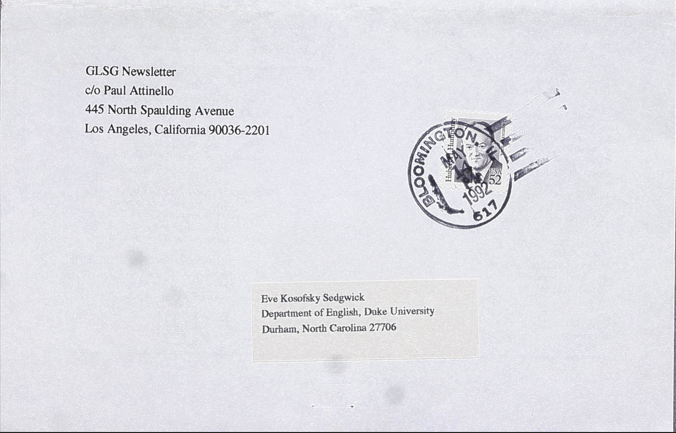
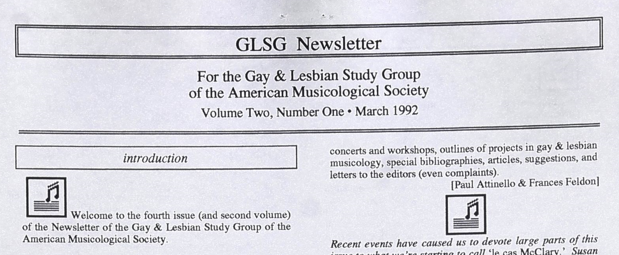
GLSG Newsletter
During my visit, I engaged with many magnificent sources that will feature in my dissertation. One such source from the Eve Kosofsky Sedgwick Papers, is volume 2 issue 4 of the Gay and Lesbian Study Group of the American Musicological Society “GLSG Newsletter,” published in March 1992. As a Ph.D. candidate at The CUNY Graduate Center, an institution at which Sedgwick worked and made important scholarly contributions, I found it to be an almost surreal and emotional experience going through her collection at Duke University. While Sedgwick was employed at Duke, she spearheaded LGBTQ+ issues at the university, serving as consultant on the University Coordinating Committee for Lesbian, Gay, and Bisexual Studies, as well as being an active member of the Modern Language Association’s Gay and Lesbian Caucus. Through her scholarly and activist networks, she amassed ephemera from around the country, providing amazing insights into the state of LGBTQ+ faculty’s political and social organizing during the 1980s and 1990s.
The GLSG Newsletter provides a fascinating snapshot of a transitionary period in the history of LGBTQ+ faculty organizing for their rights and recognition within higher education. In the wake of the Stonewall Uprising in 1969, lesbian and gay academics formed the Gay Academic Union (GAU) in 1973, the first group of out academics who strove to transform academia into an industry more accepting of LGBTQ+ scholarship and workers. The GAU grew to be a multidisciplinary national network, though within four years, it began to fragment and ultimately dissolve due to a number of factors, including sexism within the organization that alienated lesbian members, chronic funding and outreach issues, and the challenges of maintaining a nation-wide vision for LGBTQ+ faculty organizing. While initially fueled by the energy of the Gay Liberation movement, by the late 1970s, many of the organization’s most radical members had splintered away. By the 1980s, its president, Jonathan Dunn-Rankin, was struggling to bring GAU’s chapters together. While Gay Academic Unions persisted into the 1990s, they were no longer part of a national radical movement, and instead isolated often into specific campus chapters.
By the 1980s and 1990s, discipline-specific LGBTQ+ faculty organizations began to proliferate across the United States, such as the Society of Lesbian and Gay Anthropologists (SOLGA) which formed in 1979, and the GL/Q Caucus for the Modern Languages (GLQCML). The Gay & Lesbian Study Group (GLSG) of the American Musicological Society, established in 1991, is part of this legacy, and its newsletters provide insights into its vision for LGBTQ+ issues in higher education.
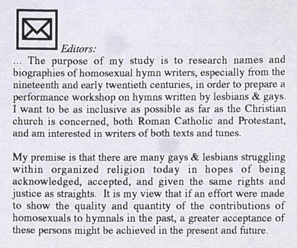
Letter to the editor in GLSG
The March 1992 GLSG newsletter states that their objectives include “promoting communication among lesbian & gay music scholars, increasing awareness of issues in sexuality and music in the academic community, and establishing a forum for the presentation of lesbian & gay music studies,” as well as “to provide an environment in which to examine the process of coming out in academia, and to contribute to a positive political climate for gay & lesbian affirmative action and curricula.” While professional development and networking were key prerogatives for the GLSG, with letters to the editor frequently soliciting help with research and studies, it is very clear that this organization also serves a social function. The GLSG held meetings during the AMS conventions to encourage LGBTQ+ faculty and students to engage with one another. These letters reveal repeated acknowledgment of the importance of forging community, not only for individual professional advancement or to contribute to the vitality of lesbian and gay studies, but to combat loneliness and isolation experienced by LGBTQ+ academics and to share the progressive changes others were working towards at their home campuses. One such contributor, Patrick Brannon from the University of Northern Iowa, writes, “It’s always good to connect with people from afar – eases the isolation that we here in the Midwest feel from time to time… Some of us have been working on passage of a human rights amendment to the University of Northern Iowa’s charter that will provide protection based on sexual orientation.” Similarly to LGBTQ+ faculty organizations rooted in other disciplines, the GLSG attended to a variety of professional, personal, and intellectual needs faced by LGBTQ+ academics in the early 1990s.
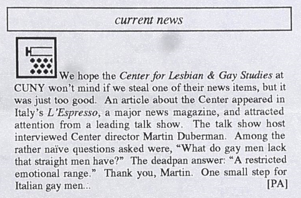
News item in GLSG borrowed from the Center for Lesbian & Gay Studies at CUNY.
Something that I find fascinating and have loved exploring with my dissertation is the degree to which these organizations often operated, at least initially, on a very ad hoc basis, openly experimental with their aims and organizing strategies. Many of these groups formed because of the intrepid bravery of a handful of LGBTQ+ faculty who, working without funds and institutional support, were nonetheless able to cater to the needs of LGBTQ+ faculty in their scholarly disciplines. They relied heavily on parallel organizations to provide helpful models and actionable strategies to reach their goals. In this newsletter, under its “News” section, the writers of the GLSG state, “We hope the Center for Lesbian & Gay Studies at CUNY won’t mind if we steal one of their news items, but it was just too good,” later adding, “The same Center for Lesbian & Gay Studies at CUNY, commonly known as CLAGS, has inspired graduate students to request and even push for classes in lesbian & gay studies… This is an interesting model: graduate students requesting and negotiating for classes in gay & lesbian musicology might also be successful elsewhere.”
The early 1990s was a tumultuous period in the history of LGBTQ+ activism. Driven by the desperate conditions of the AIDS crisis, in the wake of earlier organizations like the GAU, LGBTQ+ academics strove for recognition of LGBTQ+ studies as worthy of scholarly validation, for their right to equal treatment and protection from discrimination within the academy, and for community outside of campus boundaries. The GLSG newsletter is an artifact that perfectly captures this dynamic moment in LGBTQ+ history and the history of higher education.
The Rubenstein Rare Book & Manuscript Library is pleased to announce the recipients of the 2024-2025 travel grants. Our research centers annually award travel grants to students, scholars, and independent researchers through a competitive application process. We extend a warm congratulations to this year’s awardees. We look forward to meeting and working with you!
Archive of Documentary Arts
Elizabeth Barahona, Ph.D. candidate, Northwestern University, “Black and Latino Coalition Building in Durham, North Carolina 1980-2010.” (Joint award with the Human Rights Archive)
Diana Ruiz, Faculty, University of Washington, Seattle, “Apprehension through Representation: Image Capture of the US-Mexico Border.” (Joint award with the Human Rights Archive)
Sallie Bingham Center for Women’s History and Culture
Mary Lily Research Travel Grants
Taylor Doherty, Ph.D. candidate, University of Arizona, Department of Gender and Women’s Studies, “Minnie Bruce Pratt’s Anti-Imperialist Lesbian Feminist ‘Longed-for but Unrealized World.’”
Thalia Ertman, Ph.D. candidate, University of California, Los Angeles Department of History, “U.S. Feminist Anti-Nuclear Activism and Women’s Bodies, 1970s-1990s.”
Samuel Huber, Faculty, Yale University, Department of English. “A World We Can Bear: Kate Millett’s Life in Feminism.”
Alan Mitchell, Ph.D. candidate, Cambridge University, Faculty of Art History and Architecture, “Redefining Phoebe Anna Traquair through the lenses of historicism and intersectionality.”
Emily Nelms Chastain, Ph.D. candidate, Boston University, School of Theology, “The Clergywoman Question: The International Association of Women Preachers and Ecclesial Suffrage in American Methodism.”
Ana Parejo Vadillo, Faculty, School of Creative Arts, Cultures and Communications, Birkbeck, University of London, “Bound: The Queer Poetry of Michael Field.”
Carol Quirke, Faculty, American Studies, SUNY Old Westbury, “Feminism’s ‘Official Photographer:’ Bettye Lane, News Photography and Contemporary Feminism, 1969-2000.”
Paula Ramos, Independent Researcher, “Spatiality and gender: spatial circumstances of the creative process of feminist artists in the 1970s and 1980s.”
Dartricia Rollins, Graduate Student, University of Alabama, School of Library and Information Studies, “‘You Had to Be There:’ Charis’ 50-Year History as the South’s Oldest Independent Feminist Bookstore.”
Eve Kosofsky Sedgwick Research Travel Grants
Ipek Sahinler, Ph.D. candidate, University of Texas Austin, “A Portrait of Young Women as Proto-Queer Thinkers: Eve Sedgwick vis-à-vis Gloria Anzaldúa.”
David Seitz, Faculty, Harvey Mudd College, “‘No Less Realistic’ but with ‘Different Ambitions’: Reparative Reading, Human Geography, and a Return to Sedgwick.
Doris Duke Foundation Travel Grants
Olivia Armandroff, Ph.D. candidate, University of Southern California, “Volcanic Matter: Land Formation and Artistic Creation.”
Cameron Bushnell, Faculty, Clemson University, Department of English. “‘The Invisible Orient’ in Orientalism Otherwise: Women Write the Orient.”
John Hope Franklin Center for African and African American History and Culture
Thomas Blakeslee, Ph.D. candidate, Harvard University, History Department, “Domestic Disturbances: The Resistant Masculinity of Black Fatherhood from Anti-Slavery to Civil Rights.”
Mara Curechian , Ph.D. candidate, School of English, University of St Andrews, “Acting Like Family: Performing Kinship in the Literature of the Civil War and Reconstruction.”
Michelle Decker, Faculty, Scripps College, English Department, George Washington Williams’s and Amanda B. Smith’s Appalachian Origins and African Explorations.”
Timothy Kumfer, Postdoctoral Fellow, Georgetown University, 2023-2024 Mellon Sawyer Seminar, “Counter-Capital: Grassroots Black Power and Urban Struggles in Washington, D.C.”
Hunter Moskowitz, Ph.D. candidate, Northeastern University, “Race and Labor in the Global Textile Industry: Lowell, Concord, and Monterrey in the Early 19th Century.”
Summer Sloane-Britt, Ph.D. candidate, Institute of Fine Arts, New York University, “Visions of Liberation: Gender and Photography in the Student Nonviolent Coordinating Committee, 1960-1970.”
Mila Turner, Faculty, Clark Atlanta University, “Bridging Histories: Connecting the Atlanta Student Movement with College Student Activism throughout the Southeast”
Harry H. Harkins T’73 Travel Grants for Lesbian, Gay, Bisexual, and Transgender History
Kadin Henningsen, Ph.D. candidate, University of Illinois at Urbana-Champaign, “Walt’s Companions.”
Julie Kliegman, Author, book-length exploration of transgender pioneers.
John W. Hartman Center for Sales, Advertising, and Marketing History
John Furr Fellowship
Hannah Pivo, Ph.D. candidate, Columbia University, Department of Art History and Archaeology, “Charting the Future: Graphic Methods and Planning in the United States, c. 1910-60.”
Lewis Smith, Faculty, Brunel University London, Brunel Business School, Division of Marketing, “Marketing the State”: J. Walter Thompson Company and the Marketing of the Public Sector in Britain.”
Alvin Achenbaum Travel Grants
Warren Dennis, Ph.D. candidate, Boston University, “Hard Power Paths: Gender and American Energy Policy, 1960-2000.” (Joint award with History of Medicine with support from the Louis H. Roddis Endowment)
Dan Du, Faculty, University of North Carolina at Charlotte, Department of History, “U.S. Tea Trade and Consumption after the American Revolution.”
Will Mari, Faculty, Louisiana State University, Manship School of Mass Communication, “Selling the computer to women media workers: gendered ads during the Cold War.”
Janine Rogers, Ph.D. candidate, University of California Los Angeles, Theater Department, “Performance, Militarization, and Materialisms: Canned Goods in Asian America”.
Foare
Jonathan MacDonald, Ph.D. candidate, Brown University, Department of American Studies, “Psychology Hits the Road: Driving Simulators, Billboards, and Hypnosis on the Highway.”
History of Medicine Collections
Warren Dennis, Ph.D. candidate, Boston University, “Hard Power Paths: Gender and American Energy Policy, 1960-2000.” (With support from the Louis H. Roddis Endowment; Joint award with the Hartman Center)
Ava Purkiss, Faculty, University of Michigan, Ann Arbor, Department of Women’s and Gender Studies, “After Anarcha: Black Women and Gynecological Medicine in the Twentieth Century.”
Baylee Staufenbiel, Ph.D. candidate, Florida State University, Department of History, “The Seven-Cell Uterus: De Spermate and the Anatomization of Cosmology.”
Brian Martin, Ph.D. candidate, University of Alabama, History Department, “Racial Theory and African American Medical Care in the U.S. Civil War.”
Human Rights Archive
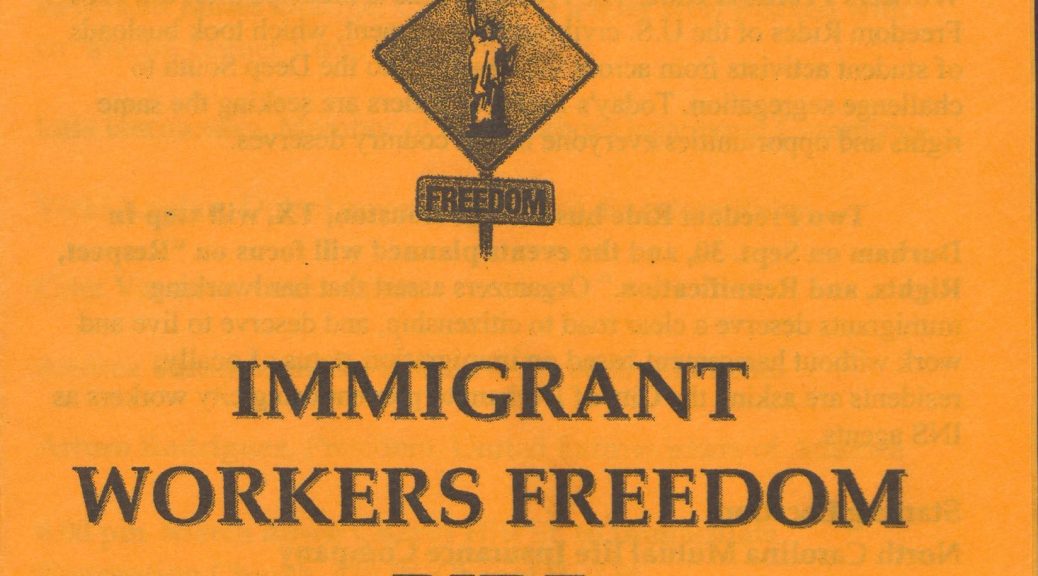
“Immigrant Workers Freedom Ride” flyer, September 30, 2003, illustrates one area of coalition building in Durham, NC, as described in Elizabeth Barahona’s dissertation research proposal. From the Joan Preiss Papers, Box 27.
Elizabeth Barahona, Ph.D. candidate, Northwestern University, “Black and Latino Coalition Building in Durham, North Carolina 1980-2010.” (Joint award with the Archive of Documentary Arts)
Diana Ruiz, Faculty, University of Washington, Seattle, “Apprehension through Representation: Image Capture of the US-Mexico Border.” (Joint award with the Archive of Documentary Arts)
Kylie Smith, Faculty, Emory University. School of Nursing, Department of History, “No Place for Children: Disability, Civil Rights, and Juvenile Detention in North Carolina.”
Harrison Wick, Faculty, Indiana University of Pennsylvania (IUP) Special Collections and University Archives, “Examination of Primary Sources related to Social Justice and Latin American Immigration in the Human Rights Archive.”
Harry H. Harkins T’73 Travel Grants for Lesbian, Gay, Bisexual, and Transgender History
History of Medicine Collections
Human Rights Archive
John Hope Franklin Research Center for African and African American History and Culture
John W. Hartman Center for Sales, Advertising & Marketing History
Sallie Bingham Center for Women’s History and Culture (Mary Lily Research Grants)
Anyone whose research would be supported by sources from the Rubenstein Library’s research centers is eligible to apply. We encourage applications from students at any level of education; faculty and teachers; visual and performing artists; writers; filmmakers; public historians; and independent researchers. For assistance determining the eligibility of your project, please contact AskRL@duke.edu with the subject line “Travel Grants.”
Eligibility
Applicants must reside beyond a 100-mile radius of Durham, N.C., and may not be current Duke students or employees.
Information Session
An online information session will be held Thursday, January 11, 2024, 2-3 pm EST. This program will review application requirements, offer tips for creating a successful application, and include an opportunity for attendees to ask questions. This program will be recorded and posted online afterwards. Register for the session here.
Timeline
The deadline for applications will be Thursday, February 29, 2024, at 6:00 pm EST.
Decisions will be announced by the end of April 2024 for travel during May 2024-June 2025. Awards are paid as reimbursement after completion of the research visit(s).
Katie Carithers was an Archival Expeditions fellow in Spring 2023. Archival Expeditions introduces Duke graduate students to teaching with digital and physical primary sources. Each student partners with a Duke faculty sponsor to design an undergraduate course module that incorporates primary source material from the Rubenstein Library’s collections tailored to a specific class taught by that faculty member.
Katie’s excellent course module, as well as previous modules created through the program and program information, can be found on the Archival Expeditions website.
Archival Expeditions is generously funded by the Vice Provost for Interdisciplinary Studies, Ed Balleisen.
Tell us a bit about yourself.
Katie Carithers.
I am a third-year doctoral student in the English Department here at Duke, and I am also pursuing a Certificate in Gender, Sexuality, and Feminist Studies. My research interests are located at the intersection between Victorian Studies and contemporary postcolonial, feminist, and queer theory. Currently, I am thinking about how nineteenth-century novels figure consenting, desiring, and gendered subjects and how those notions transform across the nineteenth century.
I applied to the Archival Expeditions out of an excitement to work with the Eve Kosofsky Sedgwick Papers. In April 2022, Rubenstein announced that the collection was now open to researchers, and this fellowship seemed like a wonderful opportunity to engage such an expansive and heterogenous collection in a way that would allow the archive to shape the project. I think that my faculty sponsor, Gabriel Rosenberg (History and Gender, Sexuality, and Feminist Studies), was similarly excited by the possibility of exploring this archive, not knowing what would be in the collection, and letting the collection inform where we would go with the module.
What is the focus of the course module you created and what did you learn from the experience of designing it?
The module was designed for an “Intro to LGBTQ Studies” course. Since Eve Kosofsky Sedgwick is often considered one of the founding thinkers of queer theory and LGBTQ studies as a discipline, this collection opened numerous pathways to think about central concepts as well as field formation (and transformation) over time.
Ultimately, the module revolves around one of Sedgwick’s seminal monographs, Epistemology of the Closet, which students will study in the class. Over the course of the module, students will encounter a range of archival artifacts—from teaching material and grant proposals to letters and marginalia—that span the creation and reception of Epistemology.
In addition to being able to spend time exploring the collection, one of my favorite aspects of the fellowship was its emphasis on pedagogy. Given the constraints of a module, I could focus on the reasoning behind each part of the lesson plan and modify as the semester progressed. As a fellow, I had the opportunity to shadow archival visits, workshop the conceptual plan for in-class activities and assessments, and receive feedback on the lesson plan and worksheets. The structured opportunity for that kind of attention to pedagogy was immensely valuable.
Meetings with my faculty sponsor as well as with Brooke Guthrie (Rubenstein Research Services,) Seth Anderson (Duke Learning Innovation), and Laura Micham (Director of the Sallie Bingham Center for Women’s History and Culture) were especially instrumental.
Also, since archival visits are usually already different from a regular class session, the module encouraged experimenting with activities and projects in its design, which was fun to think about!
What do you hope undergraduate students will gain from the experience of working with archival sources like the Eve Kosofsky Sedgwick papers?
The overall goal of the module is for students to use these archival materials to situate Sedgwick as a thinker within a cultural history. Through the selected archival materials, students will encounter Epistemology as thinking and writing that is in progress and in dialogue with other scholars and writers. And not just academic writing! There are zines, newspaper clippings, comics, and other written/visual artifacts. The aim is that, by close reading these materials, students will analyze how the taking up of sexuality as an analytic framework is tied to authorial and historical politics — and how that this is true for Sedgwick as well as scholars of LGBTQ studies today. I think that can help students reflect on the kind of questions they want to animate their own work and how they perceive their own writing in relation to their current moment.
Hopefully these archival artifacts will also showcase disciplinary formation as students encounter LGBTQ studies as something that is in the process of being thought of as a discipline, which may help highlight how that disciplinary formation is continuous and ongoing even now.
What did you enjoy about working with the Eve Kosofsky Sedgwick papers and what were some of your most interesting finds?
There’s such a range of the kinds of materials. Everything from written materials like drafts, letters, notes, and syllabi to textiles, collages, photographs, and other artwork. The collection continually surprised me! There were days when I would have no idea what the inside of a particular box would look like until I was unwrapping its contents.
For my research, I primarily focused on the first twenty or so boxes in the collection, which include teaching materials, research, and professional correspondences as well as artifacts pertaining to specific monographs. What struck me when reading through these different documents is the presence of Sedgwick as an artist and poet as well as scholar and teacher. That inseparability is apparent in Sedgwick’s published work, and it’s really interesting to see how the archive also cultivates that sentiment.
One of my favorite finds was a notebook that comprises a typescript for “The Warm Decembers.” Stanzas are repeated and reworked and rewritten. I personally loved coming across drafts, writing in-progress, or different iterations of a piece. For example, there are notes on Proust and different sets of binaries that then are described in a grant proposal for Epistemology of the Closet and later in the book’s introduction.
Edited typescript of “The Warm Decembers.”
Would you recommend the Archival Expeditions program and, if so, what advice would you offer to future fellows?
Absolutely! I think Archival Expeditions offers a unique opportunity to develop archival research skills and pedagogy. It’s also a great way to become much more familiar with the collections at Rubenstein. I learned about collections that I hope to work with in the future for my own research.
My advice for future fellows would be to let the archive alter and shape what you are going to do! It’s necessary to come in with a plan, but there are so many resources and parts of collections that you may discover during research that can lead to exciting new places.
Contributed by Annie Sansonetti, Ph. D. candidate, Department of Performance Studies, New York University; Recipient of an Eve Kosofsky Sedgwick Research Travel Grant, 2022-23, supported by the Eve Kosofsky Sedgwick Foundation.
There is a photograph of my best friend and I as children that I especially love. The year is 2002. In the photo, I am in her “girl” clothes and she is in my “boy” clothes. We pose, my hand on my hip, her arm by her side. We smile with our other arms around each other. I remember our debut in her big, sun-filled kitchen: coffee and pastries on the table and the surprise on our parents’ faces. Laughter ensued, someone took a photo, and we played in our shared clothing all day. I assume that I eventually swapped her clothes for mine, although this moment does not stand out in my mind. The memory of my friend’s roomy walk-in closet and our subsequent exit of it—down the spiral staircase hand in hand, with our footsteps set to a symphony of our giggles—does.
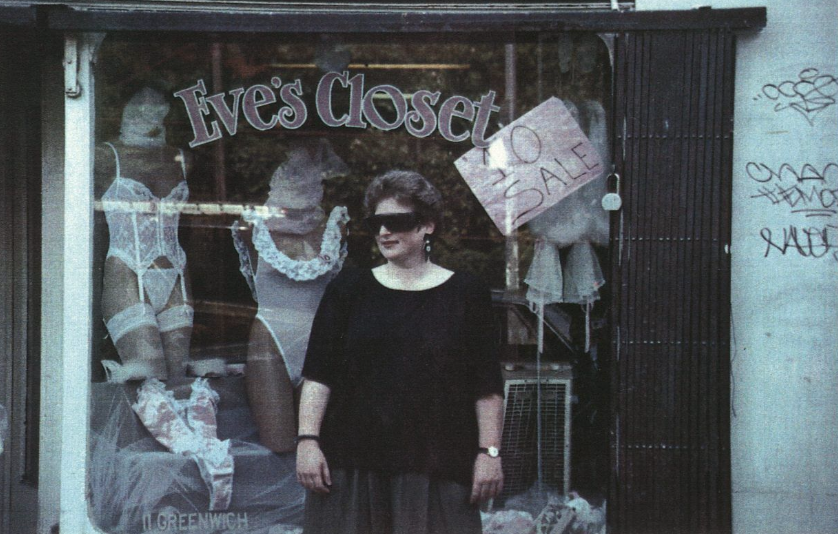
I call this moment, and the gendered and (trans)sexual activity that transpired there, “Eve’s closet.” Play in Eve’s closet is my descriptor for queer and trans pleasure in the curvature of sexual and gendered spaces, what Sedgwick described in a response to an essay by Jacob Hale as an “identification with what is, at any given moment, understood to be the growing edge of a self.” It recalls moments of childhood play—“of daring surmise and cognitive rupture”—between queer and trans kids (here trans feminine and trans masculine), where clothing, make-believe, and toys are the “very stuff” of queer sexuality and/or where friendship is a medium for gender transition or sex change. Eve’s closet is a funhouse for kids: comprised of many entrances and exits, where they are encouraged to come in and come out when they are ready. It is like a theatre’s backstage, or a dressing room, where costume choices are endless. In Eve’s closet, and in play among children, even bridal lingerie has queer and trans potential.
Eve Sedgwick poses in front of a shop called Eve’s Closet, Greenwich Village, NY, undated. Eve Kosofsky Sedgwick Papers, Box 16.
I visited the Eve Kosofksy Sedgwick papers at Duke University’s Rubenstein Library with an interest in Sedgwick’s writing on trans feminine childhood—what was then-called “feminine boyhood,” “boyhood effeminacy,” or “boyhood femininity” in common parlance of queer theory in the 1990s. I am interested in how stories of trans feminine childhood—of feminine boyhood and trans girlhood—have been written and performed in theatre and the performing arts, especially when friends (or other queer- and trans-loving collaborators) are the chosen or desired audience members or co-stars. I read an early 1989 draft of her now-famous essay “How to Bring Your Kids Up Gay,” later re-published in Tendencies in 1993 with the subtitle “The War on Effeminate Boys,” as well as her lesser-known 1989 essay “Willa Cather and Others” on Cather’s 1905 short story titled “Paul’s Case: A Study in Temperament.” But I soon became fascinated by Sedgwick’s collaborations with her best friend and once-roommate Michael Moon, especially their co-authored 1990 essay, more of a “performance piece,” on the topic of “divinity,” what they called “a little-understood emotion.”
In “Divinity,” Moon and Sedgwick reflect on the “roominess” of the fat woman’s body—and her closet—for the feminine boy. While I am interested in the content of the essay (especially a film still of Divine and the “Infant of Prague” from John Waters’ 1970 film Multiple Maniacs, and I certainly have my own stories of play in fat women’s closets as a girly-boy), for the purposes of this report, I want to dwell on Moon and Sedgwick’s collaboration for what it teaches us about the pleasure and play of the trans masculine and trans feminine relation. In Sedgwick’s papers, there are multiple drafts of “Divinity”—some with misplaced paragraphs, others with Moon’s and Sedgwick’s marginalia, and a few with Moon’s initials swapped for Sedgwick’s and vice versa, as if they were sharing and exchanging each other’s voices, or playing dress up with each other’s bodies, if you will.
Moon and Sedgwick both spent time in the closet. Moon as a “proto-gay,” feminine boy and Sedgwick as a fat woman who accompanied them there (and who was, especially in her white glasses, a fat woman who was a gay man). But they also stepped outside them quite proudly and defiantly, both together and apart, like me and my friend. For Moon and Sedgwick, their play-space was writing; for my friend and I, it was clothing. Inspired by Moon and Sedgwick’s essay and my photograph, we might make the claim that queer and trans children’s play with each other (both “actual” children and the inner child of the queer or trans adult who is “co-present,” not gone, after Mary Zaborskis) can constitute felt and pleasurable enactments of queer sexuality and/or gender transition beyond the confine of an “adult”—legal, medical, and political—form of legibility and between friends.
Play in each other’s shared clothing is co-authorship. It a chance for queer and trans kids to stage the bodies and lives they want for themselves and their friends, at least for the time being, and until they have the autonomy to demand more from the world at the level of sexual and gender-determination in an adult-centric world. In extant queer and trans scholarship and popular culture, tomboys and sissies are often staged far apart from each other. But what about their conviviality and solidarity—the “I have what you need/want, you have what I need/want” kind of mutual aid? Think: my photograph. It occurs to me that in our play, a repertoire that was certainly “t4t,” we relished the share of clothing, bodies (body parts?), and toys that sustained our queer and trans childhood—little-by-little, day-by-day, and moment-by-moment, like the best scenes of queer and trans childhood’s “divinity.”
In this sense, play among queer and trans children is best encapsulated in Sedgwick’s last words on the “divine” collaboration between Divine and Waters (and, I add, herself and Moon, and me and my friend). This play, is, as Sedgwick writes, “as scarce as it is precious.” It offers us “opulent images and daring performances that suggest the experiment of desires that might withstand the possibility of their fulfillment.” In the absence of a certain fulfillment, there is no “finale” to such play’s enactment of desire. Instead, there are only a bunch of opulent and daring debuts with the friends who withstand the often frustrated, unrealizable experiments in queer and trans desire with you. This is “Eve’s closet,” where children can change their genders/sexualities, stage a scene, and strike a pose with a friend, always as if for the first time. There may even be someone queer- and trans-loving around to photograph it.
Dispatches from the David M. Rubenstein Rare Book and Manuscript Library at Duke University