It’s that time of year when we report our annual statistics to our administration. We thought we would share these with you, too.
839 Book Repairs (down 23% from last year)
1,439 Pamphlets (up 35%)
12 Treatments: Other (not reported last year)
2,434 Flat Paper (up 75%)
6,822 Protective Enclosures (up 14%)
13,966 Disaster recovery (up 21,067%)
34 Exhibit mounts (up 325%)
89.25 hours of time in support of exhibits (includes meetings, treatment, installation, etc.) (down 88%)
1,206 items repaired for digital projects (up 20%)
58 items repaired for exhibits (up 2%)
2 items repaired for multi-spectral imaging (not reported last year)
72% of total work was for Special Collections
28% of total work was for Circulating Collections
90% of work was Level 1 [less than 15 minutes to complete; 22,985 items]
9% of work was Level 2 [15 minutes – 2 hours to complete; 2,228 items]
1% of work was Level 3 [2 – 5 hours to complete; 280 items]
0% of work was Level 4 [more than 5 hours; 19 items]
Level 1 work was greatly skewed by the amount of mold removal we did for one Rubenstein project. For that project we removed mold from almost 13,000 sheets of paper. You can see that reflected in our 3-year trend.

The Lisa Unger Baskin Exhibit took a lot of our conservator’s time last year. The opening at Rubenstien Library was a huge success. We are preparing those materials for a loan to the Grolier Club later this year. We also did a significant number of Level 1 rehousings for two collections from Rubenstein Library. One was part of the mold-removal project, and the other was the boxing of the Curtis folio plates.
This year we also significantly changed our statistical reporting. We added a “Level 4” to the treatment levels. Until last year, Level 3 (over 2 hours) was as high as we parsed out complicated repairs. This year we decided that Level 3 would reflect 2-5 hour treatments, and Level 4 would reflect treatments over 5 hours. While statistically Level 4 treatments were zero, we did complete 19 of these repairs. We also started tracking the number of hours we spend doing administrative work such as meetings, curatorial reviews, training sessions, handling assistance, etc. This better demonstrates our cross-departmental work and shows how integrated we are in the larger library setting.
Other Things We Did Last Year
- We hosted 32 tours of the lab totaling 97 people
- We presented 13 Care and Handling Training sessions to DUL staff totaling 46 people
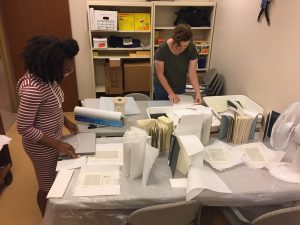
- We hosted our second HBCU Library Alliance/University of Delaware-Winterthur conservation intern.
- We continue to host Girl Scout bookbinding-badge workshops.
- We did cool things like publish instructions on making book futons; we got a suction table; did some environmental testing in our exhibit spaces; wrote about the hidden labor of Conservation; and finished these amazing boxes for the Curtis “North American Indian” series thanks to a generous supporter through the Adopt A Book Program.
The most exciting thing about FY 2020 is that we will surpass the quarter-million mark for items sent to the lab. We are currently at 247,943 cumulative repairs/enclosures since FY 2003.
 We hope you enjoy looking back at FY2019 as much as we did. We know FY 2020 holds a few interesting challenges including helping prepare the Lilly Library for renovation. We hope you will keep up with us through this blog and through our social media accounts. Happy FY 2020!