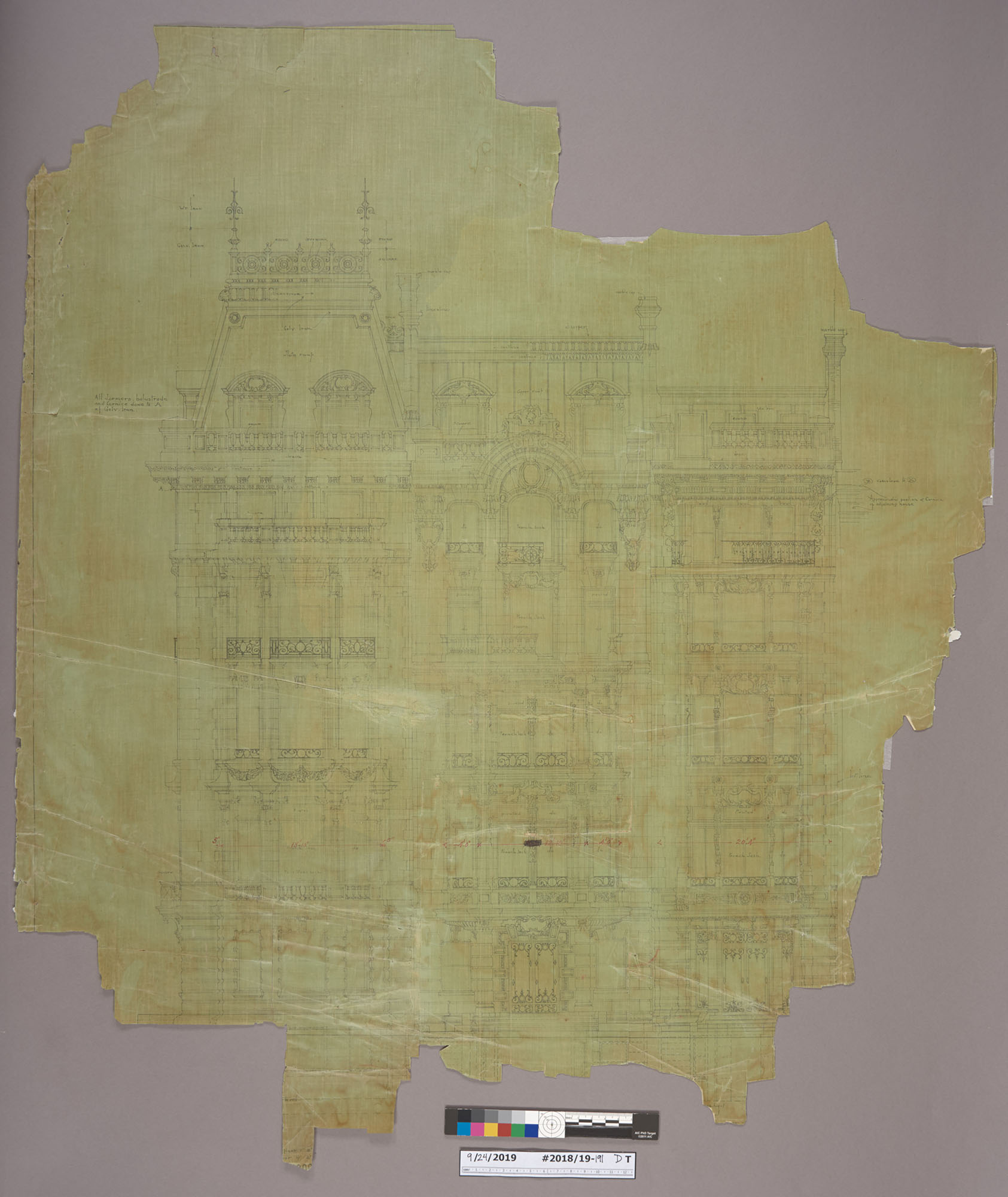
Yesterday, I was going through some collection material from the Duke family that had been transferred to the conservation lab for review and noticed an image of a very familiar-looking building. I knew I had seen it before, but I couldn’t remember where.
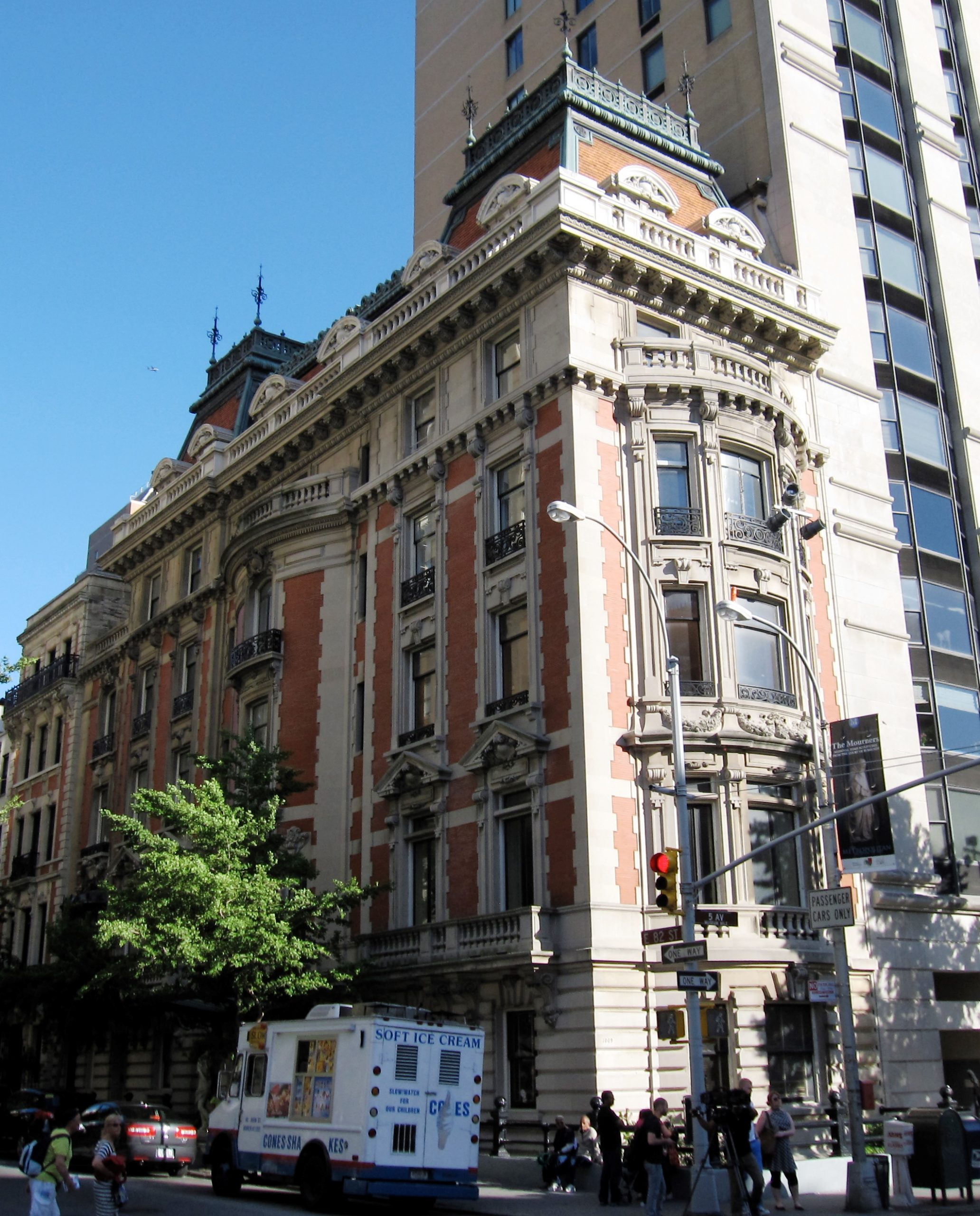
1009 5th Ave, circa 1927
It turns out, I had been looking at it for several weeks. Rachel Penniman has been treating architectural drawings of the same building!
And not only that – I had seen it in real life just a few months ago. Known as the Benjamin N. Duke House, this property is located at 1009 Fifth Avenue in Manhattan, just across from The Metropolitan Museum of Art. I had stopped by The Met after we finished our exhibit installation at the Grolier Club back in December. I stared right at it as I was leaving the museum and didn’t know what I was seeing.
The photograph and drawings that we have in the lab depict the matching limestone and red-brick facades of two other buildings along fifth avenue. Sadly, those structures have not survived.
1009 5th Ave, Today
A few years ago, the mansion received considerable attention when Mexican billionaire Carlos Slim listed it through Sotheby’s for $80 million and it became one of the most expensive public listings in New York.
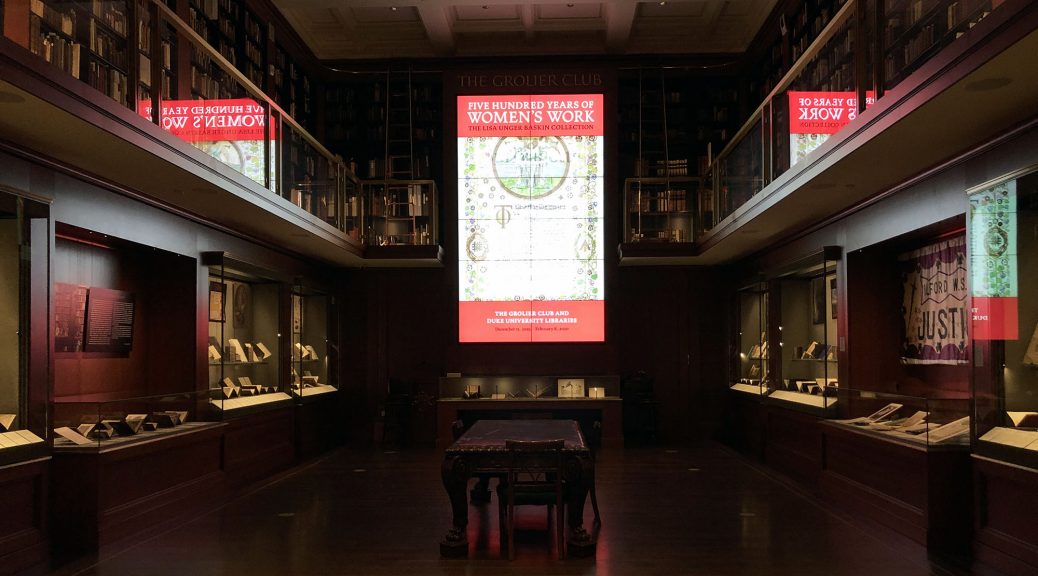
Tomorrow is your last opportunity to visit an exhibition of select items from the Lisa Unger Baskin collection at the Grolier Club. This exhibition opened at the beginning of December 2019 and has received a great deal of attention from media outlets like The New York Times, The Washington Post, Smithsonian Magazine , and New England Public Radio (just to name a few). We have been so pleased to hear all the positive feedback and see images of the Grolier’s ground floor gallery packed with visitors. Many of our staff put a great deal of work into making this exhibition happen, and, as we prepare to travel back to New York to pack up, I thought it would be fun to share some of the “behind the scenes” photos of installation.
The week after Thanksgiving, a team of Duke Library staff braved sleet and snow to begin our installation at the Grolier Club. We arrived to a brightly lit exhibit gallery and lot of carefully packed collection material on temporary work tables. We had five days to install five hundred years of women’s history – and it was going to be a busy week.
Day 1: Head of Exhibition Services, Meg Brown, surveys the exhibit space… and the large pile of unpacked boxes.
After a short huddle and review of our work plan, we broke up into two teams and dove right in. The first team was assigned the task of unpacking all the signage and large reproduction images that would be hung at the tops of the case walls and in the gallery alcoves.
Senior Library Exhibition Technician, Yoon Kim, matches reproduction image panels with the proper exhibit case.
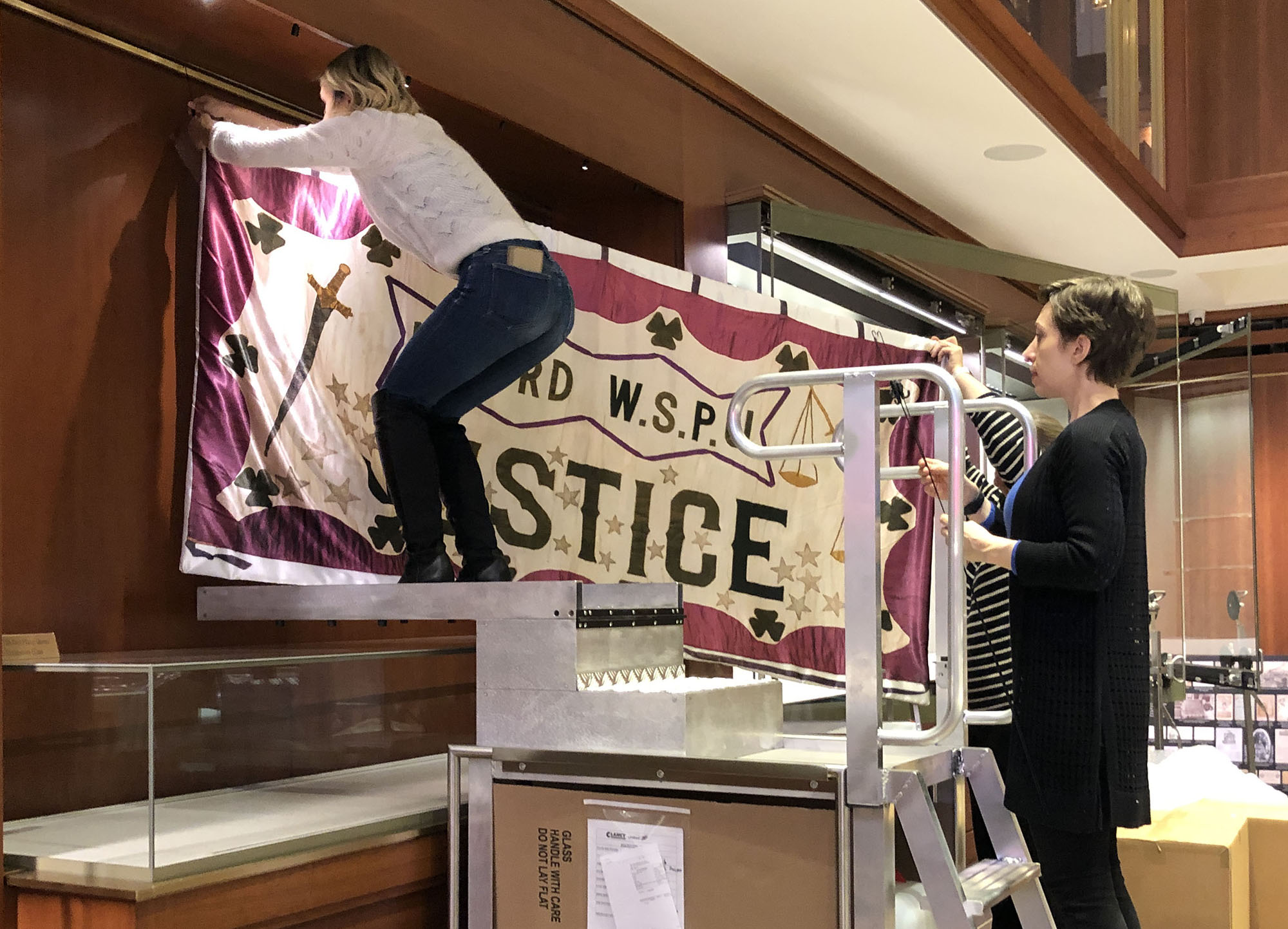
After locating each hanging piece and placing them in the appropriate exhibit case or location, the process of actually hanging began. Some objects, like the life-size reproduction suffrage banner (pictured below), required a special platform so that staff could safely access hanging hardware above the wide table case vitrines.
Grolier Exhibitions Assistant, Bee Hughes (left), Meg Brown (center-right), and Grolier Exhibitions Manager, Jennifer Sheehan (right) hang a large reproduction banner.
As the hanging continued, Lauren Reno, Head of Rare Materials Cataloging at Duke, and I began the process of unpacking and checking the condition of over 200 collection items that would be going on display. Each object needed to be accounted for, unwrapped, and reviewed for potential changes in condition. Last summer I wrote about our new method for documenting exhibit loans. I was able to run some small field tests last fall using the new method and computing hardware, but this was the first time it had been employed for such a large loan and with such a time crunch. The new documentation system performed very well and we were able to finish condition reporting ahead of schedule. I plan to share more about the documentation system in future blog posts.
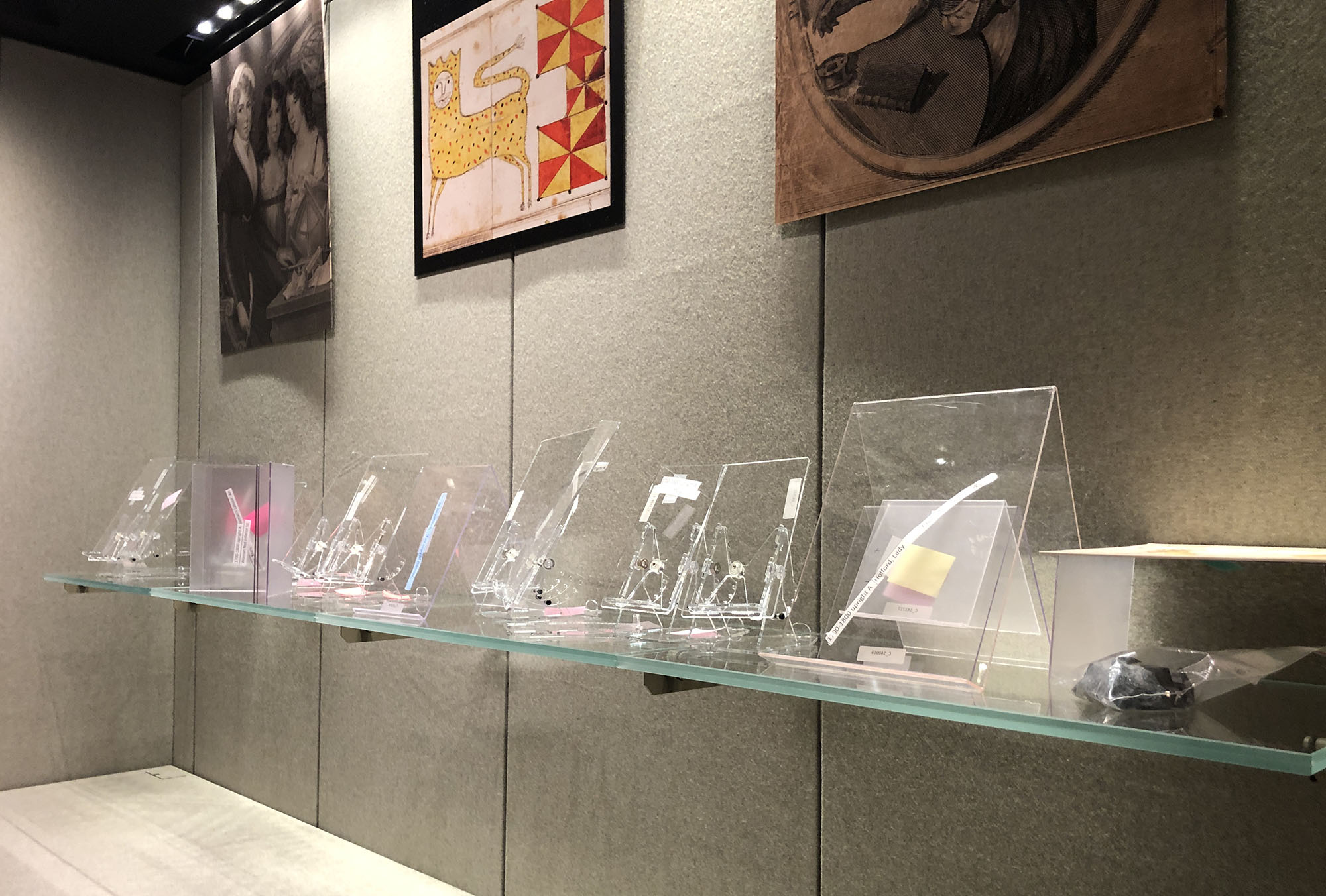
With the hanging complete and each item unpacked and checked off, it was time to sort out the exhibit supports. Yoon Kim had spent many months fabricating the custom cradles, upright angles, or support boards needed to safely support the wide variety of collection materials. During packing, we affixed small labels printed with the item’s Aeon transaction number to the underside of each piece of the support. Using a wire frame diagram of each case layout, it was easy to assemble each book cradle and place it in the correct location inside the exhibit case.
Empty supports (with labels) placed inside the exhibit case.
At this point the teams converged to begin mounting each item to it’s support and installing them inside the correct exhibit case. Objects were secured to their mount using polyester or polyethylene strapping.
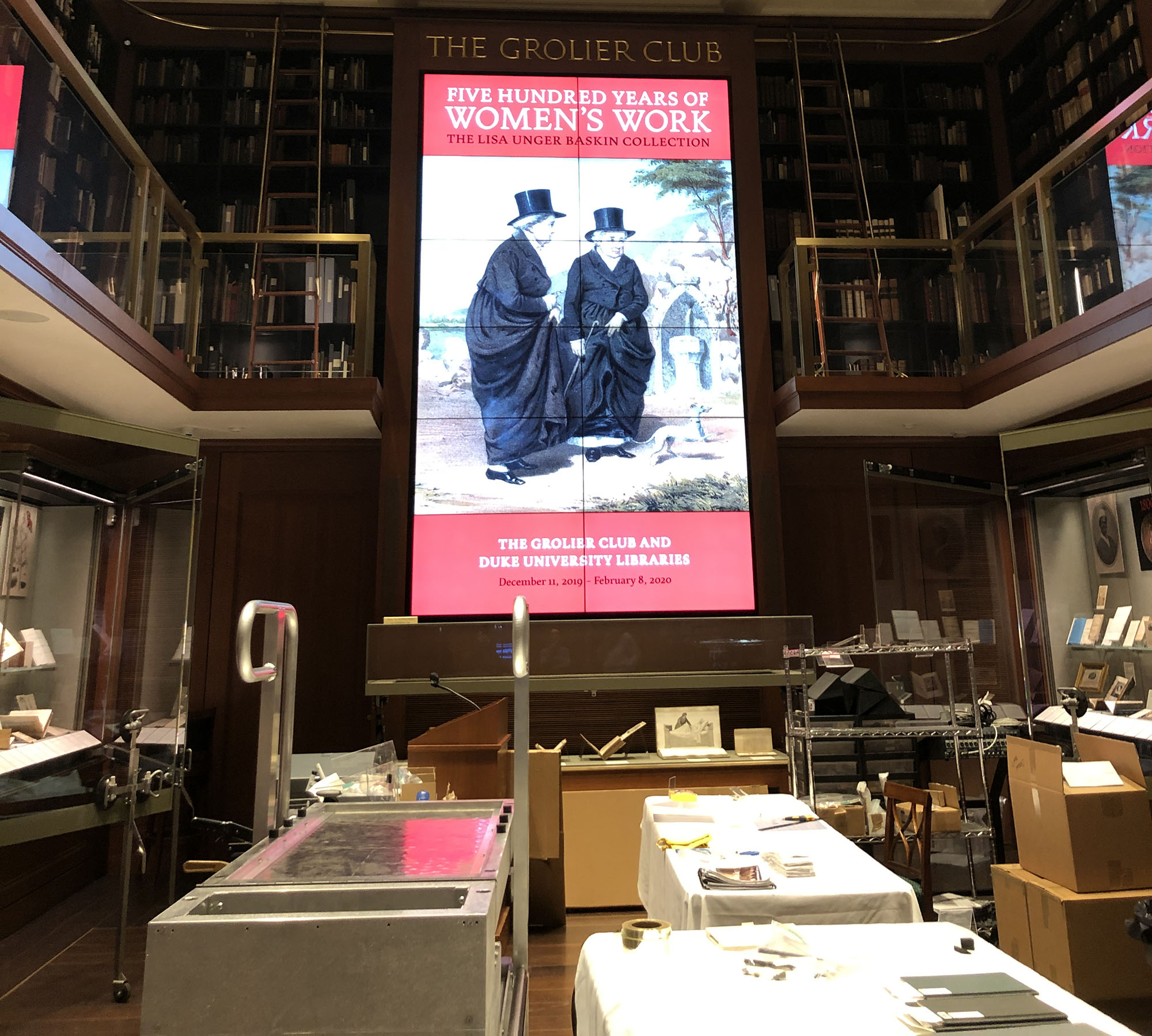
While we were all working to ready the physical materials, Grolier staff were setting up the large digital display, which would rotate a gallery of images from the collection. Despite the crowd of tables and equipment on the floor of the gallery, you could really see the exhibition beginning to take shape.
Sometimes because of the weight distribution of an item, a cradle needed to be attached to the glass shelves or metal case decks. In those situations, we were able to use stacks of neodymium disc magnets to secure the cradle. The printed exhibit labels were also attached to the case backs and label rails with small magnets.
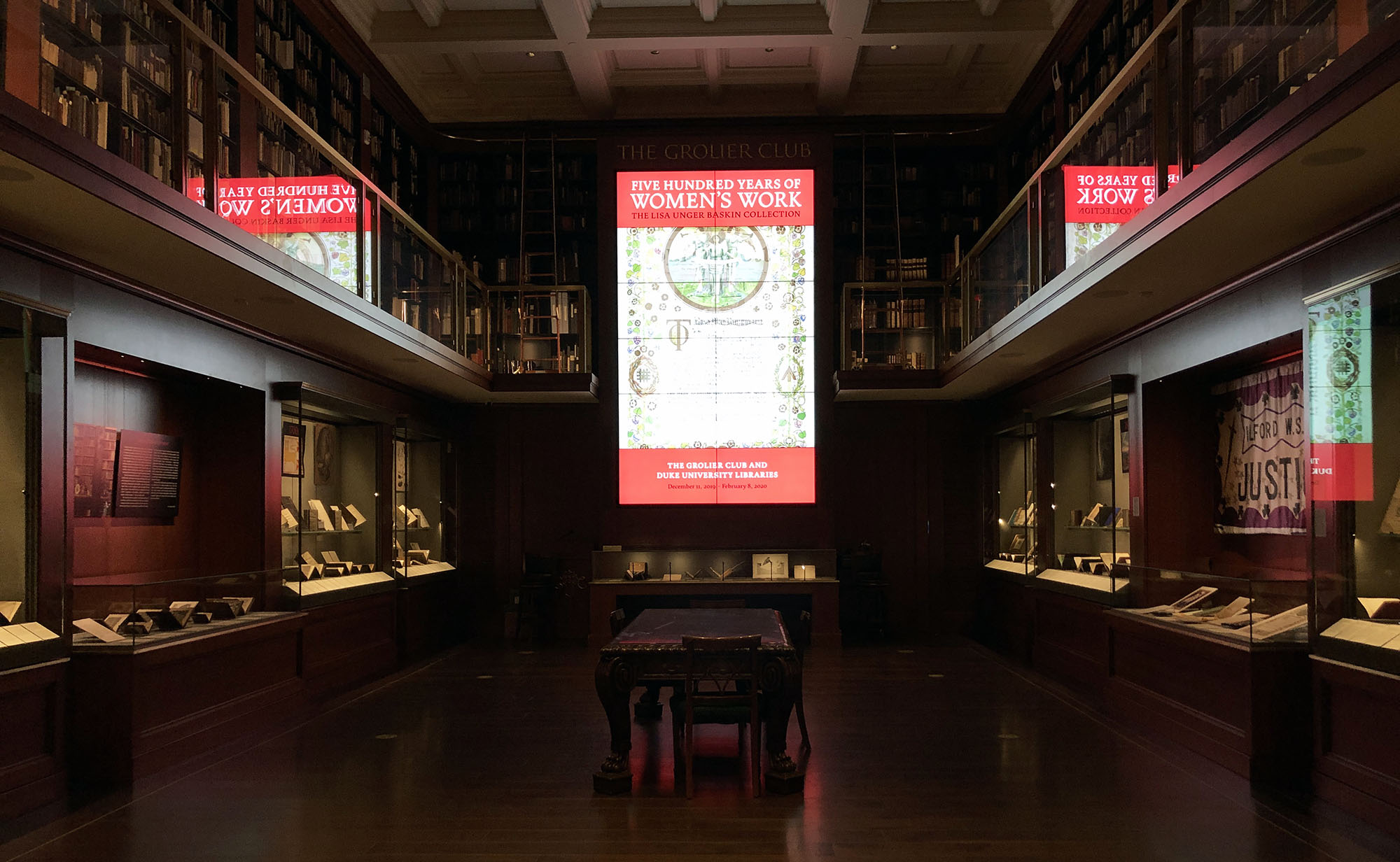
With all the items in place, we began the final step of lighting the space. Going case by case, we took light readings at each object and then added, removed, or adjusted LEDs to an appropriate level. It is such a challenge to achieve lighting that is bright enough for visitors to clearly see an object and is also appropriate for the light sensitivity media or photographic materials; however, after many rounds of review and tweaks, we were finally ready!
Even though we had already exhibited this same collection of items at the Rubenstein Library in early 2019, this somehow felt like a totally different exhibit. It required a great deal of planning and preparation to travel and install a loan of this size at a partner institution and we all learned so much throughout the process. In the end, I think all that work really shows in the final product and I’m glad that we were able to contribute to the mission of our institution by sharing and bringing awareness to a small sample of the cultural heritage we look after.
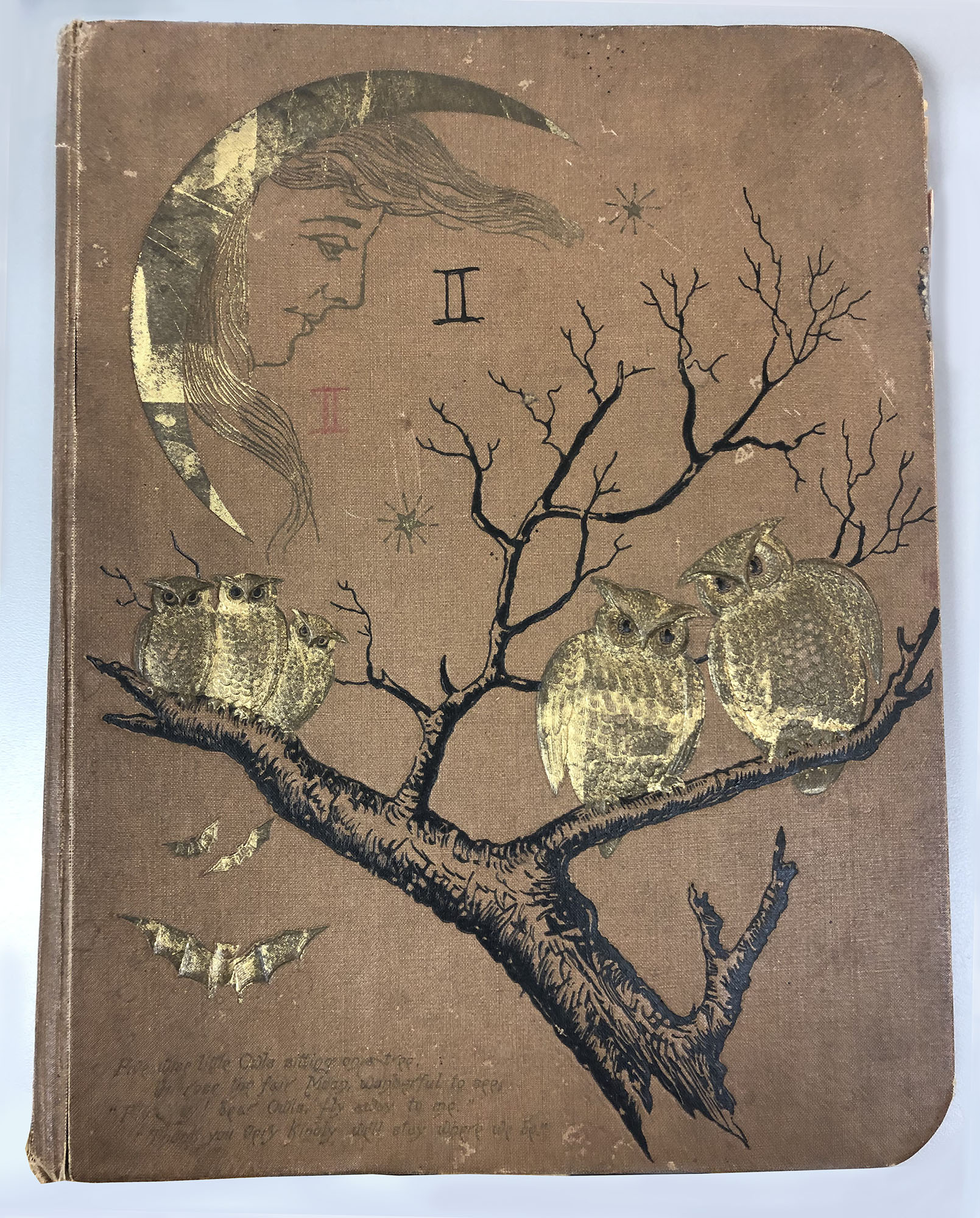
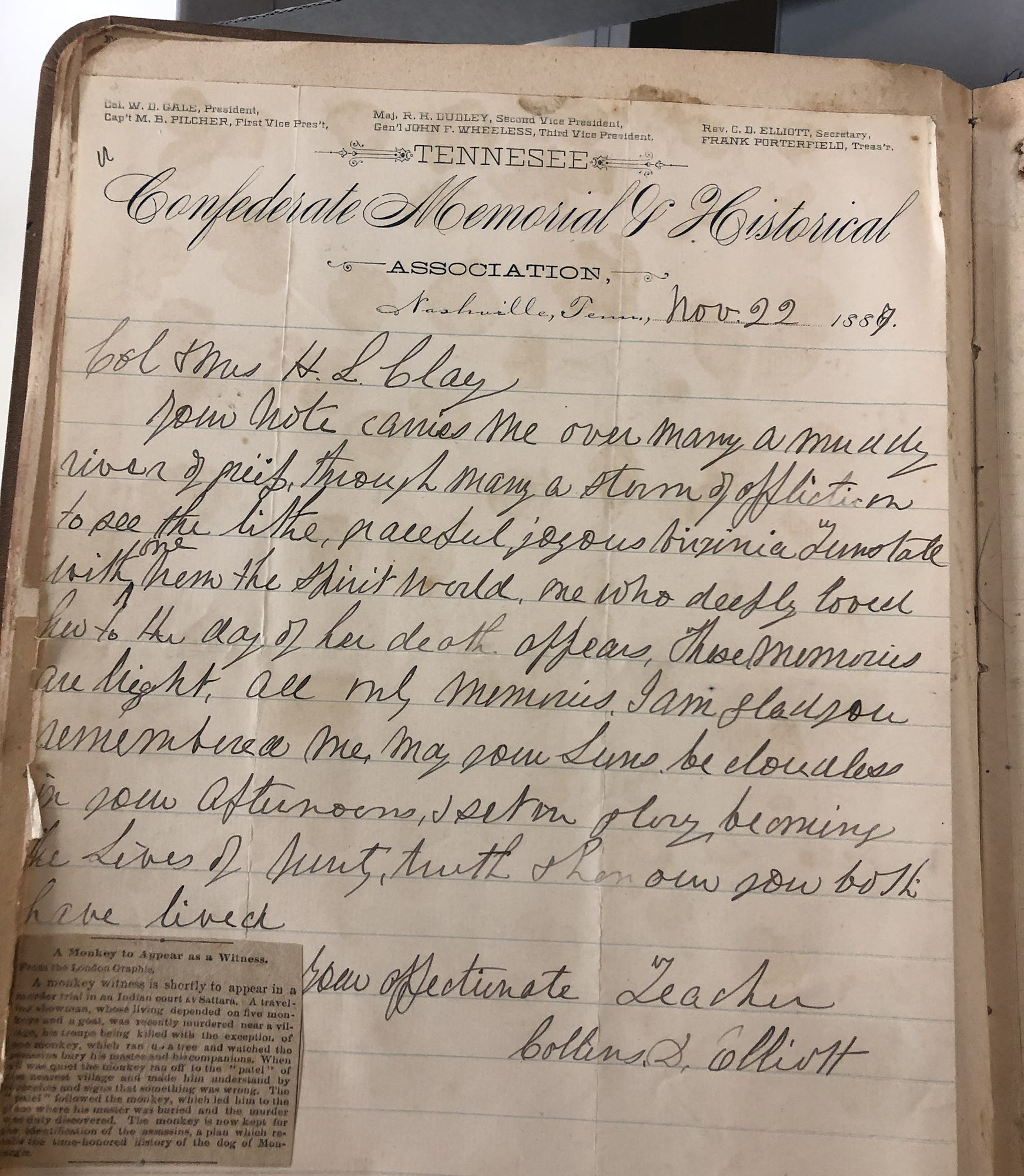
For a more adept criminal, it is probably obvious not to commit a crime in front of another person, as they can be called as a witness in court. Thanks to the scrapbooking efforts of Virginia Clay-Clopton in the late 1800s, today we learned that animals can be witnesses, too!
This scrapbook of Virginia’s (included in the C. C. Clay Papers, 1811-1925) came into the lab the other day for rehousing. It mostly includes correspondence from members of the Clay family in the post-Reconstruction period, but one little newspaper clipping caught our eye.
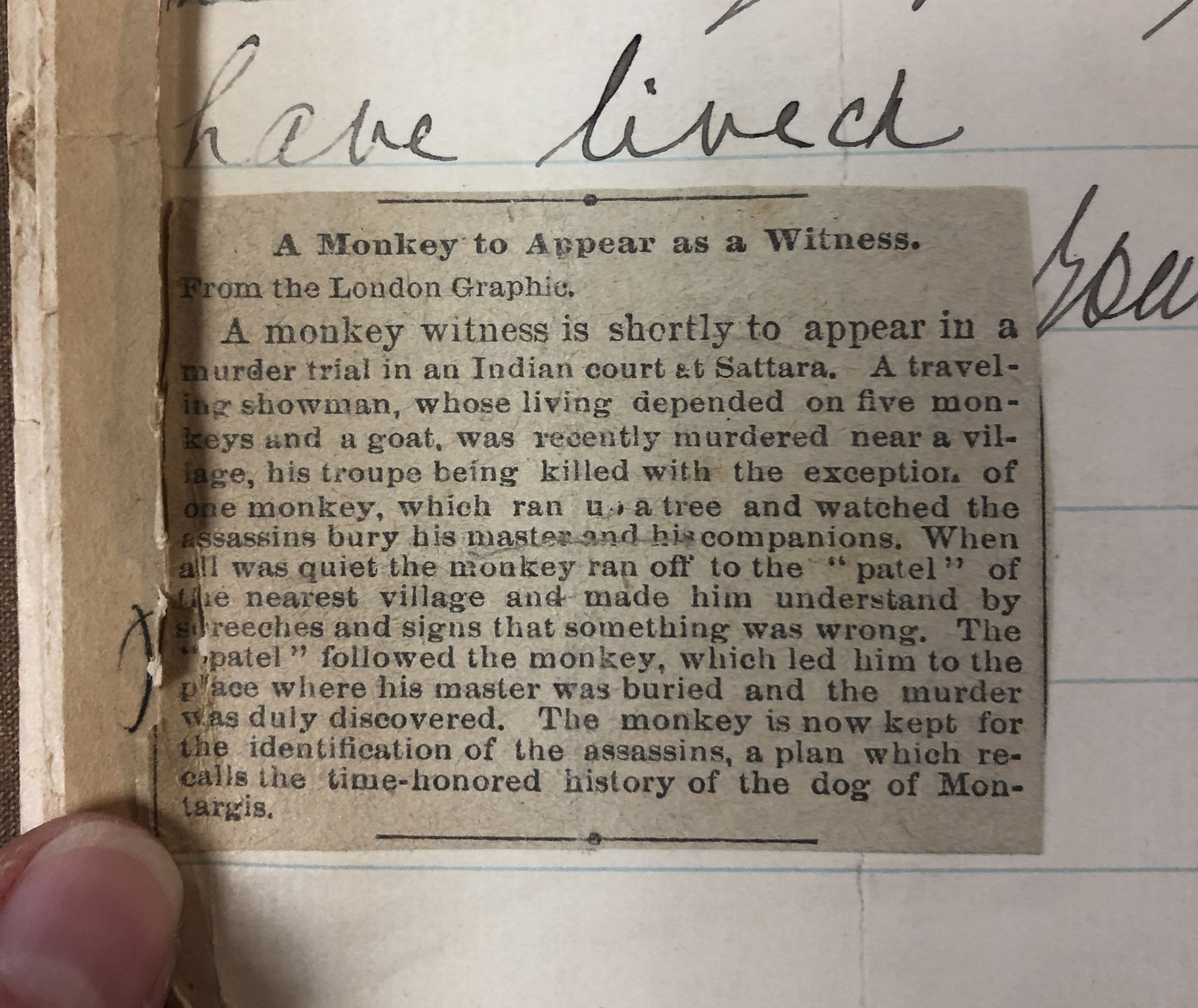
The clipping describes the murder of a traveling showman in India, which was apparently witnessed by one of his monkeys. I could not determine what eventually happened in this particular case, but the monkey was being detained as a witness.
The clipping’s mention of the Dog of Montargis lead us down a rabbit hole of stories about animal witnesses, historical and contemporary. In addition to monkeys and dogs, we read about legal proceedings involving a parrot named Echo, and a cat named Sal Esposito.
Here at the library, our primary position is that you shouldn’t commit crimes. I will leave it to experts in animal law to debate the admissibility of an animal witness – but if you are going to do some crimes, at least make sure there aren’t any monkeys around.
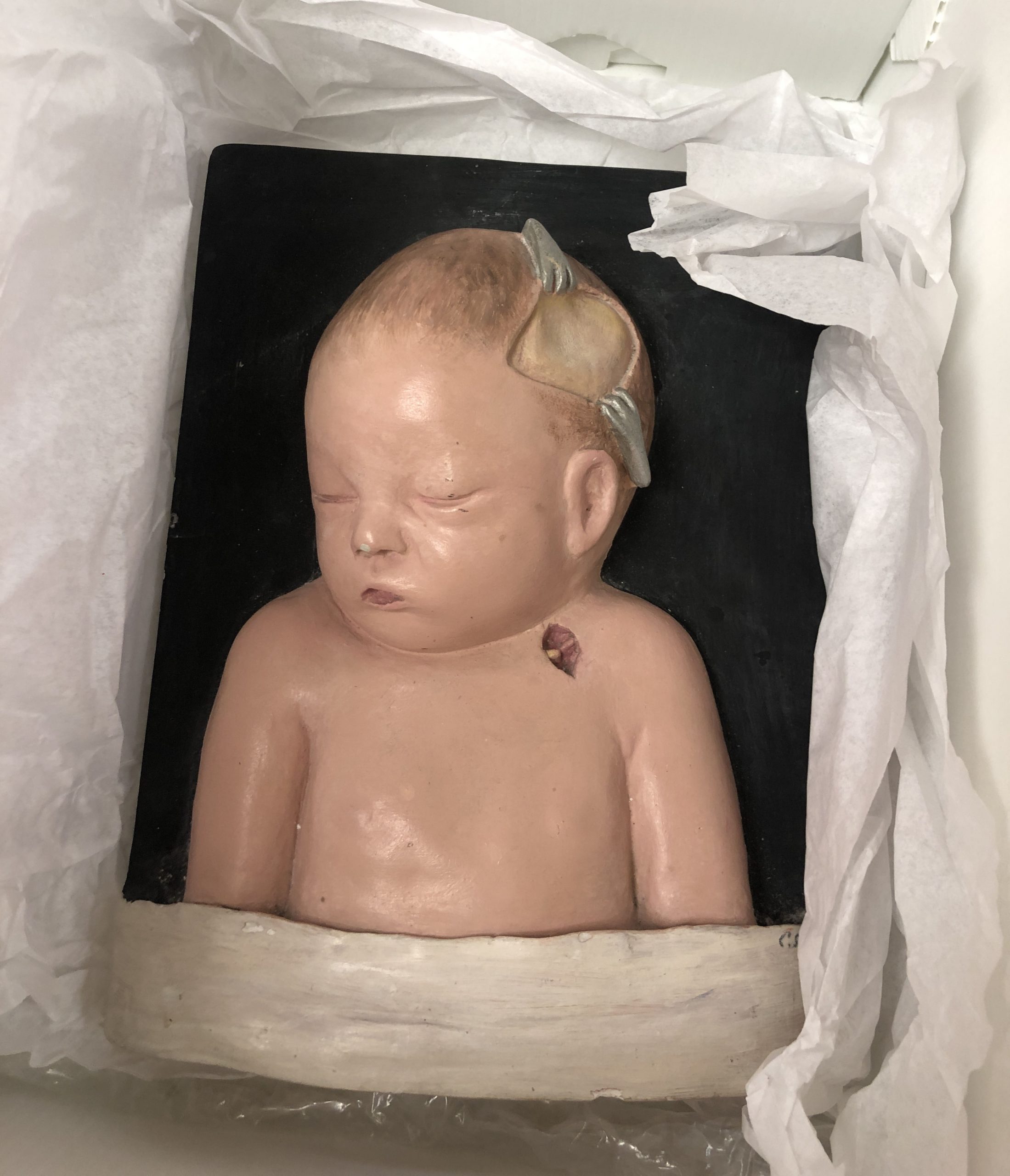
Today We Learned: Always read the label before opening a box from the History of Medicine collection. Moving aside the tissue paper packing, we were greeted by this sculpture a little too early this morning. We were not prepared for such a creepy surprise! Made by medical illustrator and sculptor Charlotte Holt in 1961, this hand-painted plaster relief sculpture depicts treatment of fetal skull and clavicle fractures. Holt’s attention to detail is excellent… which makes it all the more disturbing.
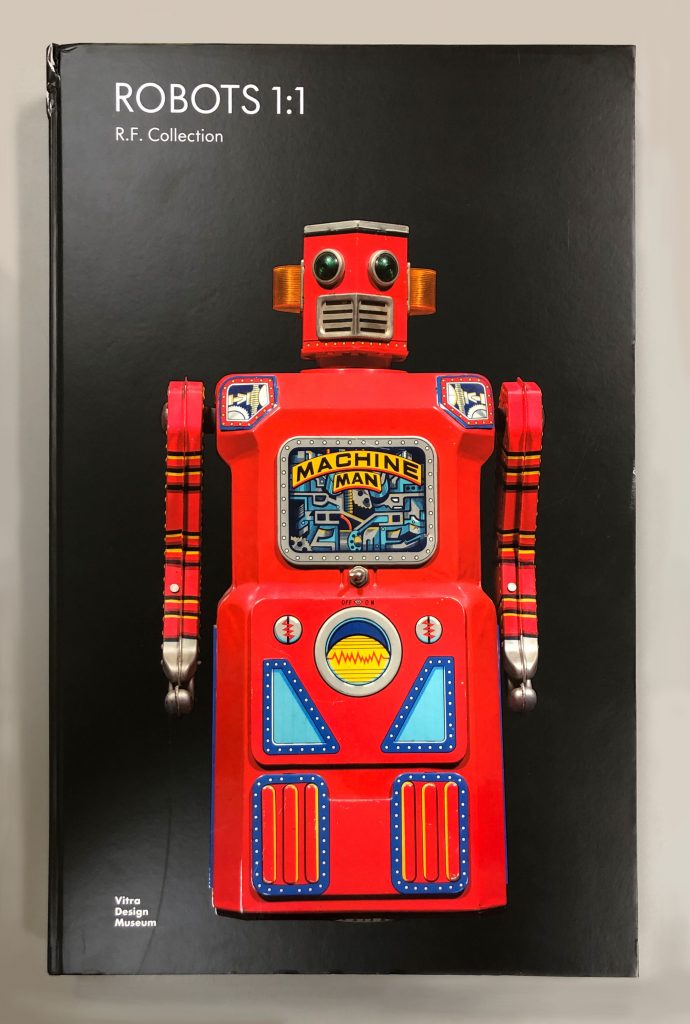
We regularly see book publishers’ attempts to set their products apart from the rest of the market here in the conservation lab – usually because the novel materials or structures they have chosen don’t hold up so well under normal use. We often find ourselves asking, “What will these publishers try next?” This week the answer to that question came in the form of robots.
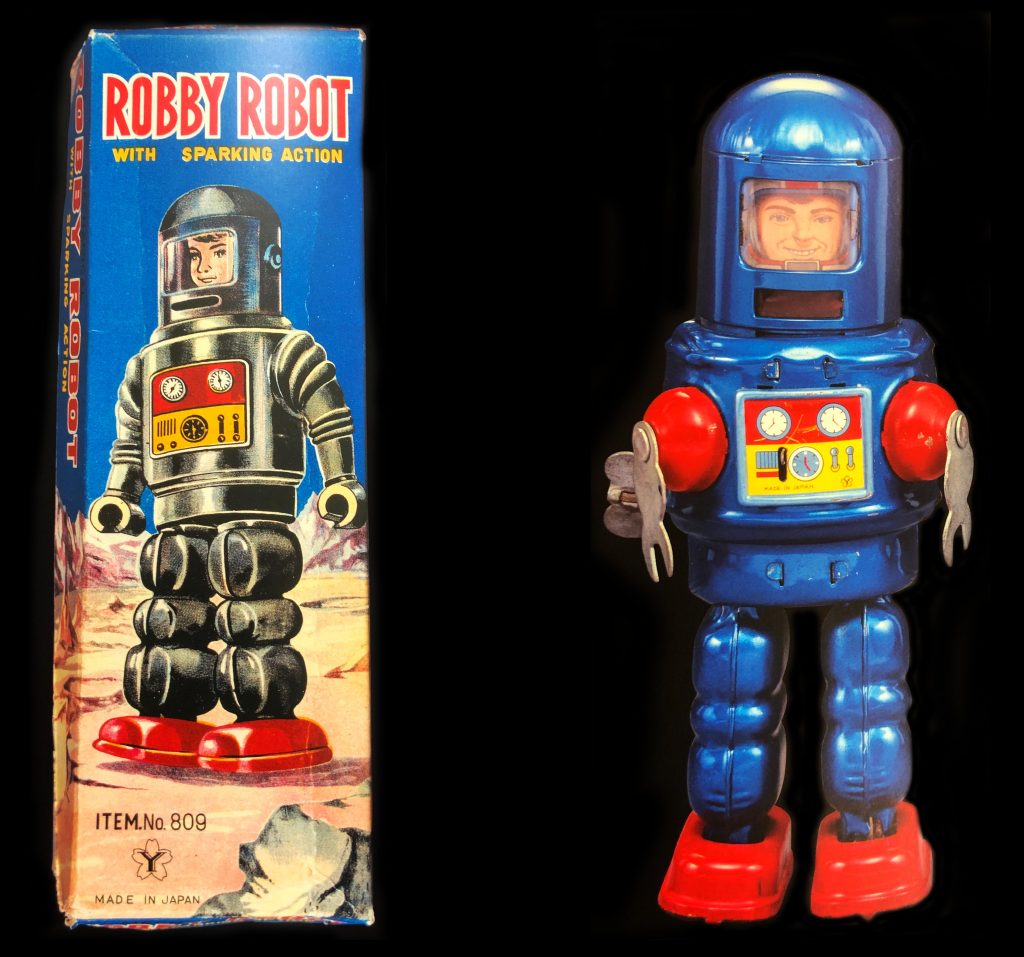
This very large and weighty volume depicts over 100 space-themed toys held by the Vitra Design Museum. Much like our copies of Audubon’s Birds of America, the book is so large because the toys and their original packaging have been photographed and printed at a scale of 1:1. And I will say the images are wonderful.
The unique feature of this book, however, is a USB memory stick that has been integrated into the headcap. The stick contains a film by Luka Dogan, showing a selection of the robots in action.
We often see volumes with additional media included, usually as a CD or DVD inside a paper or plastic pocket that has been adhered inside one of the boards. Other types of media are too thick to be handled in the same way, so the location of this USB and it’s “holster” are interesting and unobtrusive. It includes some nice design elements, like a small magnet to hold the stick securely in place.
The problem comes when you actually try to get the stick out. Grasping the stick and pulling it free puts a lot of stress on the headcap and joints, some of the weakest areas of the binding. As you can see, the front joint has already started to tear. Additionally, the glue holding the metal USB holster in place has failed and it now easily slides out from the spine piece.
Including additional media with a publication can provide a lot of additional value to the reader. It also means loose components can easily become lost. As technology ages, it can be a challenge for readers to actually use the media. For example, the laptop I’m using to write this post doesn’t have a disk drive of any kind, so reading a CD or DVD would be a problem. I guess it’s only a matter of time before a USB Type-A port becomes scarce as well. The added media might become less accessible, but at least you don’t need a machine to read the book!
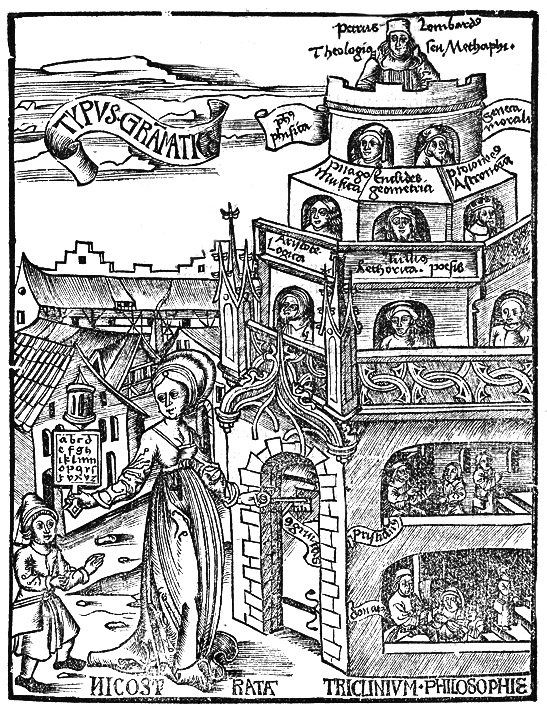
Margarita Philosophica by Gregorius Ileisch (1504), depicting a hornbook
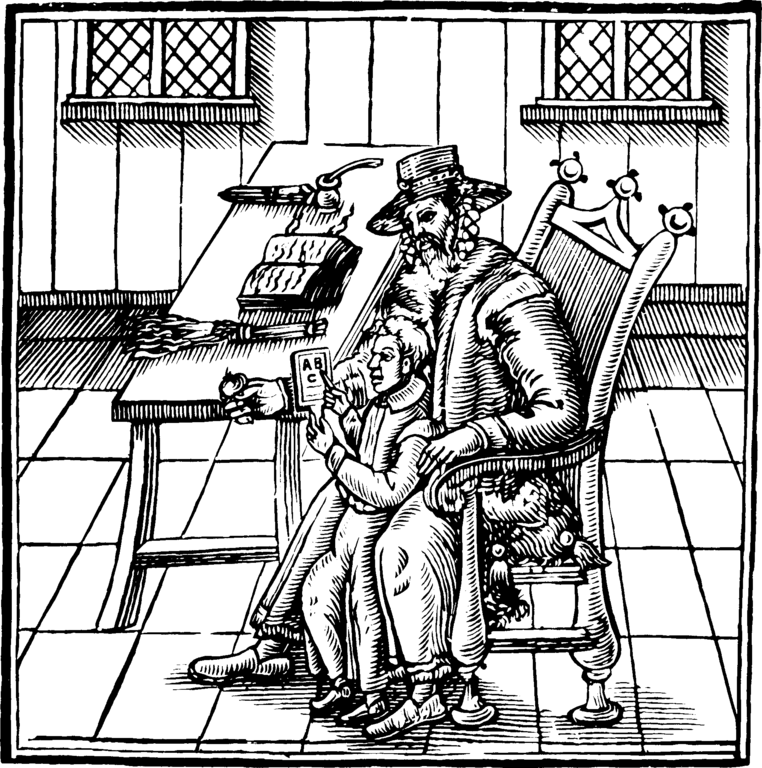
Long used as a primer in children’s education, the hornbook originated in England in the 15th century. The books commonly take the form of a wooden paddle inscribed with the alphabet or a piece of text, which is protected with a transparent sheet of horn. The materials of construction can vary, with the paddle made of wood, bone, leather, or stone. The text can be printed or in manuscript, on parchment or on paper. The protective transparent sheet might also be made from mica. The hornbook is referenced in literature as early as Shakespeare’s Love’s Labour’s Lost and is a format that was often used in both English and the American education until the late 18th century.
Woodcut vignette from the title page of Hornbyes Hornbook by William Hornby (1622)
We learned all this and more when a special edition of Andrew Tuer’s History of the Horn-Book came through the lab recently for boxing. The publisher’s use of the hornbook’s iconic shape in the decoration on the front cover and the spine label is quite appropriate.
But while this parchment case binding looks fairly ordinary, it contains quite a surprise. The front section of the book has been glued into a solid block, which is quite heavy.
The blocked section features a textile flap along the tail edge of the front flyleaf.
Opening the flaps reveals a hidden compartment with three facsimile hornbooks!
Don’t you wish every history book you picked up included little artifacts hidden inside a secret compartment? Thanks to Rachel Penniman for snapping some photos of this amazing object before it returned to the stacks in its new enclosure.
Erin Hammeke describes a wooden board repair to Mary Yordy and Rachel Penniman.
Caring for library collections often requires experimentation and ingenuity. In supporting the needs of library programs or researcher requests, we are regularly confronted with unusual objects or condition issues that have no obvious treatment solution. When you happen upon a novel or particularly effective approach to these complex treatments, it’s always nice to share what you have learned with your colleagues!
This week, the Conservation Services staff were treated to some tips in treating very large books and broken wooden boards by senior conservator Erin Hammeke. Hint: Both involve the liberal and creative application of clamps.
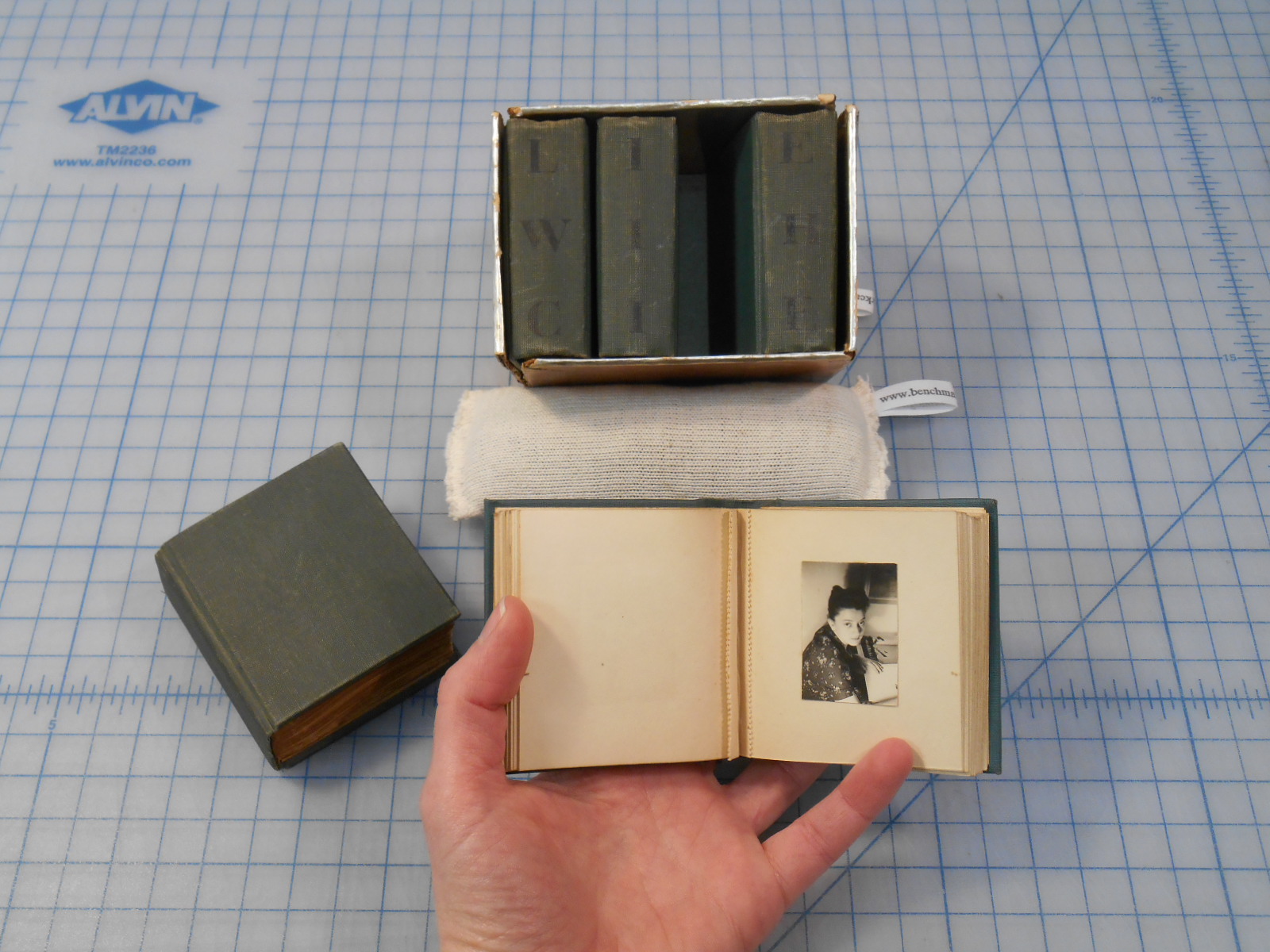
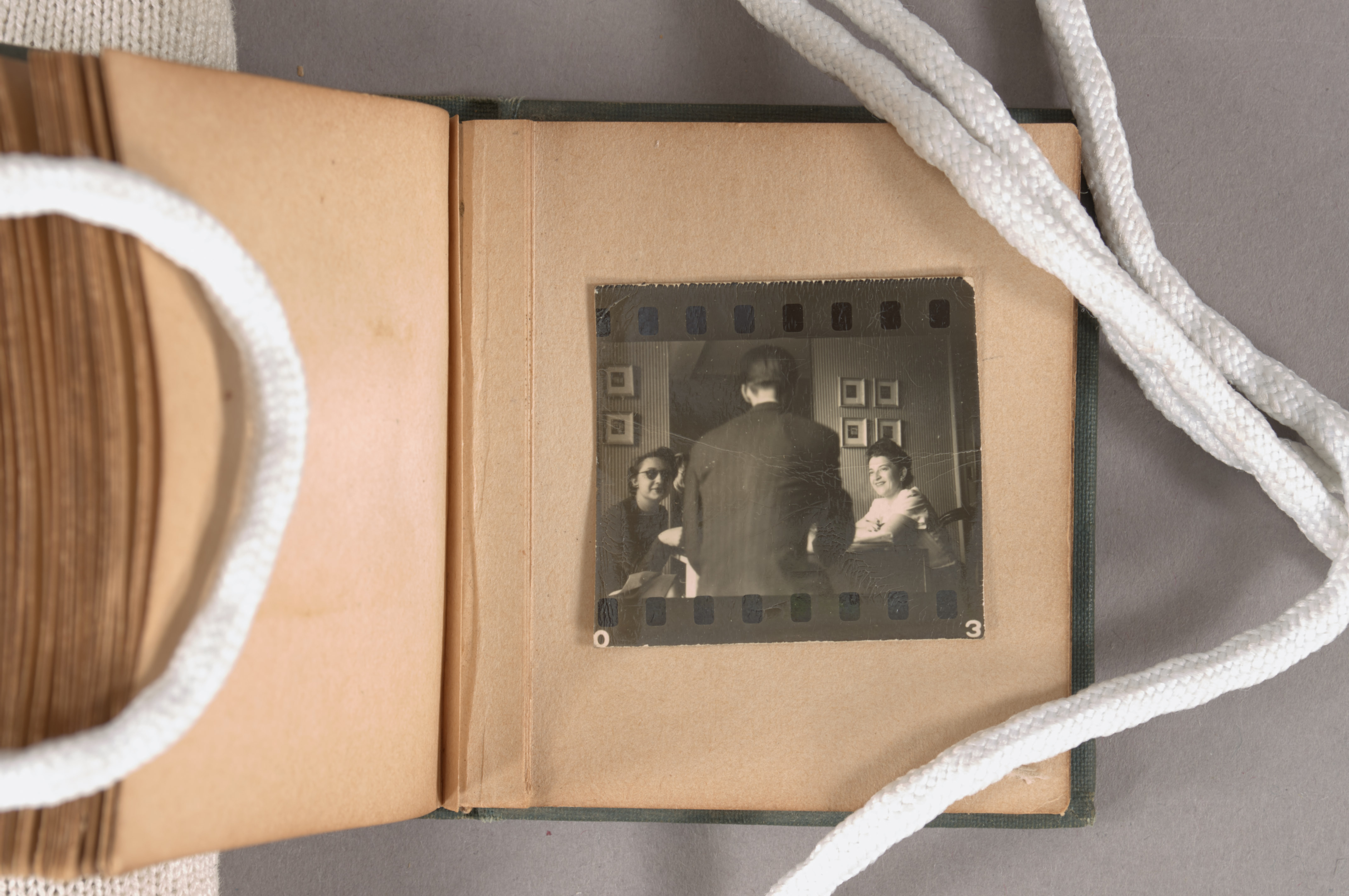
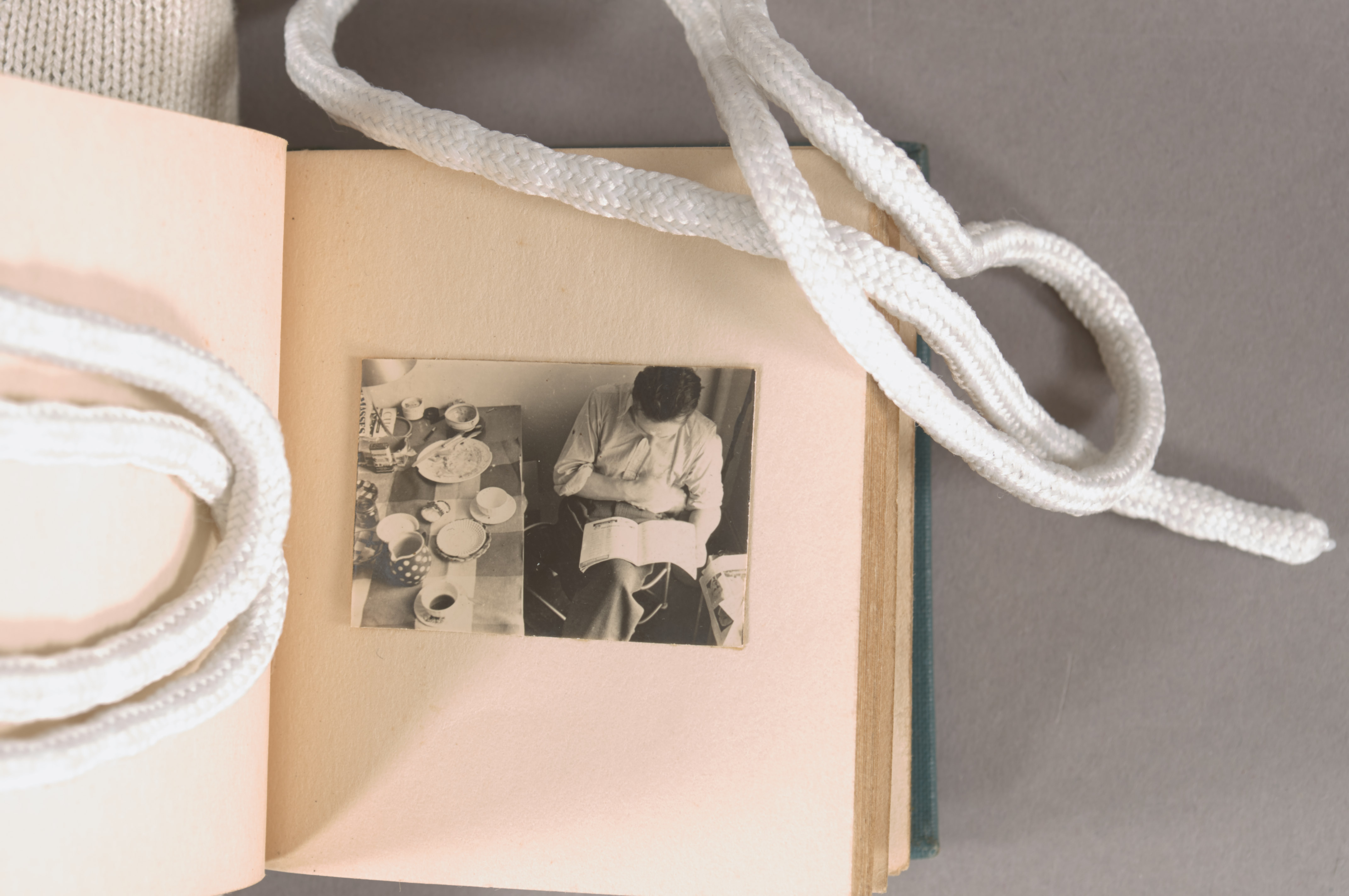
Occasionally an item will arrive in the lab that is so intriguing that I just have to know the story behind it. These five miniature photograph albums titled “LIFE WITH CIPE” caught my eye. The photographs were tiny but beautiful and I was curious about the meaning of the title. What is CIPE?
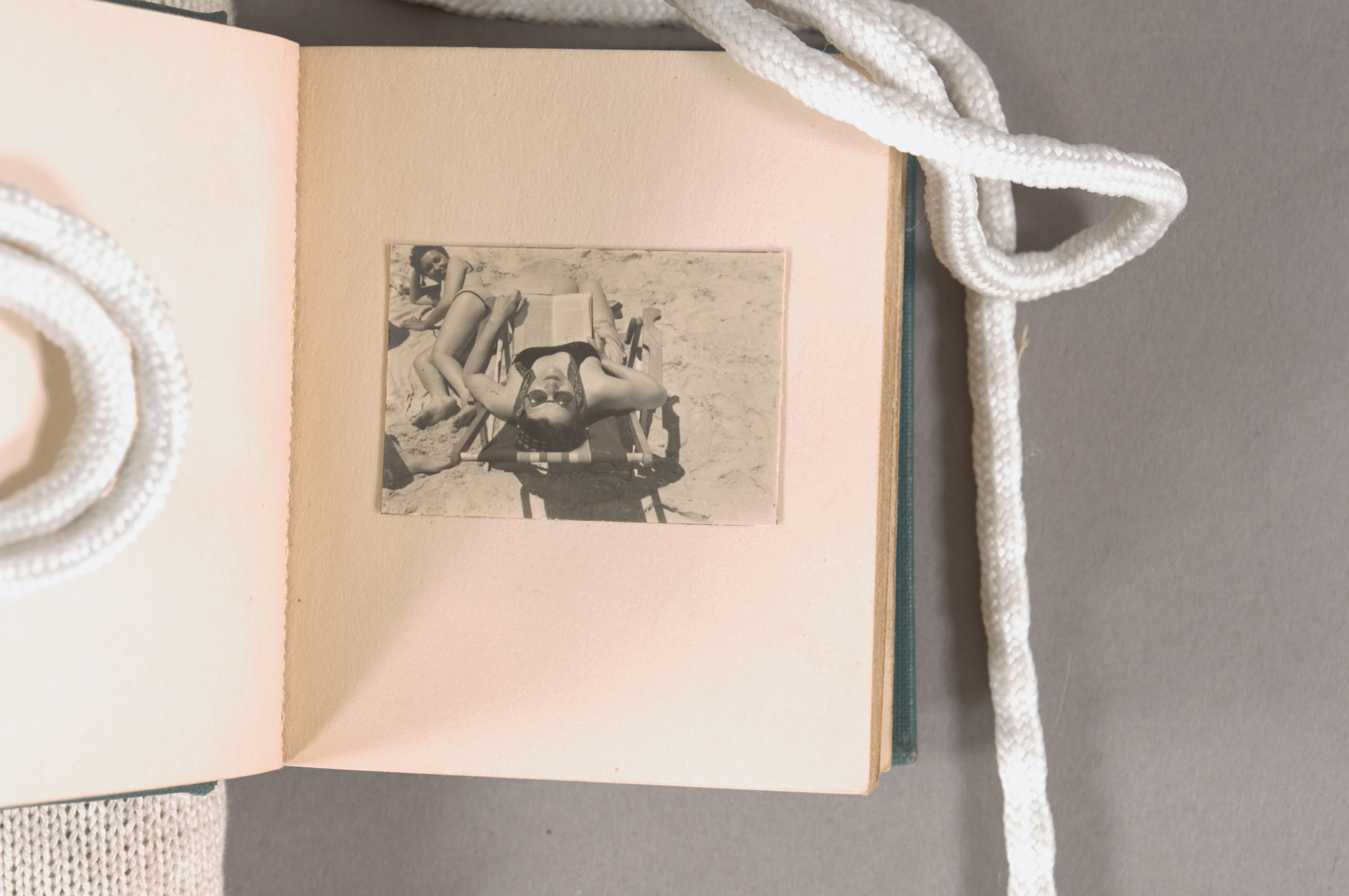
The photographs mostly look like candid vacation snapshots but there are also some still life and city scenes.
They are all so small and regular in size and proportion that they must have been printed from negatives as a contact sheet. One print even shows the holes from the film.
The images show a great sense of design and there is an eye to composition significantly better than your average family snapshots. They really felt more like an artist’s portfolio than a typical vacation album.
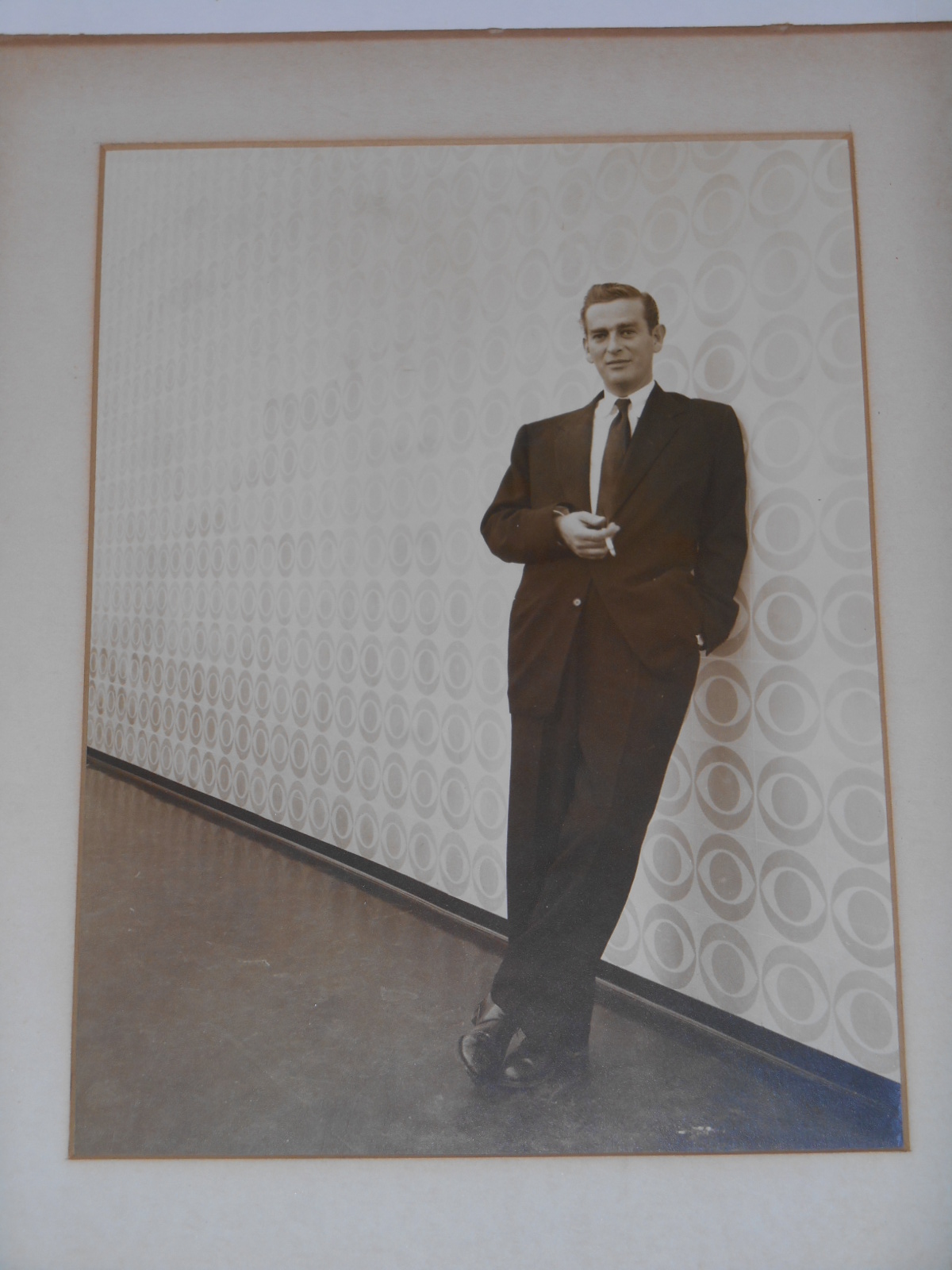
So it was no surprise when I heard back from archivist Rick Collier and Hartman Center Director Jackie Reid Wachholz that these are photographs from the personal collection of graphic design power couple Cipe Pineles and William Golden.
While the Creative Director at CBS in the 1950’s William Golden designed the eye logo still used by the broadcaster today.
Cipe Pineles (pronounced Cee-Pee) was the first female art director of a major magazine and the first female member of the Art Director’s Club of New York in 1943. Working at big name publications like Glamour, Seventeen, and Mademoiselle she created magazines directed at young working women that appealed to their intelligence and independence. She is also credited as being the first to commission fine artists like Ad Reinhardt and Andy Warhol for work in mass media publications.
In order to learn more about Cipe Pineles I borrowed a biography from Perkins Library and discovered it was written by none other than our very own conservation department volunteer Martha Scotford. Before becoming a volunteer in our lab, Martha was a professor of graphic design at North Carolina State University and is the reigning expert on Cipe Pineles. What a small world! I was so happy to be able to share this addition with Martha who recognized these albums from her visits to the Golden’s home when she was writing Cipe’s biography.
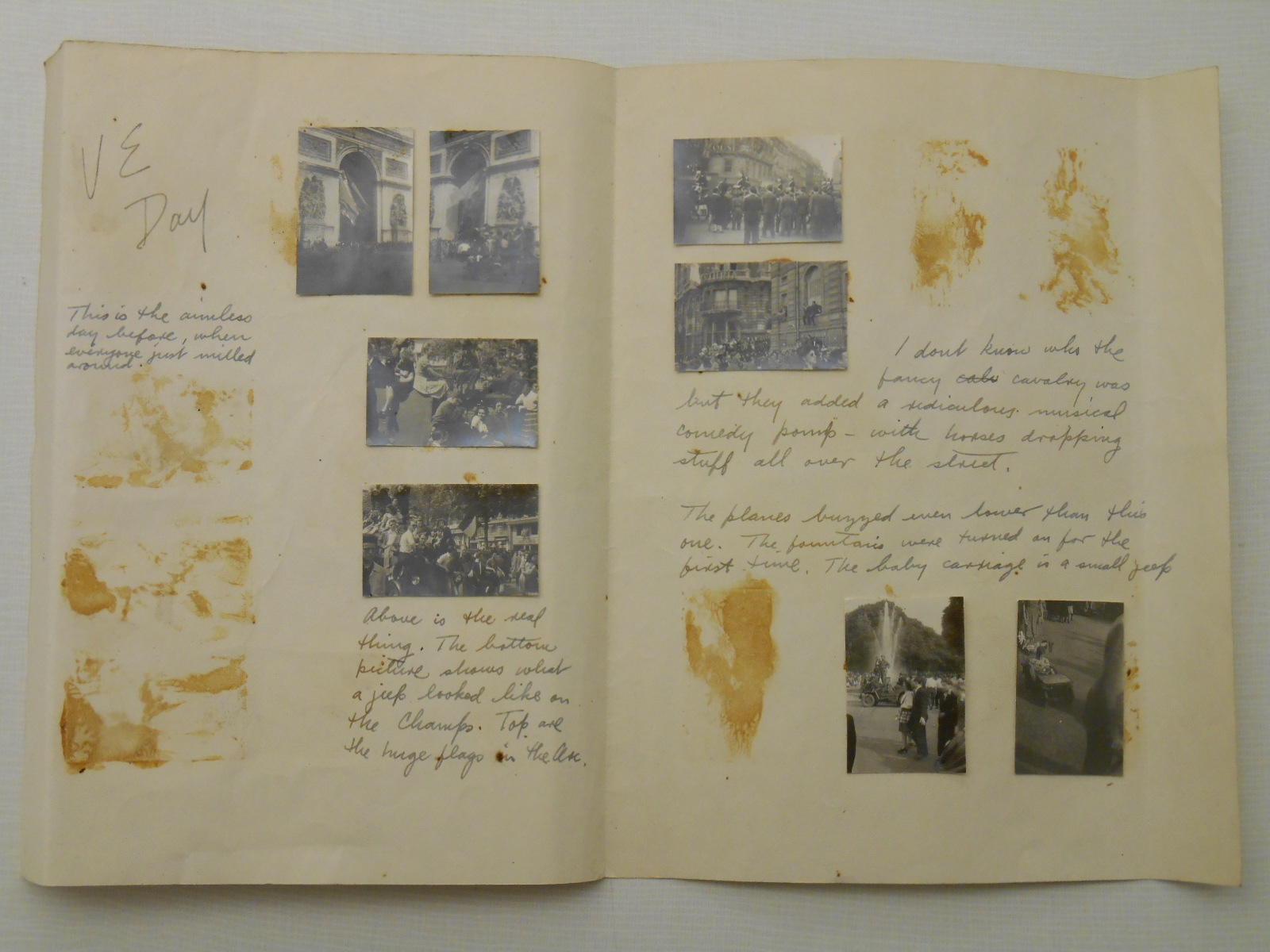
Duke Rubenstein Library also holds a collection of William Golden’s papers that I looked through for more insight into William and Cipe’s lives. One of my favorite discoveries in that collection was a letter with attached photographs that William sent to Cipe. The photos are from his time in Paris during WWII and illustrate the events he saw on VE day. The photos are the same size as the ones in LIFE WITH CIPE and I wonder if this was a precursor to the albums.
Rubenstein Library has also recently acquired a collection of Cipe’s papers too. I wonder if there are more tiny photographs there.
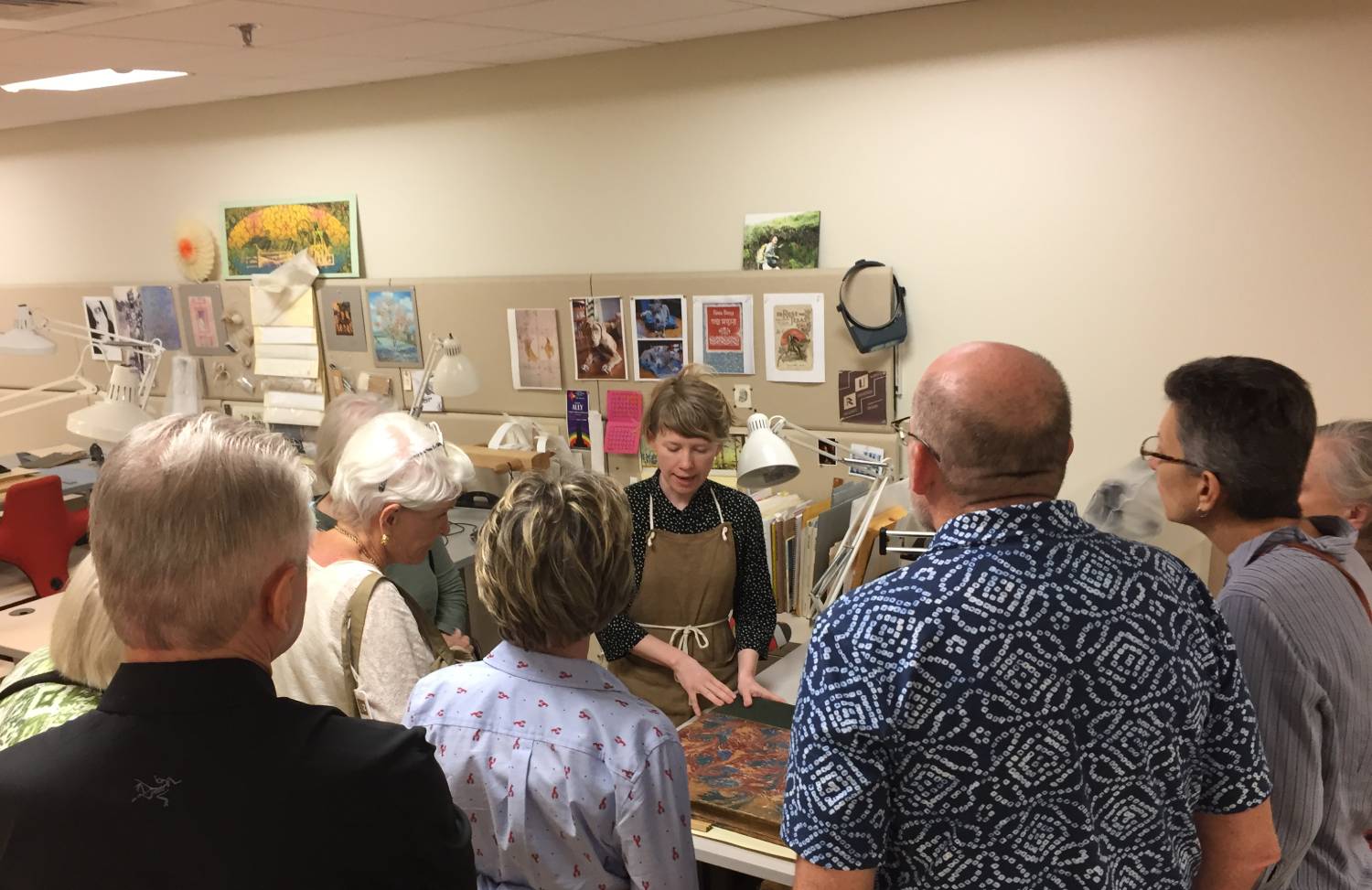
It’s so nice when folks come down to the Perkins Library basement to visit the lab, and this week we had quite a few visitors from very different parts of the campus community. Early in the week, around 20 incoming freshman came to learn about the conservation program as part of Project Search, a program designed as an introduction to undergraduate research at Duke. Then this morning, we were visited by a tour offered through the Duke Alumni Association.
Technician Sara Neel describes circulating collections repairs.Senior Conservator Erin Hammeke describes a recent conservation treatment.Conservator Henry Hebert describes some in-process conservation treatments.
It’s always a pleasure to share our work with Duke students (both current and former), because they are just so personable and naturally curious about the process of conservation and the library materials we have to show. Thanks for dropping by!
Today is the last day for Garrette Lewis-Thomas, our second HBCU Library Alliance/University of Delaware Winterthur intern. The end of this two month internship really snuck up on us! As you may have read in some of Beth’s recent posts, we have thrown a ton of information and instruction at Garrette in the last eight weeks – and she has accomplished so much in that time.
We decided to wrap up with a fun little intro to some basic bookbinding: Coptic style bindings.
These books are a simple, non-adhesive structure that mirrors some of the earliest multi-section codices. An unsupported chain stitch serves as both the primary sewing and the board attachment. The books are very flexible and open flat, which makes them wonderful little notebooks. We dressed them up a bit by covering the boards with decorative paper and stamping Garrette’s initials in gold on the front cover using our Kwikprint hot stamp.
We will miss Garrette so much, but wish her luck in the coming school year!








 The unique feature of this book, however, is a USB memory stick that has been integrated into the headcap. The stick contains a film by Luka Dogan, showing a selection of the robots in action.