The gorgeous book on Erin Hammeke’s table is 21 by 14 inches, 3 inches thick, with gold tulle and white vellum binding. It dates from the mid-17th century.
An atlas from the Dutch publisher Blaeu, it has gloriously vivid maps of the British isles. It also has a number of tears, some discolorations and maybe even some mold. It’s Hammeke’s job to repair and fix it all.
“[The repairs] are pretty straightforward,” Hammeke said the other day as she delicately worked on a tear. “You mend it with Japanese tissue and research paste. It’s transparent, and flexible. You just have to test all the colors to see if they are water soluble.”
Hammeke is one of five remarkably skilled technicians working in the conservation department of Duke University’s Perkins Library. They are responsible for keeping the library’s 6 million books and millions of other items in working condition for both current and future users, and for rehabilitating works that have suffered from decay or in some cases, disaster.
Winston Atkins, Preservation Officer for Duke University Libraries, offers tips and suggestions for storing newspapers from the recent historical election and inauguration. View details at the library’s YouTube site or read more from the Duke Office of News and Communications.
A visitor exploring one of the Duke Libraries’ digital collections is probably too engrossed in the content to think very much about how the collection got there. In fact, each digital collection is the product of a collaboration of eight to ten staff from several library departments who work together in a cross-functional team. The team begins each new project with a workplan and proceeds through a series of steps that culminates in the collection’s public launch.
Duke’s Working at Duke series interviewed Erin Hammeke, Special Collections Conservator. This series highlights a day in the life of Duke employees. In the video, Erin shares details about the items she repairs and preserves as a conservator for Special Collections.
Hello readers. We are in the process of moving information from our website to our blog. In order to do so I created posts for each entry and will be publishing them en masse. This means a lot of new (old) things in your RSS reader and they will also show up here. I apologize in advance, but after they are up we will be able to better organize and keep track of our news items. And that is what we are all about as librarians, yes? the better organization and dissemination of information?
I’ll schedule the posts overnight on Friday. You can delete them in one large group from your RSS reader, or you can relive the past with us over a hot cup of joe this weekend.
I recently got a small diary in the lab that had been previously repaired. Instead of simply joining the split pages together with a thin strip of tissue, they opted to line the entire two-page folio with heat set tissue.
Dealing with prior repairs is always a conundrum for conservators. With time and resources limited do you leave old repairs if they are still working (even if they are really ugly), or do you replace them with more sympathetic and reversible repairs? As in all things conservation it depends.
In this instance I removed the old repairs because they were difficult to read through. Luckily, whoever lined the pages with heat-set tissue didn’t use a hot enough iron so the tissue didn’t attach well to the pages. Lucky for me because if they did use a hot iron, soaking in a solvent would have been my only recourse to remove the lining. I was able to simply peel off the old tissue (image left) and replace it with smaller strips of Japanese tissue adhered with wheat starch paste (image right).
The pages look much better and you can read them without the distraction of the all-over tissue lining. I feel like I got away easy this time.
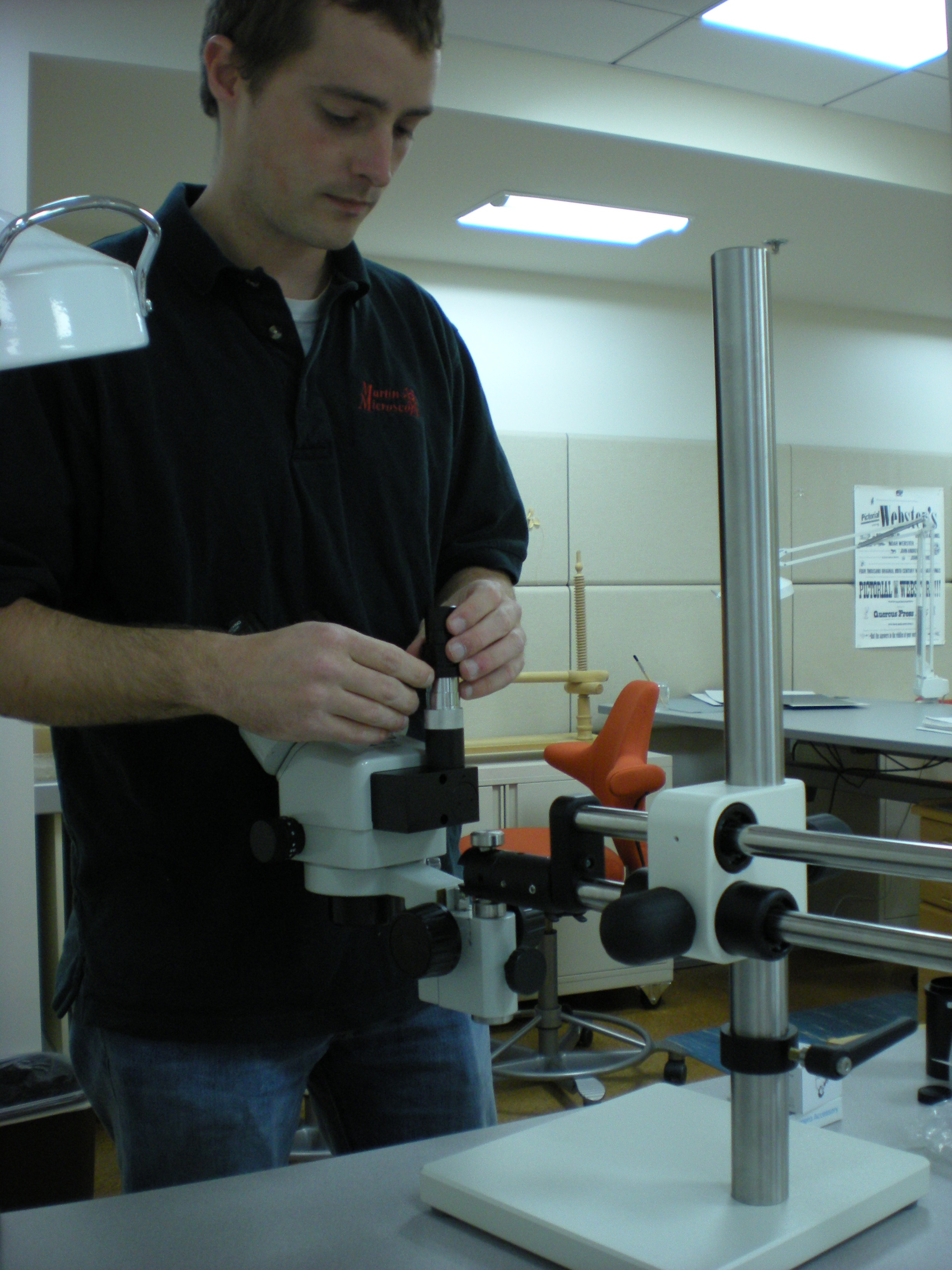
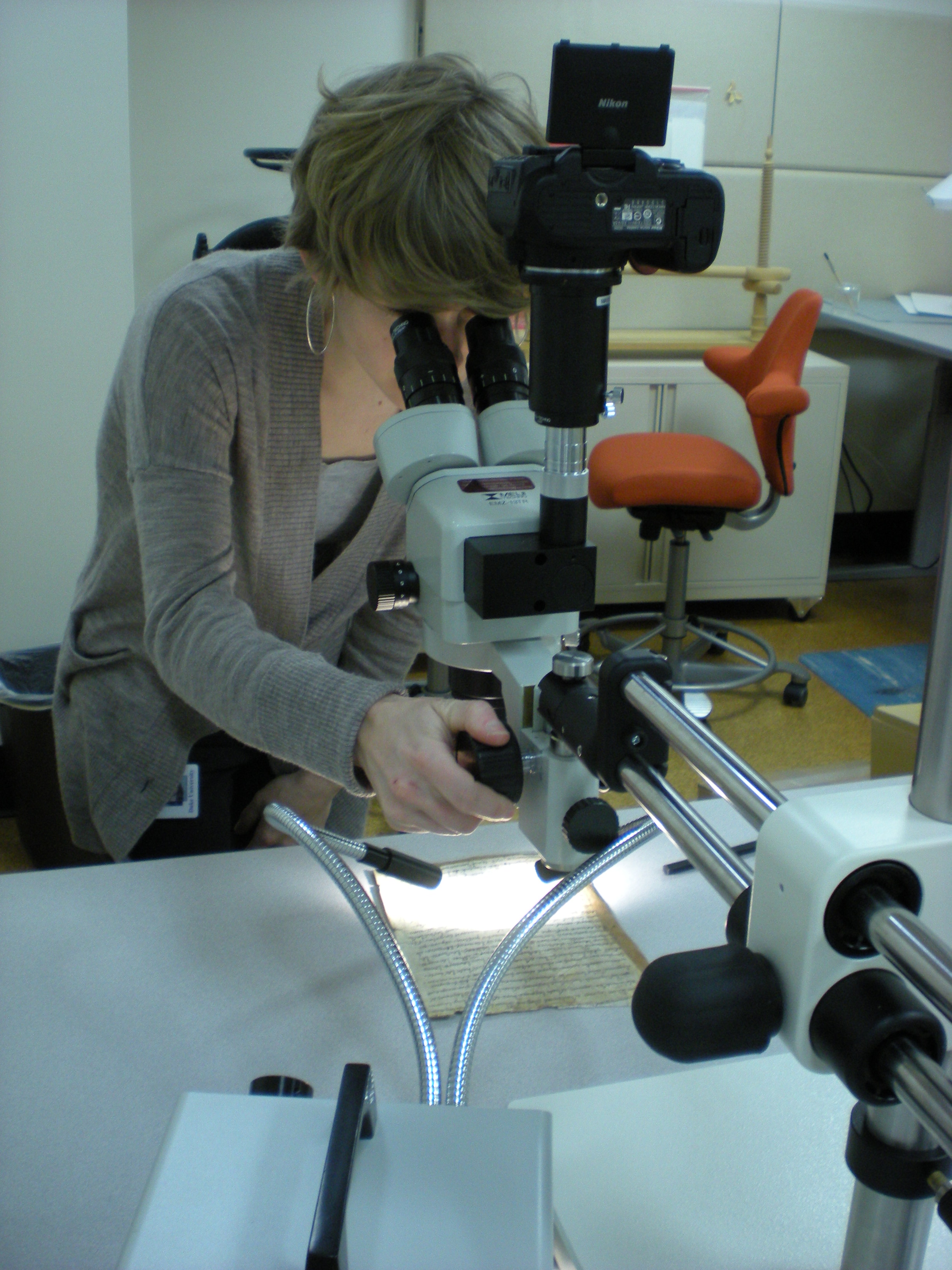
Yesterday we finally got our microscope! We are in the testing-phase with the camera attachment. This will allow us to take some great close-up shots of media and fibers as we work on materials. Until we can show you some pictures, go over to Parks Library Preservation and see what fun they have with their scope.
Aaron Cunningham (pictured left) from Martin Microscope Company set up the scope and patiently demonstrated how it all works. Erin Hammeke (pictured right) put the first object under the scope, an 8th Century manuscript that is in the lab for re-housing.
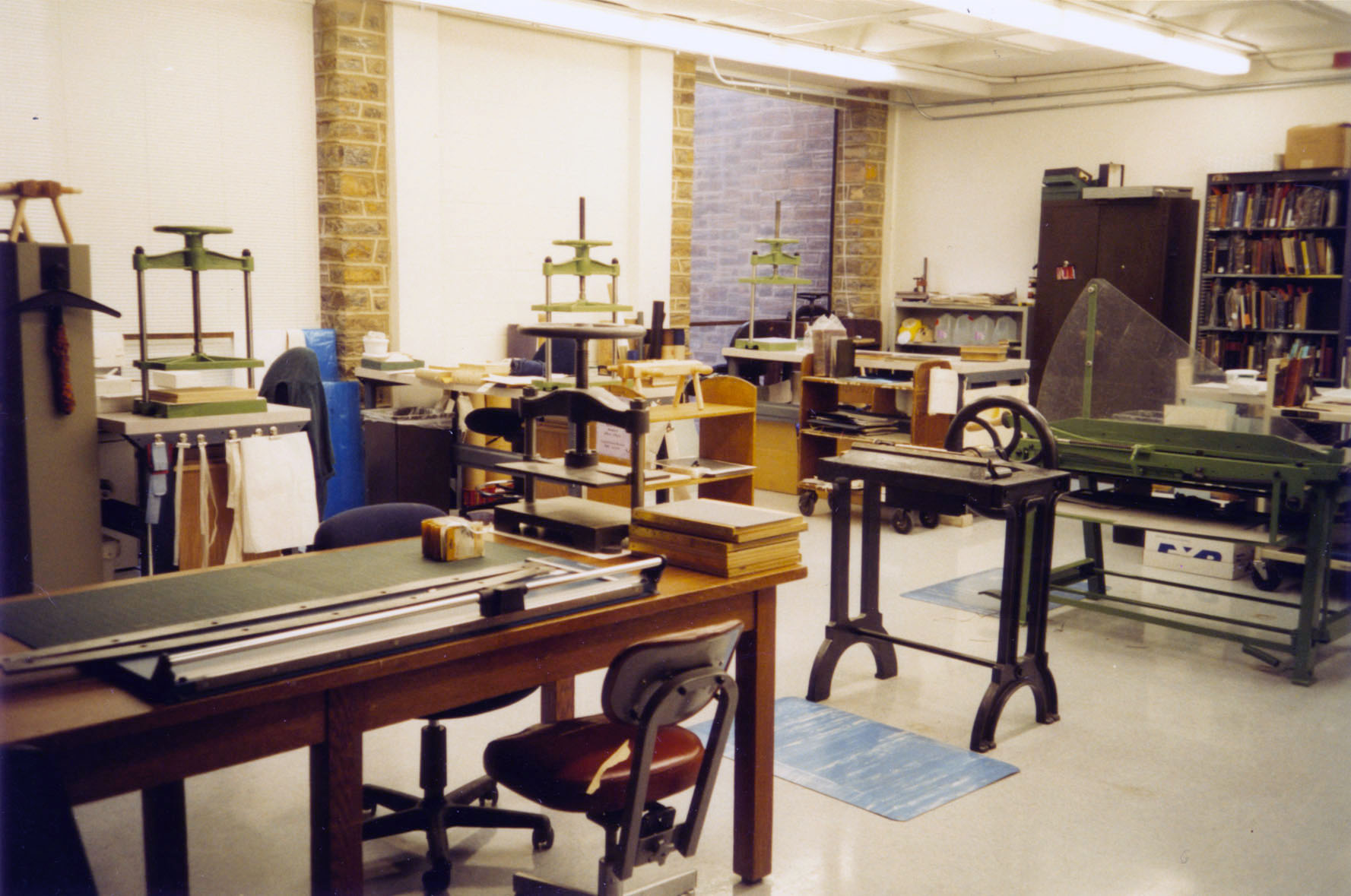
To better organize our digital photo files we have been applying a standard naming convention to our old images. In doing so I’ve found some old pictures of the lab dating back from the very beginning. It’s been a fun trip down memory lane.
On Flickr you will find images of the original space. You can also find images of our beautifully renovated Verne and Tanya Roberts Conservation Lab. We’ve come a long way, baby.
The latest issue of Duke Libraries Magazine has hit the virtual bookshelf with “Notes from the Underground.” The people of Preservation, Conservation and the Digital Production Center are highlighted along with some favorite projects.


 The Herald-Sun, recently featured Conservation in an article titled “Conservators Give New Life to Old Books.”
  Continue reading the
  Hello readers. We are in the process of moving information from our website to our blog. In order to do so I created posts for each entry and will be publishing them en masse. This means a lot of new (old) things in your RSS reader and they will also show up here. I apologize in advance, but after they are up we will be able to better organize and keep track of our news items. And that is what we are all about as librarians, yes? the better organization and dissemination of information?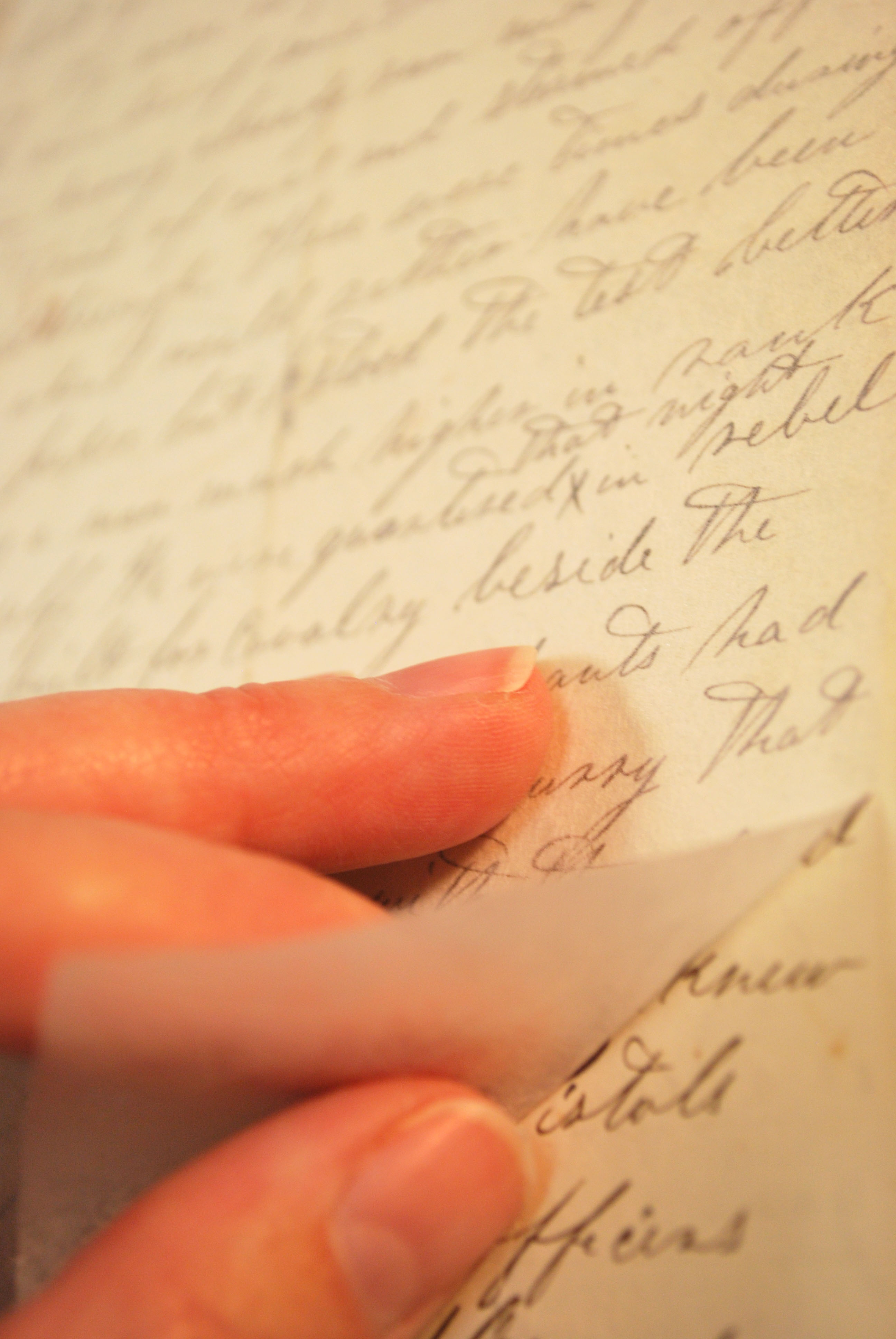

 The latest issue of