All posts by Beth Doyle

The Nominations Are….

This is the time of year to start thinking about nominating your favorite preservation and/or conservation librarian for one of the several awards available from the ALA-ALCTS Preservation and Reformatting Section (PARS). There are several available, summed up over on PCAN and listed with other awards over on the ALCTS awards website.

I want to highlight the newest PARS award and ask for your help in getting the word out to students, new preservation librarians, and to preservation programs and their faculty. The Jan Merrill-Oldham Professional Development Grant rewards the recipient with cash to help defray the cost of attending the ALA Annual Conference.

Throughout her career Jan championed new professionals and supported them by providing internships and jobs. She willingly and quickly took many new professionals, myself included, under her wing and taught them the importance of the work and why preservation matters to the greater academic world and, indeed, to society itself.

We stand on very tall shoulders and would not be successful today without the help of many, many people. What I have found in this profession is a large cadre of very smart, very dedicated and very supportive people who are more than willing to give you their time and advice. Jan is one of these people and I owe her a great number of things. Even now, more than a decade into my career, Jan continues to inspire me and provides her thoughts and advice when I need it.

Jan is humble and shies away from the limelight. But I’m here to say that she is a gem, one of those people that in decades to come we will stand and tell our stories of how Jan helped us through the tough times and supported us through our successes. Please help honor Jan by getting the word out on this new award.

Full disclosure: I am one of two authors of the PCAN blog; I was an intern for Harvard College Libraries with Nancy Schrock (another person to whom I owe so much), worked for Jan and Pamela Spitzmueller (yet another mentor) in the Weissman Preservation Center at Harvard, and I and two other librarians developed the JMO Award.
What We Find In Books: Leaves of Grass (and other formerly green things)

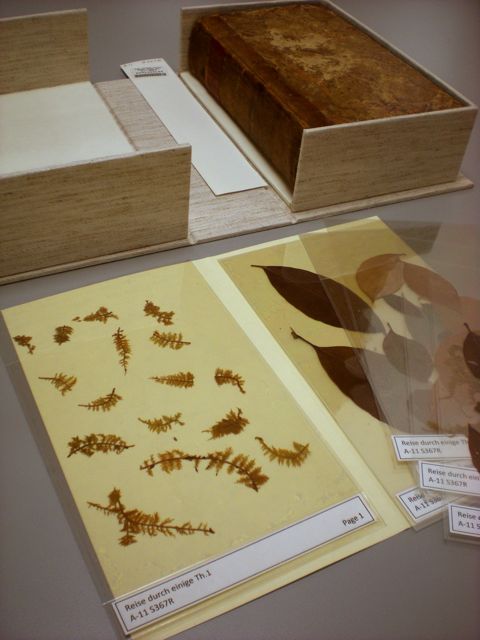
This book was sent down to Conservation for an enclosure. Inside were many, many pressed leaves and bits of ferns. We couldn’t leave them in the text as they were staining the paper, but we were hesitant to just remove them due to their provenance. Jennifer devised this clever solution to removing the leaves but saving the information about where they were in the book.

Each set of leaves was encapsulated with a tag that says where in the book they were found. The set of encapsulations are inside a small folder, and both the folder and book are inside a beautiful new box.

For more images from the Conservation lab, visit our Flickr site.

What would you do with it?

Removing prior repairs is one of those topics that elicits a lot of opinions from conservators (get four conservators around a table and you will have six opinions on the matter).

As often is the case, my answer to removing a prior repair is usually “it depends.” Is the repair damaging the item or simply aesthetically a mess? How damaging would the removal be and how much more damage are you willing to incur to remove it? What is the value and use of the item and how do these weigh with the physical risk to the item that the repair or its removal pose?

Do you hate it because it is just ugly? is that enough reason to remove it? If it is functioning but ugly, can you live with it?

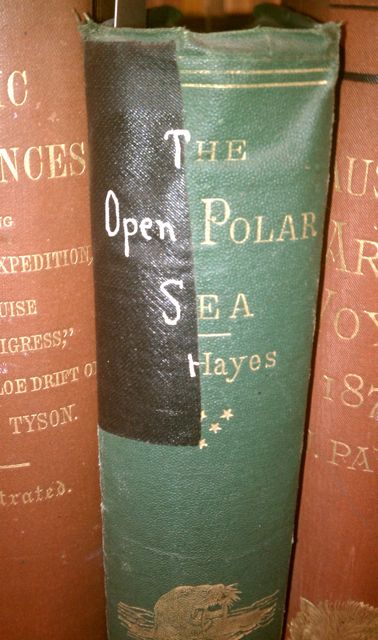
I found this item in our stacks today. We must remember that not all items in our special collections started out as “special,” many started in the general collections and old-style repairs were not always aesthetically pleasing or reversable (things we strive for now). I suspect this may be the case for this particular item.

What I hate about this repair is that the black book tape is downright ugly. What I love about it is that the person who did it cared enough to write in the part of the title that was covered by the book tape. This is one we probably wouldn’t remove unless we had a better reason than “it’s ugly.” But then again…

Thanks to Noah Huffman for the image as I was caught without my camera in the stacks.

Instruments of Torture (Our New Exhibit is Up!)

By Grace White

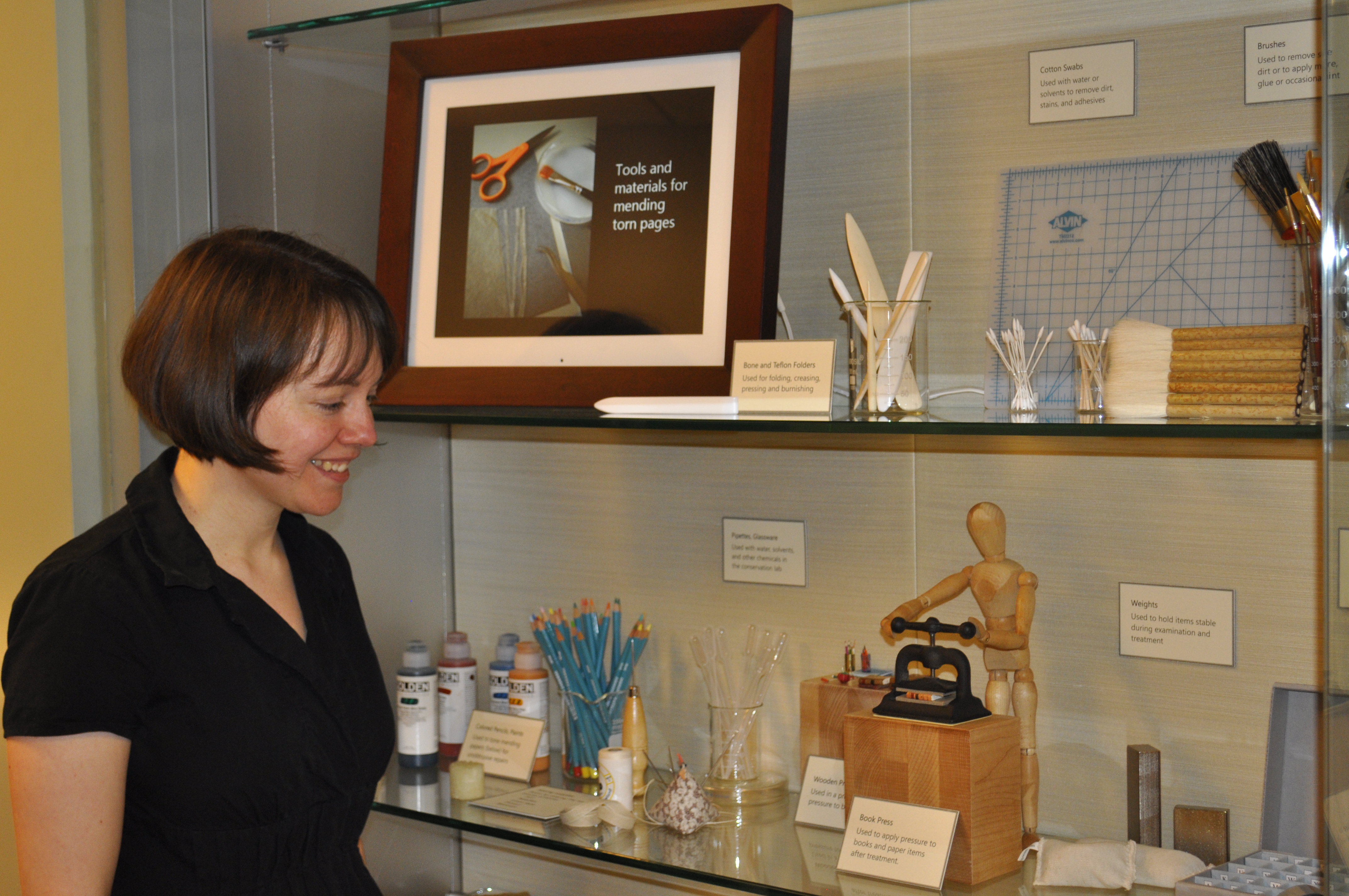
“Tools of Conservation” showcases some of the tools we use in book and paper conservation.  Small items such as scalpels, brushes and bone folders are displayed, as well as materials like Japanese paper and sewing threads.  It would have been impossible to fit a full size press in the display case, so a miniature version is presented alongside some tiny creations (since I love miniatures).  A digital display lets viewers see the tools in use.

Reviews so far have been positive, including “They look like medieval torture instruments!”

The exhibit is open during regular Perkins/Bostock hours. We are located on the Lower Level (same level as the Link), by Perkins Room 023.  Come and have a look!

No Smoking In The Library (Plus a Lesson Learned)

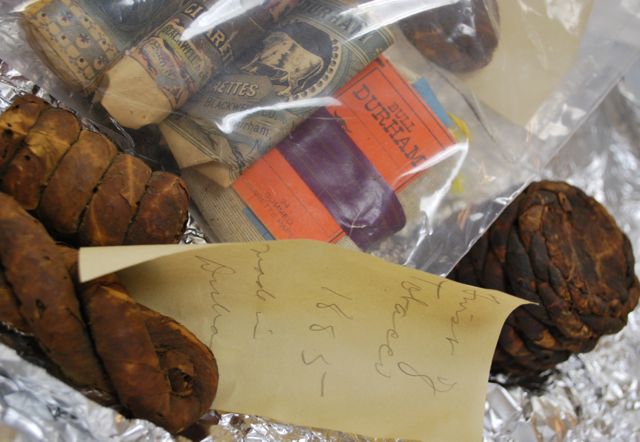
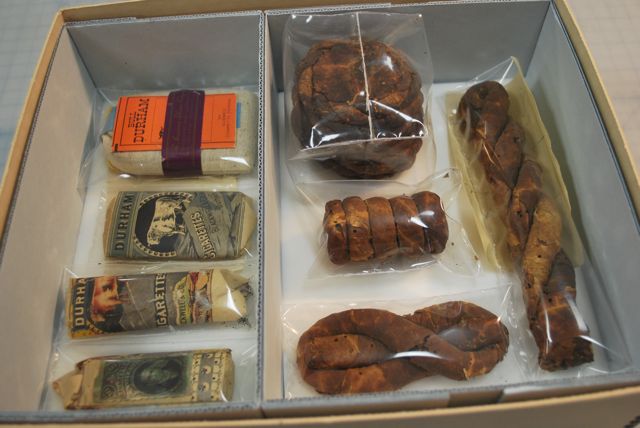
A couple of weeks ago we got a box from Technical Services labeled “tobacco samples.” Obviously, these needed something more than Zip Loc bags before going to the shelf.

Still riding the success of boxing the Blue Devil, I got out the CoLibri pockets and enclosed each sample in a pouch. Then I made a blue-corrugated tray with multiple compartments to contain the various packages of tobacco.

The result: the tobacco is contained but accessible for viewing without all of the loose tobacco getting everywhere. The CoLibri pouches can be easily removed if we want to exhibit these items in the future, which was a concern for the archivists. Overall, I think this was another successful non-traditional use of CoLibri.

The Lesson Learned: I made this great container, with even more little dividers than the one in the image in order to keep all the tobacco safe from rolling around.

I was so proud of my solution and showed the box to everyone in the lab. They all smiled and praised their boss for actually making something. Then I tried to put the lid on the box….and I made the tray to fit the lid of the box rather than the base of the box. DOH! Humble pie, meet fork.

50,000 And Climbing

It’s the end of the fiscal year and you know what that means…it’s statistics season! I’ve just finished compiling our FY2010-2011 stats and will now be subjecting them to feats of interpretation and contemplation.
Did you know:

  • Since FY2003 we have repaired and bound over 50,000 books and pamphlets; we have also made over 51,000 custom enclosures.
  • Last year we made 8,538 enclosures thanks in large part to the broadside project and the History of Medicine project.
  • In FY2011, 57.7% of our work came from the Perkins Library system and 42.3% from Special Collections and Archives.
  • About 78% of our output for the general collections last year was “shelf preparation” work  including pamphlet binding, CoLibri covers, and pockets for books with CD’s.
  • 90% of our output for special collections last year fits into the category of protective enclosures [see bullet #2 above].

I could go on and on, I love statistics as my staff will attest. What do these numbers mean? Several things which will become more apparent as I delve deeper into the meaning behind these numbers. One thing our data does say, our small staff is cranking out the work!

Image from the Emergence of Advertising In America 1850-1920 digital collection.