Category Archives: News and Features

Big Book, Little Book

Big Book, Little Book

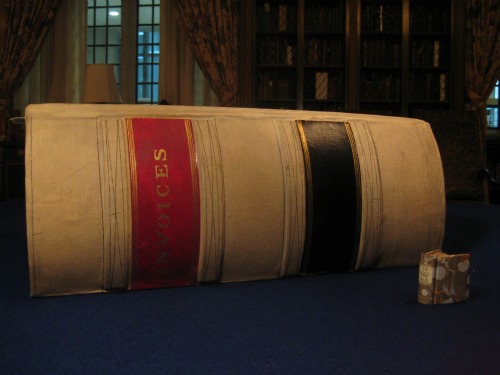
Wandering through the stacks earlier this week, we found ourselves a bit goggle-eyed upon discovering this enormous volume of newspaper clippings from the George Tinkham Papers. For comparison, we’ve placed it next to The Bible in Miniature, or, A Concise History of the Old and New Testaments, an 1805 volume from our miniature books collection.

P.S. These aren’t the biggest or littlest books in our collections.

P.P.S. Surprisingly, the big book is not as heavy as it might seem.

University Archives Field Trip

And you thought only children get to go on field trips?

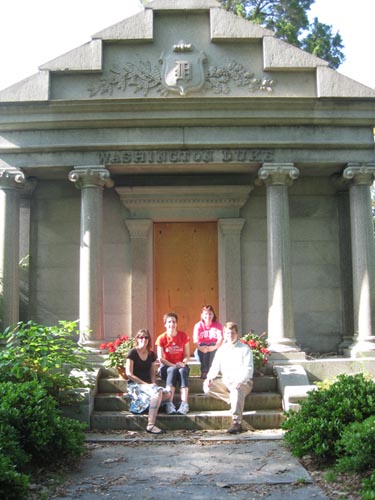
Today, the staff of the Duke University Archives paid a visit to Maplewood Cemetery and the graves of the people whose papers we work with every day. We started with a visit to the Dukes.

Visiting the Duke Family Mausoleum

It’s very sunny on the steps of the Duke Mausoleum at 9:30 AM! From left to right are Molly Bragg, our outgoing Drill Intern; Mary Samouelian, Doris Duke Collection Archivist; Kim Sims, Technical Services Archivist; and Seth Shaw, Electronic Records Archivist. (I’m taking the photo!)

We also visited President Robert L. Flowers, Trustees James Southgate and Julian S. Carr, Chancellor (and Dean of the School of Law) A. Kenneth Pye, Coach Wilbur Card, and Professors Fritz London, William Cranford, Charles Ellwood, and Aleksandar Sedmak Vesić.

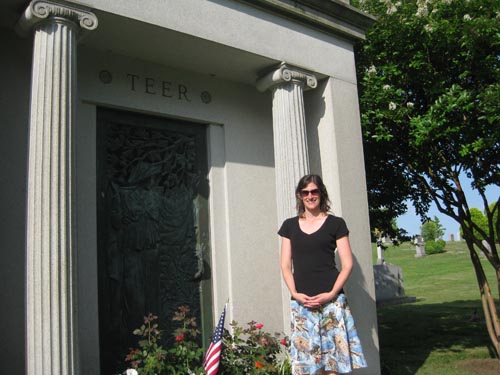
Molly and the Teer Family Mausoleum

Here’s Molly at the Teer Family’s mausoleum. During her internship, Molly studied Duke University’s construction, becoming well-acquainted with Nello Teer. She wrote this article about him for Duke Magazine.

The Cleanest Books Around

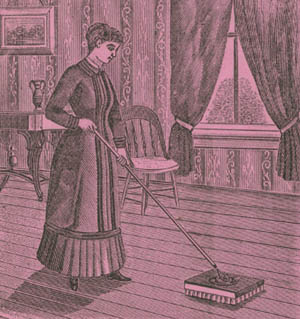
I-XL Pump Co.'s New Scrubbing BrushThe RBMSCL’s reading room is going to be closed on Monday, May 9th so that we can devote a few hours to a careful cleaning and ordering of our stacks. We’ll reopen again on Tuesday, May 10th at 9:00 AM with everything sparkling and tidy!

(Incidentally, doesn’t this homemaker look thrilled with her I-XL Pump Co. Scrubbing Brush? According to the advertising circular, it “takes the cake.” Which we don’t doubt, because who isn’t equally a fan of cake and cleaning products?)

To get ourselves ready for cleaning day, we thought we’d take a look at the suggestions for cleaning and caring for books and libraries that have been offered to industrious homemakers and housekeepers over the years.

Please note that the RBMSCL doesn’t actually use any of these cleaning and care practices, nor do we recommend that you use them on your own books or manuscripts.

To Prevent Moulding in Books, Ink, Paste and Leather: Collectors of books will not be sorry to learn that a few drops of oil of lavender will insure their libraries from this pest.”

—From The Skillful Housewife’s Book, 1846.

“When a parlor with handsome furniture is to be swept, cover the sofas, centre-table, piano, books, and mantel-piece, with old cottons, kept for the purpose. . . . Dust ornaments, and fine books, with feather brushes, kept for the purpose.”

—From Miss Beecher’s Housekeeper and Healthkeeper, 1873.

To Preserve Books: Bindings may be preserved from mildew by brushing them over with the spirits of wine. . . . Russia leather which is perfumed with the tar of the birch-tree, never molds or sustains injury from damp. The Romans used oil of cedar to preserve valuable manuscripts.”

and

To Remove Ink Spots on Books: A solution of oxalic acid will remove them without injuring the print.”

—From Practical Housekeeping, 1883. (With regard to the second piece of advice: now you know why we use pencils!)

“As the library . . . often knows the scent of cigar smoke we would refrain from adding upholsteries to catch and retain the odor, which, while it may not be objectionable at first, is certainly not enjoyable when stale.”

—From Home-Making and Housekeeping, 1889.

“Glazed bookcases are quite unnecessary. . . . Books do not suffer, but rather benefit, by coming into contact with the air. . . . Even if the [library] is not in regular daily use, a fire should be lighted frequently, especially in damp weather; otherwise the books will inevitably be attacked by mildew, and ruined sooner or later.”

—From The Book of the Home, 1900.

“Gum camphor laid among books on the shelves will keep the mice away.”

—From Putnam’s Household Handbook, 1916. (We would like to note how happy we are that we don’t have this problem!)

2011-2012 Franklin Research Center Travel Grants Awarded

The John Hope Franklin Research Center for African and African American History and Culture is pleased to announce the recipients of this year’s travel grants. These grants support the work of students, scholars, and independent researchers for travel to Durham to conduct research using the Franklin Research Center’s collections.

  • Andrew David Amron, Ph.D. candidate, Department of History, University of Alabama, for his dissertation on black working-class masculinity and identity during the World War I era.
  • Maureen Cummins, independent scholar, for the production of a limited edition artist book concerning slavery in the U.S., mid 19th century.
  • Ira Dworkin, Assistant Professor, Department of English and Comparative Literature, The American University in Cairo, for research on African Americans in the Congo, particularly George Washington Williams.
  • Nina Ehrlich, master’s student, Department of History, Colorado State University, for a study of relationships between black and white women during the Civil Rights Movement.
  • Reginald K. Ellis, Visiting Professor, Department of History, Florida A&M University, for work on a manuscript concerning James Edward Shepard and black North Carolinians in the 20th century.
  • Rebecca Wieters Moake, Ph.D. candidate, Department of History, University of Maryland-College Park, for work on her dissertation concerning the working people of Charleston, S.C., in the late 19th century.
  • Tyler D. Parry, Ph.D. candidate and master’s student, Department of History, University of South Carolina, for dissertation and article exploring slave kinship in the Antebellum South.
  • Ibram H. Rogers, Assistant Professor, Department of History and Africana & Latino Studies, State University of New York College at Oneonta, for a book examining the struggle to diversify higher education, 1965-1972.
  • Daniel Royles, Ph.D. candidate, Department of History, Temple University, for research exploring African American AIDS activism and advocacy in the United States.

Filmmaker and Projectionist

Filmmaker David Gatten threads 16mm prints of his films for a screening in the Rare Book Room this past Thursday.

These photos were taken by guest Michael Graziano, and we thank him for letting us share them here. (For more information about the event and the films shown, visit this earlier blog post.)

You’ll find more photos from the screening at the “RBMSCL Events” set on the RBMSCL’s Flickr photostream!

2011-2012 Mary Lily Research Grants Awarded

The Sallie Bingham Center for Women’s History and Culture is pleased to announce the recipients of this year’s Mary Lily Research Grants. These grants support the work of students, scholars, and independent researchers who will travel to Durham from all over the U.S. to make use of the Bingham Center’s rich collections. We would like to gratefully acknowledge our faculty reader, Kimberly Lamm, Assistant Professor of Women’s Studies, who offered her insights and expertise as the committee reviewed a competitive pool of 40 proposals.

This year’s grant program received additional support from the Program in Women’s Studies. Every year, the Program in Women’s Studies explores ideas and concepts from a variety of disciplines that touch on women, gender, and feminism. The theme for 2011-12 is “The Future of the Feminist 1970s.” Many of our grant recipients this year are focusing on related research questions, and we anticipate that they will help enrich the conversations on campus that will evolve in the classroom and beyond about how the multiple feminist paradigms of the 1970s continue to have an impact on feminist thought.

  • Marika Cifor, master’s student, History and Library and Information Science, Simmons College, for master’s thesis research that examines historical relationships of lesbians and prostitutes in the United States, 1869-1969.
  • Jessica Frazier, PhD candidate, History, Binghamton University, for dissertation research on Vietnamese militiawomen and the interconnections of empire, race and gender in the feminist movement, 1965-1980.
  • Choonib Lee, PhD candidate, History, State University of New York at Stony Brook, for dissertation research on militant women in the new left and civil rights movements in the late 1960s and early 1970s.
  • La Shonda Mims, PhD candidate, History, Georgia State University, for dissertation research on lesbian community and identity in the cities of Charlotte, NC and Atlanta, GA from WWII to the present.
  • Jennifer Nelson, Associate Professor, Women’s and Gender Studies, University of Redland, for a book on community health reform movements from the mid-1960s to the present.
  • Ally Nevarez, master’s student, Book Arts and Library and Information Science, University of Alabama, for an artist’s book that highlights the important role that women have in contributing to community and preserving culture.
  • Rose Norman, Professor Emeritus of English, University of Alabama at Huntsville, for research on lesbian feminist activism in the South, 1965-1985.
  • Robin Robinson, Associate Professor, History, University of Massachusetts at Dartmouth, for a book and article on transportation and transformation of female convicts as unfree labor in Colonial America.
  • Emily Thuma, PhD candidate, American Studies, New York University, for dissertation research on prisons and the politics of resisting gendered violence, 1968-1984.
  • Elizabeth York, Associate Professor, Music Therapy, Converse College, for research on Atlanta women’s music and culture, 1976-1986.

Post contributed by Kelly Wooten, Research Services and Collection Development Librarian for the Sallie Bingham Center for Women’s History and Culture.

Letters to Diamond Hill

As part of our “RBMSCL Scholars” series, we’ve asked some of the wonderful researchers that the RBMSCL has hosted over the years to contribute a few words on their new books and research projects. Today, we have an essay from J. Keith Jones, editor of The Boys of Diamond Hill: The Lives and Civil War Letters of the Boyd Family of Abbeville County, South Carolina, released in March by McFarland Publishers.

Cover of The Boys of Diamond HillWhen I first began investigating the Robert Boyd Family Papers at Duke’s Rare Book, Manuscript, and Special Collections Library, I expected to find something that would appeal to genealogists of this family and those researching the history of Abbeville County, South Carolina. I didn’t know that I would discover a rich story about the triumphs of love and the tragedies of war. I would not have believed that two years later their story would be available to the world in The Boys of Diamond Hill: The Lives and Civil War Letters of the Boyd Family of Abbeville County, South Carolina. With the guidance of the staff at RBMSCL and my editors at McFarland Publishers, that is exactly what has happened.

The backbone of this work can be found in the 86 letters of the five Boyd brothers and the husband of their eldest sister lovingly preserved in the RBMSCL. With the additional research of this family and the units they served in, their full story slowly emerged. In April 1861, brothers Daniel and Pressley Boyd joined the Confederate army. Soon the war would sweep the other three Boyd brothers—William, Thomas and Andrew—as well as their brother-in-law Fenton Hall, away from their farm in Abbeville County, South Carolina. Researching this collection uncovered warmth, humor, horror and loss of four long years of war.

I understand from descendants of Fenton Hall that a number of letters from this family had been lost in a house fire. They were thrilled to learn that those destroyed did not constitute the entire body of the brothers’ letters. It is so wonderful that Duke has preserved these surviving letters so the fascinating lives of these young men would not be lost to history. The helpful staff and wonderful facilities made the marathon sessions with this collection a joy and their support through the preparation for the publication process was invaluable.

To learn more about the book, as well as Keith’s other research projects, visit his website!

P.S. We’re still collecting responses for our reader feedback poll. Please click the orange button at the right to tell us your thoughts about The Devil’s Tale. Thanks!

Change Blog Readers Can Believe In (take our poll)

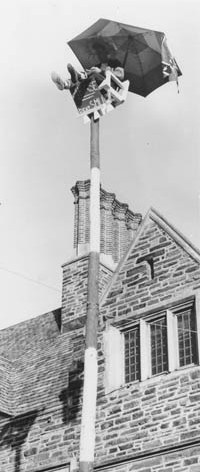
Flagpole Sitter, 1956
Flagpole Sitter, 1956. From the Duke University Archives.

We’re librarians: we like information. For the next month, The Devil’s Tale will be gathering information from you, our reader, in our first-ever feedback poll!

This is your chance to tell us a little bit about your blog-reading habits and what you’d like to see when you visit The Devil’s Tale. In the sidebar you’ll see an orange button that links to our short survey—we hope you’ll take a few minutes to help us learn how to create a better, more informative blog. Of course, your responses and comments will be submitted anonymously, so click away!

We’ll be gathering responses through Friday, April 15th, and we’ll be sure to let you know what we’ve learned once the results are tabulated.

All of the other Duke University Libraries blogs will be running the exact same poll, so head over to the other blogs that you read and leave some feedback for them, too.

Thanks!

Atelier@Duke

Date: Friday-Saturday, 25-26 February 2011
Time: please see schedule
Location: Gothic Reading Room, Perkins Library
Contact Information: Jennifer Thompson, 919-660-5922 or jennifer2.thompson(at)duke.edu

As part of the 15th anniversary celebration of the John Hope Franklin Research Center for African and African American History and Culture, Duke University Libraries and the Office of the Provost present the first Atelier@Duke: “The Idea of Archive—Producing and Performing Race.”

The event will be a “series of conversations that reproduce what might happen in a workshop—an ‘atelier’—of ideas. Our panelists’ conversations will engage the moments before ideas become text, fixed images, documented policies or remembered spectacle,” said Atelier@Duke organizer Karla F C Holloway, the James B. Duke Professor of English and a professor of law at Duke. The series of panel discussions will also consider what and how histories are saved and shared.

This occasion also marks the inaugural John Hope Franklin Research Center Book Award, which will be presented to author Paula J. Giddings for her critically-acclaimed biography, Ida: A Sword Among Lions (2008). For more information about the award, please see the Duke University Libraries’ announcement.

The Atelier@Duke panel discussions are free and open to the public. Please visit the conference’s website for registration and schedule information.

Post contributed by Jennifer Thompson, John Hope Franklin Research Center Librarian.