Location: Center for Documentary Studies, 1317 W. Pettigrew St, Durham, NC
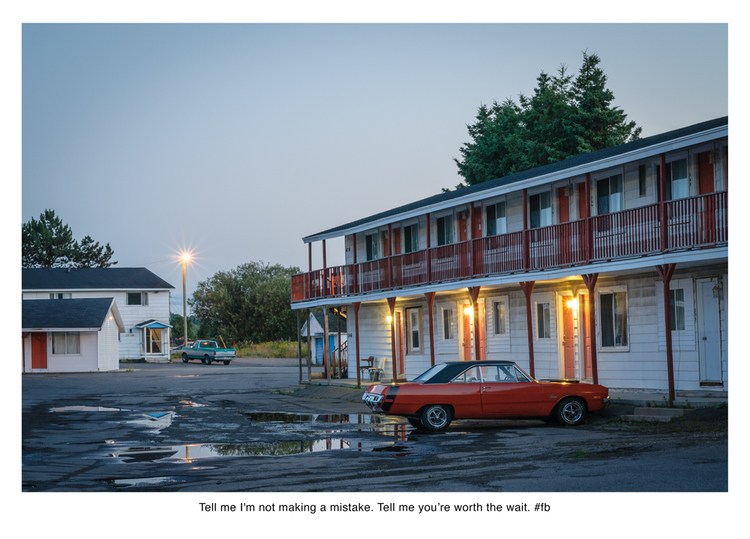
In October 2015, the David M. Rubenstein Rare Book & Manuscript Library will welcome Nate Larson as the second Barbaralee Diamonstein-Spielvogel Visiting Artist. Named in honor of Dr. Diamonstein-Spielvogel, a prolific author, interviewer, curator, and champion of the arts, this new artist-in-residence program provides an extended opportunity for an artist to study and engage with archival, manuscript and other special collections in support of developing a new body of creative work.
Nate Larson is a contemporary artist working with photographic media, artist books and digital video. His projects have been widely shown across the US and internationally as well as featured in numerous publications and media outlets, including Wired Raw File, The Picture Show from NPR, Slate, CNN, Hyperallergic, Gizmodo, Buzzfeed News, Vice Magazine, the New York Times Lens Blog, Flavorwire, the BBC News Viewfinder, Frieze Magazine, the British Journal of Photography, The Washington Post, and Art Papers. His artwork is included in the collections of Crystal Bridges Museum of American Art, the Orlando Museum of Art, Portland Art Museum, the Museum of Fine Arts Houston, the Center for Photography at Woodstock, and the Museum of Contemporary Photography Chicago. Additionally, Larson holds a full‐time academic appointment in the photography department at Maryland Institute College of Art in Baltimore and chaired the 2014 national conference of the Society for Photographic Education.
Larson will be in residence at the Rubenstein Library October 26-November 22, 2015. During this time, Larson will meet with scholars, students and staff from across the academic disciplines at Duke and conduct his own research. Larson will give an Artist’s Talk about his work to date at the Center for Documentary Studies on November 5, 2015 from 6:00-8:00pm.
The event is free and open to the public and made possible through the generous support of Dr. Barbaralee Diamonstein-Spielvogel. Larson’s visit is jointly organized and sponsored by the David M. Rubenstein Rare Book & Manuscript Library, the Center for Documentary Studies, and the Master of Fine Arts in Experimental and Documentary Arts Program at Duke University.
Is there damage to be done from meddling with the ear or attempting any cure for deafness?
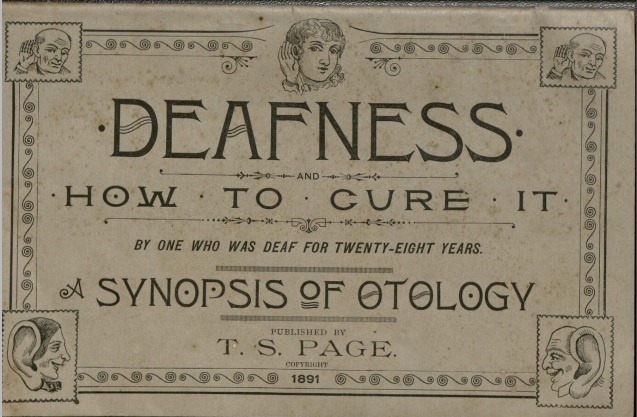
“Now, right here,” says T.Page, “stop and think a moment…If your stove smoked constantly, day after day, you would not place a poultice around the stove pipe, would you? You would clean out the flue or chimney, wouldn’t you?” Well, would you? Well, the same should go for fixing deafness, according to Page in his 1891 pamphlet: “Clean out the obstruction inside of your head, and you hear again as well as ever.” Why should one pay for a high-priced aurist (a specialist of the ear), when an easy remedy promises to do the same, at half the cost, and with minimal pain?
Indeed, what motivated people with hearing loss to select amongst an abundance of deafness cures or make plans to visit the aurist? My monograph, tentatively titled Deafness Misery, Hearing Happiness: Fakes and Fads in Deafness Cures, 1850-1950, examines these motivations, exploring how the lines between reputable medical treatment and “quack cure” were frequently negotiated as newer surgical procedures and technologies redefined, if not reflected, cultural expectations of “normalcy.” As it was difficult to distinguish between the “quack with a scheme” and the “visionary with a theory” promising a permanent cure for hearing loss, deaf persons were portrayed as particularly vulnerable to the clutches of fraud, since once “cured,” they were no longer condemned to the “miserable,” “isolating” state of deafness.
In June, I visited the David M. Rubenstein Rare Books and Manuscript Library at Duke University, a trip made possible thanks to the library’s generous History of Medicine Travel Grant. My research had two aims. First, to examine through the advertising collection in both the History of Medicine collections and the John W. Hartman Center for Sales, Advertising & Marketing History to investigate the cultural history of American advertisements for deafness cures and hearing aids. This research, which will be incorporated into one of my book chapters, “Those Instinctive, Invisible, Improved Aids,” examines how these advertisements embodied the rhetoric of “curability” and what disability scholars refer as “passing”—the masking of disability or infirmity to appear as “normal”—as marketing and sales techniques. Advertisements not only reveal the kinds of technological options available for deafened persons, but enable us to investigate the ways in which deafness was constructed as a stigma and how goods for hearing loss was marketed and sold. Indeed, many adverts propagated the refrain “Deafness is Misery,” addressing the despair and desperation deaf people felt over failed medical therapeutics. They also justified the exorbitant price of goods by connecting to the marvels of electricity and communication.
Secondly, I hoped to uncover (hidden) stories of deaf persons or persons with (temporary) hearing loss, and whether they attempted any treatment(s) for deafness. This was a more challenging task, but a good place to start was the collection of recipe books/receipt books in the History of Medicine collection. Some of these books were written by physicians and surgeons, who kept tally of the treatments they advised to their patients. For instance, I came across the receipt book of John Kearsley Mitchell (1793-1858), which lists a treatment for deafness:
“If deficy [sic] of cerumen – use salt dropped into ear or place on coarse wool some of Rx __ terebinth [an aromatic used to interrupt condition by stimulating senses and dissolve wax] gtt 10. [10 drops]. Ol olio [to oil in Italian] [symbol for fluid ounce].”By the way, I had a difficult time comprehending Mitchell’s writing—so I did what any historian fluent in social media would do: I asked my twitter followers to help me decipher the text!
Another receipt book, this time belonging to Dr. William R. Blakeslee, a civil war surgeon, contains a list of prescriptions the surgeon recommended while stationed at Camp Muhlenburg with the 48th Regiment of the Pennsylvania State Militia (near Scranton) during August 1863. Blakeslee provides details for various soldiers’ treatment(s) and his prescribed remedy, but in the case of Private William Workeizer (?) who suffered from otitis, there was no remedy listed. Does this mean that Blakeslee did not provide a treatment? Or that there was no remedy for otitis that would help the private?
There are also recipes for ear ailments written in home recipe and remedy books. One from 1896 copies a recipe from “Farmer’s Friend” for earache: “A remedy which never fails is a pinch of black pepper gathered up in a bit of cotton batting wet in sweet oil and inserted in the ear. It will give immediate relief.”
I came across many more examples, far too many for this blog post. I’d like to share one more, a letter that was out of place in the Eva Parris Letters (1892-1909) collection, written by a Virginia P. Dean of Montgomery, to G.H. Branaman of Kanas City, on July 10, 1909. In the short, carefully written letter, Dean thanks Branaman for his “cure,” which left her hearing “as good as it ever was,” and promises to recommend his method for anyone else afflicted with catarrhal deafness. This was a tremendous find for me: Branaman established the Branaman Medical Institute, which was notoriously exposed in the 1910s by the U.S. Post Office for its mail-order fraud and quackery in delivering deafness “cures.” His deafness treatment was a strange combination treatment, which made use of a special nostrum medicine and the use of his “electro-magnetic head cap.” Used properly, Branaman claimed his method could cure even the most incurable cases of deafness—or your money back! He was eventually charged with four counts of fraud and eventually put out of business.
Submitted by Jaipreet Virdi-Dhesi (Brock University), 2015-16 History of Medicine Collections Travel Grant Awardee
The popular Netflix series Orange is the New Black, based on the memoir of the same name by Piper Kerman, has brought renewed attention to the conditions inside U.S. women’s prisons. While prison reform has not been contemporarily understood as a priority of the LGBTQ and feminist communities, the special collections at the David M. Rubenstein Rare Book & Manuscript Library, illustrate the degree to which prison reform and anti-prison activism have, since the 19th century, operated as a cornerstone of both LGBTQ and feminist movements.
In the 19th century, charity efforts led by white middle-class feminists led to the creation of prison reform organizations such as the Women’s Prison Association (WPA) and the Gilbert Library and Prisoners’ Aid Society. These organizations advocated for separate women’s reformatories, the decriminalization of prostitution, rehabilitation programs for former inmates, and the creation and expansion of prison libraries.
These early reform efforts are reflected in the ledger and scrapbook of Linda Gilbert, the founder and president of the Gilbert Library and Prisoners’ Aid Society. The ledger details Gilbert’s fundraising efforts on behalf of the organization and the expenses it incurred from roughly 1868 to 1894, as it helped to establish libraries in institutions such as the New York House of Detention, Ludlow St. Jail, and Sing Sing Female Prison. A pamphlet included in the Linda Gilbert scrapbook speaks to the particular significance of prison libraries and literature to reformers of this period, who saw increasing literacy among prisoners and increasing access to reading material as central to their moral improvement.
Linda Gilbert account and scrapbook, 1894
The incarceration collections held in the Rubenstein Library, however, reflect the importance of circulating periodicals to prison reform efforts more generally, and the changing role of reading and writing in prison reform movements over time. In the 1960’s and 70’s, prison libraries and education programs helped to instigate an expanding prisoners’ rights movement both within and beyond prison walls. These efforts are reflected in several women’s prison newsletters and pamphlets that were published by lesbian feminist organizations in the late 20th century, including “No More Cages” and “Through the Looking Glass,” which are held in the Atlanta Lesbian Feminist Alliance Periodicals Collection and the Women’s and Lesbian, Gay, Bisexual, and Transgender Movements (LGBTQ) Periodicals Collection, respectively.
These newsletters were the collaborative projects of lesbian feminist and anti-prison activists in the late twentieth century in the context of neo-liberal economic policies, intensifying restrictions on access to welfare, and a corresponding rise in incarceration rates. The newsletters that grew out of these coalitions often aimed their critiques at increasing restrictions on access to welfare that, while initiated by the Nixon administration, were part of a larger conservative backlash against the Economic Opportunity Act of 1964 that continued through the 1990’s, making women of color, in particular, vulnerable to mass incarceration.
“Break ‘de Chains of U.S. Legalized Slavery,” a joint publication between the Triangle Area Lesbian Feminists’ Prison Book Project and inmates at the North Carolina Correctional institute for women, documents a prison rebellion at the North Carolina Correctional Institute for Women in 1975 that began as a work stoppage in the prison laundry. The pamphlet not only critiques healthcare and labor conditions in the prison, but contests media accounts of the rebellion itself. Additionally, the Rubenstein Library also holds a publication from Action for Forgotten Women, a feminist organization that was also active in the Triangle in the 1970’s.
Gay and lesbian publications such as Feminary, Lesbian Tide, RFD, and Gay Community News, which frequently reported on conditions inside prisons and incidents of police brutality, gave advice to gay and lesbian readers about how to protect themselves from law enforcement, and published letters from prisoners that also circulated widely both inside and outside of prisons during this period. These publications helped to galvanize support for prisoners, and encouraged readers to understand the policing and criminalization of gender and sexual non-normativity as intersecting with the policing and criminalization of people of color, immigrants, and the poor.
More recently, zines distributed by prison books programs, anti-prison zine distros, and collectively owned bookstores and activist centers have done similar work, attempting to fill a gap left by increasingly restrictive policies and funding for prison libraries and education.
Many of the most widely circulating zines are included in the Incarceration Zine Collection, part of the Human Rights Archive, which was acquired from the Chicago Anarchist Black Cross Zine Distro. The collection spans the years from 1995 to 2007, and includes 103 zines distributed inside and outside of jails and prisons, with writing by notable inmates and anti-prison activists, including Mumia Abu-Jamal, Sundiata Acoli, Ashanti Alston Omowali, David Gilbert and his son, Chesa Boudin, Kevin “Rashid” Johnson, Dennis Kyne, Anthony Rayson, Bobby Sands, Sean Swain, and Harold H. Thompson. Zines related specifically to the concerns of women and LGBTQ people, including The Invisibility of Women Prisoners’ Resistance, Reaching through the Bars, Tenacious: Art and Writings from Women in Prison, and Queers Bash Back can be found in the Bingham Center Women’s Zine Collection.
The Incarceration Zine Collection
These resources offer researchers insight into the dialogue amongst prison reformers and anti-prison activists both inside and outside of prison, and into the particular role of reading and writing in the expansion of prison reform and prisoners’ rights movements.
Submitted by – Jennifer Ansley, Ph.D. Postdoctoral Fellow, Thompson Writing Program, jennifer.ansley@duke.edu
In June 1997, President Bill Clinton announced the creation of “One America in the 21st Century: The President’s Initiative on Race,” a 15-month initiative that was established to encourage community dialogue on race relations in the United States. Through the development of guidelines to promote national dialogue, the Board hoped to bridge racial divides and calm tensions, increase understanding about racial issues, and develop concrete solutions to racial challenges.
One America Pamphlet
John Hope Franklin was appointed Chairman of the seven member advisory board whose members included: William F. Winter (former Democratic Governor of Mississippi), Linda Chavez-Thompson (Executive Vice-President, AFL-CIO), Robert Thomas (President and CEO of Nissan Motor Corporation, USA), Angela E. Oh (attorney), Susan D. Johnson Cook (Senior Pastor, Bronx Christian Fellowship), and Thomas H. Kean (former Republican Governor of New Jersey).
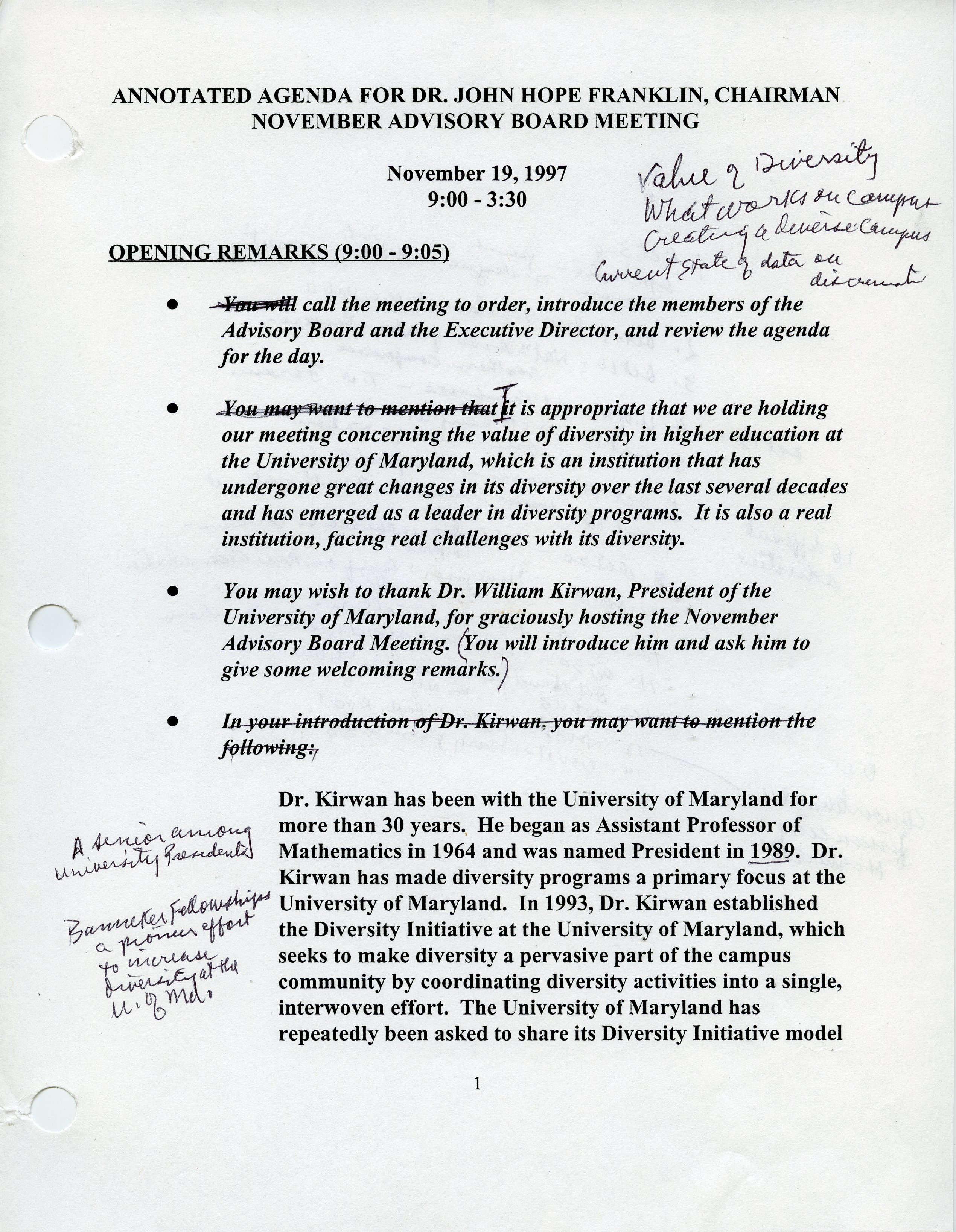
John Hope Franklin’s annotated meeting agenda.
The President’s Advisory Board on Race faced intense public scrutiny and was widely criticized by civil rights activists, who felt that the Board did not have a tangible end goal, and could not adequately represent the interests of the entire population on race matters. Critics also felt that dialogue was not sufficient for addressing serious race related problems in the United States.
In spite of the negative press the initiative endured, Franklin felt the work of the board was a much needed step in having a national conversation on race.
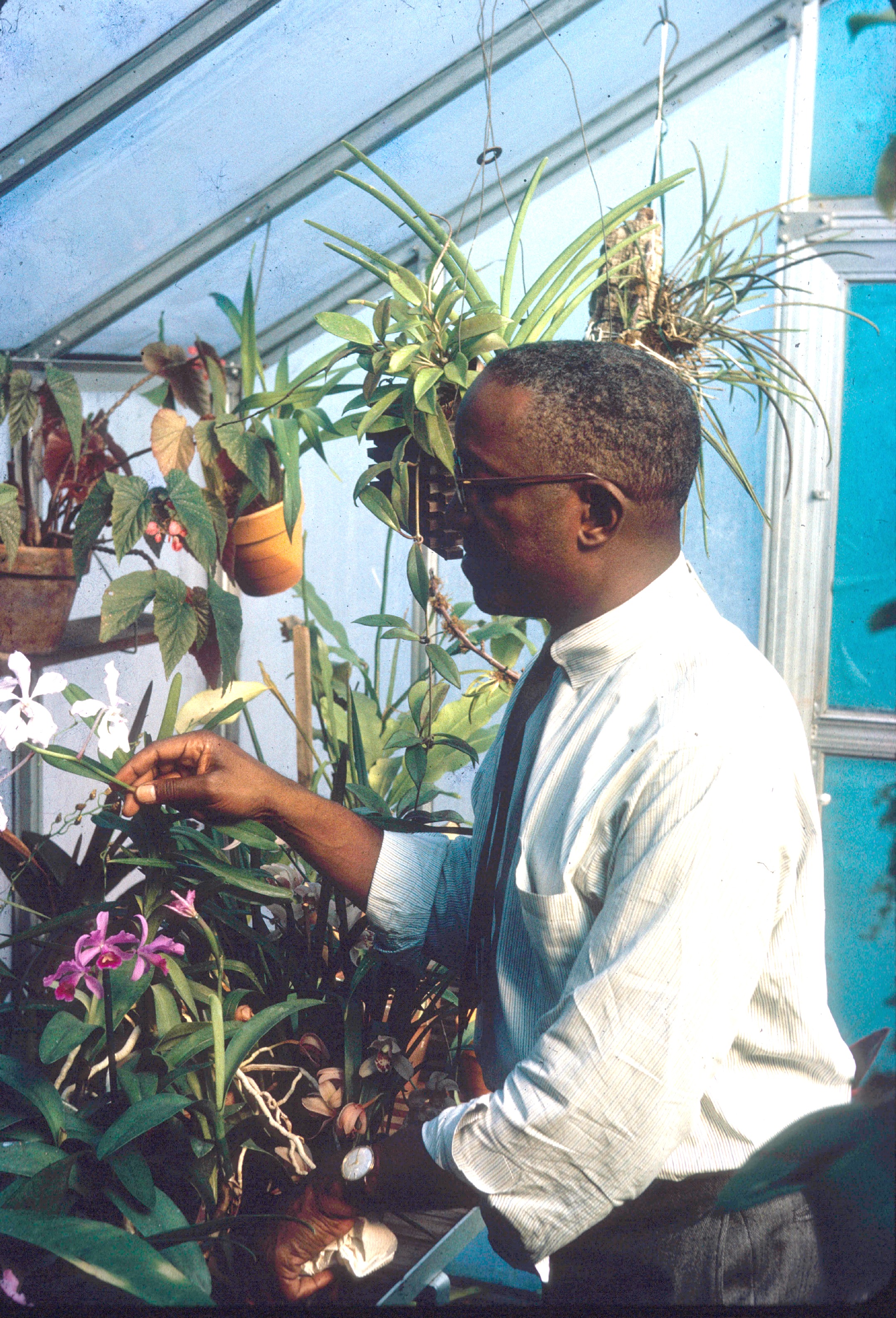
One of John Hope Franklin’s most well known hobbies was growing orchids and he had a prized collection, which included over 1000 orchids of different varieties, shapes, and sizes. In 1959, while teaching in Hawaii, Franklin became fascinated with the precious flower.
John Hope Franklin tending to his greenhouse. 1960’s
Many of Franklin’s orchids were acquired during his travels around the world, and he built greenhouses in his homes in Brooklyn, Chicago, and Durham to cultivate and house his special collection of orchid specimens and hybrids. Franklin’s custom-built greenhouse at his home in Durham measured 17 x 25 feet.
John Hope and John Whittington Franklin in the family Greenhouse, 1960’s
In 1976, John T. Wilson, president of the University of Chicago named an orchid hybrid in honor of Franklin, the Phalaenopis John Hope Franklin. The flower, which is white and red in color, is recognized by Britain’s Royal Horticultural Society. Another species of orchid was named in honor of Aurelia Franklin after her passing in 1999.
Phalaenopis John Hope Franklin
The Franklin family was renowned for their orchid collection, and frequently showed them off to visitors to their home; John Hope frequently referred to them as his “babies.”
The National Association for the Advancement of Colored People (NAACP), founded in 1909, is the oldest and largest civil rights organization in the United States.
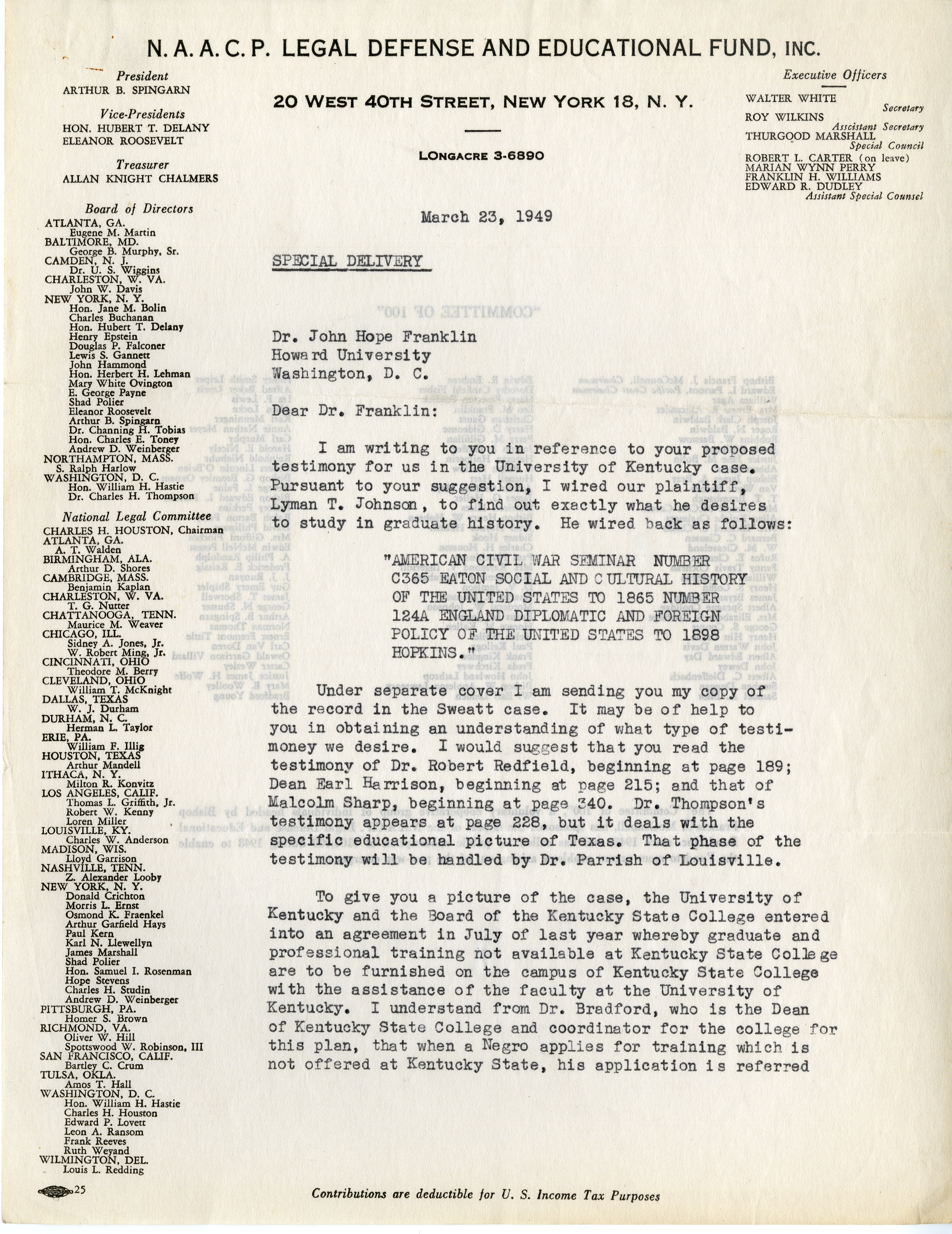
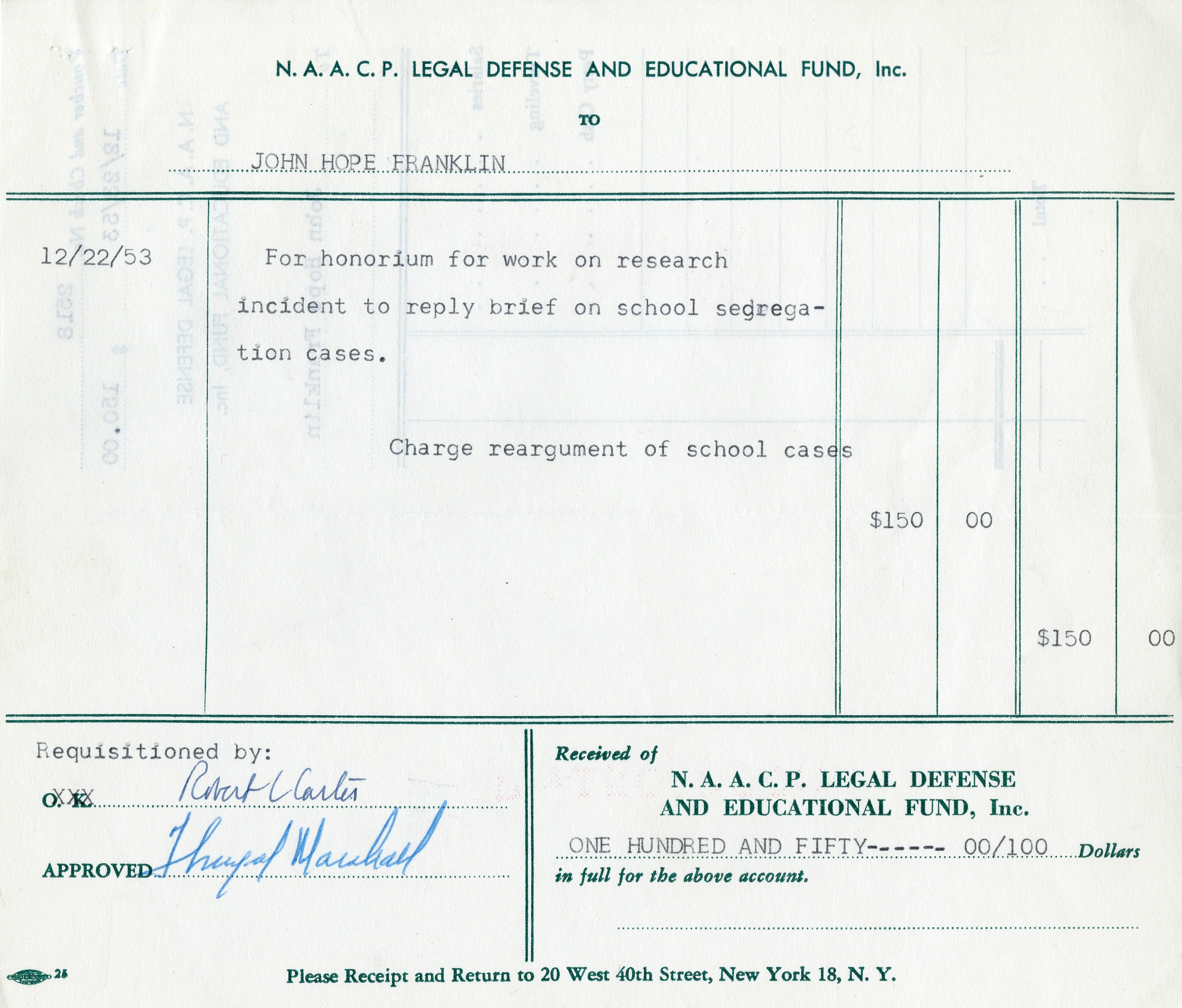
In 1949, the NAACP approached John Hope Franklin to provide his expertise and testify at the Lyman Johnson v. University of Kentucky trial. The Johnson case successfully challenged the “separate but equal” doctrine that had been established by the Plessy v. Fergusson trial of 1896. John Hope Franklin later worked as the lead historian for the NAACP Legal Defense Fund team in preparation for Brown v. Board of Education in 1954. Franklin’s research contributed to Thurgood Marshall and the NAACP’s legal victory in this landmark case.
Letter from Robert Carter, NAACP, to John Hope Franklin, 1949Pay invoice to John Hope Franklin for work on the Brown v. Board of Education, 1953
His relationship with the NAACP continued throughout his life, serving as a memeber of committees of the Legal Defense Fund and a mentor to a number of leaders in the organization. In 1995, the NAACP honored John Hope Franklin with the Spingarn Medal, “in recognition of an unrelenting quest for truth and the enlightenment of Western Civilization.” The Spingarn Medal is the NAACP’s highest honor, and is awarded annually to a person of African descent and American citizenship. The recipient of the Spingarn Medal is an individual who has attained high achievement and distinguished merit in any field.
Mirror to America: The Autobiography of John Hope Franklin is a riveting memoir that chronicles Franklin’s life and offers a candid account of America’s complex history of civil rights the final book written by Franklin. Mirror to America was published in 2005 by Farrar, Straus and Giroux.
Mirror to America, 2005
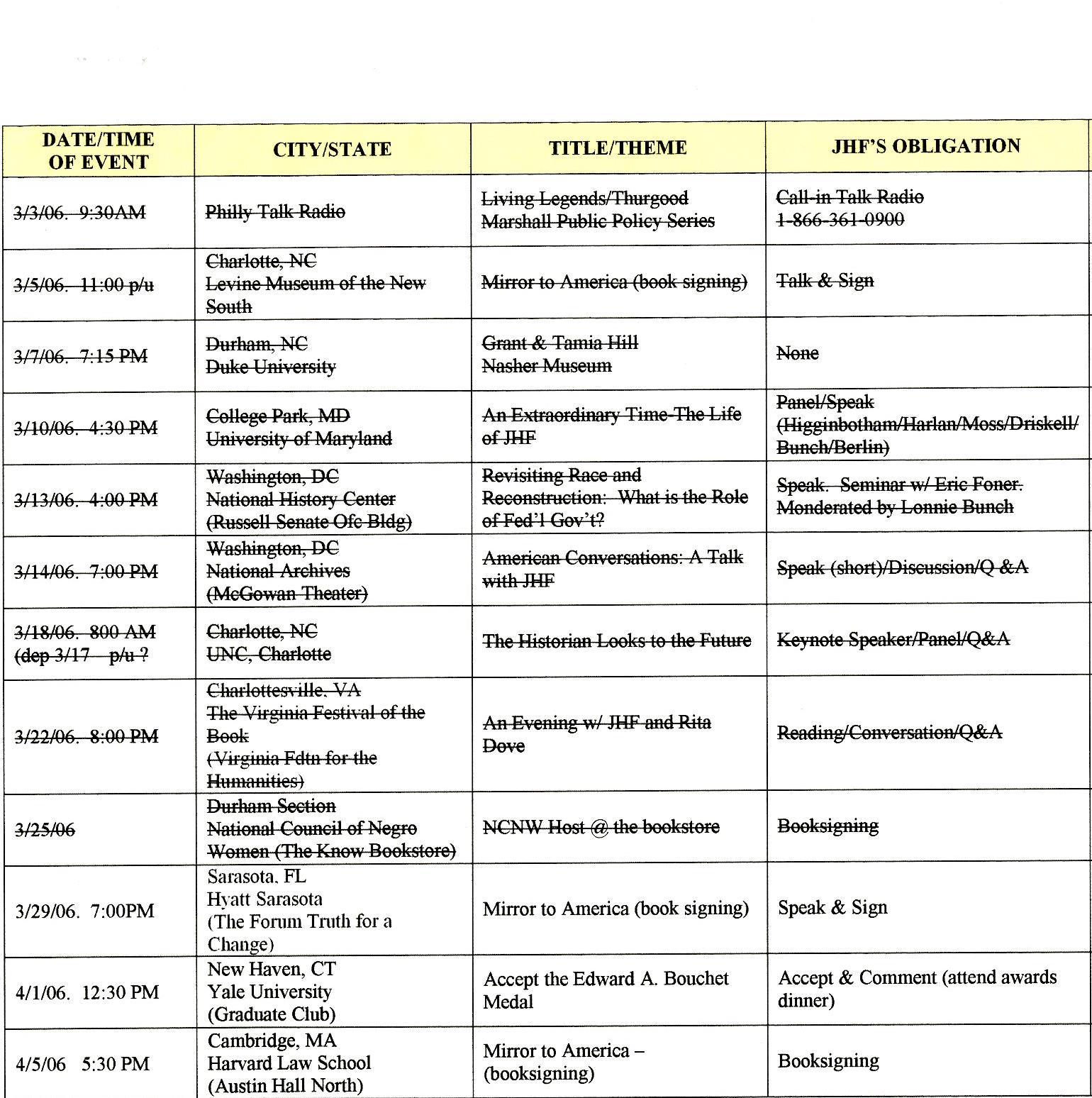
Franklin spent a number of years researching his own history, locating documents related to his family and his hometown, Rentiesville, Oklahoma. Once the book was completed, Franklin went on a national speaking tour, to not only share his personal story but discuss the impact of race in the many events he witnessed in American history.
Itinerary for Mirror to American book tour, 2006
In 2011, two years after Franklin’s death, Mirror to America received the Robert F. Kennedy Center for Justice and Human Rights Book Award. The RFK Book Award is presented to a novelist who “most faithfully and forcefully reflects Robert Kennedy’s purposes – his concern for the poor and the powerless, his struggle for honest and even-handed justice, his conviction that a decent society must assure all young people a fair chance, and his faith that a free democracy can act to remedy disparities of power and opportunity.”
After the Tulsa Riots occurred in 1921, Buck Franklin, John Hope’s father, was separated from the family for extended periods of time until the entire Franklin family was able to move to Tulsa, OK in 1925. Over the period of separation, Mollie Franklin, John Hope’s mother, took charge of family affairs and raising the children, and even taught John Hope how to fish, in preparation to be a boy scout. Fishing would remain a lifelong hobby for John Hope Franklin. As a young man, he would go fishing with his father. Later in life, John Hope would frequently go fishing in Montana.
Franklin casting a line in Montana, undatedFranklin celebrating a catch, undated
In addition to fishing, Franklin loved to cook. His friends and students often spoke about the delicious meals that he prepared, and they described him as an excellent cook. The Franklin family were revered as hosts to anyone who visited their home.
John Hope and his wife Aurelia also traveled extensively due to his extremely busy speaking engagements and visiting professor commitments.
John Hope and Aurelia Franklin sailing in San Francisco, 1970s
Another of John Hope Franklin’s hobbies was growing orchids and he had a prized collection, which included over 1000 orchids of different varieties, shapes, and sizes. Franklin built his first substantial greenhouse at his home in Brooklyn, New York.
Alfred A. Knopf, Inc. is a publishing house located in New York. The company was founded by Alfred A. Knopf, Sr. in 1915, was acquired by Random House in 1960, and is now part of the Knopf Doubleday Publishing Group.
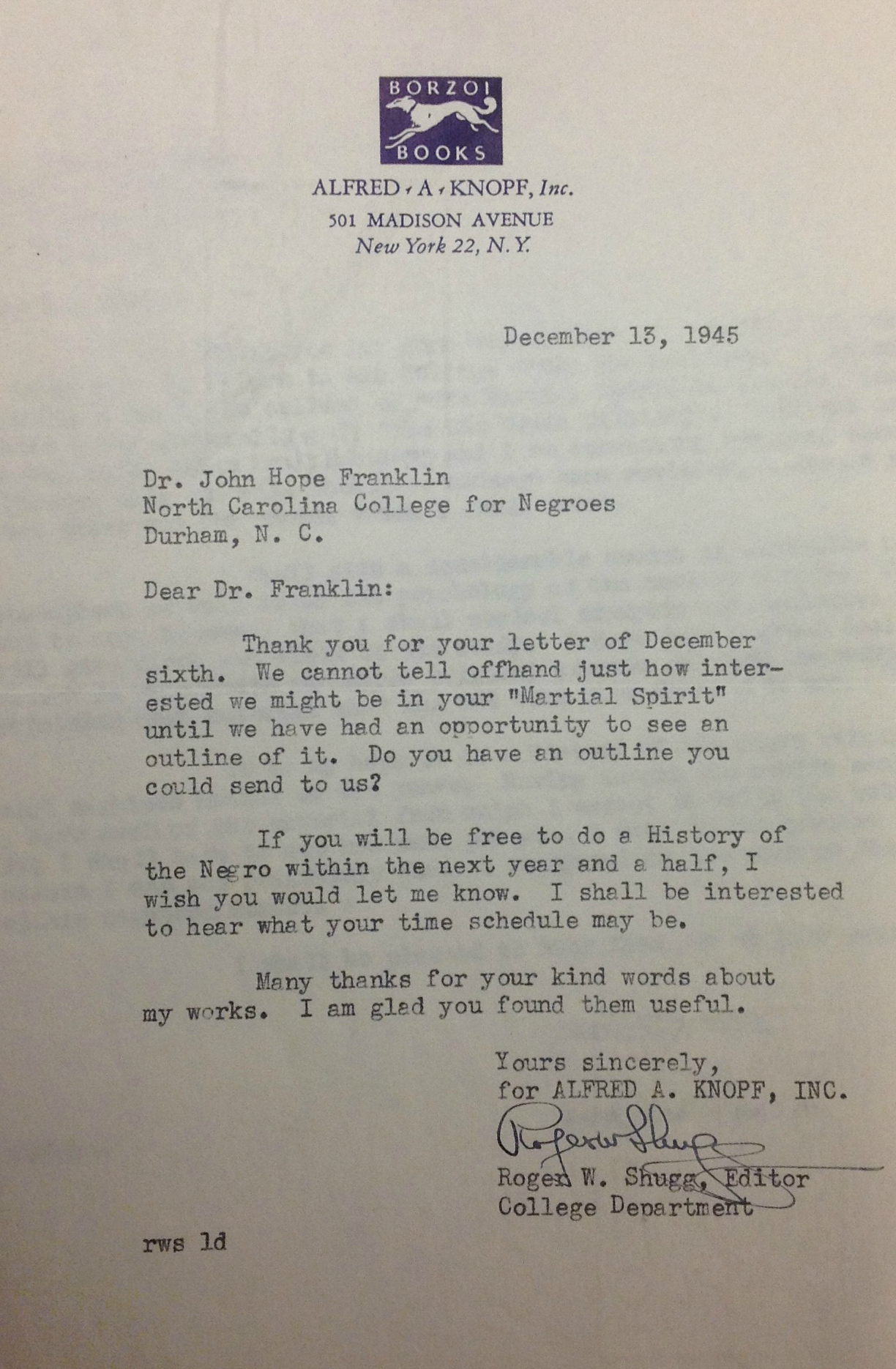
Alfred A. Knopf published John Hope Franklin’s seminal work, From Slavery to Freedom: A History of African Americans in 1947. In 1945, John Hope Franklin wrote to Knopf to see if the publisher would be interested in his project on the Martial South. On December 13, 1945, Robert Shugg, editor of the College Department replied that Knopf’s interest in the project would require an outline to see if the project was appealing to them. But in the second part of his letter, Shugg asked if Franklin would be interested in writing a history of the Negro. Franklin’s initial response was lukewarm, as his interests were primarily in the history of the American South. But correspondence between the two continued over a number of months until Franklin agreed to Knopf’s proposal.
Letter from Robert Shugg to John Hope Franklin, 1945
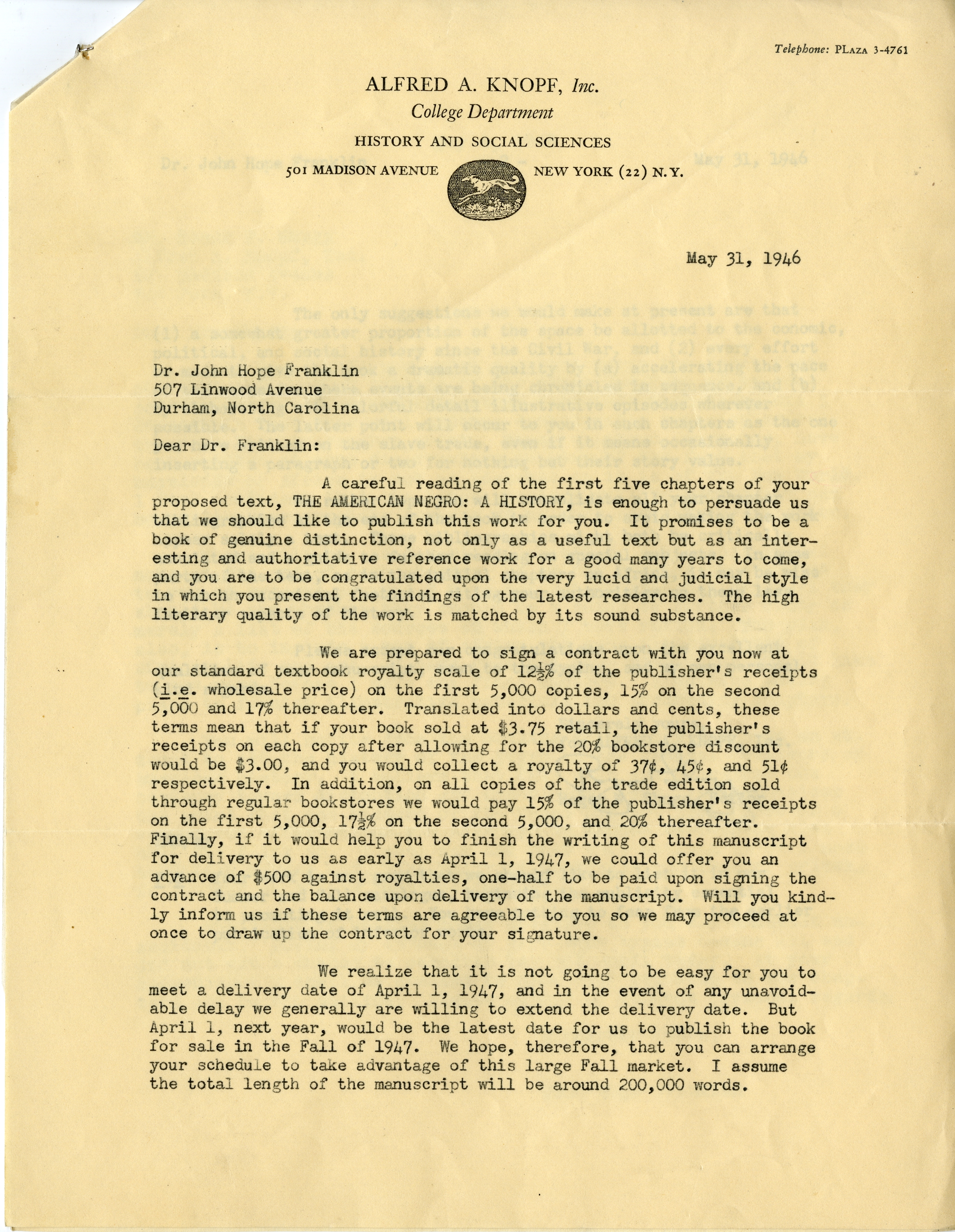
In six months, Franklin wrote the first five chapters of his work under the title “The American Negro: A History.” Robert Shugg noted, “It promises to be a book of genuine distinction, not only as a useful text but as an interesting and authoritative reference work for a good many years to come.” Even with modest sales of the first edition, Knopf contracted an updated second edition for printing in 1954. The burgeoning civil rights movement spawned a global interest in the history of African Americans, and From Slavery to Freedom served as a guide to understanding the changes taking place in America. Knopf continued publication of the work through it’s 8th edition.
Robert Shugg commenting on the first five chapters on “The American Negro: A History,” 1946
Established in 1972, the Jefferson Lecture in the Humanities is the highest honor that the United States federal government confers on an individual for distinguished intellectual achievement in the humanities.
In 1976, The National Endowment for the Humanities invited John Hope Franklin to be the fifth Jefferson Lecturer in the Humanities. Franklin gave three lectures as part of the series; the first lecture was given in Washington, D.C., the second in Chicago, and the final lecture was in San Francisco.
Incidentally, Franklin received the invitation to give his lectures during the same year as the bicentennial of the Declaration of Independence. Franklin’s three lectures focused not only on Thomas Jefferson, but also on the topic of “Racial Equality in America.” The first lecture was titled “The Dream Deferred” and focused on the period from the revolution to 1820. The second lecture was titled “The Old Order Changeth Not” and explored the 19th century. The third lecture was titled “Equality Indivisible” and discussed events and issues of the 20th century.
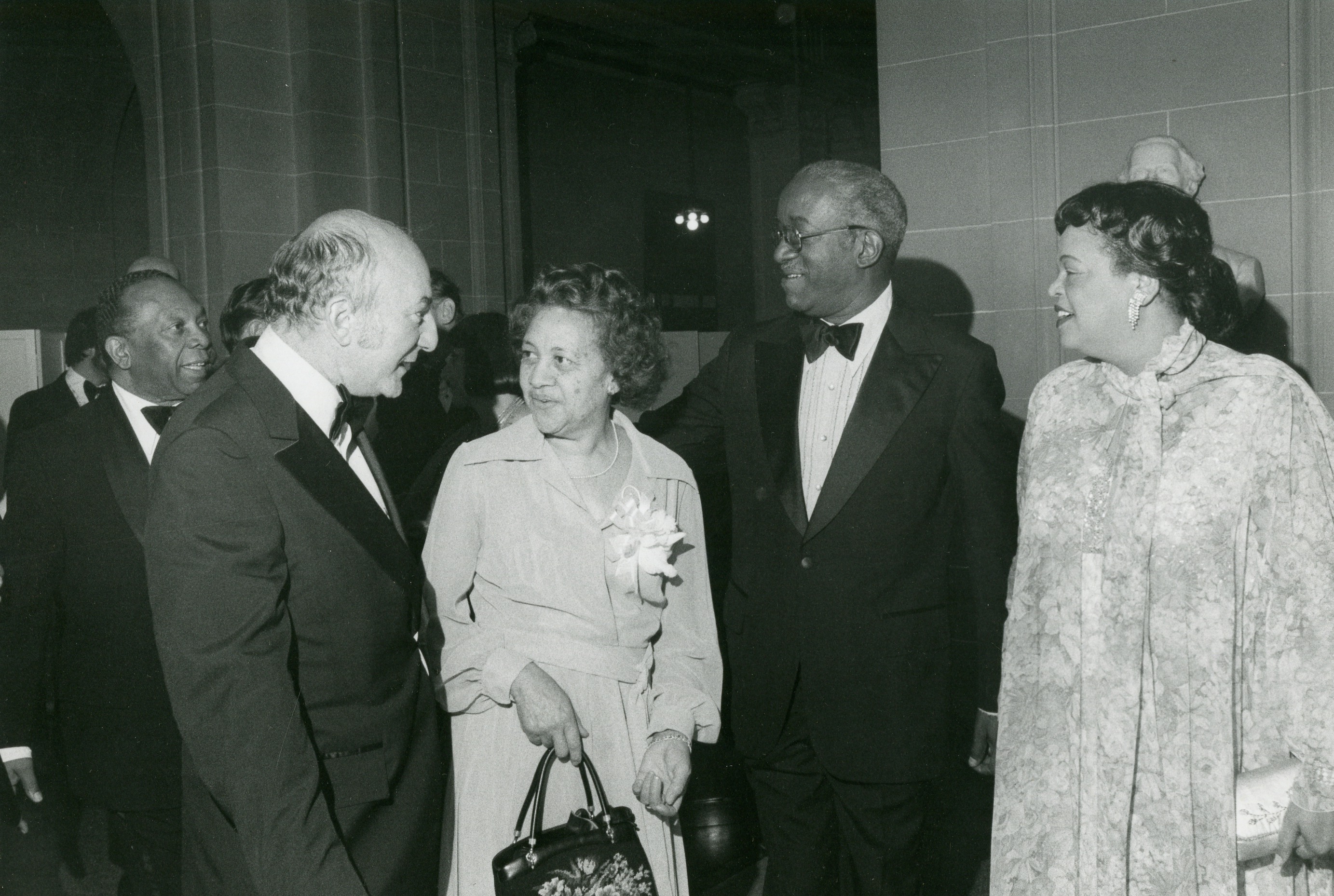
(l to r) Mayor Walter Washington, Ronald S. Berman, Aurelia and John Hope Franklin, and Mrs. Washington at the Washington DC reception of the Jefferson Lectures
In a scathing critique of Thomas Jefferson, Franklin highlighted the differences between perceptions and reality in some commonly held beliefs about race by using government texts and extensive data from the Census, property documents, as well as other sources.
Franklin’s lectures for the Jefferson lecture series were compiled and published in the book Racial Equality in America. The book was published by the University of Missouri Press in 1976.


 In October 2015, the David M. Rubenstein Rare Book & Manuscript Library will welcome Nate Larson as the second Barbaralee Diamonstein-Spielvogel Visiting Artist. Named in honor of Dr. Diamonstein-Spielvogel, a prolific author, interviewer, curator, and champion of the arts, this new artist-in-residence program provides an extended opportunity for an artist to study and engage with archival, manuscript and other special collections in support of developing a new body of creative work.