

This is the second of a summer series highlighting a few film shorts from the Full Frame Archive, a collection within the Archive of Documentary Arts, with the goal of preserving masters all past winners of Durham’s Full Frame Documentary Film Festival. The Full Frame Archive has grown to 75 films since 2007 and continues to grow; DVD use copies of these films can be viewed in the RBMSCL’s reading room. A complete list with descriptions, as well as titles of award-winners not yet acquired, can be found in the finding aid.
“Virtuosity and improvisation.” That’s what connects Nilesh Patel’s 2001 film short that documents his mother’s hands making samosas with John Coltrane’s jazz masterpiece, its namesake. “I wanted to refer to both of these ideas, which I believe can be ascribed to a mother’s cooking. A mother feeds you before you emerge into the world, and would even go hungry if necessary, just to ensure that her children can eat.”
A ten-minute, black-and-white film, A Love Supreme won the 2002 Full Frame Jury Award for Best Short and is, in my opinion, one of the more consciously artistic films in the Full Frame Archive. The film shows Patel’s mother, whose face is never shown, making the popular deep-fried Indian pastry stuffed with potatoes, peas and spices. Completely wordless, it presents the preparation process in ten stages, each set to its own tempo, images seamlessly edited in time with a musical or ambient soundtrack.
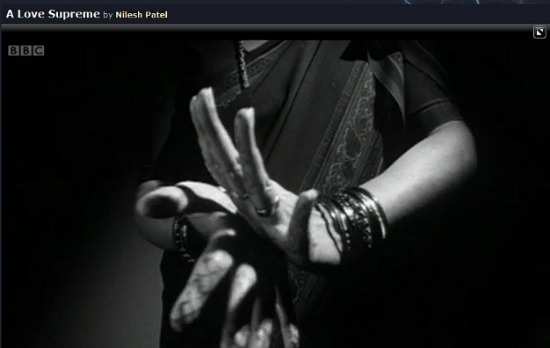
I interviewed the director by email earlier this month. Nilesh Patel (not to be confused with the Canadian filmmaker of the same name) is a London-based architect who developed “a keen interest in world and art cinema and began reading widely around film” in the late 1990s, taking a class and learning from the burgeoning Internet community of filmmakers, through which he eventually assembled a crew.
Regretting that he had not had the chance to capture his mother’s mother on film before she passed away, he “was determined to record my mother for posterity. I have many memories of her preparing traditional Indian foods when I was growing up, as you could not purchase Indian foodstuffs easily in the late 1960s and early 1970s in England, let alone prepared Indian meals for the microwave. My mother’s arthritis developed as a result of her work in knitwear factories, and I feared that it could spread and become more acute in the future. I decided to attempt to film her making the most well-known dish, and certainly one of the most time-consuming: samosas.”
Patel’s mother was not immediately on board with the project, however. “My mother was skeptical initially, and concerned that I would be investing a lot of personal money in the project, as I planned to use 35mm film. . . . It was only when she met the rest of the film crew, and saw the cases of camera equipment that she realised that the project was more than a whim.
“We did not show her the rushes or any of the in progress work, even though she asked many times. After a few months, she accepted that she would only see the film once it was complete, which was eighteen months after the shoot. As I did not know whether the completed film would ever be shown, I decided to organise my own premiere. I hired a central London screening room and organised catering for eighty people, so that the film would be seen in cinematic conditions. . . . My mother was very moved when she saw the film, because so many people had contributed their time and resources to help me make a film about her, and also because very few people get to see themselves projected on a cinema screen.”
Indeed, in retrospect, Patel appreciates most the film’s emotional impact, on family and strangers alike, “and that this is despite the fact the the film offers no factual information such as a name, date, time, location or even identity…. [I]t exceeded my initial aspirations and expectations.”
A Love Supreme screened at several international film festivals in 2002 to critical success. Since then, Patel has continued to focus on his career at an architect, but he is working on new film projects as well. “I have been planning a short documentary about agriculture and landscape, and hope to begin shooting soon. There have been extraordinary developments in digital filmmaking, and I plan to exploit these whilst also trying to make another film which explores the documentary format.”
Post contributed by Tanya Lee, Full Frame Archive Intern.
One thought on “A Love Supreme”
Comments are closed.