When librarians team up with first-year Duke engineers, archives inspire innovation
By Aaron Welborn, Director of Communications
The Pratt students’ toothbrush tester, on display as part of the new Consumer Reports exhibit.
Next time you visit Perkins Library, expect to be greeted with a smile.
You’ll find it waiting in a display case near the entrance—a gleaming set of artificial teeth kept in perfect pearly whiteness by a machine that brushes them for you.
If that sounds odd or even a little creepy, you should see the grill that inspired it.
This curious dental doohickey is a toothbrush tester, designed and built by Duke students. It’s part of a new library exhibit on the archives of Consumer Reports, the nonprofit consumer education and advocacy organization that’s been putting everything from toasters to tires through their paces since 1936.
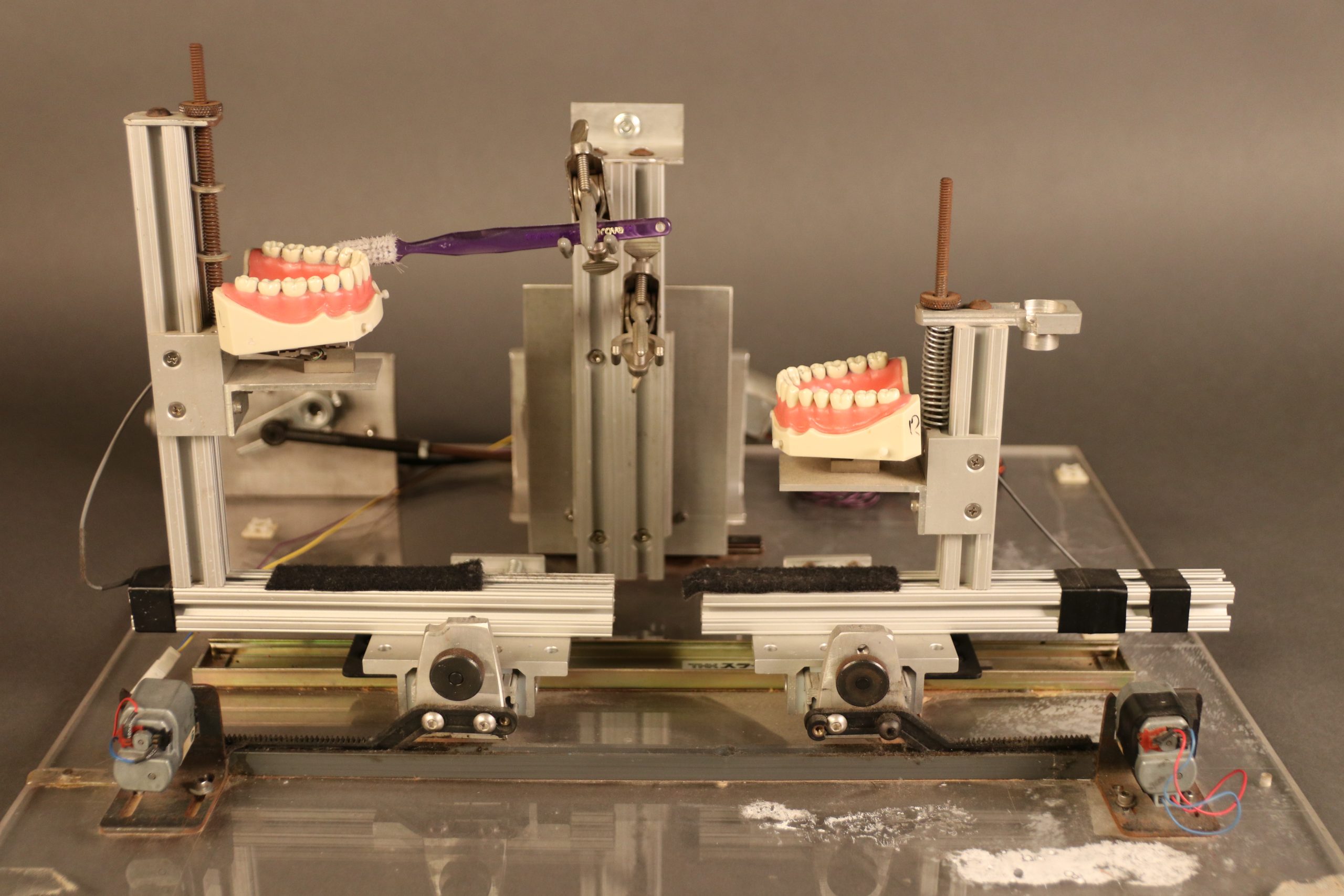
When Duke’s Rubenstein Rare Book & Manuscript Library acquired the papers of Consumer Reports in 2019, the collection came with dozens of bizarrely wonderful contraptions—including the original, old-fangled toothbrush tester, a Rube Goldberg-esque device sporting a truly nightmarish set of choppers.
The original Consumer Reports toothbrush tester.
There was also a lipstick tester, razor blade tester, tissue tester, even a condom tester—each one custom-built by Consumer Reports staff engineers to assess the effectiveness, durability, and value of different consumer products.
Once these devices entered the archives, they became historical artifacts—ingenious examples of engineering in the public interest, no longer for actual use (tempting though it may be to plug them in and see what happens).
Still, for classes visiting the Rubenstein Library, it would be nice to offer some idea of how they worked. That was the thinking of Joshua Larkin Rowley, Research Services Librarian with the Rubenstein’s Hartman Center for Sales, Advertising, and Marketing History. Rowley regularly uses Consumer Reports materials in his instruction sessions, and he’s part of the team that put together the new library exhibit—Test, Inform, Protect: The Consumer Reports Archive at Duke University—the first public showcase of this massive collection since it arrived at Duke.
Joshua Larkin Rowley, Research Services Librarian, Rubenstein Library
Rowley loves sharing the testing equipment with students. But he has long wished he could demonstrate the machines in action—to help students appreciate Consumer Reports’ scientific rigor and make the learning experience come alive.
For help, he turned to Duke’s own budding in-house engineers. Rowley submitted a proposal to the First-Year Design program in the Pratt School of Engineering.
Each incoming class of Pratt undergrads is required to take First-Year Design (EGR 101). The course divides students into teams and matches them with “clients” around campus and the local community who have real-world design problems in need of solutions. Rowley’s challenge: build a modern-day toothbrush tester that replicates the original’s functionality, is safe to operate, and could invite hands-on interaction in the classroom. If it worked, it might even appear in the upcoming exhibit.
Luckily, he got a bite.
Four first-year Pratt students—Jonathan Ransom, Bryan Chan, Gulnoza Abdurashidova, and Ewa Adebayo-Oke—formed the “Consumer Reports Team.” All four are electrical and computer engineering majors, and they were intrigued by both the technical complexity of the project and the promise of seeing their work exhibited in one of Duke’s busiest public spaces.
The team met regularly with Rowley, who served as their “client,” updating him throughout the semester as they defined the engineering challenges, conducted research, brainstormed ideas, prototyped, and tested designs. They also consulted with Exhibits Librarian Meg Brown about exhibit safety and display standards. And they got some unexpected help when Rowley arranged a video session with Misha Kollontai, an actual testing engineer at Consumer Reports, who offered feedback on their work-in-progress and answered questions about the organization’s work today.
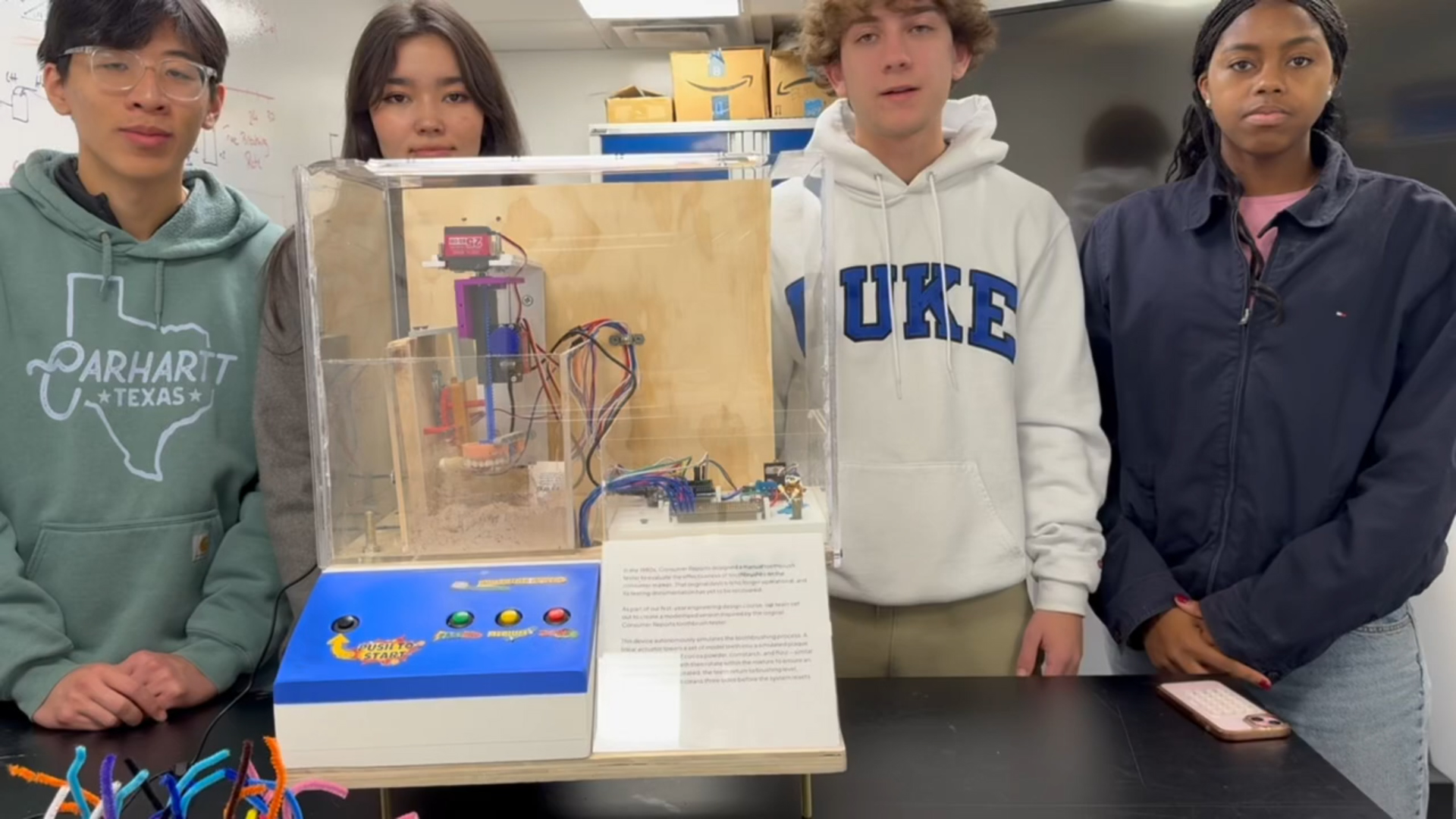
Pratt first-year students (left to right) Bryan Chen, Gulnoza Abdurashidova, Jonathan Ransom, and Ewa Adebayo-Oke with their prototype.
When the students finally unveiled their functioning toothbrush tester—complete with a homemade blend of dental “plaque” that gets scrubbed away with the push of a button—Rowley and his colleagues were all smiles.
You can see the device for yourself in the new Chappell Family Gallery exhibit, on view through early June 2026. After the exhibit comes down, the tester will have a new life in Rubenstein Library instruction sessions about the Consumer Reports Archive.
Aside from the chance to ruminate on their own oral hygiene, the experience gave the Pratt undergrads a new appreciation for the extensive design and testing that goes into everyday products we take for granted. It also drove home the importance of what libraries and archives do, preserving hard-won knowledge for posterity.
After all, as any dentist will remind you, you don’t have to brush your teeth. Just the ones you want to keep.
Leonhardt at the Bundestag in Berlin for the 2024 American Council on Germany Young Leaders Conference.
By Michele Lynn
Theodore L. Leonhardt’s list of accolades and accomplishments is long, especially for someone who received his Duke bachelor’s degree, with a double major in history and political science, just ten years ago. Currently an associate focusing on bankruptcy and restructuring at New York law firm Cleary Gottlieb, Leonhardt T’15, L’20 is a civic leader whose activities also include serving as a term member of the Council on Foreign Relations and a Next-Gen Leader on the White House Historical Association.
Prior to joining the law firm, he worked for former Secretary of State Henry Kissinger during 2022 and 2023, helping with his writings, speeches, press appearances, trips, and meetings—an opportunity that arose thanks to a Duke friend and professors. Leonhardt said that in this role, whether he was working on a speech or developing an historical essay, he drew upon the research and writing skills and intellectual rigor he learned at Duke.
“What I love about Duke as a university is that it brings together a mix of people devoted to intellect, energy, and also personal warmth, three facets that are key in the professional world,” he said. “The Libraries represent the essence of what it means to be a university—there is a universe of knowledge in the books and an openness and availability of them.”
Leonhardt believes that the Libraries physically epitomize the different aspects of Duke. “There are quiet spaces for reflection and writing, collaborative spaces like The Link and the von der Heyden coffee area, and the personal warmth of the librarians who help guide students,” he said.
One of those librarians is Carson Holloway, whose expertise includes British history, a perfect fit for Leonhardt, whose undergraduate research with Professors Philip Stern and Peter Feaver often explored the history of the British Empire. Holloway remembers Leonhardt as an impressive student who was “beautifully prepared.” Holloway said, “I watched Ted develop as an intellectual throughout his years at Duke.”
Leonhardt likens Holloway and his librarian peers to navigators on a ship. “The collections in the Libraries are so vast that when I was a young undergraduate, they could feel a bit daunting, especially in the early years,” said Leonhardt. “As a scholar, I was steering the direction of my research, but Carson played the role of navigator who, on a ship, is oftentimes more experienced and senior. Carson helped me find resources that I didn’t know about and wouldn’t have been able to locate without him.”
In 2013, Leonhardt’s paper about Britain and the Falklands war was honored by the Libraries with the Lowell Aptman Prize. This award recognizes undergraduates’ “excellence in research, including their analysis, evaluation and synthesis of sources, and encourages students to make use of the general library collections and services at Duke University.”
“Winning that prize was very meaningful and gave me confidence and energy as I proceeded as a historian,” said Leonhardt. “The fact that Mr. Aptman has devoted his philanthropy to the Libraries is a big part of inspiring my own gifts to the Libraries every year.”
Leonhardt said that when he looks back on his time at Duke, both for his undergraduate and law school studies, the Libraries are a constant. “The Libraries mean so much to me, in terms of where I spent my time physically, the relationships I formed there, and the intellectual growth that I experienced there,” he said. “Duke University and the Libraries provided an intellectual map for me, which is why the Libraries have always felt like home and why I’m always excited to visit them and to support them.”
Duke Families Connect Over Stories with Author David Grann
Author David Grann (center) poses with daughter Ella (right) and his wife, producer and investigative reporter Kyra Darnton (left).
Every October during Duke Family Weekend, we look for a parent of a Duke student who has an interesting job and invite them to share their experiences with other Duke moms and dads. This year we were fortunate to be joined by bestselling author and new Duke parent David Grann.
Grann is a staff writer at The New Yorker magazine and author most recently of The Wager: A Tale of Shipwreck, Mutiny, and Murder (2023), named one of the best books of the year the New York Times, Wall Street Journal, TIME, Smithsonian, NPR, and others. He is also the author of Killers of the Flower Moon: The Osage Murders and the Birth of the FBI (2017), which was also a New York Times bestseller and has been adapted into a major motion picture directed by Martin Scorsese. Grann’s other books include The Lost City of Z (2009), The White Darkness (2018), and The Devil and Sherlock Holmes (2010). Grann and his wife, producer and investigative reporter Kyra Darnton, are the parents of Ella, a first-year student at Duke, who interviewed her dad at the event.
No stranger to libraries and archives, Grann shared insights and anecdotes from a long career of unearthing true-life episodes from history that turn out to be stranger than fiction.
Duke Grad Places 2nd in National Book Collectors Contest
Peter de Guzman
Every other year, we hold the Andrew T. Nadell Book Collectors Contest to recognize and encourage student bibliophiles at Duke. This year’s graduate-level winner was Peter de Guzman, a graduate student in Interdisciplinary Data Science, for his collection on Filipino American identity.
As the first-place winner, de Guzman was eligible to enter the National Collegiate Book Collecting Contest in Washington, D.C.—the “Final Four” of book collecting competitions—where he won second place!
De Guzman’s collection was inspired by a quote from Filipino writer Nick Joaquin: “The identity of the Filipino today is of a person asking what is his identity.” The Duke student has explored this question through his collection, with many discoveries since his collecting began in 2018. De Guzman and his fiancée hope to continue building their collection and eventually donate it to a public library to promote youth education and Filipino American Studies.
At Duke, the biennial book collectors contest is named for Dr. Andrew T. Nadell M’74, who began collecting rare books when he was a student here.
Zooming In on Duke Engineers
This September we hosted our third annual library open house especially for students, faculty, and staff from the Pratt School of Engineering. The event offered attendees a chance to interact with some fascinating and unusual items from the Rubenstein Rare Book & Manuscript Library—like a 1665 first edition of Robert Hooke’s Micrographia (below), famous for its detailed illustrations of observations made through a microscope, including the first use of the word “cell” to describe minute structures invisible to naked eye. Over a hundred students and faculty members attended to get a sampling of the wide variety of collections we hold on the history of science and engineering, including many they might not expect.
Students examine a 1665 first edition of Robert Hooke’s “Micrographia.” (Photo by Alex Sanchez)
Bookish Tradition Celebrates Faculty Success
Each year, Duke honors faculty members who have achieved tenure or promotion during the previous academic year with a special tradition. In recognition of their achievement, each faculty member is invited to select a book from the Libraries’ collection to be book-plated in their name, and to write a brief reflection their personal connection to the chosen work. The books and their accompanying statements are then displayed for guests to explore at a special celebration in the Rubenstein Library’s Gothic Reading Room, hosted by President Vincent Price and Provost Alec Gallimore.
At this year’s November 5 event, sixty-one Duke faculty members were recognized for their scholarly and creative achievements. The diversity of books they picked—from groundbreaking scientific texts and explorations of teaching and healthcare to timeless works of literature—offers a glimpse into the intellectual richness and spirit of curiosity that define Duke’s academic community. Following the event, a collection spotlight on the main floor of Perkins Library continued the celebration, highlighting some of the selected titles and the listing the honorees by name. Congratulations to all!
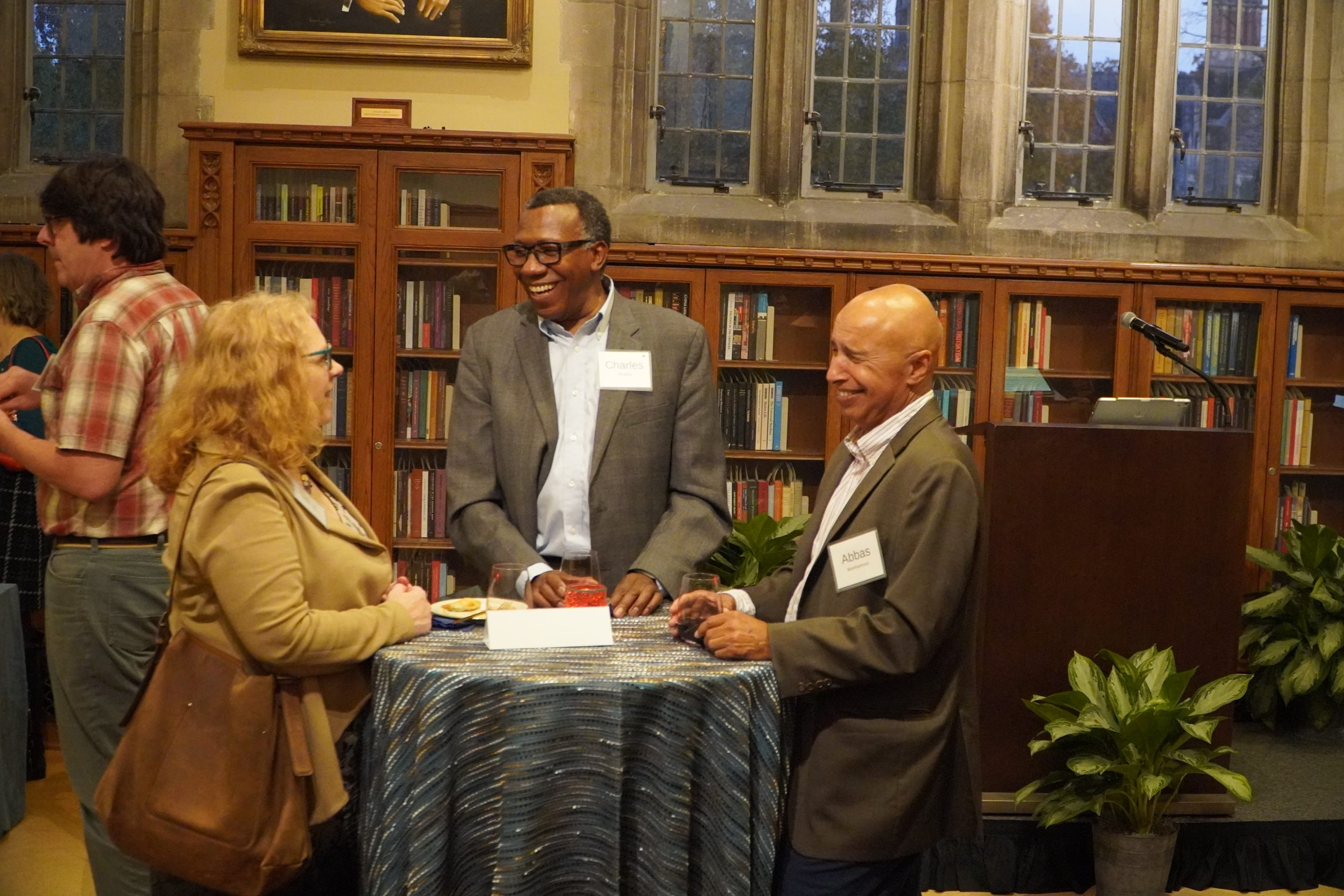
Faculty members and guests mingle at a November 5 reception honoring newly tenured and promoted Duke faculty in the Gothic Reading Room. (Photo by Andrew Park)
Spotlight on the “Space Race” for Library Collections
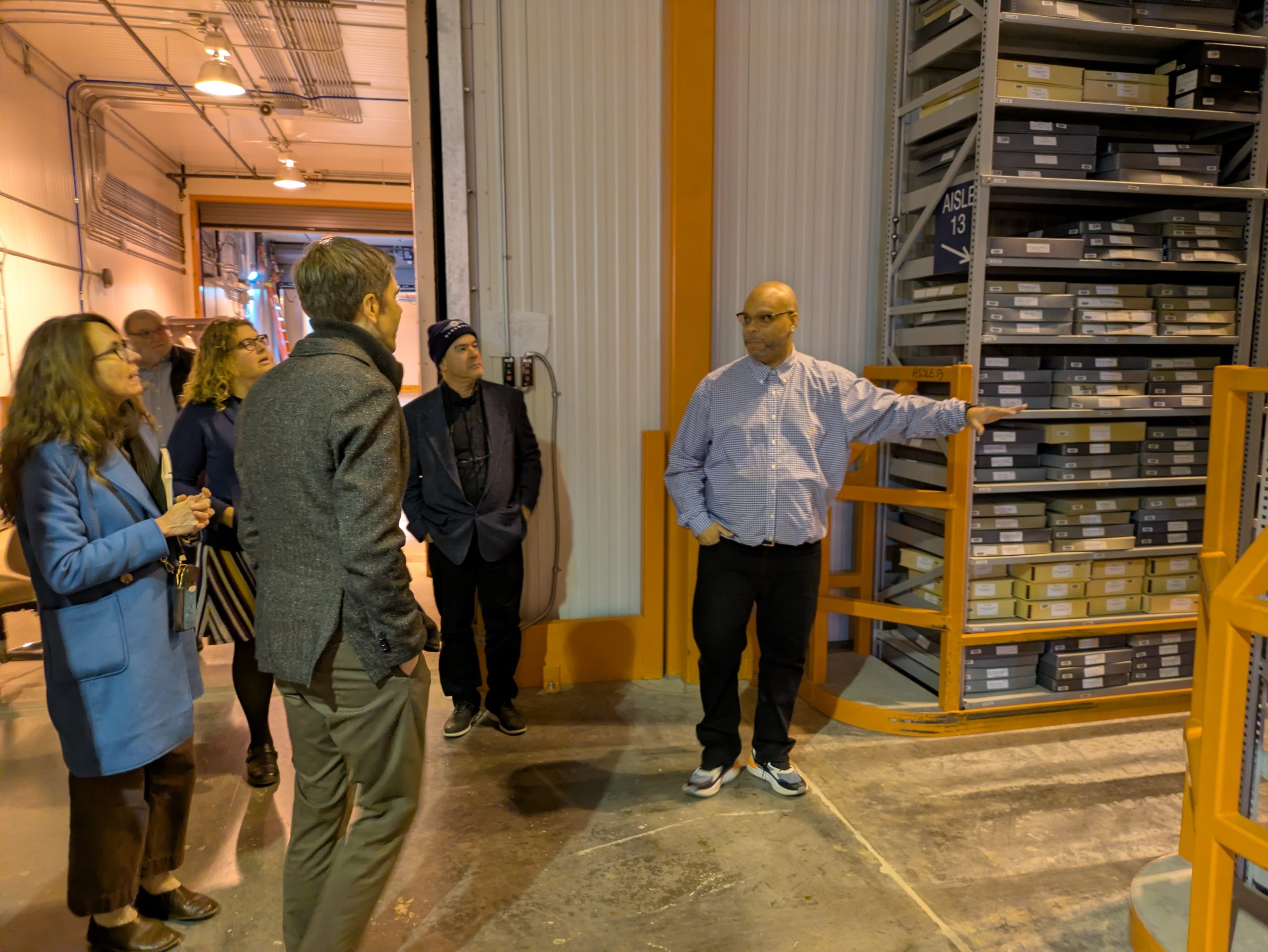
Below, Duke faculty members chat with Earl Alston, manager of the Duke Library Service Center, during a recent tour of the facility by the Library Council. The Library Council advises Duke’s University Librarian on library policy and serves as a communication link between the Libraries and the faculty. Members are appointed by the Provost.
Tucked away in an industrial park a few miles south of downtown Durham, the Library Service Center holds more than six million books, documents, and boxes of archival materials. About half of them belong to Duke. But the facility also manages millions of volumes on behalf of the University of North Carolina at Chapel Hill.
During the tour, Library Council members got to see for themselves how the LSC is running out of space. Built in 2001, it has been added onto twice and is now at 98 percent capacity. As usage keeps going up, it will need to be expanded again in the years ahead.
Made for This Campaign Invests in Duke Libraries
In early 2025, Duke University launched the most significant fundraising and engagement campaign in its history. Made For This: The Duke Campaign will engage alumni and friends to accelerate progress in areas where Duke can make the greatest difference for the world—advancing innovation through science and technology, creating a more sustainable planet, shaping students as next-generation leaders, and advancing healthcare to help communities thrive.
The comprehensive campaign will support key priorities across the university, with a goal of raising $125 million for the Duke University Libraries.
This undertaking comes at a momentous time. The explosive growth of online information and artificial intelligence has enabled knowledge to spread faster and more easily than ever. But it has also created an environment for disinformation and distortion, eroding trust in what we see and hear.
In this disorienting world, libraries have a vital role to play. It’s crucial that we remain a trusted source of sound research and guidance, prioritizing people, deepened collaborations, and a culture that is truly inclusive.
We can’t do it alone. We rely on a community of donors who generously support our work. This campaign brings with it new opportunities to collaborate on timely, transformative projects that will not simply enable the best teaching and research at Duke, but amplify and showcase it, increasing its impact on the world and countless individual lives. With your help in achieving our goal of $125 million, we can do just that.
Duke Vice Provost for the Arts Deborah F. Rutter (left) interviewed author Percival Everett for the Weaver Memorial Lecture. (Photos by Jared Lazarus, Duke Marketing and Communications)
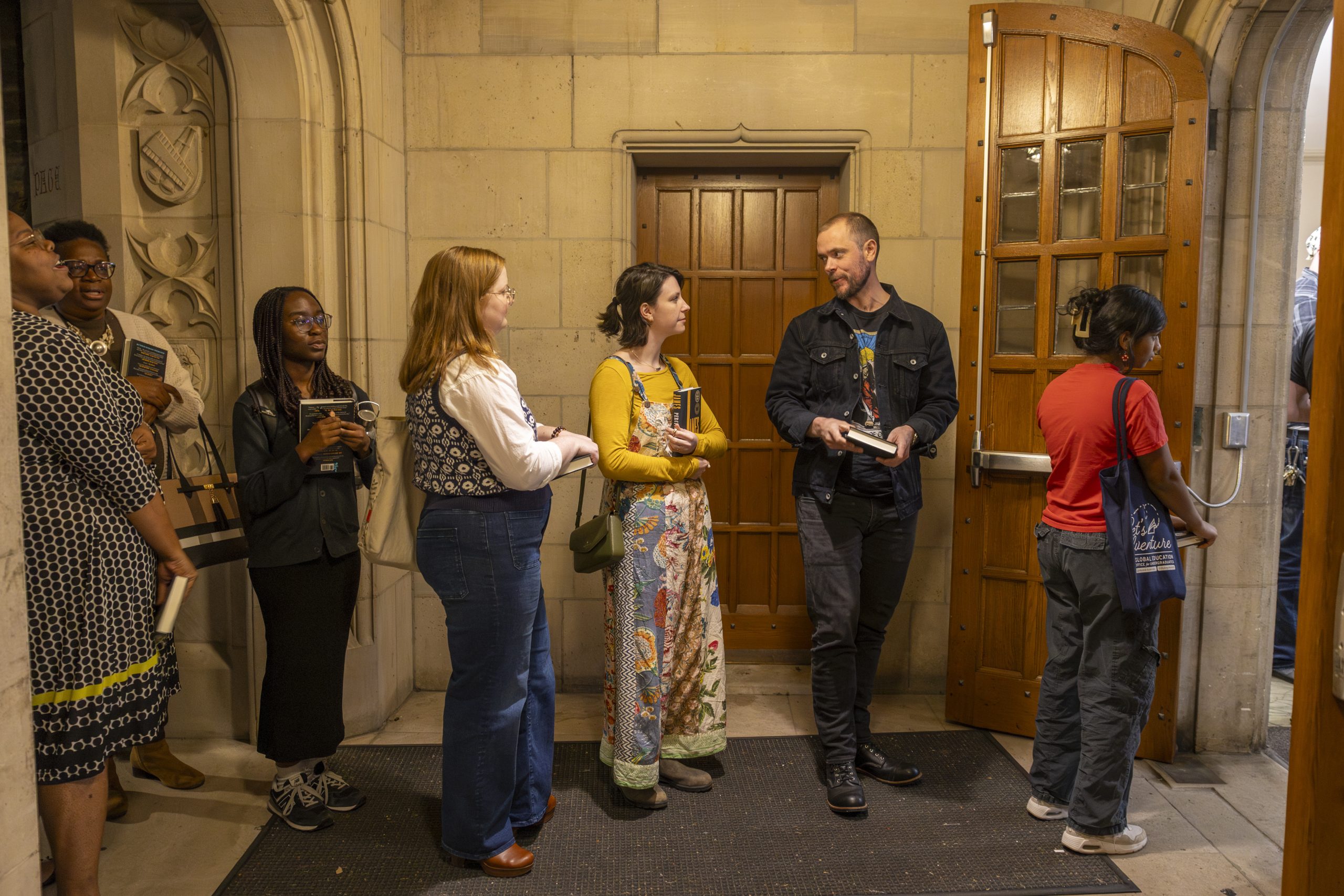
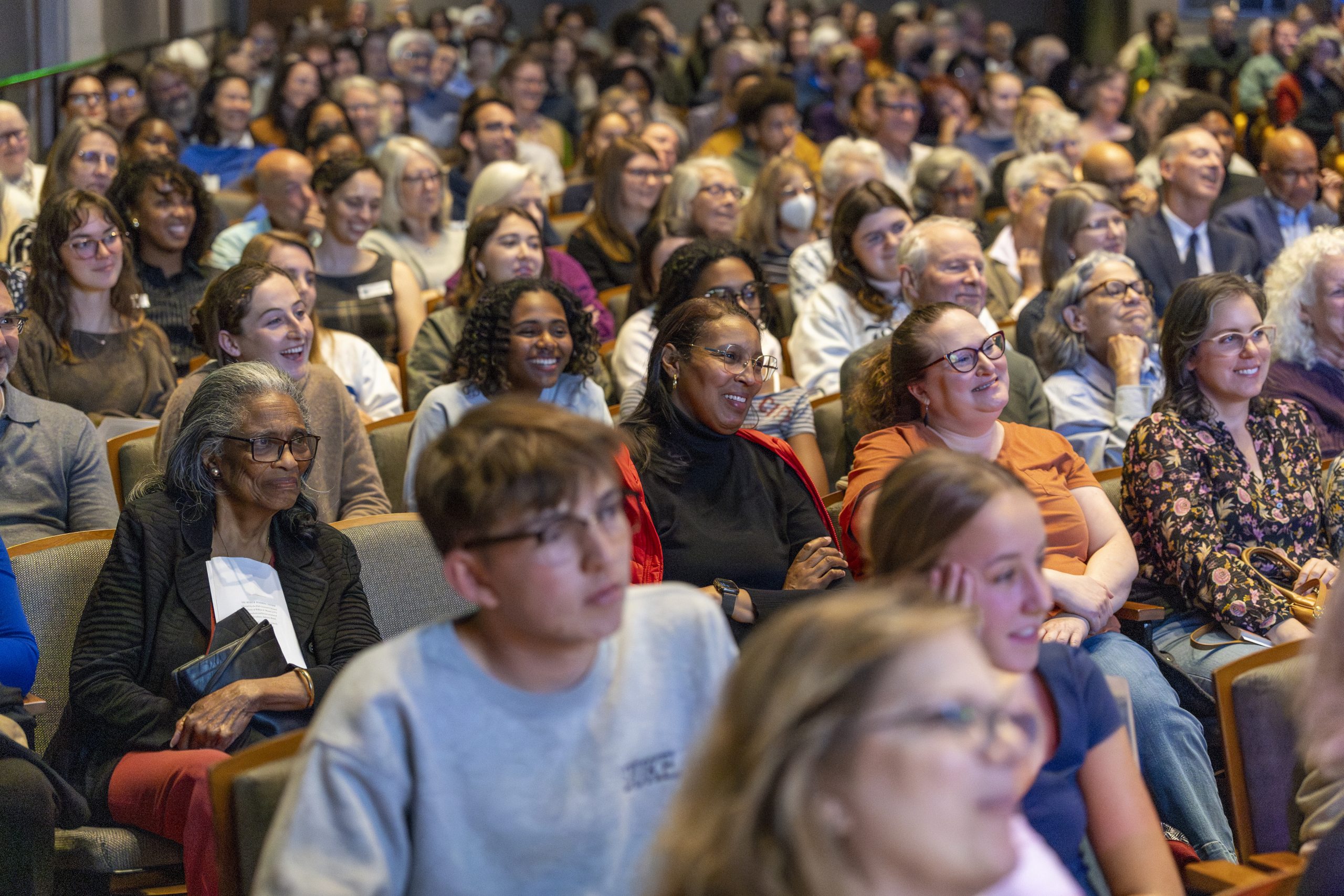
There were few empty seats in Duke’s Page Auditorium when author Percival Everett took the stage on Thursday, October 23, to talk about his novel James, winner of the 2024 National Book Award and 2025 Pulitzer Prize. The book—a satirical reimagining of Mark Twain’s American classic The Adventures of Huckleberry Finn, told from the enslaved character Jim’s point of view—was selected as the Duke Common Experience reading for the Class of 2029.
Everett was joined on stage in conversation with Deborah F. Rutter, former president of the John F. Kennedy Center for the Performing Arts in Washington, D.C., and newly appointed Vice Provost for the Arts at Duke. Everett’s appearance at Duke was presented as the Weaver Memorial Lecture, an endowed speaker series hosted every other year by the Duke University Libraries in memory of William B. Weaver, a 1972 Duke graduate and former member of the Duke Library Advisory Board. In addition to the public talk, Everett also met earlier that day with a group of undergraduate fellows from the Reginaldo Howard Leadership Program for a thought-provoking, insightful, up-close-and-personal conversation about the book, a free copy of which was mailed to every first-year Duke student this year before they arrived on campus.
Q&A with Duke’s Librarian for Artificial Intelligence Learning
Hannah Rozear, Librarian for Biological Sciences, Global Health, and Artificial Intelligence Learning
Artificial intelligence is reshaping how we all learn, create, and consume information. At Duke, that transformation is being met not with fear or uncritical excitement, but with curiosity, critical thinking, and conversation—led in part by Duke librarians.
Hannah Rozear, Librarian for Biological Sciences, Global Health, and Artificial Intelligence Learning, works with Duke students and faculty on using AI technologies in responsible, creative, and impactful ways. Earlier this year, she collaborated with a small team of Duke undergraduates and researchers to develop the AI Ethics Learning Toolkit, a new resource that invites students and faculty to ask big questions about AI’s impact on knowledge, creativity, and society. The toolkit is built around discussion prompts and classroom activities that make space for thoughtful, values-driven engagement with generative AI.
We recently caught up with Rozear to ask how the toolkit came to be, what it’s teaching Duke students about the promise and pitfalls of AI, and why libraries are uniquely positioned to help communities approach these new technologies with reflection and a healthy dose of perspective.
Conversations about artificial intelligence are unfolding everywhere—in the news, throughout higher ed, and across Duke’s campus. What motivated you and your collaborators to develop the AI Ethics Learning Toolkit? How did you envision it helping the Duke community to engage thoughtfully with generative AI?
There’s no shortage of buzz about the good, the bad, and the ugly of AI’s impacts. Much of the conversation swings between extremes—either AI-hype or doomsday predictions about world-ending robots—without as much attention to the subtler human and social dimensions of these technologies. At a liberal arts institution like Duke, our team saw an opportunity to explore AI from a more humanistic perspective.
Our design team—two undergraduates, an education scholar, and a librarian—decided that a toolkit with adaptable classroom activities and discussion prompts would have the greatest potential impact. With students as collaborators, we built a resource that centers student perspectives and experiences. Because there’s no “one-size-fits-all” approach to conversations about AI, the toolkit aims to offer flexible starting points, letting faculty choose topics that align with their courses and adapt activities to fit their teaching goals and available time.
What challenges do you see Duke faculty and students currently facing as they try to navigate the use of generative AI tools responsibly? How does this toolkit help to address those challenges?
Generative AI can still feel like a taboo topic, and both faculty and students struggle to determine where the line is between acceptable and inappropriate use. The toolkit doesn’t address that question head- on. Instead, it offers nuanced and creative ways to spark meaningful conversations about AI use in the classroom. The term AI literacy can be unhelpfully broad, but it refers to understanding how these technologies work “under the hood” and recognizing their broader societal impacts. By helping faculty and students engage critically and thoughtfully with AI, the toolkit encourages curiosity, reflection, and ethical awareness—approaches that will help students make informed, responsible decisions about when and how to use AI tools. The toolkit also helps normalize conversations about AI, supporting Duke’s broader commitment to fostering ethical engagement with AI.
How do you see the role of the library—and librarians in particular—evolving as AI becomes a more integral part of research, teaching, and everyday information use?
My first experience with ChatGPT’s limitations came in 2023, when I encountered one of its now-famous citation “hallucinations.” In that moment, I realized two things: 1) everyone would be clamoring to use this tool for research and information-seeking, and 2) libraries would have a critical role in helping users understand the limitations of this seemingly magical technology.
Libraries have often been at the forefront of major technological shifts (remember the internet?), and the rise of generative AI is no exception. Library staff bring an incredible range of expertise—spanning coding, cataloging, archives, data, and research—and we’ve long been advocates for privacy, ethical technology use, and open access to knowledge.
As AI becomes increasingly integrated in everyday information practices, librarians play a key role in helping students and faculty evaluate AI outputs, recognize potential biases, and develop critical AI literacy skills. Our broad, systems-level view of information and technology uniquely positions us to guide our community in using these tools thoughtfully and responsibly.
Can you share any examples of how Duke students or faculty have been using the toolkit to think more deeply—or teach more effectively—about AI and its social implications?
We shared the toolkit with Thompson Writing Program faculty at the beginning of the fall 2025 semester, and many appreciated having simple, ready-made entry points for talking about AI with their students. Sometimes getting over the initial hump—simply naming AI in the classroom—opens the door to important conversations with students. In collaboration with one writing instructor, we tried out a toolkit activity in which students used ChatGPT to generate a bibliography for their research topics. One group discovered that every citation had been fabricated, which brought home the lesson about the need to fact-check AI-generated information carefully. Another faculty member shared that she and her students had created a collaborative AI policy together after I visited their class.
The toolkit has also gained attention beyond Duke. We’ve heard from librarians, educators, and academics across North Carolina (and as far away as Australia!) who are interested in adapting the materials for their own institutions. Their feedback has been encouraging, and we hope to incorporate these new perspectives as we continue to refine and expand the toolkit.
The topics and conversation starters in the toolkit seem intentionally simple and direct. For example: Is AI theft? Is AI a spy? Who benefits from AI? But there’s a lot to unpack in each of those questions. Which prompts do you think have particularly resonated and started good conversations with Duke students?
The students on our design team felt that concise, provocative questions offered more engaging hooks for their peers. A prompt like “Is AI theft?” sparks curiosity more quickly than a more formal question like “What are the impacts of AI on the copyright landscape?” Even though both essentially ask the same thing.
When I introduced the toolkit to students in a Focus AI program (a cohort of first-year students), the question “Can I trust AI?” really resonated. Many of them have seen firsthand how AI can make things up, but they’ve also experienced how valuable these tools can be when trying to grasp a complex topic. That tension between usefulness and reliability sparked thoughtful discussion about what “trust” in AI might look like.
In an Environmental Science course I worked with, students gravitated toward the question, “Is AI sustainable?” Many were concerned about the environmental costs of AI technologies, and some expressed skepticism about whether the benefits outweighed the harms. That conversation opened space to think critically about the broader systems, infrastructure, and energy use that underpin AI’s rapid expansion.
These questions are intentionally provocative. They may even come across as overly critical. But combined with supporting resources and guided classroom discussion, they invite students to explore multiple perspectives.
What tips do you have for people to help them identify if AI-generated information is true and reliable?
Be skeptical and fact-check any suspicious information. If it seems too good or too easy to be true, it probably is! Fact-checking can be as simple as opening a new browser tab and looking into the author, organization, or claim that you find suspicious. I think this process of fact-checking will become one of the most important twenty-first-century research skills. To help with this, I created something called the SNIFF test, to provide a framework for evaluating AI-generated information:
Source check Navigate to a new tab Investigate citations Fact-check everything Fight the urge to copy + paste!
Don’t get discouraged if certain sources or concepts conflict with one another or require a deeper dive. Librarians are well positioned to teach and model these strategies, helping students become more discerning fact-checkers and users of AI-generated information. Professors are also experts in their fields and can help students navigate to the best sources in their discipline.
How does the Duke Libraries’ involvement in projects like this reflect our broader mission to help students and faculty think critically about the information they encounter?
Information requires context. In an era where much of what we consume comes through social media feeds or AI-generated summaries, we’re experiencing what you could call a “context collapse.” We see snippets of information, detached from their sources, and the constant deluge of content can make it harder to pause, verify, and critically evaluate what we’re seeing. From misinformation and disinformation to AI hallucinations and deepfakes, students and faculty increasingly look to the library for help navigating this complex information landscape. That’s part of our mission. Unlike AI chatbots trained on terabytes of largely uncurated internet data, the library’s carefully curated collections—and the expertise of the people who steward them—offer depth, reliability, and perspective that AI alone can’t replace.
Portrait of Jane Austen by her sister, Cassandra Austen. National Portrait Gallery, London
This December marked the 250th anniversary of Jane Austen’s birth. Across Britain and around the world, celebrations and movie marathons honored the novelist whose keen wit and perception turned Regency-era village life into enduring art.
In her own lifetime, Austen was relatively unknown. When her first novel Sense and Sensibility appeared in 1811, its author was simply identified as “a Lady.” Her subsequent books were also published anonymously. Yet from those unobtrusive beginnings emerged one of the most popular and canonized voices in all of English literature.
Title pages of the first editions of “Sense and Sensibility” (1811) and “Emma” (1816), Rubenstein Library
Austen enthusiasts might like to know that Duke’s Rubenstein Rare Book & Manuscript Library holds a remarkable connection to the beloved novelist: five early copies of her works once owned by Austen’s close friend Elizabeth Heathcote (née Bigg-Withers).
Heathcote and her sisters were part of Austen’s intimate circle who knew the author not as a literary icon, but as Jane, their friend since childhood. When Austen fell mysteriously ill at age forty-one, it was Elizabeth Heathcote who arranged her lodgings in Winchester and visited almost daily. Austen’s brother James wrote that Heathcote was “the greatest possible comfort” during his sister’s final days.
Heathcote’s set of Austen’s complete works includes first editions of Sense and Sensibility (1811), Emma (1816), and Northanger Abbey: and Persuasion (published together in 1818), a second edition of Mansfield Park (1816), and a third edition of Pride and Prejudice (1817)—all printed in small runs, and all exceedingly rare and valuable today. With their personal link to Heathcote, the Rubenstein volumes offer a tangible reminder of the friends and family who surrounded Austen during her too-short life. To hold them is to touch a precious piece of the author’s own world that survives right here at Duke.





 In early 2025, Duke University launched the most significant fundraising and engagement campaign in its history. Made For This: The Duke Campaign will engage alumni and friends to accelerate progress in areas where Duke can make the greatest difference for the world—advancing innovation through science and technology, creating a more sustainable planet, shaping students as next-generation leaders, and advancing healthcare to help communities thrive.
 The comprehensive campaign will support key priorities across the university, with a goal of raising $125 million for the Duke University Libraries.

 There’s no shortage of buzz about the good, the bad, and the ugly of AI’s impacts. Much of the conversation swings between extremes—either AI-hype or doomsday predictions about world-ending robots—without as much attention to the subtler human and social dimensions of these technologies. At a liberal arts institution like Duke, our team saw an opportunity to explore AI from a more humanistic perspective.
 Generative AI can still feel like a taboo topic, and both faculty and students struggle to determine where the line is between acceptable and inappropriate use. The toolkit doesn’t address that question head- on. Instead, it offers nuanced and creative ways to spark meaningful conversations about AI use in the classroom. The term AI literacy can be unhelpfully broad, but it refers to understanding how these technologies work “under the hood” and recognizing their broader societal impacts. By helping faculty and students engage critically and thoughtfully with AI, the toolkit encourages curiosity, reflection, and ethical awareness—approaches that will help students make informed, responsible decisions about when and how to use AI tools. The toolkit also helps normalize conversations about AI, supporting Duke’s broader commitment to fostering ethical engagement with AI.
 My first experience with ChatGPT’s limitations came in 2023, when I encountered one of its now-famous citation “hallucinations.” In that moment, I realized two things: 1) everyone would be clamoring to use this tool for research and information-seeking, and 2) libraries would have a critical role in helping users understand the limitations of this seemingly magical technology.
 We shared the toolkit with Thompson Writing Program faculty at the beginning of the fall 2025 semester, and many appreciated having simple, ready-made entry points for talking about AI with their students. Sometimes getting over the initial hump—simply naming AI in the classroom—opens the door to important conversations with students. In collaboration with one writing instructor, we tried out a toolkit activity in which students used ChatGPT to generate a bibliography for their research topics. One group discovered that every citation had been fabricated, which brought home the lesson about the need to fact-check AI-generated information carefully. Another faculty member shared that she and her students had created a collaborative AI policy together after I visited their class.
 The students on our design team felt that concise, provocative questions offered more engaging hooks for their peers. A prompt like “Is AI theft?” sparks curiosity more quickly than a more formal question like “What are the impacts of AI on the copyright landscape?” Even though both essentially ask the same thing.
 Be skeptical and fact-check any suspicious information. If it seems too good or too easy to be true, it probably is! Fact-checking can be as simple as opening a new browser tab and looking into the author, organization, or claim that you find suspicious. I think this process of fact-checking will become one of the most important twenty-first-century research skills. To help with this, I created something called the SNIFF test, to provide a framework for evaluating AI-generated information:
 Information requires context. In an era where much of what we consume comes through social media feeds or AI-generated summaries, we’re experiencing what you could call a “context collapse.” We see snippets of information, detached from their sources, and the constant deluge of content can make it harder to pause, verify, and critically evaluate what we’re seeing. From misinformation and disinformation to AI hallucinations and deepfakes, students and faculty increasingly look to the library for help navigating this complex information landscape. That’s part of our mission. Unlike AI chatbots trained on terabytes of largely uncurated internet data, the library’s carefully curated collections—and the expertise of the people who steward them—offer depth, reliability, and perspective that AI alone can’t replace.
 In her own lifetime, Austen was relatively unknown. When her first novel Sense and Sensibility appeared in 1811, its author was simply identified as “a Lady.” Her subsequent books were also published anonymously. Yet from those unobtrusive beginnings emerged one of the most popular and canonized voices in all of English literature.