
When librarians team up with first-year Duke engineers, archives inspire innovation
By Aaron Welborn, Director of Communications

Next time you visit Perkins Library, expect to be greeted with a smile.
You’ll find it waiting in a display case near the entrance—a gleaming set of artificial teeth kept in perfect pearly whiteness by a machine that brushes them for you.
If that sounds odd or even a little creepy, you should see the grill that inspired it.
This curious dental doohickey is a toothbrush tester, designed and built by Duke students. It’s part of a new library exhibit on the archives of Consumer Reports, the nonprofit consumer education and advocacy organization that’s been putting everything from toasters to tires through their paces since 1936.
When Duke’s Rubenstein Rare Book & Manuscript Library acquired the papers of Consumer Reports in 2019, the collection came with dozens of bizarrely wonderful contraptions—including the original, old-fangled toothbrush tester, a Rube Goldberg-esque device sporting a truly nightmarish set of choppers.
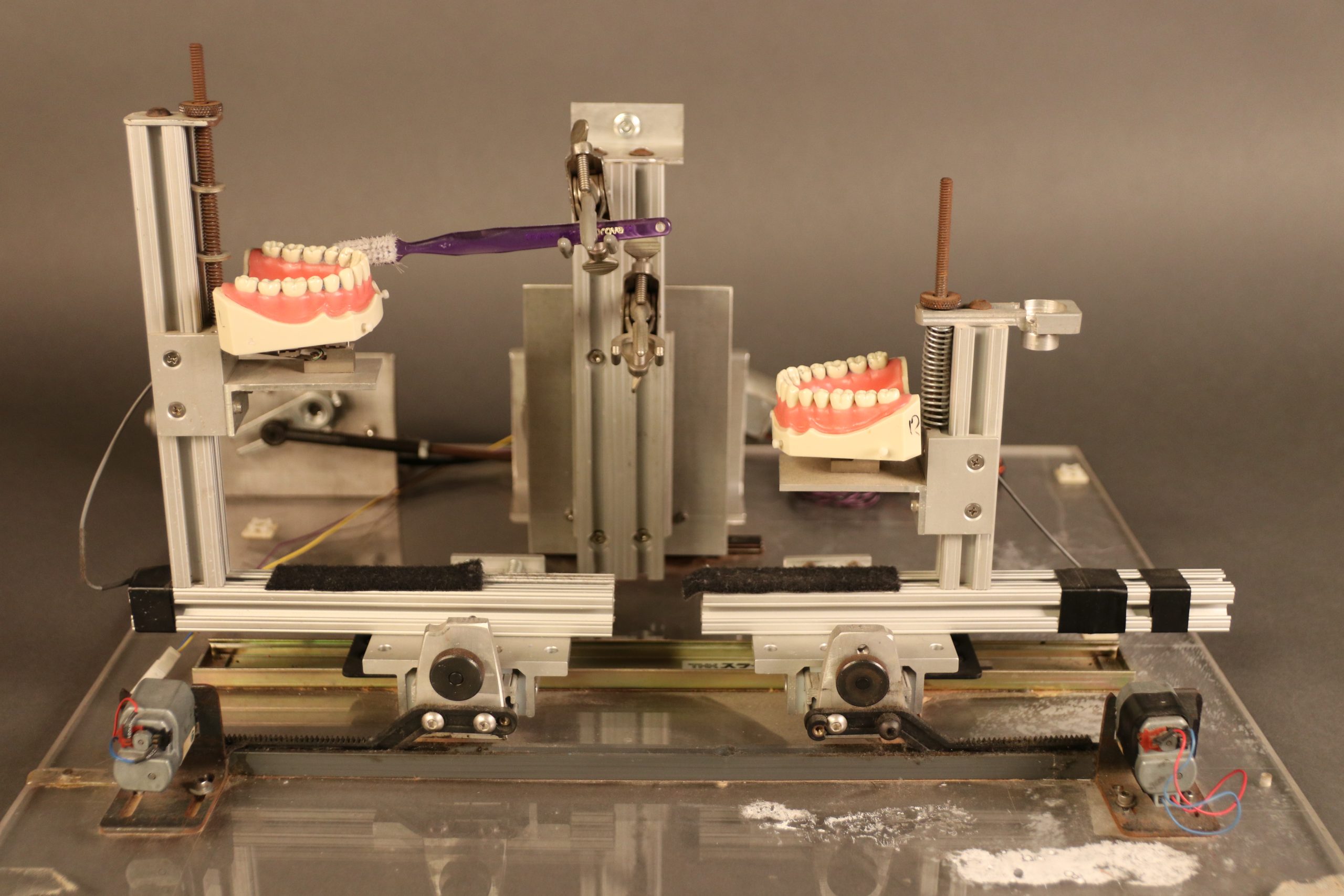
There was also a lipstick tester, razor blade tester, tissue tester, even a condom tester—each one custom-built by Consumer Reports staff engineers to assess the effectiveness, durability, and value of different consumer products.
Once these devices entered the archives, they became historical artifacts—ingenious examples of engineering in the public interest, no longer for actual use (tempting though it may be to plug them in and see what happens).
Still, for classes visiting the Rubenstein Library, it would be nice to offer some idea of how they worked. That was the thinking of Joshua Larkin Rowley, Research Services Librarian with the Rubenstein’s Hartman Center for Sales, Advertising, and Marketing History. Rowley regularly uses Consumer Reports materials in his instruction sessions, and he’s part of the team that put together the new library exhibit—Test, Inform, Protect: The Consumer Reports Archive at Duke University—the first public showcase of this massive collection since it arrived at Duke.

Rowley loves sharing the testing equipment with students. But he has long wished he could demonstrate the machines in action—to help students appreciate Consumer Reports’ scientific rigor and make the learning experience come alive.
For help, he turned to Duke’s own budding in-house engineers. Rowley submitted a proposal to the First-Year Design program in the Pratt School of Engineering.
Each incoming class of Pratt undergrads is required to take First-Year Design (EGR 101). The course divides students into teams and matches them with “clients” around campus and the local community who have real-world design problems in need of solutions. Rowley’s challenge: build a modern-day toothbrush tester that replicates the original’s functionality, is safe to operate, and could invite hands-on interaction in the classroom. If it worked, it might even appear in the upcoming exhibit.
Luckily, he got a bite.
Four first-year Pratt students—Jonathan Ransom, Bryan Chan, Gulnoza Abdurashidova, and Ewa Adebayo-Oke—formed the “Consumer Reports Team.” All four are electrical and computer engineering majors, and they were intrigued by both the technical complexity of the project and the promise of seeing their work exhibited in one of Duke’s busiest public spaces.
The team met regularly with Rowley, who served as their “client,” updating him throughout the semester as they defined the engineering challenges, conducted research, brainstormed ideas, prototyped, and tested designs. They also consulted with Exhibits Librarian Meg Brown about exhibit safety and display standards. And they got some unexpected help when Rowley arranged a video session with Misha Kollontai, an actual testing engineer at Consumer Reports, who offered feedback on their work-in-progress and answered questions about the organization’s work today.
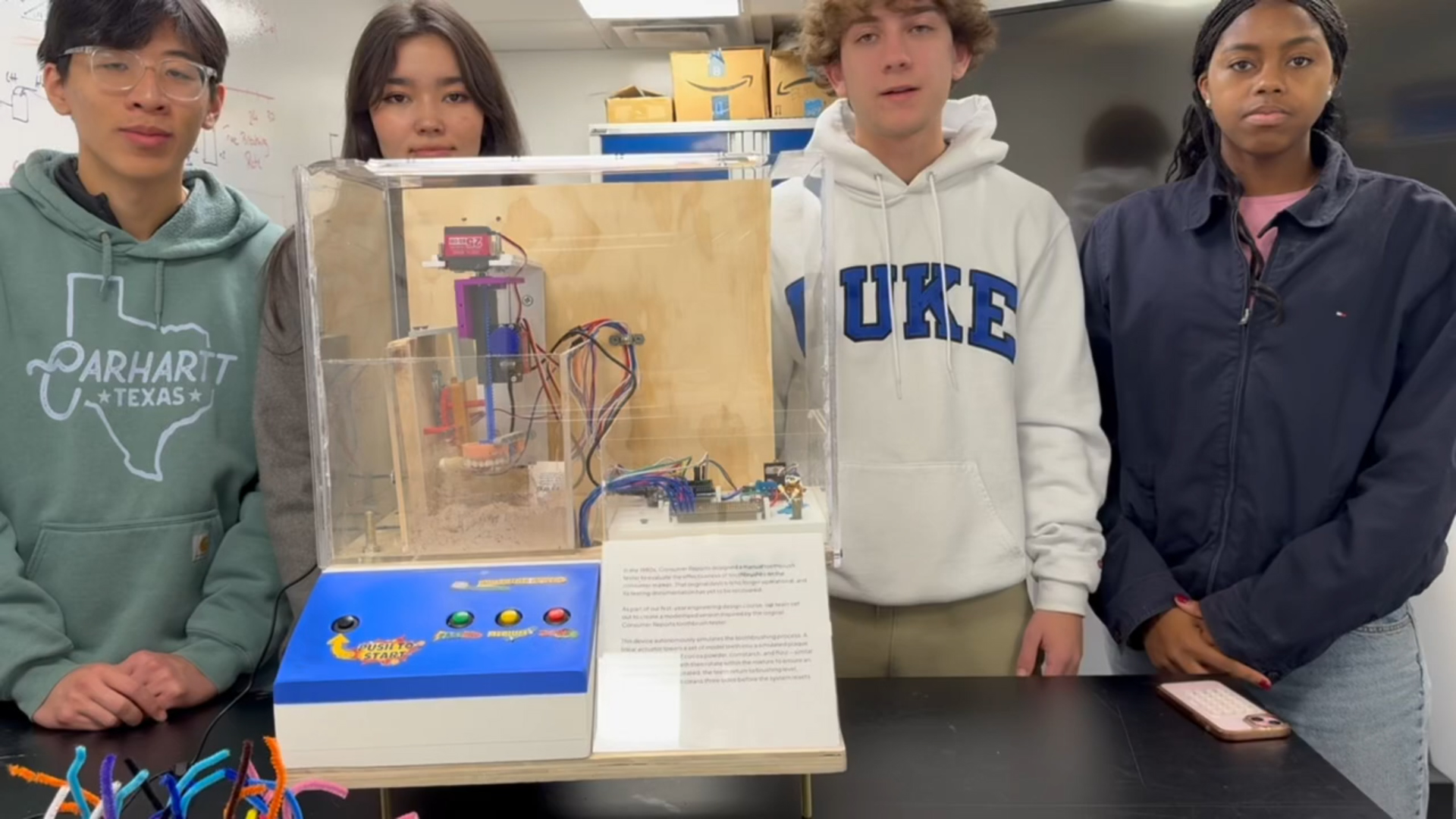
When the students finally unveiled their functioning toothbrush tester—complete with a homemade blend of dental “plaque” that gets scrubbed away with the push of a button—Rowley and his colleagues were all smiles.
You can see the device for yourself in the new Chappell Family Gallery exhibit, on view through early June 2026. After the exhibit comes down, the tester will have a new life in Rubenstein Library instruction sessions about the Consumer Reports Archive.
Aside from the chance to ruminate on their own oral hygiene, the experience gave the Pratt undergrads a new appreciation for the extensive design and testing that goes into everyday products we take for granted. It also drove home the importance of what libraries and archives do, preserving hard-won knowledge for posterity.
After all, as any dentist will remind you, you don’t have to brush your teeth. Just the ones you want to keep.