Category Archives: Lilly Library at Bishop’s House

Topping Out with a Twist: Lilly Library Raises the Roof on a Presidential Mystery

A mysterious signature found high in the library’s rafters sparks a deep dive into the archives and campus history


A crane hoists an air handling unit onto the roof of the Lilly Library expansion, marking the official “topping-out” of the building. (Photo courtesy of LeChase Construction Services)

Last week, the Lilly Library renovation and expansion project officially reached its pinnacle.

On a gravel lot near the building site, nearly a hundred construction workers and contractors mingled with librarians and representatives from Duke Facilities Management for a “topping-out ceremony” organized by LeChase Construction Services, the construction manager overseeing the project for Duke.

Traditionally, topping-out is when the last steel beam is placed at the highest point of a structure. It’s a time-honored milestone in major construction projects, marking the completion of the building’s frame. Often construction workers and key individuals are invited to sign the beam before it is placed.

In this case, since the steel framing on the new Lilly addition had already been completed, the topping-out ceremony was to be marked by an air handling unit hoisted by crane onto the library’s roof.

As things turned out, construction work was running ahead of schedule and the air handler had been installed the day before the formal photo-op. But no matter—everyone could agree that for this long overdue library renovation, it was good to be ahead of the game for once.

At the celebration, Joseph Salem, Duke University Librarian and Vice Provost for Library Affairs, thanked the architects, engineers, contractors, and many skilled laborers who have put in hundreds of hours on the project, acknowledging the effort and teamwork it took to get to this point.

University Librarian Joe Salem speaks to the construction team and others gathered for the topping-out ceremony, thanking them for their work.

“This is a once-in-a-generation project for Duke,” said Salem, noting that the new and improved Lilly Library will provide Duke students and faculty with a vibrant destination for collaboration, research, and study for generations to come.

Even with no steel beam to sign or air handling unit to watch gliding through the air, the topping-out did offer a high point of a completely different and unexpected kind.

LeChase had brought in a local marketing agency, Brasco, to document the construction project and conduct video interviews with key players. While getting B-roll video footage and photos inside Lilly, the Brasco and LeChase teams noticed something unusual. High up in the rafters, an exposed steel beam dating from the library’s original construction appeared to bear someone’s signature. Next to it was written the year 1926.

The steel beam with a mysterious signature, dated 1926. (Photo courtesy of Brasco)

Could this be evidence of Lilly’s very first topping-out ceremony? It seemed plausible. But whose signature was it? The two initial capital C’s and two o’s in the last name offered a clue. But the rest of the letters were hard to decipher. And why did only one person sign the beam?

Rebecca Pattillo, Assistant University Archivist, Rubenstein Library

Never able to pass up an historical mystery, Duke library staff dove into the archives with the help of Assistant University Archivist Rebecca Pattillo. Among the first sources we consulted were the Office of the University Treasurer Records, which contain historical pay ledgers listing the names, job titles, and wages of every laborer who worked in campus construction nearly a century ago, still preserved in the stacks of the Rubenstein Library. By looking for someone with a first and last name starting with C, we hoped we could narrow the search.

A team of Duke students used these same pay ledgers for a summer research project years ago, unearthing the names of over four hundred workers and craftsmen who gave Duke’s West Campus its iconic Gothic Wonderland buildings. Their project—Stone by Stone: Who Built Duke’s Chapel and West Campus?—is available online and brings to life the stories of individual stonemasons, carpenters, and laborers who were employed in the construction of campus.

Sample page from the historical pay ledgers in the University Archives, listing the names, titles, and wages of construction workers who helped build Duke’s campus a century ago.

Alas, none of the names in the pay ledgers seemed to match the signature on the beam. However, after much enthusiastic debate, one of Pattillo’s astute colleagues noticed a striking similarity with a well-known autograph of the same age—that of Calvin Coolidge, thirtieth president of the United States, whose tenure in the White House (1923–1929) neatly overlapped with the period when the East Campus library was built. (Yes, this is actually what it’s like working with Duke archivists and librarians on a daily basis. Once they activate the hive-mind, tangled threads begin to unravel and puzzle pieces snap into place.)

When compared side-by-side, the resemblance was remarkable.

The signature on the steel beam compared with an authenticated signature by Calvin Coolidge (right, from a letter held by the Rubenstein Library).

As exciting as this discovery initially was, it didn’t make sense for the signature to belong to Coolidge, who never visited Durham during his presidency, Pattillo explained. Even for a man as tight-lipped and publicity-shy as “Silent Cal,” any visit by a sitting U.S. president to Duke’s campus would surely have made headlines in the Chronicle, as well as the local newspapers. But a survey of the contemporary historical sources revealed no trace of President Coolidge in Durham in 1926, for the simple reason that he was never here.

And yet it clearly looks like his signature, right down to the tell-tale C’s and the flourish of the lowercase g at the end. Could Coolidge have possibly signed the beam before it made its way to Durham? Highly unlikely, and again that would have made good press for the fledgling university to promote.

At the end of the day, the simplest and most likely explanation is that we’ve been had. To make it look like the President of the United States personally had a hand in building this library really made some wise guy’s day in 1926. And ninety-nine years later, it really made ours.

We’ll probably never know the prankster’s identity, or how much work it took to get the swoop of those C’s just right. But as professional custodians of history, we respect the guy’s long game. Libraries and archives are full of untold stories just waiting to be discovered by the right person. But a practical joke a century in the making, hidden above all our heads, by a shadowy human face winking at us from across all that time? It’s hard to top that.

A member of the LeChase construction team stands under the skylight on the roof of Lilly Library, where the beam and signature were found. (Photo courtesy of Brasco)

Hard Hats and High Hopes: Our Library Advisory Board Gets a First Look at Lilly’s Transformation

Looking around the Carpenter Reading Room. The ornamental plaster ceiling has been repainted, the windows restored, and most of the original woodwork removed. New finishes and lighting will be installed to preserve the charm and character of this inspiring quiet study space, and new millwork display bookshelves will be installed along the room’s perimeter.

Two weeks ago, members of the Duke Library Advisory Board got a hard hat tour of the Lilly Library renovation site. The Library Advisory Board meets on campus twice a year, and it includes some of our biggest library supporters and advocates. The board has been hearing about plans for the renovation for years, and they were instrumental in making those plans a reality. But this was the first time they got an up-close look at the site since the library closed to the public in the summer of 2024.

With the steel framing for the new addition completed, new floor decking erected and filled with concrete, and new portals cut through the masonry walls to connect the original historic structure with the modern steel-and-glass addition, it’s getting easier to imagine what the new-and-improved Lilly Library is going to look like.

The Library Advisory Board also heard about plans for the next phases of the project in the coming months. While the construction crew continues to frame out the walls and install the building’s plumbing, electrical, and mechanical systems, several library working groups are meeting to advance other aspects of the project. These include finalizing furniture selections and fabrics based on feedback gathered during our furniture fairs earlier this year; identifying artwork to go throughout the building; designing signage and reservation processes for group study rooms and other high-demand spaces; working with our campus partners who will have dedicated space in Lilly (such as the Thompson Writing Program, OIT, Duke Dining Services, and the Duke Testing Center); and designing outreach programs and events so that we can hit the ground running when Lilly officially opens.

Since we can’t take everyone inside an active construction site, we wanted to share a few images from the board’s behind-the-scenes tour. (Special thanks to our board chair Erica Swenson Danowitz for sharing some of her pics!) We’re approximately one year out from the renovation’s planned completion date, and it’s exciting to see all the different elements finally coming together.

Remember, throughout the renovation, Lilly Library staff will operate out of Bishop’s House (located behind Bassett Residence Hall and next to the Academic Advising Building), where you can always get help with any library questions or services.


Standing just inside Lilly’s main front door. On one side of this entryway will be the new Booklover’s Room, while the other side will be occupied by the Writing Center, where students will be able to get help with their writing and course assignments.

A view of the main entrance atrium. Workers have erected a temporary wooden platform above while they install the library’s new sprinkler system. At upper left, you can see the new second-story balcony that will connect the building’s two wings.

Lilly Project Manager Eddie Hull indicates where the library’s stack core originally stood. This area will now be occupied on the main floor by the library service concourse, where Lilly’s service and checkout desk will be located.

On the Lower Level, the group stands where a new reading area and open collaboration space will be, surrounded by new group study rooms.

On the Lower Level, Eddie Hull points to where high-density compact shelving will be installed. After the renovation, most of Lilly’s collection materials will be stored on the Lower Level, in order to open up more user space on the floors above.

Inside the Thomas Reading Room on the second floor of the building. The charm and character of this beloved quiet study spot will be preserved, with new furnishings, fresh colors and curtains, and many more electrical outlets bringing it into the twenty-first century.

The Library Advisory Board poses for a group photo in the space that will eventually be Lilly’s new café/commons, where students and faculty will be able to meet up over coffee. In terms of square footage, the café will be slightly larger than the von der Heyden Pavilion at Perkins Library. Check back soon for more updates!

Steeling Ourselves for Lilly’s Next Phase

Over the last several weeks, the steel framing of the expanded Lilly Library has started to take shape.

As the fall semester gets into full swing, so is the expansion phase of the Lilly Library renovation and expansion project.

If you’ve visited East Campus lately, you’ve probably seen the steel structural skeleton rising up behind the library. A major part of the Lilly Project is to increase the library’s footprint. When complete, Lilly will be nearly 75 percent larger than it was originally. It will have significantly more user seating (635 seats, up from 444) and offer more group study spaces, more technology-equipped project rooms, more quiet reading nooks, a 75-seat assembly space for events, and (finally!) a large café where students and faculty can meet up over a cup of coffee.

A few weeks ago, a small group of library staff took a hard hat tour of the construction site to get an up-close look at the progress. A few of these images have been featured on Lilly’s Instagram account, but we also wanted to share them here as we mark this major project milestone. In case it’s helpful to visualize what the new-and-improved Lilly will look like, we included some renderings from the architect. As we close in on one year from the project’s anticipated completion date, it’s exciting to see so much careful planning, design, fundraising, and hard work come to life!

Remember, throughout the renovation, Lilly Library staff will operate out of Bishop’s House (located behind Bassett Residence Hall and next to the Academic Advising Building), where you can always get help with any library questions or services.

Check back soon for more updates!


In the main entrance atrium, where Lilly’s circulation desk once stood, steel beams show where a new second-story balcony will go, connecting the building’s two wings.

A view of the new balcony from the second floor.

Architect’s rendering of the finished space, suggesting how the entrance atrium will look after completion.

The Few Reading Room. The historic windows have been refurbished and reinstalled, the ceiling repainted, and most of the original woodwork removed.

Architect’s rendering of the same room, which will appear much as it did pre-renovation, with updated finishes and furnishings.


Looking at Lilly from the south, showing where the steel and glass extension will join the historic 1927 masonry structure.

Architect’s rendering from the same perspective, showing the completed building extension.

Above and below, the steel framing of the library extension slowly comes together. The beams at the top of the stepladder are at ground level, where the new cafe/commons will be located.


Architect’s rendering of the new cafe, showing steps leading up and connecting to the original library building.

Only one more year until we can welcome you inside. Check back soon for more updates and behind-the-scenes photos of our progress!

Field Trip Time: Lilly Staff Get a Look at How the Renovation Is Going

Librarian Carson Holloway (left) gets a selfie with help from Kelley Lawton, Head of East Campus Libraries, on a recent staff tour of Lilly Library.

Last month, staff members from Lilly Library (currently working out of Bishop’s House) got a hard-hat tour of the renovation in progress. It’s been several months since most of them had been back inside the building, and the place is starting to look pretty different.

With the old stack core completely removed, the compact shelving taken out, windows boarded up, and the project still very much in the destruction rather than construction phase, it can take some imagination to picture what the future Lilly is going to look like.

But the walkthrough did prompt a number of fond memories and reflections from library staff, particularly those who have worked in Lilly for many years.

Since we can’t take everyone inside an active building site, we wanted to share a few images from their behind-the-scenes tour, as well as a few personal reflections from Lilly’s staff on what the experience brought to mind.

Do you have a memory of the old Lilly Library you’d like to share? If so, feel free to drop it in the comments. We’d love to hear from you!


Plywood protects the marble floor and original architectural features in Lilly’s entrance atrium. After the renovation, a new second-story balcony walkway will cross this space, connecting the building’s two wings.
“After thirty years of working in Lilly, I never realized how poorly the space was utilized until I saw everything removed from it. It was good for 1927, but the add-ons and add-ons resulted in a clumsy functioning we had all gotten used to. A complete start-over like this renovation was a great reminder of that.” — Lee Sorensen, Librarian for Visual Studies and Dance (pictured)
Lilly staff explore the Few Reading Room. After the renovation, the well-loved study space will appear much as it did before, with updated wooden shelving, lighting, and furnishings.
Standing inside what was once Lilly’s original stack core. “With the stacks completely removed from the back section, the space remaining became a cathedral. Handsome exposed brick to a height of three stories (!) and the large rounded windows shedding light in from the top. I found myself humbled again by the experience of architecture—and the long-gone workers who made it.” — Lee Sorensen, Librarian for Visual Studies and Dance


“I was surprised by how small and empty the stack tower felt. It was not nearly as tall as I’d imagined it would be. Shed of its steel bones, thousands of books, and poor lighting, I actually admire how the original building was adapted by introducing the interior framing during construction to expand from three to four levels.” — Carol Terry, Lilly Library Collection Services, Communications, and Social Media Coordinator
Upstairs in the historic Thomas Reading Room. “You know that over the years so many people have thought of this as their room or hideaway, and they have a personal connection to it. The intended use of the space as a haven for quiet study belies all the important and personal events we’ve hosted there—retirements and departures, baby and bridal showers, Eagle Scout inductions, celebrations of life for deceased faculty, graduation-related events, even presidential dinners (during the Brodie era) with honorary degree recipients.” — Carol Terry, Lilly Library Collection Services, Communications, and Social Media Coordinator (foreground, looking up)
Pausing for a group photo. “We saw the car from the dumbwaiter in the old staff room and it brought back many memories of the numerous books that we sent between all the levels and was glad to see not too many books were found in the shaft. Several books were found, however, in the drop ceiling and under the compact shelving.” — Nathaniel Brown, Lilly Library Access and Delivery Services Manager (far right)
Exploring the lower level, where students once studied among rows of compact shelving and cramped cubicles. “It is very exciting to see all the differences that the new Lilly will have. I especially look forward to the loading dock area and the workroom. I know colleagues from Smith are excited about the café and a place to get coffee.” — Nathaniel Brown, Lilly Library Access and Delivery Services Manager
“I have been at the Duke University Libraries for over thirty years, and for at least fifteen of those we have been dreaming, contemplating, and talking about a Lilly Library renovation. So when I enter Lilly and see construction in progress, it feels a bit unreal. The stacks core and mobile shelving are gone; plaster and ceiling tiles have been removed; and the service desk is no longer in its place, but I can see what Lilly will be—a library that meets the research and study needs of students, a hub for East Campus programming, and a gathering spot for students, faculty, and staff. The combination of the beautiful historic reading rooms in addition to the new spaces and services will truly meet the needs of our users. Each phase of construction means that we are one step closer to opening, and I am thrilled!” — Kelley Lawton, Head of East Campus Libraries (pictured in front of her old office)

Last Act for the Old Stacks

As the new year gets under way, we’re happy to report that the Lilly Library renovation is also entering a new and exciting phase.

Over the last couple of months, construction workers have removed all four levels of the library’s original book stack core, from top to bottom, almost like coring an apple.

Needless to say, accomplishing such a task in a century-old building presents all kinds of interesting logistical challenges, as the original steel stacks were load-bearing and anchored into the surrounding brick walls.

Each floor of stacks was held up by a grid of steel pillars supporting a deck of white marble flooring, all of which needed to come out, starting at the top and gradually moving down to ground level.

The old steel stacks were the state-of-the-art in 1927, when the library first opened. But over the years they presented numerous challenges and limitations, including their inflexibility, cramped and narrow aisles, and shallow shelf depth, which didn’t work well for housing Lilly’s many large-format art and photography books.

After the renovation, Lilly’s new book stacks will be located in the bottom level of the building in brand new compact shelving, in order to increase their holding capacity and free up space in the upper levels for library users.

We wanted to share some before-and-after shots, showing the progress of the stack demolition and removal. It’s a dramatic transformation, we think you’ll agree—the first of many to come! Stay tuned and check back soon for more renovation updates. And don’t forget to visit Lilly’s home-away-from-home during the renovation at Bishop’s House!


A view of Lilly’s stacks before the renovation. Note the low ceiling and narrow, cramped aisles.
The shallow depth of the steel shelves was never ideal for housing Lilly’s sizable collection of large-format art and photography books.
A view of the stack demolition in progress.
Each floor of the original stacks was held up by a grid of steel pillars supporting a deck of white marble flooring. Here, the marble floor has been removed, exposing the level below.
Because the stack core was load-bearing, construction workers had to start at the top and gradually work their way down to ground level, almost like coring an apple.
In addition to removing the stacks, workers also had to remove the plaster covering the original brick walls and remediate hazardous materials like asbestos.
Getting down to the original brick walls that surrounded the steel stack core structure.
The original brick walls, now exposed, which anchored the stacks in place.
Demolition complete! The space is now ready for its next transformation.

Spotlight on East Campus Study Spaces

Looking for study space around East Campus? You have probably heard that Lilly Library is closed this year for renovation. The Lilly building is closed but you can get help from Lilly staff at the Bishop’s House (located behind Bassett Residence Hall and next to the Academic Advising Building). We want to highlight several other prominent study spots available on East. Check out the Academic Resource Center’s Campus Study Spaces Map to find more study spaces!

Wall Center for Student Life (East Campus Union)

Photograph of soft seating in Wall Center foyer

There are a number of study spaces available in the Wall Center. You can choose from large open tables to soft seating.

Photograph of booths, tables, and chairs in Marketplace dining area

The South side of the Marketplace dining area is open for late night study from 9 PM to 2 AM Sunday through Thursday.

Photograph of balcony study area in Wall Center with large table, chairs, and a whiteboard

The 2nd floor of the Wall Center has two balcony study rooms with large tables, chairs, and whiteboards.

The Trinity Cafe area in the basement includes tables, chairs, and booths. The Wall Center is accessible to students by card swipe until 2 AM.

Music Library

Photograph of Music Library with couches, soft chairs, and tables

The Music Library is located in the Biddle Music Building (this is the low brick building back behind Pegram Residence Hall). In addition to library services, the Music Library offers a variety of study options, including soft seating, open study tables, individual study cubicles, and lots of natural lighting on the first floor.

Photograph of study carrels at the Music Library

There is a reservable group study room in the basement with whiteboards and seating for 8. 

Photograph of group study room in the Music Library with table, 6 chairs, and whiteboard

The Music Library is open 9 AM to 8 PM Monday through Thursday, 9 AM to 5 PM on Friday, 1 to 5 PM on Saturday, and 1 to 8 PM on Sunday. 

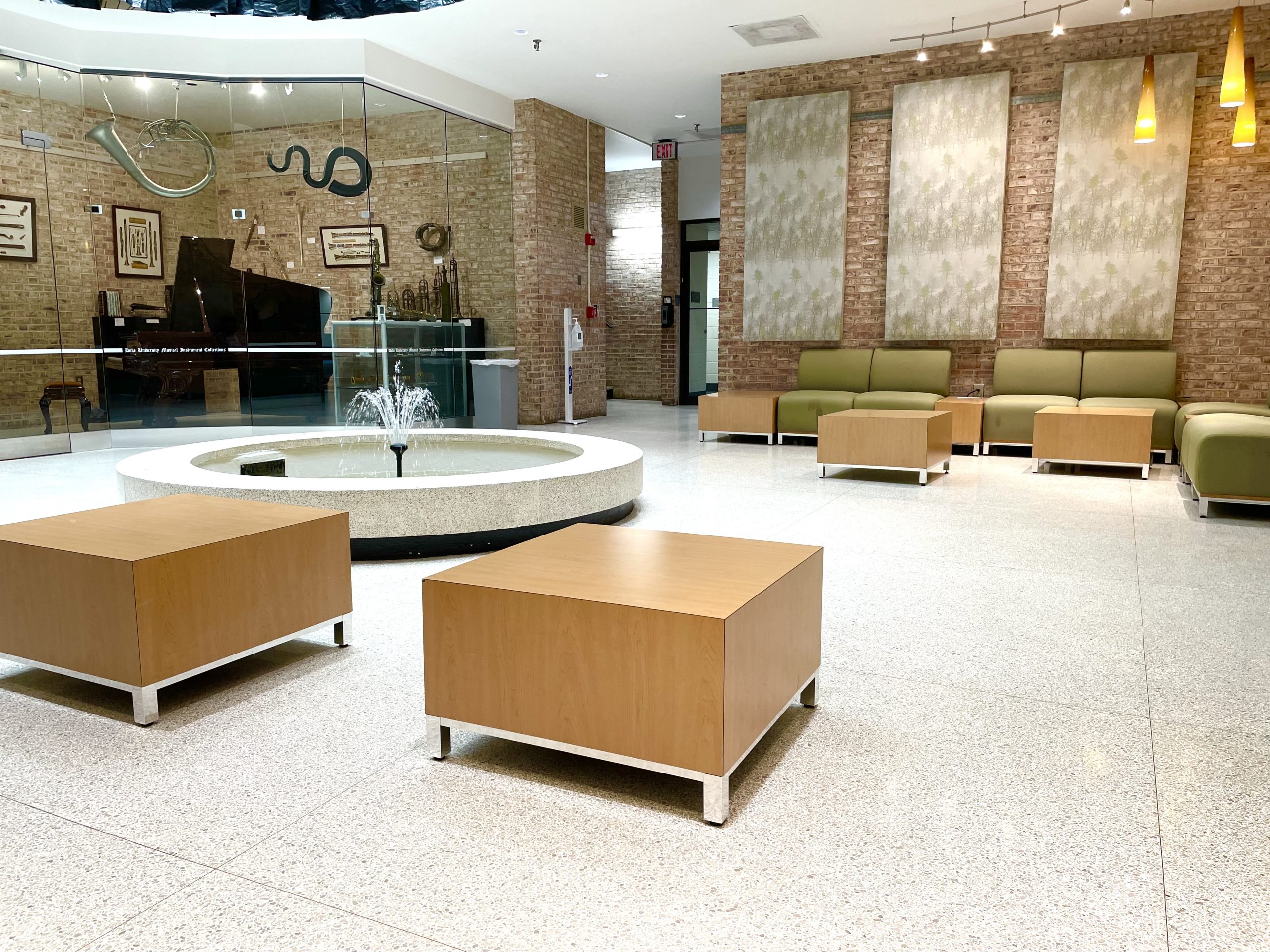
Photograph of soft seating around a fountain in the basement of the Biddle Music Building

The basement of the Biddle Music Building also has a soft seating area with a relaxing fountain.

Gilbert-Addoms DownUnder

Photograph of Gilbert-Addoms DownUnder study area. Includes soft chairs, couches, and pool tables.

Located in the basement of Gilbert-Addoms Residence Hall, GA DownUnder offers a large space for study with soft seating and tables. Looking to take a break from study? GA DownUnder also has a pool table and ping pong table.

Bishop’s House Front Porch

Photograph of outdoor seating on Bishop's House front porch

Although study space inside Bishop’s House is limited, we have outdoor seating on the porch for days when the weather is nice.