



We recently completed processing the Americans for Immigrant Justice (AIJ) Records. Formerly the Florida Immigrant Advocacy Center (FIAC), AIJ is a not-for profit legal organization that advocates on behalf of immigrants and refugees, including those being held at various detention centers, such as Guantanamo, Krome and Turner Guilford Knight. The majority of the material in this collection deals with the Haitian refugee population in Florida. Two aspects of this collection struck me. First, while this collection contains material that addresses the Haitian refugee crises from a broader political and historical perspective, it is notable for the quantity of material it contains that focuses on the stories and testimonies of individual refugees, in their own words, in documents such as affidavits and correspondence.
The second aspect of this collection that struck me as particularly interesting is the amount of material it contains on children – child refugees and detainees, children seeking asylum, children stranded in Haiti, and especially unaccompanied minors. As I became more familiar with this collection, I became especially interested in the detained child as both a fact and an idea. Sifting through accounts both by and about children of their emotional, mental, and physical experiences in detention, I began to wonder how the search for asylum and subsequent detention is conceived of by children.
The reason why this subject fascinated me is because of the strong incongruity in the idea of the child, on the one hand, and the idea of imprisonment of any kind, on the other, an incongruity that suggested to me that accounts of children in detention might uniquely illuminate how we think about detention and refuge. We often associate children with places of refuge, with a powerful need for and unique faculty to find or construct places of refuge. One example of this faculty is play. As I looked through photographs of and read testimony by children detained at Guantanamo, I began to wonder what place “play” has in detention, in homelessness, and in lack of refuge.
The subset of documents about which I am writing are dated from around the early and mid-1990s, during and following the campaign of terror against Aristide supporters. One must bear in mind that the majority of Haitian refugees held at Guantanamo at this time were forcibly returned to Haiti where their lives were imperiled (5,000 Aristide supporters were estimated to be killed in 1993). In fact, many of the children detained at Guantanamo were unaccompanied for precisely this reason – their parents or caretakers had been killed in Haiti during this period. As the AIJ Records reveal, many of these children, upon repatriation, were thus compelled to eke out a living on the streets.
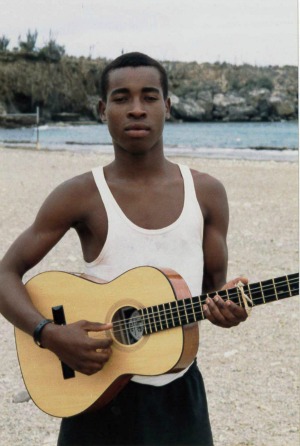
So, how does the child reconfigure the way we conceive of detention? Three photographs from the Photographic Materials Series caught my attention. After I selected them, I asked myself why I had been drawn to them, and I realized that in each, a child or children were holding some kind of object – a fish, makeshift drums, a guitar.
I considered these photographs against the written testimony about and by children detained at Guantanamo (information packets, emergency action requests related to medical conditions, correspondence, affidavits, reports, etc.). The written documentation described abuses, including rape, that were committed at Guantanamo against women and children. Child detainees, not surprisingly, wrote of their desperation and depression (their own words), and observers of these children offered similar accounts. Yet, these children not only subsist at Guantanamo but also, as the photographs above communicate, find ways to play. It is not difficult to perceive a form of resistance in their play, in their insistence upon occupying places that we cannot envision as inhabitable. I was likewise captivated by the photographs in which children are holding objects because they seem to me to manifest the construction of places of refuge within displacement and dispossession. The subjects in these photographs seek asylum in the objects themselves. There is something about gripping an object, possessing that object, that also solidifies the reality of oneself – and this in a place in which that very reality is relentlessly objected to – in abuse, obscurity, neglect, remaining unheard.

Post contributed by Clare Callahan, graduate student assistant in Rubenstein Technical Services and the Human Rights Archive.