

Ted Minah and the Duke University Dining Halls
Mary Samouelian
We know things are tough all over, but can’t we have any silverware? Restaurants seem to have steaks or good cuts of meat now. How about the Union? Must we eat chicken, chicken, chicken, chicken, chicken (poorly prepared too)? Will we ever have pitchers of cream on the table at breakfast like last year? Why continually run out of food?Duke dining hall suggestion box, 1945

This comment from a suggestion box in the men’s dining hall on West Campus captures student sentiment about the state of campus cuisine when Theodore W. “Ted” Minah arrived in January 1946 as the newly appointed manager of the Duke University dining rooms. The student discontent was in reaction to an outdated compulsory meal ticket system, wartime food rationing, and a decline in the quality of the dining services that was due to poor food preparation and an untrained staff.
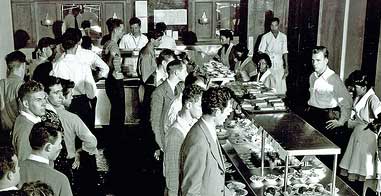
Minah faced logistical challenges as well, such as feeding the influx of returning veterans, who increased the number of students on campus to 5,000. Long lines in the dining halls and insufficient seating only added to the student discontent. Under these circumstances, it would have been understandable if Ted Minah had turned down Duke’s offer. But as the materials in the Theodore W. “Ted” Minah Records and Papers in the University Archives reveal, Minah was no ordinary man. During his twenty-eight years at Duke, he transformed the dining halls into an award-winning, highly rated operation that served millions of meals to generations of Duke students.
 Early in Minah’s tenure he resolved to make the dining halls more than just a place to grab a quick meal. His objectives and operational philosophy for the dining halls were to provide a social atmosphere where students could mingle and have a healthy meal. More importantly, Minah believed that good dining was part of the students’ overall education. Dining halls including the Great Hall and the Oak Room were designed, and in some cases, renovated, to encourage students from different racial and socioeconomic backgrounds to engage with each other and with faculty and guests. The Men’s Graduate Center (now Trent Hall) was a shining example of this model. Constructed in 1953, the new dining hall featured a cafeteria, private dining rooms where those students with “allied interests” could eat together, and a coffee lounge where graduate students, faculty, and friends could gather informally. In 1961, the Graduate Center was opened to freshman and sophomore nursing students, with the hope that dining there would contribute to their “social education.”
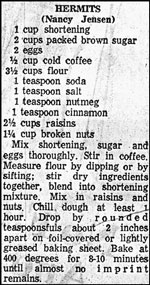 Minah also believed that “adventurous and stimulating eating habits” contributed to a student’s education. His office is said to have been filled with cookbooks and magazines, and the assorted recipes preserved in his records and papers suggest that he frequently experimented to meet changing student tastes. While some of Minah’s culinary offerings were popular with all Duke students (including the famous Duke Toll House cookies and hermit cookies, which some alumni still reminisce about!), others like the congealed apple and cottage cheese salad were reserved for the more “daring” appetite. Minah’s success in providing food that was healthful, nutritious, and palatable earned him the Silver Plate Award as Outstanding Food Services Operator in the Colleges and Universities Division in 1968.
Employing students in the dining halls was another Minah innovation. In a 1974 interview he claimed to be the first university dining director in the country to develop a program for student employees. The idea for the program probably derived from his own experience: Minah learned the food business from the bottom up—starting on the dish machine, washing pots, and then working his way up to the status of journeyman cook while still in college. In the program Minah established at Duke, interested students were recruited, trained, and given opportunities to become dishwashers and cooks, cashiers and waiters, with the promise of gaining valuable work experience while still having ample time for an academic and social schedule.
Incentives spurred the workers to move up into better and higher paying positions. Countless letters from students seeking employment in the dining halls speak to the program’s success. One, dating from 1966 reads, “my sister … spoke to you concerning my working in the dining hall next fall, and I was glad to hear that a place is available … I appreciate your giving me the opportunity to work at Duke and am looking forward to it.”

Minah’s rapport with students never faltered, even in difficult situations. During his career he weathered three boycotts—grapes, lettuce, and meat—and the 1968 dining hall strike for “decent living wages.” While the episodes were marked by controversy and strongly held views, Minah always tried to reach common ground with students, not only to meet their demands, but to keep the dining halls open. During the dining hall strike, he recalled that “there were some 250 students who volunteered to work—they simply didn’t want this crowd (union supporters) to take over the university.”
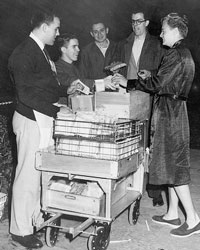 Recognizing that students were a vital part of the dining halls’ success, Minah was always open to their suggestions and ideas. The “chowman” was one such initiative. Students proposed the service to counter the night-time bootlegging of food in dorms that had culminated in unsanitary conditions in rooms, food poisoning, and complaints about students knocking on door at all hours of the night trying to sell food. Introduced in 1950 and run by the M.S.G.A. (Men’s Student Government Association) Catering Service, the student chowman vendors peddled sandwiches, milk, ice cream and other snack foods from 10:30 to midnight to hungry West Campus students. Student vendors earned a commission—up to 20% of the sales, which was about $500 per student per semester. Eventually replaced by “robot rooms” (vending machines) in 1961, the chowman left a legacy of feeding Duke students for nearly eleven years.
 As important as students were to the success of the dining halls, they were just one side of the equation; the dining hall employees were the other half. When Minah arrived at Duke, more than 90% of the food services employees were African American, and, as he said, “there was no one in the vicinity that had had restaurant experience…” Demonstrating a commitment to equal opportunity that was rare for the time, Minah set out to “provide an atmosphere in which all those employees who are in our employ will have the opportunity and desire to improve their skills and by their increased productivity attain higher goals of status and remuneration.” Minah backed up his words with action.
In 1947, he initiated an on-the-job training program, taking advantage of the U.S. government’s offer to fund education for returning veterans of World War II under the G.I. Bill. In the program’s first year, six veterans were enrolled in training for institutional or restaurant management, with fourteen others learning to be professional cooks and bakers. Over the course of several years, Minah expanded on-the-job training, enabling cooks and supervisors to attend schools including the Culinary Arts School and the Cornell Hotel School. He also instituted promotion policies and worked to ensure that pay and benefits were competitive. By 1967, nearly half of the supervisors and clerical staff (including cashiers) were African American, and for many years there was less than a 5% turnover rate in Minah’s department.
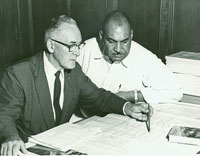 Minah’s commitment to his employees is well-documented. His records and papers are replete with thank-you letters from employees grateful for Minah’s interest in their well-being; service bulletins and newspaper advertisements promoting dining hall employees who were available for summer jobs in North Carolina and out-of-state resorts (an arrangement that enabled them to combine vacation with extra income); and letters of recommendations, including Minah’s letter praising William “Big Bill” Jones. Minah had known Jones since 1937 and, when he came to Duke in 1946, Minah thought Jones would be ideal as the banquet manager for the dining halls. The two worked together at Duke for nearly thirty years, and in 1970 Minah wrote of Jones:
I shall always consider it a great privilege to have been associated with him for the past 33 years since we began working together in the Brown University Dining Halls back in 1937. He has taught me a great deal not only about the operation of a dining hall service but how better to understand my fellow man.
Managing employees and the operations of the dining halls were only part of what Minah did every day. His duties also included buying, warehousing, preparing, and serving food; service and selling; housekeeping; office management and accounting; and renovations, repairs, installations and alterations. In performing his responsibilities, Minah’s goal was to “initiate and engage in continuing experimentation, research and self-development which will raise the standards of [the] profession.” As with his other operational philosophies, Minah’s actions matched his words. During his tenure at Duke, he not only introduced new dining hall concepts (for some of Minah’s innovations, see the sidebar), but also established a reputation for successful high-profile catering events, including Duke presidential inaugurations, receptions for dignitaries such as Vice President Hubert Humphrey, and banquets, including a 1,000-person affair in the Cameron Indoor Stadium honoring Dr. Wilburt C. Davison, the first dean of Duke Medical School.
Ted Minah was a prolific writer, publishing dozens of articles in College and University Business and Institutions Magazine, and he frequently provided counsel and the benefit of his experience to the industry. Minah served as president of the College and University Food Service Directors (1964), vice president of the North Carolina Restaurant Association (1950), and president of the Kiwanis Club of Durham. With each position he had the opportunity to promote healthy eating, employee training, new methods of cooking, and the importance of the food services industry. The National Association of College & University Food Services recognized Minah’s significant contributions to the profession by renaming its highest award the Theodore W. Minah Distinguished Service Award in 1973; Minah had received the award when it was established in 1967. Today, the award is still bestowed on those who have made an outstanding and enduring contribution to the food service industry and to the association.
By his retirement in 1974, Minah had transformed dining services at Duke University from a small, disjointed department to an award-winning operation of twelve dining halls serving approximately 15,000 meals per day. Throughout the nation, Ted Minah was known as the “dean” of college and university food service directors. He died in 1991 at the age of 82.
Minah’s records and papers, which were received by the University Archives soon after his retirement, show a complex man who was kindhearted, creative, and wholly committed to his profession, students, employees and the University. For those who worked with or knew Ted, and for those being introduced to him for the first time, he will be remembered for the indelible mark he made on the foodservice industry and Duke University.
All quotes are from materials in the Theodore W. “Ted” Minah Records and Papers in the University Archives.
Duke Dining Trivia
- Ted Minah and his dining hall staff catered inauguration dinners for Dr. Arthur Hollis Edens (October 21, 1949), Dr. Douglas M. Knight (December 10, 1963), and Terry Sanford (October 18, 1970). Julian Deryl Hart (1960-1963) is missing from the list because as president pro tem (he was appointed to the position following the Gross-Edens controversy) he did not have as formal an inauguration dinner.
- Institutions Magazine presented its Honors Award (the highest honor in the food service industry) to two Duke dining facilities: the Graduate Center (1953) and Gilbert-Addoms Dining Hall (1960).
- The Oak Room closed in 2003 to make way for the Mary Lou Williams Center for Black Culture. The Blue & White Room has become the DukeCard Office.
- The gargoyles in the Cambridge Inn watch over the coats of arms of the colleges of Cambridge University.
Duke Dining “Firsts”
During his tenure, Ted Minah introduced many innovations. A few of the more notable include:

- The “scramble” cafeteria Ted Minah introduced the concept of free-flow service counters in the Blue & White Room in 1962. This system didn’t require students to line up, but instead gave them the freedom to go directly to the counter that served the food they wanted. This change made it possible to serve large numbers of students in a short time. While the “scramble” concept was wildly popular with students, it befuddled their visiting parents.
- The Cambridge Inn Created to return some of the business lost to the “robot room” and to meet the needs of student requests for a room large enough for groups to gather formally or informally, the “C.I.” became the first university/college self-service snack bar in the country. Open 7:30 to midnight, it boasted “raid-it-yourself” refrigerators, snack bar and pizza kitchen. Students who could not eat during regularly planned dinners or those who craved late-night snacking welcomed the new snack bar.
- Food waste refrigeration Minah was the first Durham food handler to adopt the practice of putting garbage in cold storage until it could be hauled away. Thousands of noses rejoiced.
- The Oak Room Opened in 1946, the Oak Room became the first dining hall within a dining hall system to rely on student waiters and waitresses. It offered table service in an intimate restaurant-style dining setting (coat and ties required for men) where faculty, student and guests could meet on common ground.
- Food credit system Ted Minah discontinued meal tickets and instituted a cash cafeteria service for the men on West Campus and a cafeteria board system for the Woman’s College on East. The parents received the bills (instead of relying on the students to have enough cash readily available). Over time the food credit system became a million dollar business, with losses of less than $250 annually.
Read More about Dining at Duke
The Inventory of the Theodore W. “Ted” Minah Records and Papers (http://library.duke.edu/digitalcollections/rbmscl/uaminah/inv/) and photograph exhibit “Dining at Duke” at http://www.flickr.com/photos/dukeyearlook/.
News Service Biographical Files, circa 1930s-2004. University Archives, Duke University.
Theodore W. “Ted” Minah Records and Papers, 1941-1975. University Archives, Duke University.
 Mary Samouelian was the 2007-2008 Isobel Craven Drill Intern in University Archives. In 2008 at the annual meeting of the Society of American Archivists, she received the Theodore Calvin Pease Award, which recognizes superior writing achievements by students of archival administration. Samouelian received the award for her paper, “Embracing Web 2.0: Archives and the Newest Generation of Web Applications,” an investigation of the extent to which Web 2.0 features have been integrated into archival digitization projects.
I always wondered why they called that area surrounding the Chick-Fil-A the Cambridge Inn!
Great article.
Minor correction: The University Room has become the DukeCard office. The Blue & White Room is the Great Hall servery.
Anne Smyrski Light, T’89
Ted Minah was indeed one of Duke’s treasures. The food he served was good, and so was his heart.
Bill Jones ranked right up there along side him.
When Mr. Minah received his Duke appointment, he insisted on bringing Big Bill along. And thus he became the first black supervisor at Duke University, fully participating in management meetings for food services.
And Mr. Minah insisted that all his dining halls serve everyone. This at a time when Duke was struggling with desegregation, first of its graduate and professional schools and then its undergraduate colleges.
Some time after I graduated, the Oak Room was renamed Ted Minah’s Oak Room. And it is unfortunate that Duke has closed this and lost Mr. Minah’s name, as it is losing the names of so many others in its history.
One footnote: my recollection is that men had to wear coat and tie in the Oak Room only on Sunday.
Where did the Devils come from and what does the fork have to do with the Duke Devils? Can I have access to the original logo for me and my grandson, not for printing or any other use. It’s for my grandsons room.
Thank You!
Tammie
I agree with Mr. Rickards’ comments above. I worked on the football training table for “Big Bill” Jones along with Alex and Ginny from the cafeteria staff and Hershall Caldwell, another student, in ’55 and ’56. I worked the regular cafeteria during the winter and spring of those years. I would like to see something done in memory of “Big Bill”—anyone else interested? He was a huge help to me and one of the best friends/mentors I have ever had.
Ms. Samouelian, how about an article about Bill Jones and his contributions to the University?
Best regards,
Carroll